Performance
Appraisal
Presented by:
Aranas, Rhymbert II
Calaquian, Dave
Fernandez, Ivan
What is Performance?
The job-related activities expected of a worker and
how well those activities were executed.
Employees are
performing well when
they are both effective
and efficient.
Performance also
includes personnel data
such as:
● Measures of
accidents
● Absences
● Tardiness
What is Appraisal?
Appraisals are judgments of the characteristics, traits
and performance of others.
On the basis of these
judgments we assess the
worth or value of others
and identify what is good
or bad.
Appraisals are essential
for making many
administrative decisions
such as:
● Selection
● Promotion
● Training
What is Performance Appraisal?
- It is the step where the management finds out how effective it has been at
hiring and placing employees
- Process by which a manager or consultant examines or evaluates an
employee’s work behavior to show where improvements are needed and why.
Objectives of Performance Appraisal
Employees
- Concrete and tangible particulars
about their work
- Assessment of performance
- For personal development
- Work satisfaction
- Involvement organization
Organization
- Measures efficiency
- To maintain organizational control
- Mutual goals of the employee and
organization
- Growth and development
- Increase harmony and enhance
effectiveness
Why conduct Performance Appraisal?
Provide information about the performance ranks
Provide feedback about level of achievement
Provide information which helps to counsel the employees
Provide information to diagnose the deficiency of the employees
Provide training and development needs of the employees
When to conduct a Performance Appraisal?
The performance review must occur at least once a year
However, as a part of performance management, the performance review is a
continuing, ongoing activity.
Performance Appraisals Process
Setting
Performance
Standards
Communicatin
g Standards
Measuring
Standards
Comparing
Standards
Discussing
Results
Taking
corrective
standards
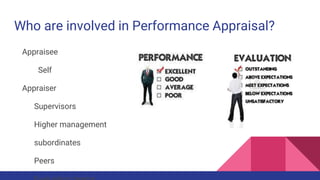
Who are involved in Performance Appraisal?
Appraisee
Self
Appraiser
Supervisors
Higher management
subordinates
Peers
Performance Appraisal Tools
1. Ranking
2.Performance Test
3.Confidential Report
4.Essay Evaluation
5.Graphic Rating Scale
6.Checklists
1.Higher Management Appraisal - performance appraisal done by an
employee’s supervisor or manager and often reviewed by a manager one level
higher
- Subordinate appraisal - performance appraisal of a superior by an employee, for developmental
purposes
1. Self Appraisal - performance appraisal done by the employee being
evaluated, generally on an appraisal form completed by the employee prior to
the performance review
Kinds of Appraisal
Kinds of Appraisals
3. Peer Appraisal - performance appraisal done by one’s employees, generally on
forms that are compiled into a single profile for use in the performance interview
conducted by the manager
4. Team Appraisal - performance appraisal based on Total Quality Management
concepts that recognizes team accomplishments rather than individual
performance
5. 360 Performance Appraisal
Methods of Appraisal
Management by Objectives (MBO)
It means management by objectives and the performance is rated against the
achievement of objectives stated by the management.
Psychological Appraisal
It is done in the form of in-depth interviews, psychological tests, and discussion
with supervisors and review of other evaluations.
Methods of Appraisal
Assessment Centers
An assessment center is a central location where managers may come together to
have their participation in job related exercises evaluated by trained observers.
Advantages of Performance Appraisal
1.Promotion - Helps supervisors to chalk out the promotion programmes for
efficient employees. In this case, inefficient employees can be dismissed or
demoted.
2.Compensation - Performance Appraisal helps scheme out the compensation
packages for each employee in the company and also tries to give worth to
employees’ performance.
Packages include:
Bonus
High Salary Rates
Advantages of Performance Appraisal
3. Employees Development - The systematic procedure of performance
appraisal helps supervisors to frame training and programmes. It helps
analyze strengths and weaknesses of employees so that jobs can be filtered
depending on the efficiency of employees.
4. Motivation - Performance appraisal is an effective motivational tool.
Through performance evaluation of employees, a person’s efficiency can be
determined if the targets are achieved. This very well motivates a person for
better job and helps him improve his performance in the future.
Advantages of Performance Appraisal
5. Communication - Effective communication between employers and
employees is very important. Through performance appraisal, communication
can be sought for in the following keys:
❖The employers can understand and accept skills of subordinates
❖Subordinates can create trust and confidence in superiors
❖Helps maintaining labor management relationship
❖Develops the spirit of work and boosts the morale of employees
Disadvantages of Performance Appraisal
1.The Halo Effect
The halo effect bias refers to a tendency form people to form a generalized
positive impression of an employee, and rate the employee highly on all
rating criteria even if the employee really doesn't deserve a high rating for
every one.
In other words, the manager thinks highly of an employee and rather than
rate independently for each item, the manager inflates the ratings.
Disadvantages of Performance Appraisal
2. Rater Bias
The rater’s prejudices and biases can also influence rating. For example, a
supervisor can underrate an employee based on race, sex, religion,
appearance and favouritism.
3. Sampling Error
If the rater uses a very small sample of the employee’s work, it may be
subject to sampling error.
Disadvantages of Performance Appraisal
4. Personal Biases
The way a supervisor feels about each of the individuals working under him
- whether he likes or dislikes them - as a tremendous effect on the rating
of their performances.
5. Recency Effect
Rating is influenced by the most recent behaviour ignoring the commonly
demonstrated behaviours during the entire appraisal period.
end

Performance appraisal

  • 1.
    Performance Appraisal Presented by: Aranas, RhymbertII Calaquian, Dave Fernandez, Ivan
  • 2.
    What is Performance? Thejob-related activities expected of a worker and how well those activities were executed. Employees are performing well when they are both effective and efficient. Performance also includes personnel data such as: ● Measures of accidents ● Absences ● Tardiness
  • 3.
    What is Appraisal? Appraisalsare judgments of the characteristics, traits and performance of others. On the basis of these judgments we assess the worth or value of others and identify what is good or bad. Appraisals are essential for making many administrative decisions such as: ● Selection ● Promotion ● Training
  • 4.
    What is PerformanceAppraisal? - It is the step where the management finds out how effective it has been at hiring and placing employees - Process by which a manager or consultant examines or evaluates an employee’s work behavior to show where improvements are needed and why.
  • 5.
    Objectives of PerformanceAppraisal Employees - Concrete and tangible particulars about their work - Assessment of performance - For personal development - Work satisfaction - Involvement organization Organization - Measures efficiency - To maintain organizational control - Mutual goals of the employee and organization - Growth and development - Increase harmony and enhance effectiveness
  • 6.
    Why conduct PerformanceAppraisal? Provide information about the performance ranks Provide feedback about level of achievement Provide information which helps to counsel the employees Provide information to diagnose the deficiency of the employees Provide training and development needs of the employees
  • 7.
    When to conducta Performance Appraisal? The performance review must occur at least once a year However, as a part of performance management, the performance review is a continuing, ongoing activity.
  • 8.
    Performance Appraisals Process Setting Performance Standards Communicatin gStandards Measuring Standards Comparing Standards Discussing Results Taking corrective standards
  • 9.
    Who are involvedin Performance Appraisal? Appraisee Self Appraiser Supervisors Higher management subordinates Peers
  • 10.
    Performance Appraisal Tools 1.Ranking 2.Performance Test 3.Confidential Report 4.Essay Evaluation 5.Graphic Rating Scale 6.Checklists
  • 11.
    1.Higher Management Appraisal- performance appraisal done by an employee’s supervisor or manager and often reviewed by a manager one level higher - Subordinate appraisal - performance appraisal of a superior by an employee, for developmental purposes 1. Self Appraisal - performance appraisal done by the employee being evaluated, generally on an appraisal form completed by the employee prior to the performance review Kinds of Appraisal
  • 12.
    Kinds of Appraisals 3.Peer Appraisal - performance appraisal done by one’s employees, generally on forms that are compiled into a single profile for use in the performance interview conducted by the manager 4. Team Appraisal - performance appraisal based on Total Quality Management concepts that recognizes team accomplishments rather than individual performance
  • 13.
  • 14.
    Methods of Appraisal Managementby Objectives (MBO) It means management by objectives and the performance is rated against the achievement of objectives stated by the management. Psychological Appraisal It is done in the form of in-depth interviews, psychological tests, and discussion with supervisors and review of other evaluations.
  • 15.
    Methods of Appraisal AssessmentCenters An assessment center is a central location where managers may come together to have their participation in job related exercises evaluated by trained observers.
  • 16.
    Advantages of PerformanceAppraisal 1.Promotion - Helps supervisors to chalk out the promotion programmes for efficient employees. In this case, inefficient employees can be dismissed or demoted. 2.Compensation - Performance Appraisal helps scheme out the compensation packages for each employee in the company and also tries to give worth to employees’ performance. Packages include: Bonus High Salary Rates
  • 17.
    Advantages of PerformanceAppraisal 3. Employees Development - The systematic procedure of performance appraisal helps supervisors to frame training and programmes. It helps analyze strengths and weaknesses of employees so that jobs can be filtered depending on the efficiency of employees. 4. Motivation - Performance appraisal is an effective motivational tool. Through performance evaluation of employees, a person’s efficiency can be determined if the targets are achieved. This very well motivates a person for better job and helps him improve his performance in the future.
  • 18.
    Advantages of PerformanceAppraisal 5. Communication - Effective communication between employers and employees is very important. Through performance appraisal, communication can be sought for in the following keys: ❖The employers can understand and accept skills of subordinates ❖Subordinates can create trust and confidence in superiors ❖Helps maintaining labor management relationship ❖Develops the spirit of work and boosts the morale of employees
  • 19.
    Disadvantages of PerformanceAppraisal 1.The Halo Effect The halo effect bias refers to a tendency form people to form a generalized positive impression of an employee, and rate the employee highly on all rating criteria even if the employee really doesn't deserve a high rating for every one. In other words, the manager thinks highly of an employee and rather than rate independently for each item, the manager inflates the ratings.
  • 20.
    Disadvantages of PerformanceAppraisal 2. Rater Bias The rater’s prejudices and biases can also influence rating. For example, a supervisor can underrate an employee based on race, sex, religion, appearance and favouritism. 3. Sampling Error If the rater uses a very small sample of the employee’s work, it may be subject to sampling error.
  • 21.
    Disadvantages of PerformanceAppraisal 4. Personal Biases The way a supervisor feels about each of the individuals working under him - whether he likes or dislikes them - as a tremendous effect on the rating of their performances. 5. Recency Effect Rating is influenced by the most recent behaviour ignoring the commonly demonstrated behaviours during the entire appraisal period.
  • 22.