DATABASE SECURITY
Database
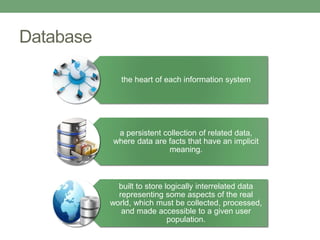
the heart of each information system
a persistent collection of related data,
where data are facts that have an implicit
meaning.
built to store logically interrelated data
representing some aspects of the real
world, which must be collected, processed,
and made accessible to a given user
population.
Database Concepts
• The database is constructed according
to a data model which define the way in
which data and interrelationships
between them can be represented.
Data
Models
• The collection of software programs that
provide the functionalities for defining,
maintaining, and accessing data stored
in a database is called a database
management system (DBMS).
DBMS
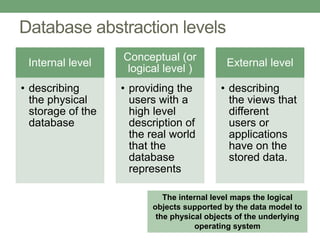
Database abstraction levels
Internal level
• describing
the physical
storage of the
database
Conceptual (or
logical level )
• providing the
users with a
high level
description of
the real world
that the
database
represents
External level
• describing
the views that
different
users or
applications
have on the
stored data.
The internal level maps the logical
objects supported by the data model to
the physical objects of the underlying
operating system
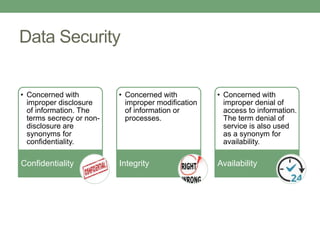
Data Security
• Concerned with
improper disclosure
of information. The
terms secrecy or non-
disclosure are
synonyms for
confidentiality.
Confidentiality
• Concerned with
improper modification
of information or
processes.
Integrity
• Concerned with
improper denial of
access to information.
The term denial of
service is also used
as a synonym for
availability.
Availability
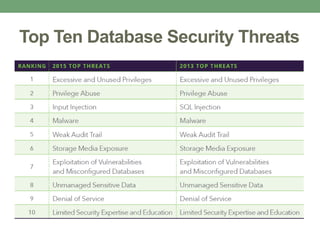
Top Ten Database Security Threats
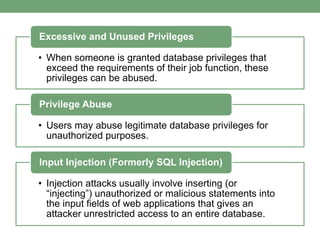
• When someone is granted database privileges that
exceed the requirements of their job function, these
privileges can be abused.
Excessive and Unused Privileges
• Users may abuse legitimate database privileges for
unauthorized purposes.
Privilege Abuse
• Injection attacks usually involve inserting (or
“injecting”) unauthorized or malicious statements into
the input fields of web applications that gives an
attacker unrestricted access to an entire database.
Input Injection (Formerly SQL Injection)
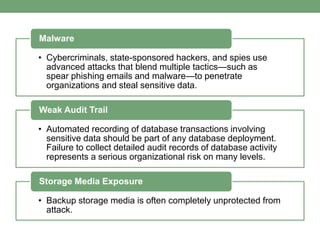
• Cybercriminals, state-sponsored hackers, and spies use
advanced attacks that blend multiple tactics—such as
spear phishing emails and malware—to penetrate
organizations and steal sensitive data.
Malware
• Automated recording of database transactions involving
sensitive data should be part of any database deployment.
Failure to collect detailed audit records of database activity
represents a serious organizational risk on many levels.
Weak Audit Trail
• Backup storage media is often completely unprotected from
attack.
Storage Media Exposure
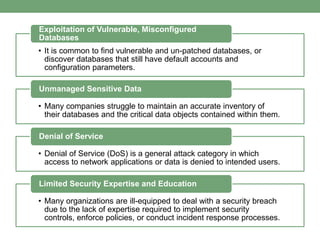
• It is common to find vulnerable and un-patched databases, or
discover databases that still have default accounts and
configuration parameters.
Exploitation of Vulnerable, Misconfigured
Databases
• Many companies struggle to maintain an accurate inventory of
their databases and the critical data objects contained within them.
Unmanaged Sensitive Data
• Denial of Service (DoS) is a general attack category in which
access to network applications or data is denied to intended users.
Denial of Service
• Many organizations are ill-equipped to deal with a security breach
due to the lack of expertise required to implement security
controls, enforce policies, or conduct incident response processes.
Limited Security Expertise and Education
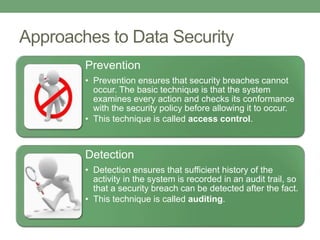
Approaches to Data Security
Prevention
• Prevention ensures that security breaches cannot
occur. The basic technique is that the system
examines every action and checks its conformance
with the security policy before allowing it to occur.
• This technique is called access control.
Detection
• Detection ensures that sufficient history of the
activity in the system is recorded in an audit trail, so
that a security breach can be detected after the fact.
• This technique is called auditing.
ACCESS CONTROL
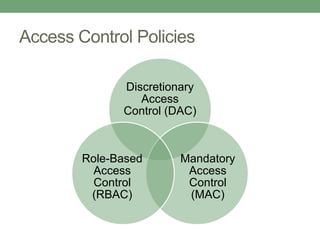
Access Control Policies
Discretionary
Access
Control (DAC)
Mandatory
Access
Control
(MAC)
Role-Based
Access
Control
(RBAC)
Discretionary Access Control
• The word discretionary characterizes the fact that users
can be given the ability of passing their privileges to
others.
• Discretionary access control policies are based on
authorizations rules.
• An authorization rule states that a subject has the privilege to
exercise a given action on a given object.
• The kind (and granularity) of subjects, objects, and
actions that can be referenced in authorizations may be
different in different systems.
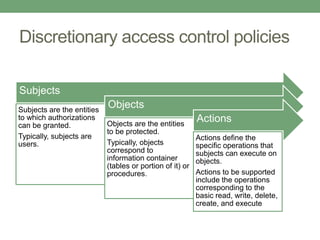
Discretionary access control policies
Subjects
Subjects are the entities
to which authorizations
can be granted.
Typically, subjects are
users.
Objects
Objects are the entities
to be protected.
Typically, objects
correspond to
information container
(tables or portion of it) or
procedures.
Actions
Actions define the
specific operations that
subjects can execute on
objects.
Actions to be supported
include the operations
corresponding to the
basic read, write, delete,
create, and execute
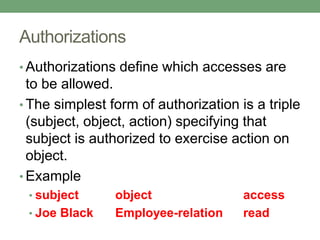
Authorizations
• Authorizations define which accesses are
to be allowed.
• The simplest form of authorization is a triple
(subject, object, action) specifying that
subject is authorized to exercise action on
object.
• Example
• subject object access
• Joe Black Employee-relation read
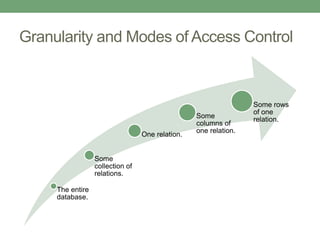
Granularity and Modes of Access Control
The entire
database.
Some
collection of
relations.
One relation.
Some
columns of
one relation.
Some rows
of one
relation.
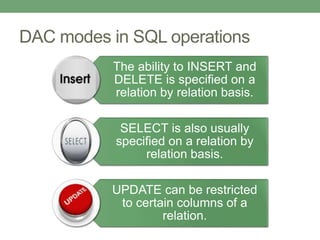
DAC modes in SQL operations
The ability to INSERT and
DELETE is specified on a
relation by relation basis.
SELECT is also usually
specified on a relation by
relation basis.
UPDATE can be restricted
to certain columns of a
relation.
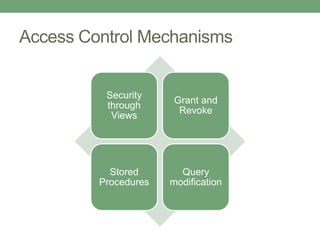
Access Control Mechanisms
Security
through
Views
Grant and
Revoke
Stored
Procedures
Query
modification
SECURITY THROUGH
VIEWS
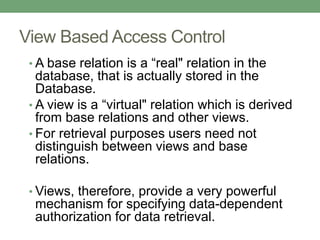
View Based Access Control
• A base relation is a “real" relation in the
database, that is actually stored in the
Database.
• A view is a “virtual" relation which is derived
from base relations and other views.
• For retrieval purposes users need not
distinguish between views and base
relations.
• Views, therefore, provide a very powerful
mechanism for specifying data-dependent
authorization for data retrieval.
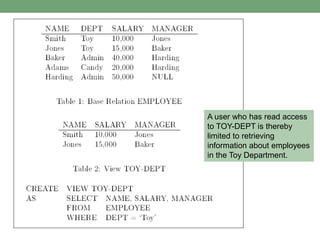
A user who has read access
to TOY-DEPT is thereby
limited to retrieving
information about employees
in the Toy Department.
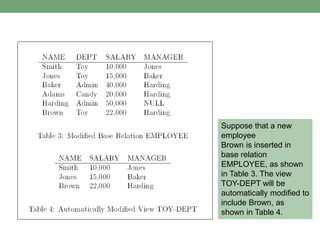
Suppose that a new
employee
Brown is inserted in
base relation
EMPLOYEE, as shown
in Table 3. The view
TOY-DEPT will be
automatically modified to
include Brown, as
shown in Table 4.
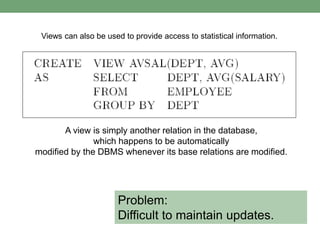
Views can also be used to provide access to statistical information.
A view is simply another relation in the database,
which happens to be automatically
modified by the DBMS whenever its base relations are modified.
Problem:
Difficult to maintain updates.
GRANTING AND
REVOCATION OF ACCESS
Grant
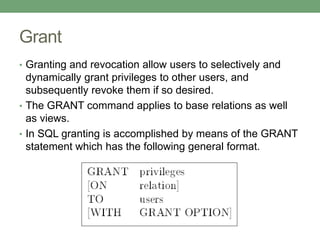
• Granting and revocation allow users to selectively and
dynamically grant privileges to other users, and
subsequently revoke them if so desired.
• The GRANT command applies to base relations as well
as views.
• In SQL granting is accomplished by means of the GRANT
statement which has the following general format.
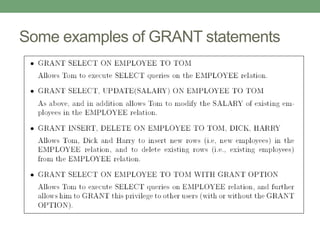
Some examples of GRANT statements
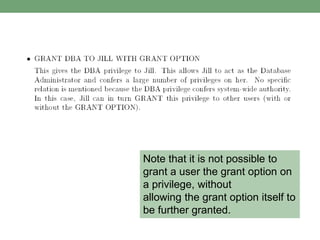
Note that it is not possible to
grant a user the grant option on
a privilege, without
allowing the grant option itself to
be further granted.
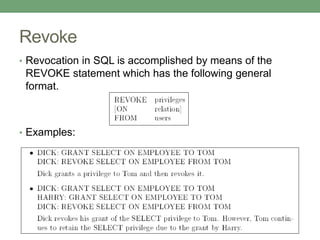
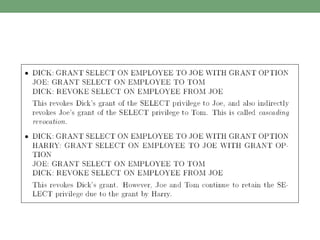
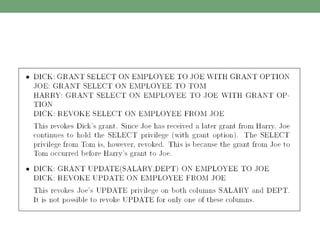
Revoke
• Revocation in SQL is accomplished by means of the
REVOKE statement which has the following general
format.
• Examples:
STORED PROCEDURES
Assign rights to execute compiled programs
GRANT RUN ON <program> TO <user>
Problem:
Programs may access resources for which the user who runs the program
does not have permission.
QUERY MODIFICATION
• It is not supported in SQL
• In this technique, a query submitted by a user is
modified to include further restrictions as determined
by the user's authorization.

01 database security ent-db

  • 1.
  • 2.
    Database the heart ofeach information system a persistent collection of related data, where data are facts that have an implicit meaning. built to store logically interrelated data representing some aspects of the real world, which must be collected, processed, and made accessible to a given user population.
  • 3.
    Database Concepts • Thedatabase is constructed according to a data model which define the way in which data and interrelationships between them can be represented. Data Models • The collection of software programs that provide the functionalities for defining, maintaining, and accessing data stored in a database is called a database management system (DBMS). DBMS
  • 4.
    Database abstraction levels Internallevel • describing the physical storage of the database Conceptual (or logical level ) • providing the users with a high level description of the real world that the database represents External level • describing the views that different users or applications have on the stored data. The internal level maps the logical objects supported by the data model to the physical objects of the underlying operating system
  • 5.
    Data Security • Concernedwith improper disclosure of information. The terms secrecy or non- disclosure are synonyms for confidentiality. Confidentiality • Concerned with improper modification of information or processes. Integrity • Concerned with improper denial of access to information. The term denial of service is also used as a synonym for availability. Availability
  • 6.
    Top Ten DatabaseSecurity Threats
  • 7.
    • When someoneis granted database privileges that exceed the requirements of their job function, these privileges can be abused. Excessive and Unused Privileges • Users may abuse legitimate database privileges for unauthorized purposes. Privilege Abuse • Injection attacks usually involve inserting (or “injecting”) unauthorized or malicious statements into the input fields of web applications that gives an attacker unrestricted access to an entire database. Input Injection (Formerly SQL Injection)
  • 8.
    • Cybercriminals, state-sponsoredhackers, and spies use advanced attacks that blend multiple tactics—such as spear phishing emails and malware—to penetrate organizations and steal sensitive data. Malware • Automated recording of database transactions involving sensitive data should be part of any database deployment. Failure to collect detailed audit records of database activity represents a serious organizational risk on many levels. Weak Audit Trail • Backup storage media is often completely unprotected from attack. Storage Media Exposure
  • 9.
    • It iscommon to find vulnerable and un-patched databases, or discover databases that still have default accounts and configuration parameters. Exploitation of Vulnerable, Misconfigured Databases • Many companies struggle to maintain an accurate inventory of their databases and the critical data objects contained within them. Unmanaged Sensitive Data • Denial of Service (DoS) is a general attack category in which access to network applications or data is denied to intended users. Denial of Service • Many organizations are ill-equipped to deal with a security breach due to the lack of expertise required to implement security controls, enforce policies, or conduct incident response processes. Limited Security Expertise and Education
  • 10.
    Approaches to DataSecurity Prevention • Prevention ensures that security breaches cannot occur. The basic technique is that the system examines every action and checks its conformance with the security policy before allowing it to occur. • This technique is called access control. Detection • Detection ensures that sufficient history of the activity in the system is recorded in an audit trail, so that a security breach can be detected after the fact. • This technique is called auditing.
  • 11.
  • 12.
    Access Control Policies Discretionary Access Control(DAC) Mandatory Access Control (MAC) Role-Based Access Control (RBAC)
  • 13.
    Discretionary Access Control •The word discretionary characterizes the fact that users can be given the ability of passing their privileges to others. • Discretionary access control policies are based on authorizations rules. • An authorization rule states that a subject has the privilege to exercise a given action on a given object. • The kind (and granularity) of subjects, objects, and actions that can be referenced in authorizations may be different in different systems.
  • 14.
    Discretionary access controlpolicies Subjects Subjects are the entities to which authorizations can be granted. Typically, subjects are users. Objects Objects are the entities to be protected. Typically, objects correspond to information container (tables or portion of it) or procedures. Actions Actions define the specific operations that subjects can execute on objects. Actions to be supported include the operations corresponding to the basic read, write, delete, create, and execute
  • 15.
    Authorizations • Authorizations definewhich accesses are to be allowed. • The simplest form of authorization is a triple (subject, object, action) specifying that subject is authorized to exercise action on object. • Example • subject object access • Joe Black Employee-relation read
  • 16.
    Granularity and Modesof Access Control The entire database. Some collection of relations. One relation. Some columns of one relation. Some rows of one relation.
  • 17.
    DAC modes inSQL operations The ability to INSERT and DELETE is specified on a relation by relation basis. SELECT is also usually specified on a relation by relation basis. UPDATE can be restricted to certain columns of a relation.
  • 18.
    Access Control Mechanisms Security through Views Grantand Revoke Stored Procedures Query modification
  • 19.
  • 20.
    View Based AccessControl • A base relation is a “real" relation in the database, that is actually stored in the Database. • A view is a “virtual" relation which is derived from base relations and other views. • For retrieval purposes users need not distinguish between views and base relations. • Views, therefore, provide a very powerful mechanism for specifying data-dependent authorization for data retrieval.
  • 21.
    A user whohas read access to TOY-DEPT is thereby limited to retrieving information about employees in the Toy Department.
  • 22.
    Suppose that anew employee Brown is inserted in base relation EMPLOYEE, as shown in Table 3. The view TOY-DEPT will be automatically modified to include Brown, as shown in Table 4.
  • 23.
    Views can alsobe used to provide access to statistical information. A view is simply another relation in the database, which happens to be automatically modified by the DBMS whenever its base relations are modified. Problem: Difficult to maintain updates.
  • 24.
  • 25.
    Grant • Granting andrevocation allow users to selectively and dynamically grant privileges to other users, and subsequently revoke them if so desired. • The GRANT command applies to base relations as well as views. • In SQL granting is accomplished by means of the GRANT statement which has the following general format.
  • 26.
    Some examples ofGRANT statements
  • 27.
    Note that itis not possible to grant a user the grant option on a privilege, without allowing the grant option itself to be further granted.
  • 28.
    Revoke • Revocation inSQL is accomplished by means of the REVOKE statement which has the following general format. • Examples:
  • 31.
    STORED PROCEDURES Assign rightsto execute compiled programs GRANT RUN ON <program> TO <user> Problem: Programs may access resources for which the user who runs the program does not have permission.
  • 32.
    QUERY MODIFICATION • Itis not supported in SQL • In this technique, a query submitted by a user is modified to include further restrictions as determined by the user's authorization.