PERFORMANCE
APPRAISAL
Patriana Z P.
Benliro
What is
performance?
Performance
Its Determinants & Obstacles
• Performance- refers to the effective and
efficient accomplishment of objectives.
• It may be stated in terms of levels:
excellent
outstanding
good
poor
Performance
Its Determinants & Obstacles
• It is the result of the efforts expended by
the employee and which is modified by
his abilities and his perception of his/her
role.
• Abilities eg. Language facility, finger
dexterity, etc.
• Role perceptions constitute the directions
in which the employee believes he should
exert his effort in doing his job.
Performance
Its Determinants & Obstacles
• Poor performance may be the result of
any or all of the following:
Employee
• Inadequate effort expended on the job;
• Lack of proficiency in doing the job
• Wrong role perception.
Performance
Its Determinants & Obstacles
Environmental Factors
• Conflicting demands on the employee’s
time
• Inappropriate work facilities &
equipment
• Restrictive policies that affect the job
• Lack of cooperation from co-employees
• Poor supervision
Performance
Its Determinants & Obstacles
• Poor performance may be the result of any
or all of the following:
Environmental Factors
• Inappropriate temperature in the workplace
• Poor lighting
• Noisy surrounding
• Improper shifting of the employee
• Unsafe premises
Performance
Its Determinants & Obstacles
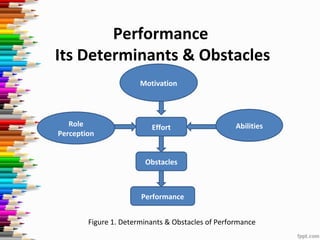
Effort
Obstacles
Performance
Motivation
Role
Perception
Abilities
Figure 1. Determinants & Obstacles of Performance
What is
performance
appraisal?
What is Performance Appraisal?
It is the process of evaluating individual job
performance as a basis for making
objective personnel decisions.
It is alternately referred to as
• Employee rating
• Employee evaluation
• Performance review
• Performance evaluation
• Results appraisal
Importance of Performance Appraisal
• One reason why
employees tend to
maintain the desired
behavior is if they knew
that their performance
is monitored and
appraised.
Performance
Its Determinants & Obstacles
Individual Goals
Organizational
Goals
Performance
Performance
Evaluation
Process
Behavior
Figure 2. Behavior And Performance
Appraisal
Uses of Performance Appraisal
• The information generated from
Performance Appraisal is useful inputs in
making decisions involving:
– Compensation -financial reward
– Placement- decisions concerning promotion,
demotion, discharge
– Training and Development- potentials and
weakness of employees are needed for
identifying training & development needs.
Formal Performance Appraisal
• Performance Appraisal is formal if it uses a
systematic appraisal. Usually characterized
by the following:
• Managers & subordinates share understanding
about what has to be accomplished.
• Performance is measured using some techniques.
• Assessment of employee performance is done on
a regular basis such as every six months or every
year.
• During the assessment proceedings, the
employee is well aware that his performance is
being assessed.
Informal Performance Appraisal
• Informal appraisal is done
whenever the supervisor
feels the need for it.
• The assessment is usually
made during conversations
between superior and the
subordinate or on the spot
examination of the
subordinate’s output.
What are the processes
in performance
appraisal?
Process of Appraisal
• Establishment of performance
standards.
• Joint superior-subordinate setting of
measurable goals.
• Measurement of performance.
• Compare performance with standards.
• Discuss result appraisal with employee.
• When necessary, corrective action is
initiated.
Process of Appraisal
Establish
performance
standards
Joint superior-
subordinate setting of
goals
Measurement of
actual performance
Compare
performance with
standards
Relay result to
employee
Corrective action
initiated when
necessary
What are the methods
of performance
appraisal?
Methods of Appraisal
• Work standards approach
• Critical-incident appraisal
• Checklist
• Essay appraisal
• Graphic rating scale
• Behaviorally anchored rating scale
• Ranking methods
• Forced-choice rating
• Goal-setting or management by objectives
(MBO)
Methods of Appraisal
• Work standards approach
Involves setting a standard level of
output and then comparing every
employee’s performance with the
standard.
Disadvantage: There is difficulty in
comparing standards for the different
categories of job.
Methods of Appraisal
• Critical-incident appraisal
The evaluator keeps a record of
desirable and desirable incidents of each
employee.
Disadvantages:
-Recording the incidents covering all
employees is time consuming.
-There is much difficulty quantifying
critical incidents.
Methods of Appraisal
• Checklist
Item Yes No
1. Does the person scan records to
determine accounts due for collection
everyday?
/
2. Does the person make a routine check-up
of equipment under his care?
/
3. When a customer is unable to settle an
amount due, does the person make a follow-
up?
/
4. Does the person make a report right after
field collection?
/
5. Does the person volunteer to help other
employees?
/
Methods of Appraisal
• Essay Appraisal
The appraiser writes a narrative about
the person being appraised. The narrative
describes a person’s strengths,
weaknesses, past performance, potential,
etc.
Disadvantages:
-Writing abilities of appraisers differ.
-Difficult to compare.
-Difficult to quantify
Methods of Appraisal
• Graphic Rating Scale
Uses identified performance factors.
Eg. Quantity, quality of work, job
knowledge, dependability, attendance,
loyalty, etc. Rating scales are developed
making it easier to assess performance.
Disadvantages:
-It does not provide the depth of
information other methods do.
Methods of Appraisal
• Behaviorally-Anchored Rating Scale
Scale Values Attitude Toward Customers & Prospects
1-Unacceptable The salesclerk should be expected to ignore persons who
make inquiries.
2-Very Poor The SC show little interest in convincing prospect buyers.
3-Poor The SC listen to suggestions and complaints from customers.
4-Below Average The SC relay suggestions and complaints of customers.
5-Average The SC require some help in knowing the right approach to
customers.
6-Good The SC apply various procedures designed to make
customers feel free to communicate
7-Very good The SC make customers feel that they are important to the
company.
8-Excellent The SC regard customer an important link between them &
the company.
Methods of Appraisal
• Ranking Method
1. Alternation
From the list of employees to be evaluated,
the evaluator prepares another list where the
individual names are entered and arranged
according to their value or importance.
The method is useful if the list is short but
may encounter problems if the list is too long.
1. Paired Comparisons
2. Forced-Distribution
Methods of Appraisal
• Ranking Method
2. Paired Comparisons
The name of the employee is paired with
another and the evaluator determines who is
better employee.
Paired Comparison Results
_X _Gina vs. Anna ___ ___Anna vs. Donna___
___Gina vs.Juana___ X_Juana vs Dina ____
___Gina vs Donna___ ___Juana vs Diana___
Note: X mark indicates better employee.
Methods of Appraisal
• Ranking Method
2. Paired Comparisons
Name of Employee No. of times judged as
better employee
Rank
Gina 5 1
Anna 4 2
Juana 3 3
Dina 2 4
Donna 1 5
Diana 0 6
Methods of Appraisal
• Ranking Method
3. Forced-Distribution
The levels of performance Percentage
Does not meet expected results 15%
Meets expected results 70%
Exceeds expected results 15%
Methods of Appraisal
• Forced-Choice Rating
Sales supervisor evaluating the performance of a
sales clerk:
____ 1. is able to hold the interest of prospects
____ 2. performs product demonstrations with
confidence
____ 3. provides accurate information to
prospects
____ 4. prepares accurate sales report
____ 5. thinks generally in terms of items sold.
The rater must choose between two or more specific
statements about an employees work behavior
Goal Setting or MBO
MBO Steps
1.The employee and his superior jointly set
goals.
2.The employee tries to meet the goals.
3.Performance is evaluated against the goals.
4.The employee and superior jointly set new
goals for the next time period.
Goal Setting or MBO
Management By-Objectives (MBO)
Prerequisites:
1.The use of the participative style of
management.
2.Pinpointing which employee is
responsible for which results.
3.Providing performance feedback to
concerned employees.
Who are the sources of
performance
appraisal?
Sources of Performance Information
• Supervisors
• Peers
• Subordinates
• Self
• Customers
What are the errors of
performance
appraisal?
Errors in Performance Appraisal
• Halo Error
Result of evaluation of one trait
influences the evaluator in the assessment of
other traits.
• Single Criterion
Several tasks are evaluated on the basis
of a single criterion.
• Leniency Error
Evaluators use his or her own value
system in appraising the performance of
employees.
Errors in Performance Appraisal
• Central Tendency Error
All employees are rated within a narrow
range as if the performances of all
employees are equal or almost equal.
Performance No. of employees rated
Excellent 0
Above Average 10
Average 1, 246
Below Average 9
Poor 0
Errors in Performance Appraisal
• Recency Problem
Recent performance is given greater
weight than earlier performance.
Primacy Error/Problem
Early performance is considered more
important than later performance.
How do we overcome
errors in performance
Appraisal?
Overcoming Errors in Performance
Appraisal
• Using multiple criteria.
• Emphasizing behaviors rather than traits.
• Documenting performance behavior.
• Using multiple evaluators.
• Evaluating selectively.
• Training evaluators.
Summary
• Performance Appraisal is the process of
evaluating the job performance of each
employee or manager.
• Performance evaluation outputs are inputs of
decision-making, especially on matters
relation to promotion, transfer and retention
of employees.
• Appraisal is formal if it uses a systematic
appraisal system. It is informal if it is done
anytime the supervisor fells there is a need for
it.
Summary
• The steps in performance appraisal consist
of 1.)establishing performance standards,
2.)joint superior-subordinate setting of
measurable goals, 3. measuring
performance, 4. comparing performance
with standards, 5. discussing results of
appraisal with the employee and 6.
initiating corrective action when
necessary.
Summary
• Various methods of appraising consist of
work-standards approach, critical incident
appraisal, checklist, essay appraisal, graphic
rating scale, behaviorally anchored rating
scale, ranking method, force-d choice rating
and goal setting or management by
objectives.
• Sources of PA are supervisors, peers,
subordinates, self and customers.
Summary
• Appraisal Errors consist of halo error,
single criterion, leniency error, central
tendency error and recency problem.
• Overcoming errors in PA are using multiple
criteria, emphasizing behavior rather than
traits, documenting performance
behaviors, using multiple evaluators,
evaluating selectively and training
evaluators.
Performance appraisal

Performance appraisal

  • 1.
  • 2.
  • 3.
    Performance Its Determinants &Obstacles • Performance- refers to the effective and efficient accomplishment of objectives. • It may be stated in terms of levels: excellent outstanding good poor
  • 4.
    Performance Its Determinants &Obstacles • It is the result of the efforts expended by the employee and which is modified by his abilities and his perception of his/her role. • Abilities eg. Language facility, finger dexterity, etc. • Role perceptions constitute the directions in which the employee believes he should exert his effort in doing his job.
  • 5.
    Performance Its Determinants &Obstacles • Poor performance may be the result of any or all of the following: Employee • Inadequate effort expended on the job; • Lack of proficiency in doing the job • Wrong role perception.
  • 6.
    Performance Its Determinants &Obstacles Environmental Factors • Conflicting demands on the employee’s time • Inappropriate work facilities & equipment • Restrictive policies that affect the job • Lack of cooperation from co-employees • Poor supervision
  • 7.
    Performance Its Determinants &Obstacles • Poor performance may be the result of any or all of the following: Environmental Factors • Inappropriate temperature in the workplace • Poor lighting • Noisy surrounding • Improper shifting of the employee • Unsafe premises
  • 8.
    Performance Its Determinants &Obstacles Effort Obstacles Performance Motivation Role Perception Abilities Figure 1. Determinants & Obstacles of Performance
  • 9.
  • 10.
    What is PerformanceAppraisal? It is the process of evaluating individual job performance as a basis for making objective personnel decisions. It is alternately referred to as • Employee rating • Employee evaluation • Performance review • Performance evaluation • Results appraisal
  • 11.
    Importance of PerformanceAppraisal • One reason why employees tend to maintain the desired behavior is if they knew that their performance is monitored and appraised.
  • 12.
    Performance Its Determinants &Obstacles Individual Goals Organizational Goals Performance Performance Evaluation Process Behavior Figure 2. Behavior And Performance Appraisal
  • 13.
    Uses of PerformanceAppraisal • The information generated from Performance Appraisal is useful inputs in making decisions involving: – Compensation -financial reward – Placement- decisions concerning promotion, demotion, discharge – Training and Development- potentials and weakness of employees are needed for identifying training & development needs.
  • 14.
    Formal Performance Appraisal •Performance Appraisal is formal if it uses a systematic appraisal. Usually characterized by the following: • Managers & subordinates share understanding about what has to be accomplished. • Performance is measured using some techniques. • Assessment of employee performance is done on a regular basis such as every six months or every year. • During the assessment proceedings, the employee is well aware that his performance is being assessed.
  • 15.
    Informal Performance Appraisal •Informal appraisal is done whenever the supervisor feels the need for it. • The assessment is usually made during conversations between superior and the subordinate or on the spot examination of the subordinate’s output.
  • 16.
    What are theprocesses in performance appraisal?
  • 17.
    Process of Appraisal •Establishment of performance standards. • Joint superior-subordinate setting of measurable goals. • Measurement of performance. • Compare performance with standards. • Discuss result appraisal with employee. • When necessary, corrective action is initiated.
  • 18.
    Process of Appraisal Establish performance standards Jointsuperior- subordinate setting of goals Measurement of actual performance Compare performance with standards Relay result to employee Corrective action initiated when necessary
  • 19.
    What are themethods of performance appraisal?
  • 20.
    Methods of Appraisal •Work standards approach • Critical-incident appraisal • Checklist • Essay appraisal • Graphic rating scale • Behaviorally anchored rating scale • Ranking methods • Forced-choice rating • Goal-setting or management by objectives (MBO)
  • 21.
    Methods of Appraisal •Work standards approach Involves setting a standard level of output and then comparing every employee’s performance with the standard. Disadvantage: There is difficulty in comparing standards for the different categories of job.
  • 22.
    Methods of Appraisal •Critical-incident appraisal The evaluator keeps a record of desirable and desirable incidents of each employee. Disadvantages: -Recording the incidents covering all employees is time consuming. -There is much difficulty quantifying critical incidents.
  • 23.
    Methods of Appraisal •Checklist Item Yes No 1. Does the person scan records to determine accounts due for collection everyday? / 2. Does the person make a routine check-up of equipment under his care? / 3. When a customer is unable to settle an amount due, does the person make a follow- up? / 4. Does the person make a report right after field collection? / 5. Does the person volunteer to help other employees? /
  • 24.
    Methods of Appraisal •Essay Appraisal The appraiser writes a narrative about the person being appraised. The narrative describes a person’s strengths, weaknesses, past performance, potential, etc. Disadvantages: -Writing abilities of appraisers differ. -Difficult to compare. -Difficult to quantify
  • 25.
    Methods of Appraisal •Graphic Rating Scale Uses identified performance factors. Eg. Quantity, quality of work, job knowledge, dependability, attendance, loyalty, etc. Rating scales are developed making it easier to assess performance. Disadvantages: -It does not provide the depth of information other methods do.
  • 26.
    Methods of Appraisal •Behaviorally-Anchored Rating Scale Scale Values Attitude Toward Customers & Prospects 1-Unacceptable The salesclerk should be expected to ignore persons who make inquiries. 2-Very Poor The SC show little interest in convincing prospect buyers. 3-Poor The SC listen to suggestions and complaints from customers. 4-Below Average The SC relay suggestions and complaints of customers. 5-Average The SC require some help in knowing the right approach to customers. 6-Good The SC apply various procedures designed to make customers feel free to communicate 7-Very good The SC make customers feel that they are important to the company. 8-Excellent The SC regard customer an important link between them & the company.
  • 27.
    Methods of Appraisal •Ranking Method 1. Alternation From the list of employees to be evaluated, the evaluator prepares another list where the individual names are entered and arranged according to their value or importance. The method is useful if the list is short but may encounter problems if the list is too long. 1. Paired Comparisons 2. Forced-Distribution
  • 28.
    Methods of Appraisal •Ranking Method 2. Paired Comparisons The name of the employee is paired with another and the evaluator determines who is better employee. Paired Comparison Results _X _Gina vs. Anna ___ ___Anna vs. Donna___ ___Gina vs.Juana___ X_Juana vs Dina ____ ___Gina vs Donna___ ___Juana vs Diana___ Note: X mark indicates better employee.
  • 29.
    Methods of Appraisal •Ranking Method 2. Paired Comparisons Name of Employee No. of times judged as better employee Rank Gina 5 1 Anna 4 2 Juana 3 3 Dina 2 4 Donna 1 5 Diana 0 6
  • 30.
    Methods of Appraisal •Ranking Method 3. Forced-Distribution The levels of performance Percentage Does not meet expected results 15% Meets expected results 70% Exceeds expected results 15%
  • 31.
    Methods of Appraisal •Forced-Choice Rating Sales supervisor evaluating the performance of a sales clerk: ____ 1. is able to hold the interest of prospects ____ 2. performs product demonstrations with confidence ____ 3. provides accurate information to prospects ____ 4. prepares accurate sales report ____ 5. thinks generally in terms of items sold. The rater must choose between two or more specific statements about an employees work behavior
  • 32.
    Goal Setting orMBO MBO Steps 1.The employee and his superior jointly set goals. 2.The employee tries to meet the goals. 3.Performance is evaluated against the goals. 4.The employee and superior jointly set new goals for the next time period.
  • 33.
    Goal Setting orMBO Management By-Objectives (MBO) Prerequisites: 1.The use of the participative style of management. 2.Pinpointing which employee is responsible for which results. 3.Providing performance feedback to concerned employees.
  • 34.
    Who are thesources of performance appraisal?
  • 35.
    Sources of PerformanceInformation • Supervisors • Peers • Subordinates • Self • Customers
  • 36.
    What are theerrors of performance appraisal?
  • 37.
    Errors in PerformanceAppraisal • Halo Error Result of evaluation of one trait influences the evaluator in the assessment of other traits. • Single Criterion Several tasks are evaluated on the basis of a single criterion. • Leniency Error Evaluators use his or her own value system in appraising the performance of employees.
  • 38.
    Errors in PerformanceAppraisal • Central Tendency Error All employees are rated within a narrow range as if the performances of all employees are equal or almost equal. Performance No. of employees rated Excellent 0 Above Average 10 Average 1, 246 Below Average 9 Poor 0
  • 39.
    Errors in PerformanceAppraisal • Recency Problem Recent performance is given greater weight than earlier performance. Primacy Error/Problem Early performance is considered more important than later performance.
  • 40.
    How do weovercome errors in performance Appraisal?
  • 41.
    Overcoming Errors inPerformance Appraisal • Using multiple criteria. • Emphasizing behaviors rather than traits. • Documenting performance behavior. • Using multiple evaluators. • Evaluating selectively. • Training evaluators.
  • 42.
    Summary • Performance Appraisalis the process of evaluating the job performance of each employee or manager. • Performance evaluation outputs are inputs of decision-making, especially on matters relation to promotion, transfer and retention of employees. • Appraisal is formal if it uses a systematic appraisal system. It is informal if it is done anytime the supervisor fells there is a need for it.
  • 43.
    Summary • The stepsin performance appraisal consist of 1.)establishing performance standards, 2.)joint superior-subordinate setting of measurable goals, 3. measuring performance, 4. comparing performance with standards, 5. discussing results of appraisal with the employee and 6. initiating corrective action when necessary.
  • 44.
    Summary • Various methodsof appraising consist of work-standards approach, critical incident appraisal, checklist, essay appraisal, graphic rating scale, behaviorally anchored rating scale, ranking method, force-d choice rating and goal setting or management by objectives. • Sources of PA are supervisors, peers, subordinates, self and customers.
  • 45.
    Summary • Appraisal Errorsconsist of halo error, single criterion, leniency error, central tendency error and recency problem. • Overcoming errors in PA are using multiple criteria, emphasizing behavior rather than traits, documenting performance behaviors, using multiple evaluators, evaluating selectively and training evaluators.