1
Chapter 2:
The Project Management
Context and Processes
2
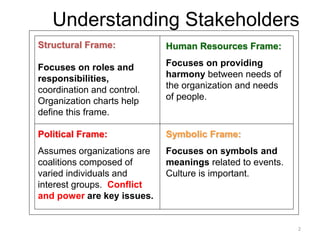
Understanding Stakeholders
Structural Frame:
Focuses on roles and
responsibilities,
coordination and control.
Organization charts help
define this frame.
Human Resources Frame:
Focuses on providing
harmony between needs of
the organization and needs
of people.
Political Frame:
Assumes organizations are
coalitions composed of
varied individuals and
interest groups. Conflict
and power are key issues.
Symbolic Frame:
Focuses on symbols and
meanings related to events.
Culture is important.
3
Recognize the Importance of
Project Stakeholders
• Recall that project stakeholders are the people
involved in or affected by project activities
• Project managers must take time to identify,…
… understand, and manage relationships…
… with all project stakeholders
• Using the four frames of organizations can help
meet stakeholder needs and expectations
4
Table 2-2. What Helps Projects
Succeed?
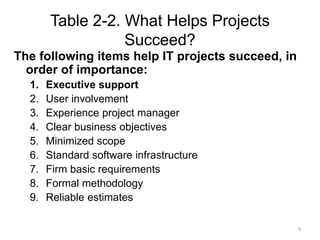
The following items help IT projects succeed, in
order of importance:
1. Executive support
2. User involvement
3. Experience project manager
4. Clear business objectives
5. Minimized scope
6. Standard software infrastructure
7. Firm basic requirements
8. Formal methodology
9. Reliable estimates
5
Table 2-2. What Helps Projects
Succeed?
The following items help IT projects succeed, in
order of importance:
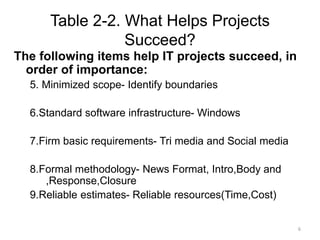
1. Executive support- Concurrence from Board of
Directors and Top Mgmt.( ABC 5- MVP, LCV)
2. User involvement- NEWS Team- Presidentiable
DEBATE Coverage
3. Experience project manager- Specialization
4. Clear business objectives- Objective is to help people
who are abused and maltreated by calling the
attention…….
6
Table 2-2. What Helps Projects
Succeed?
The following items help IT projects succeed, in
order of importance:
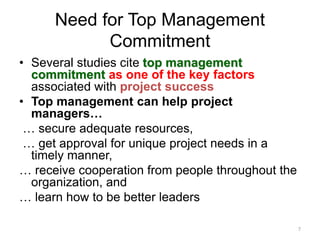
5. Minimized scope- Identify boundaries
6.Standard software infrastructure- Windows
7.Firm basic requirements- Tri media and Social media
8.Formal methodology- News Format, Intro,Body and
,Response,Closure
9.Reliable estimates- Reliable resources(Time,Cost)
7
Need for Top Management
Commitment
• Several studies cite top management
commitment as one of the key factors
associated with project success
• Top management can help project
managers…
… secure adequate resources,
… get approval for unique project needs in a
timely manner,
… receive cooperation from people throughout the
organization, and
… learn how to be better leaders
8
Need for Organizational Commitment to
Information Technology (IT)
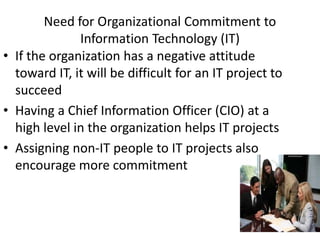
• If the organization has a negative attitude
toward IT, it will be difficult for an IT project to
succeed
• Having a Chief Information Officer (CIO) at a
high level in the organization helps IT projects
• Assigning non-IT people to IT projects also
encourage more commitment
9
Suggested Skills for a
Project Manager
 Communication Skills: listening,
persuading
 Organizational Skills: planning, goal-
setting, analyzing
 Team Building Skills: empathy,
motivation, esprit de corps
 Leadership Skills: sets example,
energetic, vision (big picture),
delegates, positive
 Coping Skills: flexibility, creativity,
patience, persistence
 Technological Skills: experience,
project knowledge
10
Table 2-3. Most Significant Characteristics of
Effective and Ineffective Project Managers
• Leadership by example
• Visionary
• Technically competent
• Decisive
• Good communicator
• Good motivator
• Stands up to upper
management when
necessary
• Supports team members
• Encourages new ideas
• Sets bad example
• Not self-assured
• Lacks technical expertise
• Poor communicator
• Poor motivator
Effective Project Managers Ineffective Project Managers
11
Project Management Process
• Project management can be viewed as a
number of interlinked processes
• The project management process groups
include
1. initiating processes
2. planning processes
3. executing processes
4. controlling processes
5. closing processes
12
Project Management Process
1. Project conception and initiation
An idea for a project will be carefully examined to
determine whether or not it benefits the
organization. During this phase, a decision making
team will identify if the project can realistically be
completed.
13
Project Management Process
2. Project definition and planning
A project plan, project charter and/or
project scope may be put in writing,
outlining the work to be performed. During
this phase, a team should prioritize the
project, calculate a budget and schedule,
and determine what resources are needed.
14
Project Management Process
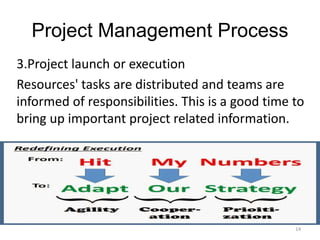
3.Project launch or execution
Resources' tasks are distributed and teams are
informed of responsibilities. This is a good time to
bring up important project related information.
15
Project Management Process
4. Project performance and control
Project managers will compare project status and
progress to the actual plan, as resources perform
the scheduled work. During this phase, project
managers may need to adjust schedules or do
what is necessary to keep the project on track.
.
16
Project Management Process
5. Project close
After project tasks are completed and the client
has approved the outcome, an evaluation is
necessary to highlight project success and/or
learn from project history.
17
Project Management Process
Projects and project management processes vary
from industry to industry; however, these are
more traditional elements of a project. The
overarching/primary goal is typically to offer a
product, change a process or to solve a problem
in order to benefit the organization.
18
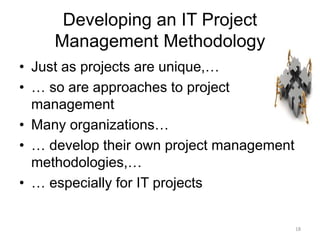
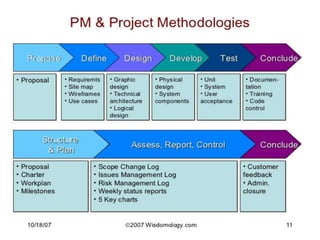
Developing an IT Project
Management Methodology
• Just as projects are unique,…
• … so are approaches to project
management
• Many organizations…
• … develop their own project management
methodologies,…
• … especially for IT projects
20
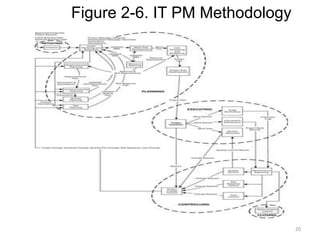
Figure 2-6. IT PM Methodology

Chapter 2

  • 1.
    1 Chapter 2: The ProjectManagement Context and Processes
  • 2.
    2 Understanding Stakeholders Structural Frame: Focuseson roles and responsibilities, coordination and control. Organization charts help define this frame. Human Resources Frame: Focuses on providing harmony between needs of the organization and needs of people. Political Frame: Assumes organizations are coalitions composed of varied individuals and interest groups. Conflict and power are key issues. Symbolic Frame: Focuses on symbols and meanings related to events. Culture is important.
  • 3.
    3 Recognize the Importanceof Project Stakeholders • Recall that project stakeholders are the people involved in or affected by project activities • Project managers must take time to identify,… … understand, and manage relationships… … with all project stakeholders • Using the four frames of organizations can help meet stakeholder needs and expectations
  • 4.
    4 Table 2-2. WhatHelps Projects Succeed? The following items help IT projects succeed, in order of importance: 1. Executive support 2. User involvement 3. Experience project manager 4. Clear business objectives 5. Minimized scope 6. Standard software infrastructure 7. Firm basic requirements 8. Formal methodology 9. Reliable estimates
  • 5.
    5 Table 2-2. WhatHelps Projects Succeed? The following items help IT projects succeed, in order of importance: 1. Executive support- Concurrence from Board of Directors and Top Mgmt.( ABC 5- MVP, LCV) 2. User involvement- NEWS Team- Presidentiable DEBATE Coverage 3. Experience project manager- Specialization 4. Clear business objectives- Objective is to help people who are abused and maltreated by calling the attention…….
  • 6.
    6 Table 2-2. WhatHelps Projects Succeed? The following items help IT projects succeed, in order of importance: 5. Minimized scope- Identify boundaries 6.Standard software infrastructure- Windows 7.Firm basic requirements- Tri media and Social media 8.Formal methodology- News Format, Intro,Body and ,Response,Closure 9.Reliable estimates- Reliable resources(Time,Cost)
  • 7.
    7 Need for TopManagement Commitment • Several studies cite top management commitment as one of the key factors associated with project success • Top management can help project managers… … secure adequate resources, … get approval for unique project needs in a timely manner, … receive cooperation from people throughout the organization, and … learn how to be better leaders
  • 8.
    8 Need for OrganizationalCommitment to Information Technology (IT) • If the organization has a negative attitude toward IT, it will be difficult for an IT project to succeed • Having a Chief Information Officer (CIO) at a high level in the organization helps IT projects • Assigning non-IT people to IT projects also encourage more commitment
  • 9.
    9 Suggested Skills fora Project Manager  Communication Skills: listening, persuading  Organizational Skills: planning, goal- setting, analyzing  Team Building Skills: empathy, motivation, esprit de corps  Leadership Skills: sets example, energetic, vision (big picture), delegates, positive  Coping Skills: flexibility, creativity, patience, persistence  Technological Skills: experience, project knowledge
  • 10.
    10 Table 2-3. MostSignificant Characteristics of Effective and Ineffective Project Managers • Leadership by example • Visionary • Technically competent • Decisive • Good communicator • Good motivator • Stands up to upper management when necessary • Supports team members • Encourages new ideas • Sets bad example • Not self-assured • Lacks technical expertise • Poor communicator • Poor motivator Effective Project Managers Ineffective Project Managers
  • 11.
    11 Project Management Process •Project management can be viewed as a number of interlinked processes • The project management process groups include 1. initiating processes 2. planning processes 3. executing processes 4. controlling processes 5. closing processes
  • 12.
    12 Project Management Process 1.Project conception and initiation An idea for a project will be carefully examined to determine whether or not it benefits the organization. During this phase, a decision making team will identify if the project can realistically be completed.
  • 13.
    13 Project Management Process 2.Project definition and planning A project plan, project charter and/or project scope may be put in writing, outlining the work to be performed. During this phase, a team should prioritize the project, calculate a budget and schedule, and determine what resources are needed.
  • 14.
    14 Project Management Process 3.Projectlaunch or execution Resources' tasks are distributed and teams are informed of responsibilities. This is a good time to bring up important project related information.
  • 15.
    15 Project Management Process 4.Project performance and control Project managers will compare project status and progress to the actual plan, as resources perform the scheduled work. During this phase, project managers may need to adjust schedules or do what is necessary to keep the project on track. .
  • 16.
    16 Project Management Process 5.Project close After project tasks are completed and the client has approved the outcome, an evaluation is necessary to highlight project success and/or learn from project history.
  • 17.
    17 Project Management Process Projectsand project management processes vary from industry to industry; however, these are more traditional elements of a project. The overarching/primary goal is typically to offer a product, change a process or to solve a problem in order to benefit the organization.
  • 18.
    18 Developing an ITProject Management Methodology • Just as projects are unique,… • … so are approaches to project management • Many organizations… • … develop their own project management methodologies,… • … especially for IT projects
  • 20.
    20 Figure 2-6. ITPM Methodology