Human Resource Management.
Performance appraisal and its methods.
Submitted to : Prof. Priyanka Batra
Submitted By : Hiran Patel (IB )
Roll no. 13
WHAT IS PERFORMANCE APPRAISAL?
 It is concerned with behaviors that affects
performance.
 Assessment of an individual’s performance in a
systematic way.
WHAT IS PERFORMANCE APPRAISAL
CONTI…
 “Performance appraisal is a systematic appraisal of
the employee’s personality traits and performance
on the job and is designed to determine his
contribution and relative worth to the firm”
-Shubin
FACTORS TO BE CONSIDERED FOR
PERFORMANCE APPRAISAL
 Job knowledge
 Quality and quantity of an output
 Leadership abilities
 Dependability
 Co-operation
CHARACTERISTICS
 Arranged periodically according to definite plan.
 Continuous process.
 Basic purpose is to find out the output given by
employee.
 Systematic description of an employee’s job
relevant strength and weaknesses.
NEED OF PERFORMANCE APPRAISAL
 To assess the training and development needs of
an employee.
 To effect promotions based on competence and
performance.
 To confirm the services of probationary employees
upon their completing the probationary period
satisfactorily.
 To determine whether HR programmes are effective
or not.
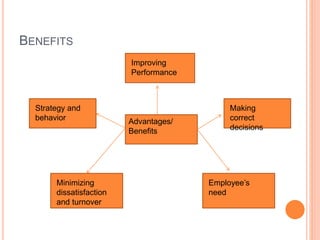
BENEFITS
Improving
Performance
Advantages/
Benefits
Making
correct
decisions
Strategy and
behavior
Minimizing
dissatisfaction
and turnover
Employee’s
need
DESIGN APPRAISAL PROGRAMME
 Formal vs informal
 Whose performance is to be assessed?
 Who are the raters?
 What problems are encountered?
 How to solve the problems?
 What should be evaluated?
 When to evaluate?
 What methods of appraisal are to be used?
METHODS
 Approaches to appraisal can be classified in to two
categories:
(i) Past oriented methods
(ii) future oriented methods
PAST ORIENTED METHODS
 Rating scale
 Check list
 Forced distribution method
 Forced choice method
 Critical incidents method
 Behaviorally anchored rating scaled
 Field review method
 Performance tests and observations
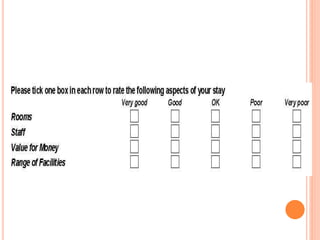
 Rating scales:
 simplest and most popular technique.
 it consists of several numerical scale
represents a job related performance criterion such as
dependability, output, attendence, attitude, co-operation.
 Each scale ranges from excellent to poor.
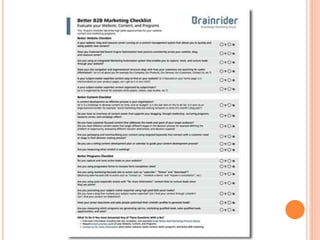
 Checklist
 a checklist of statements on the traits of the
employee and his or her job is prepared in two
columns- ‘yes’ column and ‘no’ column.
 the evaluation is done by HR department.
 The HR dept. assigns some points to the number of
‘yes’ and ‘no’ as well.
 On the basis of this final evaulation takes place.
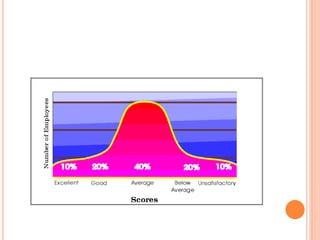
 Forced distribution method
 To measure performance appraisal for large
number of employees is difficult.
 To overcome this error the method helps the rater
to distribute the rates on all points on the rating
scale.
 The method operates under assumption that
employee performance level conforms to a normal
statistical distribution.
 Forced choice method
 The rater is forced to select the statements which
are readymade.
 typical statements can be
Learns fast - - - - - - - - - - - - works hard
work is reliable - - - - - - - - - performance is a
good example for.
 Critical incidents method
 The approach focuses on certain critical behavior
of an employee that make all the differences
between effective and non-effective performance of
a job.
 such incidents are recorded by the superiors as
and when they occur.
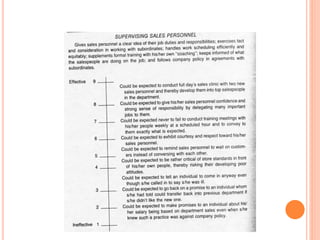
 Behaviorally anchored rating scales (BARS)
 here, the rater is expected to indicate which
behavior on each scale best describe an
employee’s performance.
 Descriptive statements varying from the least to
the most effective.
 Field review method
 Appraisal by someone outside the department
usually from the corporate office or HR department.
 Used for making promotional decisions at
managerial level.
 Performance tests and observations
 In the case of limited no. of jobs, employee
assessment done by knowledge or skills.
 Test may be of paper and pencil or demonstration
of skills.
FUTURE ORIENTED METHODS
 Management by objectives
 Psychological appraisal
 360 degree feedback
 Management by objectives
 Concept given by Peter F. Drucker .
 MBO is not applicable to all jobs in an organization.
For example assembly line work.
those workers has so little job flexibility that the
performance standards and objectives are already
determined.
 MBO is useful with managerial personnel and
employees who have a wide range of flexibility and
self control in their jobs.
 Psychological appraisals
 Full time psychologists are employ in large
organizations. They assess employee’s future
potential and not the past performance.
 It normally consists of interviews, psychological
tests, discussions with supervisors and a review of
other evaluations.
 After that psychologists write an evaluation of the
employee’s intellectual, emotional, motivational and
other related characteristics that suggests individual
performance and predict future performance.
 the evaluation done for the specific job opening for
which the employee has been considered.
 As this approach is slow and also costly it used only
for bright employees.
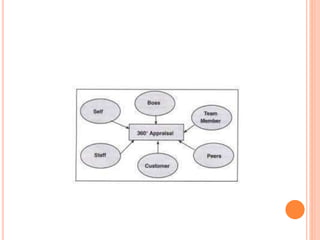
 360 degree feedback
 The 360 degree evaluation is understood as
systematic collection of performance data on an
individual or group, derived from a number of
stack holders.
 Enables an employee to compare his perception
about self with other’s perception.
 Provide formalized communication link between
an employee and his or her customers.
 effective in identifying and measuring
interpersonal skills, customer satisfaction, and team
building skills.
performance appraisal and its methods

performance appraisal and its methods

  • 1.
    Human Resource Management. Performanceappraisal and its methods. Submitted to : Prof. Priyanka Batra Submitted By : Hiran Patel (IB ) Roll no. 13
  • 2.
    WHAT IS PERFORMANCEAPPRAISAL?  It is concerned with behaviors that affects performance.  Assessment of an individual’s performance in a systematic way.
  • 3.
    WHAT IS PERFORMANCEAPPRAISAL CONTI…  “Performance appraisal is a systematic appraisal of the employee’s personality traits and performance on the job and is designed to determine his contribution and relative worth to the firm” -Shubin
  • 4.
    FACTORS TO BECONSIDERED FOR PERFORMANCE APPRAISAL  Job knowledge  Quality and quantity of an output  Leadership abilities  Dependability  Co-operation
  • 5.
    CHARACTERISTICS  Arranged periodicallyaccording to definite plan.  Continuous process.  Basic purpose is to find out the output given by employee.  Systematic description of an employee’s job relevant strength and weaknesses.
  • 6.
    NEED OF PERFORMANCEAPPRAISAL  To assess the training and development needs of an employee.  To effect promotions based on competence and performance.  To confirm the services of probationary employees upon their completing the probationary period satisfactorily.  To determine whether HR programmes are effective or not.
  • 7.
  • 8.
    DESIGN APPRAISAL PROGRAMME Formal vs informal  Whose performance is to be assessed?  Who are the raters?  What problems are encountered?  How to solve the problems?  What should be evaluated?  When to evaluate?  What methods of appraisal are to be used?
  • 9.
    METHODS  Approaches toappraisal can be classified in to two categories: (i) Past oriented methods (ii) future oriented methods
  • 10.
    PAST ORIENTED METHODS Rating scale  Check list  Forced distribution method  Forced choice method  Critical incidents method  Behaviorally anchored rating scaled  Field review method  Performance tests and observations
  • 11.
     Rating scales: simplest and most popular technique.  it consists of several numerical scale represents a job related performance criterion such as dependability, output, attendence, attitude, co-operation.  Each scale ranges from excellent to poor.
  • 13.
     Checklist  achecklist of statements on the traits of the employee and his or her job is prepared in two columns- ‘yes’ column and ‘no’ column.  the evaluation is done by HR department.  The HR dept. assigns some points to the number of ‘yes’ and ‘no’ as well.  On the basis of this final evaulation takes place.
  • 15.
     Forced distributionmethod  To measure performance appraisal for large number of employees is difficult.  To overcome this error the method helps the rater to distribute the rates on all points on the rating scale.  The method operates under assumption that employee performance level conforms to a normal statistical distribution.
  • 17.
     Forced choicemethod  The rater is forced to select the statements which are readymade.  typical statements can be Learns fast - - - - - - - - - - - - works hard work is reliable - - - - - - - - - performance is a good example for.
  • 18.
     Critical incidentsmethod  The approach focuses on certain critical behavior of an employee that make all the differences between effective and non-effective performance of a job.  such incidents are recorded by the superiors as and when they occur.
  • 19.
     Behaviorally anchoredrating scales (BARS)  here, the rater is expected to indicate which behavior on each scale best describe an employee’s performance.  Descriptive statements varying from the least to the most effective.
  • 21.
     Field reviewmethod  Appraisal by someone outside the department usually from the corporate office or HR department.  Used for making promotional decisions at managerial level.
  • 22.
     Performance testsand observations  In the case of limited no. of jobs, employee assessment done by knowledge or skills.  Test may be of paper and pencil or demonstration of skills.
  • 23.
    FUTURE ORIENTED METHODS Management by objectives  Psychological appraisal  360 degree feedback
  • 24.
     Management byobjectives  Concept given by Peter F. Drucker .  MBO is not applicable to all jobs in an organization. For example assembly line work. those workers has so little job flexibility that the performance standards and objectives are already determined.  MBO is useful with managerial personnel and employees who have a wide range of flexibility and self control in their jobs.
  • 25.
     Psychological appraisals Full time psychologists are employ in large organizations. They assess employee’s future potential and not the past performance.  It normally consists of interviews, psychological tests, discussions with supervisors and a review of other evaluations.  After that psychologists write an evaluation of the employee’s intellectual, emotional, motivational and other related characteristics that suggests individual performance and predict future performance.
  • 26.
     the evaluationdone for the specific job opening for which the employee has been considered.  As this approach is slow and also costly it used only for bright employees.
  • 27.
     360 degreefeedback  The 360 degree evaluation is understood as systematic collection of performance data on an individual or group, derived from a number of stack holders.
  • 29.
     Enables anemployee to compare his perception about self with other’s perception.  Provide formalized communication link between an employee and his or her customers.  effective in identifying and measuring interpersonal skills, customer satisfaction, and team building skills.