CONTENTS


What is performance appraisal and the uses or
benefits of performance appraisal.



The various techniques of performance appraisal.



The limitations of performance appraisal.

2




(1) According to Edwin Flippo, "Performance
Appraisal is the systematic, periodic and impartial
rating of an employee's excellence, in matters
pertaining to his present job and his potential for a
better job."
(2) According to Dale Beach, "Performance
Appraisal is the systematic evaluation of the
individual with regards to his or her performance
on the job and his potential for development."

3
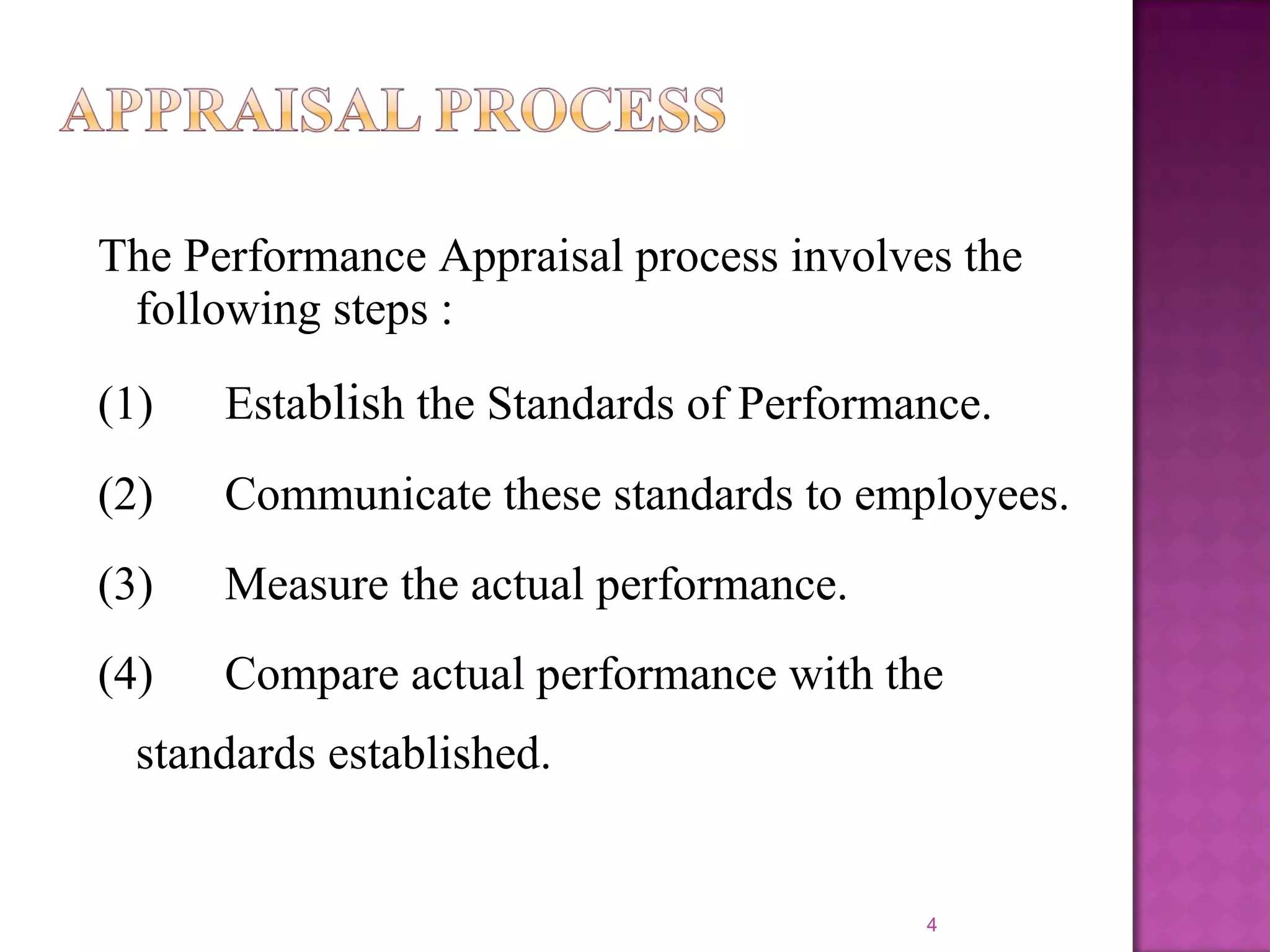
The Performance Appraisal process involves the
following steps :
(1)

Establish the Standards of Performance.

(2)

Communicate these standards to employees.

(3)

Measure the actual performance.

(4)

Compare actual performance with the

standards established.

4
(5)

In case of variation, initiate corrective action.

(6)

Communicate the rating to the employee.

(7)

Discuss the feedback with the employee.

(8)

Conduct post-appraisal Interview.

(9)

Initiate corrective action if required.

5
The main purposes of employee assessment are as
follows :
(1) Identify employees who are eligible for
salary increase.
(2) Generate data to take personnel decisions
such as promotion, transfer and lay-off or
termination decision.
(3) Determine the training and development
needs of the employees.

6
(4) Validate the selection process.
(5) To measure whether standards laid down has
been achieved by the employees or not.
(6) Estimate the future requirement of work force.
(7) Helps to recognize potential of promising
employees.
(8) Last but not the least, performance appraisal
also helps in motivating employees by providing
feed back about their level of performance.

7
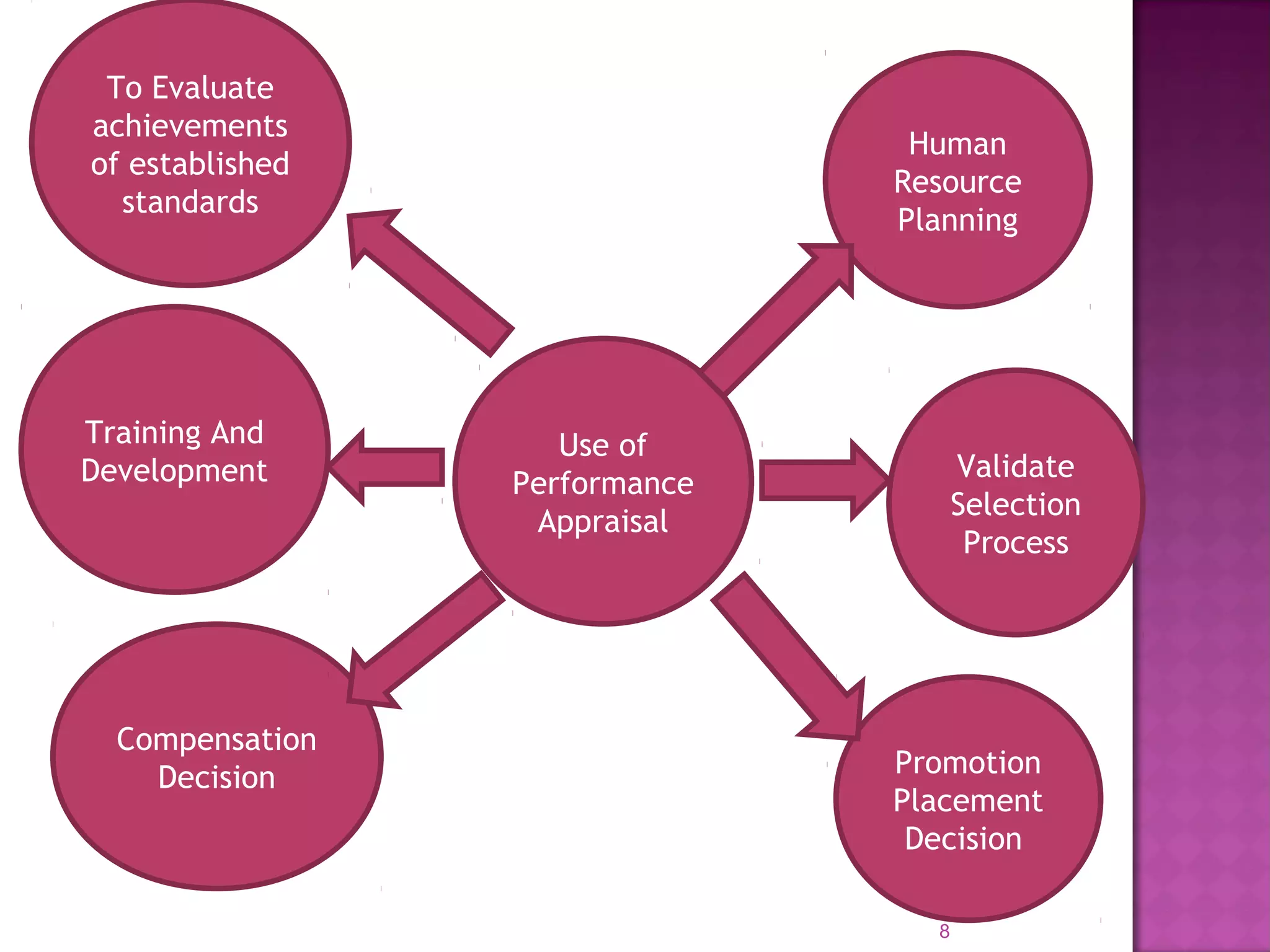
To Evaluate
achievements
of established
standards

Training And
Development

Compensation
Decision

Human
Resource
Planning

Use of
Performance
Appraisal

Validate
Selection
Process

Promotion
Placement
Decision
8
(1) SWOT Analysis : Performance Appraisal
gives a complete idea of the employee's
strength, weaknesses and based on that their
opportunities and threats.
(2) Career Planning : On the basis of one's
own SWOT analysis, an employee can have his
career plans.
(3) Suitable Placement : Performance
appraisal enables a company to give suitable
placement to an employee based on their talents
and skills.
9
(4) Self-Development : Performance Appraisal is
very much a positive activity which enables an
employee to know his own weaknesses and also
enables him to remove their weaknesses and lead
to self-development.
(5) Effective Training Programme : Training
programmes can be drawn out on the basis of the
needs of employees to remove their weaknesses.
(6) Sound Personnel Policies : Personnel
policies for promotions, transfer must be sound
and objective. Performance Appraisal provides
valuable information and reliable data for such
decisions.
10
(7) Employee – Employer Relations will be
healthy if performance Appraisal information will
be used for personnel management. This will
minimize grievances and improve confidence in
the management.
(8) Higher Employee Productivity : Employee
morale will be high because there can be a system
of rewards for employees with higher
performance. This will improve organization
productivity.
(9) Performance Appraisal will help in potential
human resource planning.
11






Personal Bias : The biggest limitation of
performance Appraisal is subjectivity. Due to
human element in Appraisal, there is always a
fear of one's own opinion coming in the way of
Appraisal.
(2) Halo Effect : The tendency of an individual
to rate an employee consistently high due to
some earlier good performance rather than his
existing performance is called as carrying a halo
around oneself.
(3) Horn Effect : The tendency of a superior to
rate a subordinate lower than his performance
justifies due to some recent/earlier failures.
12
(4) Lack of Uniform Standards : The standards
used by different departments in the organization
may not be the same, hence, rating becomes
unscientific and employees suffer. Some rates are
too liberal while others are too strict causing lack
of uniformity.
(5) Appropriate
Appraisal
Technique
:
Selection of appropriate appraisal technique is
important to give the correct result. Some of the
techniques are time-consuming and costly and so
avoided. If wrong techniques are applied
performance appraisal results may prove defective.
(6) Wrong Appraisal by Superior : Superiors
have continuous and daily relations with the
subordinates, giving accurate ratings may lead to
spoiling relations with them which the superiors
may want to avoid, hence higher rating to the
subordinates.
13
(7) Stress on Individual and not on
Performance : Performance Appraisal must lay
stress on the performance of the individual and not
on his individual and not on his personal
characteristics. Many a times this is overlooked
and the personnel characteristics comes in the way
of his performance appraisal.
(8) Central Tendency : Many a times to be on
the safer side the rater would put the rate on
average scores. This happens because of 2 reasons
— first of all if the rater does not want low scores
to the ratee. Secondly, if he himself is not
competent and would not like to show his
incompetency.

14
(9) Lack of Importance to Self-Development :
Performance Appraisal is not for witch hunting but
for finding out strengths as well as weaknesses.
The strengths can be consolidated upon and the
weaknesses too be removed through appropriate
training. However, this aspect is not given
importance and so the main objective of
performance appraisal is neglected.
(10) Lack of Communication and Participation
with Employees : Performance appraisal is not
complete without communicating to the employee
the results of the appraisal and also give him a
chance to give his opinion, otherwise it is a onesided affair without participation of employee and
will not lead to their development.
15
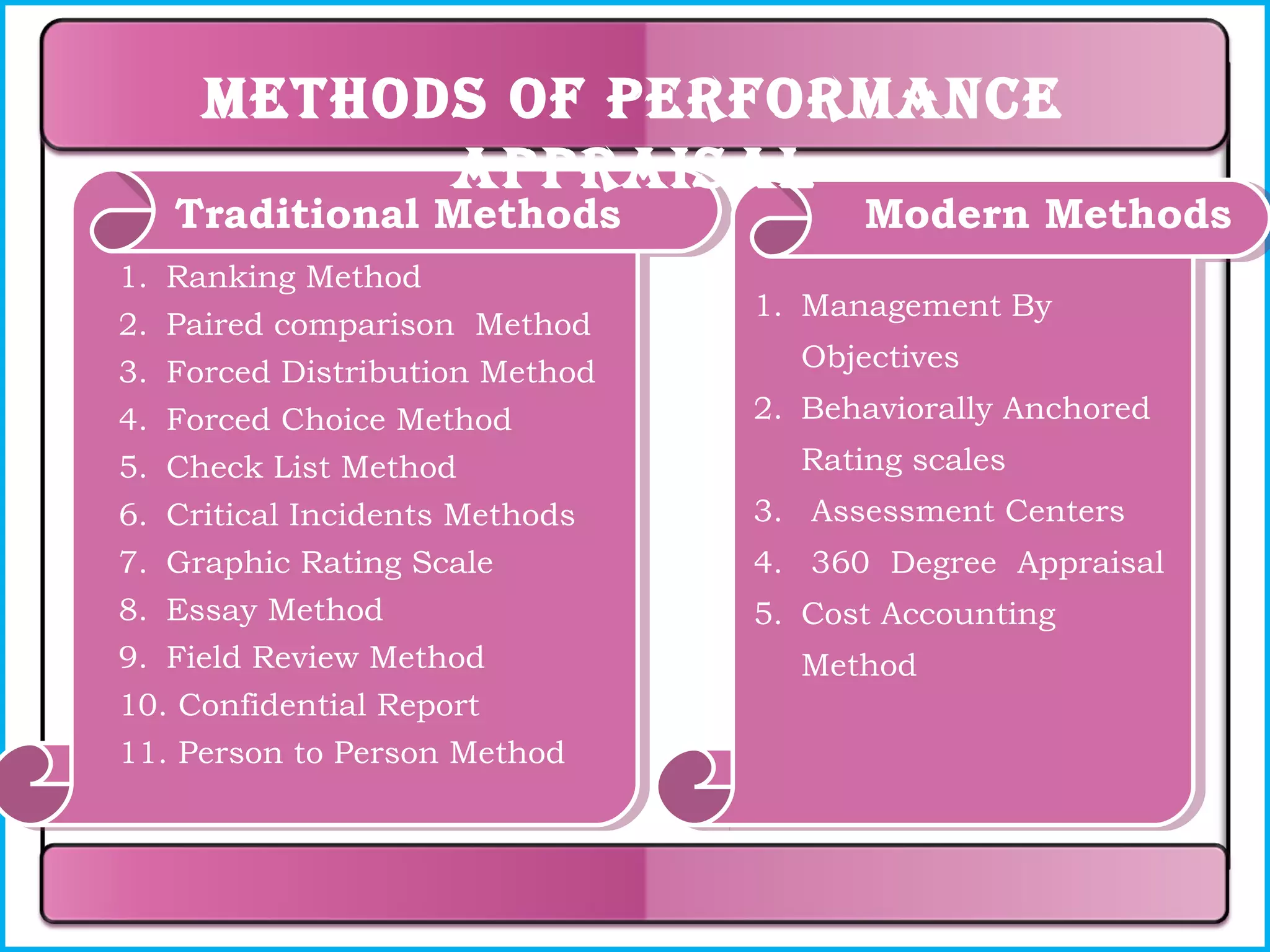
Methods of PerforMance
aPPraisal

Traditional Methods
1. Ranking Method
2. Paired comparison Method
3. Forced Distribution Method
4. Forced Choice Method
5. Check List Method
6. Critical Incidents Methods
7. Graphic Rating Scale
8. Essay Method
9. Field Review Method
10. Confidential Report
11. Person to Person Method

Modern Methods

1. Management By
Objectives
2. Behaviorally Anchored
Rating scales
3. Assessment Centers
4. 360 Degree Appraisal
5. Cost Accounting
Method
(1) Traditional Methods :
These methods lay more emphasis on rating of
individuals' personality traits, such as initiative,
dependability,
drive,
creativity,
integrity,
intelligence, leadership potential, etc. In the
following pages each method has been described
in brief.
(a) Ranking Method :
It is the oldest and simplest method of performance
appraisal. In this method the employee is ranked
from the highest to the lowest or from best to the
worst. Thus, if there are ten employees the Best
employee is given the first rank and the worst
employee in the group is given the tenth rank.
17
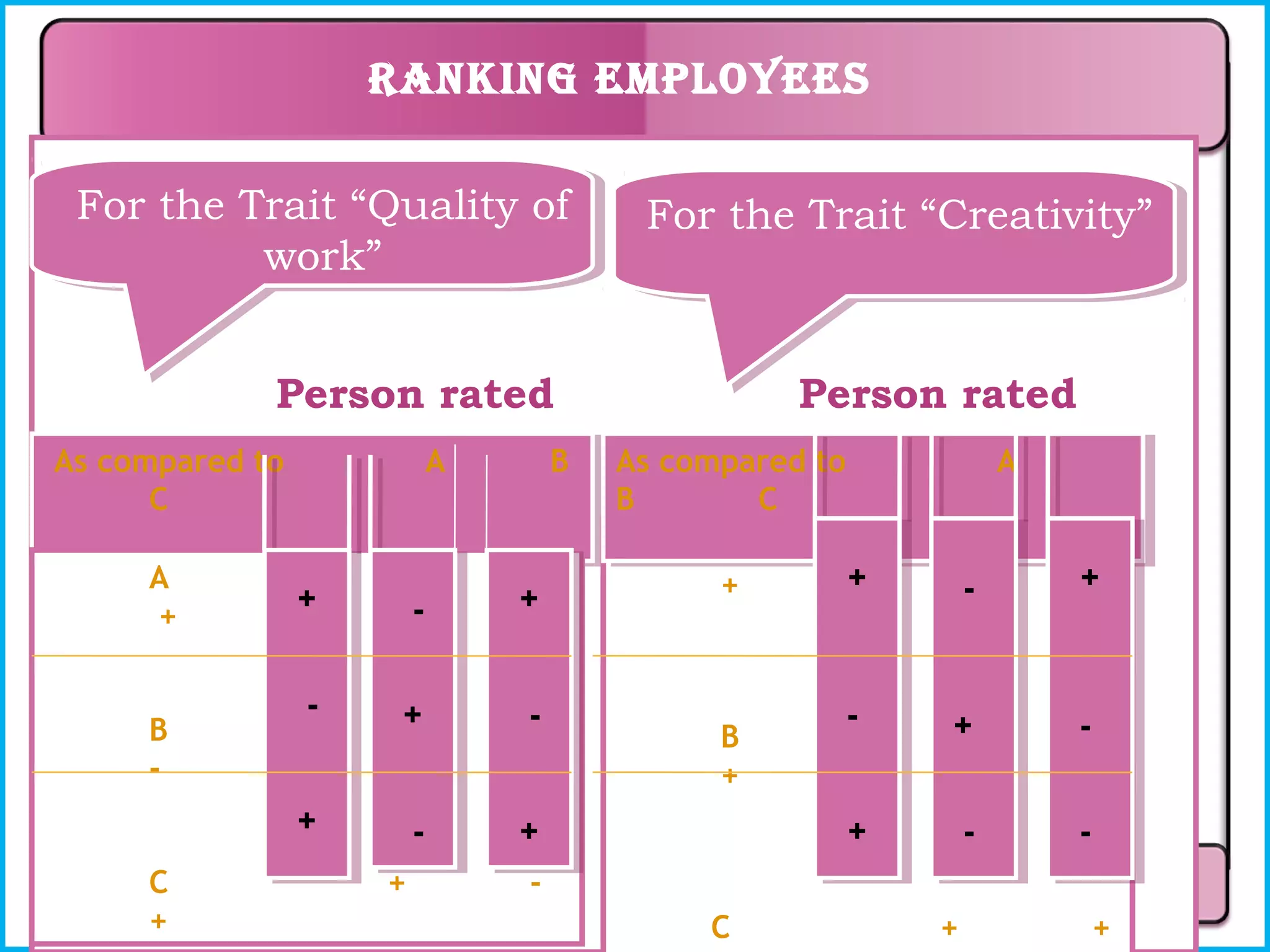
ranking eMPloyees
For the Trait “Quality of
work”

For the Trait “Creativity”

Person rated
As compared to
As compared to
C
C
A
+

A
A

+

+

-

C
+

-+

+

B
-

-

+

B
B

Person rated

-

As compared to
As compared to
B
C
B
C
A
+
+

+

+

A
A

+

-

+
+

-

+
+

--

+

B
+

-

-

-

C

+

+
(b) Paired Comparison Method :
In this method, each employee is compared with the
other on one-to-one basis. This method makes
judgment easier as compared to ranking method.
The number of times the employee is rated as
better in comparisons with others determines his or
her final ranking. The total number of comparison
can be ascertained by the following formula :
where N stands for number of employees to be
evaluated.
The concept can be illustrated with the help of the
following example.

19
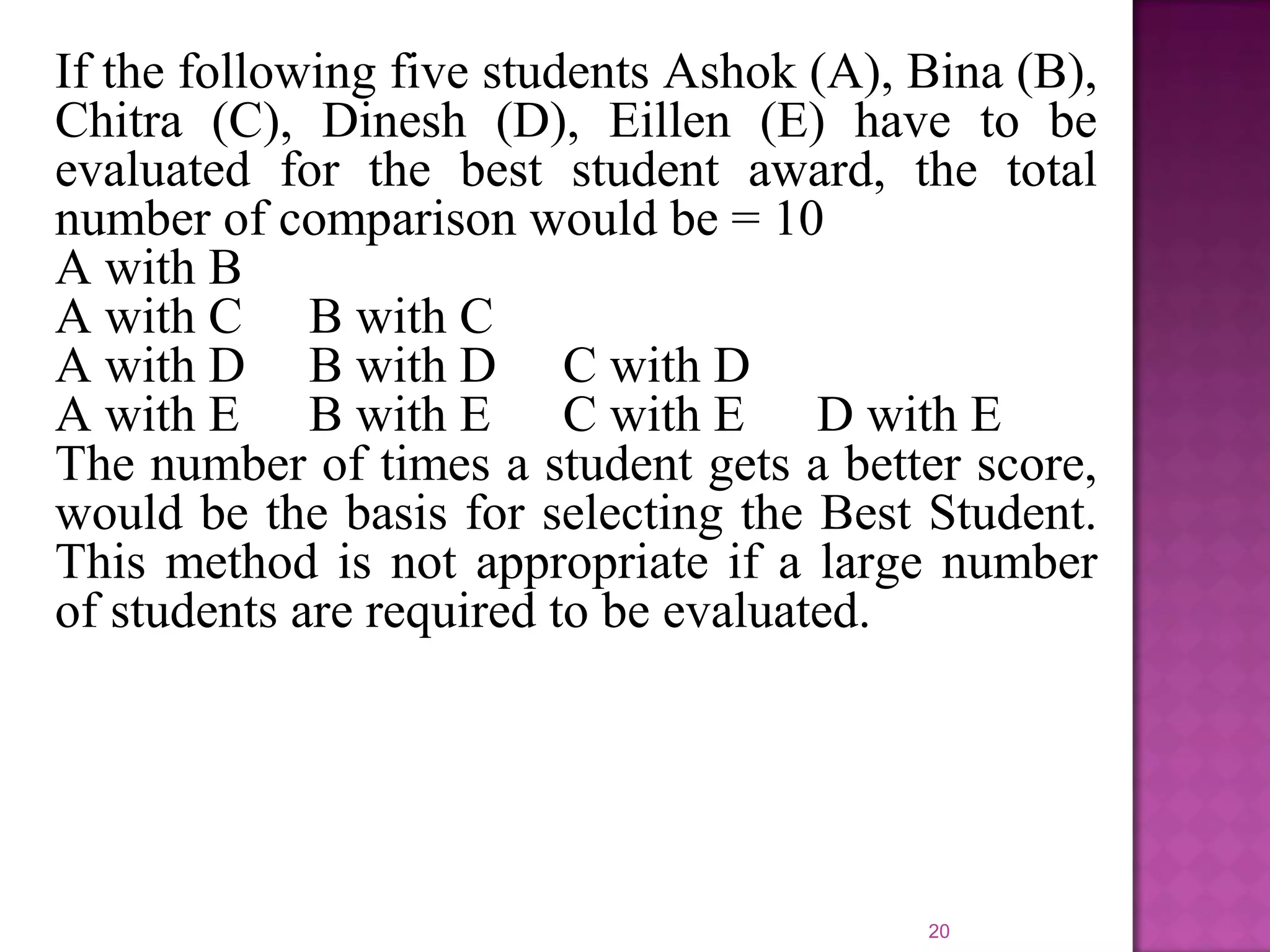
If the following five students Ashok (A), Bina (B),
Chitra (C), Dinesh (D), Eillen (E) have to be
evaluated for the best student award, the total
number of comparison would be = 10
A with B
A with C B with C
A with D B with D C with D
A with E B with E C with E D with E
The number of times a student gets a better score,
would be the basis for selecting the Best Student.
This method is not appropriate if a large number
of students are required to be evaluated.

20
(c)

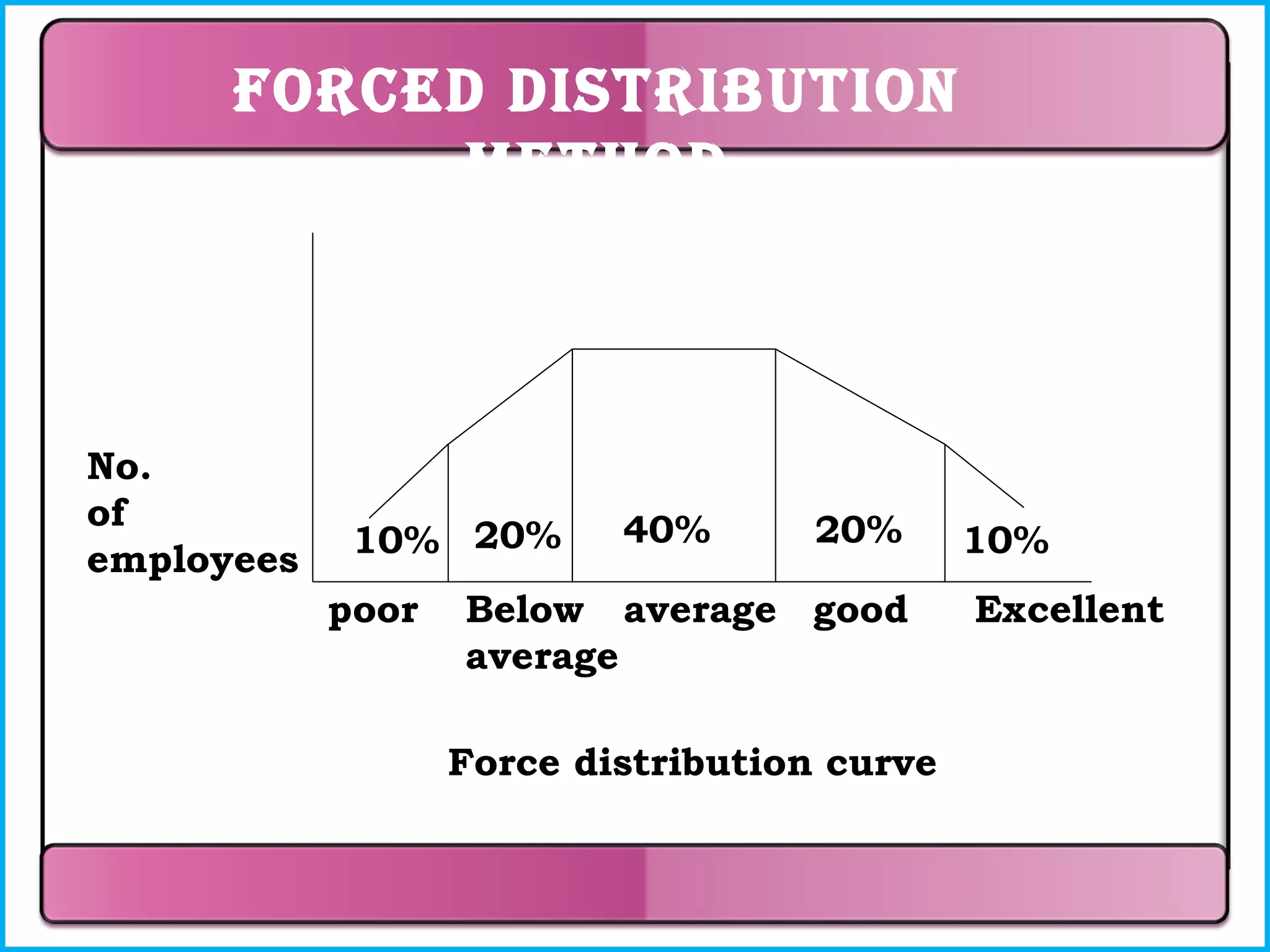
Forced Distribution Method :

This technique was contributed by Joseph Tiffin.
The method operates under the assumption that an
employee's performance can be plotted in a bellshaped curve. Here 10% of the employees are
given excellent grade, 20% are given good grade,
40% are given the average grade, next 20% are
given the below average grade and last 10% are
given unsatisfactory grade.

21
Forced distribution
method

No.
of
employees

10% 20%
poor

40%

20%

Below average good
average
Force distribution curve

10%
Excellent
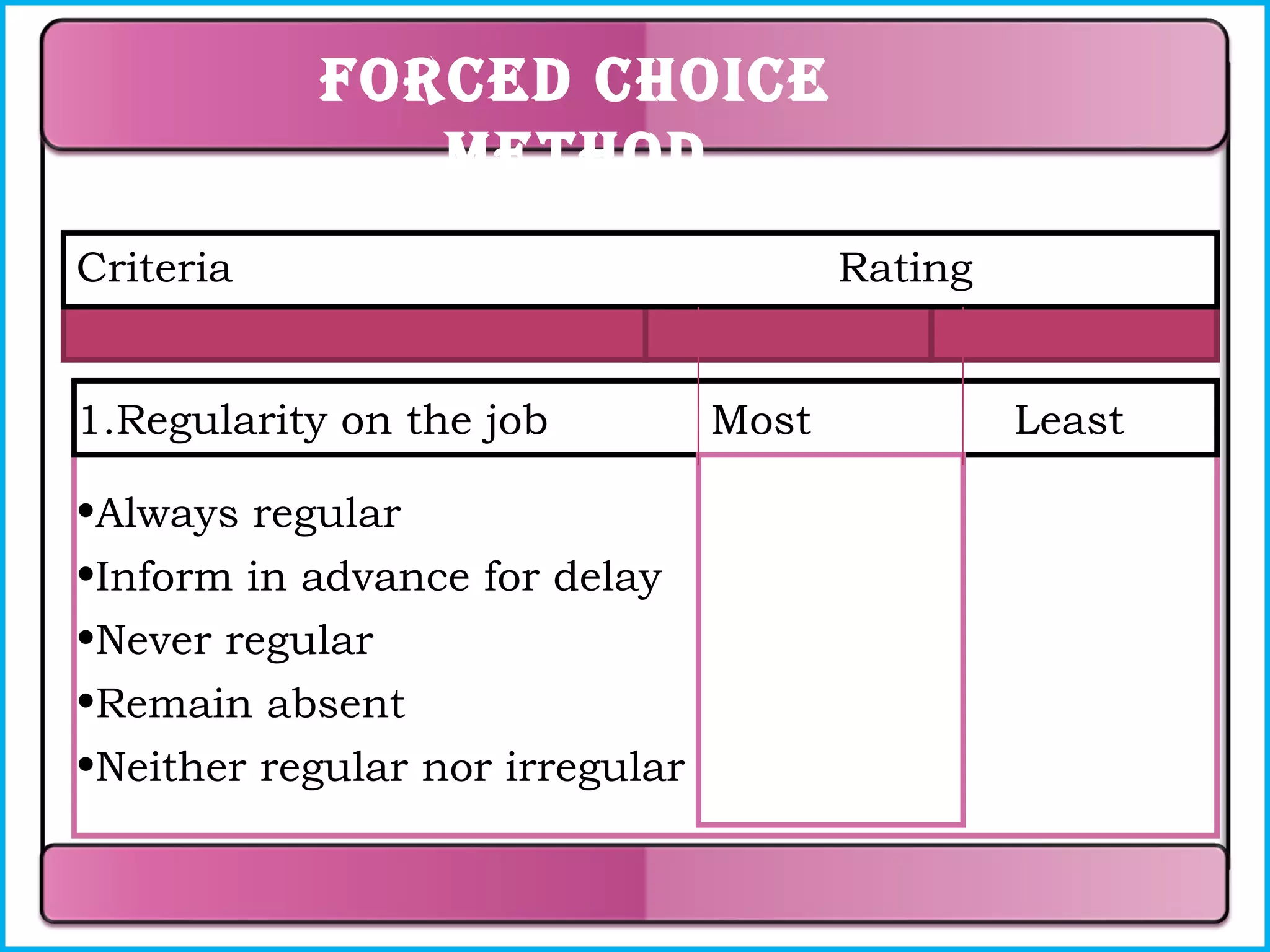
(d) Forced Choice Method :
This method was contributed by J.P. Guilford.
Here, an evaluator rates an employee on the basis
of a group of statements. These statements are a
combination of positive and negative statements
and are arranged in blocks of two or more. The
rater is required to identify the most or least
descriptive statement pertaining to an employee.
For example :
(1) Provides clear guidance to employees.
(2) Can be depended to complete the assignment
on hand.
(3) Is reliable and trustworthy.
(4) Is partial to some employees
23
Forced choice
method
Criteria
1.Regularity on the job
•Always regular
•Inform in advance for delay
•Never regular
•Remain absent
•Neither regular nor irregular

Rating
Most

Least
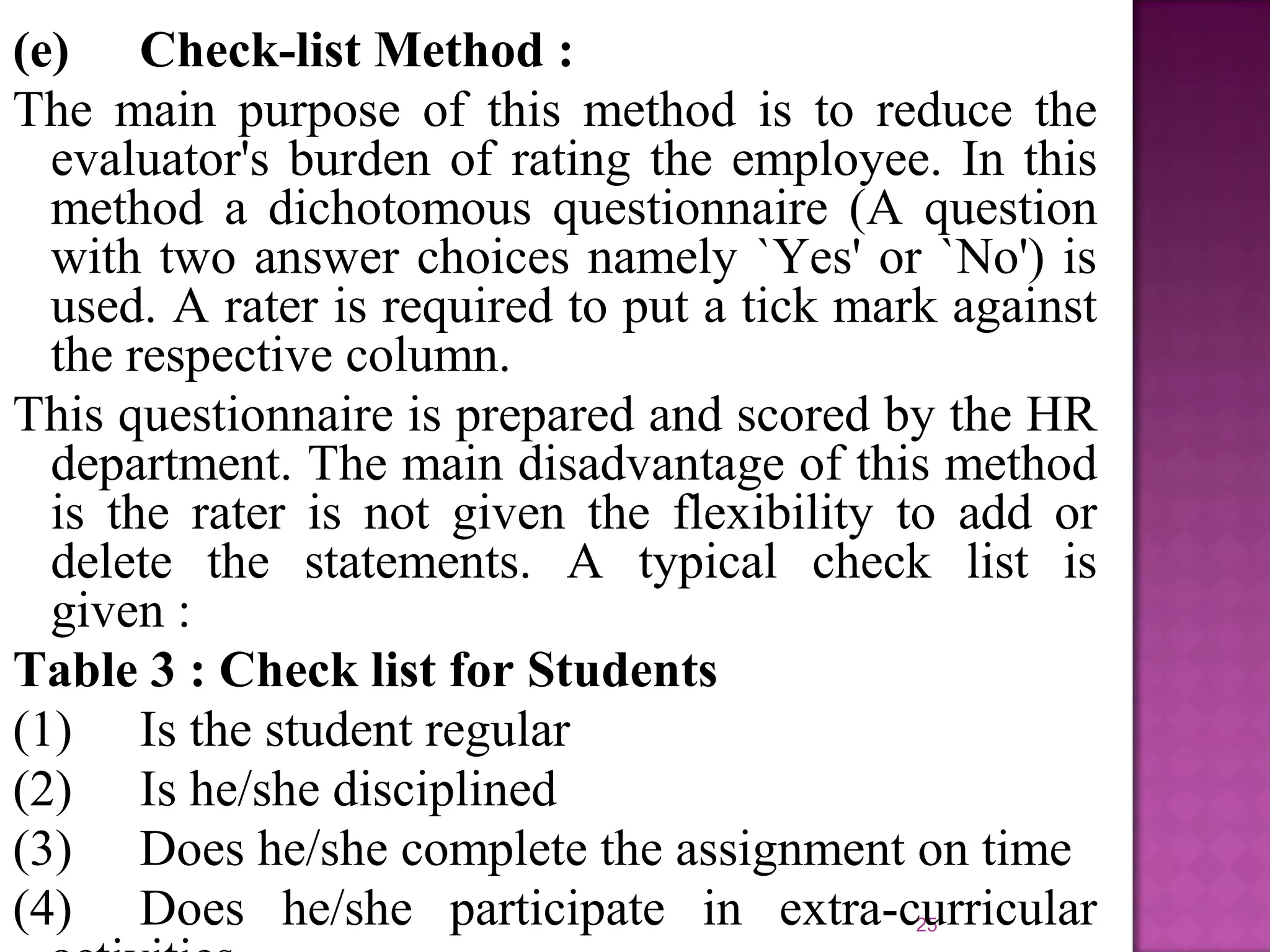
(e) Check-list Method :
The main purpose of this method is to reduce the
evaluator's burden of rating the employee. In this
method a dichotomous questionnaire (A question
with two answer choices namely `Yes' or `No') is
used. A rater is required to put a tick mark against
the respective column.
This questionnaire is prepared and scored by the HR
department. The main disadvantage of this method
is the rater is not given the flexibility to add or
delete the statements. A typical check list is
given :
Table 3 : Check list for Students
(1) Is the student regular
(2) Is he/she disciplined
(3) Does he/she complete the assignment on time
(4) Does he/she participate in extra-curricular
25
(f)

Critical Incident Method :

This method evaluates an employee on the basis of
certain `events' or `episodes' known as critical
incident. The underlying principle of this method is
"there are certain significant acts in each
employee's behavior and performance, which can
make all the difference between success and failure
on the job." Thus, in this method the rater focuses
his attention on all those factors, that can make a
difference between performing a job in a
noteworthy manner.

26
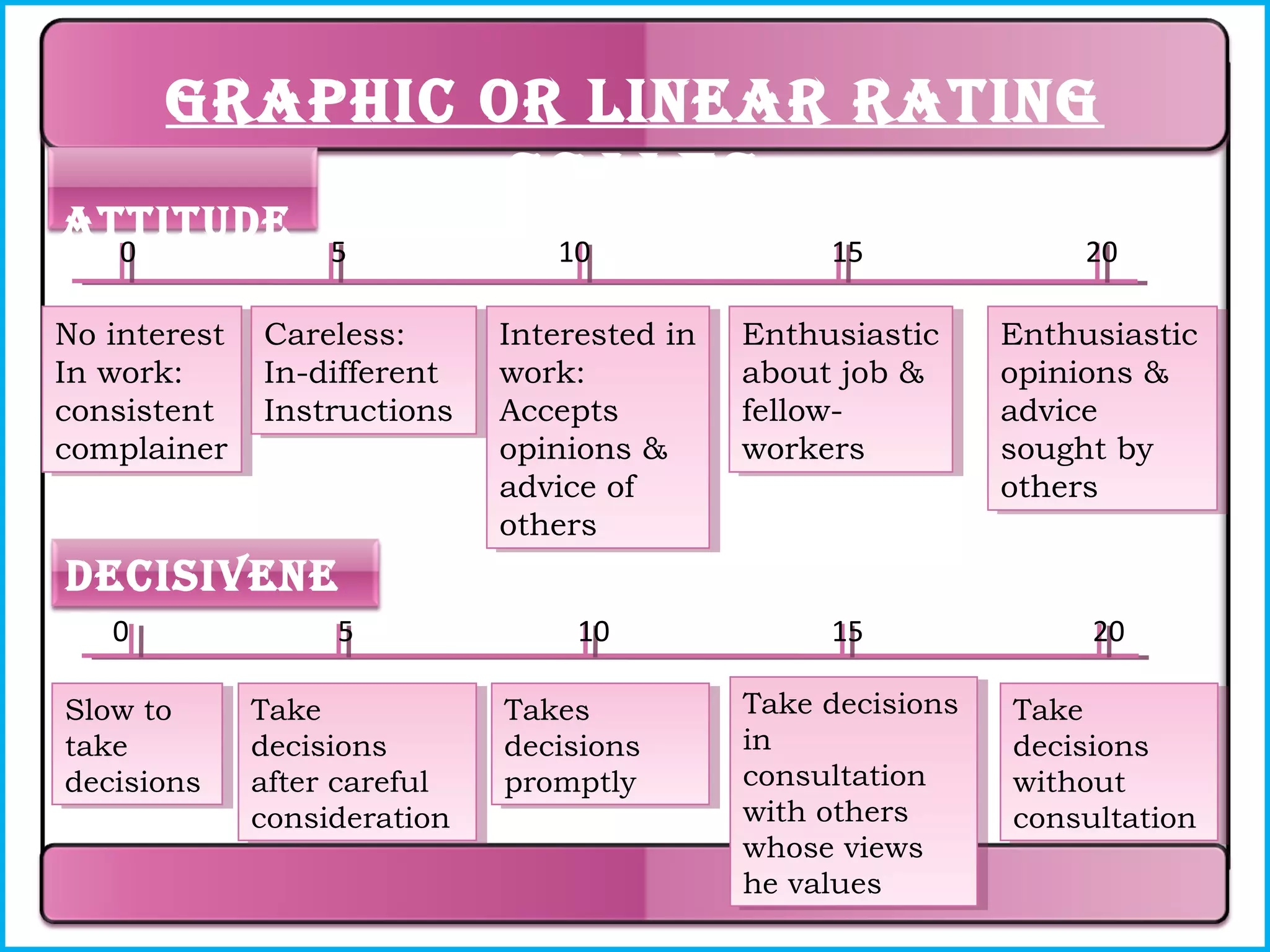
Graphic or Linear ratinG
scaLes

attitude
0

5

No interest Careless:
In work:
In-different
In work:
In-different
consistent
consistent Instructions
Instructions
complainer
complainer

decisivene
5
ss0
Slow to
Slow to
take
take
decisions
decisions

Take
Take
decisions
decisions
after careful
after careful
consideration
consideration

10

15

20

Interested in
Interested in
work:
work:
Accepts
Accepts
opinions &
opinions &
advice of
advice of
others
others

Enthusiastic
Enthusiastic
about job &
about job &
fellowfellowworkers
workers

Enthusiastic
Enthusiastic
opinions &
opinions &
advice
advice
sought by
sought by
others
others

10

15

20

Take decisions
Take decisions
in
in
consultation
consultation
with others
with others
whose views
whose views
he values
he values

Take
Take
decisions
decisions
without
without
consultation
consultation

Takes
Takes
decisions
decisions
promptly
promptly
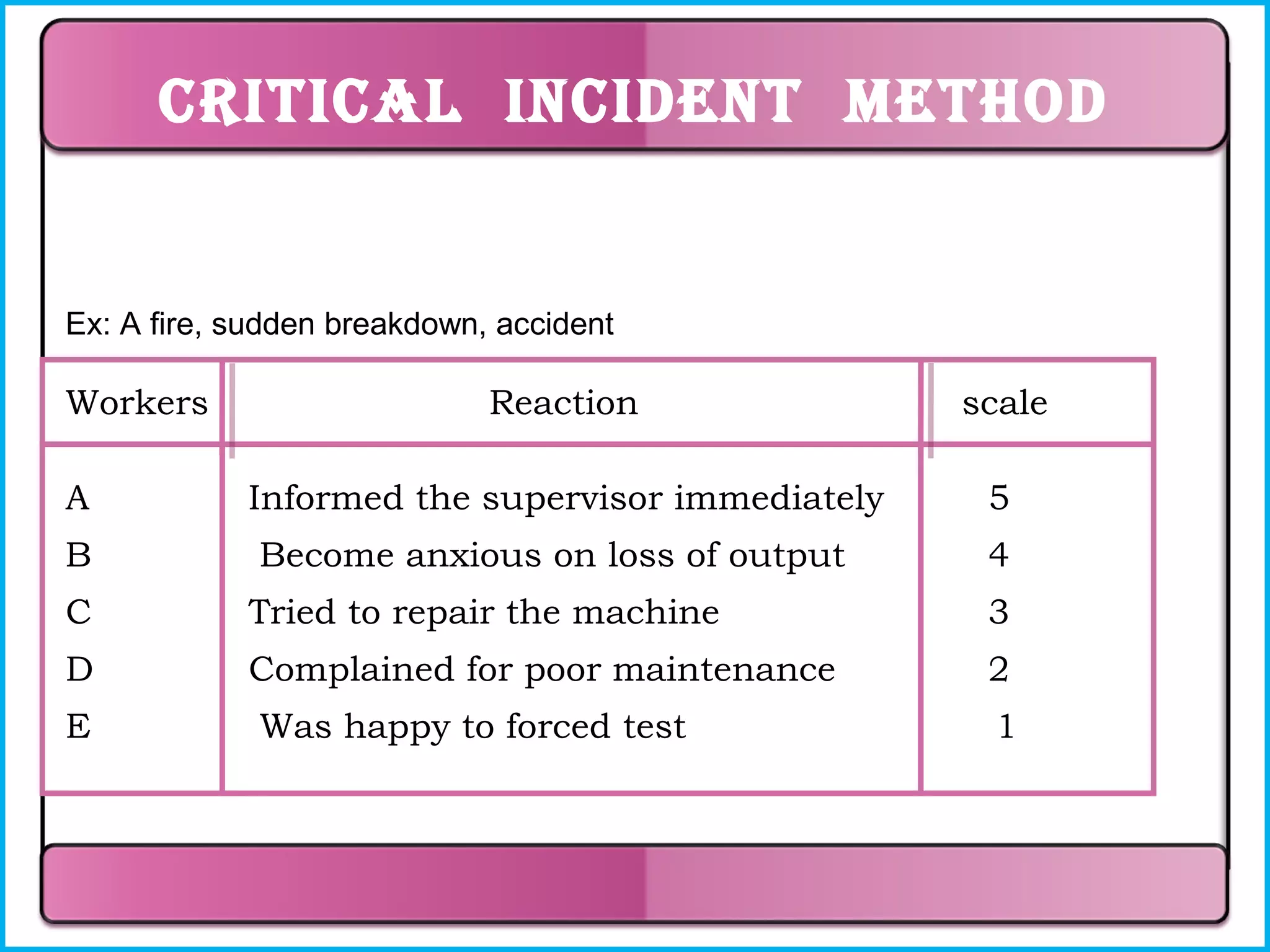
criticaL incident method

Ex: A fire, sudden breakdown, accident

Workers
A
B

Reaction

scale

Informed the supervisor immediately

5

Become anxious on loss of output

4

C

Tried to repair the machine

3

D

Complained for poor maintenance

2

E

Was happy to forced test

1
(h) Essay Method :
In this method, the rater writes a narrative description of
an employees strengths, weaknesses, past performance,
potential and suggestions for improvement. As there is
no prescribed format, the length and content of essay is
likely to vary. Similarly, the quality of Essay would
depend upon the rater's writing skills. As the essays are
descriptive in nature, it only provides qualitative
information about the employee.
(i) Confidential Report :
This is a traditional method of evaluating an employee's
performance. It is normally used in Government
departments and small business units. Here, the
evaluation is done by the immediate boss or supervisor.
The main limitation of this method is the ratings are
generally not discussed with the ratee (only in case of
29
adverse remark).
(a) MBO (Management by Objectives or Joint
Target Setting)
This method was propounded by Alfred Sloans and
Donaldson Brown in 1920s. However, it was
further popularized by Peter Drucker in his book
"The Practice of Management" in 1954.
According to George S. Odiorne, MBO can be
described as "a process whereby the superior and
the immediate subordinate of an organization
jointly identify the common goals, define each
individual's major areas of responsibility in terms
of results expected of him and use these measures
as guides for operating the unit and assessing the
contribution of each of its members."
30


In this method emphasis is laid on stating
objectives for Key Result Areas (KRAs) in
Quantifiable terms. For example, in case of
Research and Development department, objective
is stated in the following terms. i.e. to design a new
product by 31st March, 2005.



MBO is used as a performance appraisal technique,
as it is easy to measure whether the stated
objectives have been achieved or not.

31
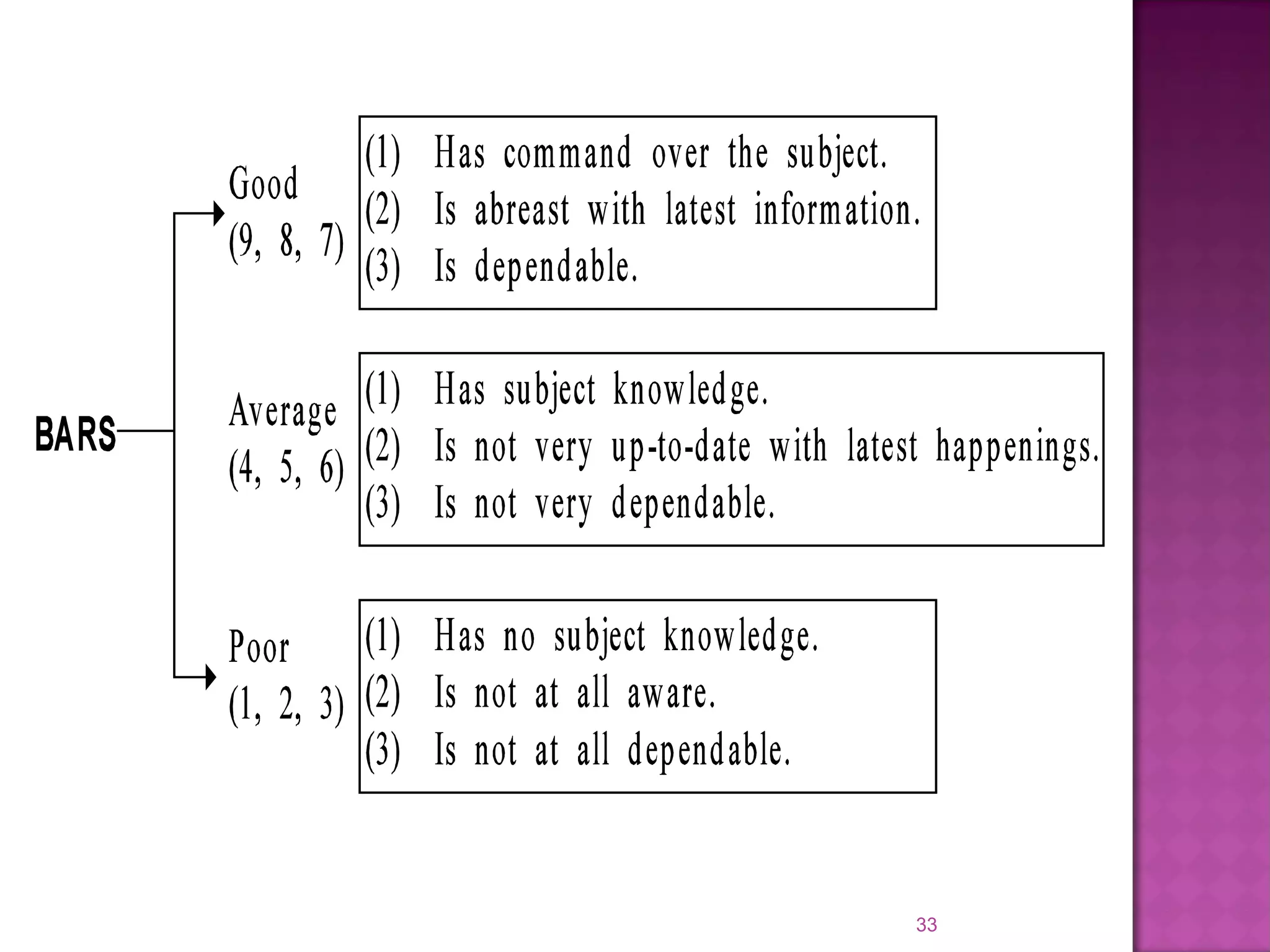
(b) BARS (Behaviorally Anchored Rating
Scale): In order to overcome the problem of
judgmental evaluation, this method was conceived
by some organizations. This method combines the
benefits of Essay Method, Critical Incident and
Rating scales .In this method the employee's
behavior and performance dimensions are
analyzed and used for evaluating the performance
of the employee. The HR department is involved
in the process of preparing the BARS. Based on
the Employee's performance and behavior,
employees are anchored in different slots of good,
average and poor. The rater is required to give
corresponding ratings to the employee.
32
33
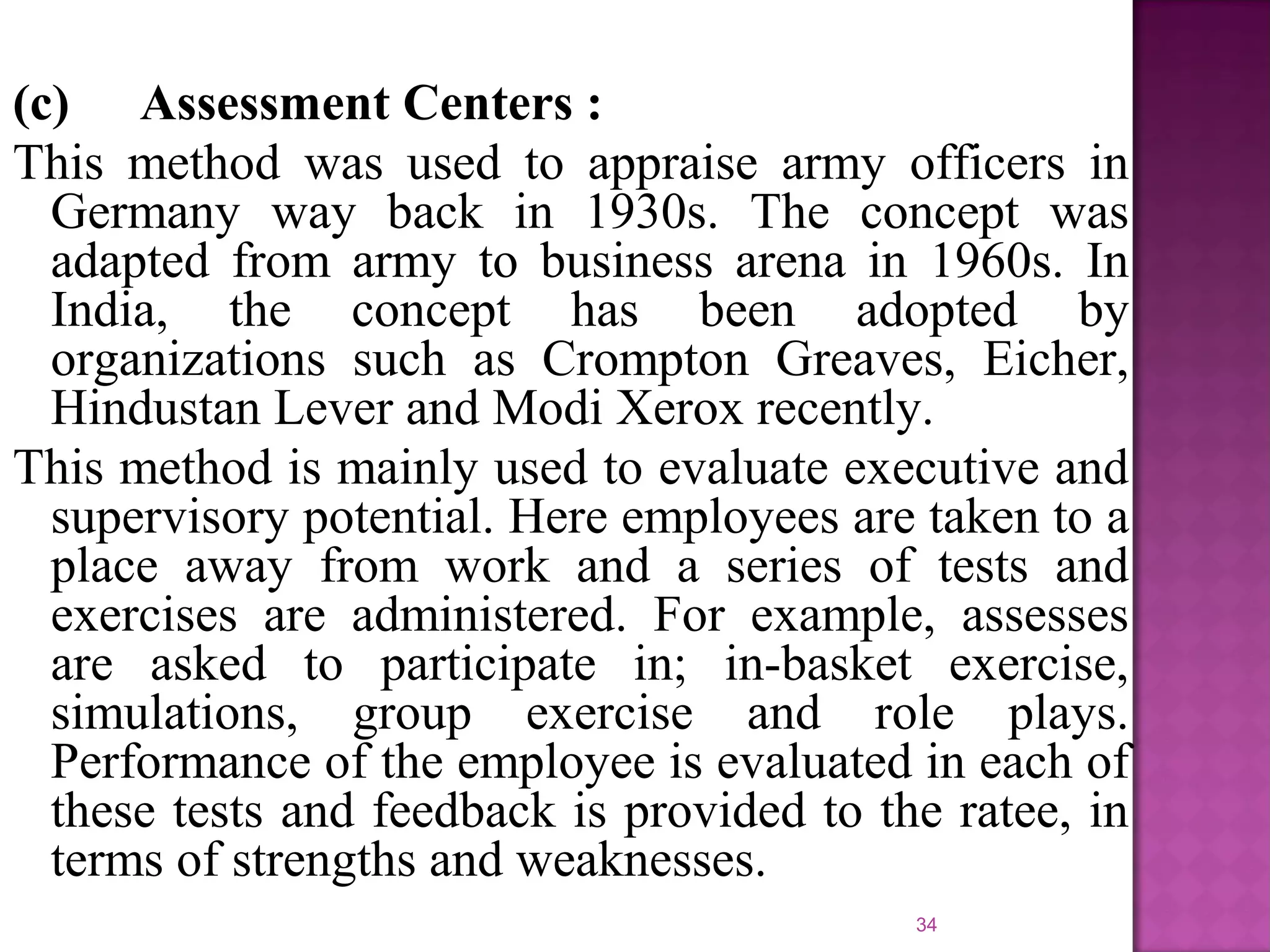
(c) Assessment Centers :
This method was used to appraise army officers in
Germany way back in 1930s. The concept was
adapted from army to business arena in 1960s. In
India, the concept has been adopted by
organizations such as Crompton Greaves, Eicher,
Hindustan Lever and Modi Xerox recently.
This method is mainly used to evaluate executive and
supervisory potential. Here employees are taken to a
place away from work and a series of tests and
exercises are administered. For example, assesses
are asked to participate in; in-basket exercise,
simulations, group exercise and role plays.
Performance of the employee is evaluated in each of
these tests and feedback is provided to the ratee, in
terms of strengths and weaknesses.
34
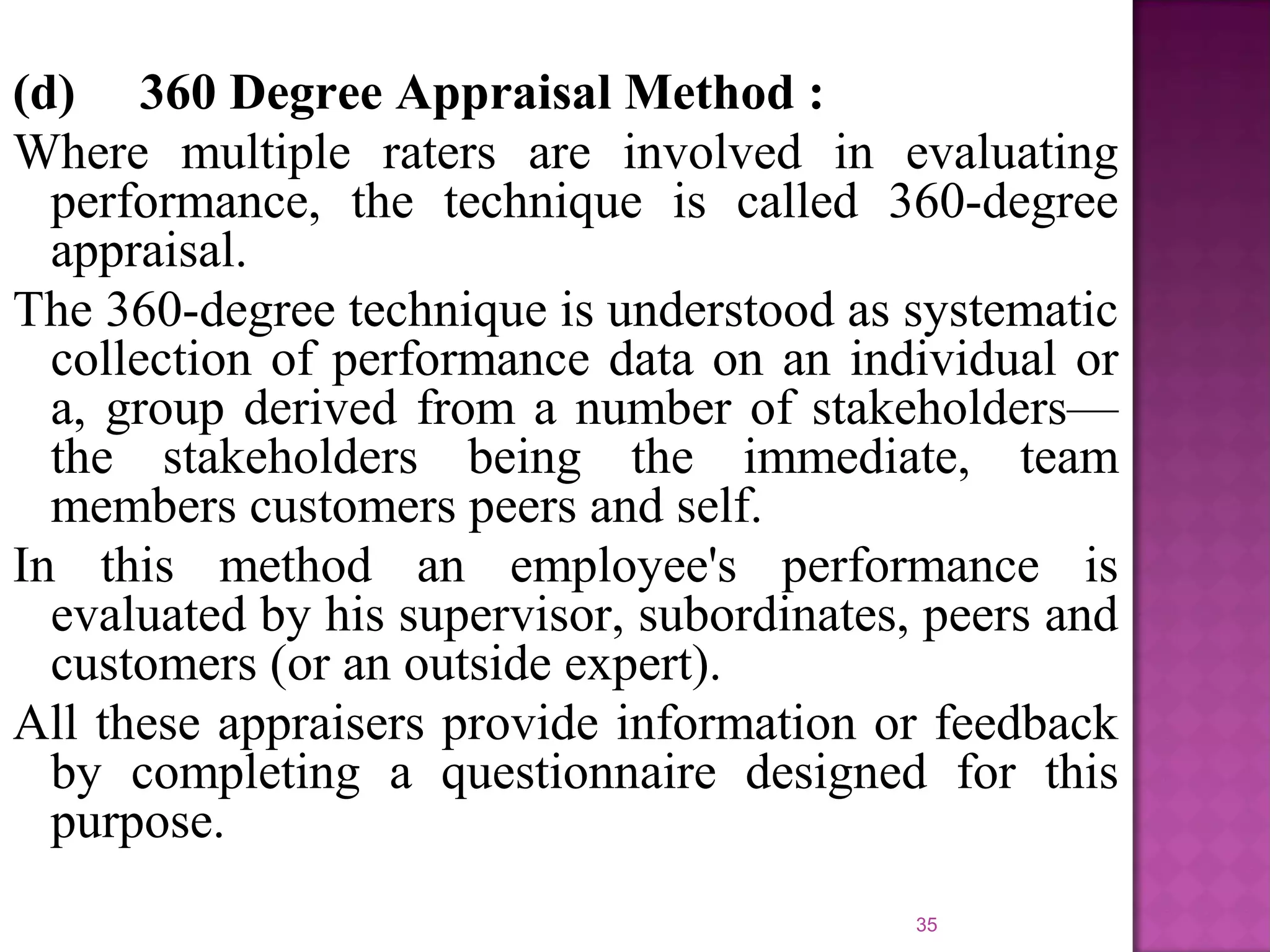
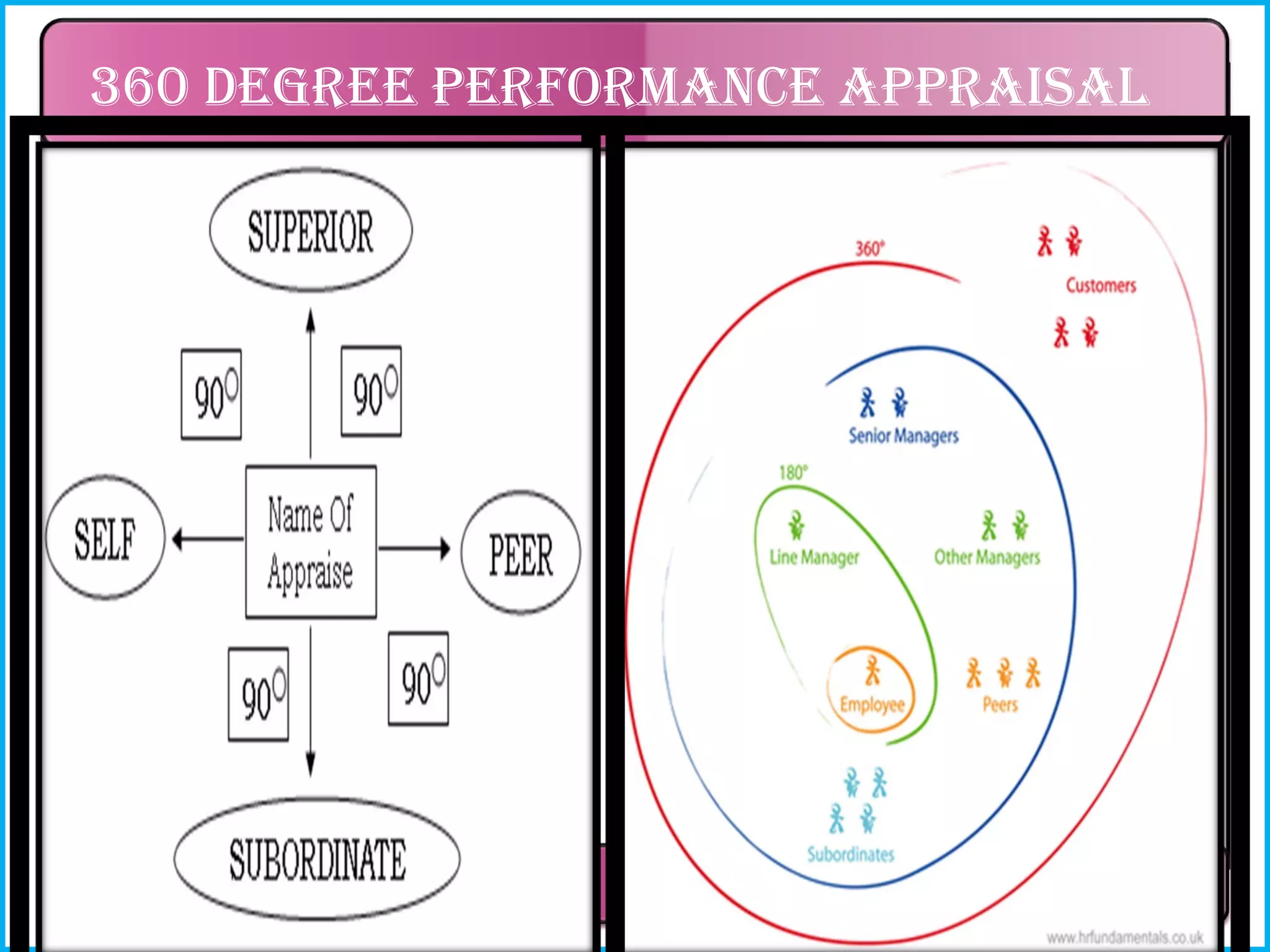
(d) 360 Degree Appraisal Method :
Where multiple raters are involved in evaluating
performance, the technique is called 360-degree
appraisal.
The 360-degree technique is understood as systematic
collection of performance data on an individual or
a, group derived from a number of stakeholders—
the stakeholders being the immediate, team
members customers peers and self.
In this method an employee's performance is
evaluated by his supervisor, subordinates, peers and
customers (or an outside expert).
All these appraisers provide information or feedback
by completing a questionnaire designed for this
purpose.
35
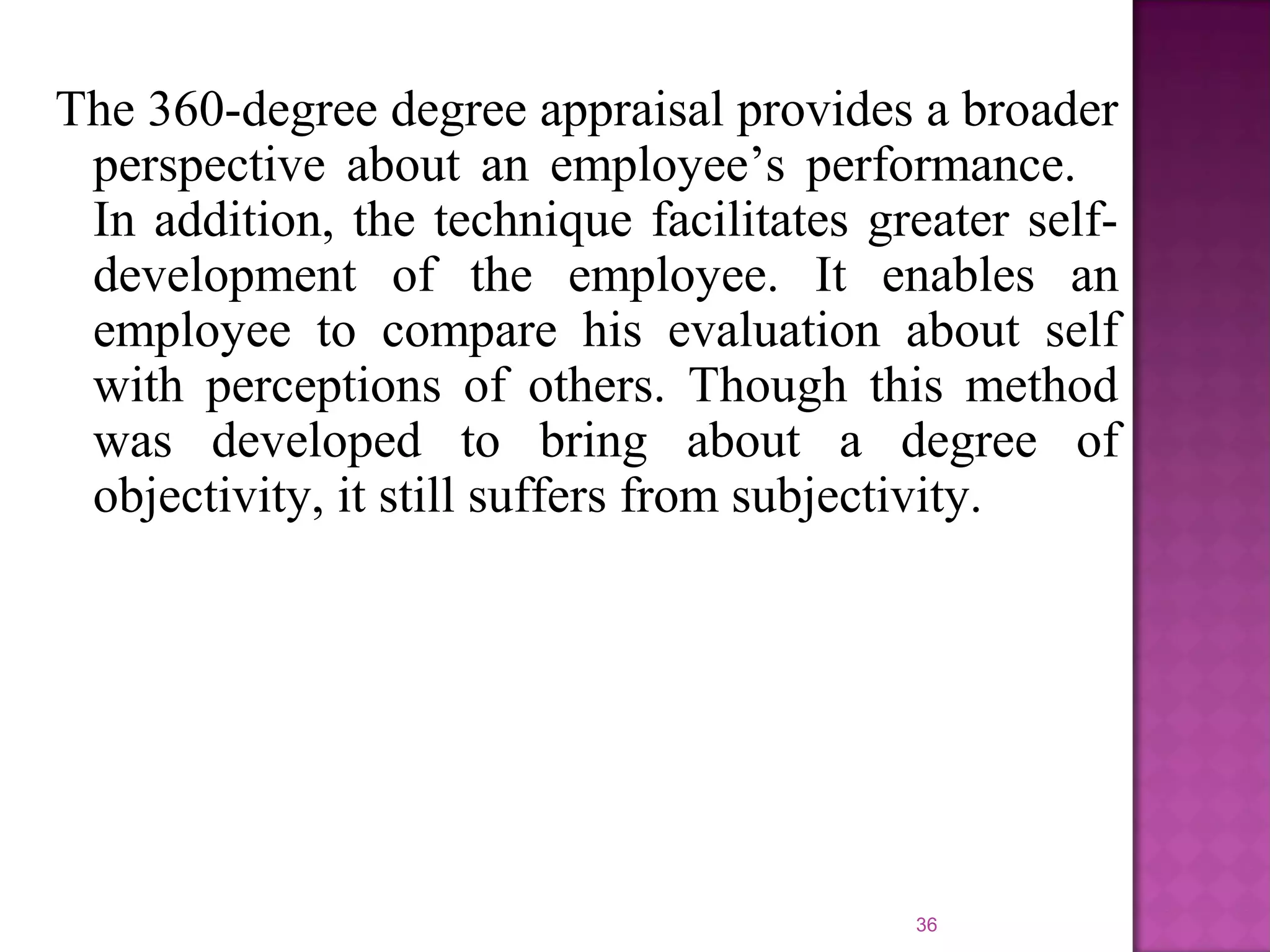
The 360-degree degree appraisal provides a broader
perspective about an employee’s performance.
In addition, the technique facilitates greater selfdevelopment of the employee. It enables an
employee to compare his evaluation about self
with perceptions of others. Though this method
was developed to bring about a degree of
objectivity, it still suffers from subjectivity.

36
360 degree performance appraisal
(e) Cost Accounting Method :
This method evaluates an employee's performance in
relation to the contribution of an employee in
monetary terms. Here the rater evaluates the
employee in terms of cost of retaining the
employee and the benefits the organization derives
from him/her. The following factors are taken into
account in this method :
(1) Cost of training the employee.
(2) Quality of product or service rendered.
(3) Accidents, damages, errors, spoilage,
wastages, etc.
(4) The time spent in appraising the employee.
38

Performance appraisal

  • 2.
    CONTENTS  What is performanceappraisal and the uses or benefits of performance appraisal.  The various techniques of performance appraisal.  The limitations of performance appraisal. 2
  • 3.
      (1) According toEdwin Flippo, "Performance Appraisal is the systematic, periodic and impartial rating of an employee's excellence, in matters pertaining to his present job and his potential for a better job." (2) According to Dale Beach, "Performance Appraisal is the systematic evaluation of the individual with regards to his or her performance on the job and his potential for development." 3
  • 4.
    The Performance Appraisalprocess involves the following steps : (1) Establish the Standards of Performance. (2) Communicate these standards to employees. (3) Measure the actual performance. (4) Compare actual performance with the standards established. 4
  • 5.
    (5) In case ofvariation, initiate corrective action. (6) Communicate the rating to the employee. (7) Discuss the feedback with the employee. (8) Conduct post-appraisal Interview. (9) Initiate corrective action if required. 5
  • 6.
    The main purposesof employee assessment are as follows : (1) Identify employees who are eligible for salary increase. (2) Generate data to take personnel decisions such as promotion, transfer and lay-off or termination decision. (3) Determine the training and development needs of the employees. 6
  • 7.
    (4) Validate theselection process. (5) To measure whether standards laid down has been achieved by the employees or not. (6) Estimate the future requirement of work force. (7) Helps to recognize potential of promising employees. (8) Last but not the least, performance appraisal also helps in motivating employees by providing feed back about their level of performance. 7
  • 8.
    To Evaluate achievements of established standards TrainingAnd Development Compensation Decision Human Resource Planning Use of Performance Appraisal Validate Selection Process Promotion Placement Decision 8
  • 9.
    (1) SWOT Analysis: Performance Appraisal gives a complete idea of the employee's strength, weaknesses and based on that their opportunities and threats. (2) Career Planning : On the basis of one's own SWOT analysis, an employee can have his career plans. (3) Suitable Placement : Performance appraisal enables a company to give suitable placement to an employee based on their talents and skills. 9
  • 10.
    (4) Self-Development :Performance Appraisal is very much a positive activity which enables an employee to know his own weaknesses and also enables him to remove their weaknesses and lead to self-development. (5) Effective Training Programme : Training programmes can be drawn out on the basis of the needs of employees to remove their weaknesses. (6) Sound Personnel Policies : Personnel policies for promotions, transfer must be sound and objective. Performance Appraisal provides valuable information and reliable data for such decisions. 10
  • 11.
    (7) Employee –Employer Relations will be healthy if performance Appraisal information will be used for personnel management. This will minimize grievances and improve confidence in the management. (8) Higher Employee Productivity : Employee morale will be high because there can be a system of rewards for employees with higher performance. This will improve organization productivity. (9) Performance Appraisal will help in potential human resource planning. 11
  • 12.
       Personal Bias :The biggest limitation of performance Appraisal is subjectivity. Due to human element in Appraisal, there is always a fear of one's own opinion coming in the way of Appraisal. (2) Halo Effect : The tendency of an individual to rate an employee consistently high due to some earlier good performance rather than his existing performance is called as carrying a halo around oneself. (3) Horn Effect : The tendency of a superior to rate a subordinate lower than his performance justifies due to some recent/earlier failures. 12
  • 13.
    (4) Lack ofUniform Standards : The standards used by different departments in the organization may not be the same, hence, rating becomes unscientific and employees suffer. Some rates are too liberal while others are too strict causing lack of uniformity. (5) Appropriate Appraisal Technique : Selection of appropriate appraisal technique is important to give the correct result. Some of the techniques are time-consuming and costly and so avoided. If wrong techniques are applied performance appraisal results may prove defective. (6) Wrong Appraisal by Superior : Superiors have continuous and daily relations with the subordinates, giving accurate ratings may lead to spoiling relations with them which the superiors may want to avoid, hence higher rating to the subordinates. 13
  • 14.
    (7) Stress onIndividual and not on Performance : Performance Appraisal must lay stress on the performance of the individual and not on his individual and not on his personal characteristics. Many a times this is overlooked and the personnel characteristics comes in the way of his performance appraisal. (8) Central Tendency : Many a times to be on the safer side the rater would put the rate on average scores. This happens because of 2 reasons — first of all if the rater does not want low scores to the ratee. Secondly, if he himself is not competent and would not like to show his incompetency. 14
  • 15.
    (9) Lack ofImportance to Self-Development : Performance Appraisal is not for witch hunting but for finding out strengths as well as weaknesses. The strengths can be consolidated upon and the weaknesses too be removed through appropriate training. However, this aspect is not given importance and so the main objective of performance appraisal is neglected. (10) Lack of Communication and Participation with Employees : Performance appraisal is not complete without communicating to the employee the results of the appraisal and also give him a chance to give his opinion, otherwise it is a onesided affair without participation of employee and will not lead to their development. 15
  • 16.
    Methods of PerforMance aPPraisal TraditionalMethods 1. Ranking Method 2. Paired comparison Method 3. Forced Distribution Method 4. Forced Choice Method 5. Check List Method 6. Critical Incidents Methods 7. Graphic Rating Scale 8. Essay Method 9. Field Review Method 10. Confidential Report 11. Person to Person Method Modern Methods 1. Management By Objectives 2. Behaviorally Anchored Rating scales 3. Assessment Centers 4. 360 Degree Appraisal 5. Cost Accounting Method
  • 17.
    (1) Traditional Methods: These methods lay more emphasis on rating of individuals' personality traits, such as initiative, dependability, drive, creativity, integrity, intelligence, leadership potential, etc. In the following pages each method has been described in brief. (a) Ranking Method : It is the oldest and simplest method of performance appraisal. In this method the employee is ranked from the highest to the lowest or from best to the worst. Thus, if there are ten employees the Best employee is given the first rank and the worst employee in the group is given the tenth rank. 17
  • 18.
    ranking eMPloyees For theTrait “Quality of work” For the Trait “Creativity” Person rated As compared to As compared to C C A + A A + + - C + -+ + B - - + B B Person rated - As compared to As compared to B C B C A + + + + A A + - + + - + + -- + B + - - - C + +
  • 19.
    (b) Paired ComparisonMethod : In this method, each employee is compared with the other on one-to-one basis. This method makes judgment easier as compared to ranking method. The number of times the employee is rated as better in comparisons with others determines his or her final ranking. The total number of comparison can be ascertained by the following formula : where N stands for number of employees to be evaluated. The concept can be illustrated with the help of the following example. 19
  • 20.
    If the followingfive students Ashok (A), Bina (B), Chitra (C), Dinesh (D), Eillen (E) have to be evaluated for the best student award, the total number of comparison would be = 10 A with B A with C B with C A with D B with D C with D A with E B with E C with E D with E The number of times a student gets a better score, would be the basis for selecting the Best Student. This method is not appropriate if a large number of students are required to be evaluated. 20
  • 21.
    (c) Forced Distribution Method: This technique was contributed by Joseph Tiffin. The method operates under the assumption that an employee's performance can be plotted in a bellshaped curve. Here 10% of the employees are given excellent grade, 20% are given good grade, 40% are given the average grade, next 20% are given the below average grade and last 10% are given unsatisfactory grade. 21
  • 22.
    Forced distribution method No. of employees 10% 20% poor 40% 20% Belowaverage good average Force distribution curve 10% Excellent
  • 23.
    (d) Forced ChoiceMethod : This method was contributed by J.P. Guilford. Here, an evaluator rates an employee on the basis of a group of statements. These statements are a combination of positive and negative statements and are arranged in blocks of two or more. The rater is required to identify the most or least descriptive statement pertaining to an employee. For example : (1) Provides clear guidance to employees. (2) Can be depended to complete the assignment on hand. (3) Is reliable and trustworthy. (4) Is partial to some employees 23
  • 24.
    Forced choice method Criteria 1.Regularity onthe job •Always regular •Inform in advance for delay •Never regular •Remain absent •Neither regular nor irregular Rating Most Least
  • 25.
    (e) Check-list Method: The main purpose of this method is to reduce the evaluator's burden of rating the employee. In this method a dichotomous questionnaire (A question with two answer choices namely `Yes' or `No') is used. A rater is required to put a tick mark against the respective column. This questionnaire is prepared and scored by the HR department. The main disadvantage of this method is the rater is not given the flexibility to add or delete the statements. A typical check list is given : Table 3 : Check list for Students (1) Is the student regular (2) Is he/she disciplined (3) Does he/she complete the assignment on time (4) Does he/she participate in extra-curricular 25
  • 26.
    (f) Critical Incident Method: This method evaluates an employee on the basis of certain `events' or `episodes' known as critical incident. The underlying principle of this method is "there are certain significant acts in each employee's behavior and performance, which can make all the difference between success and failure on the job." Thus, in this method the rater focuses his attention on all those factors, that can make a difference between performing a job in a noteworthy manner. 26
  • 27.
    Graphic or LinearratinG scaLes attitude 0 5 No interest Careless: No interest Careless: In work: In-different In work: In-different consistent consistent Instructions Instructions complainer complainer decisivene 5 ss0 Slow to Slow to take take decisions decisions Take Take decisions decisions after careful after careful consideration consideration 10 15 20 Interested in Interested in work: work: Accepts Accepts opinions & opinions & advice of advice of others others Enthusiastic Enthusiastic about job & about job & fellowfellowworkers workers Enthusiastic Enthusiastic opinions & opinions & advice advice sought by sought by others others 10 15 20 Take decisions Take decisions in in consultation consultation with others with others whose views whose views he values he values Take Take decisions decisions without without consultation consultation Takes Takes decisions decisions promptly promptly
  • 28.
    criticaL incident method Ex:A fire, sudden breakdown, accident Workers A B Reaction scale Informed the supervisor immediately 5 Become anxious on loss of output 4 C Tried to repair the machine 3 D Complained for poor maintenance 2 E Was happy to forced test 1
  • 29.
    (h) Essay Method: In this method, the rater writes a narrative description of an employees strengths, weaknesses, past performance, potential and suggestions for improvement. As there is no prescribed format, the length and content of essay is likely to vary. Similarly, the quality of Essay would depend upon the rater's writing skills. As the essays are descriptive in nature, it only provides qualitative information about the employee. (i) Confidential Report : This is a traditional method of evaluating an employee's performance. It is normally used in Government departments and small business units. Here, the evaluation is done by the immediate boss or supervisor. The main limitation of this method is the ratings are generally not discussed with the ratee (only in case of 29 adverse remark).
  • 30.
    (a) MBO (Managementby Objectives or Joint Target Setting) This method was propounded by Alfred Sloans and Donaldson Brown in 1920s. However, it was further popularized by Peter Drucker in his book "The Practice of Management" in 1954. According to George S. Odiorne, MBO can be described as "a process whereby the superior and the immediate subordinate of an organization jointly identify the common goals, define each individual's major areas of responsibility in terms of results expected of him and use these measures as guides for operating the unit and assessing the contribution of each of its members." 30
  • 31.
     In this methodemphasis is laid on stating objectives for Key Result Areas (KRAs) in Quantifiable terms. For example, in case of Research and Development department, objective is stated in the following terms. i.e. to design a new product by 31st March, 2005.  MBO is used as a performance appraisal technique, as it is easy to measure whether the stated objectives have been achieved or not. 31
  • 32.
    (b) BARS (BehaviorallyAnchored Rating Scale): In order to overcome the problem of judgmental evaluation, this method was conceived by some organizations. This method combines the benefits of Essay Method, Critical Incident and Rating scales .In this method the employee's behavior and performance dimensions are analyzed and used for evaluating the performance of the employee. The HR department is involved in the process of preparing the BARS. Based on the Employee's performance and behavior, employees are anchored in different slots of good, average and poor. The rater is required to give corresponding ratings to the employee. 32
  • 33.
  • 34.
    (c) Assessment Centers: This method was used to appraise army officers in Germany way back in 1930s. The concept was adapted from army to business arena in 1960s. In India, the concept has been adopted by organizations such as Crompton Greaves, Eicher, Hindustan Lever and Modi Xerox recently. This method is mainly used to evaluate executive and supervisory potential. Here employees are taken to a place away from work and a series of tests and exercises are administered. For example, assesses are asked to participate in; in-basket exercise, simulations, group exercise and role plays. Performance of the employee is evaluated in each of these tests and feedback is provided to the ratee, in terms of strengths and weaknesses. 34
  • 35.
    (d) 360 DegreeAppraisal Method : Where multiple raters are involved in evaluating performance, the technique is called 360-degree appraisal. The 360-degree technique is understood as systematic collection of performance data on an individual or a, group derived from a number of stakeholders— the stakeholders being the immediate, team members customers peers and self. In this method an employee's performance is evaluated by his supervisor, subordinates, peers and customers (or an outside expert). All these appraisers provide information or feedback by completing a questionnaire designed for this purpose. 35
  • 36.
    The 360-degree degreeappraisal provides a broader perspective about an employee’s performance. In addition, the technique facilitates greater selfdevelopment of the employee. It enables an employee to compare his evaluation about self with perceptions of others. Though this method was developed to bring about a degree of objectivity, it still suffers from subjectivity. 36
  • 37.
  • 38.
    (e) Cost AccountingMethod : This method evaluates an employee's performance in relation to the contribution of an employee in monetary terms. Here the rater evaluates the employee in terms of cost of retaining the employee and the benefits the organization derives from him/her. The following factors are taken into account in this method : (1) Cost of training the employee. (2) Quality of product or service rendered. (3) Accidents, damages, errors, spoilage, wastages, etc. (4) The time spent in appraising the employee. 38