PERFORMANCE APPRAISAL
DEFINITION
Performance appraisal
• According to Flippo, a prominent
personality in the field of Human
resources, "performance appraisal is
the systematic, periodic and an
impartial rating of an employee’s
excellence in the matters pertaining
to his present job and his potential
for a better job."
 Provide a review of past work performance.
 Establish lines of communication.
 Create an opportunity to discuss professional
development goals and objectives.
NEED OF
PERFORMANCE EVALUATIONS
– Document employee performance.
– Document corrective action necessary to improve work
performance.
– It is the supervisor’s and manager’s responsibility to
monitor, evaluate and coach employees.
AIMS OF PERFORMANCE
APPRAISAL
• Give employee feedback.
• Identify employee training need
• Document criteria.
• Form a basis for personnel: salary increases,
promotions, disciplinary actions, bonuses, etc.
• Provide the opportunity for organizational diagnosis and
development
• Facilitate communication
• Validate selection techniques and human resource
policies.
PURPOSES OF
PERFORMANCE APPRAISAL
• To review the performance of the
employees.
• To judge the gap between the
actual and the desired
performance.
• To help the management in
exercising organizational control.
• To diagnose the training and
development needs of the future.
• Provide information to assist in the HR
decisions like promotions, transfers etc.
• Provide clarity of the expectations and
responsibilities of the functions to be
performed by the employees.
• To judge the effectiveness of the other
human resource functions.
• To reduce the grievances of the employees.
• Helps to strengthen the relationship and
communication between superior –
subordinates and management – employees.
OBJECTIVES OF
PERFORMANCE APPRAISAL
WORK RELATED OBJECTIVES
–To provide a control for
work done
–To improve efficiency
–To help in assigning
work and plan future
work assignment; and
–To carry out job
evaluation
CAREER DEVELOPMENT
OBJECTIVES
– To identify strong and weak points and
encourage finding remedies for weak
points through training;
– To determine career potential;
– To plan developmental( promotional or
lateral) assignments; and
– To plan career goals
OBJECTIVES OF COMMUNICATION
• To provide adequate feedback on
performance;
• To clearly establish goals, i.e what is
expected of the staff members in terms
of performance and future work
assignments;
• To provide counseling and job
satisfaction through open discussion on
performance and
• To let employees assess where they
stand within the organization in terms of
their performance.
ADMINISTRATIVE OBJECTIVES
• To serve as a basis for
promotion or demotion;
• To serve as a basis for
allocating incentives;
• To serve as a basis for
determining transfers ; and
• To serve as a basis for
termination in case of reduction
of staff.
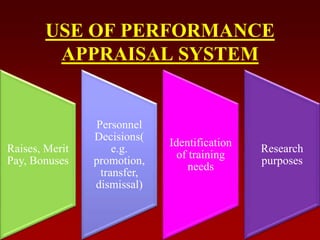
USE OF PERFORMANCE
APPRAISAL SYSTEM
Raises, Merit
Pay, Bonuses
Personnel
Decisions(
e.g.
promotion,
transfer,
dismissal)
Identification
of training
needs
Research
purposes
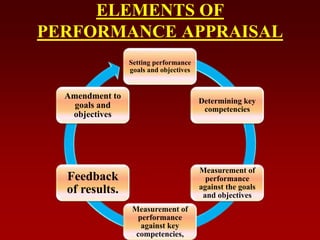
ELEMENTS OF
PERFORMANCE APPRAISAL
Setting performance
goals and objectives
Determining key
competencies
Measurement of
performance
against the goals
and objectives
Measurement of
performance
against key
competencies,
Feedback
of results.
Amendment to
goals and
objectives
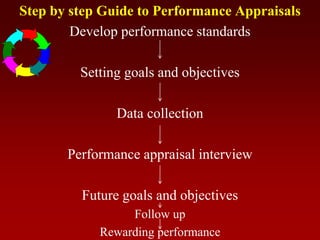
Step by step Guide to Performance Appraisals
Develop performance standards
Setting goals and objectives
Data collection
Performance appraisal interview
Future goals and objectives
Follow up
Rewarding performance
A.DEVELOP THE STANDARDS
FOR EVALUATION
Performance standards are:
• Based on the position, not the individual
• Observable, specific indicators of success
• Meaningful, reasonable and attainable
• Describe “fully satisfactory” performance
once trained
• Expressed in terms of quantity, quality,
timeliness, cost, safety or outcomes
B. SETTING OBJECTIVES
• Specific
• Performance oriented
• Realistic
• Observable
C. DATA COLLECTION
• Sources of performance
information
– Personal observation
– Reports, documentation,
correspondence. Etc.
– Feedback (internal and external)
– Periodic discussions with employee
D. PERFORMANCE
APPRAISAL INTERVIEW
• Review standards, documentation
and job description as well as the
appraisal form and various ratings.
• Write the appraisal ( Complete the
Performance Appraisal Form).
• Know the person’s record
thoroughly.
• Prepare the employee in advance.
E. FUTURE GOALS AND
OBJECTIVES
• At the end of the interview, the employer should
allow some time to create a development plan.
• The employer should record specific goals,
targets or benchmarks that the employee will
attempt to achieve.
• Both employer and employee should agree on
the steps to be taken to achieve these targets,
• Both should agree on how the employee’s
progress towards these objectives will be
measured and set a defined timeframe, even if
this is simply the next performance appraisal.
F. FOLLOW UP
• Follow up means more than simply
conducting regular formal performance
reviews once a year.
• If employers review employees and
provide feedback as part of everyday
management, both employers and the
employee will learn much more about
their strengths, weaknesses and how
employers would prefer the job to be
done.
G. THE PERFORMANCE
EVALUATION REPORT
• Class specification and / or informal job
description.
• Job standards, procedures and regulations.
• Established goals, objectives and
expectations.
• Knowledge and abilities to perform the
job.
• Job relationships required for successful
performance, i.e supervisors, co-workers,
county employees and the public.
• Quality of work, including the nature
and consequences of errors made
during the evaluation period.
• Production rate, if applicable.
• Commendations awarded relative to
employee performance.
• Use of job skills and efforts to enhance
skills.
• Ability to work with others.
• Attendance, use of sick leave,
punctuality.
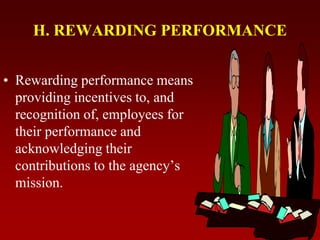
H. REWARDING PERFORMANCE
• Rewarding performance means
providing incentives to, and
recognition of, employees for
their performance and
acknowledging their
contributions to the agency’s
mission.
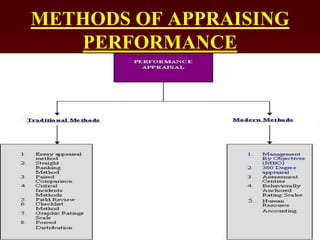
METHODS OF APPRAISING
PERFORMANCE
Traditional methods of
performance appraisal
1. Essay appraisal method
 This traditional form of appraisal, also known
as "Free Form method" involves a description
of the performance of an employee by his
superior.
 The description is an evaluation of the
performance of any individual based on the
facts and often includes examples and
evidences to support the information.
 A major drawback of the method is the
inseparability of the bias of the evaluator.
2. Straight ranking method
1. This is one of the oldest and simplest techniques
of performance appraisal.
2. In this method, the appraiser ranks the employees
from the best to the poorest on the basis of their
overall performance.
3. It is quite useful for a comparative evaluation.
3. Paired comparison
• A better technique of comparison than the
straight ranking method, this method
compares each employee with all others in
the group, one at a time.
• After all the comparisons on the basis of the
overall comparisons, the employees are
given the final rankings.
6. Checklist method
• The rater is given a checklist of the
descriptions of the behaviour of the
employees on job.
• The checklist contains a list of
statements on the basis of which the
rater describes the on the job
performance of the employees.
4. Critical incidents methods
• In this method of Performance
appraisal the evaluator rates the
employee on the basis of critical
events and how the employee behaved
during those incidents.
• It includes both negative and positive
points.
• The drawback of this method is that
the supervisor has to note down the
critical incidents and the employee
behavior as and when they occur.
5. Field review
• In this method, a senior member of
the Human Resource department or a
training officer discusses and
interviews the supervisors to evaluate
and rate their respective subordinates.
• A major drawback of this method is
that it is a very time consuming
method.
• But this method helps to reduce the
superiors’ personal bias.
8. Forced Distribution
• To eliminate the element of bias from the
rater’s ratings, the evaluator is asked to
distribute the employees in some fixed
categories of ratings like on a normal
distribution curve.
• The rater chooses the appropriate fit for the
categories on his own discretion
Modern methods of
performance appraisal
1. Assessment centres
• An assessment centre typically involves the
use of methods like social/informal events,
tests and exercises, assignments being given
to a group of employees to assess their
competencies to take higher responsibilities
in the future.
• Generally, employees are given an
assignment similar to the job they would be
expected to perform if promoted.
• The trained evaluators observe and evaluate
employees as they perform the assigned jobs
and are evaluated on job related
characteristics.
3. Human resource accounting method
• Human resources are valuable assets
for every organization. Human
resource accounting method tries to
find the relative worth of these assets
in the terms of money.
• In this method the Performance
appraisal of the employees is judged
in terms of cost and contribution of
the employees.
• The cost of employees include all the
expenses incurred on them like their
compensation, recruitment and selection
costs, induction and training costs etc
whereas their contribution includes the
total value added (in monetary terms).
• The difference between the cost and the
contribution will be the performance of the
employees.
• Ideally, the contribution of the employees
should be greater than the cost incurred on
them.
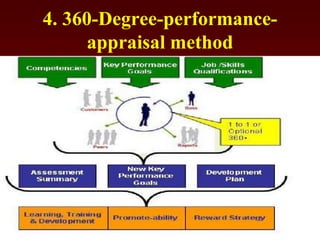
4. 360-Degree-performance-
appraisal method
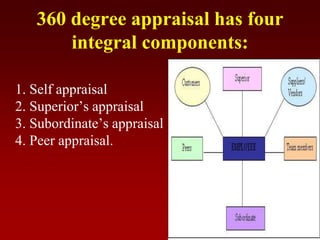
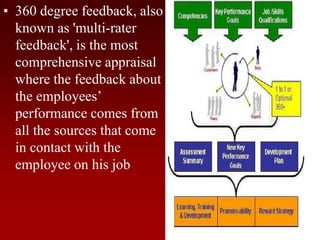
• 360 degree feedback, also
known as 'multi-rater
feedback', is the most
comprehensive appraisal
where the feedback about
the employees’
performance comes from
all the sources that come
in contact with the
employee on his job
360 degree appraisal has four
integral components:
1. Self appraisal
2. Superior’s appraisal
3. Subordinate’s appraisal
4. Peer appraisal.
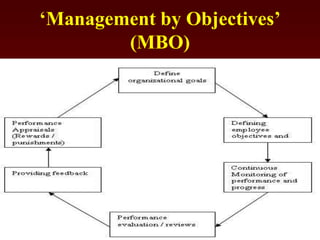
‘Management by Objectives’
(MBO)
• Clarity of goals – With MBO, came
the concept of SMART goals i.e.
goals that are:
Specific
Measurable
Achievable
Realistic, and
Time bound
1. Halo/horn effect – employee’s
extreme competence in one
area “shines” over all others.
Conversely, employee does
poorly in one area and this
overshadows all areas.
2. Bias – own prejudices {race,
national origin, gender,
appearance, etc.} influence the
appraisal
3. Comparison Rating –
contrasting one employee with
another
Common Problems Associated with Conducting
the Appraisal
3. Central Tendency – rate everyone as average
4. Recency Effect – focusing on recent
performance instead of entire year
5. Personal Prejudice – If the rater dislikes one
group or employees, he may rate them at the
lower end.
6. Favoritism – evaluating friends or those who
don’t make waves, etc. more favorably than
others
Common Problems Associated with Conducting the
Appraisal
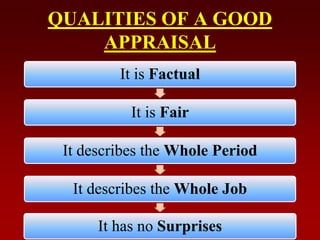
QUALITIES OF A GOOD
APPRAISAL
It is Factual
It is Fair
It describes the Whole Period
It describes the Whole Job
It has no Surprises
BENEFITS OF PERFORMANCE
APPRAISAL
Benefit for the individual:
• Gaining a better understanding of their role
• Understanding more clearly how and where they fit in
within the wider picture
• A better understanding of how performance is assessed
and monitored
• Getting an insight
• Improving understanding of their strengths and
weaknesses and developmental needs
• Identifying ways in which they can improve performance
• Providing an opportunity to discuss and clarify
developmental and training needs
• Understanding and agreeing their objectives for the next
year
• An opportunity to discuss career direction and prospects.
Benefit to the line/
manager/supervisor/team leader:
• Oppurtunities to
– hear and exchange views and opinions away
from the normal pressure of work
– to identify any potential difficulties or
weaknesses
– An improved understanding of the resources
available
– to plan for and set objectives for the next period
– to think about and clarity their own role
– to plan for achieving improved performance
– to plan for further delegation and coaching
– to motivate members of the team
Benefits to the organization
• A structured means of identifying and
assessing potential
• Up-to-date information regarding the
expectations and aspirations of
employees
• Information on which to base decisions
about promotions and motivation
• An opportunity to review succession
planning
• Information about training needs which can
act as a basis for developing training plans
• Updating of employee records (
achievements, new competencies, etc)
• Career counseling
• Communication of information
PERFORMANCE APPRAISAL FOR
EMPLOYEES AT DIFFERENT LEVELS
• For top level management
• Degree of organizational growth and
expansion
• Extent of achievement of organizational
goal
• Contribution towards the society
• Profitability and return on capital
employed
• For middle level managers
• Performance of the departments or teams
• Co-ordination with other departments
• Optimal use of resources
• Costs Vs. revenues for a given period of
time
• The communication with superiors and
subordinates
• For front line supervisors
• Quantity of actual output against the
targets
• Quality of output against the targets
• Number of accidents in a given period
• Rate of employee absenteeism

Performance appraisal

  • 1.
  • 2.
    DEFINITION Performance appraisal • Accordingto Flippo, a prominent personality in the field of Human resources, "performance appraisal is the systematic, periodic and an impartial rating of an employee’s excellence in the matters pertaining to his present job and his potential for a better job."
  • 3.
     Provide areview of past work performance.  Establish lines of communication.  Create an opportunity to discuss professional development goals and objectives. NEED OF PERFORMANCE EVALUATIONS
  • 4.
    – Document employeeperformance. – Document corrective action necessary to improve work performance. – It is the supervisor’s and manager’s responsibility to monitor, evaluate and coach employees.
  • 5.
    AIMS OF PERFORMANCE APPRAISAL •Give employee feedback. • Identify employee training need • Document criteria. • Form a basis for personnel: salary increases, promotions, disciplinary actions, bonuses, etc. • Provide the opportunity for organizational diagnosis and development • Facilitate communication • Validate selection techniques and human resource policies.
  • 6.
    PURPOSES OF PERFORMANCE APPRAISAL •To review the performance of the employees. • To judge the gap between the actual and the desired performance. • To help the management in exercising organizational control. • To diagnose the training and development needs of the future.
  • 7.
    • Provide informationto assist in the HR decisions like promotions, transfers etc. • Provide clarity of the expectations and responsibilities of the functions to be performed by the employees. • To judge the effectiveness of the other human resource functions. • To reduce the grievances of the employees. • Helps to strengthen the relationship and communication between superior – subordinates and management – employees.
  • 8.
  • 9.
    WORK RELATED OBJECTIVES –Toprovide a control for work done –To improve efficiency –To help in assigning work and plan future work assignment; and –To carry out job evaluation
  • 10.
    CAREER DEVELOPMENT OBJECTIVES – Toidentify strong and weak points and encourage finding remedies for weak points through training; – To determine career potential; – To plan developmental( promotional or lateral) assignments; and – To plan career goals
  • 11.
    OBJECTIVES OF COMMUNICATION •To provide adequate feedback on performance; • To clearly establish goals, i.e what is expected of the staff members in terms of performance and future work assignments; • To provide counseling and job satisfaction through open discussion on performance and • To let employees assess where they stand within the organization in terms of their performance.
  • 12.
    ADMINISTRATIVE OBJECTIVES • Toserve as a basis for promotion or demotion; • To serve as a basis for allocating incentives; • To serve as a basis for determining transfers ; and • To serve as a basis for termination in case of reduction of staff.
  • 13.
    USE OF PERFORMANCE APPRAISALSYSTEM Raises, Merit Pay, Bonuses Personnel Decisions( e.g. promotion, transfer, dismissal) Identification of training needs Research purposes
  • 14.
    ELEMENTS OF PERFORMANCE APPRAISAL Settingperformance goals and objectives Determining key competencies Measurement of performance against the goals and objectives Measurement of performance against key competencies, Feedback of results. Amendment to goals and objectives
  • 15.
    Step by stepGuide to Performance Appraisals Develop performance standards Setting goals and objectives Data collection Performance appraisal interview Future goals and objectives Follow up Rewarding performance
  • 16.
    A.DEVELOP THE STANDARDS FOREVALUATION Performance standards are: • Based on the position, not the individual • Observable, specific indicators of success • Meaningful, reasonable and attainable • Describe “fully satisfactory” performance once trained • Expressed in terms of quantity, quality, timeliness, cost, safety or outcomes
  • 17.
    B. SETTING OBJECTIVES •Specific • Performance oriented • Realistic • Observable
  • 18.
    C. DATA COLLECTION •Sources of performance information – Personal observation – Reports, documentation, correspondence. Etc. – Feedback (internal and external) – Periodic discussions with employee
  • 19.
    D. PERFORMANCE APPRAISAL INTERVIEW •Review standards, documentation and job description as well as the appraisal form and various ratings. • Write the appraisal ( Complete the Performance Appraisal Form). • Know the person’s record thoroughly. • Prepare the employee in advance.
  • 20.
    E. FUTURE GOALSAND OBJECTIVES • At the end of the interview, the employer should allow some time to create a development plan. • The employer should record specific goals, targets or benchmarks that the employee will attempt to achieve. • Both employer and employee should agree on the steps to be taken to achieve these targets, • Both should agree on how the employee’s progress towards these objectives will be measured and set a defined timeframe, even if this is simply the next performance appraisal.
  • 21.
    F. FOLLOW UP •Follow up means more than simply conducting regular formal performance reviews once a year. • If employers review employees and provide feedback as part of everyday management, both employers and the employee will learn much more about their strengths, weaknesses and how employers would prefer the job to be done.
  • 22.
    G. THE PERFORMANCE EVALUATIONREPORT • Class specification and / or informal job description. • Job standards, procedures and regulations. • Established goals, objectives and expectations. • Knowledge and abilities to perform the job. • Job relationships required for successful performance, i.e supervisors, co-workers, county employees and the public.
  • 23.
    • Quality ofwork, including the nature and consequences of errors made during the evaluation period. • Production rate, if applicable. • Commendations awarded relative to employee performance. • Use of job skills and efforts to enhance skills. • Ability to work with others. • Attendance, use of sick leave, punctuality.
  • 24.
    H. REWARDING PERFORMANCE •Rewarding performance means providing incentives to, and recognition of, employees for their performance and acknowledging their contributions to the agency’s mission.
  • 25.
  • 26.
  • 27.
    1. Essay appraisalmethod  This traditional form of appraisal, also known as "Free Form method" involves a description of the performance of an employee by his superior.  The description is an evaluation of the performance of any individual based on the facts and often includes examples and evidences to support the information.  A major drawback of the method is the inseparability of the bias of the evaluator.
  • 28.
    2. Straight rankingmethod 1. This is one of the oldest and simplest techniques of performance appraisal. 2. In this method, the appraiser ranks the employees from the best to the poorest on the basis of their overall performance. 3. It is quite useful for a comparative evaluation.
  • 29.
    3. Paired comparison •A better technique of comparison than the straight ranking method, this method compares each employee with all others in the group, one at a time. • After all the comparisons on the basis of the overall comparisons, the employees are given the final rankings.
  • 30.
    6. Checklist method •The rater is given a checklist of the descriptions of the behaviour of the employees on job. • The checklist contains a list of statements on the basis of which the rater describes the on the job performance of the employees.
  • 31.
    4. Critical incidentsmethods • In this method of Performance appraisal the evaluator rates the employee on the basis of critical events and how the employee behaved during those incidents. • It includes both negative and positive points. • The drawback of this method is that the supervisor has to note down the critical incidents and the employee behavior as and when they occur.
  • 32.
    5. Field review •In this method, a senior member of the Human Resource department or a training officer discusses and interviews the supervisors to evaluate and rate their respective subordinates. • A major drawback of this method is that it is a very time consuming method. • But this method helps to reduce the superiors’ personal bias.
  • 33.
    8. Forced Distribution •To eliminate the element of bias from the rater’s ratings, the evaluator is asked to distribute the employees in some fixed categories of ratings like on a normal distribution curve. • The rater chooses the appropriate fit for the categories on his own discretion
  • 34.
  • 35.
    1. Assessment centres •An assessment centre typically involves the use of methods like social/informal events, tests and exercises, assignments being given to a group of employees to assess their competencies to take higher responsibilities in the future. • Generally, employees are given an assignment similar to the job they would be expected to perform if promoted. • The trained evaluators observe and evaluate employees as they perform the assigned jobs and are evaluated on job related characteristics.
  • 36.
    3. Human resourceaccounting method • Human resources are valuable assets for every organization. Human resource accounting method tries to find the relative worth of these assets in the terms of money. • In this method the Performance appraisal of the employees is judged in terms of cost and contribution of the employees.
  • 37.
    • The costof employees include all the expenses incurred on them like their compensation, recruitment and selection costs, induction and training costs etc whereas their contribution includes the total value added (in monetary terms). • The difference between the cost and the contribution will be the performance of the employees. • Ideally, the contribution of the employees should be greater than the cost incurred on them.
  • 38.
  • 39.
    • 360 degreefeedback, also known as 'multi-rater feedback', is the most comprehensive appraisal where the feedback about the employees’ performance comes from all the sources that come in contact with the employee on his job
  • 40.
    360 degree appraisalhas four integral components: 1. Self appraisal 2. Superior’s appraisal 3. Subordinate’s appraisal 4. Peer appraisal.
  • 41.
  • 42.
    • Clarity ofgoals – With MBO, came the concept of SMART goals i.e. goals that are: Specific Measurable Achievable Realistic, and Time bound
  • 43.
    1. Halo/horn effect– employee’s extreme competence in one area “shines” over all others. Conversely, employee does poorly in one area and this overshadows all areas. 2. Bias – own prejudices {race, national origin, gender, appearance, etc.} influence the appraisal 3. Comparison Rating – contrasting one employee with another Common Problems Associated with Conducting the Appraisal
  • 44.
    3. Central Tendency– rate everyone as average 4. Recency Effect – focusing on recent performance instead of entire year 5. Personal Prejudice – If the rater dislikes one group or employees, he may rate them at the lower end. 6. Favoritism – evaluating friends or those who don’t make waves, etc. more favorably than others Common Problems Associated with Conducting the Appraisal
  • 45.
    QUALITIES OF AGOOD APPRAISAL It is Factual It is Fair It describes the Whole Period It describes the Whole Job It has no Surprises
  • 46.
  • 47.
    Benefit for theindividual: • Gaining a better understanding of their role • Understanding more clearly how and where they fit in within the wider picture • A better understanding of how performance is assessed and monitored • Getting an insight • Improving understanding of their strengths and weaknesses and developmental needs • Identifying ways in which they can improve performance • Providing an opportunity to discuss and clarify developmental and training needs • Understanding and agreeing their objectives for the next year • An opportunity to discuss career direction and prospects.
  • 48.
    Benefit to theline/ manager/supervisor/team leader: • Oppurtunities to – hear and exchange views and opinions away from the normal pressure of work – to identify any potential difficulties or weaknesses – An improved understanding of the resources available – to plan for and set objectives for the next period – to think about and clarity their own role – to plan for achieving improved performance – to plan for further delegation and coaching – to motivate members of the team
  • 49.
    Benefits to theorganization • A structured means of identifying and assessing potential • Up-to-date information regarding the expectations and aspirations of employees • Information on which to base decisions about promotions and motivation • An opportunity to review succession planning
  • 50.
    • Information abouttraining needs which can act as a basis for developing training plans • Updating of employee records ( achievements, new competencies, etc) • Career counseling • Communication of information
  • 51.
    PERFORMANCE APPRAISAL FOR EMPLOYEESAT DIFFERENT LEVELS • For top level management • Degree of organizational growth and expansion • Extent of achievement of organizational goal • Contribution towards the society • Profitability and return on capital employed
  • 52.
    • For middlelevel managers • Performance of the departments or teams • Co-ordination with other departments • Optimal use of resources • Costs Vs. revenues for a given period of time • The communication with superiors and subordinates
  • 53.
    • For frontline supervisors • Quantity of actual output against the targets • Quality of output against the targets • Number of accidents in a given period • Rate of employee absenteeism