PERFORMANCE
APPRAISAL
PROBLEMS,ESSENTIALS,METHODS
PERFORMANCE APPRAISAL
Performance Appraisal is the systematic , periodic and an
impartial rating of an employee’s excellence in matters
pertaining to his present job and his potential for a better
job.
OBJECTIVES
 To provide feedback to employees
 To provide a valid database for personal
decisions concerning
promotions,transfer,punishments etc.
 To diagnose the strengths and weakness of
individual so as to identify further training
needs
 To provide coaching,councelling, career
planning and motivation to subordinates,
 To develop positive superior-subordinate
relation and thereby reduce grievances
 To facilitate research in HRM
 To test effectiveness of recruitment , selection,
Placement and induction programmes.
Problems in
performance
appraisal
1. Errors in Rating
2. Lack of Reliability
3. Incompetence
4. Negative Approach
5. Multiple Objectives
6. Resistance
7. Lack of knowledge
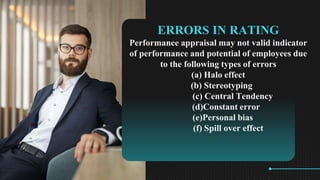
ERRORS IN RATING
Performance appraisal may not valid indicator
of performance and potential of employees due
to the following types of errors
(a) Halo effect
(b) Stereotyping
(c) Central Tendency
(d)Constant error
(e)Personal bias
(f) Spill over effect
VARYING STANDARDS:
PROBLEM:
The evaluators uses different standards and expectations for different employees
who are performing similar jobs
EXAMPLE:
A teacher wont give same grade to all students, few times it depends on the affection
that the teacher has towards a specific student.
SOLUTION:
The rater should be able to shows coherent arguments in order to explain the
difference.
HALO EFFECT:
PROBLEM:
When a evaluator rates an employee high on all items because of one
characteristic that he or she likes
EXAMPLE:
If a employee was absent for few days but the evaluator has a good relationship
with him, then rating will be higher in all other areas of work in order to
balance it
SOLUTION:
The re-examination is done by higher-level managers to correct such appraising
because they are supposed to be more partial
COMPARISON RATING :
The evaluator may have tendency to evaluate a persons performance by
comparing with others performance rather than his or her individual
performance.
EXAMPLE:
If a teacher has to evaluate 2 students who usually wont complete their
homework but one is silent and other one is naughty then teacher will give
more marks to silent one
SOLUTION:
The rating should reflect the actual performance of an individual but not by
comparing with others performance
REDENCY EFFECT:
The evaluator may evaluate an employee by comparing his latest performance but
not his or her entire years performance.
EXAMPLE:
When a professor gives grades to the students based on their last week
performance but not his or her entire semester performance
SOLUTIONS:
order to avoid these the evaluator should use some methods such as documenting
both in positive and negative aspects and should also consider past performances
CENTRAL TENDENCY:
When the evaluator gives average score to a group, the member in group
who have performed excellent work will also get average
PROBLEM:
If evaluator is using 7 pointer scales then he or she will rate all the
employees in the range of 3-5
SOLUTION:
Each group member should be evaluated individually based on his or her
contribution
CREDITS: This presentation template was created by Slidesgo, and
includes icons by Flaticon, and infographics & images by Freepik
ESSENTIALS OF PERFORMANCE
APPRAISAL
 Performance appraisal helps the management to take
decision about the salary increase of an employee.
 The continuous evaluation of an employee helps in
improving the quality of an employee in job
performance.
 The Performance appraisal brings out the facilities
available to an employee,when the management is
prepared to provide adequate facilities for effective
performance.
 It minimizes the communication gap between the employer and employee.
 Promotion is given to an employee on the basis of performance appraisal.
 The training needs of an employee be identified performance appraisal.
 The decision for discharging an employee.
 Performance appraisal is used to transfer a person.
 The grievances of an employee are eliminated through performance
appraisal.
 The job satisfaction of an employee increases morale.
METHODS OF PERFORMANCE
APPRAISAL
The methods of performance appraisal are as
follows
 TRADITIONAL METHODS
 MODERN METHODS
A. TRADITIONAL METHODS ARE AS FOLLOWS
 Ranking Methods
 Paired comparison
 Grading Method
 Forced distribution Method
 Check-list Method
 Critical list Method
 Graphic rating Method
 Essay Method
 Field Review Method
 Confidential Report
1.RANKING METHOD:
It is the oldest and simplest formal systematic method of
performance appraisal in which employee is compared with
all others for the purpose of placing order of worth. The
employees are ranked from the highest to the lowest or from
the best to the worst.
2. PAIRED COMPARISON:
In this method, each employee is compared with other
employees on one- on one basis only. The rater is provided
with a bunch of slips each coining pair of names, the rater
puts a tick mark against the employee whom he insiders the
better of the two.
3.GRADING METHOD:
In this method, certain categories of worth are established in
advance and carefully defined. There can be three
categories established for employees: outstanding,
satisfactory and unsatisfactory. The employee is, then,
allocated to the grade that best describes his or her
performance.
FORCED DISTRIBUTION METHOD
 In this method,the rater is required to distribute his ratings in the form of a normal frequency
distribution’
 Here also the ranking techniquebis used. This method is highly simple to understand and easy to apply.
 Secondly ,it helps to reduce bias involved in straight ranking method and paired comparision method.
CHECKLIST METHOD
 A Checklist is a list of statements that describe the characteristics and performance of employees.the
rater checks it indicate if the behaviour of an employee is positive or negative to each statement.
 The checklist is time consuming and expensive method as different checklist must be prepared for each
job category.
CRITICAL INCIDENT METHOD :
 The critical incident method is a type of appraisal system which involves gathering data, facts, or
samples so as to determine accuracy in the performance of employees and general trends if there are
any.
GRAPHIC RATING METHOD
The graphic Rating Scale is a performance appraisal method to evaluate employee engagement,
performance & productivity-related criteria. Respondents can choose a particular option on a line
or scale to show how they feel about something. A graphic rating scale shows the answer choices
on a scale of 1-3, 1-5, etc.
EASY METHOD:
The essay method, sometimes known as the “free-form method,” is a performance review
system where a superior creates a written review of the employee's performance.
FIELD REVIEW METHOD:
This method is based on superiors' opinion on the performance, behavior and skills of the
employee. The HR specialist asks seniors to answer questions related to employee's
employment and appraises the employee on the basis of feedback received from the
superiors.
CONFIDENTIAL REPORT:
In this method of appraising system, subordinate is observed by his superiors regarding his
performance in the job and on his duties done. Thereafter Superior writes confidential report on
his performance, mainly on his behavior in the organization and conduct and remarks if any.
MODERN METHODS OF PERFORMANCE APPRAISAL
 Assessment Centre
 Human Resource Accounting
 Behaviorally Anchored Ratting Scales
 Appraisal through MBO
 360 Degree Appraisal
ASSESSMENT METHOD:
During the assessment, employees are asked to take part in social-simulation exercises like in-
basket exercises, informal discussions, fact-finding exercises, decision-making problems, role-
play, and other exercises that ensure success in a role.
HUMAN RESOURCE ACCOUNTING METHOD:
Also known as Human Resource Cost Accounting Method, it is used to evaluate an employee's
performance as per the monetary benefits they yield from the organization. This means the
performance of an employee is compared against the salary & other costs the company pays to
the employee.
BEHAVIORALLY ANCHORED RATTING SCALES:
Also known as Human Resource Cost Accounting Method, it is used to evaluate an employee's
performance as per the monetary benefits they yield from the organization. This means the
performance of an employee is compared against the salary & other costs the company pays to
the employee.
APPRAISAL THROUGH MBO
MBO stands for management by objectives and is a system of appraising employees.
As discussed earlier, performance appraisal is where a company evaluates how employees
perform their specific duties as per their job descriptions.
360 DEGREE APPRAISAL :
360-degree appraisal is a management tool where the manager and an employee evaluate the
latter's performance. It is also known as multi-rater feedback. 360-degree feedback also allows
you to receive feedback from superiors, peers, clients, and other staff members.
• MBO is an acronym for Management by Objectives. It can be defined as a management system
that measures employees’ performance against a series of set targets or goals to gauge their overall
performance in their role.
• Management by objectives (MBO) refers to the process of setting specific objectives for your
employees to work towards. This has become a key part of performance management in recent
decades.
Management by Objectives
HUMAN RESOURCE MANAGEMENT PERFORMANCE MGT

HUMAN RESOURCE MANAGEMENT PERFORMANCE MGT

  • 1.
  • 2.
    PERFORMANCE APPRAISAL Performance Appraisalis the systematic , periodic and an impartial rating of an employee’s excellence in matters pertaining to his present job and his potential for a better job.
  • 3.
    OBJECTIVES  To providefeedback to employees  To provide a valid database for personal decisions concerning promotions,transfer,punishments etc.  To diagnose the strengths and weakness of individual so as to identify further training needs  To provide coaching,councelling, career planning and motivation to subordinates,  To develop positive superior-subordinate relation and thereby reduce grievances  To facilitate research in HRM  To test effectiveness of recruitment , selection, Placement and induction programmes.
  • 4.
    Problems in performance appraisal 1. Errorsin Rating 2. Lack of Reliability 3. Incompetence 4. Negative Approach 5. Multiple Objectives 6. Resistance 7. Lack of knowledge
  • 5.
    ERRORS IN RATING Performanceappraisal may not valid indicator of performance and potential of employees due to the following types of errors (a) Halo effect (b) Stereotyping (c) Central Tendency (d)Constant error (e)Personal bias (f) Spill over effect
  • 6.
    VARYING STANDARDS: PROBLEM: The evaluatorsuses different standards and expectations for different employees who are performing similar jobs EXAMPLE: A teacher wont give same grade to all students, few times it depends on the affection that the teacher has towards a specific student. SOLUTION: The rater should be able to shows coherent arguments in order to explain the difference.
  • 7.
    HALO EFFECT: PROBLEM: When aevaluator rates an employee high on all items because of one characteristic that he or she likes EXAMPLE: If a employee was absent for few days but the evaluator has a good relationship with him, then rating will be higher in all other areas of work in order to balance it SOLUTION: The re-examination is done by higher-level managers to correct such appraising because they are supposed to be more partial
  • 8.
    COMPARISON RATING : Theevaluator may have tendency to evaluate a persons performance by comparing with others performance rather than his or her individual performance. EXAMPLE: If a teacher has to evaluate 2 students who usually wont complete their homework but one is silent and other one is naughty then teacher will give more marks to silent one SOLUTION: The rating should reflect the actual performance of an individual but not by comparing with others performance
  • 9.
    REDENCY EFFECT: The evaluatormay evaluate an employee by comparing his latest performance but not his or her entire years performance. EXAMPLE: When a professor gives grades to the students based on their last week performance but not his or her entire semester performance SOLUTIONS: order to avoid these the evaluator should use some methods such as documenting both in positive and negative aspects and should also consider past performances
  • 10.
    CENTRAL TENDENCY: When theevaluator gives average score to a group, the member in group who have performed excellent work will also get average PROBLEM: If evaluator is using 7 pointer scales then he or she will rate all the employees in the range of 3-5 SOLUTION: Each group member should be evaluated individually based on his or her contribution
  • 11.
    CREDITS: This presentationtemplate was created by Slidesgo, and includes icons by Flaticon, and infographics & images by Freepik ESSENTIALS OF PERFORMANCE APPRAISAL  Performance appraisal helps the management to take decision about the salary increase of an employee.  The continuous evaluation of an employee helps in improving the quality of an employee in job performance.  The Performance appraisal brings out the facilities available to an employee,when the management is prepared to provide adequate facilities for effective performance.
  • 12.
     It minimizesthe communication gap between the employer and employee.  Promotion is given to an employee on the basis of performance appraisal.  The training needs of an employee be identified performance appraisal.  The decision for discharging an employee.  Performance appraisal is used to transfer a person.  The grievances of an employee are eliminated through performance appraisal.  The job satisfaction of an employee increases morale.
  • 13.
    METHODS OF PERFORMANCE APPRAISAL Themethods of performance appraisal are as follows  TRADITIONAL METHODS  MODERN METHODS
  • 14.
    A. TRADITIONAL METHODSARE AS FOLLOWS  Ranking Methods  Paired comparison  Grading Method  Forced distribution Method  Check-list Method  Critical list Method  Graphic rating Method  Essay Method  Field Review Method  Confidential Report
  • 15.
    1.RANKING METHOD: It isthe oldest and simplest formal systematic method of performance appraisal in which employee is compared with all others for the purpose of placing order of worth. The employees are ranked from the highest to the lowest or from the best to the worst. 2. PAIRED COMPARISON: In this method, each employee is compared with other employees on one- on one basis only. The rater is provided with a bunch of slips each coining pair of names, the rater puts a tick mark against the employee whom he insiders the better of the two. 3.GRADING METHOD: In this method, certain categories of worth are established in advance and carefully defined. There can be three categories established for employees: outstanding, satisfactory and unsatisfactory. The employee is, then, allocated to the grade that best describes his or her performance.
  • 16.
    FORCED DISTRIBUTION METHOD In this method,the rater is required to distribute his ratings in the form of a normal frequency distribution’  Here also the ranking techniquebis used. This method is highly simple to understand and easy to apply.  Secondly ,it helps to reduce bias involved in straight ranking method and paired comparision method. CHECKLIST METHOD  A Checklist is a list of statements that describe the characteristics and performance of employees.the rater checks it indicate if the behaviour of an employee is positive or negative to each statement.  The checklist is time consuming and expensive method as different checklist must be prepared for each job category. CRITICAL INCIDENT METHOD :  The critical incident method is a type of appraisal system which involves gathering data, facts, or samples so as to determine accuracy in the performance of employees and general trends if there are any.
  • 17.
    GRAPHIC RATING METHOD Thegraphic Rating Scale is a performance appraisal method to evaluate employee engagement, performance & productivity-related criteria. Respondents can choose a particular option on a line or scale to show how they feel about something. A graphic rating scale shows the answer choices on a scale of 1-3, 1-5, etc. EASY METHOD: The essay method, sometimes known as the “free-form method,” is a performance review system where a superior creates a written review of the employee's performance. FIELD REVIEW METHOD: This method is based on superiors' opinion on the performance, behavior and skills of the employee. The HR specialist asks seniors to answer questions related to employee's employment and appraises the employee on the basis of feedback received from the superiors.
  • 18.
    CONFIDENTIAL REPORT: In thismethod of appraising system, subordinate is observed by his superiors regarding his performance in the job and on his duties done. Thereafter Superior writes confidential report on his performance, mainly on his behavior in the organization and conduct and remarks if any.
  • 19.
    MODERN METHODS OFPERFORMANCE APPRAISAL  Assessment Centre  Human Resource Accounting  Behaviorally Anchored Ratting Scales  Appraisal through MBO  360 Degree Appraisal
  • 20.
    ASSESSMENT METHOD: During theassessment, employees are asked to take part in social-simulation exercises like in- basket exercises, informal discussions, fact-finding exercises, decision-making problems, role- play, and other exercises that ensure success in a role. HUMAN RESOURCE ACCOUNTING METHOD: Also known as Human Resource Cost Accounting Method, it is used to evaluate an employee's performance as per the monetary benefits they yield from the organization. This means the performance of an employee is compared against the salary & other costs the company pays to the employee. BEHAVIORALLY ANCHORED RATTING SCALES: Also known as Human Resource Cost Accounting Method, it is used to evaluate an employee's performance as per the monetary benefits they yield from the organization. This means the performance of an employee is compared against the salary & other costs the company pays to the employee.
  • 21.
    APPRAISAL THROUGH MBO MBOstands for management by objectives and is a system of appraising employees. As discussed earlier, performance appraisal is where a company evaluates how employees perform their specific duties as per their job descriptions. 360 DEGREE APPRAISAL : 360-degree appraisal is a management tool where the manager and an employee evaluate the latter's performance. It is also known as multi-rater feedback. 360-degree feedback also allows you to receive feedback from superiors, peers, clients, and other staff members.
  • 22.
    • MBO isan acronym for Management by Objectives. It can be defined as a management system that measures employees’ performance against a series of set targets or goals to gauge their overall performance in their role. • Management by objectives (MBO) refers to the process of setting specific objectives for your employees to work towards. This has become a key part of performance management in recent decades. Management by Objectives