This document analyzes the performance of genetic algorithms (GA) as a stochastic optimization tool for solving complex engineering design problems. The paper outlines traditional optimization methods and highlights the advantages of soft computing techniques, particularly GA, in reaching optimal solutions under constraints. It concludes that GA is effective for design optimization, rapidly converging to optimal solutions and suitable for applications in various engineering disciplines.
![ISSN 2349-7815
International Journal of Recent Research in Electrical and Electronics Engineering (IJRREEE)
Vol. 2, Issue 4, pp: (71-76), Month: October - December 2015, Available at: www.paperpublications.org
Page | 71
Paper Publications
Performance Analysis of Genetic Algorithm as
a Stochastic Optimization Tool in Engineering
Design Problems
Raju Basak1
, Amarnath Sanyal2
, Arabinda Das3
, Avik Ghosh4
, Asmita Poddar5
1
Research Scholar, 113/3, Dakshindari Road, Dinesh apartment, Flat – A2/4, Sreebhumi,
Kolkata – 700 048; West Bengal, India
2
Professor, Calcutta Institute of Engineering and Management, 24/1A, Chandi Ghosh Road,; West Bengal, India,
Kolkata -700040;
3
Associate Professor, Electrical engineering department, Jadavpur University; Kolkata-700032; West Bengal., India
4,5
Assistant Professor, Elecreical Engineering Departent, Ideal Institute of Engineering, Kalyani, Nadia, West Bengal
Abstract: Engineering design problems are complex by nature because of their critical objective functions involving
many variables and Constraints. Engineers have to ensure the compatibility with the imposed specifications
keeping the manufacturing costs low. Moreover, the methodology may vary according to the design problem.
The main issue is to choose the proper tool for optimization. In the earlier days, a design problem was optimized
by some of the conventional optimization techniques like gradient Search, evolutionary optimization, random
search etc. These are known as classical methods.
The method is to be properly Chosen depending on the nature of the problem- an incorrect choice may sometimes
fail to give the optimal solution. So the methods are less robust.
Now-a-days soft-computing techniques are being widely used for optimizing a function. These are more robust.
Genetic algorithm is one such method. It is an effective tool in the realm of stochastic optimization (non-classical).
The algorithm produces many strings and generation to reach the optimal point.
The main objective of the paper is to optimize engineering design problems using Genetic Algorithm and to
analyze how the algorithm reaches the optima effectively and closely. We choose a mathematical expression for the
objective function in terms of the design variables and optimize the same under given constraints using GA.
Keywords: Engineering Optimization, Genetic Algorithm, Objective function, convergence, Engineering
Application.
I. INTRODUCTION
Optimization is the process of maximizing or minimizing a function consisting of number of variables under given
constraints. It means solving problems in which one seeks to minimize or maximize a real function by systematically
choosing the values of real or integer variables from within a set [1,2].
A real world problem may have many feasible solutions. Optimal design is the best possible design out of many feasible
designs, generally in presence of a number of inequality constraints.
Various tools are available to reach the optimal solution- classical and non-classical. The non-classical techniques based
on soft computing, have now become much popular.
The modern approach is to search and choose the best design method for specific tasks. Engineering optimization deals
with the optimal solution in all engineering fields.](https://image.slidesharecdn.com/performanceanalysis-546-170328052026/85/Performance-Analysis-of-Genetic-Algorithm-as-a-Stochastic-Optimization-Tool-in-Engineering-Design-Problems-1-320.jpg)
![ISSN 2349-7815
International Journal of Recent Research in Electrical and Electronics Engineering (IJRREEE)
Vol. 2, Issue 4, pp: (71-76), Month: October - December 2015, Available at: www.paperpublications.org
Page | 72
Paper Publications
Now use of Design Optimization is rapidly growing in almost all the engineering disciplines [2, 3], like mechanical, civil,
electrical, energy and off-shore engineering etc. This is due to the increase of manufacturer’s competition and the
development of strong and efficient techniques in order to achieve best product against minimum cost [4].
Engineering systems are represented by sophisticated numerical models. They involve several interacting disciplines that
must be considered simultaneously to obtain efficient designs [5].
Multidisciplinary optimization problem involve complex systems including subsystems. The main challenges are to
develop efficient numerical tools.
Some physical phenomena naturally describe an optimization problem, when the "equilibrium" is attained at the minimum
of an energy level [6].
II. GENETIC ALGORITHM
Genetic algorithm has been developed by John Holland, established by Holland and Dejong, and popularized by
Goldberg. Several researchers have contributed in many ways on various aspects and applications of Genetic algorithms.
GA has found its applications almost in every branch of engineering and still in an area of active research [7].
GA searches the natural genetics. Genetic algorithms (GA) are processed by three operators: reproduction, crossover and
mutation. GA creates an initial single population or species by randomly encoded chromosomes where each chromosome
representing a possible solution. Encoded chromosomes undergo natural selection for recombination through the
crossover operator whereby improved off-springs are generated in successive generations.
Roulette wheel selections for reproduction, single point crossover and probabilistic bit mutation are the basic mechanisms
suggested for the operations of the simple Genetic Algorithm. As GA is a stochastic search process a good solution
detected in early generations may not be selected for the latter generations (due to genetic drift). This has been referred to
as the generation gap. Generation gap may lead the GA to a non-optimal solution. Elitist GA has been suggested to
overcome this problem. In case of Elitist GA a solution having high fitness value is copied in the next population thus
ensuring the presence of the best solution detected in the final generations. Different Elitist schemes have been suggested.
Elitism has both advantages and disadvantages. By forcing the presence of some pre-selected solution strings in the next
population, we apply the so called selection pressure. Higher selection pressure reduces the variations in the population
which may lead to premature convergence of GA. Premature convergence occurs when the population strings become
identical before the optimum solution is detected [8].
Crossover is a method of exchanging information between two chromosomes. Most calculus based optimization methods
are based on exploitation (hill climbing) of the search space. Random search algorithms allow exploration of the search
space. GAs is robust as they find solutions by exploitation and exploration of the hyper planes of the search space. GA
exploits through the process of selection and explores through crossover and mutation.
As the mutation rate is increased mutation becomes more disruptive (explorative) until the exploitative effects of selection
are completely overwhelmed. A low mutation rate on the other hand, allows the algorithm to exploit a particular hyper
plane. Setting the mutation rate high allow the algorithm to explore different hyper planes. Crossover also helps
exploration. But, the amount of exploration through crossover is also dependent upon the selection. With increased
selection pressure, crossover can hardly bring any difference in the child population. Increased exploitation by selection
leads to decreased exploration by crossover.
A single allele mutation of an individual can also be thought of as a local search (exploitation) in an area surrounding that
individual in a multidimensional space. When the GA converges prematurely a higher mutation rate can be helpful.
Many real life problems, especially of engineering, are characterized by several goals. Each of these goals belongs to the
optimum of an objective function to be optimized. Most of the cases, the objective functions are in conflict. A common
approach to deal with this kind of problems is to amalgam multi objective functions into a single one by giving different
weighing factors to different objectives and then solving the weighted objective function. One can select the most
dominant feature as the objective function and other as constraints. The designer must give the priority to each objective
function according to their merits [7, 8].](https://image.slidesharecdn.com/performanceanalysis-546-170328052026/85/Performance-Analysis-of-Genetic-Algorithm-as-a-Stochastic-Optimization-Tool-in-Engineering-Design-Problems-2-320.jpg)
![ISSN 2349-7815
International Journal of Recent Research in Electrical and Electronics Engineering (IJRREEE)
Vol. 2, Issue 4, pp: (71-76), Month: October - December 2015, Available at: www.paperpublications.org
Page | 73
Paper Publications
For a multi objective optimization, the problem is stated as given below:
Minimize
T
1 2( ), ( ),..................... ( )mf f x f x f x
--------- [1]
Subject to:
T T
1 2( ), g ( ),..................... ( ) 0, 0, .............0 ,ng g x x g x
--------- [2]
Where,
T
1 2, ,..................... kx x x x
--------- [2a]
In GA, although the binary coded algorithm can be better explained by biological heredities there exist some problems
such as, discretization and code conversion in solving continuous optimization. Various crossover and mutation
techniques have been developed for real coding of Genetic algorithm. One of the simplest crossover techniques is the
arithmetic crossover where the child chromosomes are produced as follows.
1 1 2
2 2 1
C = λP +(1-λ)P
C = λP +(1-λ)P ,
[3]
where 0 1 , P1, P2 are the parents and C1, C2 are the children.
Fig.1. Flow chart for genetic algorithm](https://image.slidesharecdn.com/performanceanalysis-546-170328052026/85/Performance-Analysis-of-Genetic-Algorithm-as-a-Stochastic-Optimization-Tool-in-Engineering-Design-Problems-3-320.jpg)
![ISSN 2349-7815
International Journal of Recent Research in Electrical and Electronics Engineering (IJRREEE)
Vol. 2, Issue 4, pp: (71-76), Month: October - December 2015, Available at: www.paperpublications.org
Page | 74
Paper Publications
III. THE OPTIMIZING FUNCTION
Objective function given below has been taken arbitrarily. It may be taken as the mathematical expression for cost
function of some electrical equipment, having four variables with upper and lower bounds. The function is to be
optimized by Genetic Algorithm having four variables:x1, x2, x3 and x4.It has been found that the optimal values of the
variables are 1.6, 4, 10, 5 respectively and the minimum value of the objective function is 257.3199999999998 257.32.
The objective function is given as:
y = 100(x1
2
– x2) + (1 – x1)2
+x1+x3x4-x3/x4
Mathematical programming techniques or MATLAB software can also be used for finding out the optimal solution [9,
10]. Several authors have made use of GA or its improved for reaching the optimum solution for a design problem [11,
12].
IV. RESULTS
The results are given below in tabular form, which shows the convergence:
Table-1
Generation f(x) Generation f(x)
1 727.330 29 260.844
2 484.650 30 259.191
3 479.441 31 259.191
4 358.179 32 258.469
5 298.915 33 258.469
6 298.915 34 258.468
7 298.760 35 258.468
8 298.760 36 258.462
9 298.760 37 258.462
10 298.760 38 258.462
11 298.760 39 258.462
12 298.760 40 258.461
13 280.372 41 258.459
14 279.993 42 258.459
15 270.090 43 257.898
16 270.090 44 257.895
17 270.090 45 257.895
18 270.09 46 257.895
19 268.791 47 257.891
20 268.791 48 257.891
21 268.791 49 257.350
22 262.859 50 257.350
23 262.747 51 257.329
24 260.844 52 257.329
25 260.844 53 257.329
26 260.844 54 257.324
27 260.844 55 257.324
28 260.844 55 257.324](https://image.slidesharecdn.com/performanceanalysis-546-170328052026/85/Performance-Analysis-of-Genetic-Algorithm-as-a-Stochastic-Optimization-Tool-in-Engineering-Design-Problems-4-320.jpg)
![ISSN 2349-7815
International Journal of Recent Research in Electrical and Electronics Engineering (IJRREEE)
Vol. 2, Issue 4, pp: (71-76), Month: October - December 2015, Available at: www.paperpublications.org
Page | 76
Paper Publications
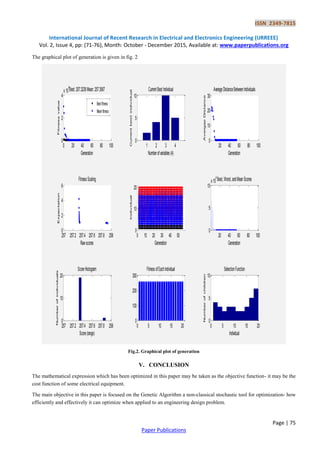
It may be observed from the table of convergence and the graphical plot that GA reaches the optimal solution very fast
and steady, creating so many generations and uses large search space.
Engineering Design problem requires global minima; otherwise optimization cannot give fruitful result on which the vale
of the objective function depends.
It can be very much effective for mass production. So, Genetic Algorithm may be chosen as one of the best tools for
optimizing an engineering design problem.
REFERENCES
[1] Kalyanmoy Deb, “Optimization for engineering design”, PHI Pvt.Ltd. 1998.
[2] Parkinson, A.RBalling, R. and Hedengren, J.D. “Optimization Methods for Engineering Design”, Brigham Young
University, 2013.
[3] M. Ramamoorty, “Computer-aided design of electrical equipment”, Affiliated East-West Press Pvt. Ltd. New Delhi
– 110 002, 1987, ISBN 81-85095-57-4
[4] A.K Sawhney “A course in electrical machine design”, DhanpatRai& Sons, Delhi – 110 001
[5] H.M. Rai “Principles of electrical machine design”, SatyaPrakashan, New Delhi, 1985
[6] S.S. Rao, “Engineering optimization - theory and practice”, Third Edition, New Age International (P) Ltd.,1996
[7] D E. Goldberg, “Genetic Algorithms in search, optimization and machine learning”, Pearson Education, South Asia,
Sixth Impression, 2011, ISBN 978-81-775-8829-3.
[8] S. Rajasekaran, Vijayalakshmi Pai, G.A, “Neural Network, Fuzzy Logic, Genetic Algorithms- synthesis and
application”, Fourth edition, ISBN 81-203-2186-3, PHI Pvt. Ltd, New Delhi – 110 001.
[9] N.S. Kambo, “Mathematical programming techniques”, Revised Edition, 1991, 1984, affiliated East-West Press Pvt.
Ltd. New Delhi – 110 001, ISBN 81-85336-47-4.
[10] R. Bansal K,Goel A,K,Sharma M.K –“MATLAB and its application in engineering”, First Impression, Pearson
Education in South Asia, ISBN 978-81-317-1681-6, New Delhi – 110 001.
[11] L. Hui, H. Li, H. Bei, and Y. Shunchang, “Application research based on improved genetic algorithm for optimum
design of power transformers,” in Proc. 5th Int. Conf. Electrical Machines and Systems, Vol. 1, pp. 242–245, 2001
[12] Li Hui, Han Li, He Bei, Y.Shunchang, “Application research based on Improved Genetic Algorithm for Optimum
Design of Power Transformers”, IEEE Transactions on Power Systems, Vol. 3, No. 2, pp. 105-109, February, 2000.](https://image.slidesharecdn.com/performanceanalysis-546-170328052026/85/Performance-Analysis-of-Genetic-Algorithm-as-a-Stochastic-Optimization-Tool-in-Engineering-Design-Problems-6-320.jpg)


