ISSN 2349-7815
International Journal of Recent Research in Electrical and Electronics Engineering (IJRREEE)
Vol. 2, Issue 3, pp: (11-19), Month: July 2015 - September 2015, Available at: www.paperpublications.org
Page | 11
Paper Publications
RELIABILITY BASED POWER
DISTRIBUTION SYSTEMS PLANNING
USING CREDIBILITY THEORY
1
M. Azhar Khan, 2
Dr. Shailja Shukla
1
Research Scholar, Electrical Department, Jabalpur (Govt.) Engineering, College, Jabalpur, India
2
HOD, Computer Science Department, Jabalpur (Govt.) Engineering, College, Jabalpur, India
Abstract: This paper presents an analytical technique for distribution system planning based on reliability
evaluation using credibility theory. With the development of economy and society power planning is facing with
the influence of much uncertainty, which are mainly power distribution network. Power system especially at the
distribution level is prone to failures and disturbances as many devices are responsible for the successful operation
of a radial distribution system. We also mention whether the work has been done at the strategic level, i.e. if it
concerns the planning of power distribution system based on reliability and uncertainty.
Keywords: Power Distribution system, Credibility Theory, Reliability evaluation.
I. INTRODUCTION
The increased demand of reliable power with which system are designed, power distribution company need for higher
reliable and lower operational costs, are forcing companies to continuously search for ways to improve their performance.
Reliability models decision support systems and uncertainty analysis tools are examples of approaches taken by system in
a challenge to develop their operational performance and remain competitive in the threat of competition. Godfrey et al
(1996) identified three major issues for the implementation of reliability planning. Reliability data Customer damage
function data reliability analysis software to these have been added: Policy Business process Research Skills
development. All of these aspects present challenges for distribution planners because of a history of no or only limited
reliability assessments. Billinton et al (1984) and Ajodhia (2002) had been studied a lack of data on distribution system
reliability and customer impact has forced planners to adopt deterministic approaches to system planning and, historically,
redundancy-planning decisions have been based on simple rules. New requirements to assess the reliability constraints of
reinforcement alternatives need quantitative reliability analysis as well as uncertainty to use the results for decision-
making.
Khator et al (1997) developed a power distribution planning is a complex task in which planners must ensure that there is
adequate substation capacity (transformer capacity) and feeder capacity (distribution capacity) to meet the load demands.
Decisions such as allocation of power flow, installation of feeders and substations, and procurement of transformers are
costly ones which must be evaluated carefully. The review of research problems as well as models related to the planning
of substations and/or distribution feeders. Sagar et al (2013) described the concept and characteristics of smart grid
distribution systems, basic difference between conventional and smart grid distribution systems, functional management
and reliability evaluation of smart grid distribution systems. In smart grid distribution system, remotely controlled high
rated power electronic switches were used in the place of normal disconnecting switches on feeder. In normal operation of
distribution system, these act as normally closed switches. Firuzabad et al (2009) presented a preventive maintenance
application-based study and modeling of failure rates in breakers of electrical distribution systems. They were considered
as a part of a Reliability Centered Maintenance application program. A number of load point reliability indices were
derived using the mathematical model of the failure rate, which is established using the observed data in a distribution
ISSN 2349-7815
International Journal of Recent Research in Electrical and Electronics Engineering (IJRREEE)
Vol. 2, Issue 3, pp: (11-19), Month: July 2015 - September 2015, Available at: www.paperpublications.org
Page | 12
Paper Publications
system. Lantharthong et al (2012) developed a reliability evaluation technique which was applied in distribution system
planning studies and operation. Reliability evaluation of distribution systems has been the subject of many recent papers
and the modeling and evaluation techniques had been improved considerably. J. Ramírez et al (2004) were presented a
new possibilistic (fuzzy) model for the multiobjective optimal planning of power distribution networks that finds out the
nondominated multiobjective solutions corresponding to the simultaneous optimization of the fuzzy economic cost, level
of fuzzy reliability, and exposure (optimization of robustness) of such networks, using an original and powerful meta-
heuristic algorithm based on Tabu Search. The model also allows determining the optimal reserve feeders that provided
the best distribution network reliability at the lowest cost for a given level of robustness. The model had been intensively
tested in real distribution networks, which proves their practical application to large power distribution systems.
Billinton et al (2006) illustrated weather environment can severely impact the performance of an overhead distribution
system and an electric utility‟s operational ability. The likelihood of system failure increases due to enhanced line failure
rates during bad weather periods. Reliability appraisals without incorporating weather conditions can be quite optimistic
and affect planning and design decisions. Recognition of various weather contributions to the total system performance
indices help to pinpoint situations where investment may provide maximum reliability improvement. An approach was
presented to assess distribution system reliability in different weather conditions such as normal, adverse and extreme and
illustrated using a practical distribution system. Brown et al (1998) illustrated distribution system reliability assessment is
able to predict the interruption profile of a distribution system based on system topology and component reliability data.
Unfortunately, many utilities do not have enough historical component reliability data to perform such an assessment, and
are not confident that other sources of data are representative of their particular system. These utilities do not incorporate
distribution system reliability assessment into their design process and forego its significant advantages. He presented a
way of gaining confidence in a reliability model by developing a validation method. This method automatically
determines appropriate default component reliability data so that predicted reliability indices match historical values. The
result was a validated base case from which incremental design improvements can be explored. Allan et al (1991) had
been described an electrical distribution system for use in teaching power system reliability evaluation. It includes the
entire main element found in practical system. However, it was sufficiently small that studied can analyses it using hand
calculations and hence fully understand reliability models and evaluation techniques. The data needed to perform basic
reliability analyses. It also contains the basic results for a range of case studied and alternative design/operating
configurations. Nahman et al (2003) studied effects of uncertain input data on the performance evaluation of a distribution
system are analyzed. A criterion was introduced for assessing the grade of uncertainty of the results obtained in the
calculation of maximum loads, voltage drops, energy losses, and characteristic reliability indices of a network if some
input parameters are only guesses based on limited experience, measurements, and/or statistical data. Reasonable outputs
bounds are determined based upon the shape of the function measuring the uncertainty. High uncertainty of a result
obtained indicates that a re-examination of relevant uncertain input data would be recommendable for a more precise
quantification. The method proposed was applied to a real life example for illustration.
II. CREDIBILITY THEORY
Credibility Theory is the cornerstones of actuarial science as applied to evaluate power distribution system reliability. The
word credibility was originally introduced into actuarial science as a measure of the credence that the actuary believes
should be attached to a particular body of experience for rate making purposes. Thus we say that the loss experience under
a new class of insurance is "still too small to be credible", implying that the experience which will develop in the future
may well be very different from that so far collected, and also implying that we have more confidence in our prior
knowledge based on other data such as current rates for similar classes. Again, the statement that the private passenger
automobile liability experience in Pennsylvania is "fully credible for rate making", implies that the experience, after
adjustment by trend factors, is adequate to establish the overall rate level in the state without reference to previous rates or
data or to experience in other states. In many cases a body of data is too small to be fully credible but large enough to
have some credibility. A scale of credibility has been established which gives 0 credibility to data too small to be any use
for rate making and credibility to data which are fully credible.
A. Least squares credibility:
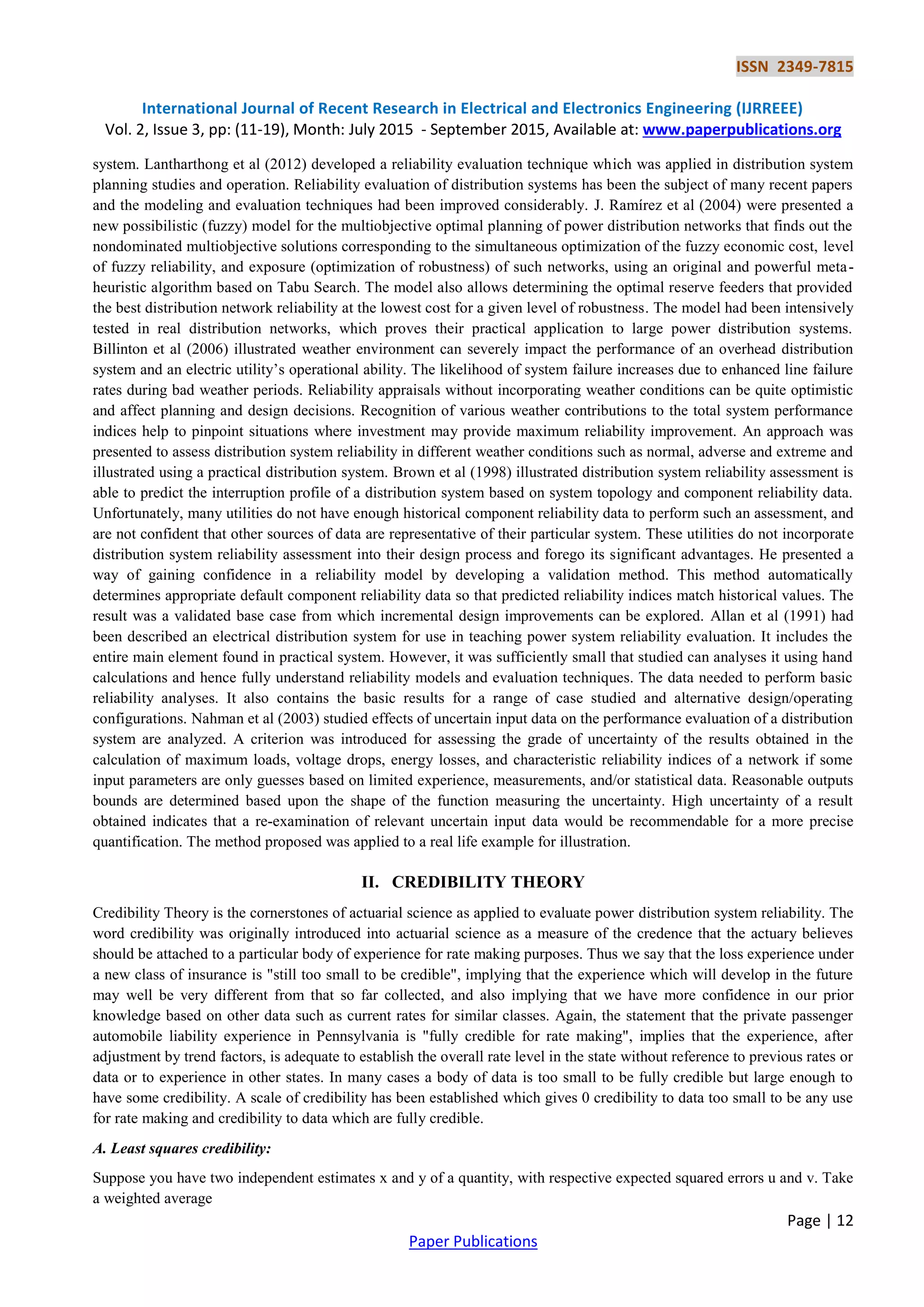
Suppose you have two independent estimates x and y of a quantity, with respective expected squared errors u and v. Take
a weighted average
ISSN 2349-7815
International Journal of Recent Research in Electrical and Electronics Engineering (IJRREEE)
Vol. 2, Issue 3, pp: (11-19), Month: July 2015 - September 2015, Available at: www.paperpublications.org
Page | 13
Paper Publications
.
The expected squared error of „a‟ is
for z minimizes w.
⁄ .
If you set that to zero you get: , or . Then is .This makes it look like each
estimate gets a weight proportional to the expected squared error of the other. To express the weights as properties of the
estimates themselves, note that
[ ] [ ]
. This shows that each estimate gets a weight proportional to the
reciprocal of its expected squared error 1. Least squares credibility is an application of this principle.
B. Non Linear Estimation:
So far this discussion has been non-parametric. That is, the forms of the distributions have not entered in. That is the
advantage of linear estimates with squared error penalties. If you have some information about the type of distribution
available, you can give up the restriction to linear functions. In a Bayesian framework the class experience becomes the
prior distribution for the member experience, and then the Bayesian conditional expected value of the member mean
given the data is the least squares estimator of the member mean of any sort, linear or not. Feng et al (2008) in some cases
the conditional mean is a linear function of the data (e.g., normal and gamma distributions) so the linear restriction of
credibility theory does not reduce the accuracy. However in highly skewed distributions, like some lognormal cases, the
Bayes estimate is highly non-linear, and credibility weighting can give large errors for classes with small means. If the
distribution type is fairly well understood, Bayesian methods would be preferable in such cases. However, an alternative
when the member means can be very different from each other is to do the usual credibility estimation in the logs of the
data, then exponentiate the results. This introduces a downward bias, however, which has to be adjusted multiplicatively
to balance to the overall data.
C. Credibility Measure of Fuzzy Event:
A few no stochastic but uncertain phenomena in power systems can be modeled as fuzzy variables. Let be a nonempty
set, the power set of and ̃ is a fuzzy variable with the membership function ̃ . The possibility of a fuzzy
event is defined as , { } ,where is the supremum operator. The necessity measure is
defined as , { } { }, where is the complement. Obviously, and are one pair of dual measure
Baoding et al(2002).
In order to give a self-dual measure for fuzzy events, a credibility measure Cr is defined as follows
It is easy to verify that . { } { } The fuzzy event must hold if its credibility is 1, and fail if its credibility is 0.
Theorem 1: Relationship between the credibility measure and membership function
Definition: Let ̃be a fuzzy variable; then the possibility, the necessity, and the credibility of the fuzzy event Aare
expressed as follows:
{ } ̃
{ } ̃
{ } { } { }
Where ̃ is membership function of ̃.
In traditional fuzzy set theory, possibility measure is considered to be a parallel concept of probability measure. But it
does not possess self-duality: when Pos {A} = 1, fuzzy event A is not always true; when Nec{A} = 0, A may also be true.
ISSN 2349-7815
International Journal of Recent Research in Electrical and Electronics Engineering (IJRREEE)
Vol. 2, Issue 3, pp: (11-19), Month: July 2015 - September 2015, Available at: www.paperpublications.org
Page | 14
Paper Publications
In order to solve this problem, Liu et al (2002). In this theory, credibility measure which corresponds to probability
measure in probability theory possesses self-duality and monotonicity – when Cr {A} = 1, fuzzy event A is inevitably
true; otherwise it is false.
III. MODELING OF FUZZY FACTORS
The component failure rate and repair time is normally used to measure the probability of failure and repair of a particular
component. While component status in the future and repair is not predictable, the failure rate ad repair time of such
component can be obtained from historical data in addition to failure rate and repair time can be modeled by triangular
fuzzy variable for failure rate is and fuzzy variable for repair time is [ ].
For failure rate
{
And repair time
{
The triangle membership function of failure rate & repair time can be easily created. The point estimate corresponds to
1.0 of the membership function grade. The significant level is always a small percentage such as 0.05 (5%). The half of α
is located at each of the two bounds in the t-distribution. Conceptually, the significant level is somewhat similar to the
fuzzy degree represented by the membership function grade since both of them reflect a subjective confidence. Therefore,
it can be assumed that the lower and higher bounds obtained from (5&6) correspond to the two points ( and ) in the
membership function that has a membership grade of (such as 0.1) With the three points of ( ), , and ,
the two linear algebraic equations in the form of can be built and the two end points (a, 0) and (b, 0) in the
membership function can be calculated. When is so small (0.025), a and should be very close and so are b and .
In other words, it is also acceptable to directly use and as the two end points of the membership function.
̆
0 (f/yr)
Fig. 1. Membership function of failure rate
Figure 1. Membership function
ISSN 2349-7815
International Journal of Recent Research in Electrical and Electronics Engineering (IJRREEE)
Vol. 2, Issue 3, pp: (11-19), Month: July 2015 - September 2015, Available at: www.paperpublications.org
Page | 15
Paper Publications
IV. RELIABILITY INDICES
Power distribution systems are often radial and consist of series connections of components like lines, transformers,
isolating switches, fuses, etc. This is important to evaluate the service continuity requires in between power resource and
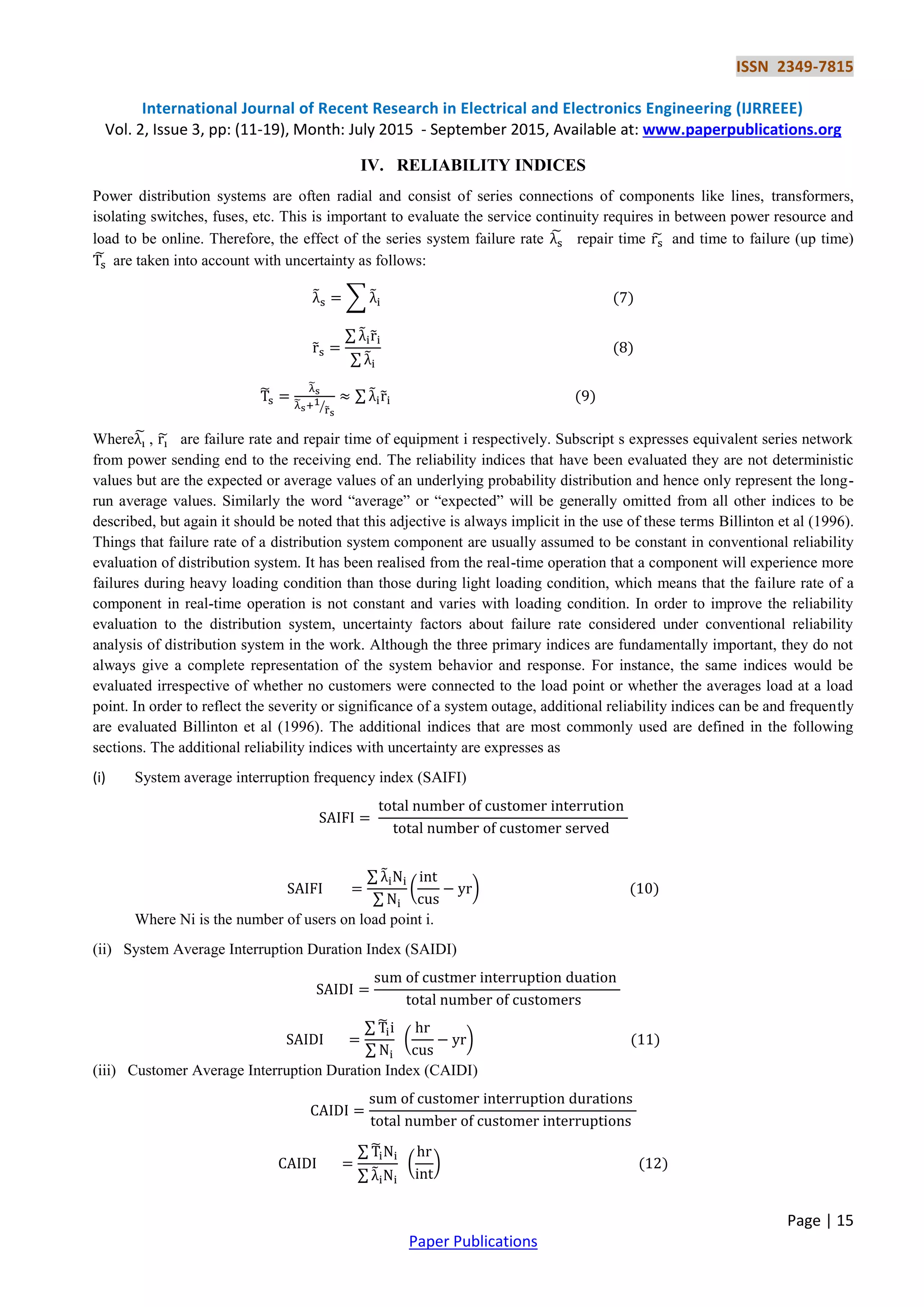
load to be online. Therefore, the effect of the series system failure rate ̃ repair time ̃ and time to failure (up time)
̃ are taken into account with uncertainty as follows:
̃ ∑ ̃
̃
∑ ̃ ̃
∑ ̃
̃
̃
̃
̃⁄
∑ ̃ ̃
Wherẽ , ̃ are failure rate and repair time of equipment i respectively. Subscript s expresses equivalent series network
from power sending end to the receiving end. The reliability indices that have been evaluated they are not deterministic
values but are the expected or average values of an underlying probability distribution and hence only represent the long-
run average values. Similarly the word “average” or “expected” will be generally omitted from all other indices to be
described, but again it should be noted that this adjective is always implicit in the use of these terms Billinton et al (1996).
Things that failure rate of a distribution system component are usually assumed to be constant in conventional reliability
evaluation of distribution system. It has been realised from the real-time operation that a component will experience more
failures during heavy loading condition than those during light loading condition, which means that the failure rate of a
component in real-time operation is not constant and varies with loading condition. In order to improve the reliability
evaluation to the distribution system, uncertainty factors about failure rate considered under conventional reliability
analysis of distribution system in the work. Although the three primary indices are fundamentally important, they do not
always give a complete representation of the system behavior and response. For instance, the same indices would be
evaluated irrespective of whether no customers were connected to the load point or whether the averages load at a load
point. In order to reflect the severity or significance of a system outage, additional reliability indices can be and frequently
are evaluated Billinton et al (1996). The additional indices that are most commonly used are defined in the following
sections. The additional reliability indices with uncertainty are expresses as
(i) System average interruption frequency index (SAIFI)
∑ ̃
∑
( )
Where Ni is the number of users on load point i.
(ii) System Average Interruption Duration Index (SAIDI)
∑ ̃
∑
( )
(iii) Customer Average Interruption Duration Index (CAIDI)
∑ ̃
∑ ̃
( )
ISSN 2349-7815
International Journal of Recent Research in Electrical and Electronics Engineering (IJRREEE)
Vol. 2, Issue 3, pp: (11-19), Month: July 2015 - September 2015, Available at: www.paperpublications.org
Page | 16
Paper Publications
Distribution system planning:
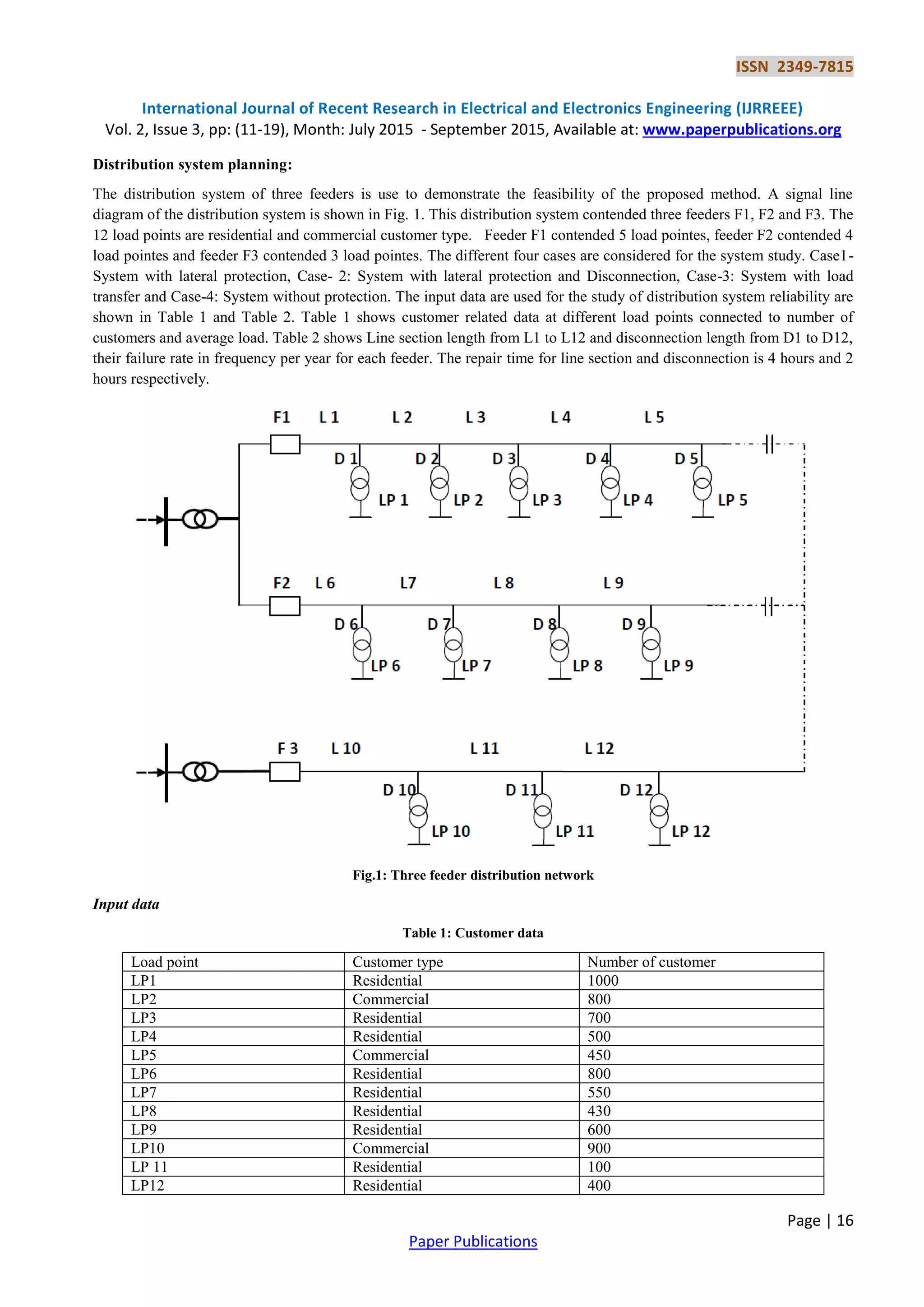
The distribution system of three feeders is use to demonstrate the feasibility of the proposed method. A signal line
diagram of the distribution system is shown in Fig. 1. This distribution system contended three feeders F1, F2 and F3. The
12 load points are residential and commercial customer type. Feeder F1 contended 5 load pointes, feeder F2 contended 4
load pointes and feeder F3 contended 3 load pointes. The different four cases are considered for the system study. Case1-
System with lateral protection, Case- 2: System with lateral protection and Disconnection, Case-3: System with load
transfer and Case-4: System without protection. The input data are used for the study of distribution system reliability are
shown in Table 1 and Table 2. Table 1 shows customer related data at different load points connected to number of
customers and average load. Table 2 shows Line section length from L1 to L12 and disconnection length from D1 to D12,
their failure rate in frequency per year for each feeder. The repair time for line section and disconnection is 4 hours and 2
hours respectively.
Fig.1: Three feeder distribution network
Input data
Table 1: Customer data
Load point Customer type Number of customer
LP1 Residential 1000
LP2 Commercial 800
LP3 Residential 700
LP4 Residential 500
LP5 Commercial 450
LP6 Residential 800
LP7 Residential 550
LP8 Residential 430
LP9 Residential 600
LP10 Commercial 900
LP 11 Residential 100
LP12 Residential 400
ISSN 2349-7815
International Journal of Recent Research in Electrical and Electronics Engineering (IJRREEE)
Vol. 2, Issue 3, pp: (11-19), Month: July 2015 - September 2015, Available at: www.paperpublications.org
Page | 17
Paper Publications
Table 2: Line section length and failure rate
Feeder no. 1 data Feeder no. 2data Feeder no. 3 data
Enter line
section
length
in km
length
Failure rate
(in f/yr.)
Enter line
section
length
in km
length
Failure
rate (in
f/yr.)
Enter line
section
length
in km
length
Failure
rate (in
f/yr.)
L1 2 0.2 L6 4 0.4 L10 5 0.5
L2 1 0.1 L7 2 0.2 L11 7 0.7
L3 3 0.3 L8 4 0.4 L12 4 0.4
L4 2 0.2 L9 3 0.3 --- --
L5 1 0.1 --- -- --- --
D1 1 0.2 D6 3 0.6 D10 3 0.6
D2 3 0.6 D7 2 0.4 D11 4 0.8
D3 2 0.4 D8 4 0.8 D12 2 0.4
D4 1 0.2 D9 1 0.2 --- --
D5 3 0.6 --- -- --- --
V. RESULT
The equipment failure rate and repair time are fuzzified by triangular membership function and minimum alpha cut are
used in this work. The fuzzy expected failure rate and repair time are used to evaluate reliability indices and their
corresponding credibility. The reliability indices evaluated for this study are System Average Interruption Frequency
Index. System Average Interruption frequency index (SAIFI), System Average Interruption Duration Index (SAIDI),
Customer Average Interruption Duration Index (CAIDI). The result obtained from the proposed method has been
compared with the traditional methods Billinton et al (1996). A comparison of traditional method and proposed method
the results obtained each three feeder for the four case studies are show in Table 3.
Table 3: Comparative Reliability Indices for Traditional Method and Proposed Method
SAIFI SAIFI SAIDI SAIDI CAIDI C AIDI
Case 1 Traditional
method
Result obtain by
proposed method
Traditional
method
Result obtain by
proposed method
Traditional
method
Result obtain by
proposed method
F1 1.7891 1.7152 6.1782 6.1144 3.4533 3.4089
F2 1.8831 1.80322 6.2732 6.21244 3.5633 3.51998
F3 2.1571 2.9422 7.5143 7.4672 3.4834 3.4398
SYS 1.6201 1.5858 5.5746 5.5387 3.441 3.4021
Case 2
F1 1.2855 1.22978 2.9101 2.88233 2.2638 2.21787
F2 1.7891 1.74978 4.3634 4.32987 2.4389 2.393526
F3 2.1571 2.1366 4.9393 4.902321 2.2897 2.227998
SYS 1.6201 1.61433 3.7815 3.71868 2.3342 2.303885
Case 3
F1 1.2855 1.216878 2.2832 2.2397 1.7761 1.72978
F2 1.7891 1.73879 3.4123 3.38786 1.9073 1.87325
F3 2.1571 2.11987 4.1443 4.128779 1.9212 1.89377
SYS 1.6201 1.597896 3.2152 3.18839 1.8612 1.836754
Case 4
F1 2.9 2.87463 7.6 7.57021 2.6207 2.596732
F2 3.3 3.25987 9.2 9.17023 2.7879 2.722787
F3 3.4 3.36997 10 9.9783 2.9412 2.877357
SYS 3.1285 3.0993789 8.5914 8.547862 2.7462 2.717649
In our approach equipment failure and repair time are uncertain, so reliability indices will also not assured. Thus
credibility also a good in addition to fuzzy expected of reliability indices. The credibility is evaluated for eight cases of
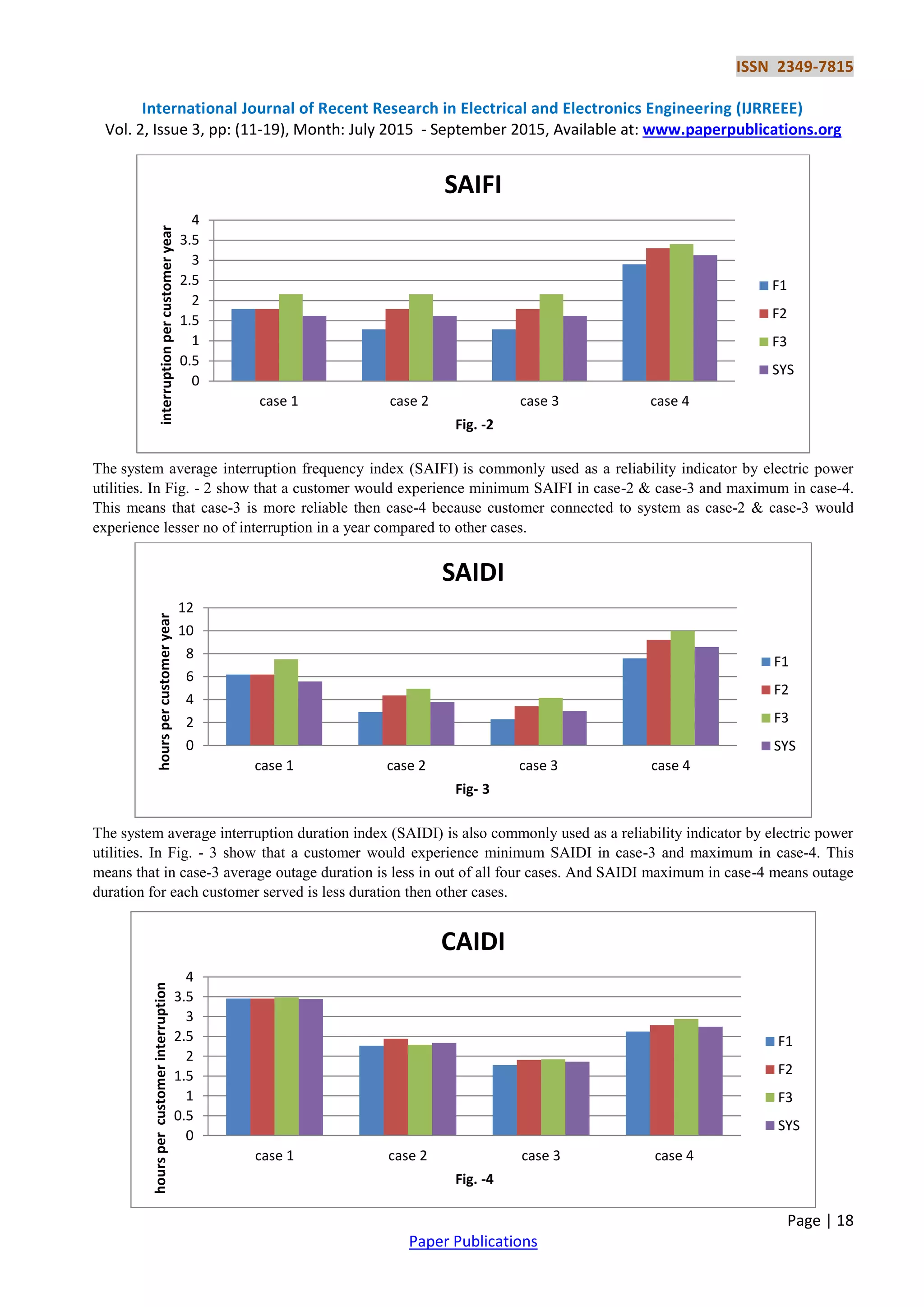
each distribution system reliability indices. The result obtained by this technique is shown in Fig. 2 to Fig. 4.
ISSN 2349-7815
International Journal of Recent Research in Electrical and Electronics Engineering (IJRREEE)
Vol. 2, Issue 3, pp: (11-19), Month: July 2015 - September 2015, Available at: www.paperpublications.org
Page | 18
Paper Publications
The system average interruption frequency index (SAIFI) is commonly used as a reliability indicator by electric power
utilities. In Fig. - 2 show that a customer would experience minimum SAIFI in case-2 & case-3 and maximum in case-4.
This means that case-3 is more reliable then case-4 because customer connected to system as case-2 & case-3 would
experience lesser no of interruption in a year compared to other cases.
The system average interruption duration index (SAIDI) is also commonly used as a reliability indicator by electric power
utilities. In Fig. - 3 show that a customer would experience minimum SAIDI in case-3 and maximum in case-4. This
means that in case-3 average outage duration is less in out of all four cases. And SAIDI maximum in case-4 means outage
duration for each customer served is less duration then other cases.
0
0.5
1
1.5
2
2.5
3
3.5
4
case 1 case 2 case 3 case 4
interruptionpercustomeryear
Fig. -2
SAIFI
F1
F2
F3
SYS
0
2
4
6
8
10
12
case 1 case 2 case 3 case 4
hourspercustomeryear
Fig- 3
SAIDI
F1
F2
F3
SYS
0
0.5
1
1.5
2
2.5
3
3.5
4
case 1 case 2 case 3 case 4
hourspercustomerinterruption
Fig. -4
CAIDI
F1
F2
F3
SYS
ISSN 2349-7815
International Journal of Recent Research in Electrical and Electronics Engineering (IJRREEE)
Vol. 2, Issue 3, pp: (11-19), Month: July 2015 - September 2015, Available at: www.paperpublications.org
Page | 19
Paper Publications
The customer average interruption duration index (CAIDI) is gives the average outage duration that any given customer
would experience. CAIDI can also be viewed as the average restoration time. In Fig-.4 shows that a customer would
experience minimum CAIDI in case-3 and maximum in case-1. The customer of case-3 would experience minimum
average restoration time/outage duration then other cases.
REFERENCES
[1] E.V. Sagar and P.V.N.Prasad, “Reliability Improvement of Radial Distribution System with Smart Grid
Technology” Proceedings of the World Congress on Engineering and Computer Science, Vol I WCECS,pag. 23-25,
2013.
[2] J. Nahman and D. Peric, “Distribution System Performance Evaluation Accounting for Data Uncertainty” IEEE
Transactions On Power Delivery, Vol. 18, No. 3, July 2003.
[3] M. F. Firuzabad, and S. Afshar, “Reliability analysis in Electrical Distribution System considering preventive
Maintenance Applications on Circuit Breakers” World Academy of Science, Engineering and Technology 25 2009.
[4] R. Billinton and J.R. Acharya, “Weather-based distribution system reliability evaluation” IEE Proc.-Gener. Transm.
Distrib., Vol. 153, No. 5, September 2006.
[5] R. Billinton, R. N. Allan, “Reliability Evaluation of Power System”, Pitman Books, New York and London, 1984.
[6] R. M. Godfrey, R. Billinton, “Guide to Value-Based Distribution Reliability Planning” Volume I, Canadian
Electricity Association, 3-46 – 3-51, 1996.
[7] R. N. Allan, R. Billinton, I. Sjarief, L. Goel and K.S. So, “A Reliability test system for educational purposes basic
distribution system data and results” IEEE transactions on power system vol.6,No,2 May 1991.
[8] R. E. Brown and J.R. Ochoa, “Distribution System Reliability:Default Data and Model Validation” IEEE
Transactions on Power Systems, Vol. 13, No. 2, May 1998.
[9] K. Suresh, Khator and C. Lawrence, Leung, “Power Distribution Planning: A Review of Models and Issues”, IEEE
Transactions on Power Systems, Vol. 12, No. 3, pp 1151-1159, August 1997.
[10] T. Lantharthong, and N. Phanthuna, “Techniques for Reliability Evaluation in Distribution System Planning” World
Academy of Science, Engineering and Technology Vol:64 27-04-2012.
[11] V. Ajodhia, “Cost Reliability and Regulation in Electricity Networks: Mapping The Issues”, IEE Power System
Management and Control. IEE, No.488, 2002.
[12] R. Rosado, J.Ignacio, and J. A. D. Navarro, “Possibilistic Model Based on Fuzzy Sets for the Multiobjective
Optimal Planning of Electric Power Distribution Networks” IEEE Transactions On Power Systems, Vol. 19, No. 4,
November 2004.
[13] R. Billinton and R. N. Allan, “Reliability Evaluation of Power Systems (2nd
Edition),” New York: Plenum. 1996.
[14] Feng Yongqing, wenchuan wu, B. Zhang, W. Li “Power System Operation Risk Assessment Using Credibility
Theory,” IEEE Transactions on Power Systems, vol. 23, no. 3, august 2008.
[15] L. Baoding and L. Yian-Kui, “Expected value of fuzzy variable and fuzzy expected value models,” IEEE Trans.
Fuzzy Syst., vol. 10, no. 4, pp. 445–450, Aug. 2002.

RELIABILITY BASED POWER DISTRIBUTION SYSTEMS PLANNING USING CREDIBILITY THEORY

  • 1.
    ISSN 2349-7815 International Journalof Recent Research in Electrical and Electronics Engineering (IJRREEE) Vol. 2, Issue 3, pp: (11-19), Month: July 2015 - September 2015, Available at: www.paperpublications.org Page | 11 Paper Publications RELIABILITY BASED POWER DISTRIBUTION SYSTEMS PLANNING USING CREDIBILITY THEORY 1 M. Azhar Khan, 2 Dr. Shailja Shukla 1 Research Scholar, Electrical Department, Jabalpur (Govt.) Engineering, College, Jabalpur, India 2 HOD, Computer Science Department, Jabalpur (Govt.) Engineering, College, Jabalpur, India Abstract: This paper presents an analytical technique for distribution system planning based on reliability evaluation using credibility theory. With the development of economy and society power planning is facing with the influence of much uncertainty, which are mainly power distribution network. Power system especially at the distribution level is prone to failures and disturbances as many devices are responsible for the successful operation of a radial distribution system. We also mention whether the work has been done at the strategic level, i.e. if it concerns the planning of power distribution system based on reliability and uncertainty. Keywords: Power Distribution system, Credibility Theory, Reliability evaluation. I. INTRODUCTION The increased demand of reliable power with which system are designed, power distribution company need for higher reliable and lower operational costs, are forcing companies to continuously search for ways to improve their performance. Reliability models decision support systems and uncertainty analysis tools are examples of approaches taken by system in a challenge to develop their operational performance and remain competitive in the threat of competition. Godfrey et al (1996) identified three major issues for the implementation of reliability planning. Reliability data Customer damage function data reliability analysis software to these have been added: Policy Business process Research Skills development. All of these aspects present challenges for distribution planners because of a history of no or only limited reliability assessments. Billinton et al (1984) and Ajodhia (2002) had been studied a lack of data on distribution system reliability and customer impact has forced planners to adopt deterministic approaches to system planning and, historically, redundancy-planning decisions have been based on simple rules. New requirements to assess the reliability constraints of reinforcement alternatives need quantitative reliability analysis as well as uncertainty to use the results for decision- making. Khator et al (1997) developed a power distribution planning is a complex task in which planners must ensure that there is adequate substation capacity (transformer capacity) and feeder capacity (distribution capacity) to meet the load demands. Decisions such as allocation of power flow, installation of feeders and substations, and procurement of transformers are costly ones which must be evaluated carefully. The review of research problems as well as models related to the planning of substations and/or distribution feeders. Sagar et al (2013) described the concept and characteristics of smart grid distribution systems, basic difference between conventional and smart grid distribution systems, functional management and reliability evaluation of smart grid distribution systems. In smart grid distribution system, remotely controlled high rated power electronic switches were used in the place of normal disconnecting switches on feeder. In normal operation of distribution system, these act as normally closed switches. Firuzabad et al (2009) presented a preventive maintenance application-based study and modeling of failure rates in breakers of electrical distribution systems. They were considered as a part of a Reliability Centered Maintenance application program. A number of load point reliability indices were derived using the mathematical model of the failure rate, which is established using the observed data in a distribution
  • 2.
    ISSN 2349-7815 International Journalof Recent Research in Electrical and Electronics Engineering (IJRREEE) Vol. 2, Issue 3, pp: (11-19), Month: July 2015 - September 2015, Available at: www.paperpublications.org Page | 12 Paper Publications system. Lantharthong et al (2012) developed a reliability evaluation technique which was applied in distribution system planning studies and operation. Reliability evaluation of distribution systems has been the subject of many recent papers and the modeling and evaluation techniques had been improved considerably. J. Ramírez et al (2004) were presented a new possibilistic (fuzzy) model for the multiobjective optimal planning of power distribution networks that finds out the nondominated multiobjective solutions corresponding to the simultaneous optimization of the fuzzy economic cost, level of fuzzy reliability, and exposure (optimization of robustness) of such networks, using an original and powerful meta- heuristic algorithm based on Tabu Search. The model also allows determining the optimal reserve feeders that provided the best distribution network reliability at the lowest cost for a given level of robustness. The model had been intensively tested in real distribution networks, which proves their practical application to large power distribution systems. Billinton et al (2006) illustrated weather environment can severely impact the performance of an overhead distribution system and an electric utility‟s operational ability. The likelihood of system failure increases due to enhanced line failure rates during bad weather periods. Reliability appraisals without incorporating weather conditions can be quite optimistic and affect planning and design decisions. Recognition of various weather contributions to the total system performance indices help to pinpoint situations where investment may provide maximum reliability improvement. An approach was presented to assess distribution system reliability in different weather conditions such as normal, adverse and extreme and illustrated using a practical distribution system. Brown et al (1998) illustrated distribution system reliability assessment is able to predict the interruption profile of a distribution system based on system topology and component reliability data. Unfortunately, many utilities do not have enough historical component reliability data to perform such an assessment, and are not confident that other sources of data are representative of their particular system. These utilities do not incorporate distribution system reliability assessment into their design process and forego its significant advantages. He presented a way of gaining confidence in a reliability model by developing a validation method. This method automatically determines appropriate default component reliability data so that predicted reliability indices match historical values. The result was a validated base case from which incremental design improvements can be explored. Allan et al (1991) had been described an electrical distribution system for use in teaching power system reliability evaluation. It includes the entire main element found in practical system. However, it was sufficiently small that studied can analyses it using hand calculations and hence fully understand reliability models and evaluation techniques. The data needed to perform basic reliability analyses. It also contains the basic results for a range of case studied and alternative design/operating configurations. Nahman et al (2003) studied effects of uncertain input data on the performance evaluation of a distribution system are analyzed. A criterion was introduced for assessing the grade of uncertainty of the results obtained in the calculation of maximum loads, voltage drops, energy losses, and characteristic reliability indices of a network if some input parameters are only guesses based on limited experience, measurements, and/or statistical data. Reasonable outputs bounds are determined based upon the shape of the function measuring the uncertainty. High uncertainty of a result obtained indicates that a re-examination of relevant uncertain input data would be recommendable for a more precise quantification. The method proposed was applied to a real life example for illustration. II. CREDIBILITY THEORY Credibility Theory is the cornerstones of actuarial science as applied to evaluate power distribution system reliability. The word credibility was originally introduced into actuarial science as a measure of the credence that the actuary believes should be attached to a particular body of experience for rate making purposes. Thus we say that the loss experience under a new class of insurance is "still too small to be credible", implying that the experience which will develop in the future may well be very different from that so far collected, and also implying that we have more confidence in our prior knowledge based on other data such as current rates for similar classes. Again, the statement that the private passenger automobile liability experience in Pennsylvania is "fully credible for rate making", implies that the experience, after adjustment by trend factors, is adequate to establish the overall rate level in the state without reference to previous rates or data or to experience in other states. In many cases a body of data is too small to be fully credible but large enough to have some credibility. A scale of credibility has been established which gives 0 credibility to data too small to be any use for rate making and credibility to data which are fully credible. A. Least squares credibility: Suppose you have two independent estimates x and y of a quantity, with respective expected squared errors u and v. Take a weighted average
  • 3.
    ISSN 2349-7815 International Journalof Recent Research in Electrical and Electronics Engineering (IJRREEE) Vol. 2, Issue 3, pp: (11-19), Month: July 2015 - September 2015, Available at: www.paperpublications.org Page | 13 Paper Publications . The expected squared error of „a‟ is for z minimizes w. ⁄ . If you set that to zero you get: , or . Then is .This makes it look like each estimate gets a weight proportional to the expected squared error of the other. To express the weights as properties of the estimates themselves, note that [ ] [ ] . This shows that each estimate gets a weight proportional to the reciprocal of its expected squared error 1. Least squares credibility is an application of this principle. B. Non Linear Estimation: So far this discussion has been non-parametric. That is, the forms of the distributions have not entered in. That is the advantage of linear estimates with squared error penalties. If you have some information about the type of distribution available, you can give up the restriction to linear functions. In a Bayesian framework the class experience becomes the prior distribution for the member experience, and then the Bayesian conditional expected value of the member mean given the data is the least squares estimator of the member mean of any sort, linear or not. Feng et al (2008) in some cases the conditional mean is a linear function of the data (e.g., normal and gamma distributions) so the linear restriction of credibility theory does not reduce the accuracy. However in highly skewed distributions, like some lognormal cases, the Bayes estimate is highly non-linear, and credibility weighting can give large errors for classes with small means. If the distribution type is fairly well understood, Bayesian methods would be preferable in such cases. However, an alternative when the member means can be very different from each other is to do the usual credibility estimation in the logs of the data, then exponentiate the results. This introduces a downward bias, however, which has to be adjusted multiplicatively to balance to the overall data. C. Credibility Measure of Fuzzy Event: A few no stochastic but uncertain phenomena in power systems can be modeled as fuzzy variables. Let be a nonempty set, the power set of and ̃ is a fuzzy variable with the membership function ̃ . The possibility of a fuzzy event is defined as , { } ,where is the supremum operator. The necessity measure is defined as , { } { }, where is the complement. Obviously, and are one pair of dual measure Baoding et al(2002). In order to give a self-dual measure for fuzzy events, a credibility measure Cr is defined as follows It is easy to verify that . { } { } The fuzzy event must hold if its credibility is 1, and fail if its credibility is 0. Theorem 1: Relationship between the credibility measure and membership function Definition: Let ̃be a fuzzy variable; then the possibility, the necessity, and the credibility of the fuzzy event Aare expressed as follows: { } ̃ { } ̃ { } { } { } Where ̃ is membership function of ̃. In traditional fuzzy set theory, possibility measure is considered to be a parallel concept of probability measure. But it does not possess self-duality: when Pos {A} = 1, fuzzy event A is not always true; when Nec{A} = 0, A may also be true.
  • 4.
    ISSN 2349-7815 International Journalof Recent Research in Electrical and Electronics Engineering (IJRREEE) Vol. 2, Issue 3, pp: (11-19), Month: July 2015 - September 2015, Available at: www.paperpublications.org Page | 14 Paper Publications In order to solve this problem, Liu et al (2002). In this theory, credibility measure which corresponds to probability measure in probability theory possesses self-duality and monotonicity – when Cr {A} = 1, fuzzy event A is inevitably true; otherwise it is false. III. MODELING OF FUZZY FACTORS The component failure rate and repair time is normally used to measure the probability of failure and repair of a particular component. While component status in the future and repair is not predictable, the failure rate ad repair time of such component can be obtained from historical data in addition to failure rate and repair time can be modeled by triangular fuzzy variable for failure rate is and fuzzy variable for repair time is [ ]. For failure rate { And repair time { The triangle membership function of failure rate & repair time can be easily created. The point estimate corresponds to 1.0 of the membership function grade. The significant level is always a small percentage such as 0.05 (5%). The half of α is located at each of the two bounds in the t-distribution. Conceptually, the significant level is somewhat similar to the fuzzy degree represented by the membership function grade since both of them reflect a subjective confidence. Therefore, it can be assumed that the lower and higher bounds obtained from (5&6) correspond to the two points ( and ) in the membership function that has a membership grade of (such as 0.1) With the three points of ( ), , and , the two linear algebraic equations in the form of can be built and the two end points (a, 0) and (b, 0) in the membership function can be calculated. When is so small (0.025), a and should be very close and so are b and . In other words, it is also acceptable to directly use and as the two end points of the membership function. ̆ 0 (f/yr) Fig. 1. Membership function of failure rate Figure 1. Membership function
  • 5.
    ISSN 2349-7815 International Journalof Recent Research in Electrical and Electronics Engineering (IJRREEE) Vol. 2, Issue 3, pp: (11-19), Month: July 2015 - September 2015, Available at: www.paperpublications.org Page | 15 Paper Publications IV. RELIABILITY INDICES Power distribution systems are often radial and consist of series connections of components like lines, transformers, isolating switches, fuses, etc. This is important to evaluate the service continuity requires in between power resource and load to be online. Therefore, the effect of the series system failure rate ̃ repair time ̃ and time to failure (up time) ̃ are taken into account with uncertainty as follows: ̃ ∑ ̃ ̃ ∑ ̃ ̃ ∑ ̃ ̃ ̃ ̃ ̃⁄ ∑ ̃ ̃ Wherẽ , ̃ are failure rate and repair time of equipment i respectively. Subscript s expresses equivalent series network from power sending end to the receiving end. The reliability indices that have been evaluated they are not deterministic values but are the expected or average values of an underlying probability distribution and hence only represent the long- run average values. Similarly the word “average” or “expected” will be generally omitted from all other indices to be described, but again it should be noted that this adjective is always implicit in the use of these terms Billinton et al (1996). Things that failure rate of a distribution system component are usually assumed to be constant in conventional reliability evaluation of distribution system. It has been realised from the real-time operation that a component will experience more failures during heavy loading condition than those during light loading condition, which means that the failure rate of a component in real-time operation is not constant and varies with loading condition. In order to improve the reliability evaluation to the distribution system, uncertainty factors about failure rate considered under conventional reliability analysis of distribution system in the work. Although the three primary indices are fundamentally important, they do not always give a complete representation of the system behavior and response. For instance, the same indices would be evaluated irrespective of whether no customers were connected to the load point or whether the averages load at a load point. In order to reflect the severity or significance of a system outage, additional reliability indices can be and frequently are evaluated Billinton et al (1996). The additional indices that are most commonly used are defined in the following sections. The additional reliability indices with uncertainty are expresses as (i) System average interruption frequency index (SAIFI) ∑ ̃ ∑ ( ) Where Ni is the number of users on load point i. (ii) System Average Interruption Duration Index (SAIDI) ∑ ̃ ∑ ( ) (iii) Customer Average Interruption Duration Index (CAIDI) ∑ ̃ ∑ ̃ ( )
  • 6.
    ISSN 2349-7815 International Journalof Recent Research in Electrical and Electronics Engineering (IJRREEE) Vol. 2, Issue 3, pp: (11-19), Month: July 2015 - September 2015, Available at: www.paperpublications.org Page | 16 Paper Publications Distribution system planning: The distribution system of three feeders is use to demonstrate the feasibility of the proposed method. A signal line diagram of the distribution system is shown in Fig. 1. This distribution system contended three feeders F1, F2 and F3. The 12 load points are residential and commercial customer type. Feeder F1 contended 5 load pointes, feeder F2 contended 4 load pointes and feeder F3 contended 3 load pointes. The different four cases are considered for the system study. Case1- System with lateral protection, Case- 2: System with lateral protection and Disconnection, Case-3: System with load transfer and Case-4: System without protection. The input data are used for the study of distribution system reliability are shown in Table 1 and Table 2. Table 1 shows customer related data at different load points connected to number of customers and average load. Table 2 shows Line section length from L1 to L12 and disconnection length from D1 to D12, their failure rate in frequency per year for each feeder. The repair time for line section and disconnection is 4 hours and 2 hours respectively. Fig.1: Three feeder distribution network Input data Table 1: Customer data Load point Customer type Number of customer LP1 Residential 1000 LP2 Commercial 800 LP3 Residential 700 LP4 Residential 500 LP5 Commercial 450 LP6 Residential 800 LP7 Residential 550 LP8 Residential 430 LP9 Residential 600 LP10 Commercial 900 LP 11 Residential 100 LP12 Residential 400
  • 7.
    ISSN 2349-7815 International Journalof Recent Research in Electrical and Electronics Engineering (IJRREEE) Vol. 2, Issue 3, pp: (11-19), Month: July 2015 - September 2015, Available at: www.paperpublications.org Page | 17 Paper Publications Table 2: Line section length and failure rate Feeder no. 1 data Feeder no. 2data Feeder no. 3 data Enter line section length in km length Failure rate (in f/yr.) Enter line section length in km length Failure rate (in f/yr.) Enter line section length in km length Failure rate (in f/yr.) L1 2 0.2 L6 4 0.4 L10 5 0.5 L2 1 0.1 L7 2 0.2 L11 7 0.7 L3 3 0.3 L8 4 0.4 L12 4 0.4 L4 2 0.2 L9 3 0.3 --- -- L5 1 0.1 --- -- --- -- D1 1 0.2 D6 3 0.6 D10 3 0.6 D2 3 0.6 D7 2 0.4 D11 4 0.8 D3 2 0.4 D8 4 0.8 D12 2 0.4 D4 1 0.2 D9 1 0.2 --- -- D5 3 0.6 --- -- --- -- V. RESULT The equipment failure rate and repair time are fuzzified by triangular membership function and minimum alpha cut are used in this work. The fuzzy expected failure rate and repair time are used to evaluate reliability indices and their corresponding credibility. The reliability indices evaluated for this study are System Average Interruption Frequency Index. System Average Interruption frequency index (SAIFI), System Average Interruption Duration Index (SAIDI), Customer Average Interruption Duration Index (CAIDI). The result obtained from the proposed method has been compared with the traditional methods Billinton et al (1996). A comparison of traditional method and proposed method the results obtained each three feeder for the four case studies are show in Table 3. Table 3: Comparative Reliability Indices for Traditional Method and Proposed Method SAIFI SAIFI SAIDI SAIDI CAIDI C AIDI Case 1 Traditional method Result obtain by proposed method Traditional method Result obtain by proposed method Traditional method Result obtain by proposed method F1 1.7891 1.7152 6.1782 6.1144 3.4533 3.4089 F2 1.8831 1.80322 6.2732 6.21244 3.5633 3.51998 F3 2.1571 2.9422 7.5143 7.4672 3.4834 3.4398 SYS 1.6201 1.5858 5.5746 5.5387 3.441 3.4021 Case 2 F1 1.2855 1.22978 2.9101 2.88233 2.2638 2.21787 F2 1.7891 1.74978 4.3634 4.32987 2.4389 2.393526 F3 2.1571 2.1366 4.9393 4.902321 2.2897 2.227998 SYS 1.6201 1.61433 3.7815 3.71868 2.3342 2.303885 Case 3 F1 1.2855 1.216878 2.2832 2.2397 1.7761 1.72978 F2 1.7891 1.73879 3.4123 3.38786 1.9073 1.87325 F3 2.1571 2.11987 4.1443 4.128779 1.9212 1.89377 SYS 1.6201 1.597896 3.2152 3.18839 1.8612 1.836754 Case 4 F1 2.9 2.87463 7.6 7.57021 2.6207 2.596732 F2 3.3 3.25987 9.2 9.17023 2.7879 2.722787 F3 3.4 3.36997 10 9.9783 2.9412 2.877357 SYS 3.1285 3.0993789 8.5914 8.547862 2.7462 2.717649 In our approach equipment failure and repair time are uncertain, so reliability indices will also not assured. Thus credibility also a good in addition to fuzzy expected of reliability indices. The credibility is evaluated for eight cases of each distribution system reliability indices. The result obtained by this technique is shown in Fig. 2 to Fig. 4.
  • 8.
    ISSN 2349-7815 International Journalof Recent Research in Electrical and Electronics Engineering (IJRREEE) Vol. 2, Issue 3, pp: (11-19), Month: July 2015 - September 2015, Available at: www.paperpublications.org Page | 18 Paper Publications The system average interruption frequency index (SAIFI) is commonly used as a reliability indicator by electric power utilities. In Fig. - 2 show that a customer would experience minimum SAIFI in case-2 & case-3 and maximum in case-4. This means that case-3 is more reliable then case-4 because customer connected to system as case-2 & case-3 would experience lesser no of interruption in a year compared to other cases. The system average interruption duration index (SAIDI) is also commonly used as a reliability indicator by electric power utilities. In Fig. - 3 show that a customer would experience minimum SAIDI in case-3 and maximum in case-4. This means that in case-3 average outage duration is less in out of all four cases. And SAIDI maximum in case-4 means outage duration for each customer served is less duration then other cases. 0 0.5 1 1.5 2 2.5 3 3.5 4 case 1 case 2 case 3 case 4 interruptionpercustomeryear Fig. -2 SAIFI F1 F2 F3 SYS 0 2 4 6 8 10 12 case 1 case 2 case 3 case 4 hourspercustomeryear Fig- 3 SAIDI F1 F2 F3 SYS 0 0.5 1 1.5 2 2.5 3 3.5 4 case 1 case 2 case 3 case 4 hourspercustomerinterruption Fig. -4 CAIDI F1 F2 F3 SYS
  • 9.
    ISSN 2349-7815 International Journalof Recent Research in Electrical and Electronics Engineering (IJRREEE) Vol. 2, Issue 3, pp: (11-19), Month: July 2015 - September 2015, Available at: www.paperpublications.org Page | 19 Paper Publications The customer average interruption duration index (CAIDI) is gives the average outage duration that any given customer would experience. CAIDI can also be viewed as the average restoration time. In Fig-.4 shows that a customer would experience minimum CAIDI in case-3 and maximum in case-1. The customer of case-3 would experience minimum average restoration time/outage duration then other cases. REFERENCES [1] E.V. Sagar and P.V.N.Prasad, “Reliability Improvement of Radial Distribution System with Smart Grid Technology” Proceedings of the World Congress on Engineering and Computer Science, Vol I WCECS,pag. 23-25, 2013. [2] J. Nahman and D. Peric, “Distribution System Performance Evaluation Accounting for Data Uncertainty” IEEE Transactions On Power Delivery, Vol. 18, No. 3, July 2003. [3] M. F. Firuzabad, and S. Afshar, “Reliability analysis in Electrical Distribution System considering preventive Maintenance Applications on Circuit Breakers” World Academy of Science, Engineering and Technology 25 2009. [4] R. Billinton and J.R. Acharya, “Weather-based distribution system reliability evaluation” IEE Proc.-Gener. Transm. Distrib., Vol. 153, No. 5, September 2006. [5] R. Billinton, R. N. Allan, “Reliability Evaluation of Power System”, Pitman Books, New York and London, 1984. [6] R. M. Godfrey, R. Billinton, “Guide to Value-Based Distribution Reliability Planning” Volume I, Canadian Electricity Association, 3-46 – 3-51, 1996. [7] R. N. Allan, R. Billinton, I. Sjarief, L. Goel and K.S. So, “A Reliability test system for educational purposes basic distribution system data and results” IEEE transactions on power system vol.6,No,2 May 1991. [8] R. E. Brown and J.R. Ochoa, “Distribution System Reliability:Default Data and Model Validation” IEEE Transactions on Power Systems, Vol. 13, No. 2, May 1998. [9] K. Suresh, Khator and C. Lawrence, Leung, “Power Distribution Planning: A Review of Models and Issues”, IEEE Transactions on Power Systems, Vol. 12, No. 3, pp 1151-1159, August 1997. [10] T. Lantharthong, and N. Phanthuna, “Techniques for Reliability Evaluation in Distribution System Planning” World Academy of Science, Engineering and Technology Vol:64 27-04-2012. [11] V. Ajodhia, “Cost Reliability and Regulation in Electricity Networks: Mapping The Issues”, IEE Power System Management and Control. IEE, No.488, 2002. [12] R. Rosado, J.Ignacio, and J. A. D. Navarro, “Possibilistic Model Based on Fuzzy Sets for the Multiobjective Optimal Planning of Electric Power Distribution Networks” IEEE Transactions On Power Systems, Vol. 19, No. 4, November 2004. [13] R. Billinton and R. N. Allan, “Reliability Evaluation of Power Systems (2nd Edition),” New York: Plenum. 1996. [14] Feng Yongqing, wenchuan wu, B. Zhang, W. Li “Power System Operation Risk Assessment Using Credibility Theory,” IEEE Transactions on Power Systems, vol. 23, no. 3, august 2008. [15] L. Baoding and L. Yian-Kui, “Expected value of fuzzy variable and fuzzy expected value models,” IEEE Trans. Fuzzy Syst., vol. 10, no. 4, pp. 445–450, Aug. 2002.