UNIVERSITY OF LUZON
GRADUATE SCHOOL
PERENNIALISM
Reporter:
KATHLEEN LAT ENCARNACION
PERENNIALISM
 Aims to develop student’s
intellectual and moral qualities.
 They emphasize that students
should not be taught information
that may soon be outdated or
found to be incorrect.
PERENNIALISM
 Classrooms are centered on
teachers.
 It ensures that students
acquire understandings about
the great ideas of Western
civilization.
PERENNIALISM
 Perennialism teaches concepts and
focuses on knowledge and the
meaning of knowledge.
 Aimed at teaching students
ways of thinking that will secure
individual freedoms, human
rights, and responsibilities
through the nature.
WHY IS IT CALLED TEACHER-CENTERED?
 Emphasize the importance of
transferring knowledge, information
and skills from the older generation to
the younger one.
 The teacher is not concern at the
student’s interest.
WHY IS IT CALLED TEACHER-CENTERED?
More focus on the curriculum
and nature need.
 The teacher set everything
based on the syllabus.
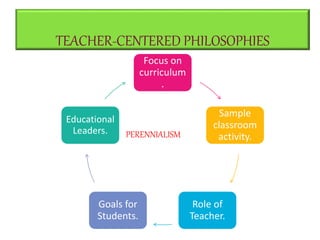
TEACHER-CENTERED PHILOSOPHIES
Focus on
curriculum
.
Sample
classroom
activity.
Role of
Teacher.
Goals for
Students.
Educational
Leaders. PERENNIALISM
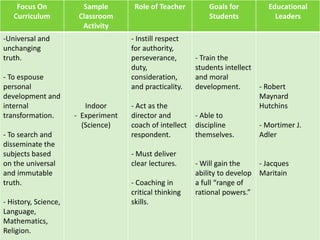
Focus On
Curriculum
Sample
Classroom
Activity
Role of Teacher Goals for
Students
Educational
Leaders
-Universal and
unchanging
truth.
- To espouse
personal
development and
internal
transformation.
- To search and
disseminate the
subjects based
on the universal
and immutable
truth.
- History, Science,
Language,
Mathematics,
Religion.
Indoor
- Experiment
(Science)
- Instill respect
for authority,
perseverance,
duty,
consideration,
and practicality.
- Act as the
director and
coach of intellect
respondent.
- Must deliver
clear lectures.
- Coaching in
critical thinking
skills.
- Train the
students intellect
and moral
development.
- Able to
discipline
themselves.
- Will gain the
ability to develop
a full “range of
rational powers.”
- Robert
Maynard
Hutchins
- Mortimer J.
Adler
- Jacques
Maritain
T H E G R E A T I D E A S I N W E S T E R N
C I V I L I Z A T I O N A R E :
 History
 Religion
 Works of literature and art
 The laws and principles of
Science
T H E G R E A T I D E A S I N W E S T E R N
C I V I L I Z A T I O N A R E :
 These ideas have the
potential for solving
problems in any era.
THE FOCUS
 Is to teach ideas that are
everlasting.
 To seek enduring truths which
are constant (not changing), as
the natural and human worlds at
their most essential level, do not
change.
CURRICULUM
Focuses on attaining
cultural literacy,
stressing students’
growth in enduring
disciplines.
CURRICULUM
They recommend that students
learn from reading and
analyzing the works by history’s
finest thinkers and writers.
(Perennialists think it is important that
individuals think deeply, analytically, flexibly
and imaginatively.)
CURRICULUM
Perennialists believe that reading is to
be supplemented with mutual
investigations (between the teacher
and the student) and minimally-
directed discussions through the
Socratic method in order to develop a
historically oriented understanding of
concepts.
CURRICULUM
A skilled teacher would keep
discussions on topic and
correct errors in reasoning, but
it would be the class, not the
teacher, who would reach the
conclusions.
The advocates
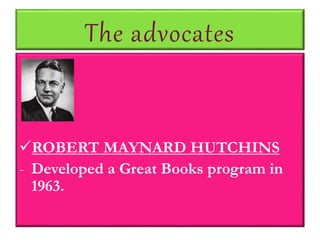
ROBERT MAYNARD HUTCHINS
- Developed a Great Books program in
1963.
The advocates
MORTIMER J. ADLER
[1902-2001]
JACQUES MARITAIN
[1882-1973]
ADLER STATES
“… our political democracy depends upon the
reconstruction of our schools. Our schools
are not turning out young people prepared
for the high office and the duties of
citizenship in a democratic republic. Our
political institutions cannot thrive, they may
not even survive, if we do not produce a
greater number of thinking citizens, from
ADLER STATES
whom some statesmen of the type we had in
the 18th century might eventually emerge. We
are, indeed, a nation at risk, and nothing but
radical reform of our schools can save us
from impending disaster…whatever the
price…the price we will pay for not doing it
will be much greater.”
Hutchins point of view
“…new books have been written that have
won their place in the list. Books once
thought entitled to belong to it have been
superseded; and this process of change will
continue as long as men can think and write.
It is the task of every generation to reassess
the tradition in which it lives, to discard
what it cannot use, and to bring into context
with
Hutchins point of view
the distant and intermediate past the
most recent contributions to the Great
conversation…the West needs to
recapture and reemphasize and bring to
bear upon its present problems the
wisdom that lies in the works of its
greatest thinkers and in the discussion
that they have carried on.
Perennialists think
Perennialism believed it
was a solution proposed in
response to what was
considered by many to be
a failing educational
system.
REFERENCES
EBSCO Research Starters® • Copyright © 2008 EBSCO
Publishing Inc.
• Contemporary Theories of Education by Richard
Pratte.
• Philosophy and the American School by Van Cleve
Morris.
• http://www.everythingphilosophy.com/philosophy-
of-education/
Thank you and have a good
day!!!

Perennialism 121110051604-phpapp02

  • 1.
    UNIVERSITY OF LUZON GRADUATESCHOOL PERENNIALISM Reporter: KATHLEEN LAT ENCARNACION
  • 2.
    PERENNIALISM  Aims todevelop student’s intellectual and moral qualities.  They emphasize that students should not be taught information that may soon be outdated or found to be incorrect.
  • 3.
    PERENNIALISM  Classrooms arecentered on teachers.  It ensures that students acquire understandings about the great ideas of Western civilization.
  • 4.
    PERENNIALISM  Perennialism teachesconcepts and focuses on knowledge and the meaning of knowledge.  Aimed at teaching students ways of thinking that will secure individual freedoms, human rights, and responsibilities through the nature.
  • 5.
    WHY IS ITCALLED TEACHER-CENTERED?  Emphasize the importance of transferring knowledge, information and skills from the older generation to the younger one.  The teacher is not concern at the student’s interest.
  • 6.
    WHY IS ITCALLED TEACHER-CENTERED? More focus on the curriculum and nature need.  The teacher set everything based on the syllabus.
  • 7.
    TEACHER-CENTERED PHILOSOPHIES Focus on curriculum . Sample classroom activity. Roleof Teacher. Goals for Students. Educational Leaders. PERENNIALISM
  • 8.
    Focus On Curriculum Sample Classroom Activity Role ofTeacher Goals for Students Educational Leaders -Universal and unchanging truth. - To espouse personal development and internal transformation. - To search and disseminate the subjects based on the universal and immutable truth. - History, Science, Language, Mathematics, Religion. Indoor - Experiment (Science) - Instill respect for authority, perseverance, duty, consideration, and practicality. - Act as the director and coach of intellect respondent. - Must deliver clear lectures. - Coaching in critical thinking skills. - Train the students intellect and moral development. - Able to discipline themselves. - Will gain the ability to develop a full “range of rational powers.” - Robert Maynard Hutchins - Mortimer J. Adler - Jacques Maritain
  • 9.
    T H EG R E A T I D E A S I N W E S T E R N C I V I L I Z A T I O N A R E :  History  Religion  Works of literature and art  The laws and principles of Science
  • 10.
    T H EG R E A T I D E A S I N W E S T E R N C I V I L I Z A T I O N A R E :  These ideas have the potential for solving problems in any era.
  • 11.
    THE FOCUS  Isto teach ideas that are everlasting.  To seek enduring truths which are constant (not changing), as the natural and human worlds at their most essential level, do not change.
  • 12.
    CURRICULUM Focuses on attaining culturalliteracy, stressing students’ growth in enduring disciplines.
  • 13.
    CURRICULUM They recommend thatstudents learn from reading and analyzing the works by history’s finest thinkers and writers. (Perennialists think it is important that individuals think deeply, analytically, flexibly and imaginatively.)
  • 14.
    CURRICULUM Perennialists believe thatreading is to be supplemented with mutual investigations (between the teacher and the student) and minimally- directed discussions through the Socratic method in order to develop a historically oriented understanding of concepts.
  • 15.
    CURRICULUM A skilled teacherwould keep discussions on topic and correct errors in reasoning, but it would be the class, not the teacher, who would reach the conclusions.
  • 16.
    The advocates ROBERT MAYNARDHUTCHINS - Developed a Great Books program in 1963.
  • 17.
    The advocates MORTIMER J.ADLER [1902-2001] JACQUES MARITAIN [1882-1973]
  • 18.
    ADLER STATES “… ourpolitical democracy depends upon the reconstruction of our schools. Our schools are not turning out young people prepared for the high office and the duties of citizenship in a democratic republic. Our political institutions cannot thrive, they may not even survive, if we do not produce a greater number of thinking citizens, from
  • 19.
    ADLER STATES whom somestatesmen of the type we had in the 18th century might eventually emerge. We are, indeed, a nation at risk, and nothing but radical reform of our schools can save us from impending disaster…whatever the price…the price we will pay for not doing it will be much greater.”
  • 20.
    Hutchins point ofview “…new books have been written that have won their place in the list. Books once thought entitled to belong to it have been superseded; and this process of change will continue as long as men can think and write. It is the task of every generation to reassess the tradition in which it lives, to discard what it cannot use, and to bring into context with
  • 21.
    Hutchins point ofview the distant and intermediate past the most recent contributions to the Great conversation…the West needs to recapture and reemphasize and bring to bear upon its present problems the wisdom that lies in the works of its greatest thinkers and in the discussion that they have carried on.
  • 22.
    Perennialists think Perennialism believedit was a solution proposed in response to what was considered by many to be a failing educational system.
  • 23.
    REFERENCES EBSCO Research Starters®• Copyright © 2008 EBSCO Publishing Inc. • Contemporary Theories of Education by Richard Pratte. • Philosophy and the American School by Van Cleve Morris. • http://www.everythingphilosophy.com/philosophy- of-education/
  • 24.
    Thank you andhave a good day!!!