This document discusses concepts and approaches related to values education. It defines values education as the process of transmitting values from one person to another, which can take place in organizations like schools, colleges, and youth groups. The document outlines several methodologies for values education, including classroom learning activities using sources that illustrate values, practical activities to apply values in real-world settings, and role-playing exercises. It also analyzes different approaches for implementing values education, such as evocation, awareness, moral reasoning, and commitment. The goal of values education is to help develop students' character and ability to make ethical decisions.
Values education transmits values in various social settings, promoting moral, cultural, and spiritual development for holistic personality growth.
Different methodologies and techniques include classroom learning activities, practical methods, and socialized techniques to support living by values.
Eight approaches include evocation, inculcation, awareness, moral reasoning, and more, aimed at fostering values understanding and application.
BASIC CONCEPTS OF
VALUESEDUCATION
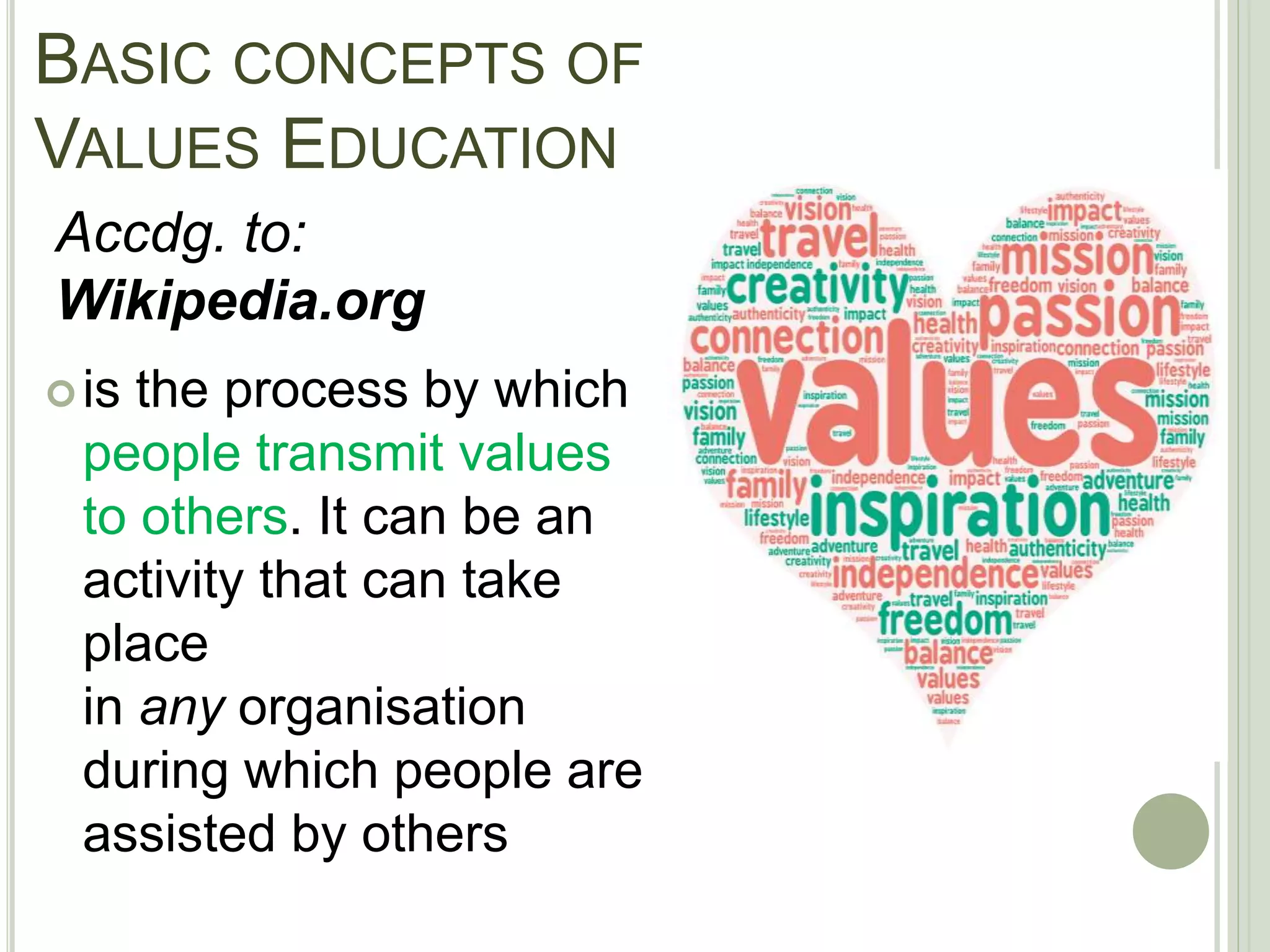
is the process by which
people transmit values
to others. It can be an
activity that can take
place
in any organisation
during which people are
assisted by others
Accdg. to:
Wikipedia.org
4.
BASIC CONCEPTS OF
VALUESEDUCATION
Values education can
take place at home, as
well as in schools,
colleges, universities,
jails and voluntary
youth organizations.
5.
BASIC CONCEPTS OF
VALUESEDUCATION
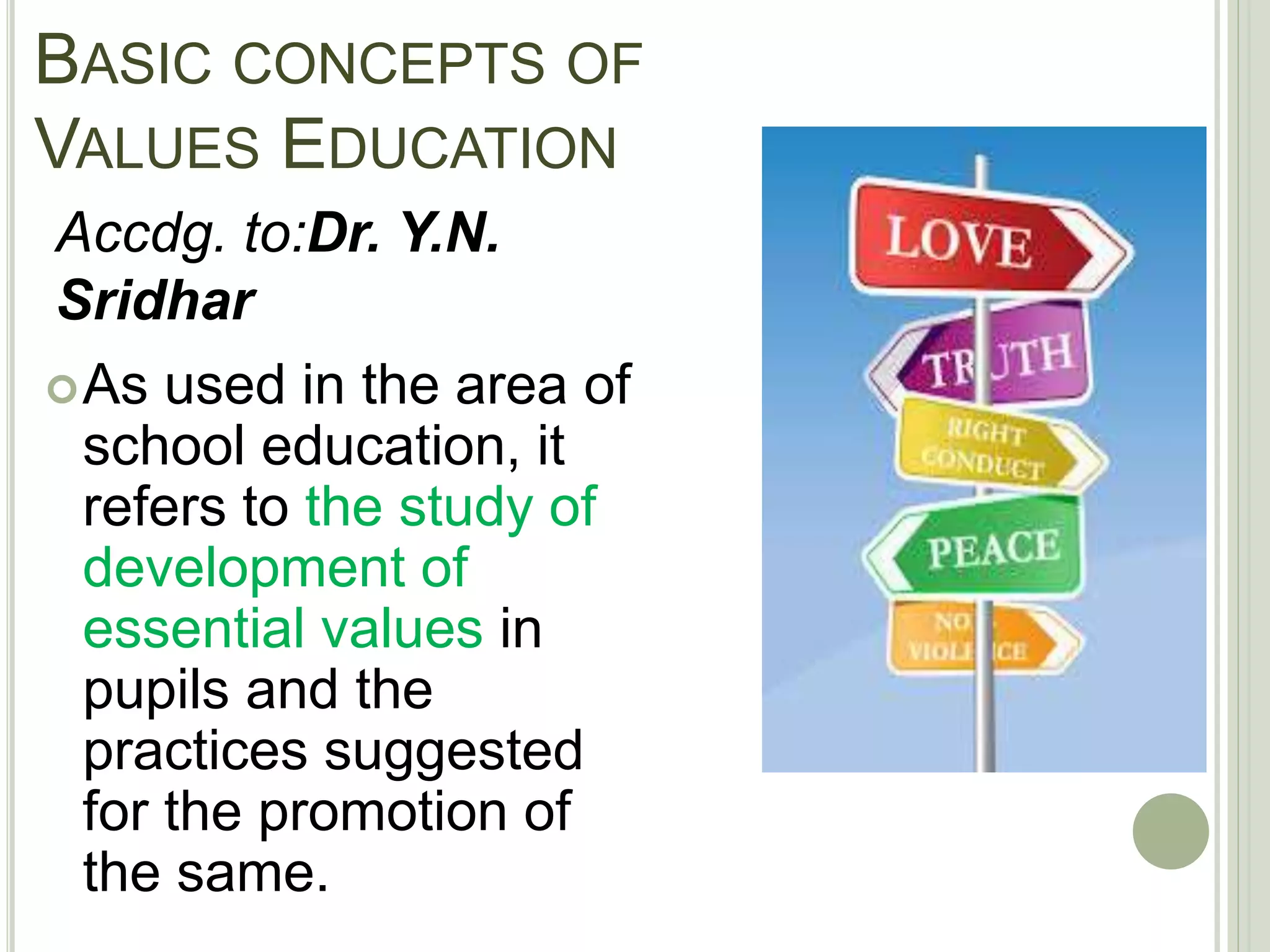
As used in the area of
school education, it
refers to the study of
development of
essential values in
pupils and the
practices suggested
for the promotion of
the same.
Accdg. to:Dr. Y.N.
Sridhar
6.
BASIC CONCEPTS OF
VALUESEDUCATION
In its full range of
meaning, value(s)
education includes
developing the
appropriate sensibilities:
moral, cultural, spiritual
and the ability to make
proper value judgment
and internalize them in
one's life.
7.
BASIC CONCEPTS OF
VALUESEDUCATION
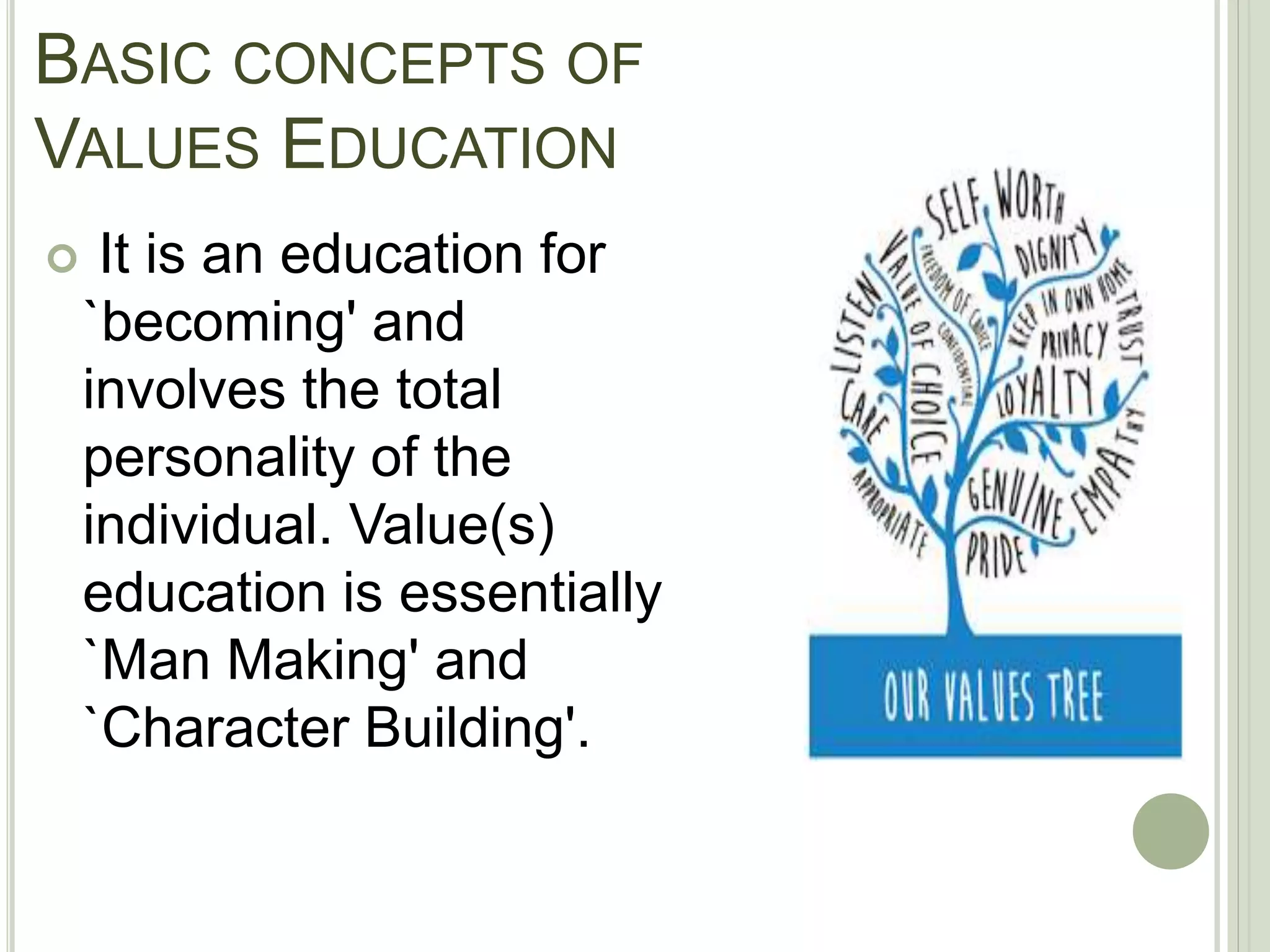
It is an education for
`becoming' and
involves the total
personality of the
individual. Value(s)
education is essentially
`Man Making' and
`Character Building'.
8.
BASIC CONCEPTS OF
VALUESEDUCATION
ay asignaturang gagabay at
huhubog sa mga kabataan
ng wastong pag-uugali,
pagdedesisyon, moral na
pagkilos na katanggap-
tanggap sa ating lipunan, at
pamumuhay nang ayon sa
plano ng Panginoon sa
Kanyang mga nilikha.
Accdg. to:
ourhappyschool.com
9.
BASIC CONCEPTS OF
VALUESEDUCATION
Hindi lamang talino,
kakayahan o talento ang
dapat bigyan ng
pagpapahalaga. Ang pag-
uugali ng makabagong
henerasyon ay dapat na
ituwid dahil sila ang
susunod na
magpapatakbo ng ating
bansa.
10.
BASIC CONCEPTS OF
VALUESEDUCATION
Dapat bigyan ng pansin ang
pagtuturo ng paggalang sa
nakatatanda, pagmamahal
at paggalang sa kapwa,
pagiging matatag sa
pagsubok ng buhay,
paghahanda upang
makapaghanap-buhay,
tamang pagdedesisyon,
pagkilos ng moral, at
pagkilala sa Maykapal.
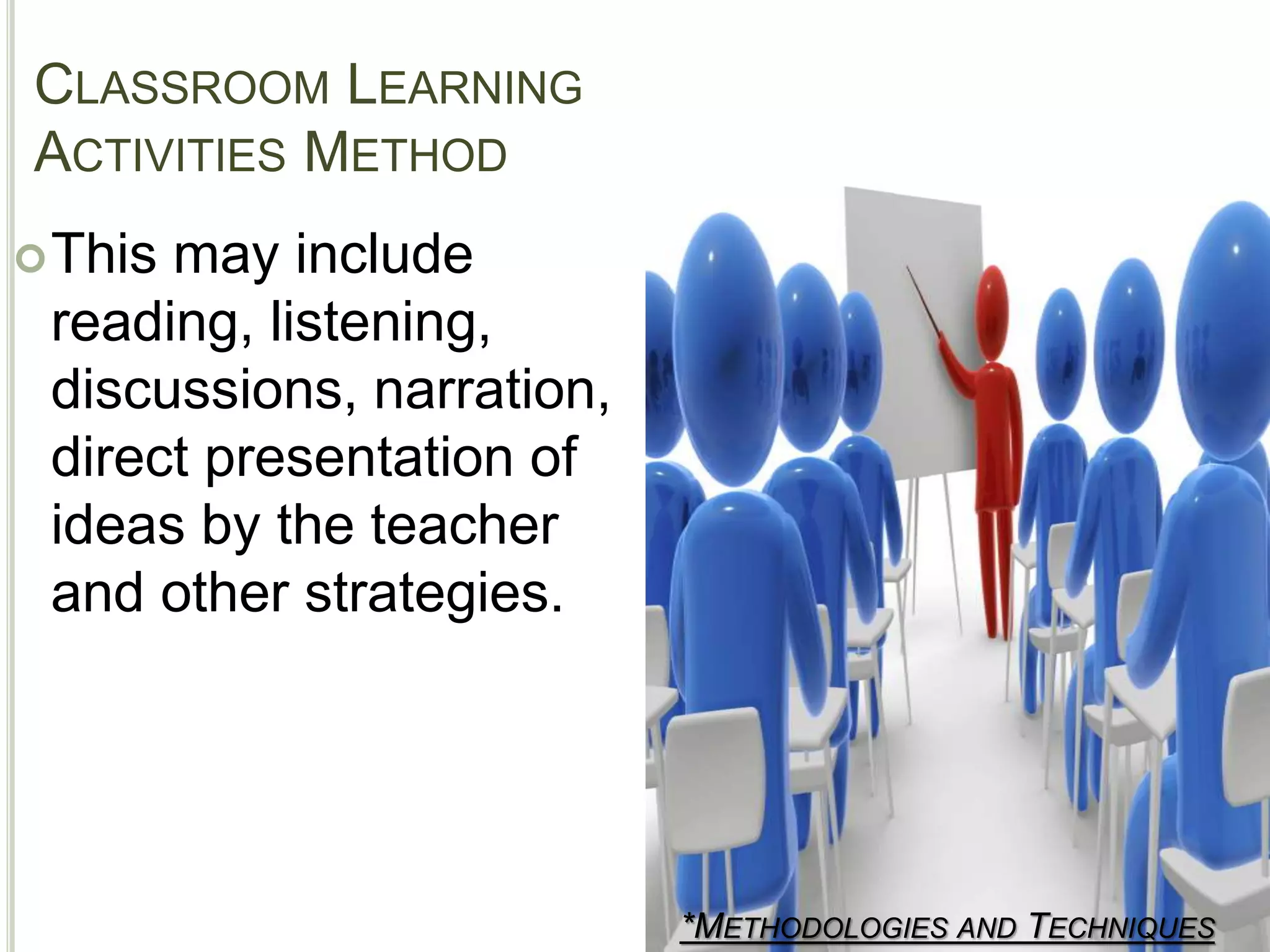
CLASSROOM LEARNING
ACTIVITIES METHOD
*METHODOLOGIESAND TECHNIQUES
These strategies should be
used with any of the
following sources of value
education (a) Biographies
(b) Stories (c) Extracts form
essays, articles, classics
and news paper (d)
Parables, proverbs,
quotations and poems (e)
value/moral dilemmas (f)
classroom
incidents/anecdotes/
conflicts.
14.
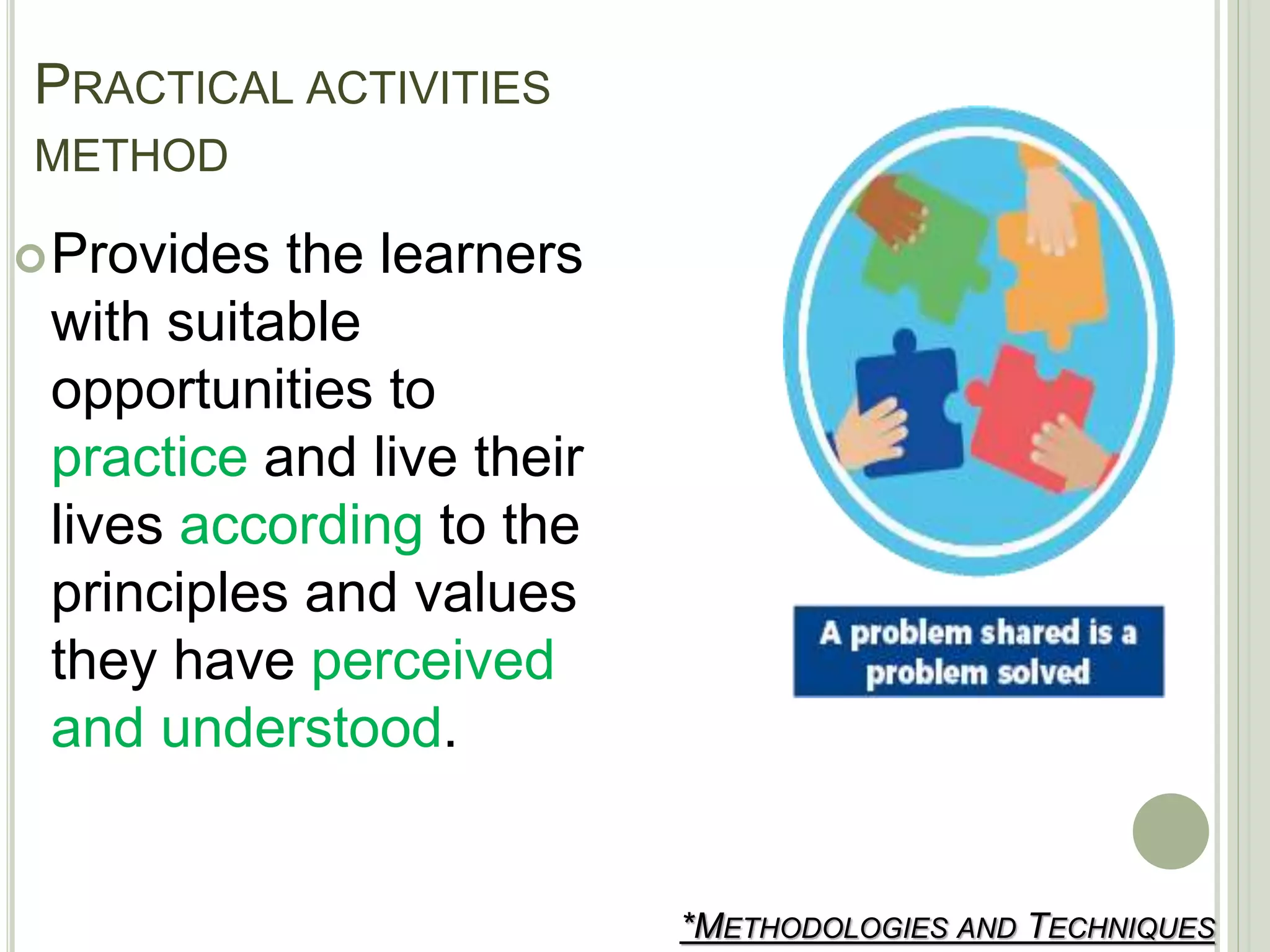
PRACTICAL ACTIVITIES
METHOD
*METHODOLOGIES ANDTECHNIQUES
Provides the learners
with suitable
opportunities to
practice and live their
lives according to the
principles and values
they have perceived
and understood.
15.
PRACTICAL ACTIVITIES
METHOD
*METHODOLOGIES ANDTECHNIQUES
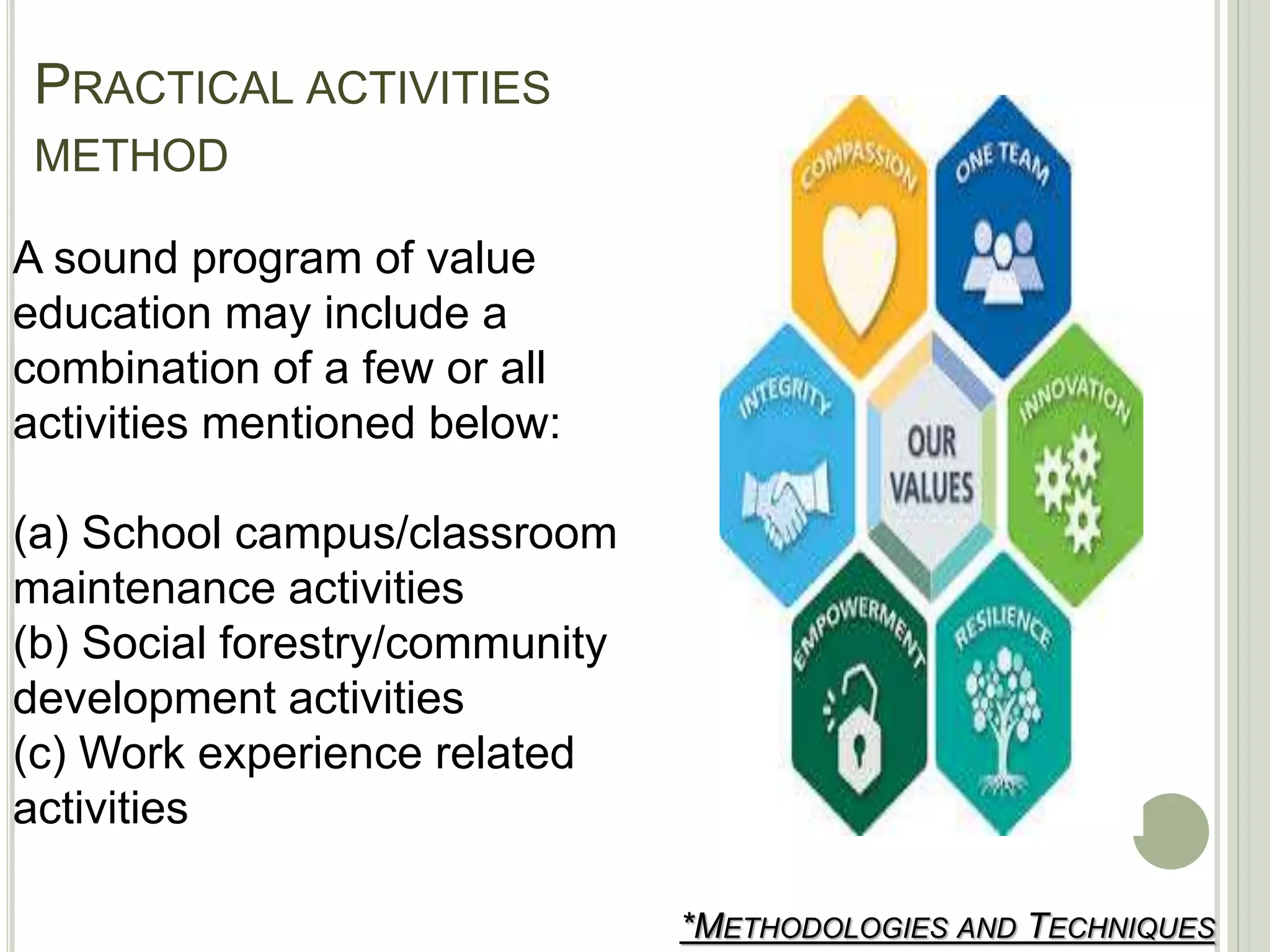
A sound program of value
education may include a
combination of a few or all
activities mentioned below:
(a) School campus/classroom
maintenance activities
(b) Social forestry/community
development activities
(c) Work experience related
activities
16.
PRACTICAL ACTIVITIES
METHOD
*METHODOLOGIES ANDTECHNIQUES
(d) Organizing campaigns on
community sanitation, literacy,
environmental awareness,
AIDS prevention awareness
e) Yoga, meditation and
prayer sessions
(f) eradication of social evils
campaign activities
(gender inequality, dowry,
alcoholism…)
(g) co- curricular/self
government activities
17.
SOCIALIZED TECHNIQUES
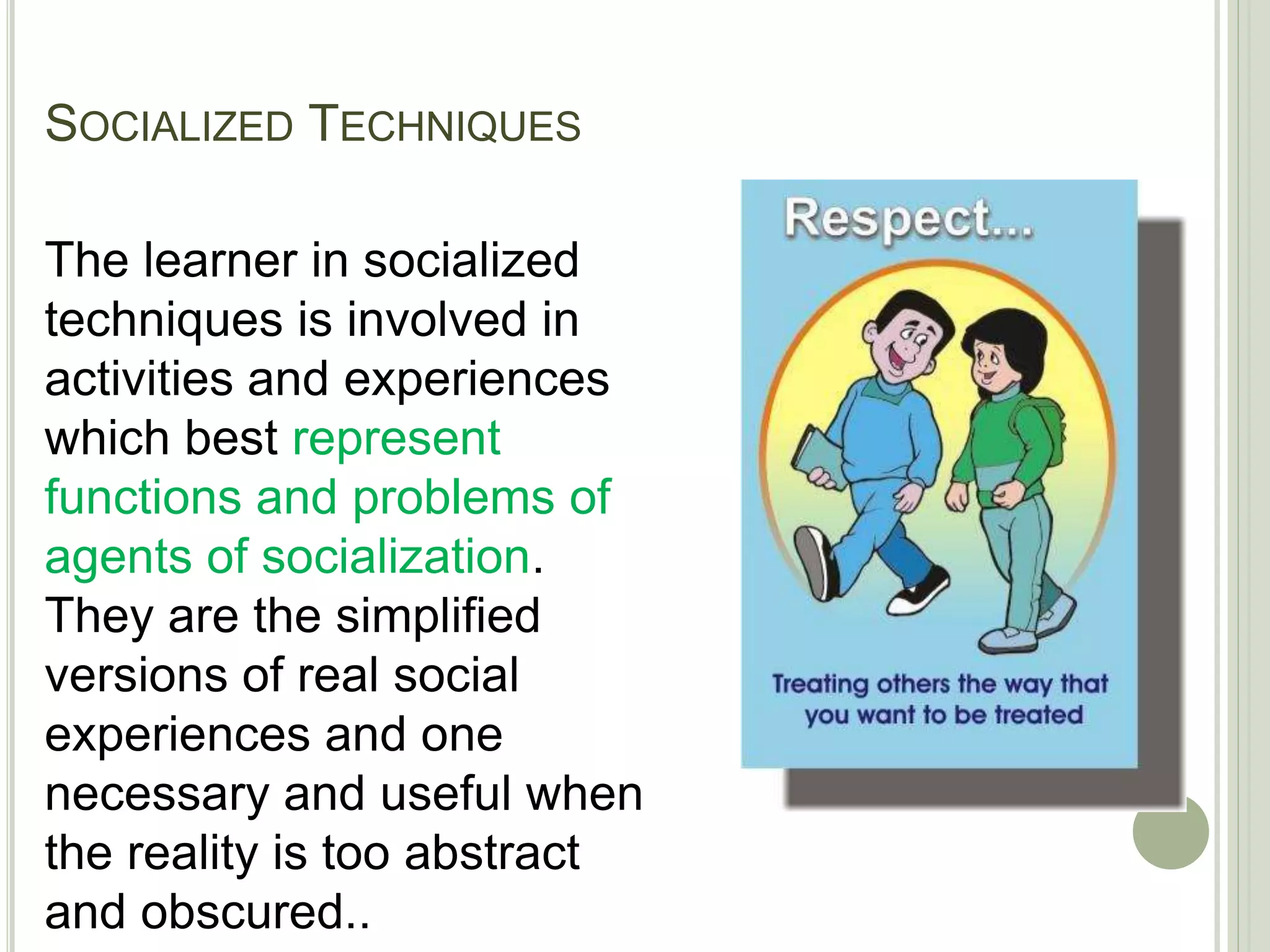
The learnerin socialized
techniques is involved in
activities and experiences
which best represent
functions and problems of
agents of socialization.
They are the simplified
versions of real social
experiences and one
necessary and useful when
the reality is too abstract
and obscured..
18.
SOCIALIZED TECHNIQUES
*METHODOLOGIES ANDTECHNIQUES
These include social role
playing enacting and
modeling. Role playing
activities should be organized
based on the life experiences
and age level of students.
Expected role of an ideal
student, teacher, parent,
patriot should encourage
student to take role taking
activities voluntarily. Negative
precepts are to be
discouraged in role playing.
19.
INCIDENTAL LEARNING
METHOD
*METHODOLOGIES ANDTECHNIQUES
An incident is an episode or
experience in the life of an
individual or group. It
consists in identifying the
wrong or right actions of an
individual or group, either
pre-planned to occur or
observed by accident, and
reprimanding or rewarding
those concerned.
*APPROACHES
The students areencouraged
to make spontaneously free,
non-rational choices, without
thought or hesitation.
EVOCATION
APPROACH
(PAGPUKAW)
23.
EVOCATION
APPROACH
(PAGPUKAW)
*APPROACHES
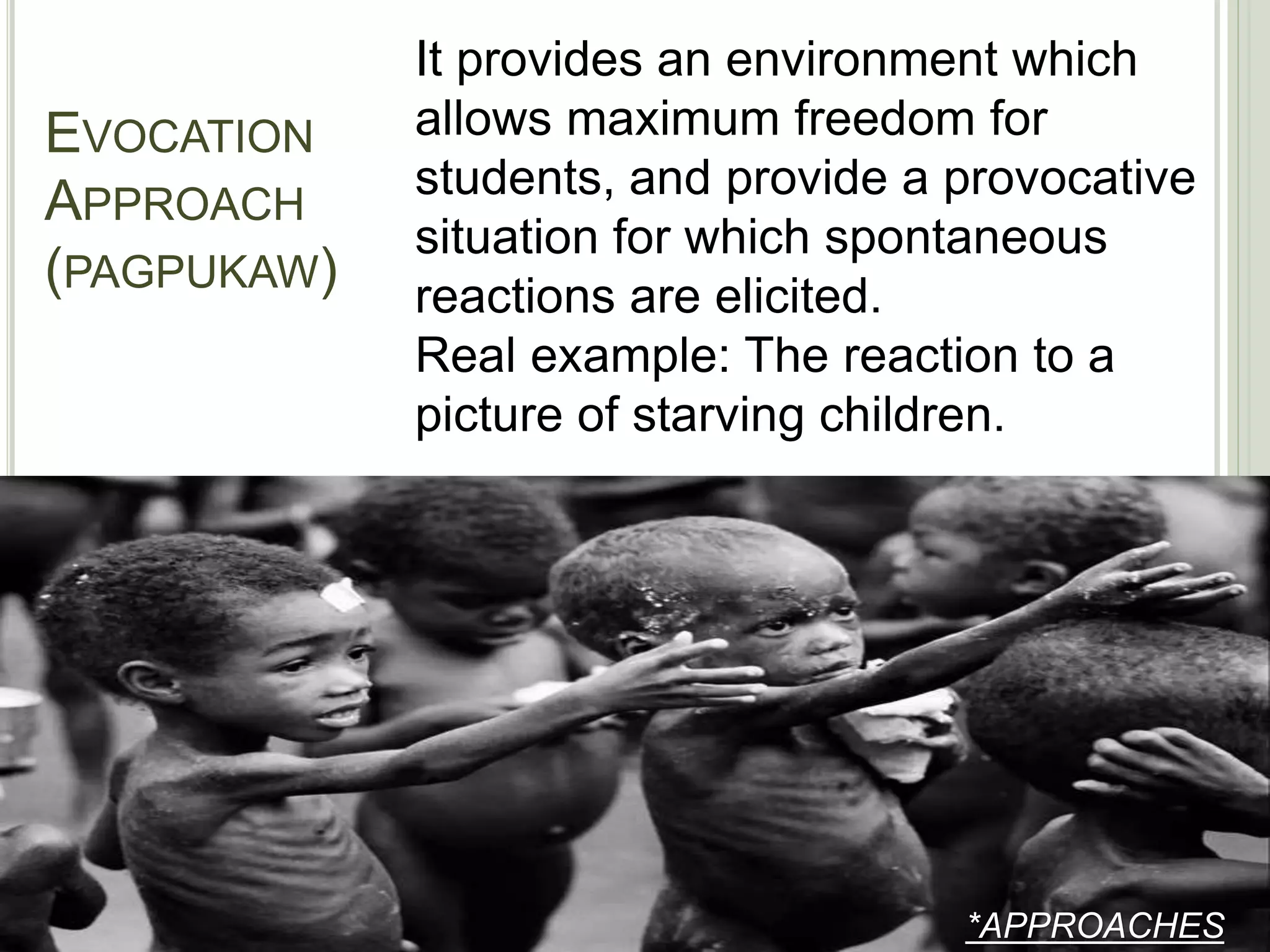
It provides anenvironment which
allows maximum freedom for
students, and provide a provocative
situation for which spontaneous
reactions are elicited.
Real example: The reaction to a
picture of starving children.
24.
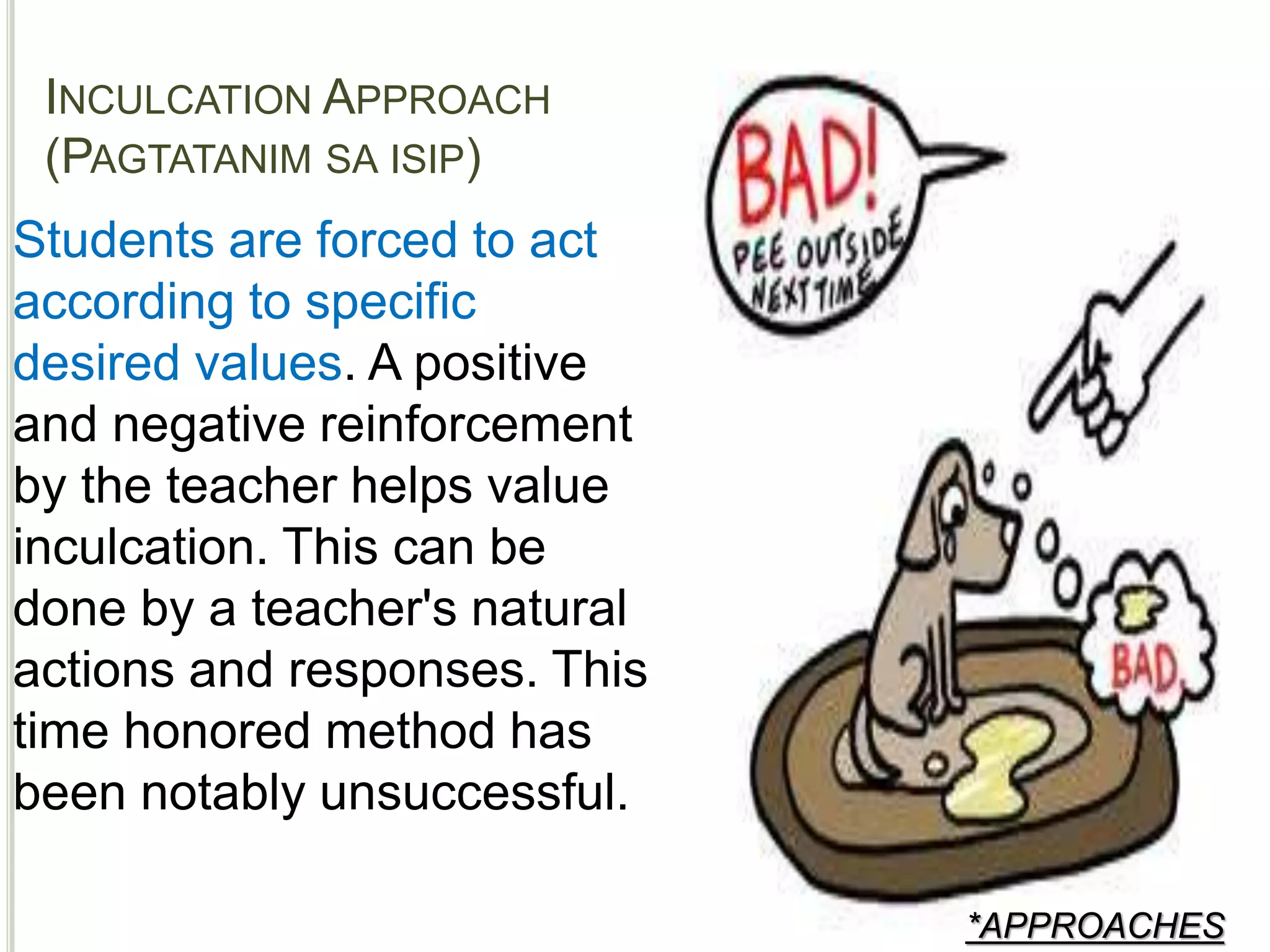
INCULCATION APPROACH
(PAGTATANIM SAISIP)
*APPROACHES
Students are forced to act
according to specific
desired values. A positive
and negative reinforcement
by the teacher helps value
inculcation. This can be
done by a teacher's natural
actions and responses. This
time honored method has
been notably unsuccessful.
AWARENESS APPROACH
(PAGKABATID)
*APPROACHES
The teacherpresents value
laden situations or dilemmas
through readings, films, role
playing, small group
discussions and simulation.
Students thus engage
themselves in the process of
making inferences about
values from the thoughts,
feelings, beliefs or behavior
of themselves and others.
27.
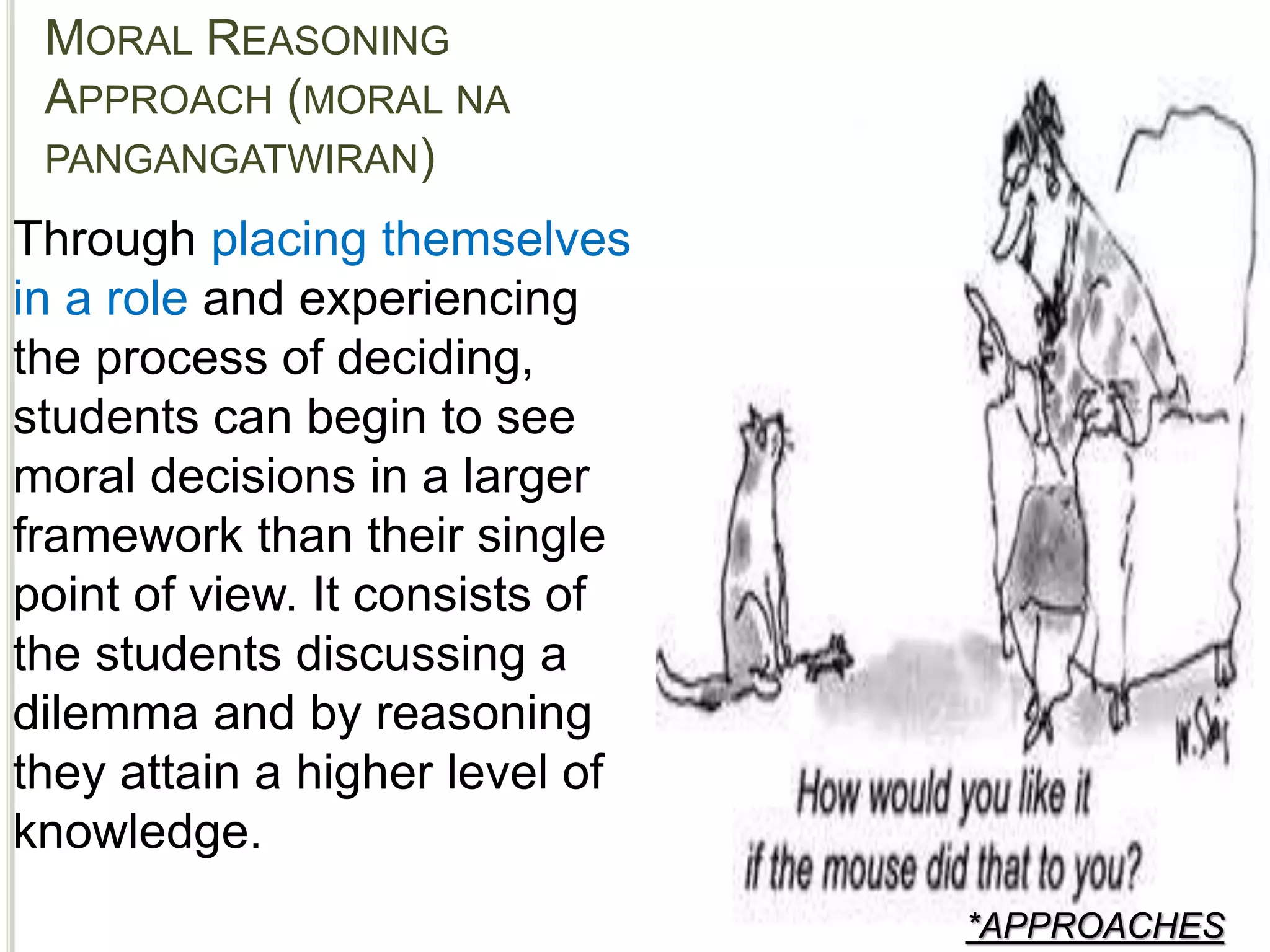
MORAL REASONING
APPROACH (MORALNA
PANGANGATWIRAN)
*APPROACHES
Through placing themselves
in a role and experiencing
the process of deciding,
students can begin to see
moral decisions in a larger
framework than their single
point of view. It consists of
the students discussing a
dilemma and by reasoning
they attain a higher level of
knowledge.
28.
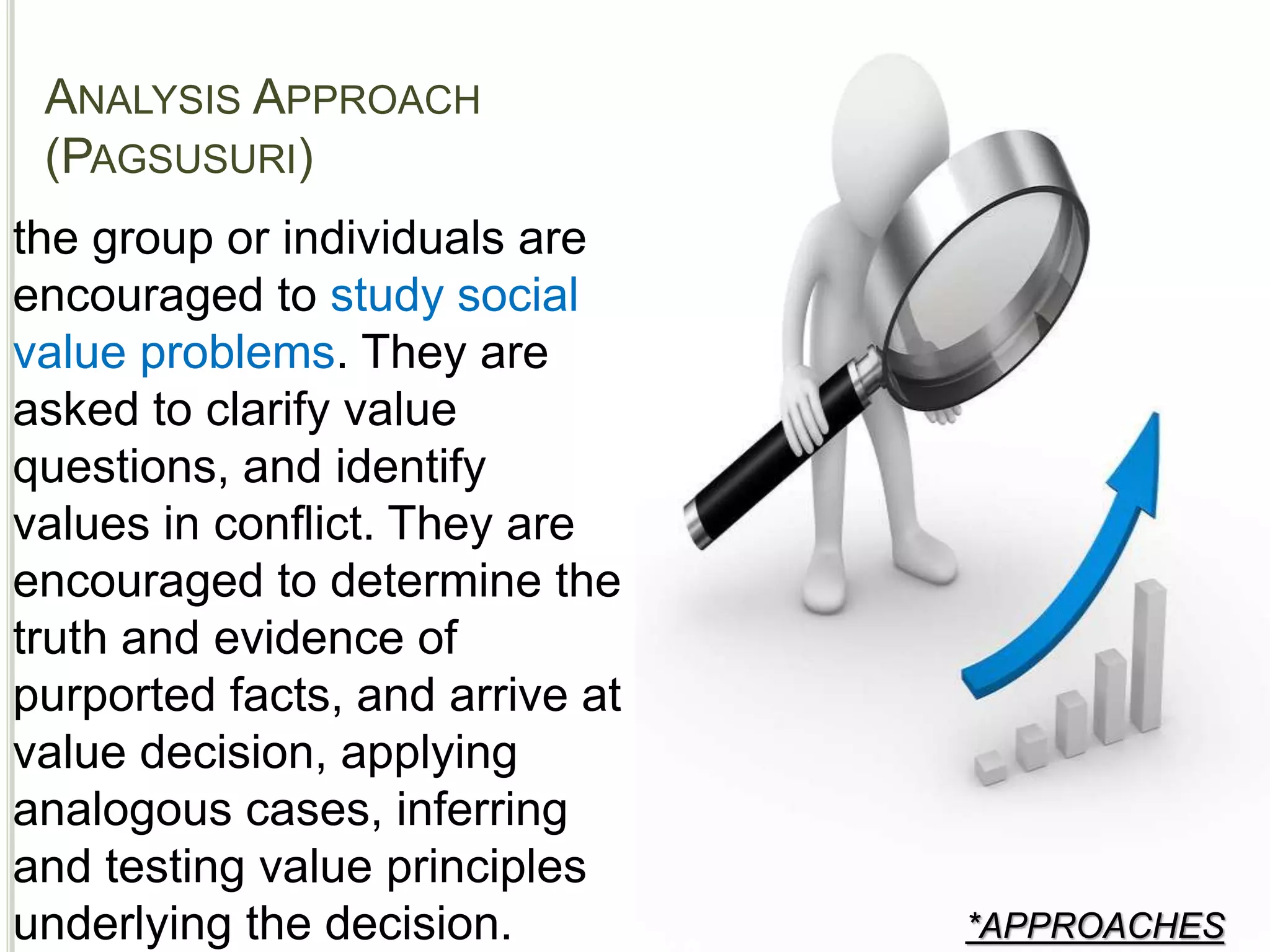
ANALYSIS APPROACH
(PAGSUSURI)
*APPROACHES
the groupor individuals are
encouraged to study social
value problems. They are
asked to clarify value
questions, and identify
values in conflict. They are
encouraged to determine the
truth and evidence of
purported facts, and arrive at
value decision, applying
analogous cases, inferring
and testing value principles
underlying the decision.
29.
VALUE CLARIFICATION
APPROACH (PAGLILINAW)
*APPROACHES
Ithelps students to use both
rational thinking and
emotional awareness to
examine personal behavior
patterns and classify and
actualize values. This
approach has been detailed
by Raths, et.al. (1966) and
Simon, et.al. (1972) where the
child is made to jot down a
self-analysis-reaction work
sheet, consisting of drawings,
questions and activities.
30.
*APPROACHES
It enables thestudents to perceive
themselves not merely as passive
reactors or as free individuals but
as inner-relative members of a
social group and system.
COMMITMENT
APPROACH
(PAGTITIWALA)
The purpose is to help students
to perceive themselves and act
not as separate egos but as part
of a larger inter-related whole-the
human race, the world, the
cosmos.
UNION
APPROACH
(PAGKAKAISA)
31.
OTHER APPROACHES (ACCORDINGTO
UNESCO APIED ON EDUCATION FOR AFFECTIVE
DEVELOPMENT)
1. Telling: enables a pupil to have a clear
picture of a value
2. Inculcating: instilling and internalizing
norms into person's own value systems.
3. Persuading: convincing the learner to
accept certain values and behave in
accordance with what is acceptable.
4. Modeling: epitomizing desirable/ideal
values is presented to the learners as a
model.
32.
OTHER APPROACHES (ACCORDINGTO
UNESCO APIED ON EDUCATION FOR AFFECTIVE
DEVELOPMENT)
5. Role playing: taking the role of another person
but without the risk of reprisals.
6. Simulating: pretend to be in a certain situation
called for by the lesson and then to portray the
events and also by imitating the character's
personality.
7. Problem solving: dilemma is presented to the
learners asking them what decisions they are going
to take.
8. Discussing situations, stories, pictures, etc:
This technique asks the learners to deliberate on
and explain the details in the lesson.
33.
OTHER APPROACHES (ACCORDINGTO
UNESCO APIED ON EDUCATION FOR AFFECTIVE
DEVELOPMENT)
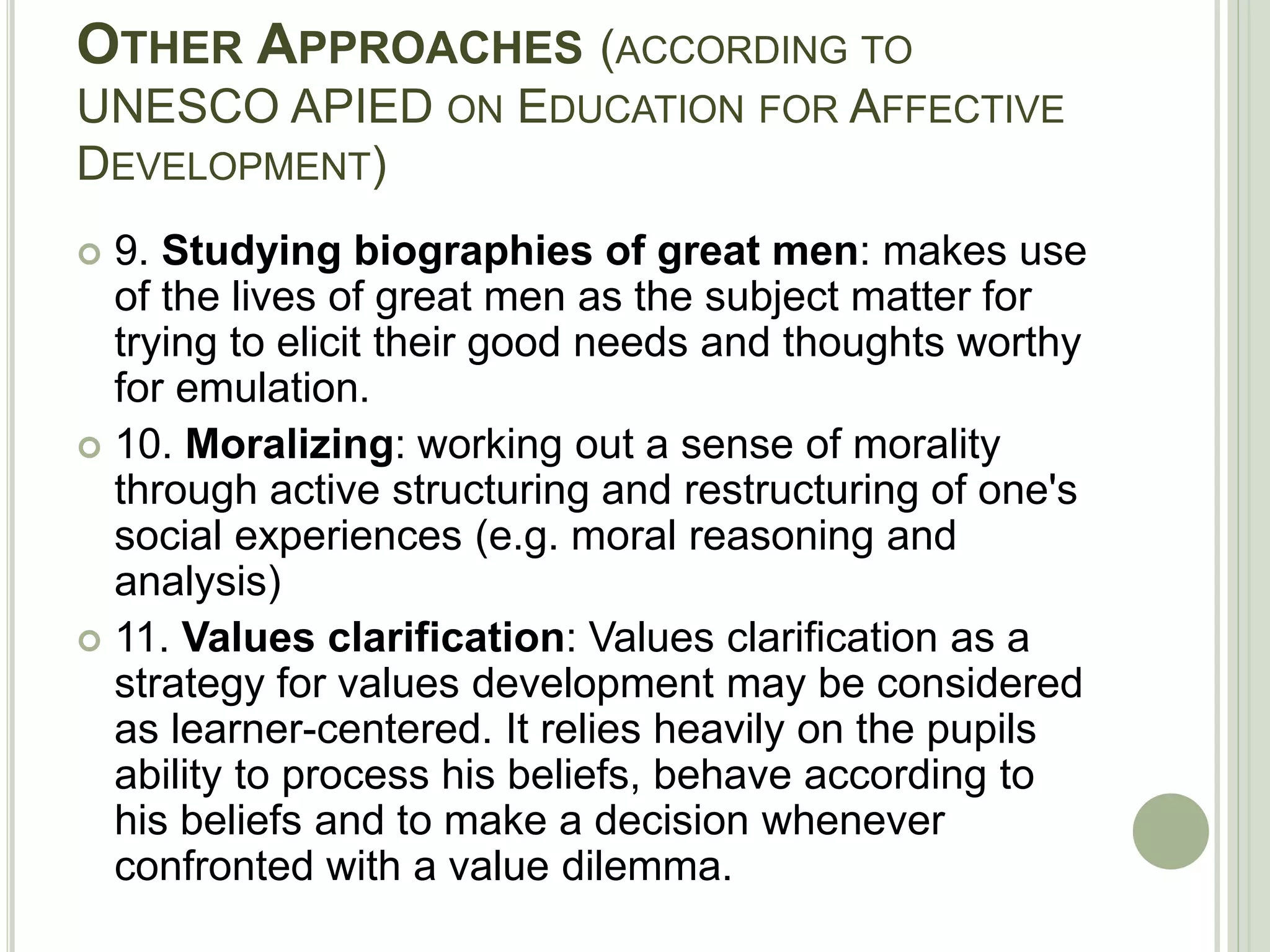
9. Studying biographies of great men: makes use
of the lives of great men as the subject matter for
trying to elicit their good needs and thoughts worthy
for emulation.
10. Moralizing: working out a sense of morality
through active structuring and restructuring of one's
social experiences (e.g. moral reasoning and
analysis)
11. Values clarification: Values clarification as a
strategy for values development may be considered
as learner-centered. It relies heavily on the pupils
ability to process his beliefs, behave according to
his beliefs and to make a decision whenever
confronted with a value dilemma.






![Approaches, methods and_techniques_in_edukasyon_sa[1]](https://cdn.slidesharecdn.com/ss_thumbnails/approachesmethodsandtechniquesinedukasyonsa1-160416051040-thumbnail.jpg?width=640&height=640&fit=bounds)


