Ideology Of Pakistan
Introduction
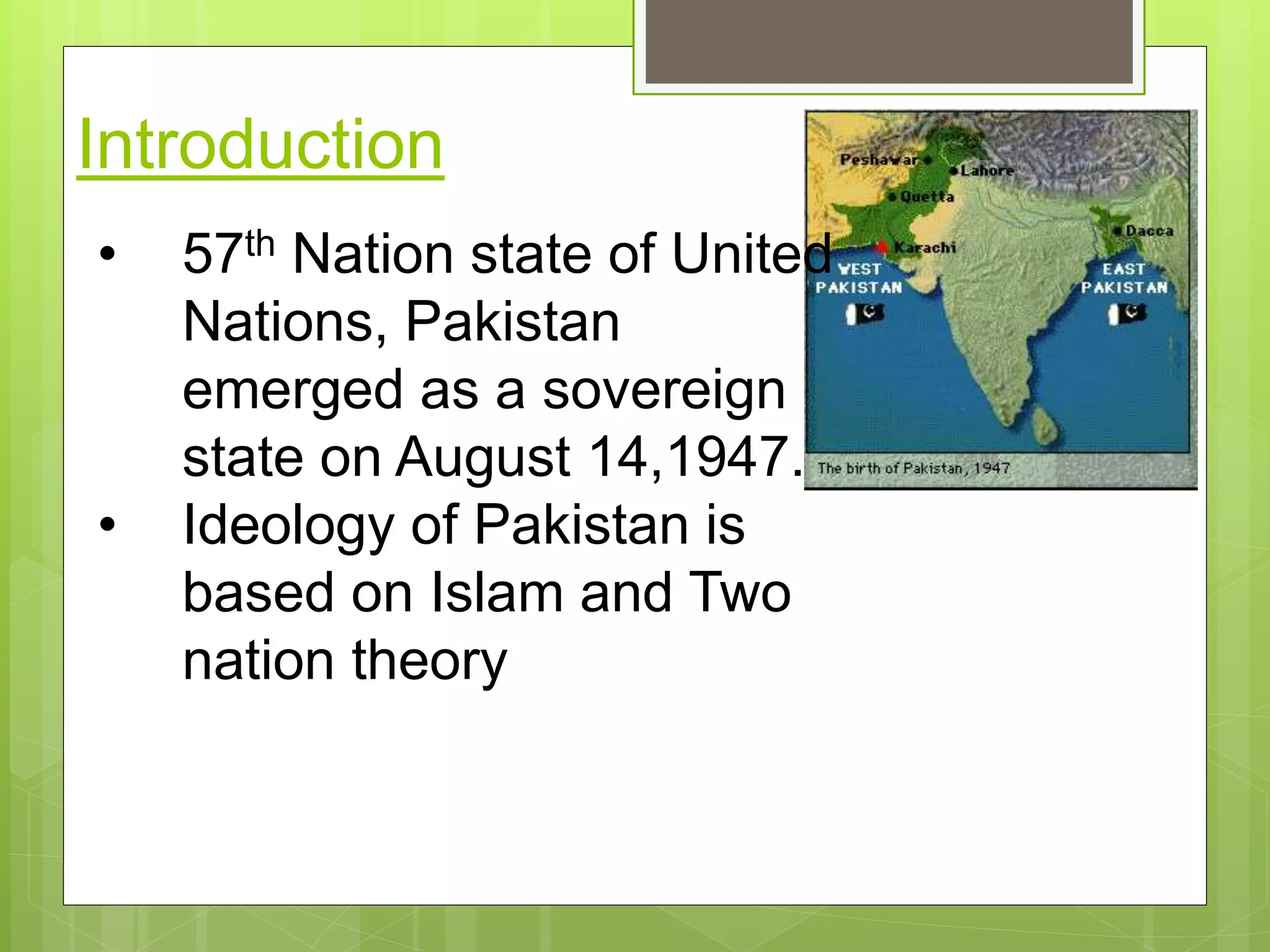
• 57th Nation state of United
Nations, Pakistan
emerged as a sovereign
state on August 14,1947.
• Ideology of Pakistan is
based on Islam and Two
nation theory
What is ideology
 Ideology is a French word.
 The French philosopher Tracy used the word
ideologie in French Revolution.
 An ideology is a set of aims and ideas that
directs one's goals, expectations, and actions
 The term ‘ideology’ means science of ideas.
What is an Ideology?
• A subjective phenomena
• Science of ideas and ideals
• A set of proposals about human nature and
society
• An interpretation of the past, explanation of the
present and a vision for the future
• Not consistent but dynamic phenomena.
• Two ideological states in the world
I:- Pakistan II:-Israel
 Here's what Webster's dictionary gives us for ideology:
 visionary theorizing
 a systematic body of concepts esp. about human life or
culture
 a manner or the content of thinking characteristic of an
individual, group, or culture
 the integrated claims, theories, and aims that constitute
a sociopolitical program
Importance of An Ideology
 Works as a lynch( hang, kill) pin among
revolutionaries
 A cementing(fortifying) force
 Provides a line of action
 A pre-requisite for establishment of a new
social system
Basis of Ideology of Pakistan
 Sovereignty belongs to Allah.
 Islamic state governed by teachings of Quran
& Sunnah.
 To save the distinct religious, political,
economical, cultural and social identity of
Muslims……traditions
 Emancipation (freedom) from Hindu
domination.
 Two-Nation theory.
 To establish an Islamic economic system.
 To establish an Islamic democracy
 Language issue
 Regional (Territorial) land
The only sovereign is Allah
 Islam acted as a nation building force before
the establishment of Pakistan. Ideology of
Pakistan basically means that Pakistan
should be a state where the Muslims should
have an opportunity to live according to the
faith and beliefs based on the Islamic
principles. They should have all the resources
at their disposal to enhance Islamic culture
and civilization.
Islam, a Nation-Building Force
 Pakistan came into being on the basis of
Islam. It was only Islam, which stimulated
Muslims and lined them up behind Muslim
League. Other factors, political and economic
ones, also played some part in uniting
Muslims to struggle for Pakistan but Islam
was the more powerful factor as it serves as a
cementing force for Muslim society and is the
primary link between Muslims the world over.
 Quaid-e-Azam said
 “We do not demand Pakistan simply to have a
piece of land but we want a laboratory where
we could experiment on Islamic principles.”
 The fundamental teachings of Islam are
universally accepted. Belief in God, finality of
prophet-hood, human rights and social justice,
management of affairs through consensus, moral
values of charitableness, tolerance and universal
brotherhood; these are sonic of the cardinal
principles enshrined by the Quran and Sunnah.
The only force which keeps Muslim nation united
is Islam which is the ideological foundation of
Pakistan.
Democratic System
 In an Islamic state, all the affairs are decided on
the basis of Shariat (Democracy). In other words,
all the social, economic, political and the cultural
affairs are operated on the basis of mutual
consensus and Islamic democracy. The same
system has also been referred in Surah Al-Imram,
Muhammad (P.B.U.H) used to operate all the state
affairs after discussing with his Sahabas
(companions), When this questions rose that what
would be the system of government in Pakistan, it
should, no doubt, be Islamic.
 Creation of Pakistan is the glorious example
of ijma-e-ummat (national consensus). At the
time of establishment of Pakistan, referendum
was held in all the Muslim majority provinces
to take their consent to the included in
Pakistan.
NATION-NATIONALISM
NATION has common
 culture
 language
 history
 sympathies
 civilization
 religion
 heroes
 regional loyalty
 boundaries
 territory.
DISPUTES ON THE BASE OF
NATIONALISM
 Violent disputes between Armenistan and
Azerbaijan.
 In Kashmir (Hindu-Muslim).
 In Indian Punjab there is Khalisa Movement.
 In Sri-Lanka “Tamil and Sinhalese”.
 Long running dispute between Arabs and Jewish.
 Kurds in Turkey, Iraq and Iran.
 In Africa, Nationalism is in the form of tribalism.
(Pakistan Case Study)
Definition: Nation
 A nation is a territory or country as political
entity or a grouping of people who share real
or imagined common history, culture,
language or ethnic origin, often possessing or
seeking its own government.
RELIGION-SOLE LOGIC FOR
IDEOLOGY OF PAKISTAN
 Foundation of Pakistan could not possibly be
laid on common race, common language and
common territory.
 In Pakistan, there were numerous ethnic
group such as Punjabi, Sindhi, Balochi,
Bengali and Pashtun.
 So, religion was a nation-building force.
 Quaid’s words regarding Pakistan as nation.
“ Islam has taught us this and i think you will agree
with me, for whatever else you may be and whatever
you are, you are a Muslim. You belong to a nation now;
you have carved out a territory, vast territory, it is all
yours; it does not belong to a Punjabi or a Sindhi or a
Pathan or a Bengali; it is yours”.
WAS QUAID IN FAVOR OF
THEOCRATIC STATE? Islam-Nationalism, Patriotism- not Secterianism.
 Pakistan- religious state not theocratic state.
 Islam creates a Polite civil Society.
 Quaid’s wordings
“Make no mistake; Pakistan is not a theocracy
or anything like it, Islam demands from us the tolerance
of other creeds and we welcome in closest association
with us all those who, of whatever creed or themselves
willing and ready to play their part as true and loyal
citizens of Pakistan”.
Two Nation theory
 A concept given by Sir Syed Ahmad Khan
that there were two Nations in British India
• Muslims
• Non-Muslims
 Muslims of India had there own culture,
civilization, mores, stereotypes,norms
contrary to that of other Non-Muslims of
India.
HINDUISM AND ISLAM
 Ideological difference.
 Religious difference.
 Socially difference.
 Economically differentiation.
 Administratively difference.
 Statistically conflict.
 Extremist point of view regarding Muslims.
 The Two Nation Theory was the basis of the struggle
for creation of Pakistan which held that Hindus and
Muslims are two separate nations. They in spite of
living together for centuries could not forget their
individual cultures and civilization. Al-Beruni recorded
his ideas in 1001 A.D in his famous book "Kitab-ul-
Hind" as The Hindu society maintained this peculiar
character over the centuries. The two societies, Hindus
and Muslims, like two streams have sometimes
touched but never merged, each following its separate
course.
Hindu Nationalism
 A number of Hindu nationalist movement, which
emerged from time to time in the Indian history,
added fuel to the fire by playing up the tension
and antagonism which already existed between
the two communities. The Hindu nationalist
leaders totally ignored the great contribution made
by the Muslims in the Indian society by way of
promoting education and other social activities.
Their writings and ideas flared up the communal
discord between Hindus and Muslims to further
pollute condition.
Economic Differences
 After 1857, the Muslim economic was crushed
and all trade policies were framed in such a
way so as to detriment the Muslim condition.
They were thrown out of Government services
and their estates and properties were
confiscated while the Hindus were provided
with the ample opportunities to progress
economically.
Political Differences
 Congress Attitude
 Urdu Controversy
 Partition of Bengal
 Language issue
Conclusion
 The fundamental concept of the ideology of
Pakistan is that Muslims are separate nation
having their own culture, literature, religion
and way of life. They cannot be merged in any
other nation. They should be able to develop
their culture and religious traditions in an
Islamic State and they should be able to
create a true Islamic society for themselves.
 Thus the ideology of Pakistan which
developed through the period of Mohammad
Bin Qasim and others and followed by political
leaders like Quaid-e-Azam was materialized
in 1947.

Ideologyofpakistan2 150121055845-conversion-gate01

  • 1.
  • 2.
    Introduction • 57th Nationstate of United Nations, Pakistan emerged as a sovereign state on August 14,1947. • Ideology of Pakistan is based on Islam and Two nation theory
  • 3.
    What is ideology Ideology is a French word.  The French philosopher Tracy used the word ideologie in French Revolution.  An ideology is a set of aims and ideas that directs one's goals, expectations, and actions  The term ‘ideology’ means science of ideas.
  • 4.
    What is anIdeology? • A subjective phenomena • Science of ideas and ideals • A set of proposals about human nature and society • An interpretation of the past, explanation of the present and a vision for the future • Not consistent but dynamic phenomena. • Two ideological states in the world I:- Pakistan II:-Israel
  • 5.
     Here's whatWebster's dictionary gives us for ideology:  visionary theorizing  a systematic body of concepts esp. about human life or culture  a manner or the content of thinking characteristic of an individual, group, or culture  the integrated claims, theories, and aims that constitute a sociopolitical program
  • 6.
    Importance of AnIdeology  Works as a lynch( hang, kill) pin among revolutionaries  A cementing(fortifying) force  Provides a line of action  A pre-requisite for establishment of a new social system
  • 7.
    Basis of Ideologyof Pakistan  Sovereignty belongs to Allah.  Islamic state governed by teachings of Quran & Sunnah.  To save the distinct religious, political, economical, cultural and social identity of Muslims……traditions
  • 8.
     Emancipation (freedom)from Hindu domination.  Two-Nation theory.  To establish an Islamic economic system.  To establish an Islamic democracy  Language issue  Regional (Territorial) land
  • 9.
    The only sovereignis Allah  Islam acted as a nation building force before the establishment of Pakistan. Ideology of Pakistan basically means that Pakistan should be a state where the Muslims should have an opportunity to live according to the faith and beliefs based on the Islamic principles. They should have all the resources at their disposal to enhance Islamic culture and civilization.
  • 10.
    Islam, a Nation-BuildingForce  Pakistan came into being on the basis of Islam. It was only Islam, which stimulated Muslims and lined them up behind Muslim League. Other factors, political and economic ones, also played some part in uniting Muslims to struggle for Pakistan but Islam was the more powerful factor as it serves as a cementing force for Muslim society and is the primary link between Muslims the world over.
  • 11.
     Quaid-e-Azam said “We do not demand Pakistan simply to have a piece of land but we want a laboratory where we could experiment on Islamic principles.”
  • 12.
     The fundamentalteachings of Islam are universally accepted. Belief in God, finality of prophet-hood, human rights and social justice, management of affairs through consensus, moral values of charitableness, tolerance and universal brotherhood; these are sonic of the cardinal principles enshrined by the Quran and Sunnah. The only force which keeps Muslim nation united is Islam which is the ideological foundation of Pakistan.
  • 13.
    Democratic System  Inan Islamic state, all the affairs are decided on the basis of Shariat (Democracy). In other words, all the social, economic, political and the cultural affairs are operated on the basis of mutual consensus and Islamic democracy. The same system has also been referred in Surah Al-Imram, Muhammad (P.B.U.H) used to operate all the state affairs after discussing with his Sahabas (companions), When this questions rose that what would be the system of government in Pakistan, it should, no doubt, be Islamic.
  • 14.
     Creation ofPakistan is the glorious example of ijma-e-ummat (national consensus). At the time of establishment of Pakistan, referendum was held in all the Muslim majority provinces to take their consent to the included in Pakistan.
  • 15.
    NATION-NATIONALISM NATION has common culture  language  history  sympathies  civilization  religion  heroes  regional loyalty  boundaries  territory.
  • 16.
    DISPUTES ON THEBASE OF NATIONALISM  Violent disputes between Armenistan and Azerbaijan.  In Kashmir (Hindu-Muslim).  In Indian Punjab there is Khalisa Movement.  In Sri-Lanka “Tamil and Sinhalese”.  Long running dispute between Arabs and Jewish.  Kurds in Turkey, Iraq and Iran.  In Africa, Nationalism is in the form of tribalism. (Pakistan Case Study)
  • 17.
    Definition: Nation  Anation is a territory or country as political entity or a grouping of people who share real or imagined common history, culture, language or ethnic origin, often possessing or seeking its own government.
  • 18.
    RELIGION-SOLE LOGIC FOR IDEOLOGYOF PAKISTAN  Foundation of Pakistan could not possibly be laid on common race, common language and common territory.  In Pakistan, there were numerous ethnic group such as Punjabi, Sindhi, Balochi, Bengali and Pashtun.  So, religion was a nation-building force.
  • 19.
     Quaid’s wordsregarding Pakistan as nation. “ Islam has taught us this and i think you will agree with me, for whatever else you may be and whatever you are, you are a Muslim. You belong to a nation now; you have carved out a territory, vast territory, it is all yours; it does not belong to a Punjabi or a Sindhi or a Pathan or a Bengali; it is yours”.
  • 20.
    WAS QUAID INFAVOR OF THEOCRATIC STATE? Islam-Nationalism, Patriotism- not Secterianism.  Pakistan- religious state not theocratic state.  Islam creates a Polite civil Society.  Quaid’s wordings “Make no mistake; Pakistan is not a theocracy or anything like it, Islam demands from us the tolerance of other creeds and we welcome in closest association with us all those who, of whatever creed or themselves willing and ready to play their part as true and loyal citizens of Pakistan”.
  • 21.
    Two Nation theory A concept given by Sir Syed Ahmad Khan that there were two Nations in British India • Muslims • Non-Muslims  Muslims of India had there own culture, civilization, mores, stereotypes,norms contrary to that of other Non-Muslims of India.
  • 22.
    HINDUISM AND ISLAM Ideological difference.  Religious difference.  Socially difference.  Economically differentiation.  Administratively difference.  Statistically conflict.  Extremist point of view regarding Muslims.
  • 23.
     The TwoNation Theory was the basis of the struggle for creation of Pakistan which held that Hindus and Muslims are two separate nations. They in spite of living together for centuries could not forget their individual cultures and civilization. Al-Beruni recorded his ideas in 1001 A.D in his famous book "Kitab-ul- Hind" as The Hindu society maintained this peculiar character over the centuries. The two societies, Hindus and Muslims, like two streams have sometimes touched but never merged, each following its separate course.
  • 24.
    Hindu Nationalism  Anumber of Hindu nationalist movement, which emerged from time to time in the Indian history, added fuel to the fire by playing up the tension and antagonism which already existed between the two communities. The Hindu nationalist leaders totally ignored the great contribution made by the Muslims in the Indian society by way of promoting education and other social activities. Their writings and ideas flared up the communal discord between Hindus and Muslims to further pollute condition.
  • 25.
    Economic Differences  After1857, the Muslim economic was crushed and all trade policies were framed in such a way so as to detriment the Muslim condition. They were thrown out of Government services and their estates and properties were confiscated while the Hindus were provided with the ample opportunities to progress economically.
  • 26.
    Political Differences  CongressAttitude  Urdu Controversy  Partition of Bengal  Language issue
  • 27.
    Conclusion  The fundamentalconcept of the ideology of Pakistan is that Muslims are separate nation having their own culture, literature, religion and way of life. They cannot be merged in any other nation. They should be able to develop their culture and religious traditions in an Islamic State and they should be able to create a true Islamic society for themselves.
  • 28.
     Thus theideology of Pakistan which developed through the period of Mohammad Bin Qasim and others and followed by political leaders like Quaid-e-Azam was materialized in 1947.