LEAD TIME GAP
BY, PRAYASH NEUPANE
“Price and quality important,
but increasingly cost of time is
crusial element in business.”
THE CONCEPT OF LEAD TIME
 The amount of time that elapses between when a
process starts and when it is completed.
 The amount of time company takes to deliver products
to the market.
 Lead time is broken into several components:
preprocessing, processing and post processing.
 Time taken to procure, make and deliver.
LIFE CYCLE AND LEAD TIME
3
Time
Sales
Late Entrant
Obsolescent
Stock
Market
LEAD TIME GAP
 The difference between logistics lead time and the customers
order cycle time is called lead time gap.
Lead time gap = logistics lead time - customers order cycle time
Where,
Logistics lead time = total time to complete the manufacturing
and product.
Customer order cycle time = time that customer is prepared to
waits from when the order is placed to the goods received.
Conted…
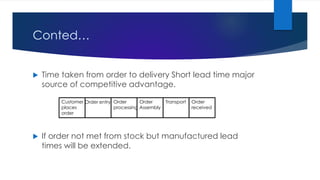
 Time taken from order to delivery Short lead time major
source of competitive advantage.
 If order not met from stock but manufactured lead
times will be extended.
Customer
places
order
Order entry Order
processing
Order
Assembly
Order
received
Transport
Conted…
Procurement Manufacturing Delivery
Logistics
lead time
Customer order cycle
Order
fulfilmentLead Time
Gap
• If logistics lead time = customers required order cycle.
Forecast & inventory not required!
7
CASH TO CASE CYCLE
 Time taken to convert order in to cash.
 The longer the pipeline form the source of materials to
the final user the less responsive to changes in demand
the system will be.
 Ensuring timely response to volatile demand will require
a fundamentally new approach.
HOW TO REDUCE LEAD TIME GAP
 The visibility of the logistics process must be
increased.
 Optimising Production Technology
 Eliminate all the waste in the fulfillment stream so
that only value remains
 Make customer consumption visible to all
members of the fulfillment stream
 Create level flow
 Use pull system ie, KANBAN
Conted…
 Reduce lead time
 Increase velocity and reduce variation
 Collaborate and use process discipline
 Focus on total cost of fulfilment
 Fundamental questioning of why we do things the way
we do.
Any Questions???

Lead time gap

  • 1.
    LEAD TIME GAP BY,PRAYASH NEUPANE “Price and quality important, but increasingly cost of time is crusial element in business.”
  • 2.
    THE CONCEPT OFLEAD TIME  The amount of time that elapses between when a process starts and when it is completed.  The amount of time company takes to deliver products to the market.  Lead time is broken into several components: preprocessing, processing and post processing.  Time taken to procure, make and deliver.
  • 3.
    LIFE CYCLE ANDLEAD TIME 3 Time Sales Late Entrant Obsolescent Stock Market
  • 4.
    LEAD TIME GAP The difference between logistics lead time and the customers order cycle time is called lead time gap. Lead time gap = logistics lead time - customers order cycle time Where, Logistics lead time = total time to complete the manufacturing and product. Customer order cycle time = time that customer is prepared to waits from when the order is placed to the goods received.
  • 5.
    Conted…  Time takenfrom order to delivery Short lead time major source of competitive advantage.  If order not met from stock but manufactured lead times will be extended. Customer places order Order entry Order processing Order Assembly Order received Transport
  • 6.
    Conted… Procurement Manufacturing Delivery Logistics leadtime Customer order cycle Order fulfilmentLead Time Gap • If logistics lead time = customers required order cycle. Forecast & inventory not required!
  • 7.
    7 CASH TO CASECYCLE  Time taken to convert order in to cash.  The longer the pipeline form the source of materials to the final user the less responsive to changes in demand the system will be.  Ensuring timely response to volatile demand will require a fundamentally new approach.
  • 8.
    HOW TO REDUCELEAD TIME GAP  The visibility of the logistics process must be increased.  Optimising Production Technology  Eliminate all the waste in the fulfillment stream so that only value remains  Make customer consumption visible to all members of the fulfillment stream  Create level flow  Use pull system ie, KANBAN
  • 9.
    Conted…  Reduce leadtime  Increase velocity and reduce variation  Collaborate and use process discipline  Focus on total cost of fulfilment  Fundamental questioning of why we do things the way we do.
  • 10.