FACTS
 Acute appendicitis is the most common
surgical emergency of the abdomen
 Appendectomy is one of the most
frequently performed surgical procedures
FACTS
Mortality rate from perforated appendicitis:
 near certain death a century ago
 10-20 per cent 50 years ago
 5 per cent during the 1960s
 1 per cent or less from the 1970s to the present
FACTS
“Rates of unnecessary appendectomies and
perforation have remained relatively high
despite gaining a century of clinical experience
with acute appendicitis”
“The dramatic expansion of diagnostic testing
options and the introduction of innovative
surgical approaches during the last decade has
actually caused even more debate and
disagreement than resolution of issues.”
OPERATIONAL DEFINITIONS
Uncomplicated Appendicitis:
 Includes the acutely inflamed, phlegmonous,
suppurative, or mildly inflamed appendix with
or without peritonitis
OPERATIONAL DEFINITIONS
Complicated Appendicitis:
 Includes gangrenous appendicitis, perforated
appendicitis, localized purulent collection at
operation, generalized peritonitis and
periappendiceal abscess
OPERATIONAL DEFINITIONS
Equivocal Appendicitis:
 A patient with right lower quadrant
abdominal pain who presents with an atypical
history and physical examination and the
surgeon cannot decide whether to discharge or
to operate on the patient
Adult size 9 cms length ; 1-3 mm lumen
Base constant = confluence of taenia coli
Blood supply – appendicular branch of
ileocolic artery
Lymphatics – follows the blood supply
HISTOLOGIC FEATURES
- Muscular layer not well defined
- Lymphoid aggregates in submucosa and
mucosa
- Mucosa is like colon, but irregular shaped
crypts
PHYSIOLOGY
-Serotonin – mediates pain arising from
non inflamed appendix
- “ carcinoid tumors”
- Immune surveillance
- Secretes mucin, fluid & proteolytic
enzymes
DISEASES OF THE VERMIFORM
APPENDIX
I. Acute appendicitis
Etiology & Pathogenesis:
A.Role of environmental: Diet and
Hygiene
Western Diet (Low fiber, High fat)
Change in motility, flora, lumen –
fecalith formation
B. Role of obstruction
- anatomical
- hyperplasia of lymphoid
- neoplasm/foreign body
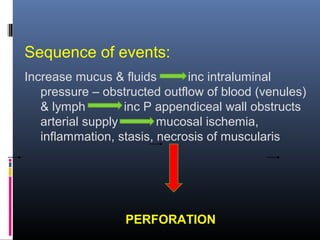
Sequence of events:
Increase mucus & fluids inc intraluminal
pressure – obstructed outflow of blood (venules)
& lymph inc P appendiceal wall obstructs
arterial supply mucosal ischemia,
inflammation, stasis, necrosis of muscularis
PERFORATION
Observation:
Impacted fecalith – no local inflammation
(50%)
C. Role of colonic flora
- 60% Anaerobes – inflammed AP
- 25% Anaerobes – non-inflammed AP
Lumen – source of microorganism
(E.coli/Bacteroides)
Pieper et al – inc antibody titer to Bacteriodes
Gangrene & perforation
NATURAL HISTORY
Temple et al(1995) Prospective study Ann.
Surgery
- 20% perforation < 24 hrs after onset of
symptoms
- 1 patient <10 hrs
- average time to perforate 64h
CLINICAL PRESENTATIONS:
Symptoms:
Abdominal pain – crampy colicky, initial
response of muscularis of appendix to
obstruction
Vomiting, nausea, loss of appetite
CLINICAL PRESENTATIONS:
Signs:
Tenderness – local inflammatory response; tip of
appendix touching parietal peritoneum
Fever rarely occurs (38.2o
C)
3 CLASSIC MANEUVERS:
• Rovsing sign – peritoneal irritation
• Psoas sign – irritation of psoas muscle
• Obturator sign – irritation of obturator
muscle
“OVERALL CLINICAL PICTURE COUNTS”
Laboratory:
Leukocytes count – serial
Urinalysis – exclude ureteral stone/UTI
Liver enzymes/amylase – R/O HBT dse
BHCG – Pregnancy
Imaging studies:
• Plain film- abnormal gas pattern
-(+) fecalith/ rule out other dse.
• Graded compression USG- A-P> 6mm
- sensitivity (55-96%), spec (85-98%)
• CT scan – dilated AP(>5cm),thickened
- wall,(92% sensitive, 94% spec)
BHCG – Pregnancy
Imaging studies
Alvarado scale for the diagnosis of AP
Migration of pain(1),anorexia(1), N/V(1)
RLQ pain (2),rebound (1),fever (1)
Leukocytosis (2), left shift (1)
• 9-10 = almost certain/no labs
• 7-8 = high likelihood
• 5-6 =compatible with but not diagnostic
Acute appendicitis is essentially a clinical
diagnosis; there is no laboratory or
radiologic test yet devised that is 100%
diagnostic of this condition
EVALUATION
Hx and PE – serial PE, one examiner, rectal
exam, speculum, bimanual examination,
urinalysis, pregnancy test
MANAGEMENT:
a. preop – fluids/antibiotics (2nd
gen)
b. Operative – open/laparoscopy
c. Postop - antibiotics
COMPLICATIONS
• Perforation
• Abscess formation
• Intestinal obstruction
• Bacteremia
• Sepsis
• Fistula
• Liver abscess
• Pyelophlebitis
Differential diagnosis:
Acute mesenteric adenitis, AGE, dse of male
urogenital system
Meckel’s diverticulitis, intessusception,
perforated peptic ulcer, colonic lesion,
epiploic appendagitis
UTI, gynecologic dse, Henoch-Schonlein
purpura
Special consideration:
Lifetime risk- 12%( males )
25%( females )
Mean age – 31.3 y/o
2nd
- 4th
decade of life
Rate of misdiagnosis- 15% (higher in females,
22.3 vs 9.3%)
Negative appendectomy women- 23.2%
Special consideration:
Advance age – 50-70% perforation
Use of imaging modalities like CT scan
Pregnancy – location of appendix base on AOG
- ultrasound
II. Neoplasm
> 0-5% incidence
> AdenoCA, Cystic neoplasm, carcinoid, mets,
lymphoma, leiomyosarcoma
> Treatment: Right hemicolectomy
> 5 yr. survival- 55%

Appendix

  • 2.
    FACTS  Acute appendicitisis the most common surgical emergency of the abdomen  Appendectomy is one of the most frequently performed surgical procedures
  • 3.
    FACTS Mortality rate fromperforated appendicitis:  near certain death a century ago  10-20 per cent 50 years ago  5 per cent during the 1960s  1 per cent or less from the 1970s to the present
  • 4.
    FACTS “Rates of unnecessaryappendectomies and perforation have remained relatively high despite gaining a century of clinical experience with acute appendicitis” “The dramatic expansion of diagnostic testing options and the introduction of innovative surgical approaches during the last decade has actually caused even more debate and disagreement than resolution of issues.”
  • 5.
    OPERATIONAL DEFINITIONS Uncomplicated Appendicitis: Includes the acutely inflamed, phlegmonous, suppurative, or mildly inflamed appendix with or without peritonitis
  • 6.
    OPERATIONAL DEFINITIONS Complicated Appendicitis: Includes gangrenous appendicitis, perforated appendicitis, localized purulent collection at operation, generalized peritonitis and periappendiceal abscess
  • 7.
    OPERATIONAL DEFINITIONS Equivocal Appendicitis: A patient with right lower quadrant abdominal pain who presents with an atypical history and physical examination and the surgeon cannot decide whether to discharge or to operate on the patient
  • 12.
    Adult size 9cms length ; 1-3 mm lumen Base constant = confluence of taenia coli Blood supply – appendicular branch of ileocolic artery Lymphatics – follows the blood supply
  • 13.
    HISTOLOGIC FEATURES - Muscularlayer not well defined - Lymphoid aggregates in submucosa and mucosa - Mucosa is like colon, but irregular shaped crypts
  • 14.
    PHYSIOLOGY -Serotonin – mediatespain arising from non inflamed appendix - “ carcinoid tumors” - Immune surveillance - Secretes mucin, fluid & proteolytic enzymes
  • 15.
    DISEASES OF THEVERMIFORM APPENDIX I. Acute appendicitis Etiology & Pathogenesis: A.Role of environmental: Diet and Hygiene Western Diet (Low fiber, High fat) Change in motility, flora, lumen – fecalith formation
  • 16.
    B. Role ofobstruction - anatomical - hyperplasia of lymphoid - neoplasm/foreign body
  • 17.
    Sequence of events: Increasemucus & fluids inc intraluminal pressure – obstructed outflow of blood (venules) & lymph inc P appendiceal wall obstructs arterial supply mucosal ischemia, inflammation, stasis, necrosis of muscularis PERFORATION
  • 18.
    Observation: Impacted fecalith –no local inflammation (50%) C. Role of colonic flora - 60% Anaerobes – inflammed AP - 25% Anaerobes – non-inflammed AP Lumen – source of microorganism (E.coli/Bacteroides) Pieper et al – inc antibody titer to Bacteriodes Gangrene & perforation
  • 19.
    NATURAL HISTORY Temple etal(1995) Prospective study Ann. Surgery - 20% perforation < 24 hrs after onset of symptoms - 1 patient <10 hrs - average time to perforate 64h
  • 20.
    CLINICAL PRESENTATIONS: Symptoms: Abdominal pain– crampy colicky, initial response of muscularis of appendix to obstruction Vomiting, nausea, loss of appetite
  • 21.
    CLINICAL PRESENTATIONS: Signs: Tenderness –local inflammatory response; tip of appendix touching parietal peritoneum Fever rarely occurs (38.2o C)
  • 22.
    3 CLASSIC MANEUVERS: •Rovsing sign – peritoneal irritation • Psoas sign – irritation of psoas muscle • Obturator sign – irritation of obturator muscle “OVERALL CLINICAL PICTURE COUNTS”
  • 23.
    Laboratory: Leukocytes count –serial Urinalysis – exclude ureteral stone/UTI Liver enzymes/amylase – R/O HBT dse BHCG – Pregnancy
  • 24.
    Imaging studies: • Plainfilm- abnormal gas pattern -(+) fecalith/ rule out other dse. • Graded compression USG- A-P> 6mm - sensitivity (55-96%), spec (85-98%) • CT scan – dilated AP(>5cm),thickened - wall,(92% sensitive, 94% spec) BHCG – Pregnancy Imaging studies
  • 25.
    Alvarado scale forthe diagnosis of AP Migration of pain(1),anorexia(1), N/V(1) RLQ pain (2),rebound (1),fever (1) Leukocytosis (2), left shift (1) • 9-10 = almost certain/no labs • 7-8 = high likelihood • 5-6 =compatible with but not diagnostic
  • 26.
    Acute appendicitis isessentially a clinical diagnosis; there is no laboratory or radiologic test yet devised that is 100% diagnostic of this condition
  • 27.
    EVALUATION Hx and PE– serial PE, one examiner, rectal exam, speculum, bimanual examination, urinalysis, pregnancy test MANAGEMENT: a. preop – fluids/antibiotics (2nd gen) b. Operative – open/laparoscopy c. Postop - antibiotics
  • 28.
    COMPLICATIONS • Perforation • Abscessformation • Intestinal obstruction • Bacteremia • Sepsis • Fistula • Liver abscess • Pyelophlebitis
  • 29.
    Differential diagnosis: Acute mesentericadenitis, AGE, dse of male urogenital system Meckel’s diverticulitis, intessusception, perforated peptic ulcer, colonic lesion, epiploic appendagitis UTI, gynecologic dse, Henoch-Schonlein purpura
  • 30.
    Special consideration: Lifetime risk-12%( males ) 25%( females ) Mean age – 31.3 y/o 2nd - 4th decade of life Rate of misdiagnosis- 15% (higher in females, 22.3 vs 9.3%) Negative appendectomy women- 23.2%
  • 31.
    Special consideration: Advance age– 50-70% perforation Use of imaging modalities like CT scan Pregnancy – location of appendix base on AOG - ultrasound
  • 32.
    II. Neoplasm > 0-5%incidence > AdenoCA, Cystic neoplasm, carcinoid, mets, lymphoma, leiomyosarcoma > Treatment: Right hemicolectomy > 5 yr. survival- 55%