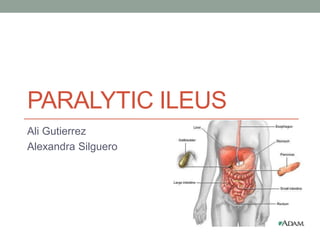
PARALYTIC ILEUS
Ali Gutierrez
Alexandra Silguero
Pathophysiology
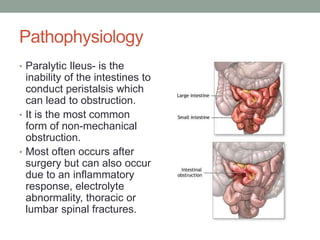
• Paralytic Ileus- is the
inability of the intestines to
conduct peristalsis which
can lead to obstruction.
• It is the most common
form of non-mechanical
obstruction.
• Most often occurs after
surgery but can also occur
due to an inflammatory
response, electrolyte
abnormality, thoracic or
lumbar spinal fractures.
Pathophysiology Cont.
• If distension occurs near an obstruction, fluid, gas, and
intestinal contents can build up pressure and cause the
bowel to collapse, collapsed bowel can build up pressure
and lead to leakage of F&E into peritoneal cavity and
ultimately lead to severe reduction in blood volume which
can result in hypotension and hypovolemic shock.
• Intestinal strangulation- can occur as a very dangerous
complication secondary to highly distended bowel, blood
flow becomes minimized resulting in edema, cyanosis,
and gangrene at portion of bowel, this can result in bowel
becoming necrotic and rupturing causing infection, sepsis,
and ultimately death.
Clinical Manifestations
• Most important manifestations (Characteristics are dependent
on the location of the obstruction)
Colicky abdominal pain (constant generalized discomfort)
Nausea
o Proximal to obstruction= rapid develop onset N&V
o Distal to obstruction = gradual in onset N&V
Vomiting (often relieves abdominal pain = higher intestines)
o Proximal to obstruction = may be projectile and contain bile
o Distal to obstruction = foul smell that looks like stool, indicates long
standing obstruction requiring immediate surgery
Clinical Manifestations Cont.
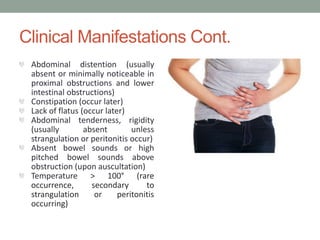
Abdominal distention (usually
absent or minimally noticeable in
proximal obstructions and lower
intestinal obstructions)
Constipation (occur later)
Lack of flatus (occur later)
Abdominal tenderness, rigidity
(usually absent unless
strangulation or peritonitis occur)
Absent bowel sounds or high
pitched bowel sounds above
obstruction (upon auscultation)
Temperature > 100° (rare
occurrence, secondary to
strangulation or peritonitis
occurring)
Interventions
• Interventions
Notify surgeon of changes in:
o VS
o Bowel sounds
o Decreased urine output
o Increased abdominal distention
o Pain
Maintain strict I&O record
Monitor for signs of dehydration and electrolyte imbalance
Assess pain and provide comfort measures
Labs & Diagnostics
• Perform a thorough history and physical examination.
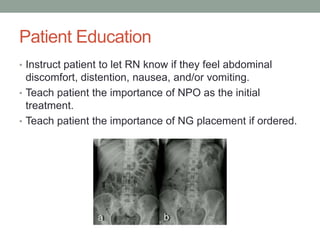
• CT scans and abdominal x-rays are ordered.
• An elevated WBC count may indicate strangulation or
perforation.
• Serum electrolytes, BUN, and creatinine are monitored
frequently to assess the degree of dehydration.
Treatments
• Placing the patient on NPO status to rest their bowel.
• Administering IV fluids and electrolytes to prevent
dehydration.
• An NG tube is sometimes placed to relieve abdominal
swelling.
• Medication to stimulate bowel movements include:
• Laxatives
• Suppositories
• Enemas
Patient Education
• Instruct patient to let RN know if they feel abdominal
discomfort, distention, nausea, and/or vomiting.
• Teach patient the importance of NPO as the initial
treatment.
• Teach patient the importance of NG placement if ordered.
References
• Ackley, B., & Ladwig, G. (2014). Nursing diagnosis
handbook: An evidence-based guide to planning care
(10th ed.). Maryland Heights, MO: Elsevier.
• Lewis, S., & Dirksen, S. (2014). Medical-surgical nursing:
Assessment and management of clinical problems (Ninth
ed.). St. Louis, MO: Elsevier.
• Pagana, K., & Pagana, T. (2014). Mosby's manual of
diagnostic and laboratory tests (Fifth ed.). St. Louis, MO:
Elsevier.

Paralytic ileus

  • 1.
  • 2.
    Pathophysiology • Paralytic Ileus-is the inability of the intestines to conduct peristalsis which can lead to obstruction. • It is the most common form of non-mechanical obstruction. • Most often occurs after surgery but can also occur due to an inflammatory response, electrolyte abnormality, thoracic or lumbar spinal fractures.
  • 3.
    Pathophysiology Cont. • Ifdistension occurs near an obstruction, fluid, gas, and intestinal contents can build up pressure and cause the bowel to collapse, collapsed bowel can build up pressure and lead to leakage of F&E into peritoneal cavity and ultimately lead to severe reduction in blood volume which can result in hypotension and hypovolemic shock. • Intestinal strangulation- can occur as a very dangerous complication secondary to highly distended bowel, blood flow becomes minimized resulting in edema, cyanosis, and gangrene at portion of bowel, this can result in bowel becoming necrotic and rupturing causing infection, sepsis, and ultimately death.
  • 4.
    Clinical Manifestations • Mostimportant manifestations (Characteristics are dependent on the location of the obstruction) Colicky abdominal pain (constant generalized discomfort) Nausea o Proximal to obstruction= rapid develop onset N&V o Distal to obstruction = gradual in onset N&V Vomiting (often relieves abdominal pain = higher intestines) o Proximal to obstruction = may be projectile and contain bile o Distal to obstruction = foul smell that looks like stool, indicates long standing obstruction requiring immediate surgery
  • 5.
    Clinical Manifestations Cont. Abdominaldistention (usually absent or minimally noticeable in proximal obstructions and lower intestinal obstructions) Constipation (occur later) Lack of flatus (occur later) Abdominal tenderness, rigidity (usually absent unless strangulation or peritonitis occur) Absent bowel sounds or high pitched bowel sounds above obstruction (upon auscultation) Temperature > 100° (rare occurrence, secondary to strangulation or peritonitis occurring)
  • 6.
    Interventions • Interventions Notify surgeonof changes in: o VS o Bowel sounds o Decreased urine output o Increased abdominal distention o Pain Maintain strict I&O record Monitor for signs of dehydration and electrolyte imbalance Assess pain and provide comfort measures
  • 7.
    Labs & Diagnostics •Perform a thorough history and physical examination. • CT scans and abdominal x-rays are ordered. • An elevated WBC count may indicate strangulation or perforation. • Serum electrolytes, BUN, and creatinine are monitored frequently to assess the degree of dehydration.
  • 8.
    Treatments • Placing thepatient on NPO status to rest their bowel. • Administering IV fluids and electrolytes to prevent dehydration. • An NG tube is sometimes placed to relieve abdominal swelling. • Medication to stimulate bowel movements include: • Laxatives • Suppositories • Enemas
  • 9.
    Patient Education • Instructpatient to let RN know if they feel abdominal discomfort, distention, nausea, and/or vomiting. • Teach patient the importance of NPO as the initial treatment. • Teach patient the importance of NG placement if ordered.
  • 10.
    References • Ackley, B.,& Ladwig, G. (2014). Nursing diagnosis handbook: An evidence-based guide to planning care (10th ed.). Maryland Heights, MO: Elsevier. • Lewis, S., & Dirksen, S. (2014). Medical-surgical nursing: Assessment and management of clinical problems (Ninth ed.). St. Louis, MO: Elsevier. • Pagana, K., & Pagana, T. (2014). Mosby's manual of diagnostic and laboratory tests (Fifth ed.). St. Louis, MO: Elsevier.