People 2.0 Working in a 2.0 World August 2008 KM Brasil
Begin with the end in mind A brief history of KM The impact of social tools and Web 2.0 on KM KM 2.0: KM goes Social World 2.0, People 2.0
Two early forms of KM Techno-centric KM People-centric KM
Techno-centric KM Corporate KM Birth 1995 (Lotus Notes 1989) Internet, Intranets, Office, E-mail  The management of unstructured  information Database and search centric For many organizations what KM is about!
People-centric KM Pioneers BP (Chris Collison, Geoff Parcell) Buckman Labs (Bob Buckman) Personal Knowledge Management (PKM) People Centred Knowledge Management (PCKM) Soft tools e.g. Cops, After Action Reviews
People-centric KM Tools Communities of Practice Storytelling and narrative After action reviews Peer assists Retrospects Knowledge Cafes Open Space Appreciative Inquiry
KM Today Both forms of KM practiced KC UK Collaboration Content Over-hyped, underperformed Is KM dead? KM changing/evolving Not driven by the traditional KM community
The Disruptor Social Tools Quietly evolving on the web Roots  not  in KM Social Tool thought leaders and even KM advocates avoid the label!
Social Tools What are social tools for? Finding and connecting with people Building communities Sharing knowledge Informal learning They are personal/social KM tools!
Social Tools Weblogs Wikis Social book marking & tagging Social Networking Communities Instant Messaging/Presence RSS Feed Readers Micro-blogging Podcasts, videocasts Mashups Blogger Technorati MediaWiki LinkedIn, Facebook Delicious Google Reader, Bloglines Skype Flickr YouTube, Google Video Twitter Odeo Slideshare iPod Creative Commons
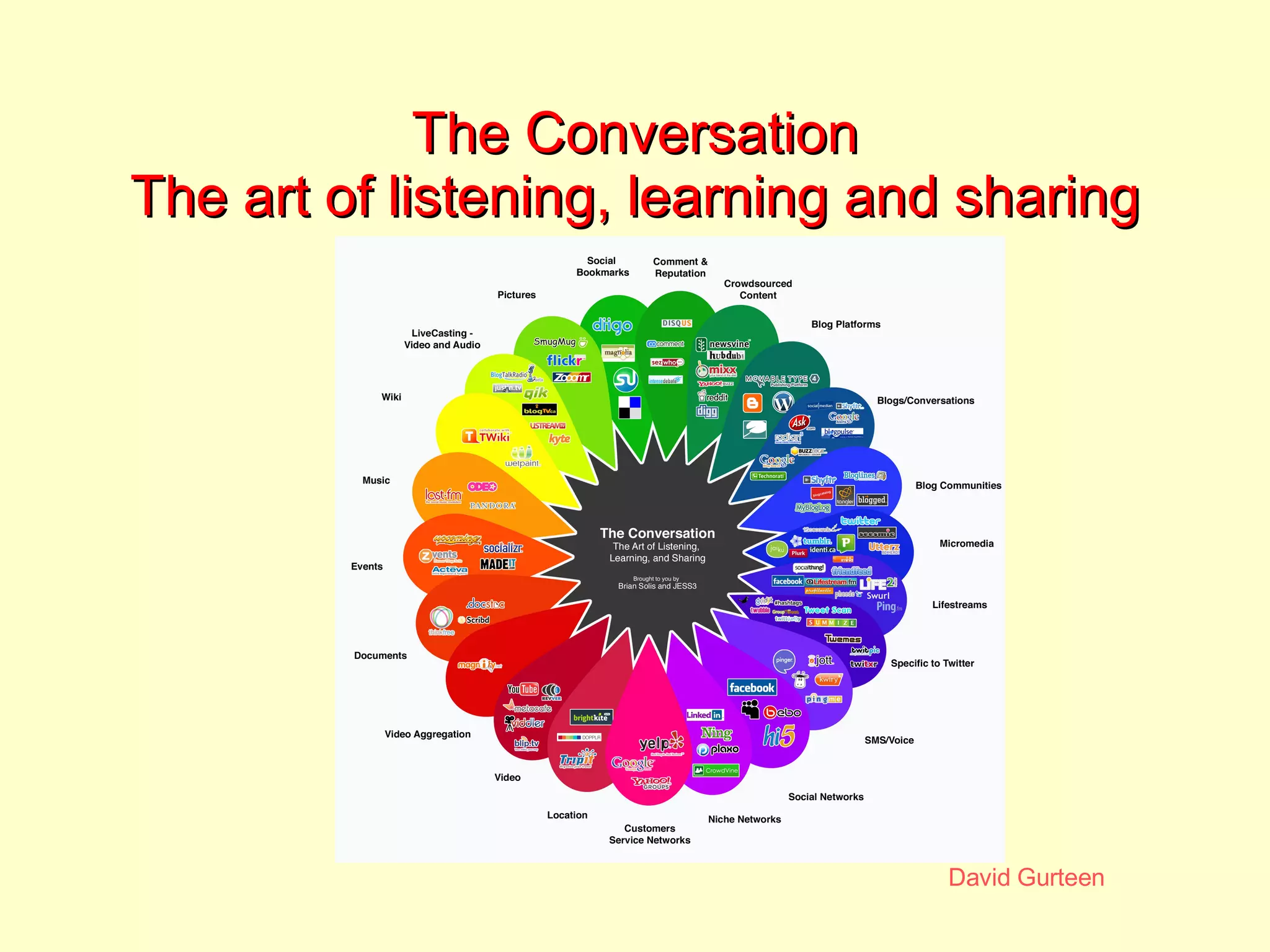
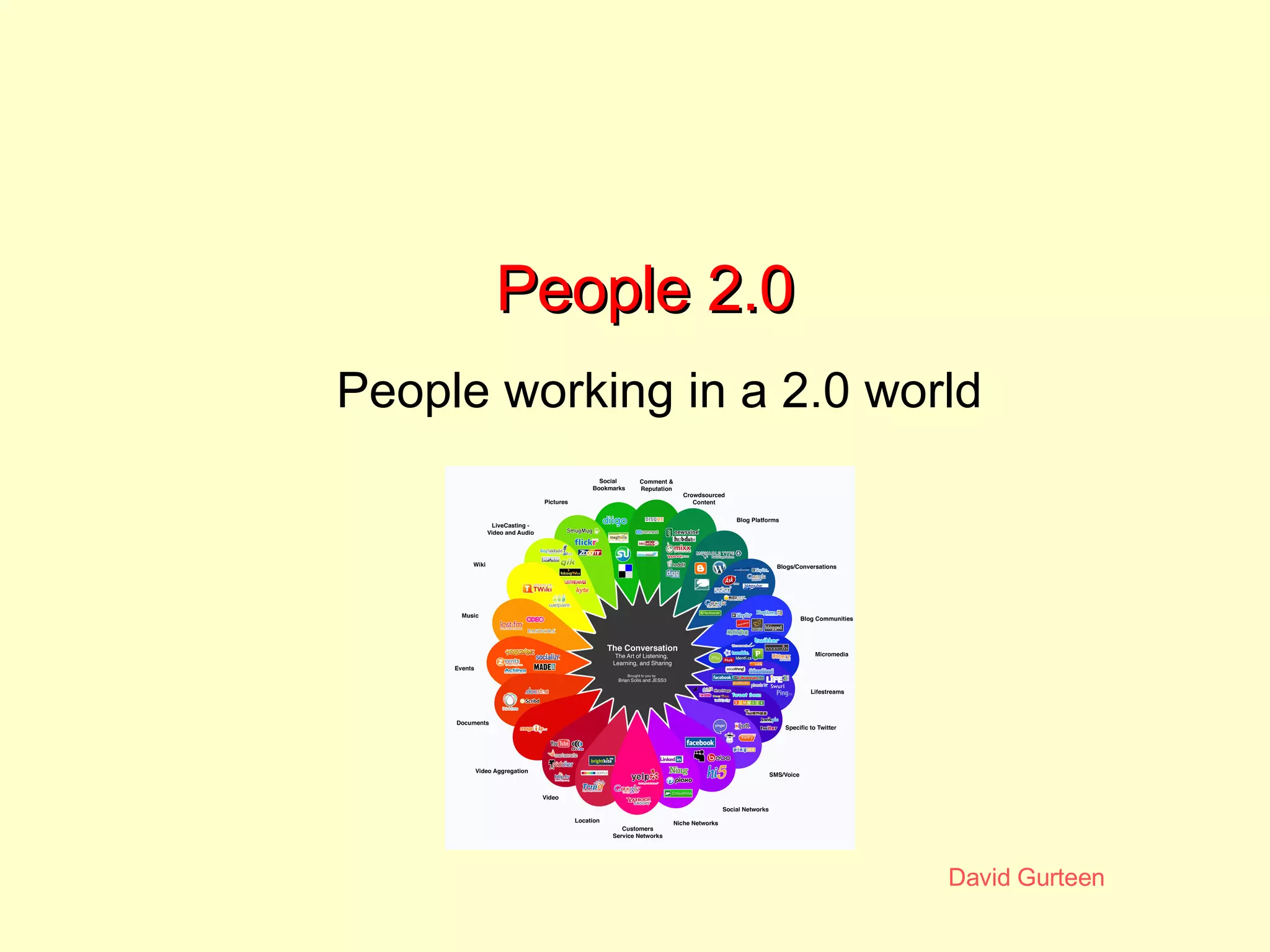
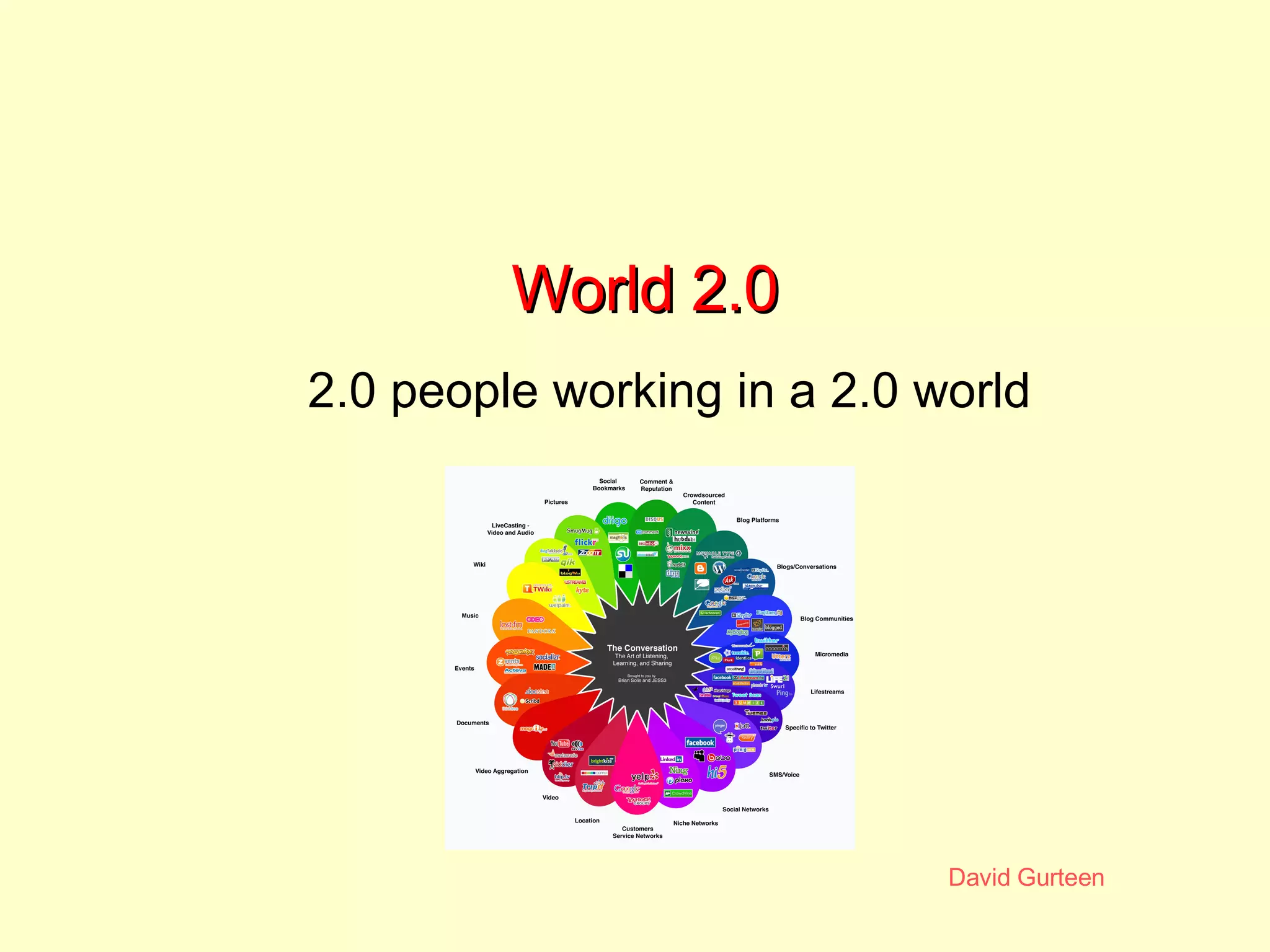
The Conversation The art of listening, learning and sharing
Web 2.0 The social web The participatory web Built around social tools Evolved, emerged Not planned Not IBM or Microsoft Open protocols Low cost
Enterprise 2.0 Taking Web 2.0 into the organization Weblogs and Wikis IBM and Microsoft now in the game And more …
So what does this mean for KM?
KM 1.0 The old traditional, corporate, techno-centric command and control form of KM
KM 2.0 Take People-centric KM, PKM CoPs, AARs, KCafes, … Social Computing Weblogs, Wikis, … To create A new form of KM  KM 2.0 or Social KM
Social KM Corporate Top down Centralised Command & Control Monolithic systems Explicit Knowledge Personal Bottom up Decentralised Distributed Ecosystems Tacit Knowledge KM 1.0 KM 2.0
KM Tool Comparison Taxonomies People Finders Databases E-mail Newsletters Discussion Forums Social Tagging Social Networking Blogs & Wikis Instant Messaging RSS Feeds & Readers Blogs KM 1.0 KM 2.0
Social KM Stories Best Practices Improved decision making & innovation Efficiency and productivity Work is open and transparent Work is behind closed doors KM 2.0 KM 1.0 Knowledge is naturally captured as part of one’s work Knowledge is captured just in case Knowledge sharing is people centric Knowledge sharing is database centric I have a choice & select my own tools IT chooses the tools I use Content is distributed freely and uncontrolled Content is centralised, protected and controlled Social Networking platforms reflect who is doing what with whom People directories provide contact information KM is part of my everyday work KM is extra work
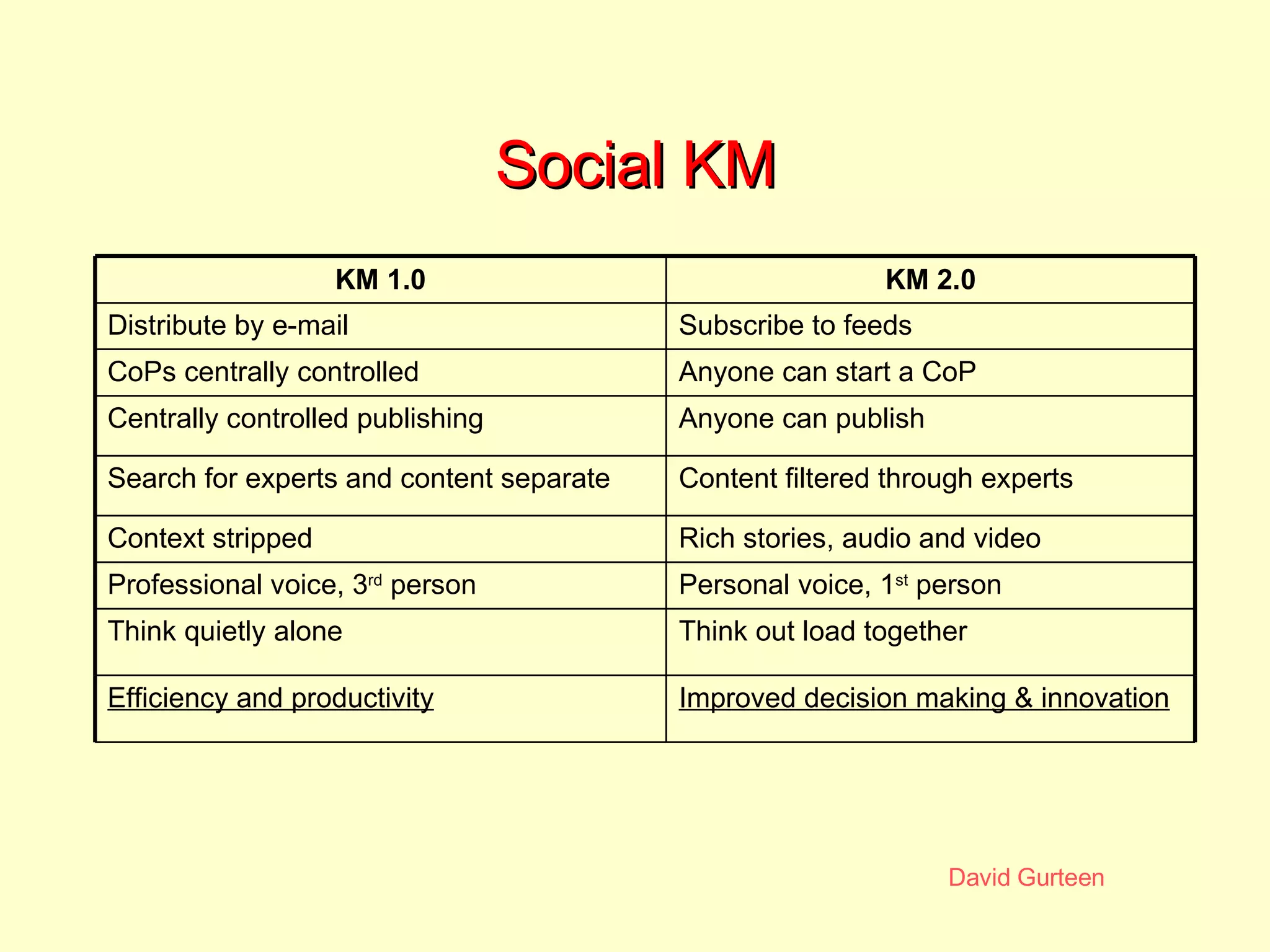
Social KM Think out load together Think quietly alone Anyone can publish Centrally controlled publishing Anyone can start a CoP CoPs centrally controlled KM 2.0 KM 1.0 Improved decision making & innovation Efficiency and productivity Personal voice, 1 st  person Professional voice, 3 rd  person Rich stories, audio and video Context stripped Content filtered through experts Search for experts and content separate Subscribe to feeds Distribute by e-mail
KM is about Conversation KM is simply the art of enabling trusted, context-rich  conversations  among the appropriate members of communities about things these communities are passionate about. Dave Pollard A powerful global  conversation  has begun. Through the Internet, people are discovering and inventing new ways to share relevant knowledge with blinding speed. As a direct result, markets are getting smarter and getting smarter faster than most companies.  The Cluetrain Manifesto
KM is Social
Everything 2.0 Web 2.0 technologies and thinking is changing everything!
Everything 2.0 Web 2.0 Enterprise 2.0 KM 2.0 Library 2.0 Management 2.0  Project Management 2.0 Education 2.0 Warfare 2.0 Politics 2.0 Manager 2.0 People 2.0 World 2.0 Credit: Hugh MacLeod, gapingvoid Participation Conversation
People 2.0 People working in a 2.0 world
WE are healthy, educated and well travelled This has happened over the last 50 years.
WE have ungated access to what is going on in the world The web & personal publishing such as blogs & YouTube has enabled this.
WE have a voice WE can influence things  WE are participants  WE wish to make a difference Social tools enable this.
WE can no longer be lied to As students, employees, consumers or citizens, we can talk openly to each other. There are whistle blowing sites.
WE can no longer be controlled WE chose who we work for!
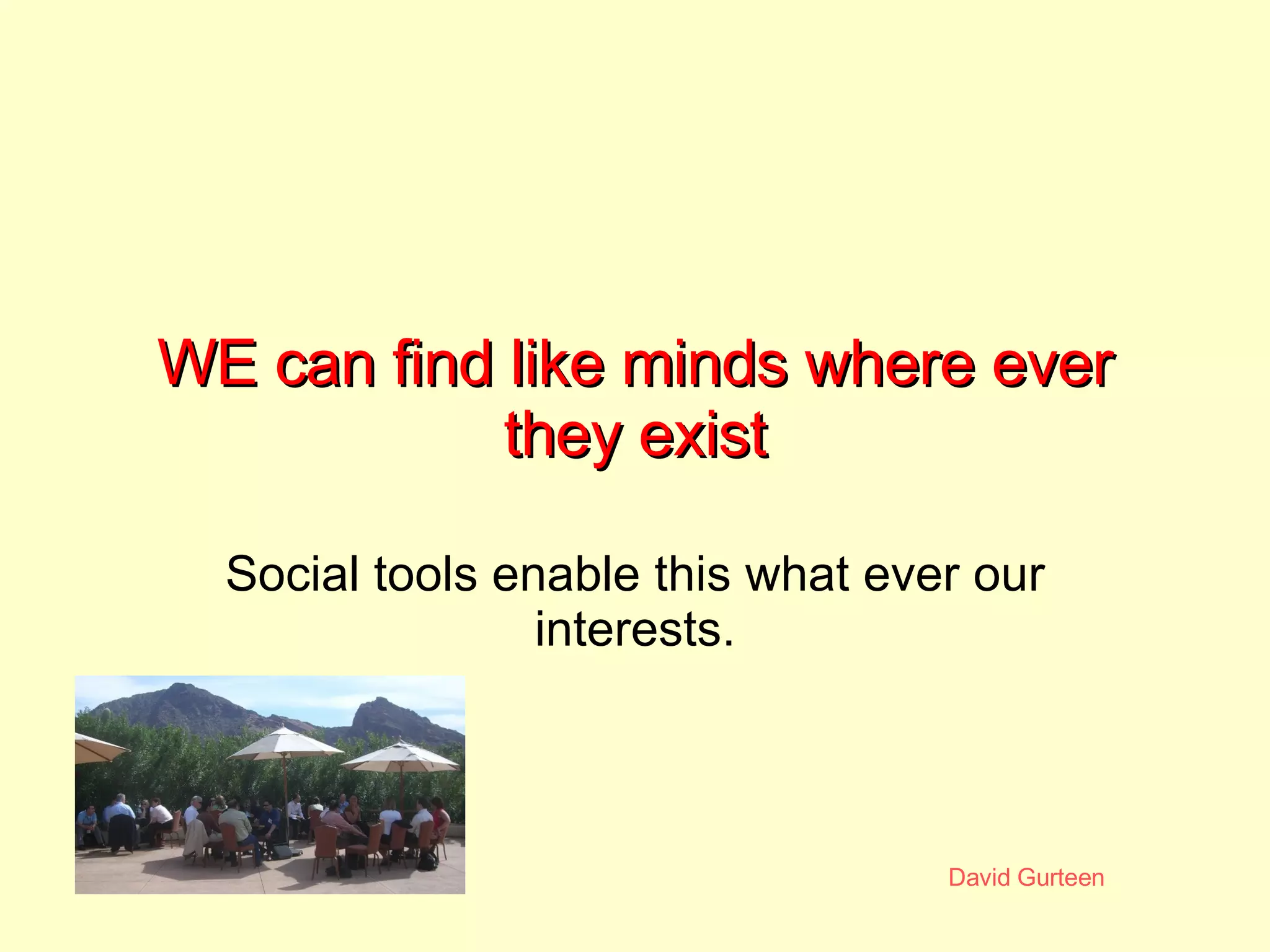
WE can find like minds where ever they exist Social tools enable this what ever our interests.
WE are free to collaborate with whom we chose about what we chose on subjects we feel passionate about Social tools enable this.
WE are free! But with freedom comes responsibility. The Bottom Line
Idealistic? Maybe, maybe not!
World 2.0 2.0 people working in a 2.0 world
Sharing WE share knowledge WE share information World 2.0 World 1.0
Sharing Sharing knowledge is not about giving people something, or getting something from them. That is only valid for information sharing. Sharing knowledge occurs when people are genuinely interested in helping one another develop new capacities for action; it is about creating learning processes.  Peter Senge
Knowledge Sharing WE (all) share knowledge as a natural part of our everyday work WE (managers) impose knowledge sharing on people as additional work World 2.0 World 1.0
Knowledge Sharing Management tries to force knowledge sharing Seen as additional work of little value Rewards are ‘gamed’ With blogs and wikis people naturally share as part of their everyday work
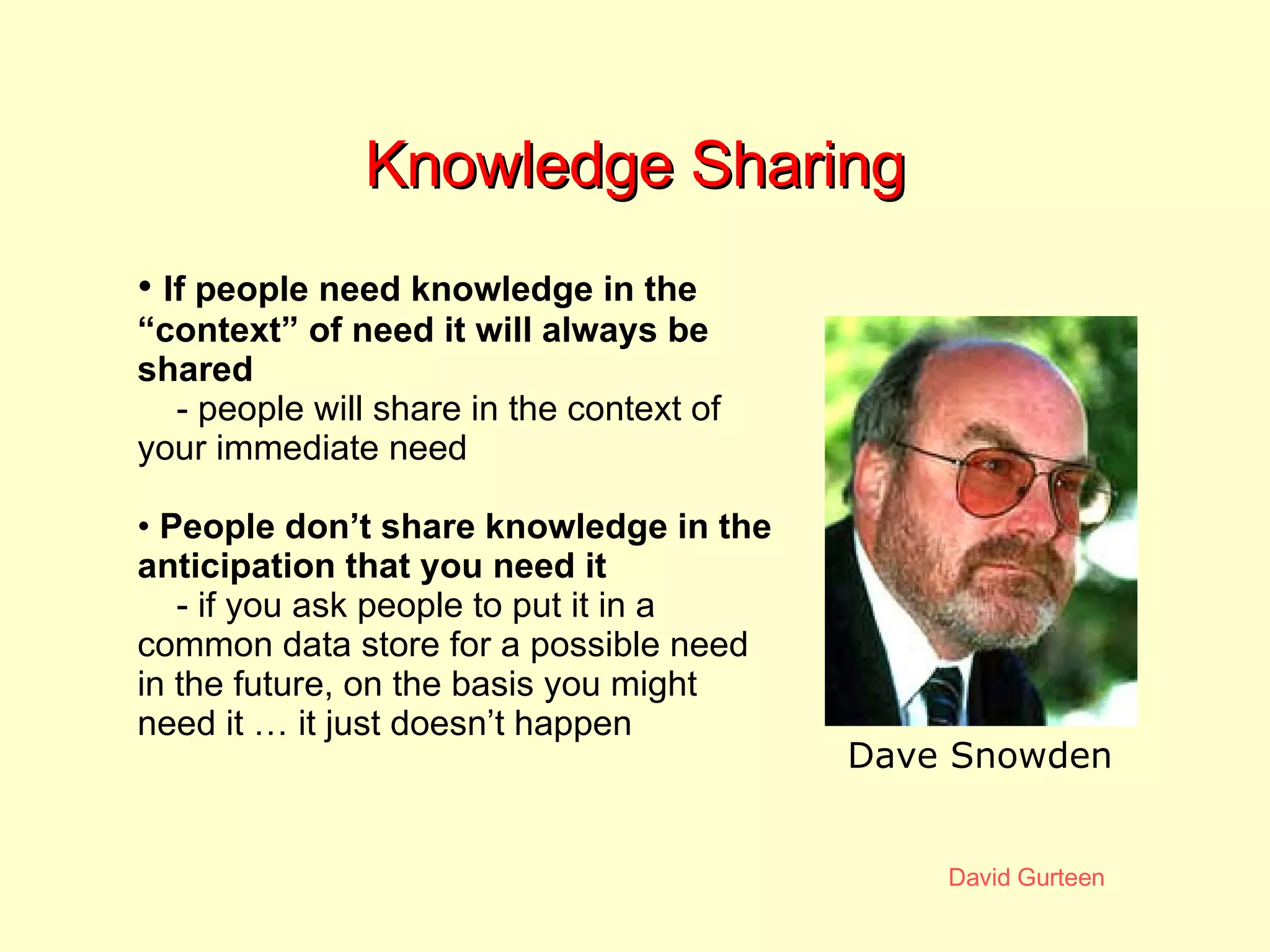
Knowledge Sharing If people need knowledge in the “context” of need it will always be shared - people will share in the context of your immediate need People don’t share knowledge in the anticipation that you need it   - if you ask people to put it in a common data store for a possible need in the future, on the basis you might need it … it just doesn’t happen Dave Snowden
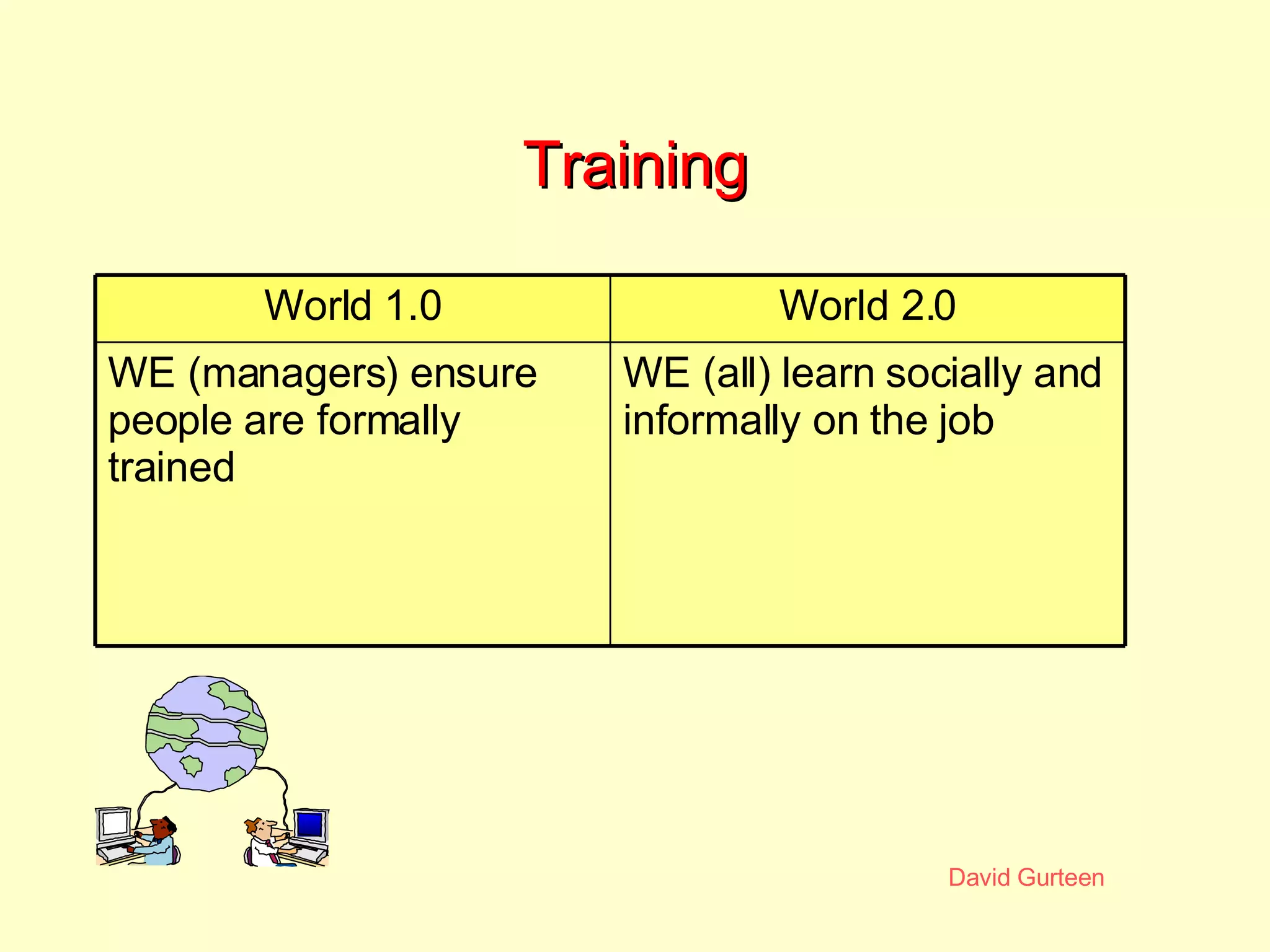
Training WE (all) learn socially and informally on the job WE (managers) ensure people are formally trained World 2.0 World 1.0
Training Learning was confined to occasional formal training Learning is continuous and informal  Social tools are informal learning tools
On being taught Personally I'm always ready to learn, although I do not always like being taught. Sir Winston Churchill
Transparency WE work transparently where everyone can see it WE work behind closed doors World 2.0 World 1.0
Transparency Before IT it was impossible for people to share work in progress Today it is easy Working transparently means we get early feedback and can adapt more quickly A fundamental part of natural knowledge sharing But old habits linger on We need to be confident
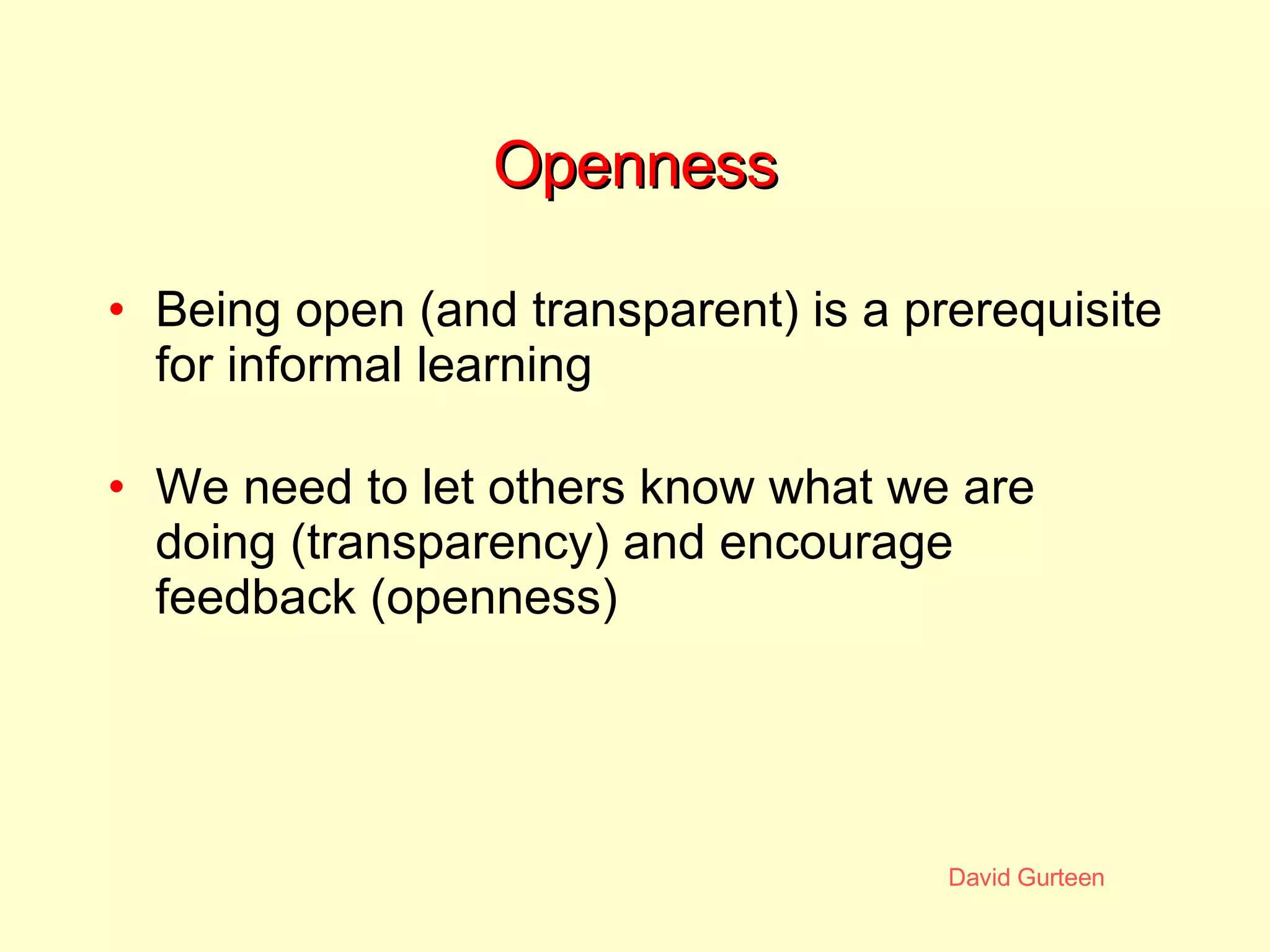
Openness WE are open. We welcome new ideas and feedback WE tend to be closed & defensive - not open to the ideas of others World 2.0 World 1.0
Openness Being open (and transparent) is a prerequisite for informal learning We need to let others know what we are doing (transparency) and encourage feedback (openness)
Command & Control WE (managers) give people freedom in return for their accepting responsibility WE (managers) control people out of fear they will do wrong World 2.0 World 1.0
Command & Control Managers need to relinquish control British military learnt this in WW1 Its about trust But with trust goes responsibility Management by outcomes not activity
The Knowledge Worker Knowledge workers are those people who have taken responsibility for their work lives. They continually strive to better understand the changing world around them and modify their work practices and behaviors to better meet their personal and organizational objectives. No one tells them what to do. They do not take “No” for an answer. They are self motivated. A Knowledge worker is someone who gets to decide what she does each morning. Tom Stewart
Control of Information WE distribute information more freely and control it only as appropriate WE (managers) centralise, protect and control information World 2.0 World 1.0
Control of Information PCs, laptops, cameras, CDs, memory dongles, blogs: its no longer possible to control the storage and flow of digital information Anyone who really wants it can gain access We cannot stop people from talking Tie down the essential stuff only Educate and trust people on the rest
Involvement WE (managers) involve people from pre-conception to implementation. We work together with them! WE (managers) do not involve people – we do things to them! World 2.0 World 1.0
Work with People – don’t do things to them! Many of the familiar principles of Quality management amount to an elaboration of this simple truth: an innovative, healthy organization requires that  we work with people rather than do things to them .  Alfie Kohn How do we better work together? How do we make them share?
Voice WE talk in our natural voice WE talk in a stilted professional voice World 2.0 World 1.0
Voice Third party passive voice Conceptual, theoretical, scientific Stripped of context Be ourselves; get specific; tell stories
On the professional voice We have been trained throughout our business careers to suppress our individual voice and to sound like a 'professional', that is, to sound like everyone else. This professional voice is distinctive. And weird. Taken out of context, it is as mannered as the ritualistic dialogue of the 17th-century French court.  David Weinberger
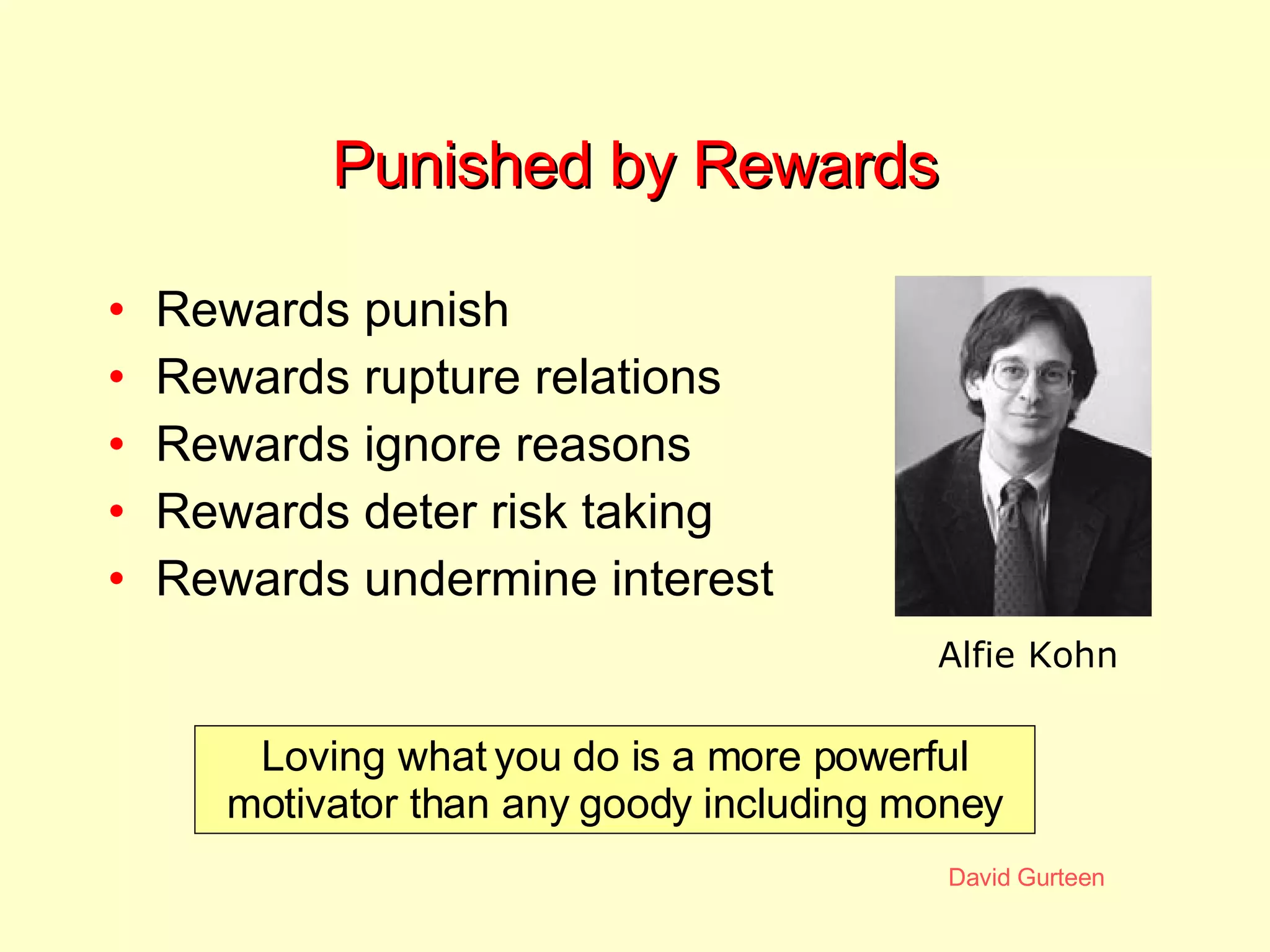
Rewards WE recognise that loving our work is the true reward WE (managers) motivate people with external rewards and incentives World 2.0 World 1.0
Punished by Rewards Rewards punish  Rewards rupture relations Rewards ignore reasons Rewards deter risk taking Rewards undermine interest Loving what you do is a more powerful motivator than any goody including money Alfie Kohn
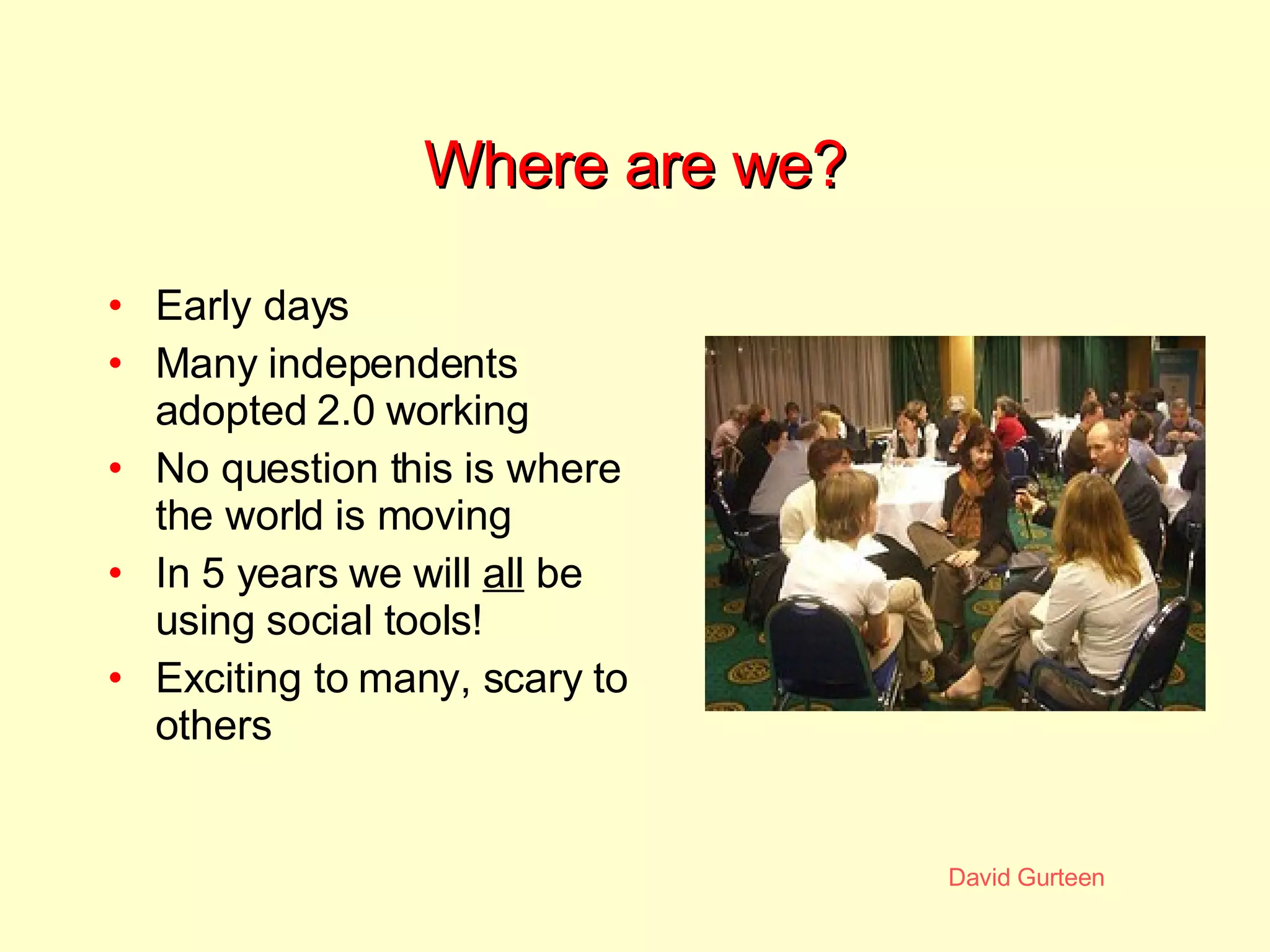
Where are we? Early days Many independents adopted 2.0 working No question this is where the world is moving In 5 years we will  all  be using social tools! Exciting to many, scary to others
The way forward Be an early adopter Start to use the tools yourself Pilot the tools within your organisation Take good advise Learn what they mean for you and your organisation Cannot plan this – its emergent Have to see where it takes us! Have  conversations  with people
 
We are moving to a  participatory  “WE world” Yes,  we . We  control the Informaton Age. Welcome to  our  world.
Conversation!  Questions?
www.gurteen.com David Gurteen Gurteen Knowledge Tel: +44 1252 812 878 Email: david.gurteen@gurteen.com
Licence You may use these slides under the following Creative Commons Licence Attribution-Share Alike 2.0 http://creativecommons.org/licenses/by-sa/2.0/uk/

Talk at KM Brasil: People 2.0: Working in a 2.0 World

  • 1.
    People 2.0 Workingin a 2.0 World August 2008 KM Brasil
  • 2.
    Begin with theend in mind A brief history of KM The impact of social tools and Web 2.0 on KM KM 2.0: KM goes Social World 2.0, People 2.0
  • 3.
    Two early formsof KM Techno-centric KM People-centric KM
  • 4.
    Techno-centric KM CorporateKM Birth 1995 (Lotus Notes 1989) Internet, Intranets, Office, E-mail The management of unstructured information Database and search centric For many organizations what KM is about!
  • 5.
    People-centric KM PioneersBP (Chris Collison, Geoff Parcell) Buckman Labs (Bob Buckman) Personal Knowledge Management (PKM) People Centred Knowledge Management (PCKM) Soft tools e.g. Cops, After Action Reviews
  • 6.
    People-centric KM ToolsCommunities of Practice Storytelling and narrative After action reviews Peer assists Retrospects Knowledge Cafes Open Space Appreciative Inquiry
  • 7.
    KM Today Bothforms of KM practiced KC UK Collaboration Content Over-hyped, underperformed Is KM dead? KM changing/evolving Not driven by the traditional KM community
  • 8.
    The Disruptor SocialTools Quietly evolving on the web Roots not in KM Social Tool thought leaders and even KM advocates avoid the label!
  • 9.
    Social Tools Whatare social tools for? Finding and connecting with people Building communities Sharing knowledge Informal learning They are personal/social KM tools!
  • 10.
    Social Tools WeblogsWikis Social book marking & tagging Social Networking Communities Instant Messaging/Presence RSS Feed Readers Micro-blogging Podcasts, videocasts Mashups Blogger Technorati MediaWiki LinkedIn, Facebook Delicious Google Reader, Bloglines Skype Flickr YouTube, Google Video Twitter Odeo Slideshare iPod Creative Commons
  • 11.
    The Conversation Theart of listening, learning and sharing
  • 12.
    Web 2.0 Thesocial web The participatory web Built around social tools Evolved, emerged Not planned Not IBM or Microsoft Open protocols Low cost
  • 13.
    Enterprise 2.0 TakingWeb 2.0 into the organization Weblogs and Wikis IBM and Microsoft now in the game And more …
  • 14.
    So what doesthis mean for KM?
  • 15.
    KM 1.0 Theold traditional, corporate, techno-centric command and control form of KM
  • 16.
    KM 2.0 TakePeople-centric KM, PKM CoPs, AARs, KCafes, … Social Computing Weblogs, Wikis, … To create A new form of KM KM 2.0 or Social KM
  • 17.
    Social KM CorporateTop down Centralised Command & Control Monolithic systems Explicit Knowledge Personal Bottom up Decentralised Distributed Ecosystems Tacit Knowledge KM 1.0 KM 2.0
  • 18.
    KM Tool ComparisonTaxonomies People Finders Databases E-mail Newsletters Discussion Forums Social Tagging Social Networking Blogs & Wikis Instant Messaging RSS Feeds & Readers Blogs KM 1.0 KM 2.0
  • 19.
    Social KM StoriesBest Practices Improved decision making & innovation Efficiency and productivity Work is open and transparent Work is behind closed doors KM 2.0 KM 1.0 Knowledge is naturally captured as part of one’s work Knowledge is captured just in case Knowledge sharing is people centric Knowledge sharing is database centric I have a choice & select my own tools IT chooses the tools I use Content is distributed freely and uncontrolled Content is centralised, protected and controlled Social Networking platforms reflect who is doing what with whom People directories provide contact information KM is part of my everyday work KM is extra work
  • 20.
    Social KM Thinkout load together Think quietly alone Anyone can publish Centrally controlled publishing Anyone can start a CoP CoPs centrally controlled KM 2.0 KM 1.0 Improved decision making & innovation Efficiency and productivity Personal voice, 1 st person Professional voice, 3 rd person Rich stories, audio and video Context stripped Content filtered through experts Search for experts and content separate Subscribe to feeds Distribute by e-mail
  • 21.
    KM is aboutConversation KM is simply the art of enabling trusted, context-rich conversations among the appropriate members of communities about things these communities are passionate about. Dave Pollard A powerful global conversation has begun. Through the Internet, people are discovering and inventing new ways to share relevant knowledge with blinding speed. As a direct result, markets are getting smarter and getting smarter faster than most companies. The Cluetrain Manifesto
  • 22.
  • 23.
    Everything 2.0 Web2.0 technologies and thinking is changing everything!
  • 24.
    Everything 2.0 Web2.0 Enterprise 2.0 KM 2.0 Library 2.0 Management 2.0 Project Management 2.0 Education 2.0 Warfare 2.0 Politics 2.0 Manager 2.0 People 2.0 World 2.0 Credit: Hugh MacLeod, gapingvoid Participation Conversation
  • 25.
    People 2.0 Peopleworking in a 2.0 world
  • 26.
    WE are healthy,educated and well travelled This has happened over the last 50 years.
  • 27.
    WE have ungatedaccess to what is going on in the world The web & personal publishing such as blogs & YouTube has enabled this.
  • 28.
    WE have avoice WE can influence things WE are participants WE wish to make a difference Social tools enable this.
  • 29.
    WE can nolonger be lied to As students, employees, consumers or citizens, we can talk openly to each other. There are whistle blowing sites.
  • 30.
    WE can nolonger be controlled WE chose who we work for!
  • 31.
    WE can findlike minds where ever they exist Social tools enable this what ever our interests.
  • 32.
    WE are freeto collaborate with whom we chose about what we chose on subjects we feel passionate about Social tools enable this.
  • 33.
    WE are free!But with freedom comes responsibility. The Bottom Line
  • 34.
  • 35.
    World 2.0 2.0people working in a 2.0 world
  • 36.
    Sharing WE shareknowledge WE share information World 2.0 World 1.0
  • 37.
    Sharing Sharing knowledgeis not about giving people something, or getting something from them. That is only valid for information sharing. Sharing knowledge occurs when people are genuinely interested in helping one another develop new capacities for action; it is about creating learning processes. Peter Senge
  • 38.
    Knowledge Sharing WE(all) share knowledge as a natural part of our everyday work WE (managers) impose knowledge sharing on people as additional work World 2.0 World 1.0
  • 39.
    Knowledge Sharing Managementtries to force knowledge sharing Seen as additional work of little value Rewards are ‘gamed’ With blogs and wikis people naturally share as part of their everyday work
  • 40.
    Knowledge Sharing Ifpeople need knowledge in the “context” of need it will always be shared - people will share in the context of your immediate need People don’t share knowledge in the anticipation that you need it - if you ask people to put it in a common data store for a possible need in the future, on the basis you might need it … it just doesn’t happen Dave Snowden
  • 41.
    Training WE (all)learn socially and informally on the job WE (managers) ensure people are formally trained World 2.0 World 1.0
  • 42.
    Training Learning wasconfined to occasional formal training Learning is continuous and informal Social tools are informal learning tools
  • 43.
    On being taughtPersonally I'm always ready to learn, although I do not always like being taught. Sir Winston Churchill
  • 44.
    Transparency WE worktransparently where everyone can see it WE work behind closed doors World 2.0 World 1.0
  • 45.
    Transparency Before ITit was impossible for people to share work in progress Today it is easy Working transparently means we get early feedback and can adapt more quickly A fundamental part of natural knowledge sharing But old habits linger on We need to be confident
  • 46.
    Openness WE areopen. We welcome new ideas and feedback WE tend to be closed & defensive - not open to the ideas of others World 2.0 World 1.0
  • 47.
    Openness Being open(and transparent) is a prerequisite for informal learning We need to let others know what we are doing (transparency) and encourage feedback (openness)
  • 48.
    Command & ControlWE (managers) give people freedom in return for their accepting responsibility WE (managers) control people out of fear they will do wrong World 2.0 World 1.0
  • 49.
    Command & ControlManagers need to relinquish control British military learnt this in WW1 Its about trust But with trust goes responsibility Management by outcomes not activity
  • 50.
    The Knowledge WorkerKnowledge workers are those people who have taken responsibility for their work lives. They continually strive to better understand the changing world around them and modify their work practices and behaviors to better meet their personal and organizational objectives. No one tells them what to do. They do not take “No” for an answer. They are self motivated. A Knowledge worker is someone who gets to decide what she does each morning. Tom Stewart
  • 51.
    Control of InformationWE distribute information more freely and control it only as appropriate WE (managers) centralise, protect and control information World 2.0 World 1.0
  • 52.
    Control of InformationPCs, laptops, cameras, CDs, memory dongles, blogs: its no longer possible to control the storage and flow of digital information Anyone who really wants it can gain access We cannot stop people from talking Tie down the essential stuff only Educate and trust people on the rest
  • 53.
    Involvement WE (managers)involve people from pre-conception to implementation. We work together with them! WE (managers) do not involve people – we do things to them! World 2.0 World 1.0
  • 54.
    Work with People– don’t do things to them! Many of the familiar principles of Quality management amount to an elaboration of this simple truth: an innovative, healthy organization requires that we work with people rather than do things to them . Alfie Kohn How do we better work together? How do we make them share?
  • 55.
    Voice WE talkin our natural voice WE talk in a stilted professional voice World 2.0 World 1.0
  • 56.
    Voice Third partypassive voice Conceptual, theoretical, scientific Stripped of context Be ourselves; get specific; tell stories
  • 57.
    On the professionalvoice We have been trained throughout our business careers to suppress our individual voice and to sound like a 'professional', that is, to sound like everyone else. This professional voice is distinctive. And weird. Taken out of context, it is as mannered as the ritualistic dialogue of the 17th-century French court. David Weinberger
  • 58.
    Rewards WE recognisethat loving our work is the true reward WE (managers) motivate people with external rewards and incentives World 2.0 World 1.0
  • 59.
    Punished by RewardsRewards punish Rewards rupture relations Rewards ignore reasons Rewards deter risk taking Rewards undermine interest Loving what you do is a more powerful motivator than any goody including money Alfie Kohn
  • 60.
    Where are we?Early days Many independents adopted 2.0 working No question this is where the world is moving In 5 years we will all be using social tools! Exciting to many, scary to others
  • 61.
    The way forwardBe an early adopter Start to use the tools yourself Pilot the tools within your organisation Take good advise Learn what they mean for you and your organisation Cannot plan this – its emergent Have to see where it takes us! Have conversations with people
  • 62.
  • 63.
    We are movingto a participatory “WE world” Yes, we . We control the Informaton Age. Welcome to our world.
  • 64.
  • 65.
    www.gurteen.com David GurteenGurteen Knowledge Tel: +44 1252 812 878 Email: david.gurteen@gurteen.com
  • 66.
    Licence You mayuse these slides under the following Creative Commons Licence Attribution-Share Alike 2.0 http://creativecommons.org/licenses/by-sa/2.0/uk/