
KM 2.0: KM goes social October 2008 NSW KM Forum Sydney
Begin with the end in mind A brief history of KM The impact of social tools and Web 2.0 on KM KM 2.0: KM goes Social Knowledge Cafe
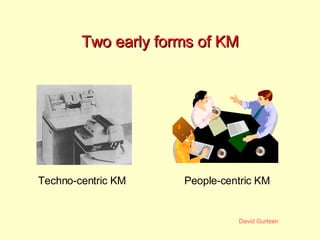
Two early forms of KM Techno-centric KM People-centric KM
Techno-centric KM Corporate KM Birth 1995 (Lotus Notes 1989) Internet, Intranets, Office, E-mail  The management of unstructured  information Database and search centric For many organizations what KM is about!
People-centric KM Pioneers BP (Chris Collison, Geoff Parcell) Buckman Labs (Bob Buckman) Personal Knowledge Management (PKM) People Centred Knowledge Management (PCKM) Soft tools e.g. Cops, After Action Reviews
People-centric KM Tools Communities of Practice Storytelling and narrative After action reviews Peer assists Retrospects Knowledge Cafes Open Space Appreciative Inquiry
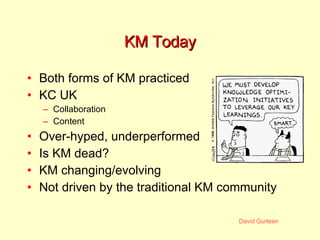
KM Today Both forms of KM practiced KC UK Collaboration Content Over-hyped, underperformed Is KM dead? KM changing/evolving Not driven by the traditional KM community
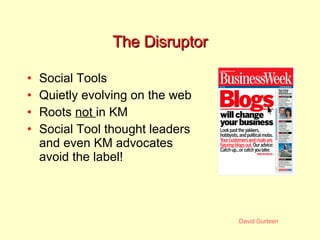
The Disruptor Social Tools Quietly evolving on the web Roots  not  in KM Social Tool thought leaders and even KM advocates avoid the label!
Social Tools What are social tools for? Finding and connecting with people Building communities Sharing knowledge Informal learning They are personal/social KM tools!
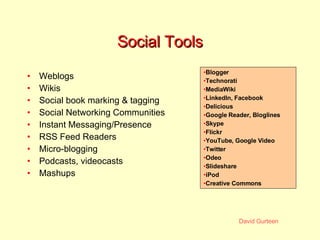
Social Tools Weblogs Wikis Social book marking & tagging Social Networking Communities Instant Messaging/Presence RSS Feed Readers Micro-blogging Podcasts, videocasts Mashups Blogger Technorati MediaWiki LinkedIn, Facebook Delicious Google Reader, Bloglines Skype Flickr YouTube, Google Video Twitter Odeo Slideshare iPod Creative Commons
Web 2.0 The social web The participatory web Built around social tools Evolved, emerged Not planned Not IBM or Microsoft Open protocols Low cost
Enterprise 2.0 Taking Web 2.0 into the organization Weblogs and Wikis IBM and Microsoft now in the game And more …
So what does this mean for KM?
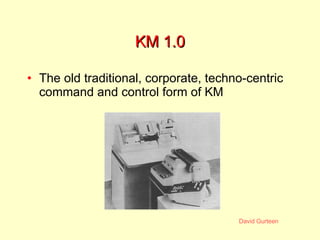
KM 1.0 The old traditional, corporate, techno-centric command and control form of KM
KM 2.0 Take People-centric KM, PKM CoPs, AARs, KCafes, … Social Computing Weblogs, Wikis, … To create A new form of KM  KM 2.0 or Social KM
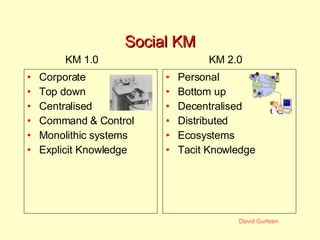
Social KM Corporate Top down Centralised Command & Control Monolithic systems Explicit Knowledge Personal Bottom up Decentralised Distributed Ecosystems Tacit Knowledge KM 1.0 KM 2.0
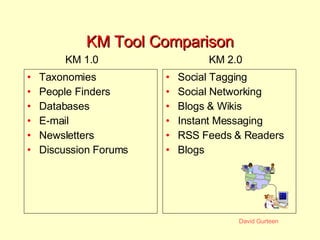
KM Tool Comparison Taxonomies People Finders Databases E-mail Newsletters Discussion Forums Social Tagging Social Networking Blogs & Wikis Instant Messaging RSS Feeds & Readers Blogs KM 1.0 KM 2.0
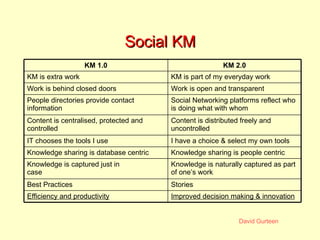
Social KM Stories Best Practices Improved decision making & innovation Efficiency and productivity Work is open and transparent Work is behind closed doors KM 2.0 KM 1.0 Knowledge is naturally captured as part of one’s work Knowledge is captured just in case Knowledge sharing is people centric Knowledge sharing is database centric I have a choice & select my own tools IT chooses the tools I use Content is distributed freely and uncontrolled Content is centralised, protected and controlled Social Networking platforms reflect who is doing what with whom People directories provide contact information KM is part of my everyday work KM is extra work
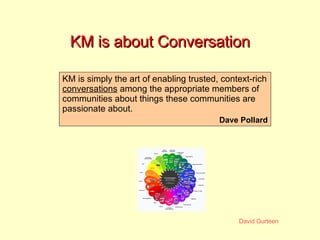
KM is about Conversation KM is simply the art of enabling trusted, context-rich  conversations  among the appropriate members of communities about things these communities are passionate about. Dave Pollard
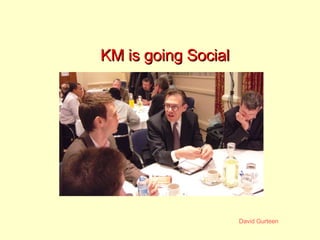
KM is going Social
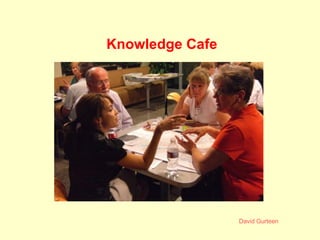
Knowledge Cafe
“ To what extent is KM social”
www.gurteen.com David Gurteen Gurteen Knowledge Tel: +44 1252 812 878 Email: david.gurteen@gurteen.com
Licence You may use these slides under the following Creative Commons Licence Attribution-Share Alike 2.0 http://creativecommons.org/licenses/by-sa/2.0/uk/

KM goes Social Talk for NSW KM Forum, Sydney, Oct 2008

  • 1.
    KM 2.0: KMgoes social October 2008 NSW KM Forum Sydney
  • 2.
    Begin with theend in mind A brief history of KM The impact of social tools and Web 2.0 on KM KM 2.0: KM goes Social Knowledge Cafe
  • 3.
    Two early formsof KM Techno-centric KM People-centric KM
  • 4.
    Techno-centric KM CorporateKM Birth 1995 (Lotus Notes 1989) Internet, Intranets, Office, E-mail The management of unstructured information Database and search centric For many organizations what KM is about!
  • 5.
    People-centric KM PioneersBP (Chris Collison, Geoff Parcell) Buckman Labs (Bob Buckman) Personal Knowledge Management (PKM) People Centred Knowledge Management (PCKM) Soft tools e.g. Cops, After Action Reviews
  • 6.
    People-centric KM ToolsCommunities of Practice Storytelling and narrative After action reviews Peer assists Retrospects Knowledge Cafes Open Space Appreciative Inquiry
  • 7.
    KM Today Bothforms of KM practiced KC UK Collaboration Content Over-hyped, underperformed Is KM dead? KM changing/evolving Not driven by the traditional KM community
  • 8.
    The Disruptor SocialTools Quietly evolving on the web Roots not in KM Social Tool thought leaders and even KM advocates avoid the label!
  • 9.
    Social Tools Whatare social tools for? Finding and connecting with people Building communities Sharing knowledge Informal learning They are personal/social KM tools!
  • 10.
    Social Tools WeblogsWikis Social book marking & tagging Social Networking Communities Instant Messaging/Presence RSS Feed Readers Micro-blogging Podcasts, videocasts Mashups Blogger Technorati MediaWiki LinkedIn, Facebook Delicious Google Reader, Bloglines Skype Flickr YouTube, Google Video Twitter Odeo Slideshare iPod Creative Commons
  • 11.
    Web 2.0 Thesocial web The participatory web Built around social tools Evolved, emerged Not planned Not IBM or Microsoft Open protocols Low cost
  • 12.
    Enterprise 2.0 TakingWeb 2.0 into the organization Weblogs and Wikis IBM and Microsoft now in the game And more …
  • 13.
    So what doesthis mean for KM?
  • 14.
    KM 1.0 Theold traditional, corporate, techno-centric command and control form of KM
  • 15.
    KM 2.0 TakePeople-centric KM, PKM CoPs, AARs, KCafes, … Social Computing Weblogs, Wikis, … To create A new form of KM KM 2.0 or Social KM
  • 16.
    Social KM CorporateTop down Centralised Command & Control Monolithic systems Explicit Knowledge Personal Bottom up Decentralised Distributed Ecosystems Tacit Knowledge KM 1.0 KM 2.0
  • 17.
    KM Tool ComparisonTaxonomies People Finders Databases E-mail Newsletters Discussion Forums Social Tagging Social Networking Blogs & Wikis Instant Messaging RSS Feeds & Readers Blogs KM 1.0 KM 2.0
  • 18.
    Social KM StoriesBest Practices Improved decision making & innovation Efficiency and productivity Work is open and transparent Work is behind closed doors KM 2.0 KM 1.0 Knowledge is naturally captured as part of one’s work Knowledge is captured just in case Knowledge sharing is people centric Knowledge sharing is database centric I have a choice & select my own tools IT chooses the tools I use Content is distributed freely and uncontrolled Content is centralised, protected and controlled Social Networking platforms reflect who is doing what with whom People directories provide contact information KM is part of my everyday work KM is extra work
  • 19.
    KM is aboutConversation KM is simply the art of enabling trusted, context-rich conversations among the appropriate members of communities about things these communities are passionate about. Dave Pollard
  • 20.
  • 21.
  • 22.
    “ To whatextent is KM social”
  • 23.
    www.gurteen.com David GurteenGurteen Knowledge Tel: +44 1252 812 878 Email: david.gurteen@gurteen.com
  • 24.
    Licence You mayuse these slides under the following Creative Commons Licence Attribution-Share Alike 2.0 http://creativecommons.org/licenses/by-sa/2.0/uk/