Using Web 2.0 to Power
Collaboration & Knowledge-
Sharing
Chuck Lanigan, MA
Agenda
For Your Consideration:
– Web 2.0 Definition and Potential
– The Evolving Technology
– The Changing Nature of Work
– The Impact of Organizational Culture and Goals
– The Skill and Motivation of Personnel
– 50-Cent Tour of Options (Time- and Technology-
Permitting)
– Suggested Guidelines for Using Web 2.0 to Power
Collaboration & Knowledge-Sharing
My Background & Interests
• MA in Instructional Design & Technology
(Focus on Literacy, Critical-Thinking &
Computer-Mediated Work)
• Interested in How to Facilitate Collaboration &
Knowledge-Sharing Among Individuals and
within Organizations
• Published an Article in March 2007 CIO
Magazine on Preparing a Capable Workforce
for the K-Economy
• Involved in Social Networking Initiatives at
PNC
Web 2.0 Defined
• Not a single technology, but a collection of
web-based applications including:
– Wikis
– Blogs
– Mashups
– RSS Feeds
• Social networking and the web evolved from
– Static HTML pages with links maintained by
developers
– To buying and selling products and services
– To interactive, interconnected sites
A Brief Look Under the Hood
Web 2.0 is Built Upon:
– Java and Javascript
– Web Services and Service Order
Architecture (SOA)
– Interoperability Among Applications
– XML (Extensible Markup Language)
– Ajax Programming (Asynchronous
JavaScript and XML)
Web 2.0 Characteristics
• Audience-Generated Content
• Allows Creation for specific audiences and services
• Inherently:
– Grass-Roots
– Non-bureaucratic
– Spontaneous
– Organic
• Examples: Facebook, Google+YouTube, LinkedIn
• Vendors: IBM, Google, Microsoft, Socialtext
The Good News
Anyone can create a web site and
maintain a wiki or a blog practically for
free.*
*Allowing for the cost of time, labor and attention
The Bad News
Anyone can create a web site and
maintain a wiki or a blog practically for
free*
*Whether or not they have anything significant to say and know how to
communicate it.
What Does it All Mean?
• Why would I or my organization want to
utilize Web 2.0?
• Who will maintain and regulate our site
(if, indeed, we will do so)
• Who will participate and contribute
short- and long-term?
• Who cares? (What do we hope to
achieve?)
Reasons & Rhetoric
• Turn a Profit
• Engage Our Employees and Customers
• Promote the Brand
• Practice Innovation
• Gain Efficiencies
• Be more Responsive with Vendors & Customers
• Facilitate Communication and Collaboration Across
Corporate Silos
• Create a Virtual Workplace that Allows Teams to
Operate Non-Stop in the Global Economy 24/7
The Changing Nature of Work
• From the Dark Satanic Mills*of the 19th
Century to the Bright Fluorescent
Cubes of the 20th
Century and…
• The 24/7 Mobile Workforce of the 21st
Century
*William Blake, Jerusalem
Rough Chronology
Until 1790-1800 Farming, Craft, Artisan Work (&
Slavery)
1800 – 1900 Industrial Revolution Water 
Steam  Electricity
Telegraph  Telephone
1900 – 1970 Rise of Modern Office &
Bureaucracy
Electronic Communication
(Telephone, radio Television)
1970 - Present Computing, Information
Technology & the Web
The Virtual Workplace
Idealized
• Teams of individuals work together
seamlessly across geographical and
cultural boundaries
• Time & Space Irrelevant in the Global
Marketplace
• Collaboration Occurs Automatically,
Inspiring Innovation and Productivity
The Virtual Workplace
In Reality
Misunderstandings arise caused by a failure to
articulate Ideas and communicate across
interpersonal or cross-cultural differences
Raises issues over achieving & maintaining work-life
balance
Depends on availability of technology & skill of
personnel (Digital Divide)
Produces bureaucratic infrastructure (IT, Risk,
Compliance)
Creates information overload
Raises legal issues over intellectual property and
liability that cross international boundaries
Knowledge Work
• Abstraction of labor
• Involves mainly intellectual rather than
physical tasks
• Interact with symbols and data more than
materials & people
• Create and share collective meaning from
information
• Mediated through technology (cell phones,
computers, PDAs)
Knowledge Work Challenges
• Difficult to measure & control
productivity
• Difficult to define & quantify necessary
skills:
– IT and programming?
– Logic and analysis?
– Critical thinking?
– Communication?
Evolving Web Technology
• DARPA-Net* (1960s – 70s)
• Old-school text-based bulletin boards (e.g.,
Compuserve)
• Static HTML web pages with links
• Rich Media
• Interactive web sites
• Web Services
• Web 2.0
*The Defense Advanced Research Projects Agency
The Contemporary Workplace
• Still Mostly 9-5
• Going Global & Virtual
• Characterized by So-Called Knowledge
Work
Social Networking & Cultural
Dynamics
• Web 2.0 Applications Developed as the Antithesis of
Rigid, Top-Down Control
• Developed by and for Gen Y and adapted to their
lifestyle (e.g., Facebook developed by Harvard
Students in 2004)*
• Don't need to be a programmer or have your own
server to set up your own, low-cost interactive site.
(MS OfficeLive Example)
*Though a significant and growing number of users are
now over 50.
Web 2.0 Ecology*
• Will the Technology Use Us or Will We Use the
Technology?
• Does technology automatically change culture? Or
does it reflect it?
– "All of our inventions are but improved means to unimproved
ends.” – H.D. Thoreau
– What problem does this technology solve? What problem(s)
does it create? – Neil Postman
• Even as they Try to Capitalize on and Adapt to New
Technologies, Large Organizations Struggle with
Questions of Authority and Control
c.f. Gregory Bateson, An Ecology of Mind
Web 2.0 & Organizational Culture
• Originally dismissed (as with most new
technologies) as domain of the few
enthusiasts. Examples:
– Automobile (circa 1910)
– Radio (ca. 1920)
– Personal Computer (ca. 1978)
• Now companies and organizations are
jumping on board and seeking to capitalize
(or subvert?) Web 2.0
Culture Clash?
Corporate Business
Culture
Stereotypically:
– Dogmatic
– Bureaucratic
– Top-down
– Rules-driven
– Risk-averse
– Inflexible
– Conservative
Web 2.0 Inherently:
– Flexible, dynamic
– Interconnected
– User-centric
– Spontaneous
The Goal
• Facilitate Collaboration and Knowledge-
Sharing Among Groups and Individuals
• Engage New and Existing Customers
and Business Partners
The Elephant Teaches Itself to
Dance
• To Compete in the Global Marketplace Large
Organizations are Now Trying to Reinvent (or
at Least Present) Themselves as:
– Agile
– Engaged
– Hip Responsive
– Cutting-edge
• Governmental Agencies, Banks and the U.S.
Navy Have All Undertaken Web 2.0 Projects
Virtual Workspaces
• Function in an environment in which
you work with people you never may
see
– Different cultures
– Different ideas
– Different assumptions and mores
– Different abilities
• Why can’t we all just get along?
Dynamics of Virtual Behavior
• Cross-cultural communication
• Code-switching
• Assumptions/perceptions
• Conscious and Unconscious Biases
• Level of expertise (novice vs. expert; newby
vs. mentor)
• Motivation
• How we see ourselves (and awareness of
how others see us)
Other Dynamics
• Questions of:
– Personal and Tribal Identity
– Motivation
– Recognition
– Reward
• How do these play out in a virtual
environment?
Organizational Guidelines for
Web 2.0 Success
• Create an environment that is conducive to
collaboration and sharing of knowledge
• Think carefully about goals and criteria for
success
• Recognize and reward participation and
contribution
• Engage advocates when planning who will
carry the torch in person and online at the
beginning and as things progress
People
Leveraging Web 2.0 technologies
successfully depends as much upon the
skills of the personnel using them as
the technology itself.
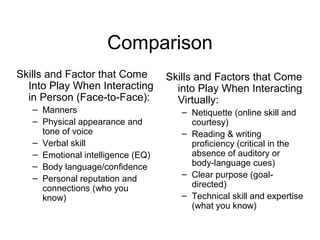
Comparison
Skills and Factor that Come
Into Play When Interacting
in Person (Face-to-Face):
– Manners
– Physical appearance and
tone of voice
– Verbal skill
– Emotional intelligence (EQ)
– Body language/confidence
– Personal reputation and
connections (who you
know)
Skills and Factors that Come
into Play When Interacting
Virtually:
– Netiquette (online skill and
courtesy)
– Reading & writing
proficiency (critical in the
absence of auditory or
body-language cues)
– Clear purpose (goal-
directed)
– Technical skill and expertise
(what you know)
Who are We
When We Interact Virtually?
http://www.unc.edu/depts/jomc/academics/dri/idog
• Our Facebook page
• Our avatar
• Our skills
• What others perceive we are
• A product of our culture
• Our company profile
Netiquette & Civility
• Pay attention to small courtesies (e.g., “Do
you have a minute?”)
• Practice tolerance. Be willing to suspend
judgment till the facts are in.
• Reserve flaming for dire situations (if at all)
• Define your terms and assumptions explicitly
• Acknowledge contributions &
misunderstandings
• Maintain a sense of humor
Personal Guidelines for Web 2.0
Success
We interact over the web almost exclusively
through reading and writing (with a phone call
or meeting maybe thrown in). Therefore, it’s
important to:
– Practice clear communication
– Promote civility
– Articulate and share ideas using common points of
reference
– Work toward a common goal (after negotiating
agreement and understanding)
Web 2.0 and Writing Skills
• Know your audience
– Know what you want to say and the results you
want to achieve
– Use grammar, spelling and language proper to the
context and audience
• Practice online writing conventions
– Chunking of text and ideas
– Using upper and lower case
• Avoid brain dumps
Web 2.0 & Reading Skills
Reading (Active vs. Passive)
– Decoding
– Comprehending
– Relating to previous knowledge and
assumptions
– Questioning
– Deciding
50-Cent Tour
Brief Review of Options for Creating and
Maintaining a Virtual Workspace
– Microsoft Office Live
– Lotus Greenhouse and Quickr
– Google Apps
Possibilities for Research
Apply the following to analyzing or thinking about
collaborating and sharing knowledge using Web 2.0:
• Social Network Analysis (David Krackhardt, CMU)
• Semiotic Analysis
– Semiotics = study of signs and symbols and their referents
(what they refer to in terms of meaning)
– Historically with info. technology, relationships to referent
(what is being worked or interacted with) and people have
become ever more abstracted and mediated
(depersonalized, once, twice removed)
Some Related References
Bateson, G., An Ecology of Mind
Hyde, L., The Gift: Imagination and the Erotic Life of Property
Kellerman, S. and O'Connor P., You Send Me: Getting It Right
When You Write Online
Lawson, S., U.S. Air Force Lets Web 2.0 Flourish Behind Walls,
CIO, July 17th 2008
Rosen, C., Virtual Friendship and the New Narcissism, The New
Atlantis, Summer 2007
Standage, T. The Victorian Internet: The Remarkable Story of the
Telegraph and the Nineteenth Century's On-Line Pioneers
Zuboff, S., In the Age of the Smart Machine: The Future of Work
and Power
Not a Site, but a Concept: Tapping the Power of Social
Networking, Knowledge@Wharton, July 9th 2008
The End
Contact Me:
– clanigan@sanepractices.com
– 412-378-5013

Lanigan STC Using Web 2.0 to Power Collaboration

  • 1.
    Using Web 2.0to Power Collaboration & Knowledge- Sharing Chuck Lanigan, MA
  • 2.
    Agenda For Your Consideration: –Web 2.0 Definition and Potential – The Evolving Technology – The Changing Nature of Work – The Impact of Organizational Culture and Goals – The Skill and Motivation of Personnel – 50-Cent Tour of Options (Time- and Technology- Permitting) – Suggested Guidelines for Using Web 2.0 to Power Collaboration & Knowledge-Sharing
  • 3.
    My Background &Interests • MA in Instructional Design & Technology (Focus on Literacy, Critical-Thinking & Computer-Mediated Work) • Interested in How to Facilitate Collaboration & Knowledge-Sharing Among Individuals and within Organizations • Published an Article in March 2007 CIO Magazine on Preparing a Capable Workforce for the K-Economy • Involved in Social Networking Initiatives at PNC
  • 4.
    Web 2.0 Defined •Not a single technology, but a collection of web-based applications including: – Wikis – Blogs – Mashups – RSS Feeds • Social networking and the web evolved from – Static HTML pages with links maintained by developers – To buying and selling products and services – To interactive, interconnected sites
  • 5.
    A Brief LookUnder the Hood Web 2.0 is Built Upon: – Java and Javascript – Web Services and Service Order Architecture (SOA) – Interoperability Among Applications – XML (Extensible Markup Language) – Ajax Programming (Asynchronous JavaScript and XML)
  • 6.
    Web 2.0 Characteristics •Audience-Generated Content • Allows Creation for specific audiences and services • Inherently: – Grass-Roots – Non-bureaucratic – Spontaneous – Organic • Examples: Facebook, Google+YouTube, LinkedIn • Vendors: IBM, Google, Microsoft, Socialtext
  • 7.
    The Good News Anyonecan create a web site and maintain a wiki or a blog practically for free.* *Allowing for the cost of time, labor and attention
  • 8.
    The Bad News Anyonecan create a web site and maintain a wiki or a blog practically for free* *Whether or not they have anything significant to say and know how to communicate it.
  • 9.
    What Does itAll Mean? • Why would I or my organization want to utilize Web 2.0? • Who will maintain and regulate our site (if, indeed, we will do so) • Who will participate and contribute short- and long-term? • Who cares? (What do we hope to achieve?)
  • 10.
    Reasons & Rhetoric •Turn a Profit • Engage Our Employees and Customers • Promote the Brand • Practice Innovation • Gain Efficiencies • Be more Responsive with Vendors & Customers • Facilitate Communication and Collaboration Across Corporate Silos • Create a Virtual Workplace that Allows Teams to Operate Non-Stop in the Global Economy 24/7
  • 11.
    The Changing Natureof Work • From the Dark Satanic Mills*of the 19th Century to the Bright Fluorescent Cubes of the 20th Century and… • The 24/7 Mobile Workforce of the 21st Century *William Blake, Jerusalem
  • 12.
    Rough Chronology Until 1790-1800Farming, Craft, Artisan Work (& Slavery) 1800 – 1900 Industrial Revolution Water  Steam  Electricity Telegraph  Telephone 1900 – 1970 Rise of Modern Office & Bureaucracy Electronic Communication (Telephone, radio Television) 1970 - Present Computing, Information Technology & the Web
  • 13.
    The Virtual Workplace Idealized •Teams of individuals work together seamlessly across geographical and cultural boundaries • Time & Space Irrelevant in the Global Marketplace • Collaboration Occurs Automatically, Inspiring Innovation and Productivity
  • 14.
    The Virtual Workplace InReality Misunderstandings arise caused by a failure to articulate Ideas and communicate across interpersonal or cross-cultural differences Raises issues over achieving & maintaining work-life balance Depends on availability of technology & skill of personnel (Digital Divide) Produces bureaucratic infrastructure (IT, Risk, Compliance) Creates information overload Raises legal issues over intellectual property and liability that cross international boundaries
  • 15.
    Knowledge Work • Abstractionof labor • Involves mainly intellectual rather than physical tasks • Interact with symbols and data more than materials & people • Create and share collective meaning from information • Mediated through technology (cell phones, computers, PDAs)
  • 16.
    Knowledge Work Challenges •Difficult to measure & control productivity • Difficult to define & quantify necessary skills: – IT and programming? – Logic and analysis? – Critical thinking? – Communication?
  • 17.
    Evolving Web Technology •DARPA-Net* (1960s – 70s) • Old-school text-based bulletin boards (e.g., Compuserve) • Static HTML web pages with links • Rich Media • Interactive web sites • Web Services • Web 2.0 *The Defense Advanced Research Projects Agency
  • 18.
    The Contemporary Workplace •Still Mostly 9-5 • Going Global & Virtual • Characterized by So-Called Knowledge Work
  • 19.
    Social Networking &Cultural Dynamics • Web 2.0 Applications Developed as the Antithesis of Rigid, Top-Down Control • Developed by and for Gen Y and adapted to their lifestyle (e.g., Facebook developed by Harvard Students in 2004)* • Don't need to be a programmer or have your own server to set up your own, low-cost interactive site. (MS OfficeLive Example) *Though a significant and growing number of users are now over 50.
  • 20.
    Web 2.0 Ecology* •Will the Technology Use Us or Will We Use the Technology? • Does technology automatically change culture? Or does it reflect it? – "All of our inventions are but improved means to unimproved ends.” – H.D. Thoreau – What problem does this technology solve? What problem(s) does it create? – Neil Postman • Even as they Try to Capitalize on and Adapt to New Technologies, Large Organizations Struggle with Questions of Authority and Control c.f. Gregory Bateson, An Ecology of Mind
  • 21.
    Web 2.0 &Organizational Culture • Originally dismissed (as with most new technologies) as domain of the few enthusiasts. Examples: – Automobile (circa 1910) – Radio (ca. 1920) – Personal Computer (ca. 1978) • Now companies and organizations are jumping on board and seeking to capitalize (or subvert?) Web 2.0
  • 22.
    Culture Clash? Corporate Business Culture Stereotypically: –Dogmatic – Bureaucratic – Top-down – Rules-driven – Risk-averse – Inflexible – Conservative Web 2.0 Inherently: – Flexible, dynamic – Interconnected – User-centric – Spontaneous
  • 23.
    The Goal • FacilitateCollaboration and Knowledge- Sharing Among Groups and Individuals • Engage New and Existing Customers and Business Partners
  • 24.
    The Elephant TeachesItself to Dance • To Compete in the Global Marketplace Large Organizations are Now Trying to Reinvent (or at Least Present) Themselves as: – Agile – Engaged – Hip Responsive – Cutting-edge • Governmental Agencies, Banks and the U.S. Navy Have All Undertaken Web 2.0 Projects
  • 25.
    Virtual Workspaces • Functionin an environment in which you work with people you never may see – Different cultures – Different ideas – Different assumptions and mores – Different abilities • Why can’t we all just get along?
  • 26.
    Dynamics of VirtualBehavior • Cross-cultural communication • Code-switching • Assumptions/perceptions • Conscious and Unconscious Biases • Level of expertise (novice vs. expert; newby vs. mentor) • Motivation • How we see ourselves (and awareness of how others see us)
  • 27.
    Other Dynamics • Questionsof: – Personal and Tribal Identity – Motivation – Recognition – Reward • How do these play out in a virtual environment?
  • 28.
    Organizational Guidelines for Web2.0 Success • Create an environment that is conducive to collaboration and sharing of knowledge • Think carefully about goals and criteria for success • Recognize and reward participation and contribution • Engage advocates when planning who will carry the torch in person and online at the beginning and as things progress
  • 29.
    People Leveraging Web 2.0technologies successfully depends as much upon the skills of the personnel using them as the technology itself.
  • 30.
    Comparison Skills and Factorthat Come Into Play When Interacting in Person (Face-to-Face): – Manners – Physical appearance and tone of voice – Verbal skill – Emotional intelligence (EQ) – Body language/confidence – Personal reputation and connections (who you know) Skills and Factors that Come into Play When Interacting Virtually: – Netiquette (online skill and courtesy) – Reading & writing proficiency (critical in the absence of auditory or body-language cues) – Clear purpose (goal- directed) – Technical skill and expertise (what you know)
  • 31.
    Who are We WhenWe Interact Virtually? http://www.unc.edu/depts/jomc/academics/dri/idog • Our Facebook page • Our avatar • Our skills • What others perceive we are • A product of our culture • Our company profile
  • 32.
    Netiquette & Civility •Pay attention to small courtesies (e.g., “Do you have a minute?”) • Practice tolerance. Be willing to suspend judgment till the facts are in. • Reserve flaming for dire situations (if at all) • Define your terms and assumptions explicitly • Acknowledge contributions & misunderstandings • Maintain a sense of humor
  • 33.
    Personal Guidelines forWeb 2.0 Success We interact over the web almost exclusively through reading and writing (with a phone call or meeting maybe thrown in). Therefore, it’s important to: – Practice clear communication – Promote civility – Articulate and share ideas using common points of reference – Work toward a common goal (after negotiating agreement and understanding)
  • 34.
    Web 2.0 andWriting Skills • Know your audience – Know what you want to say and the results you want to achieve – Use grammar, spelling and language proper to the context and audience • Practice online writing conventions – Chunking of text and ideas – Using upper and lower case • Avoid brain dumps
  • 35.
    Web 2.0 &Reading Skills Reading (Active vs. Passive) – Decoding – Comprehending – Relating to previous knowledge and assumptions – Questioning – Deciding
  • 36.
    50-Cent Tour Brief Reviewof Options for Creating and Maintaining a Virtual Workspace – Microsoft Office Live – Lotus Greenhouse and Quickr – Google Apps
  • 37.
    Possibilities for Research Applythe following to analyzing or thinking about collaborating and sharing knowledge using Web 2.0: • Social Network Analysis (David Krackhardt, CMU) • Semiotic Analysis – Semiotics = study of signs and symbols and their referents (what they refer to in terms of meaning) – Historically with info. technology, relationships to referent (what is being worked or interacted with) and people have become ever more abstracted and mediated (depersonalized, once, twice removed)
  • 38.
    Some Related References Bateson,G., An Ecology of Mind Hyde, L., The Gift: Imagination and the Erotic Life of Property Kellerman, S. and O'Connor P., You Send Me: Getting It Right When You Write Online Lawson, S., U.S. Air Force Lets Web 2.0 Flourish Behind Walls, CIO, July 17th 2008 Rosen, C., Virtual Friendship and the New Narcissism, The New Atlantis, Summer 2007 Standage, T. The Victorian Internet: The Remarkable Story of the Telegraph and the Nineteenth Century's On-Line Pioneers Zuboff, S., In the Age of the Smart Machine: The Future of Work and Power Not a Site, but a Concept: Tapping the Power of Social Networking, Knowledge@Wharton, July 9th 2008
  • 39.
    The End Contact Me: –clanigan@sanepractices.com – 412-378-5013

Editor's Notes

  • #3 Quote from ‘Victorian Internet’ Quote Carnegie on Knowledge of Workers
  • #7 Audience-generated content The medium is the message
  • #21 Possible Approaches to analyzing or thinking about sharing of knowledge over the web: Social Network Analysis (David Krackhart, CMU) Semiotic Analysis (Semiotics = study of signs and symbols and their referents (what they refer to in terms of meaning) With technology, relationship to referent (what is being worked or interacted with) becomes ever more abstracted mediated (removed):