Knowledge Management  as an ecosystem  H ow to make sense in the workplace by transforming the enterprise into a conversation network John Tropea – March 2008 http://libraryclips.blogsome.com
Overview Main Issues The workers perspective Why is this happening Result Solution Why is this important anyway? Even more issues… The new KM The nature of knowledge KM 2.0 is social computing Autonomy Next Appendix
Main Issues Collaboration and Communications Documents Versions/Attachments/Track Changes Email Conversations (closed/silo) Communication (“Didn’t you get that email”) Overload/Broadcast (push vs pull) Hierarchy Limited connections Decision-making power Finding Information and People (Experts) Search Silos Getting Things Done Rigid tools Email is the workaround Ease of use/free-form (but not good enough or open enough)
The workers perspective “ The way organizations adapt, survive and be productive is through the social interaction that happens outside the lines that we draw by hierarchy, process and organizational structure. The first form of social software to really take off to facilitate these discussions was email” “Most employees don't spend their time executing business process. That's a myth. They spend most of their time handling exceptions to business process. That's what they're doing in their [e-mail] inbox for four hours a day. Email has become the great exception handler.” “Unfortunately, what it means is all the learning disappears because it's hidden away in people's inbox. It's not searchable and discoverable “ “So at the edge of your organization, there are all kinds of exceptions that are happening. If you handle them appropriately, you can adapt to where the market is going. You can adapt to the problems you have in your existing structures“  “… the greatest source of sustainable innovation is how you're handling these exceptions to business process. “ Ross Mayfield http://snipr.com/rssm_email_process
Why is this happening? KM has not been fluid enough Findability/Info exchange Tacit - Codify & Store Conscription/mandated Rigid tools (Tech-centric) Hard to incorporate in daily  work (low participation) Findability issues Hierarchy  (Command & Control) Not keeping all in touch (in the know) Relies on Vertical decision-making and micro-managing Rather than local specialists Rather than autonomy Sharing feels like a task What’s in it for me? I’m too busy Not chargeable work Power Trust
Result Loss in innovation/opportunity Loss in work morale (frustration) Loss in productivity Cost $
Solution –  Enterprise Conversation Market Wisdom of Crowds  BOOK - James Surowiecki  None of Us Is Smarter than All of Us Companies vs Market Expectations vs Autonomous flow (Collective Intelligence) Companies pay people to perform on an expectations (target) model Hiding information may happen Markets pay people on what they do Don’t make more money if you exceed expectations Markets have “incentive” to seek valuable information  (eg. Buyer behaviour) When acted upon, it becomes public knowledge Companies need to work in this incentive model The more a worker contributes the more they are recognised and the more prosperous job (money)…information goes back up the value chain This is a new incentive model for what a worker does Aggregation/Network Effects/Emergence The worker need only worry about personal benefit Others can benefit from public aggregation of information Social Capital is leveraged
Why is this important anyway? Knowledge Economy The new competitive advantage Effectiveness, rather than Efficiency Seek and act on information Big and Agile  MOTOROLA – Toby Redshaw Everyone has: People, Assets, Cash Knowledge (flow) is the differentiator  World is Flat  BOOK – Thomas Friedman Outsource/Offshore/Supply Chain Innovation is the edge of difference Need to Decentralise Local specialist decisions (rather than micro-manage) Better worker performance Autonomy  Horizontal value chain (rather than Vertical) connect/converse/network/transparency
Even more issues… 5. Baby boomers   (and new people getting up to speed) 6. Millennial Generation Expectations (Different perspective on work) 7. IT Rogues Security vs. Productivity 8. Keeping up with the Jones’s Enterprise 2.0 is in vogue 9. Working remotely (Flattening of the world) Global virtual teams Work from home lifestyle Distant learning Carbon footprint 10. Re-inventing the wheel
The new KM Participation culture Flatten participation barriers Social computing Participating Networking Initiated by the people (but they don’t call it KM) Knowledge Flow rather than manage Publish/Subscribe model Increase interactions (get knowledge moving) Communities/Networks Come to me web Contextual in time of need (just in time) Create “conditions” for knowledge rather than “manage” Connect and Context vs Content and Collect Knowledge/Findability via people (Trusted social filter) Emergence/Autonomy
The new KM Distributed (bottom-up) vs Command and Control (top-down) Power of many vs a few (wisdom of crowds) Visibility and Opportunity (everyone is a potential innovator) Social Capital (a culture change in working) Unstructured free-form tools Easier to collaborate Easier to get things done “ A way to work” rather than a task Not trying to create a knowledge sharing culture, it just happens Sense-making How do I make sense in the enterprise so I can act in it Aim  Dave Snowden Improve decision making Conditions for innovation
The nature of Knowledge Need to understand the organics of knowledge more naturally favourable to flow model rather than a content management model Heuristics  Dave Snowden Knowledge can only be volunteered, it can never be conscripted You can’t make someone use or share knowledge if they don’t want to We only know what we know when we need to know it Knowledge is highly contextual and is recalled in context We always know more then we can tell and we will always tell more than we can write down Some things can only be known through experience
The nature of Knowledge If people need knowledge in the “context” of a real need it will always be shared People don’t share knowledge in the anticipation that you need it Asking people to store away knowledge on the basis of future needs Types of tacit knowledge  Shawn Callahan  http:// snipr.com/anec_cop Stuff people understand, but take for granted Stuff nobody understands Stuff that is hard to explain or articulate (even if you understand it) Not outcomes based (more about learning) elicit/nurture/hang-out/participate/cultivate
KM 2.0 is social computing Wikis Collaboration Relieve email Shared space Work-arounds / side notes Replaces the shared notebook in the top draw Documentation Meeting Agenda Events Intranet Topic pages A gateway to gems in the DMS Sense of Place Compared to a DMS
KM 2.0 is social computing Blogs Sense of Place Become known as an expert in topic area (speak to the author) Notifications to gems in the DMS More captivating than a folder with documents Easy to submit Unstructured/free-form Comments Discuss/Nurture/Evolve/Cultivate (in context of knowledge holder) Casual/spontaneous/editorial Work in progress (rather then just a finished report) Gems/Fragments/Anecdotes/Thoughts/Ideas/Experience/News/Project status Not a formal report Instead captures experience “as it happens” Peripheral content (stuff you don’t read in a report) Subscribe model (pull model) Trusted social filter (people, not objects) We are each others daily news Educate/Learn via the social capital No longer need to anticipate needs Centralised (archived) Searchable database Other disciplines may come across valuable content New comers get up to speed
KM 2.0 is social computing Social Networks Profile page Add people (subscribe) Private/public messages Blog may live here Communities Expert locator (people tags) Ask questions Bookmarks are public (link blogging) Presence/Status (micro-blogging) Increases bumping into someone in the coffee room by infinity Serendipity Recommendations It’s not in the nodes, but in the network
KM 2.0 is social computing Informal networks (person-centric) Enables to tune into a knowledge flow People you trust High abstraction (similar wavelength) Everyone can be heard, have impact (transparency) Strength of weak ties Cut across the hierarchy Network Effects (aggregation) Emergence (patterns) Tag clouds There is no KM, we just work in a social way Role of facilitator
Networks – strength of weak ties “ When an employee is faced with a complex, ambiguous, and uncertain problem and she doesn’t have enough information or other resources to solve it on her own, how does she find and marshal what she needs? She may search through her network, either the hierarchy or her informal social network. Using the hierarchy, she might just ask her manager (moving up) or her colleagues (laterally) or subordinates (down). Then her manager or her subordinates or her colleagues might get involved, navigating their relationships on the hierarchy. This can become time and communications-intensive, because the person or people who can solve the problem might be far away if all you can use is the organizational hierarchy. An informal social network includes ties that cut across the formal hierarchy and thus offer shortcut information finding and problem solving. If the employee has a way of searching across these ties, she might be more successful in a shorter time.” Anne Truitt Zelenka  http://snipr.com/anne_ties
Autonomy “ We need to make people less dependent upon email and sequential task processing and instead cultivate more autonomous behaviours, where individuals use their social networks to filter useful information and then carve out the time and the space in which to collaborate around actionable information and signals.” Lee Bryant  http://snipr.com/lee_auto
Next Web 2.0 tools are easier But it’s about culture change leveraging on social capital/collaboration Change management Vendors (low cost/open source) Buy-in Barriers/Concerns Deploy  Adoption Gardening ROI
APPENDIX 1 - Statistics Email  SOURCE : Via OpenText [AIIM, Gartner, Forrester, Lyman] 60 billion emails per day in 2006 75% of all digital knowledge in email I day of email = 6 Googles per day  (6 x 100 terabytes) Productivity  SOURCE : Accenture Jan 2007  http:// snipr.com/accenture_search Middle managers spend more than ¼ of their time searching for information, and when they do find it, it’s often wrong 2 hours a day searching 50% of no value 60% say due to poor distribution, they miss valuable information that exists, but they can’t find
APPENDIX 2 - Statistics Participation culture  SOURCE – Reuters Oct 2007  http:// snipr.com/reuters_ms_fb MySpace 110 Million users Facebook 47 Million users USA teens  SOURCE - Pew Internet & American Life Project Dec 2007  http:// snipr.com/pew_teens 93% of teens use the Internet 64% 12-17 year olds engaged in social media content creation Baby boomers  SOURCE – Via The Business Case for Lotus Connections  http:// snipr.com/ibm_babyb 19% of executive, admin and managerial American's will retire in 5 years Next 7 years 26% of Japan will be over 65 2016 people aged 60-64 in Australia will double
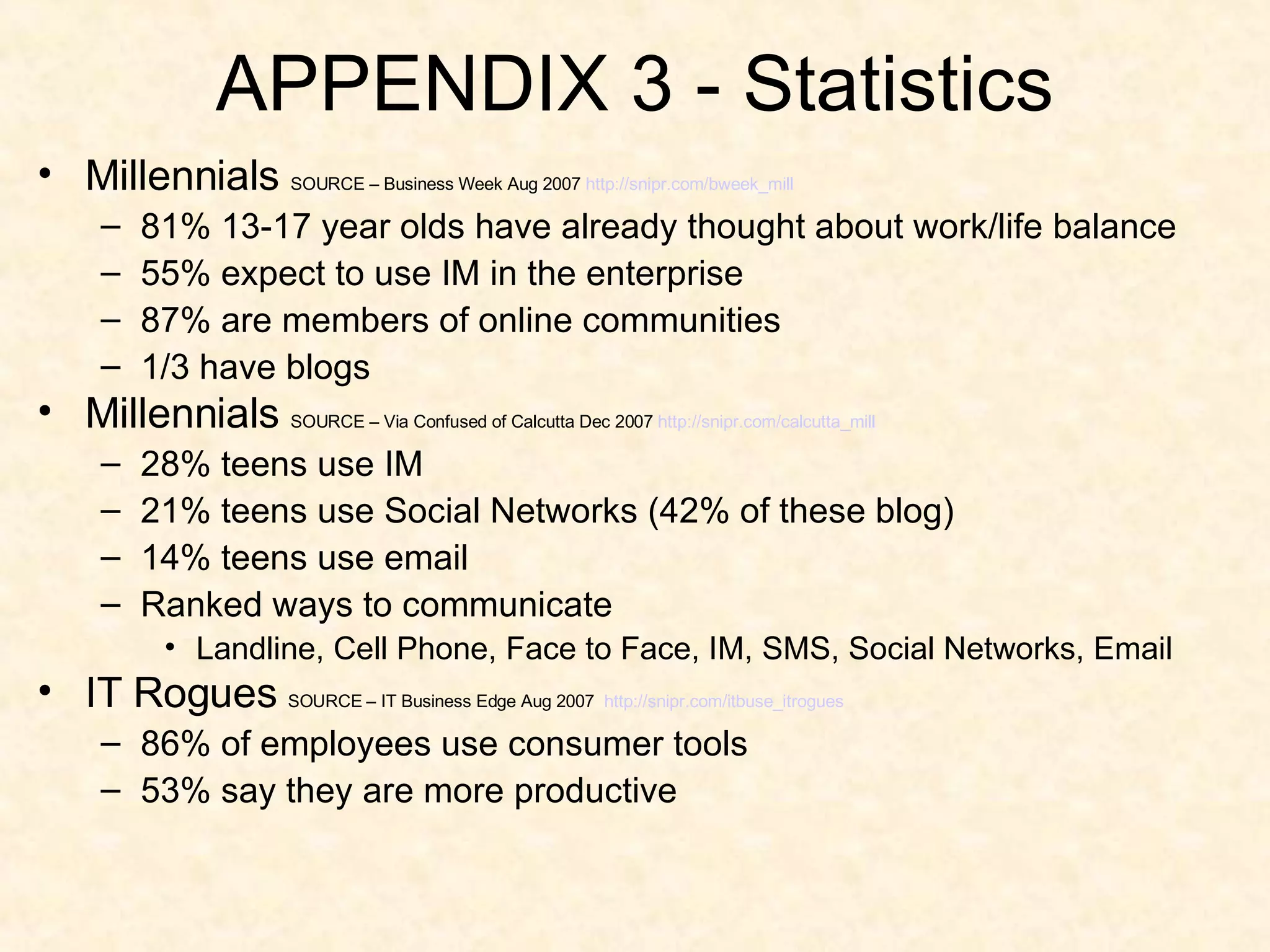
APPENDIX 3 - Statistics Millennials  SOURCE – Business Week Aug 2007  http:// snipr.com/bweek_mill 81% 13-17 year olds have already thought about work/life balance 55% expect to use IM in the enterprise 87% are members of online communities 1/3 have blogs Millennials  SOURCE – Via Confused of Calcutta Dec 2007  http://snipr.com/calcutta_mill 28% teens use IM 21% teens use Social Networks (42% of these blog) 14% teens use email Ranked ways to communicate Landline, Cell Phone, Face to Face, IM, SMS, Social Networks, Email IT Rogues  SOURCE – IT Business Edge Aug 2007  http://snipr.com/itbuse_itrogues 86% of employees use consumer tools 53% say they are more productive
APPENDIX 3 - Statistics Enterprise  SOURCE – Via FastForward Mar 2007 [Economist Intelligence Unit]  http://snipr.com/ff_eiu 80% executives view KM 2.0 as an opportunity to increase company revenue/margins Enterprise  SOURCE – Via IBM Dec 2006 [Gartner]  http:// snipr.com/gart_adopt Thirty percent of enterprises will openly sponsor internal . . . social sharing spaces to help employees find others with similar interest, skills, backgrounds and experiences. Enterprise  SOURCE – Roughtype Mar 2007 [Forrester]  http:// snipr.com/rough_adopt 89% of CIO’s have adopted social software
APPENDIX 4 - Statistics Prediction   SOURCE – ZDnet Jan 2008 [Forrester]  http:// snipr.com/forr_adopt 42% not on agenda 32% not a priority Bit weird when they say “Web 2.0 will be a 2008 priority” Vendor survey   SOURCE – Awareness Feb 2008  http:// snipr.com/aware_adopt 74% of companies with under 500 people use web 2.0 54% of companies with over 500 people use web 2.0   IBM survey   SOURCE – he Business Case for Lotus Connections Jun 2007  http://snipr.com/ibm_babyb 75% of CEO’s value collaboration as important for innovation Employee’s were considered a top source

Knowledge Management as an ecosystem

  • 1.
    Knowledge Management as an ecosystem H ow to make sense in the workplace by transforming the enterprise into a conversation network John Tropea – March 2008 http://libraryclips.blogsome.com
  • 2.
    Overview Main IssuesThe workers perspective Why is this happening Result Solution Why is this important anyway? Even more issues… The new KM The nature of knowledge KM 2.0 is social computing Autonomy Next Appendix
  • 3.
    Main Issues Collaborationand Communications Documents Versions/Attachments/Track Changes Email Conversations (closed/silo) Communication (“Didn’t you get that email”) Overload/Broadcast (push vs pull) Hierarchy Limited connections Decision-making power Finding Information and People (Experts) Search Silos Getting Things Done Rigid tools Email is the workaround Ease of use/free-form (but not good enough or open enough)
  • 4.
    The workers perspective“ The way organizations adapt, survive and be productive is through the social interaction that happens outside the lines that we draw by hierarchy, process and organizational structure. The first form of social software to really take off to facilitate these discussions was email” “Most employees don't spend their time executing business process. That's a myth. They spend most of their time handling exceptions to business process. That's what they're doing in their [e-mail] inbox for four hours a day. Email has become the great exception handler.” “Unfortunately, what it means is all the learning disappears because it's hidden away in people's inbox. It's not searchable and discoverable “ “So at the edge of your organization, there are all kinds of exceptions that are happening. If you handle them appropriately, you can adapt to where the market is going. You can adapt to the problems you have in your existing structures“ “… the greatest source of sustainable innovation is how you're handling these exceptions to business process. “ Ross Mayfield http://snipr.com/rssm_email_process
  • 5.
    Why is thishappening? KM has not been fluid enough Findability/Info exchange Tacit - Codify & Store Conscription/mandated Rigid tools (Tech-centric) Hard to incorporate in daily work (low participation) Findability issues Hierarchy (Command & Control) Not keeping all in touch (in the know) Relies on Vertical decision-making and micro-managing Rather than local specialists Rather than autonomy Sharing feels like a task What’s in it for me? I’m too busy Not chargeable work Power Trust
  • 6.
    Result Loss ininnovation/opportunity Loss in work morale (frustration) Loss in productivity Cost $
  • 7.
    Solution – Enterprise Conversation Market Wisdom of Crowds BOOK - James Surowiecki None of Us Is Smarter than All of Us Companies vs Market Expectations vs Autonomous flow (Collective Intelligence) Companies pay people to perform on an expectations (target) model Hiding information may happen Markets pay people on what they do Don’t make more money if you exceed expectations Markets have “incentive” to seek valuable information (eg. Buyer behaviour) When acted upon, it becomes public knowledge Companies need to work in this incentive model The more a worker contributes the more they are recognised and the more prosperous job (money)…information goes back up the value chain This is a new incentive model for what a worker does Aggregation/Network Effects/Emergence The worker need only worry about personal benefit Others can benefit from public aggregation of information Social Capital is leveraged
  • 8.
    Why is thisimportant anyway? Knowledge Economy The new competitive advantage Effectiveness, rather than Efficiency Seek and act on information Big and Agile MOTOROLA – Toby Redshaw Everyone has: People, Assets, Cash Knowledge (flow) is the differentiator World is Flat BOOK – Thomas Friedman Outsource/Offshore/Supply Chain Innovation is the edge of difference Need to Decentralise Local specialist decisions (rather than micro-manage) Better worker performance Autonomy Horizontal value chain (rather than Vertical) connect/converse/network/transparency
  • 9.
    Even more issues…5. Baby boomers (and new people getting up to speed) 6. Millennial Generation Expectations (Different perspective on work) 7. IT Rogues Security vs. Productivity 8. Keeping up with the Jones’s Enterprise 2.0 is in vogue 9. Working remotely (Flattening of the world) Global virtual teams Work from home lifestyle Distant learning Carbon footprint 10. Re-inventing the wheel
  • 10.
    The new KMParticipation culture Flatten participation barriers Social computing Participating Networking Initiated by the people (but they don’t call it KM) Knowledge Flow rather than manage Publish/Subscribe model Increase interactions (get knowledge moving) Communities/Networks Come to me web Contextual in time of need (just in time) Create “conditions” for knowledge rather than “manage” Connect and Context vs Content and Collect Knowledge/Findability via people (Trusted social filter) Emergence/Autonomy
  • 11.
    The new KMDistributed (bottom-up) vs Command and Control (top-down) Power of many vs a few (wisdom of crowds) Visibility and Opportunity (everyone is a potential innovator) Social Capital (a culture change in working) Unstructured free-form tools Easier to collaborate Easier to get things done “ A way to work” rather than a task Not trying to create a knowledge sharing culture, it just happens Sense-making How do I make sense in the enterprise so I can act in it Aim Dave Snowden Improve decision making Conditions for innovation
  • 12.
    The nature ofKnowledge Need to understand the organics of knowledge more naturally favourable to flow model rather than a content management model Heuristics Dave Snowden Knowledge can only be volunteered, it can never be conscripted You can’t make someone use or share knowledge if they don’t want to We only know what we know when we need to know it Knowledge is highly contextual and is recalled in context We always know more then we can tell and we will always tell more than we can write down Some things can only be known through experience
  • 13.
    The nature ofKnowledge If people need knowledge in the “context” of a real need it will always be shared People don’t share knowledge in the anticipation that you need it Asking people to store away knowledge on the basis of future needs Types of tacit knowledge Shawn Callahan http:// snipr.com/anec_cop Stuff people understand, but take for granted Stuff nobody understands Stuff that is hard to explain or articulate (even if you understand it) Not outcomes based (more about learning) elicit/nurture/hang-out/participate/cultivate
  • 14.
    KM 2.0 issocial computing Wikis Collaboration Relieve email Shared space Work-arounds / side notes Replaces the shared notebook in the top draw Documentation Meeting Agenda Events Intranet Topic pages A gateway to gems in the DMS Sense of Place Compared to a DMS
  • 15.
    KM 2.0 issocial computing Blogs Sense of Place Become known as an expert in topic area (speak to the author) Notifications to gems in the DMS More captivating than a folder with documents Easy to submit Unstructured/free-form Comments Discuss/Nurture/Evolve/Cultivate (in context of knowledge holder) Casual/spontaneous/editorial Work in progress (rather then just a finished report) Gems/Fragments/Anecdotes/Thoughts/Ideas/Experience/News/Project status Not a formal report Instead captures experience “as it happens” Peripheral content (stuff you don’t read in a report) Subscribe model (pull model) Trusted social filter (people, not objects) We are each others daily news Educate/Learn via the social capital No longer need to anticipate needs Centralised (archived) Searchable database Other disciplines may come across valuable content New comers get up to speed
  • 16.
    KM 2.0 issocial computing Social Networks Profile page Add people (subscribe) Private/public messages Blog may live here Communities Expert locator (people tags) Ask questions Bookmarks are public (link blogging) Presence/Status (micro-blogging) Increases bumping into someone in the coffee room by infinity Serendipity Recommendations It’s not in the nodes, but in the network
  • 17.
    KM 2.0 issocial computing Informal networks (person-centric) Enables to tune into a knowledge flow People you trust High abstraction (similar wavelength) Everyone can be heard, have impact (transparency) Strength of weak ties Cut across the hierarchy Network Effects (aggregation) Emergence (patterns) Tag clouds There is no KM, we just work in a social way Role of facilitator
  • 18.
    Networks – strengthof weak ties “ When an employee is faced with a complex, ambiguous, and uncertain problem and she doesn’t have enough information or other resources to solve it on her own, how does she find and marshal what she needs? She may search through her network, either the hierarchy or her informal social network. Using the hierarchy, she might just ask her manager (moving up) or her colleagues (laterally) or subordinates (down). Then her manager or her subordinates or her colleagues might get involved, navigating their relationships on the hierarchy. This can become time and communications-intensive, because the person or people who can solve the problem might be far away if all you can use is the organizational hierarchy. An informal social network includes ties that cut across the formal hierarchy and thus offer shortcut information finding and problem solving. If the employee has a way of searching across these ties, she might be more successful in a shorter time.” Anne Truitt Zelenka http://snipr.com/anne_ties
  • 19.
    Autonomy “ Weneed to make people less dependent upon email and sequential task processing and instead cultivate more autonomous behaviours, where individuals use their social networks to filter useful information and then carve out the time and the space in which to collaborate around actionable information and signals.” Lee Bryant http://snipr.com/lee_auto
  • 20.
    Next Web 2.0tools are easier But it’s about culture change leveraging on social capital/collaboration Change management Vendors (low cost/open source) Buy-in Barriers/Concerns Deploy Adoption Gardening ROI
  • 21.
    APPENDIX 1 -Statistics Email SOURCE : Via OpenText [AIIM, Gartner, Forrester, Lyman] 60 billion emails per day in 2006 75% of all digital knowledge in email I day of email = 6 Googles per day (6 x 100 terabytes) Productivity SOURCE : Accenture Jan 2007 http:// snipr.com/accenture_search Middle managers spend more than ¼ of their time searching for information, and when they do find it, it’s often wrong 2 hours a day searching 50% of no value 60% say due to poor distribution, they miss valuable information that exists, but they can’t find
  • 22.
    APPENDIX 2 -Statistics Participation culture SOURCE – Reuters Oct 2007 http:// snipr.com/reuters_ms_fb MySpace 110 Million users Facebook 47 Million users USA teens SOURCE - Pew Internet & American Life Project Dec 2007 http:// snipr.com/pew_teens 93% of teens use the Internet 64% 12-17 year olds engaged in social media content creation Baby boomers SOURCE – Via The Business Case for Lotus Connections http:// snipr.com/ibm_babyb 19% of executive, admin and managerial American's will retire in 5 years Next 7 years 26% of Japan will be over 65 2016 people aged 60-64 in Australia will double
  • 23.
    APPENDIX 3 -Statistics Millennials SOURCE – Business Week Aug 2007 http:// snipr.com/bweek_mill 81% 13-17 year olds have already thought about work/life balance 55% expect to use IM in the enterprise 87% are members of online communities 1/3 have blogs Millennials SOURCE – Via Confused of Calcutta Dec 2007 http://snipr.com/calcutta_mill 28% teens use IM 21% teens use Social Networks (42% of these blog) 14% teens use email Ranked ways to communicate Landline, Cell Phone, Face to Face, IM, SMS, Social Networks, Email IT Rogues SOURCE – IT Business Edge Aug 2007 http://snipr.com/itbuse_itrogues 86% of employees use consumer tools 53% say they are more productive
  • 24.
    APPENDIX 3 -Statistics Enterprise SOURCE – Via FastForward Mar 2007 [Economist Intelligence Unit] http://snipr.com/ff_eiu 80% executives view KM 2.0 as an opportunity to increase company revenue/margins Enterprise SOURCE – Via IBM Dec 2006 [Gartner] http:// snipr.com/gart_adopt Thirty percent of enterprises will openly sponsor internal . . . social sharing spaces to help employees find others with similar interest, skills, backgrounds and experiences. Enterprise SOURCE – Roughtype Mar 2007 [Forrester] http:// snipr.com/rough_adopt 89% of CIO’s have adopted social software
  • 25.
    APPENDIX 4 -Statistics Prediction SOURCE – ZDnet Jan 2008 [Forrester] http:// snipr.com/forr_adopt 42% not on agenda 32% not a priority Bit weird when they say “Web 2.0 will be a 2008 priority” Vendor survey SOURCE – Awareness Feb 2008 http:// snipr.com/aware_adopt 74% of companies with under 500 people use web 2.0 54% of companies with over 500 people use web 2.0 IBM survey SOURCE – he Business Case for Lotus Connections Jun 2007 http://snipr.com/ibm_babyb 75% of CEO’s value collaboration as important for innovation Employee’s were considered a top source