Peer and self assessment
Deeps meeting
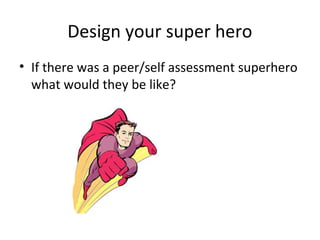
Design your super hero
• If there was a peer/self assessment superhero
what would they be like?
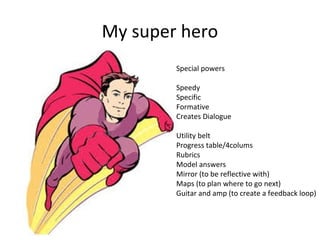
My super hero
Special powers
Speedy
Specific
Formative
Creates Dialogue
Utility belt
Progress table/4colums
Rubrics
Model answers
Mirror (to be reflective with)
Maps (to plan where to go next)
Guitar and amp (to create a feedback loop)
Some things to bear in mind
• Reviewing learning is not learning
– This is why it needs to be quick and formative

• 80% of FB is given by pupils and 80% is not
helpful FB
– This is why it needs to be specific

• It needs to be acted upon
– Creating dialogue is not just a cosy chat but
clarifies things for the learner and improvements
can be seen
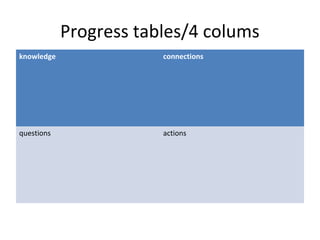
Progress tables/4 colums
knowledge

connections

questions

actions
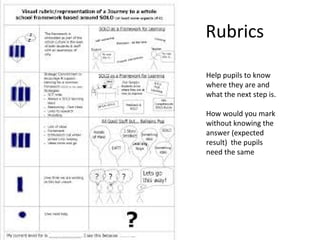
Rubrics
Help pupils to know
where they are and
what the next step is.
How would you mark
without knowing the
answer (expected
result) the pupils
need the same
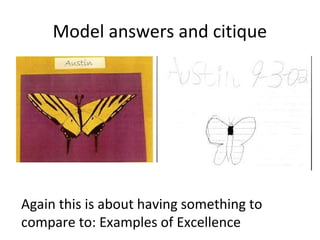
Model answers and citique

Again this is about having something to
compare to: Examples of Excellence
Rules for critique
• Be kind: All comments should focus entirely on the work.
No personal comments at all. No sarcasm or put downs.
The comments can be challenging but the creator of the
work should feel that the feedback is work orientated and
happy to receive it. Hard on content, soft on people.
• Be specific: Refined and precise dialogue with detailed
explanations on positives and steps to improve.
Comments should explain exactly what needs to be
worked on (like a set of instructions) which the writer can
simply take away and use.
• Be helpful: If the comments don't benefit the work, the
learning, the learners or the class, don't share it.
Everything you provide feedback on is there to help make
the work better.
Share your own
• Create a how to card for your favourite
method of peer or self assessment
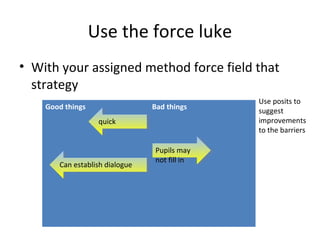
Use the force luke
• With your assigned method force field that
strategy
Good things

Bad things
quick
quick

Can establish dialogue

Pupils may
Pupils may
not fill in
not fill in

Use posits to
suggest
improvements
to the barriers

Peerandself

  • 1.
    Peer and selfassessment Deeps meeting
  • 2.
    Design your superhero • If there was a peer/self assessment superhero what would they be like?
  • 3.
    My super hero Specialpowers Speedy Specific Formative Creates Dialogue Utility belt Progress table/4colums Rubrics Model answers Mirror (to be reflective with) Maps (to plan where to go next) Guitar and amp (to create a feedback loop)
  • 4.
    Some things tobear in mind • Reviewing learning is not learning – This is why it needs to be quick and formative • 80% of FB is given by pupils and 80% is not helpful FB – This is why it needs to be specific • It needs to be acted upon – Creating dialogue is not just a cosy chat but clarifies things for the learner and improvements can be seen
  • 5.
  • 6.
    Rubrics Help pupils toknow where they are and what the next step is. How would you mark without knowing the answer (expected result) the pupils need the same
  • 7.
    Model answers andcitique Again this is about having something to compare to: Examples of Excellence
  • 8.
    Rules for critique •Be kind: All comments should focus entirely on the work. No personal comments at all. No sarcasm or put downs. The comments can be challenging but the creator of the work should feel that the feedback is work orientated and happy to receive it. Hard on content, soft on people. • Be specific: Refined and precise dialogue with detailed explanations on positives and steps to improve. Comments should explain exactly what needs to be worked on (like a set of instructions) which the writer can simply take away and use. • Be helpful: If the comments don't benefit the work, the learning, the learners or the class, don't share it. Everything you provide feedback on is there to help make the work better.
  • 9.
    Share your own •Create a how to card for your favourite method of peer or self assessment
  • 10.
    Use the forceluke • With your assigned method force field that strategy Good things Bad things quick quick Can establish dialogue Can establish dialogue Pupils may Pupils may not fill in not fill in Use posits to suggest improvements to the barriers