I Love
Marking
No, really.
‘The most important thing you do
as a teacher.’
Phil Beadle
‘Marking is an act of love.’
David Didau
Why?
• ‘Practice doesn’t make perfect. Practice
makes permanent.’ Doug Lemov
• If you don’t mark and at least read
EVERY word they write, then you are
embedding bad habits.
• ‘Perfect Practice makes perfect.’
Vince Lombardi
My Classroom
Mark every day
(if possible)
• Class jotters on pupil desks
• Cup of tea
• Get marking…
• Every jotter at least once a week
Marking is…
• Feedback
• Differentiation
• Planning
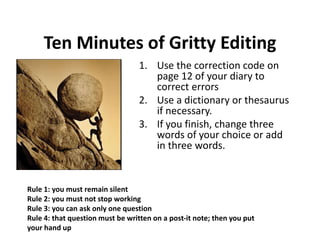
Ten Minutes of Gritty Editing
1. Use the correction code on
page 12 of your diary to
correct errors
2. Use a dictionary or thesaurus
if necessary.
3. If you finish, change three
words of your choice or add
in three words.
Rule 1: you must remain silent
Rule 2: you must not stop working
Rule 3: you can ask only one question
Rule 4: that question must be written on a post-it note; then you put
your hand up
The best three
• Collect in work of class
• Read through only, no marking.
• Using the success criteria set, choose the best
three.
• Photocopy them and give a set of three to each
group.
• Group try to explain why these three have been
chosen, re-emphasing the success criteria.
• Have another go…
Anonymous Feedback
1 • Excellent use of dialogue throughout
• You managed to include two minor sentences in your
opening
• I don’t see a simile here
2 • Good use of first person narration in paragraph one
• Your adjectives add to the tension of the story
• Can you see where you’ve missed a question mark?
3 • Your use of emotive language in the second paragraph is
excellent
• The colourful imagery works really well here.
• Your punctuation of dialogue needs to be improved.
Numbered questions
• As you read, in the margin write a circled number
where you see problems.
• At the end of the work, write that number with a
question (ALWAYS A QUESTION) and leave
enough space for them to write a detailed
answer.
• On return, in class, students spend a period
answering the questions.
• Then and only then can they think about
redrafting.
• Ensuring that they have acted on your feedback.
Exam Practice
• In English, we have Close Reading/ Interpretation
exercises in ALL years
• But relevant to all subjects
• While marking, make sure you give the grade like
this: 1/2 4/4 2/5 etc.
• When you hand the papers back, allow time – a
whole lesson? – for students to go and find someone
who got a a better mark than them.
• Learn from others.
• It is the conversation about how they got those
answers which is more powerful than teacher
feedback
What is the point of marking?
• Feedback?
• Differentiation?
• Planning?
• The best way to get to know what your
pupils have learned
What is the point of marking?
• Pick up on sloppy presentation from the start
• A genuine understanding of them as learners
• You don’t work harder, you work smarter
• If you spend more time on feedback than they
do, you need to stop. NOW!
Great resources
• How to Teach by Phil Beadle
• The Hidden Lives of Learners by Graham
Nuthall
• Visible Learning and the Science of How We
Learn by John Hattie

Marking and Feedback

  • 1.
  • 3.
    ‘The most importantthing you do as a teacher.’ Phil Beadle ‘Marking is an act of love.’ David Didau
  • 4.
    Why? • ‘Practice doesn’tmake perfect. Practice makes permanent.’ Doug Lemov • If you don’t mark and at least read EVERY word they write, then you are embedding bad habits. • ‘Perfect Practice makes perfect.’ Vince Lombardi
  • 5.
  • 6.
    Mark every day (ifpossible) • Class jotters on pupil desks • Cup of tea • Get marking… • Every jotter at least once a week
  • 7.
    Marking is… • Feedback •Differentiation • Planning
  • 8.
    Ten Minutes ofGritty Editing 1. Use the correction code on page 12 of your diary to correct errors 2. Use a dictionary or thesaurus if necessary. 3. If you finish, change three words of your choice or add in three words. Rule 1: you must remain silent Rule 2: you must not stop working Rule 3: you can ask only one question Rule 4: that question must be written on a post-it note; then you put your hand up
  • 9.
    The best three •Collect in work of class • Read through only, no marking. • Using the success criteria set, choose the best three. • Photocopy them and give a set of three to each group. • Group try to explain why these three have been chosen, re-emphasing the success criteria. • Have another go…
  • 10.
    Anonymous Feedback 1 •Excellent use of dialogue throughout • You managed to include two minor sentences in your opening • I don’t see a simile here 2 • Good use of first person narration in paragraph one • Your adjectives add to the tension of the story • Can you see where you’ve missed a question mark? 3 • Your use of emotive language in the second paragraph is excellent • The colourful imagery works really well here. • Your punctuation of dialogue needs to be improved.
  • 11.
    Numbered questions • Asyou read, in the margin write a circled number where you see problems. • At the end of the work, write that number with a question (ALWAYS A QUESTION) and leave enough space for them to write a detailed answer. • On return, in class, students spend a period answering the questions. • Then and only then can they think about redrafting. • Ensuring that they have acted on your feedback.
  • 12.
    Exam Practice • InEnglish, we have Close Reading/ Interpretation exercises in ALL years • But relevant to all subjects • While marking, make sure you give the grade like this: 1/2 4/4 2/5 etc. • When you hand the papers back, allow time – a whole lesson? – for students to go and find someone who got a a better mark than them. • Learn from others. • It is the conversation about how they got those answers which is more powerful than teacher feedback
  • 13.
    What is thepoint of marking? • Feedback? • Differentiation? • Planning? • The best way to get to know what your pupils have learned
  • 14.
    What is thepoint of marking? • Pick up on sloppy presentation from the start • A genuine understanding of them as learners • You don’t work harder, you work smarter • If you spend more time on feedback than they do, you need to stop. NOW!
  • 16.
    Great resources • Howto Teach by Phil Beadle • The Hidden Lives of Learners by Graham Nuthall • Visible Learning and the Science of How We Learn by John Hattie