Engaging students in assessment
Cameron Paterson
2021
Image: http://www.volunteerswmi.org/
3 volunteers
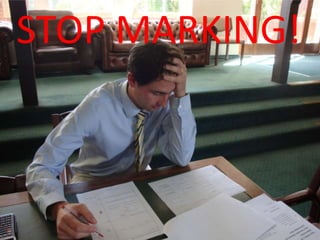
STOP MARKING!
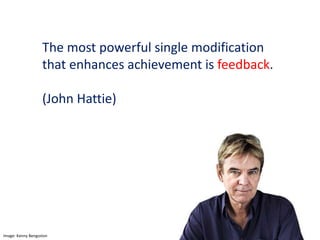
The most powerful single modification
that enhances achievement is feedback.
(John Hattie)
Image: Kenny Bengsston
Much of the feedback that students get has
little or no effect on their learning.
(Dylan Wiliam)
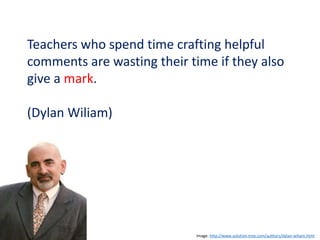
Teachers who spend time crafting helpful
comments are wasting their time if they also
give a mark.
(Dylan Wiliam)
Image: http://www.solution-tree.com/authors/dylan-wiliam.html
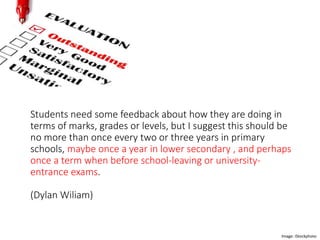
Students need some feedback about how they are doing in
terms of marks, grades or levels, but I suggest this should be
no more than once every two or three years in primary
schools, maybe once a year in lower secondary , and perhaps
once a term when before school-leaving or university-
entrance exams.
(Dylan Wiliam)
Image: iStockphoto
NESA does not require a number to be used (in relation to assessment)
until Year 12.
Grading is an end of course judgement.
School protocols squash the reality of what NESA requires out of sight.
• Too much testing
• Focus more on learning objectives and less on covering content
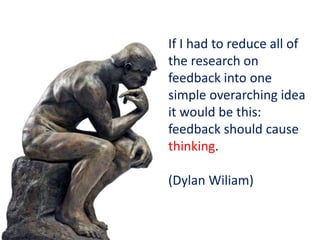
If I had to reduce all of
the research on
feedback into one
simple overarching idea
it would be this:
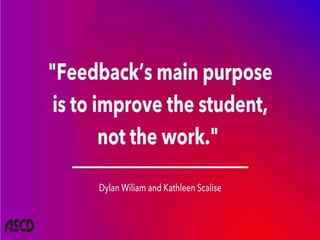
feedback should cause
thinking.
(Dylan Wiliam)
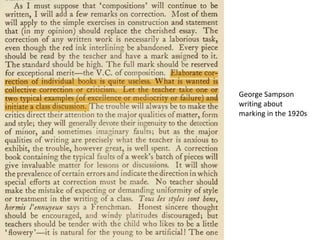
George Sampson
writing about
marking in the 1920s
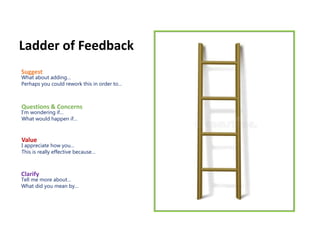
Suggest
What about adding…
Perhaps you could rework this in order to…
Questions & Concerns
I’m wondering if…
What would happen if…
Value
I appreciate how you…
This is really effective because…
Clarify
Tell me more about…
What did you mean by…
Ladder of Feedback
@Diff_central
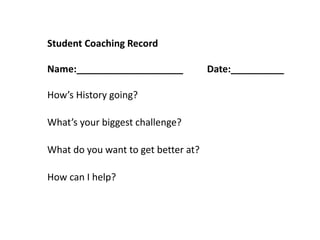
Student Coaching Record
Name:____________________ Date:__________
How’s History going?
What’s your biggest challenge?
What do you want to get better at?
How can I help?
Engaging students in assessment
Cameron Paterson
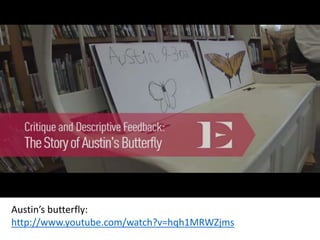
Austin’s butterfly:
http://www.youtube.com/watch?v=hqh1MRWZjms
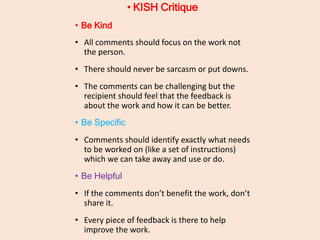
• KISH Critique
• Be Kind
• All comments should focus on the work not
the person.
• There should never be sarcasm or put downs.
• The comments can be challenging but the
recipient should feel that the feedback is
about the work and how it can be better.
• Be Specific
• Comments should identify exactly what needs
to be worked on (like a set of instructions)
which we can take away and use or do.
• Be Helpful
• If the comments don’t benefit the work, don’t
share it.
• Every piece of feedback is there to help
improve the work.
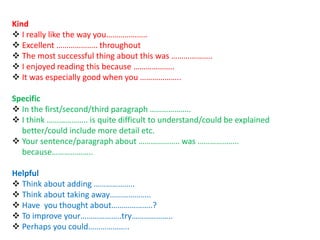
Kind
 I really like the way you………………..
 Excellent ……………….. throughout
 The most successful thing about this was ………………..
 I enjoyed reading this because ………………..
 It was especially good when you ………………..
Specific
 In the first/second/third paragraph ………………..
 I think ……………….. is quite difficult to understand/could be explained
better/could include more detail etc.
 Your sentence/paragraph about ……………….. was ………………..
because………………..
Helpful
 Think about adding ………………..
 Think about taking away………………..
 Have you thought about………………..?
 To improve your………………..try………………..
 Perhaps you could………………..
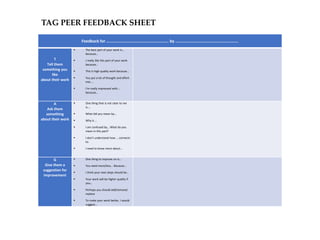
Feedback for ………………………………………………….. by ……………………………………………………
T
Tell them
something you
like
about their work
 The best part of your work is…
because…
 I really like this part of your work
because…
 This is high quality work because…
 You put a lot of thought and effort
into …
 I’m really impressed with….
because…
A
Ask them
something
about their work
 One thing that is not clear to me
is….
 What did you mean by…
 Why is …
 I am confused by… What do you
mean in this part?
 I don’t understand how … connects
to.
 I need to know more about…
G
Give them a
suggestion for
improvement
 One thing to improve on is…
 You need more/less… Because…
 I think your next steps should be…
 Your work will be higher quality if
you…
 Perhaps you should add/remove/
replace
 To make your work better, I would
suggest…
TAG PEER FEEDBACK SHEET
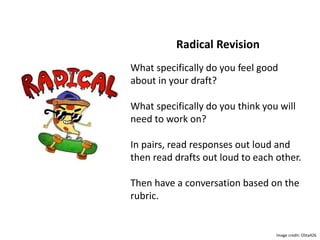
Radical Revision
What specifically do you feel good
about in your draft?
What specifically do you think you will
need to work on?
In pairs, read responses out loud and
then read drafts out loud to each other.
Then have a conversation based on the
rubric.
Image credit: Olita426
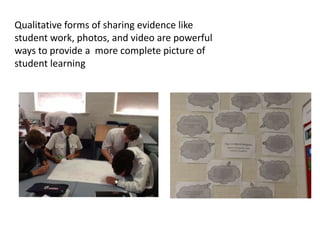
Qualitative forms of sharing evidence like
student work, photos, and video are powerful
ways to provide a more complete picture of
student learning
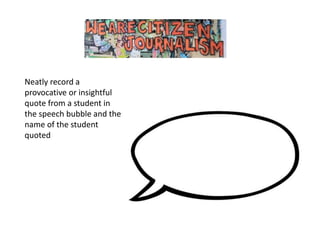
Neatly record a
provocative or insightful
quote from a student in
the speech bubble and the
name of the student
quoted
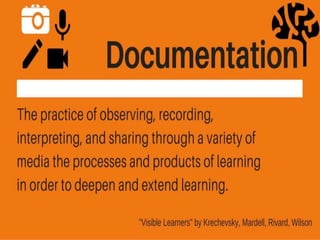
Reggio educators refer
to documentation as
“visible listening”
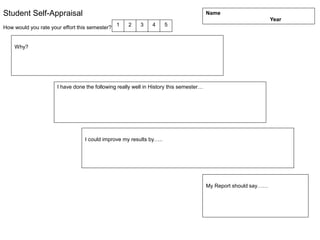
Name
Year
3
2
1
Why?
I could improve my results by…..
My Report should say……
I have done the following really well in History this semester…
4 5
Student Self-Appraisal
How would you rate your effort this semester?
Student Questionnaire – What do you think?
What do you wish teachers knew about you as a
learner?
What are the things teachers do that let you know
they respect and value you?
What advice would you give teachers to bring out
best in students?
Assessment is a
conversation, not a number
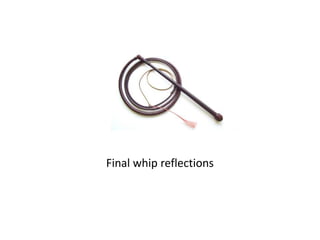
Final whip reflections
Image: iStockphoto
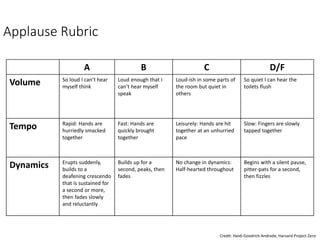
A B C D/F
Volume So loud I can’t hear
myself think
Loud enough that I
can’t hear myself
speak
Loud-ish in some parts of
the room but quiet in
others
So quiet I can hear the
toilets flush
Tempo Rapid: Hands are
hurriedly smacked
together
Fast: Hands are
quickly brought
together
Leisurely: Hands are hit
together at an unhurried
pace
Slow: Fingers are slowly
tapped together
Dynamics Erupts suddenly,
builds to a
deafening crescendo
that is sustained for
a second or more,
then fades slowly
and reluctantly
Builds up for a
second, peaks, then
fades
No change in dynamics:
Half-hearted throughout
Begins with a silent pause,
pitter-pats for a second,
then fizzles
Applause Rubric
Credit: Heidi Goodrich Andrade, Harvard Project Zero
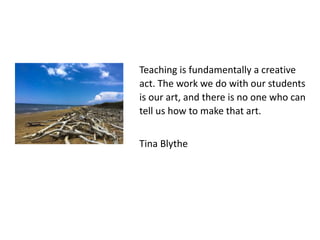
Teaching is fundamentally a creative
act. The work we do with our students
is our art, and there is no one who can
tell us how to make that art.
Tina Blythe
Free online conference in September

Cameron Paterson
E:
cdp151@mail.harvard.edu
T: cpaterso

Syd Uni - Assessment lecture 2021

  • 1.
    Engaging students inassessment Cameron Paterson 2021
  • 2.
  • 5.
  • 6.
    The most powerfulsingle modification that enhances achievement is feedback. (John Hattie) Image: Kenny Bengsston
  • 7.
    Much of thefeedback that students get has little or no effect on their learning. (Dylan Wiliam)
  • 8.
    Teachers who spendtime crafting helpful comments are wasting their time if they also give a mark. (Dylan Wiliam) Image: http://www.solution-tree.com/authors/dylan-wiliam.html
  • 10.
    Students need somefeedback about how they are doing in terms of marks, grades or levels, but I suggest this should be no more than once every two or three years in primary schools, maybe once a year in lower secondary , and perhaps once a term when before school-leaving or university- entrance exams. (Dylan Wiliam) Image: iStockphoto
  • 11.
    NESA does notrequire a number to be used (in relation to assessment) until Year 12. Grading is an end of course judgement. School protocols squash the reality of what NESA requires out of sight. • Too much testing • Focus more on learning objectives and less on covering content
  • 12.
    If I hadto reduce all of the research on feedback into one simple overarching idea it would be this: feedback should cause thinking. (Dylan Wiliam)
  • 13.
  • 14.
    Suggest What about adding… Perhapsyou could rework this in order to… Questions & Concerns I’m wondering if… What would happen if… Value I appreciate how you… This is really effective because… Clarify Tell me more about… What did you mean by… Ladder of Feedback
  • 15.
  • 16.
    Student Coaching Record Name:____________________Date:__________ How’s History going? What’s your biggest challenge? What do you want to get better at? How can I help?
  • 17.
    Engaging students inassessment Cameron Paterson
  • 23.
  • 24.
    • KISH Critique •Be Kind • All comments should focus on the work not the person. • There should never be sarcasm or put downs. • The comments can be challenging but the recipient should feel that the feedback is about the work and how it can be better. • Be Specific • Comments should identify exactly what needs to be worked on (like a set of instructions) which we can take away and use or do. • Be Helpful • If the comments don’t benefit the work, don’t share it. • Every piece of feedback is there to help improve the work.
  • 25.
    Kind  I reallylike the way you………………..  Excellent ……………….. throughout  The most successful thing about this was ………………..  I enjoyed reading this because ………………..  It was especially good when you ……………….. Specific  In the first/second/third paragraph ………………..  I think ……………….. is quite difficult to understand/could be explained better/could include more detail etc.  Your sentence/paragraph about ……………….. was ……………….. because……………….. Helpful  Think about adding ………………..  Think about taking away………………..  Have you thought about………………..?  To improve your………………..try………………..  Perhaps you could………………..
  • 26.
    Feedback for …………………………………………………..by …………………………………………………… T Tell them something you like about their work  The best part of your work is… because…  I really like this part of your work because…  This is high quality work because…  You put a lot of thought and effort into …  I’m really impressed with…. because… A Ask them something about their work  One thing that is not clear to me is….  What did you mean by…  Why is …  I am confused by… What do you mean in this part?  I don’t understand how … connects to.  I need to know more about… G Give them a suggestion for improvement  One thing to improve on is…  You need more/less… Because…  I think your next steps should be…  Your work will be higher quality if you…  Perhaps you should add/remove/ replace  To make your work better, I would suggest… TAG PEER FEEDBACK SHEET
  • 27.
    Radical Revision What specificallydo you feel good about in your draft? What specifically do you think you will need to work on? In pairs, read responses out loud and then read drafts out loud to each other. Then have a conversation based on the rubric. Image credit: Olita426
  • 32.
    Qualitative forms ofsharing evidence like student work, photos, and video are powerful ways to provide a more complete picture of student learning
  • 33.
    Neatly record a provocativeor insightful quote from a student in the speech bubble and the name of the student quoted
  • 35.
    Reggio educators refer todocumentation as “visible listening”
  • 39.
    Name Year 3 2 1 Why? I could improvemy results by….. My Report should say…… I have done the following really well in History this semester… 4 5 Student Self-Appraisal How would you rate your effort this semester?
  • 40.
    Student Questionnaire –What do you think? What do you wish teachers knew about you as a learner? What are the things teachers do that let you know they respect and value you? What advice would you give teachers to bring out best in students?
  • 41.
  • 43.
  • 44.
  • 45.
    A B CD/F Volume So loud I can’t hear myself think Loud enough that I can’t hear myself speak Loud-ish in some parts of the room but quiet in others So quiet I can hear the toilets flush Tempo Rapid: Hands are hurriedly smacked together Fast: Hands are quickly brought together Leisurely: Hands are hit together at an unhurried pace Slow: Fingers are slowly tapped together Dynamics Erupts suddenly, builds to a deafening crescendo that is sustained for a second or more, then fades slowly and reluctantly Builds up for a second, peaks, then fades No change in dynamics: Half-hearted throughout Begins with a silent pause, pitter-pats for a second, then fizzles Applause Rubric Credit: Heidi Goodrich Andrade, Harvard Project Zero
  • 47.
    Teaching is fundamentallya creative act. The work we do with our students is our art, and there is no one who can tell us how to make that art. Tina Blythe
  • 48.
  • 49.