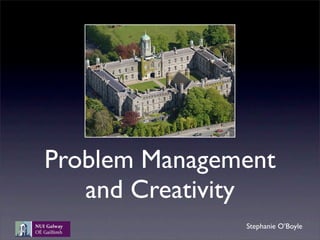
Problem Management
and Creativity
Stephanie O’Boyle
Flipped Classroom
•Group Discussion and Participation
•Think deeply and critically about what
you read
•Build confidence in discussion
•Build understanding
•Prepare for the assignment
submission
•Potentially have 20% of your marks
before you leave
Roles in Group
Engage
Listen
Respect
Contribute
Clarify
Discuss
Question - What, why, when,
where, how, who?
Rational disagreement
Learn
Facilitate
Teach
Remember
• You are not expected to ‘get
it right’ throughout
• You are expected to
• learn
• demonstrate understanding
of the salient points
following your discussion, so
• If you don’t understand say so
• If you are comfortable with
the question at hand help
others in the group to
understand but don’t impose
your view
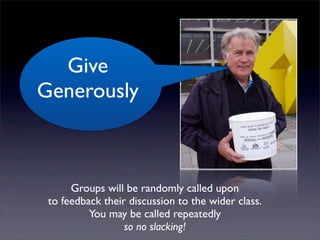
Give
Generously
Groups will be randomly called upon
to feedback their discussion to the wider class.
You may be called repeatedly
so no slacking!
Task 1
Choose and describe the
three most important
aspects of the module (from
the material you covered in
the workbook).
Justify your choices
One hour discussion
Large Group Presentation
Task 2
Identify an element of the module
content that you consider more
difficult to apply in your role as a
practitioner.
Your group may have more than one -
start with ‘all’, and narrow it down.
Task 3
Pose a question to the full class, the
answer to which may go beyond the
reading content (and doesn't reflect
the areas of confusion discussed in
the last task).
The question should reflect learning
and reveal what you think are the
implications and applications of theory
covered in ‘Problem Management and
Creativity’.
Give an example of
how you might use
5WH to clarify a
work related issue
How could you apply
the Five P Creativity
Framework to resolve
a work related issue
Self Assess
• What worked well/could have been managed
better in the group discussion?
• What aspects of Problem Management and
Creativity did you USE in your discussions
• What, if anything, did you learn about yourself
from the group work
• What should you do more of?
• Less of?

Problem Management

  • 1.
  • 2.
    Flipped Classroom •Group Discussionand Participation •Think deeply and critically about what you read •Build confidence in discussion •Build understanding •Prepare for the assignment submission •Potentially have 20% of your marks before you leave
  • 3.
    Roles in Group Engage Listen Respect Contribute Clarify Discuss Question- What, why, when, where, how, who? Rational disagreement Learn Facilitate Teach
  • 4.
    Remember • You arenot expected to ‘get it right’ throughout • You are expected to • learn • demonstrate understanding of the salient points following your discussion, so • If you don’t understand say so • If you are comfortable with the question at hand help others in the group to understand but don’t impose your view
  • 5.
    Give Generously Groups will berandomly called upon to feedback their discussion to the wider class. You may be called repeatedly so no slacking!
  • 6.
    Task 1 Choose anddescribe the three most important aspects of the module (from the material you covered in the workbook). Justify your choices One hour discussion Large Group Presentation
  • 7.
    Task 2 Identify anelement of the module content that you consider more difficult to apply in your role as a practitioner. Your group may have more than one - start with ‘all’, and narrow it down.
  • 8.
    Task 3 Pose aquestion to the full class, the answer to which may go beyond the reading content (and doesn't reflect the areas of confusion discussed in the last task). The question should reflect learning and reveal what you think are the implications and applications of theory covered in ‘Problem Management and Creativity’.
  • 9.
    Give an exampleof how you might use 5WH to clarify a work related issue How could you apply the Five P Creativity Framework to resolve a work related issue
  • 10.
    Self Assess • Whatworked well/could have been managed better in the group discussion? • What aspects of Problem Management and Creativity did you USE in your discussions • What, if anything, did you learn about yourself from the group work • What should you do more of? • Less of?