CIRTL – The College Classroom Meeting 6:
Cooperative Learning and Peer Instruction
March 3, 2016
Unless otherwise noted, content is licensed under
a Creative CommonsAttribution- 3.0 License.
Peter Newbury
Center for EngagedTeaching, UC San Diego
pnewbury@ucsd.edu
Tom Holme
Department of Chemistry, Iowa State University
taholme@iastate.edu
collegeclassroom.ucsd.edu
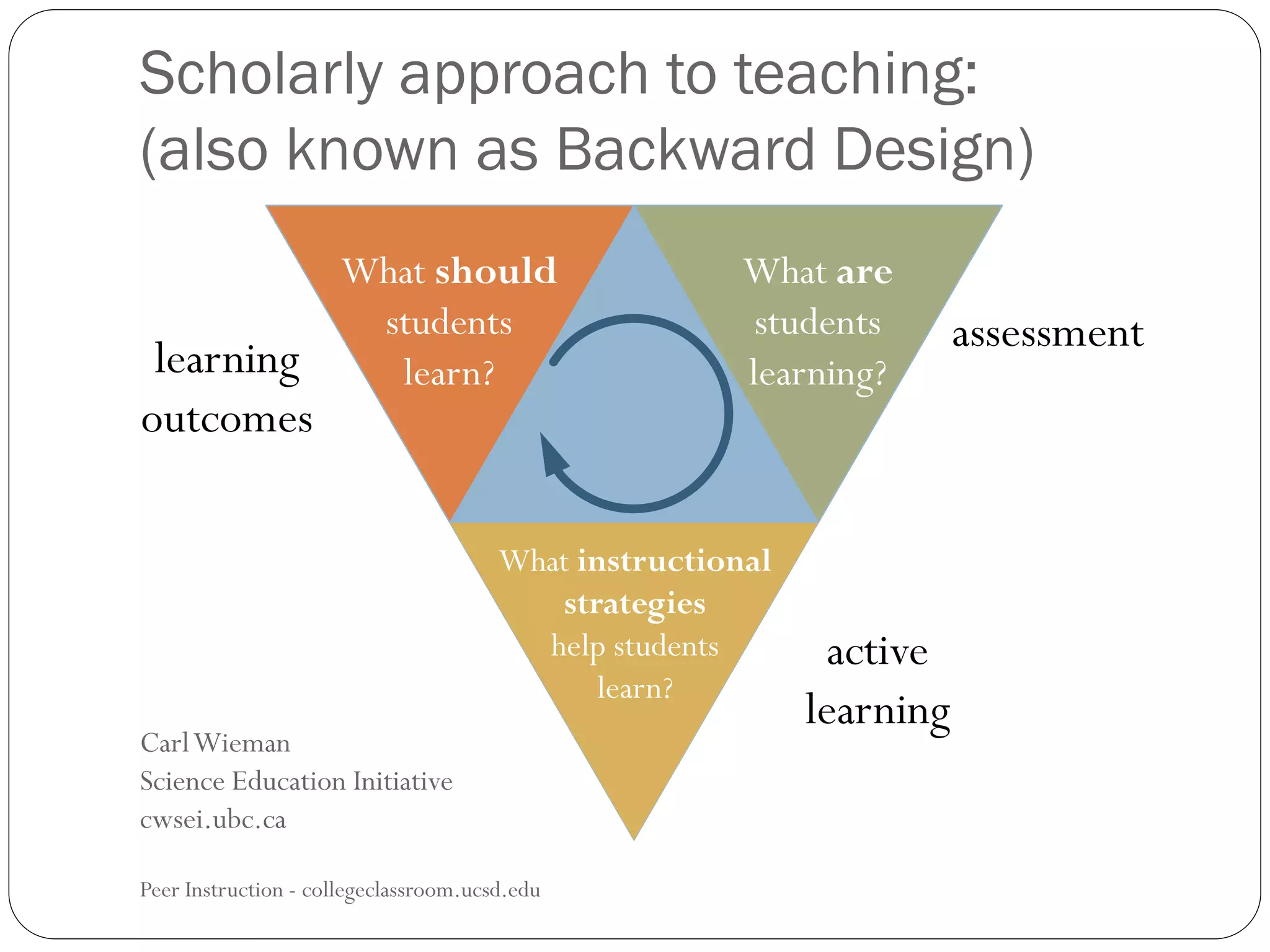
Scholarly approach to teaching:
(also known as Backward Design)
Peer Instruction - collegeclassroom.ucsd.edu
CarlWieman
Science Education Initiative
cwsei.ubc.ca
What should
students
learn?learning
outcomes
assessment
active
learning
What should
students
learn?
What are
students
learning?
What instructional
strategies
help students
learn?
Peer Instruction - collegeclassroom.ucsd.edu
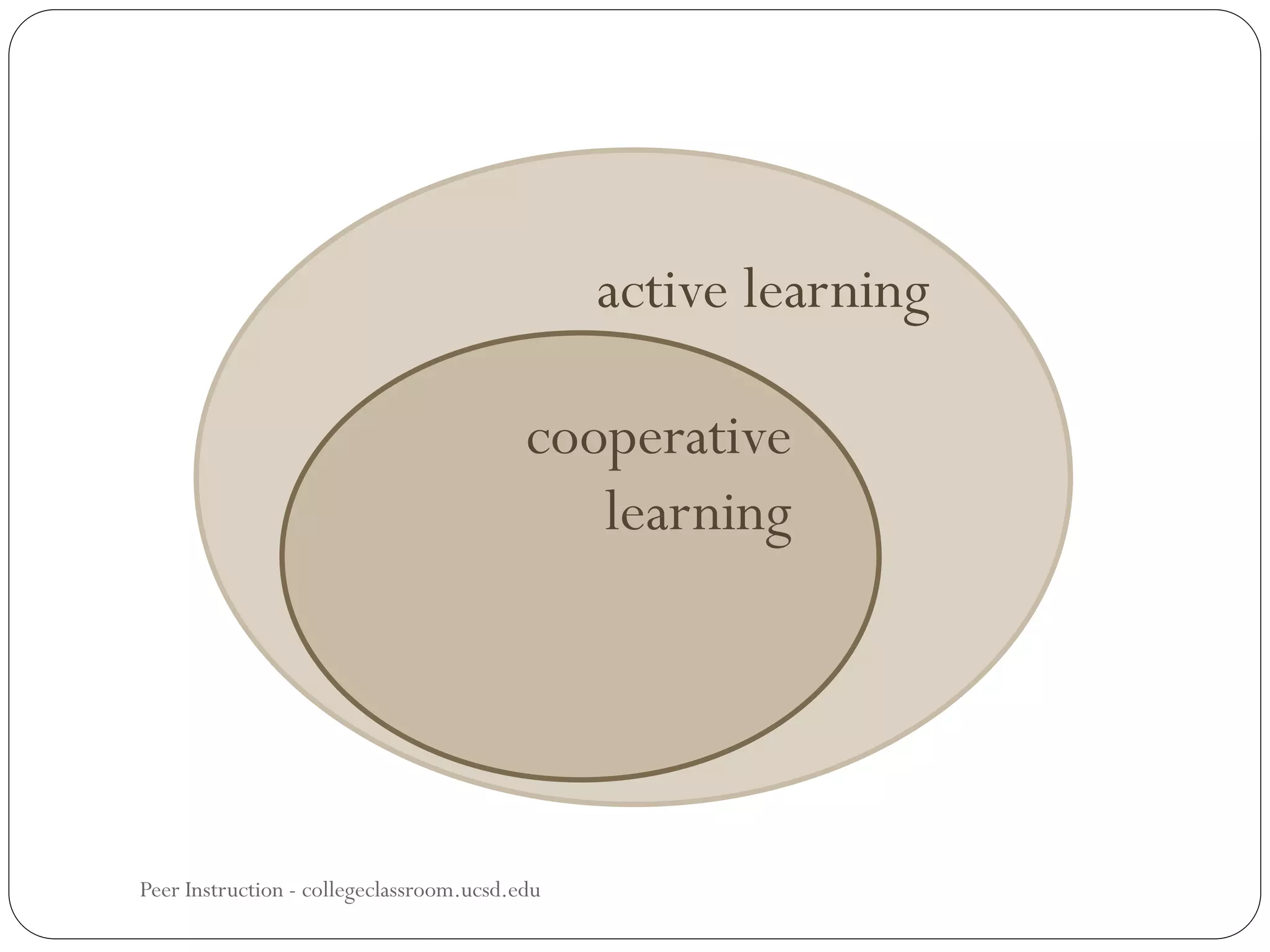
active learning
cooperative
learning
Cooperative Learning[2]
Peer Instruction - collegeclassroom.ucsd.edu
Cooperative learning is the instructional use of small groups so
that students work together to maximize their own and each other’s
learning.
(Rique Campa)
constructivism social constructivism
recognizes that knowledge is
constructed in the mind of the
learner by the learner
([3], p.262)
implies that this “building”
process is aided through
cooperative social interactions
([3], p. 262)
Key to successful cooperative learning
Peer Instruction - collegeclassroom.ucsd.edu
You need to teach the students
how to work effectively as a team.
You can’t leave it up to them to figure out
 positive team member traits
 team-building, management, conflict-resolution skills
 how to remain inquiry-based: asking questions of each
other, making recommendations, receiving feedback
 how to make effective, professional presentations
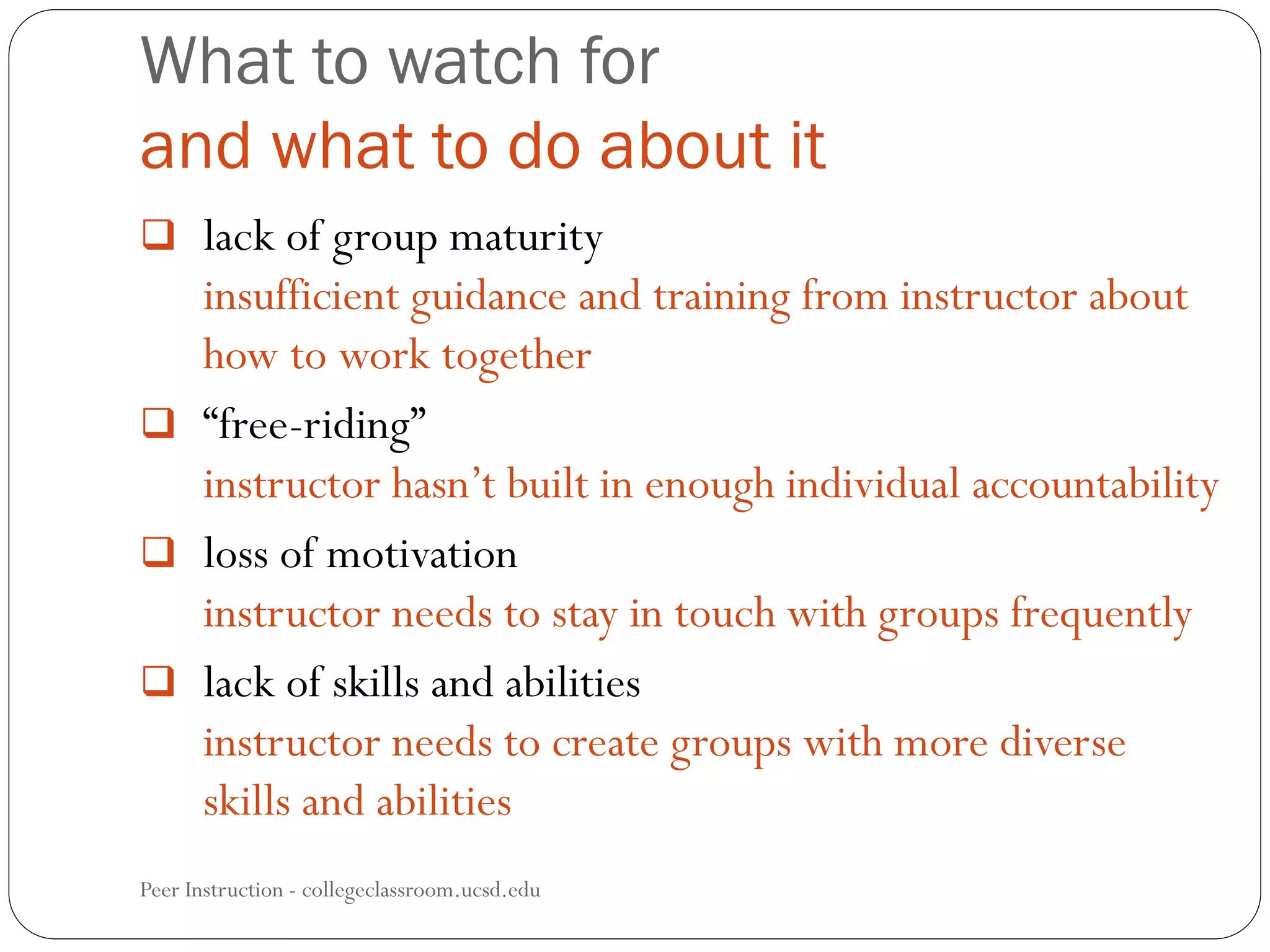
What to watch for
and what to do about it
Peer Instruction - collegeclassroom.ucsd.edu
 lack of group maturity
insufficient guidance and training from instructor about
how to work together
 “free-riding”
instructor hasn’t built in enough individual accountability
 loss of motivation
instructor needs to stay in touch with groups frequently
 lack of skills and abilities
instructor needs to create groups with more diverse
skills and abilities
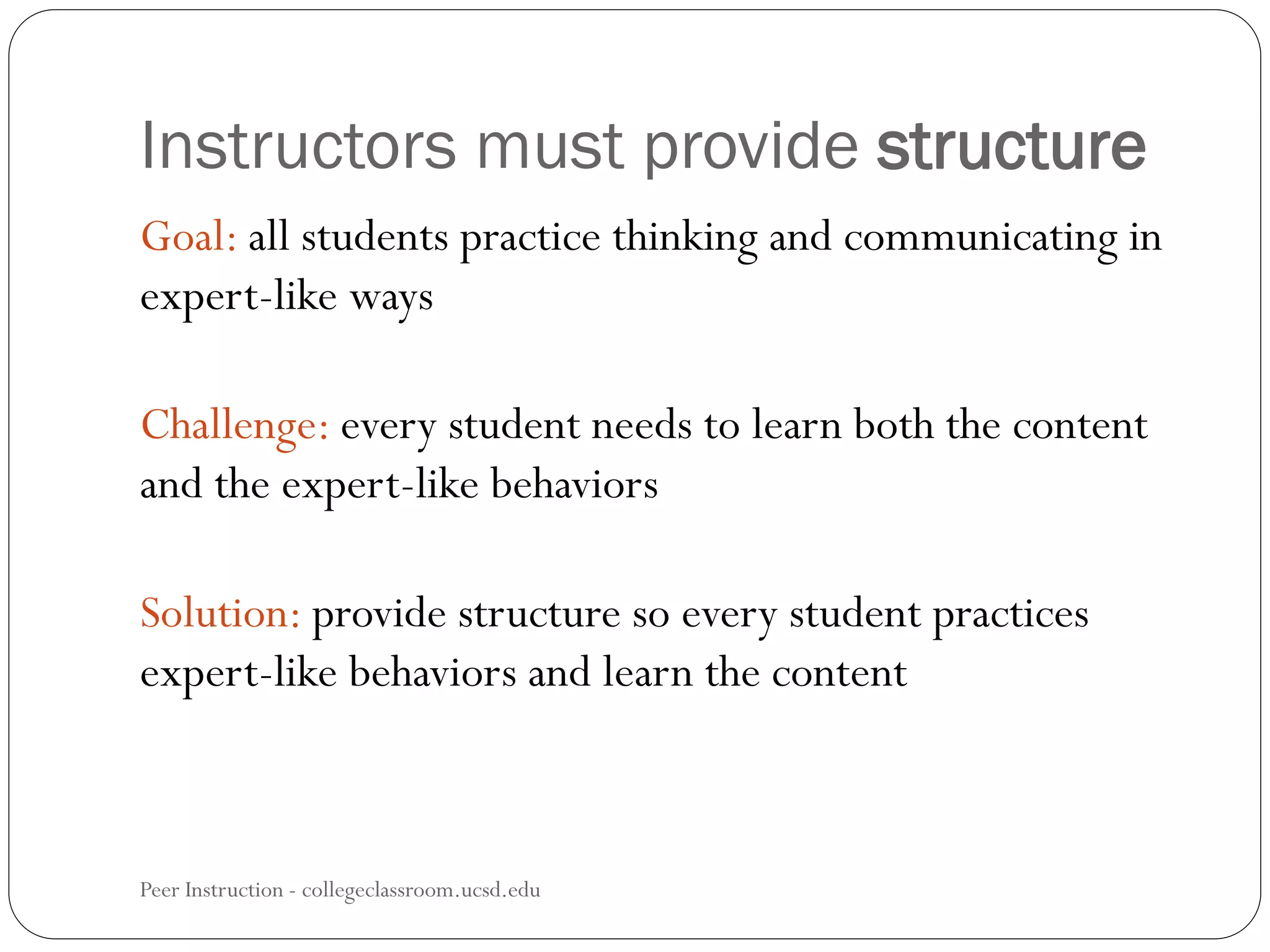
Instructors must provide structure
Peer Instruction - collegeclassroom.ucsd.edu
Goal: all students practice thinking and communicating in
expert-like ways
Challenge: every student needs to learn both the content
and the expert-like behaviors
Solution: provide structure so every student practices
expert-like behaviors and learn the content
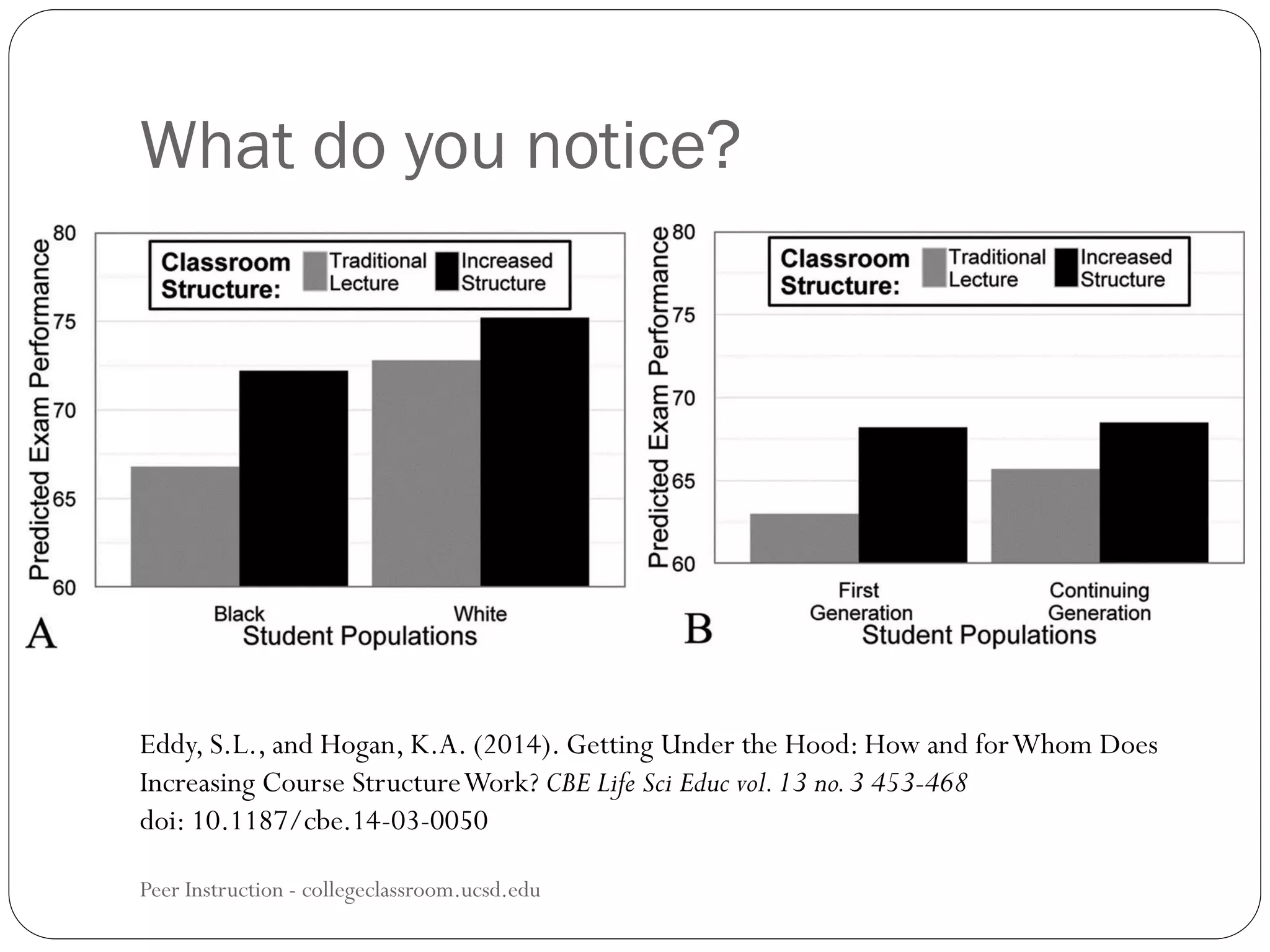
What do you notice?
Peer Instruction - collegeclassroom.ucsd.edu
Eddy, S.L., and Hogan, K.A. (2014). Getting Under the Hood: How and forWhom Does
Increasing Course StructureWork? CBE Life Sci Educ vol.13 no.3 453-468
doi: 10.1187/cbe.14-03-0050
Peer Instruction - collegeclassroom.ucsd.edu
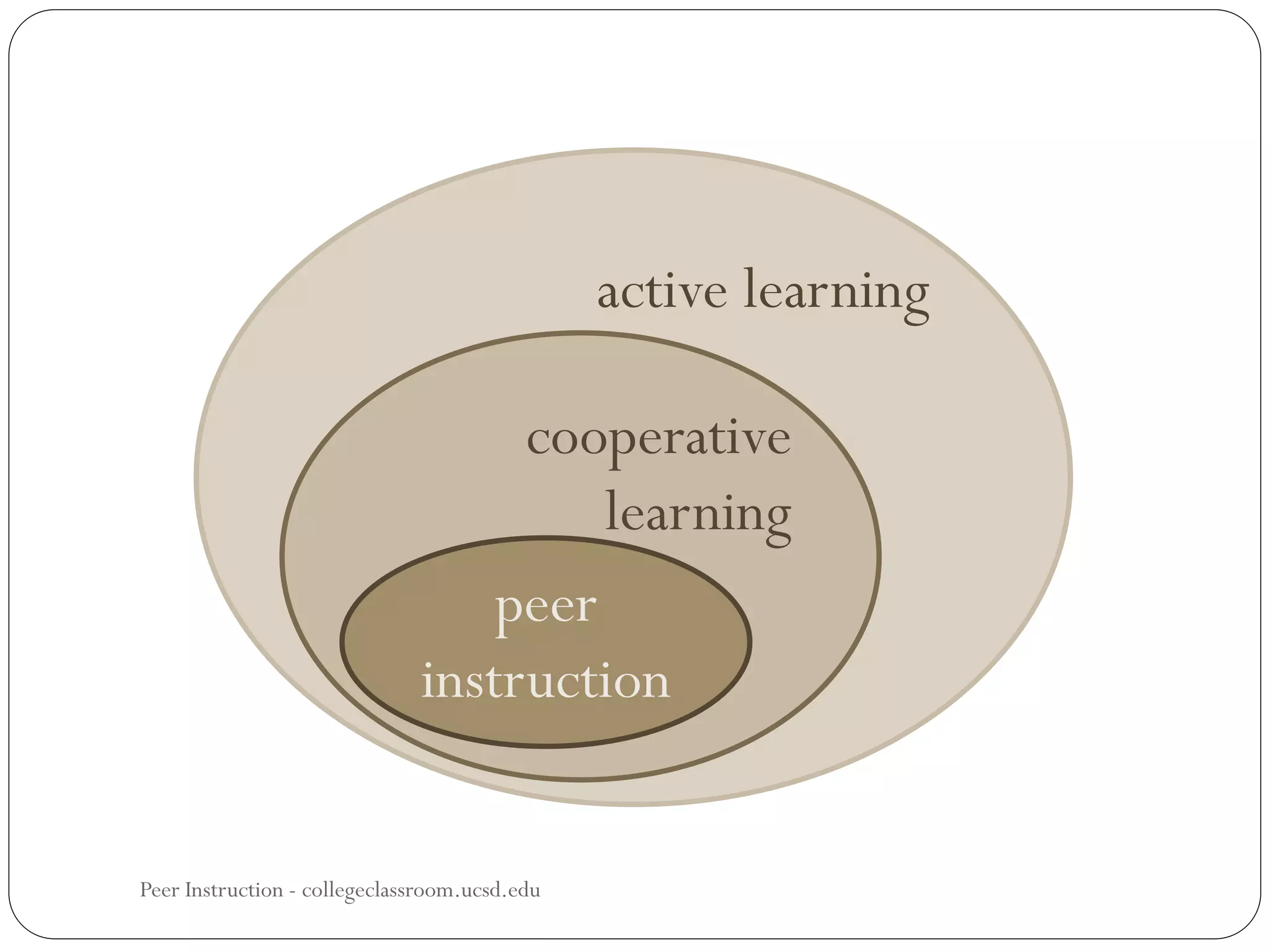
active learning
cooperative
learning
peer
instruction
Peer Instruction - collegeclassroom.ucsd.edu
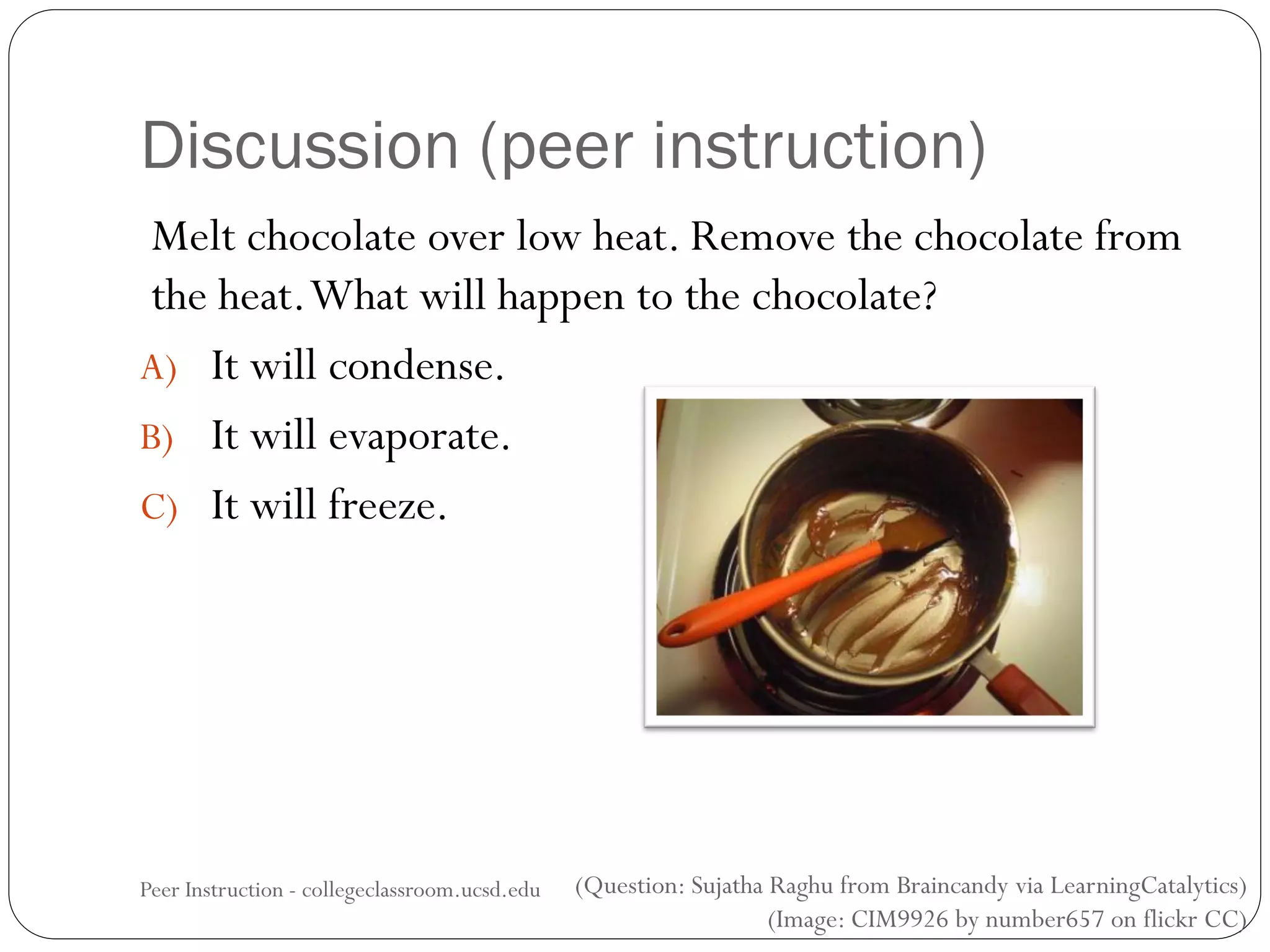
(Question: Sujatha Raghu from Braincandy via LearningCatalytics)
(Image: CIM9926 by number657 on flickr CC)
Discussion (peer instruction)
Melt chocolate over low heat. Remove the chocolate from
the heat.What will happen to the chocolate?
A) It will condense.
B) It will evaporate.
C) It will freeze.
Peer Instruction - collegeclassroom.ucsd.edu
Typical Episode of Peer Instruction
Peer Instruction - collegeclassroom.ucsd.edu
1. Instructor poses a conceptually-challenging
multiple-choice question.
2. Students think about question on their own and vote
using clickers, colored ABCD cards, smartphones,…
3. The instructor asks students to turn to their neighbors
and “convince them you’re right.”
4. After that “peer instruction”, students may vote again.
5. The instructor leads a class-wide discussion concluding
with why the right answer(s) is right and the wrong
answers are wrong.
Peer instruction is successful when
Peer Instruction - collegeclassroom.ucsd.edu
 students teach each other while
they may still hold or remember
their novice preconceptions
 students discuss the concepts in their
own (novice) language
 each student finds out what they (don’t) know
 the instructor finds out what the students (don’t) know
and reacts, building on their initial understanding and
preconceptions.
students practice
how to think,
communicate
like experts
Peer Instruction - collegeclassroom.ucsd.edu
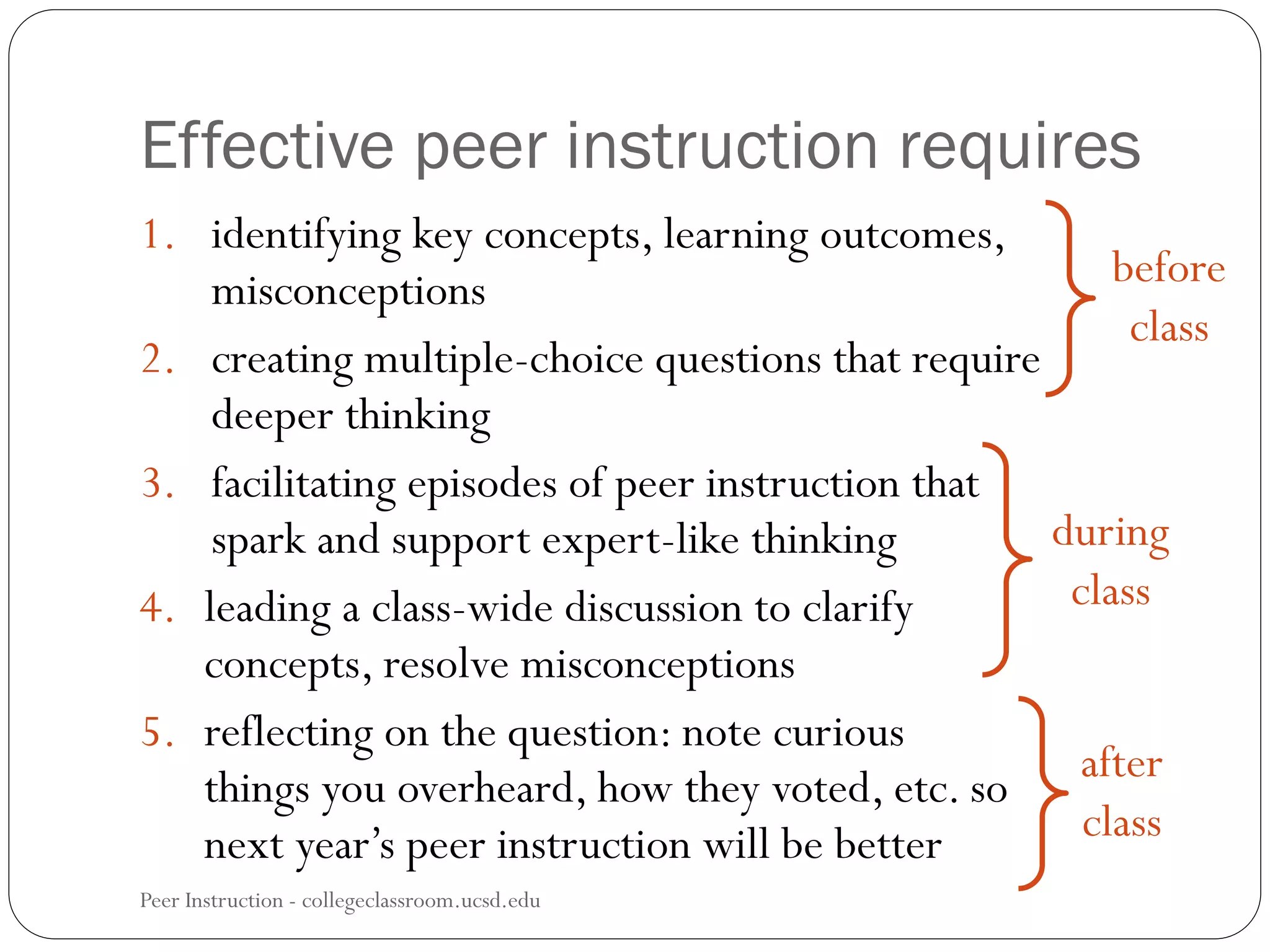
1. identifying key concepts, learning outcomes,
misconceptions
2. creating multiple-choice questions that require
deeper thinking
3. facilitating episodes of peer instruction that
spark and support expert-like thinking
4. leading a class-wide discussion to clarify
concepts, resolve misconceptions
5. reflecting on the question: note curious
things you overheard, how they voted, etc. so
next year’s peer instruction will be better
before
class
during
class
after
class
Effective peer instruction requires
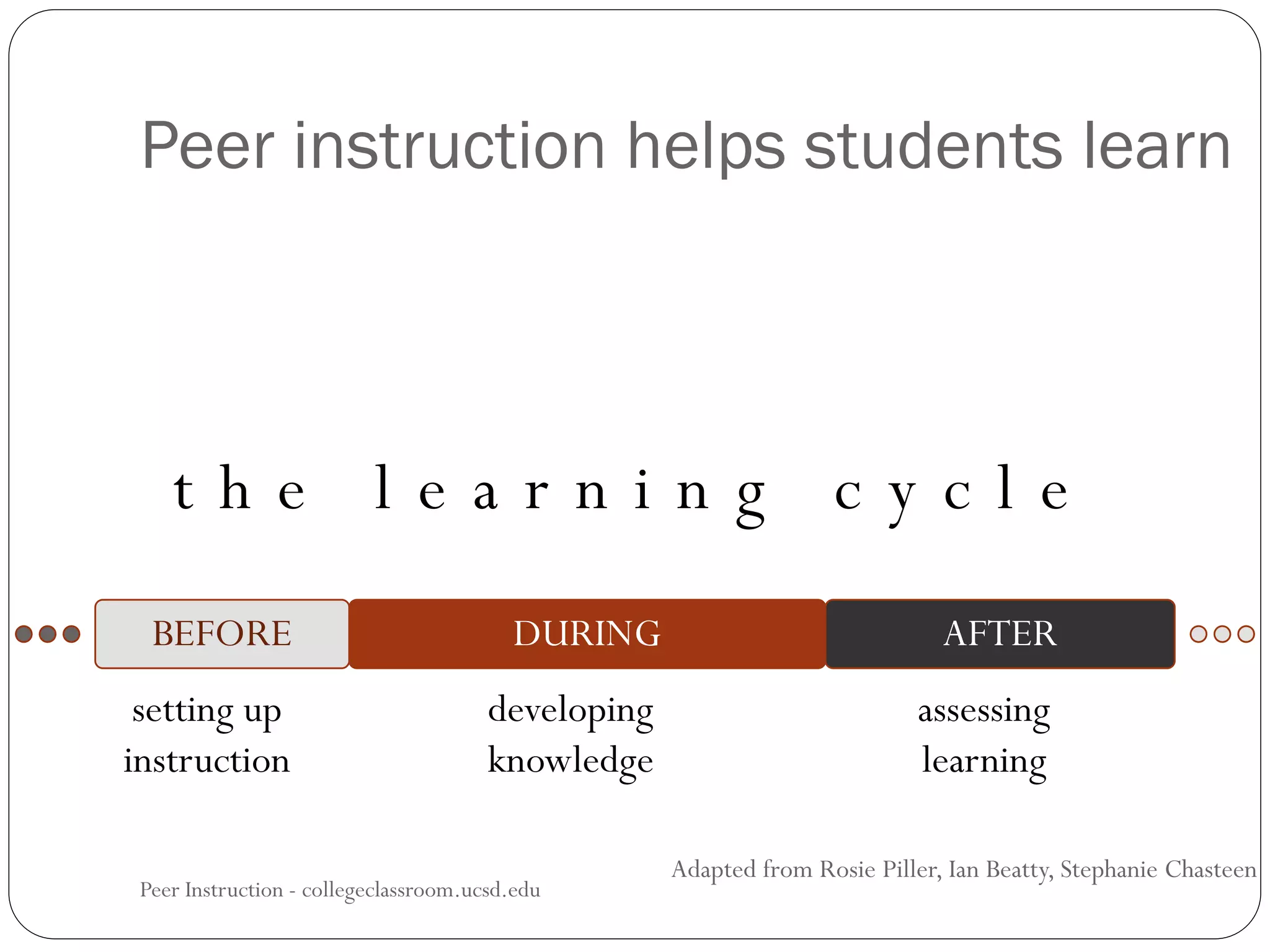
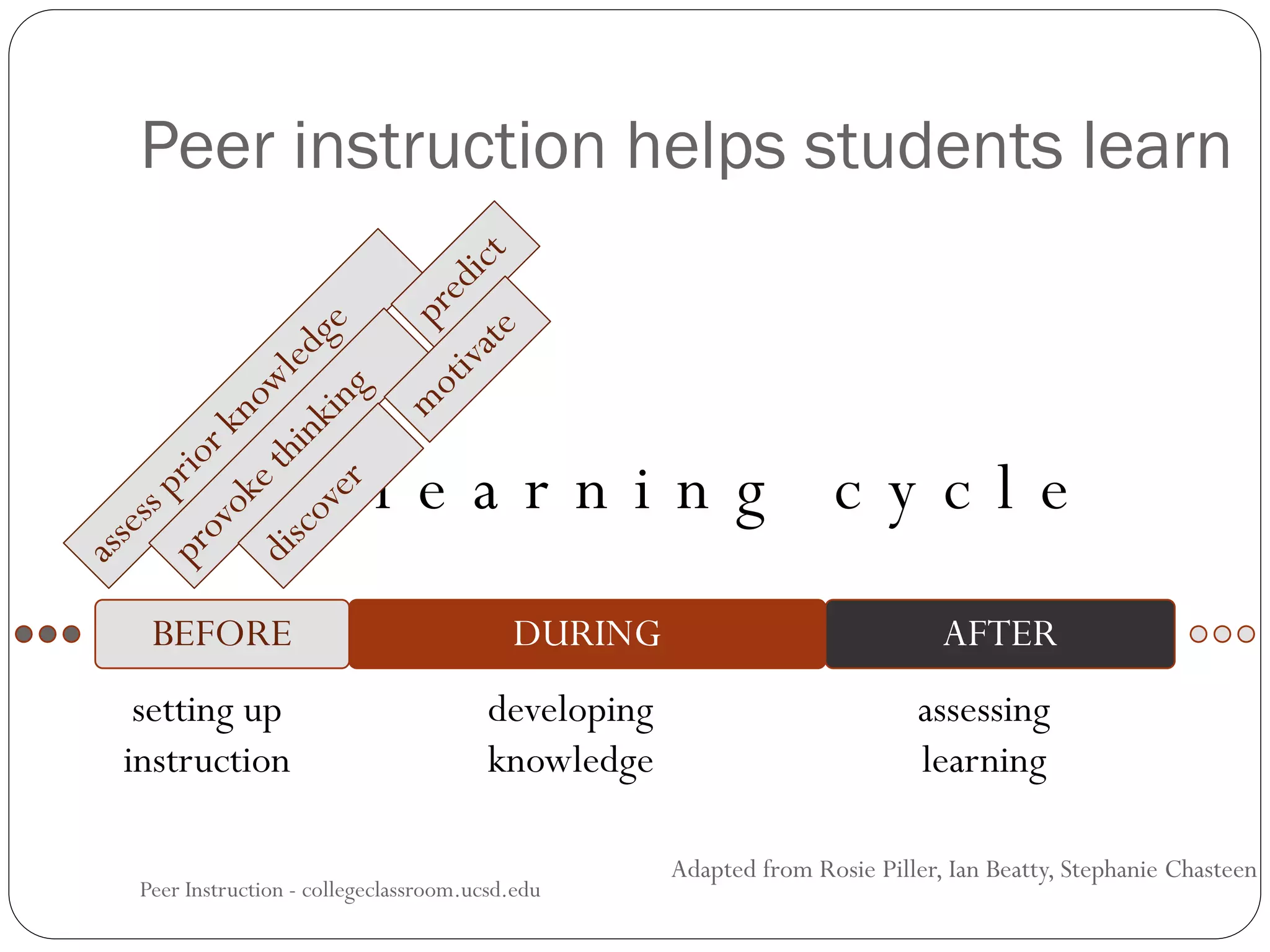
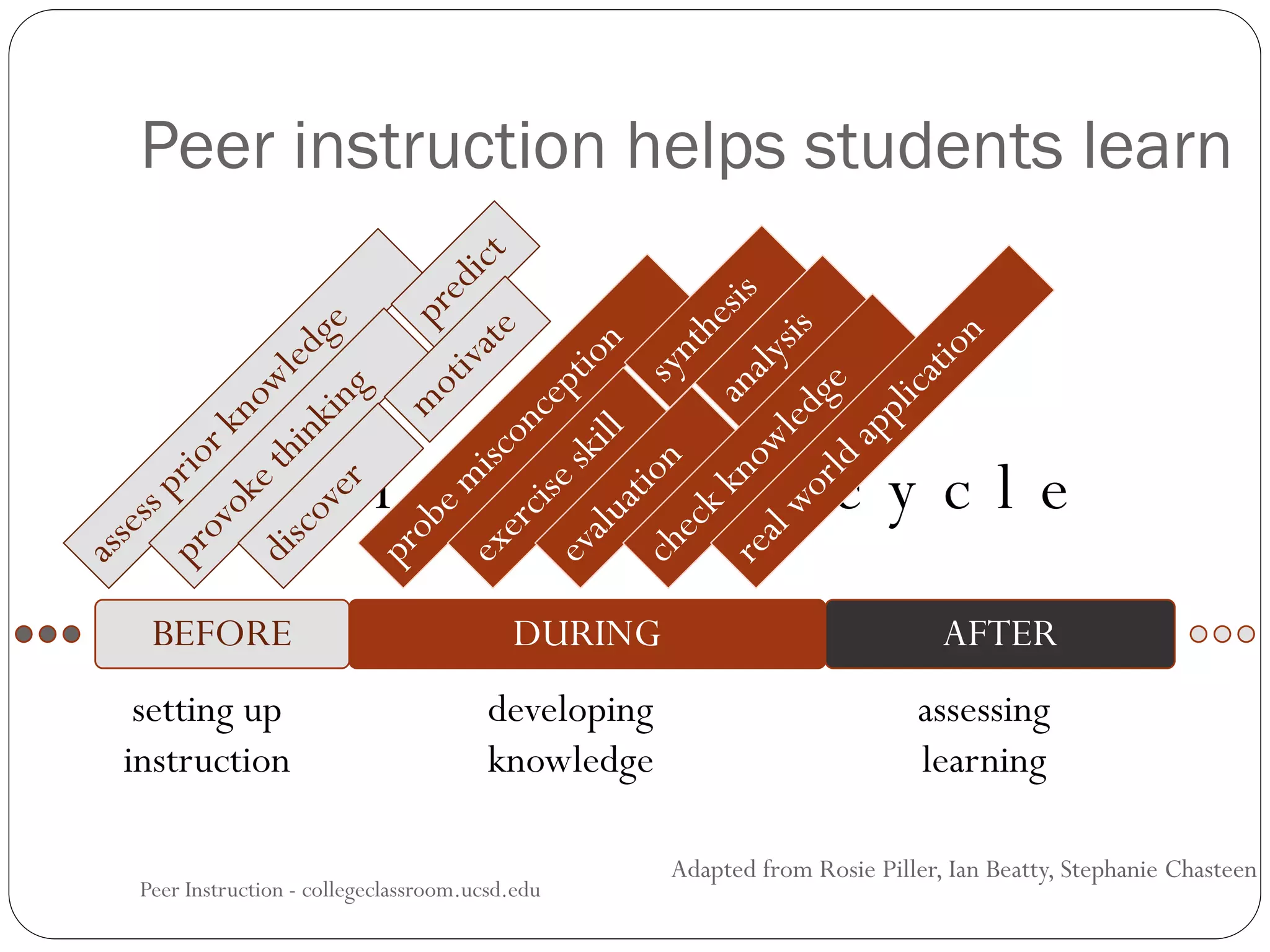
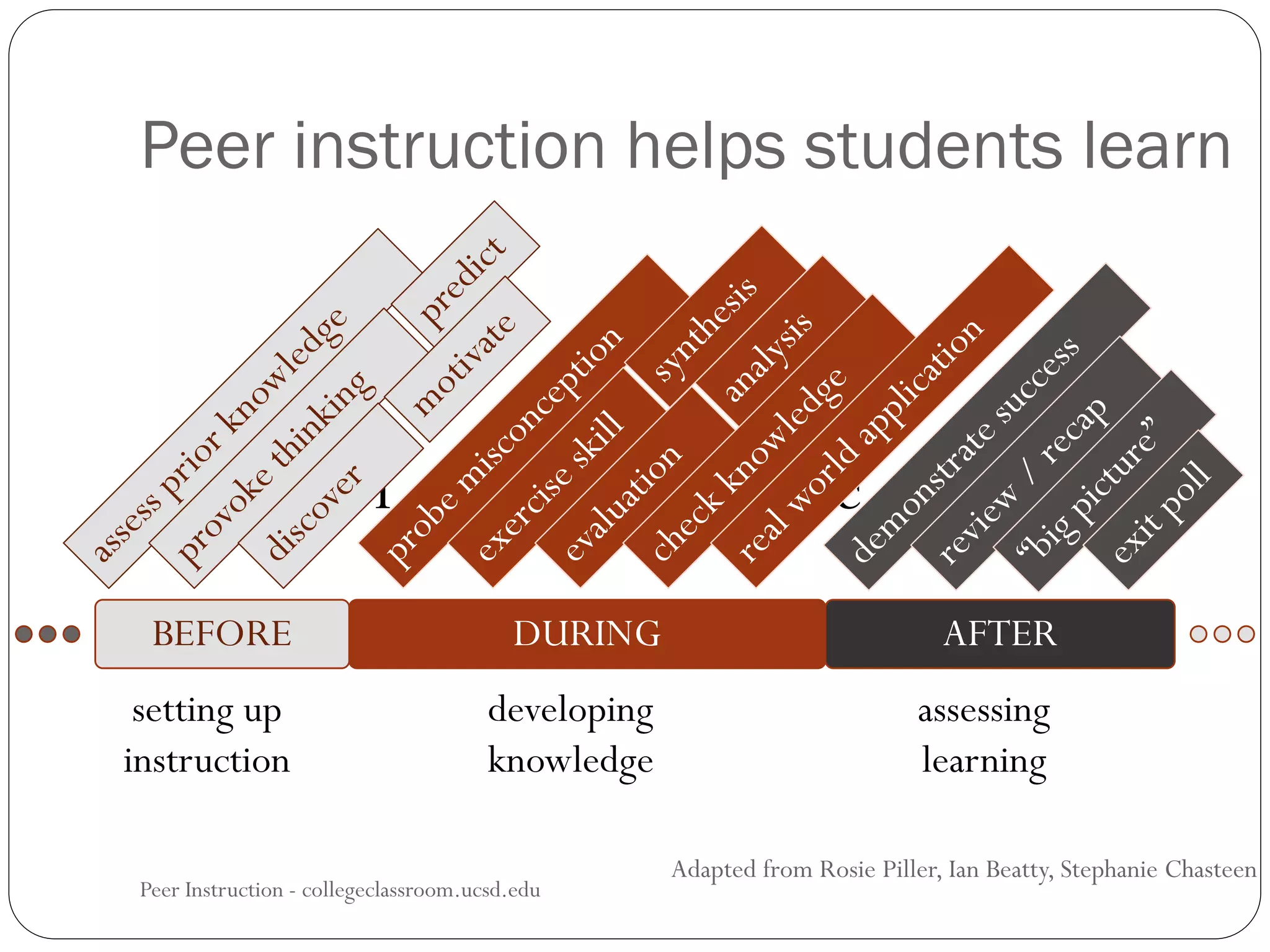
t h e l e a r n i n g c y c l e
Peer instruction helps students learn
Peer Instruction - collegeclassroom.ucsd.edu
BEFORE DURING AFTER
setting up
instruction
developing
knowledge
assessing
learning
Adapted from Rosie Piller, Ian Beatty, Stephanie Chasteen
t h e l e a r n i n g c y c l e
Peer instruction helps students learn
Peer Instruction - collegeclassroom.ucsd.edu
BEFORE DURING AFTER
setting up
instruction
developing
knowledge
assessing
learning
Adapted from Rosie Piller, Ian Beatty, Stephanie Chasteen
t h e l e a r n i n g c y c l e
Peer instruction helps students learn
Peer Instruction - collegeclassroom.ucsd.edu
BEFORE DURING AFTER
setting up
instruction
developing
knowledge
assessing
learning
Adapted from Rosie Piller, Ian Beatty, Stephanie Chasteen
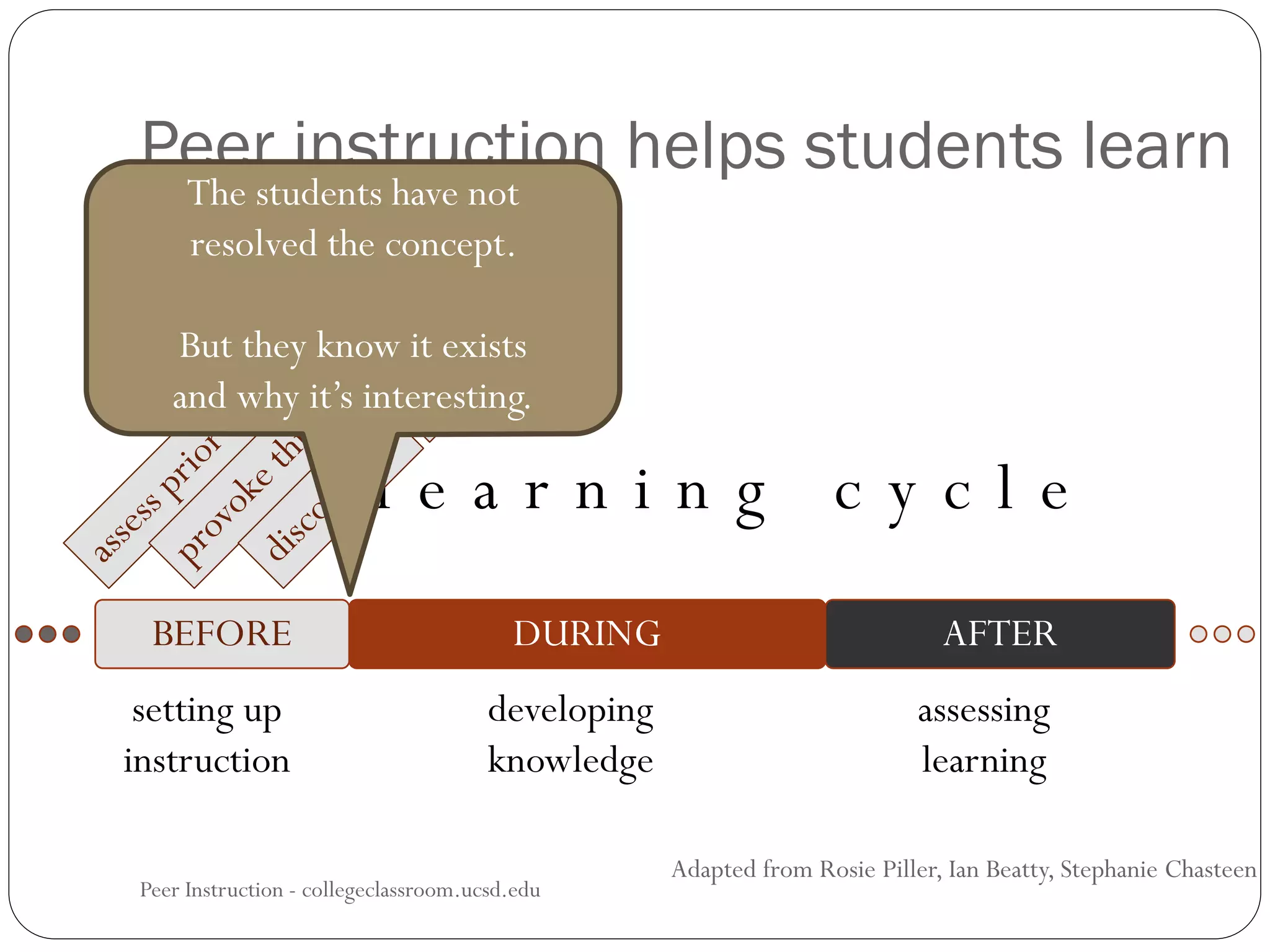
The students have not
resolved the concept.
But they know it exists
and why it’s interesting.
t h e l e a r n i n g c y c l e
Peer instruction helps students learn
Peer Instruction - collegeclassroom.ucsd.edu
BEFORE DURING AFTER
setting up
instruction
developing
knowledge
assessing
learning
Adapted from Rosie Piller, Ian Beatty, Stephanie Chasteen
t h e l e a r n i n g c y c l e
Peer instruction helps students learn
Peer Instruction - collegeclassroom.ucsd.edu
BEFORE DURING AFTER
setting up
instruction
developing
knowledge
assessing
learning
Adapted from Rosie Piller, Ian Beatty, Stephanie Chasteen
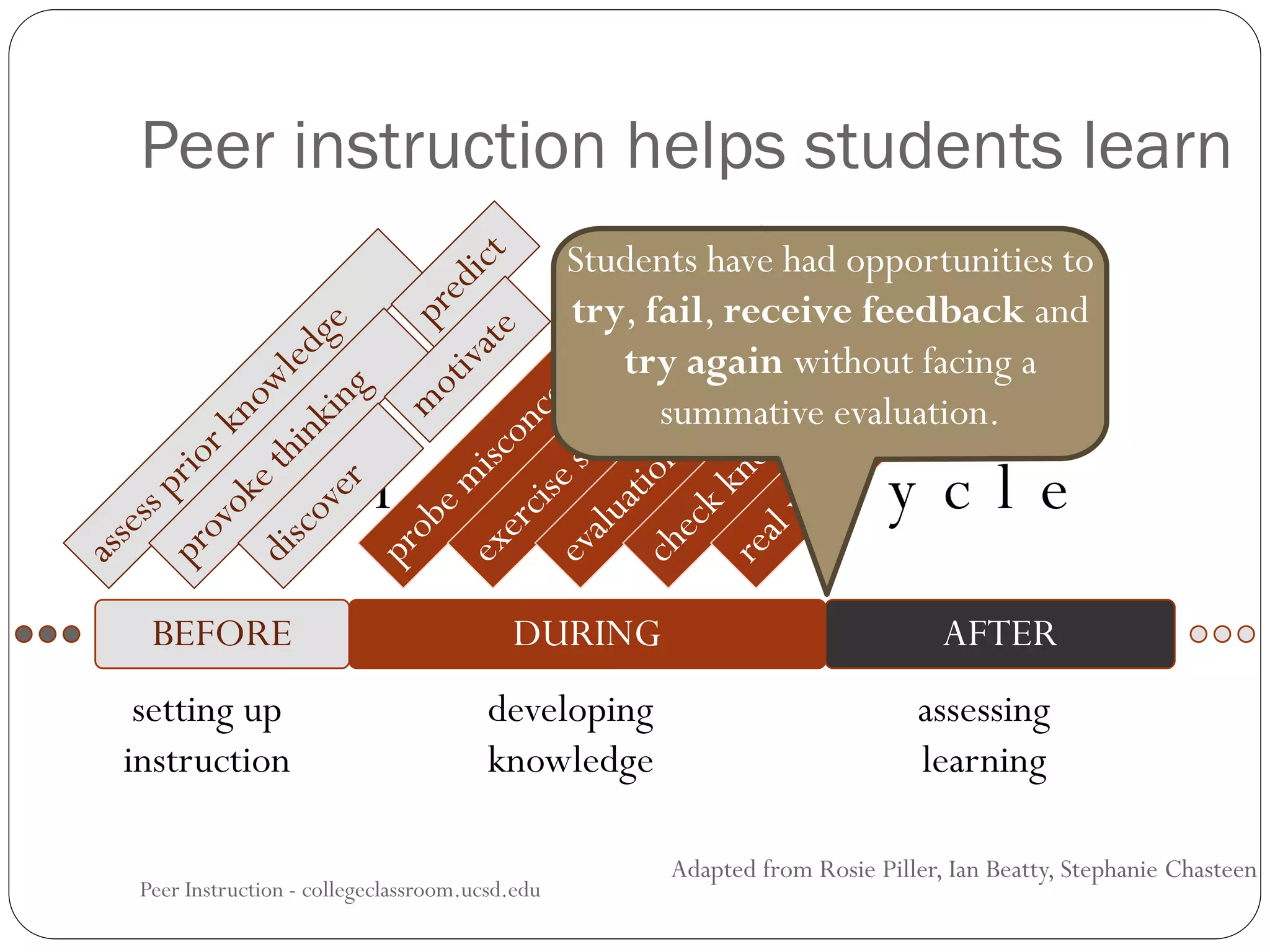
Students have had opportunities to
try, fail, receive feedback and
try again without facing a
summative evaluation.
t h e l e a r n i n g c y c l e
Peer instruction helps students learn
Peer Instruction - collegeclassroom.ucsd.edu
BEFORE DURING AFTER
setting up
instruction
developing
knowledge
assessing
learning
Adapted from Rosie Piller, Ian Beatty, Stephanie Chasteen
Writing Good
Peer Instruction Questions
Peer Instruction - collegeclassroom.ucsd.edu
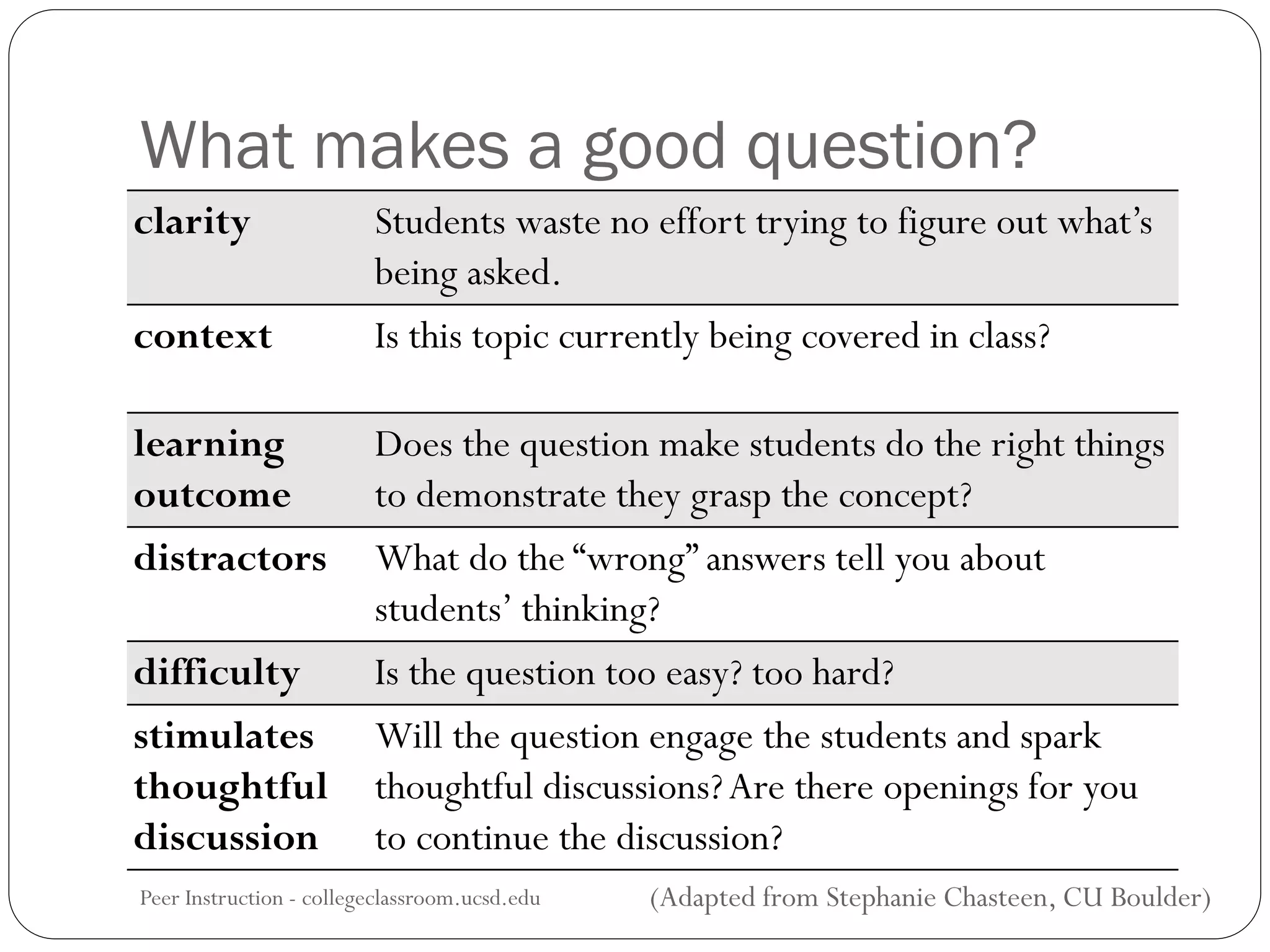
clarity Students waste no effort trying to figure out what’s
being asked.
context Is this topic currently being covered in class?
learning
outcome
Does the question make students do the right things
to demonstrate they grasp the concept?
distractors What do the “wrong” answers tell you about
students’ thinking?
difficulty Is the question too easy? too hard?
stimulates
thoughtful
discussion
Will the question engage the students and spark
thoughtful discussions?Are there openings for you
to continue the discussion?
What makes a good question?
Peer Instruction - collegeclassroom.ucsd.edu (Adapted from Stephanie Chasteen, CU Boulder)
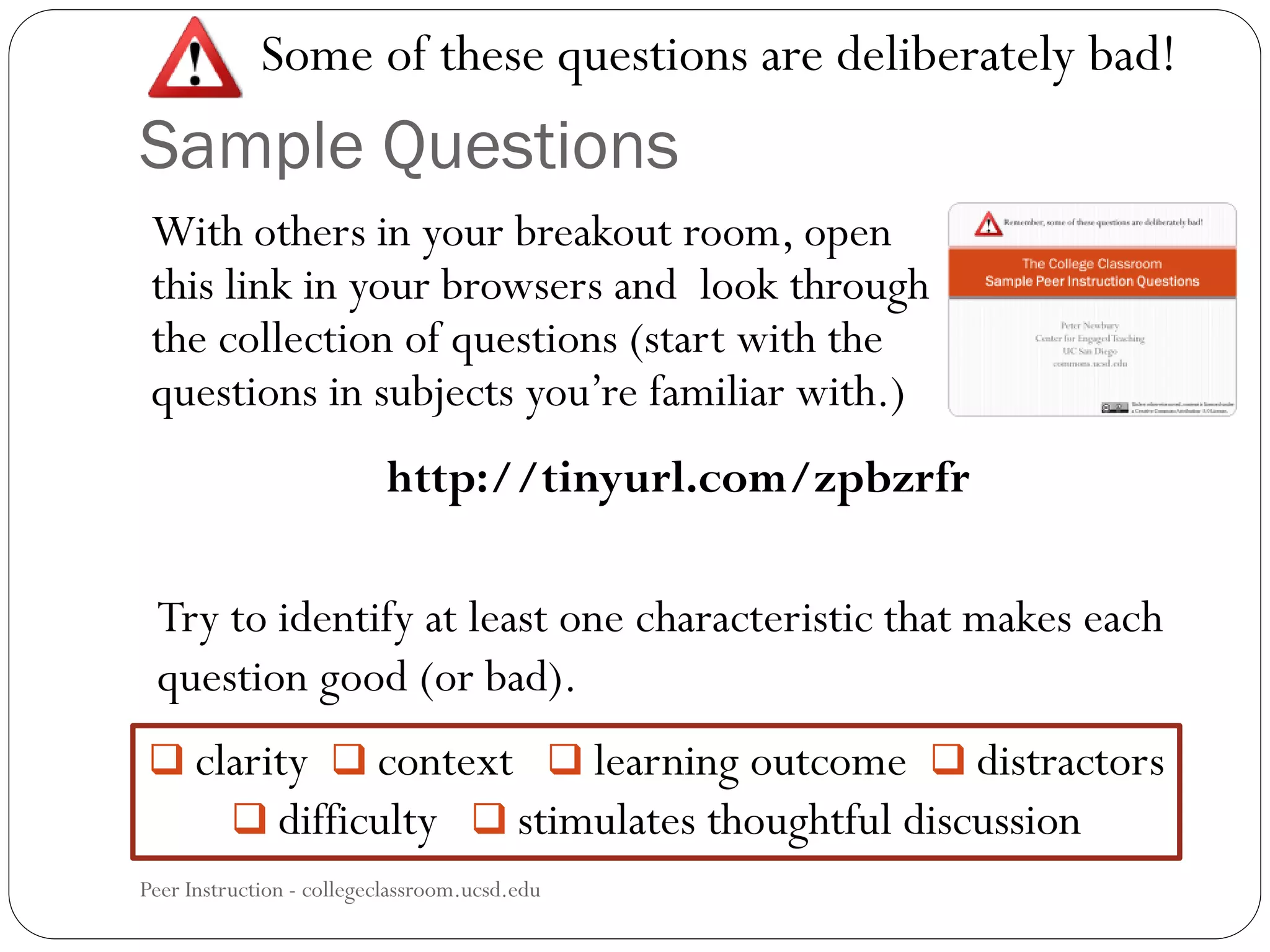
Sample Questions
Peer Instruction - collegeclassroom.ucsd.edu
With others in your breakout room, open
this link in your browsers and look through
the collection of questions (start with the
questions in subjects you’re familiar with.)
Some of these questions are deliberately bad!
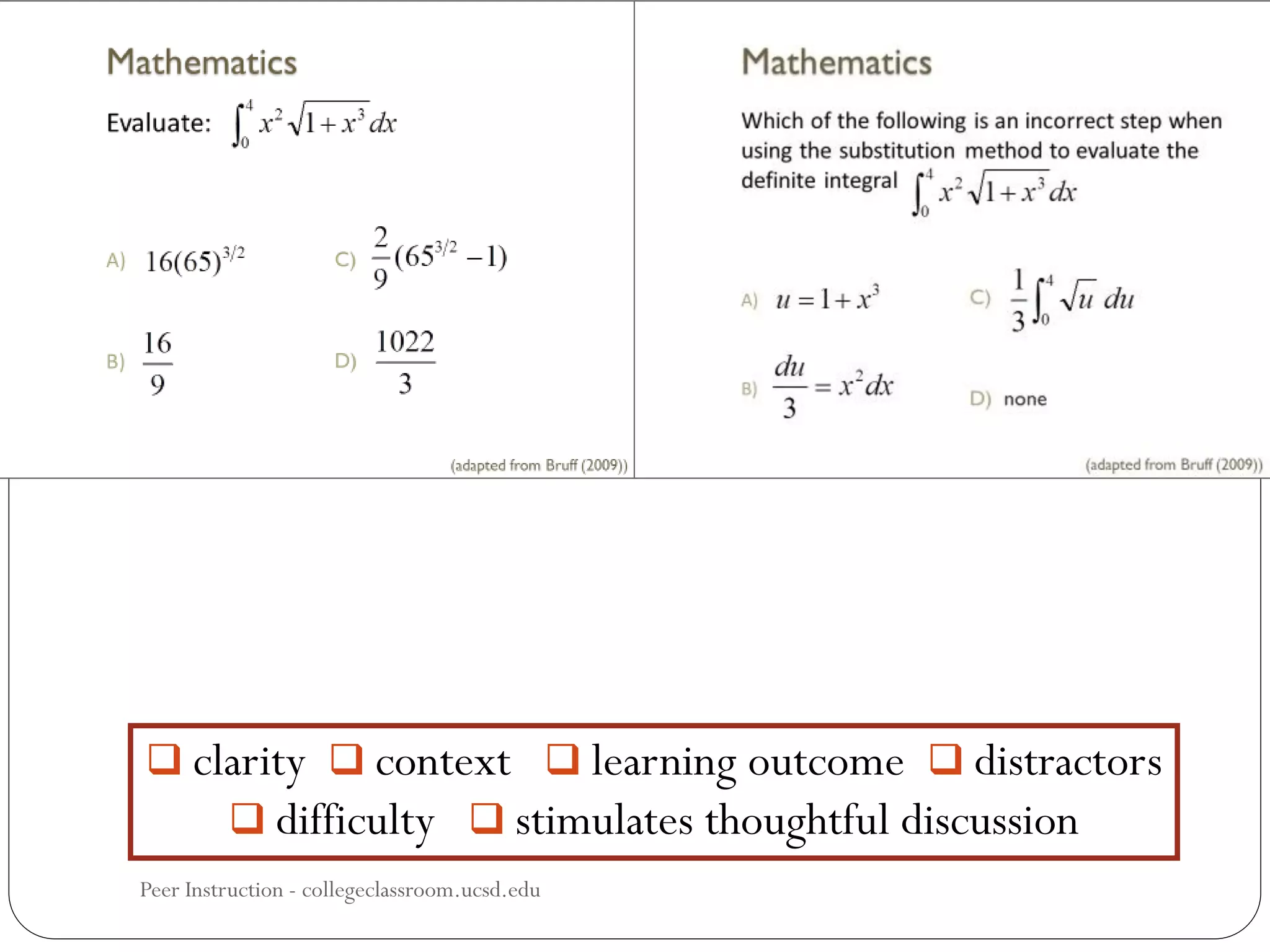
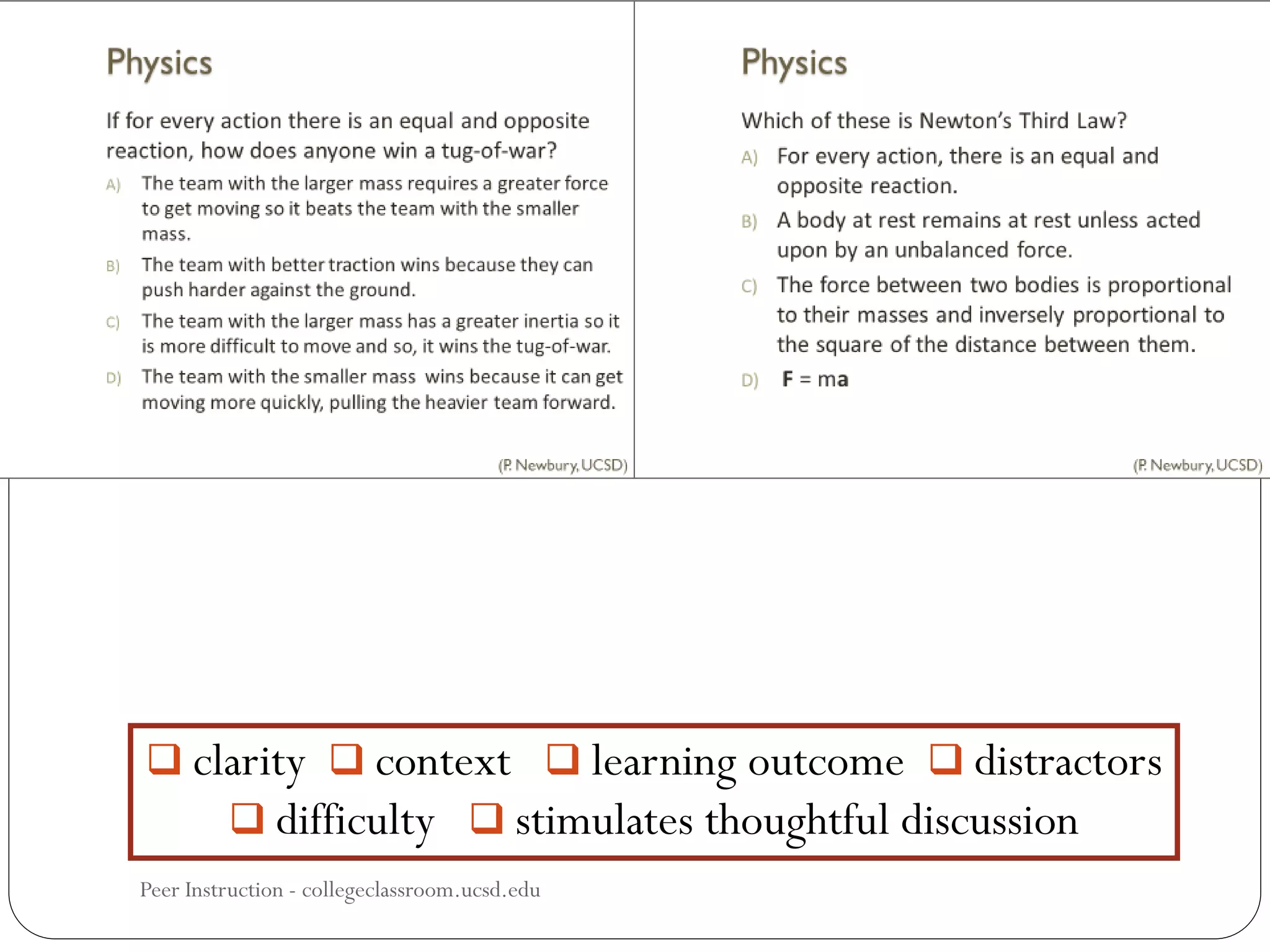
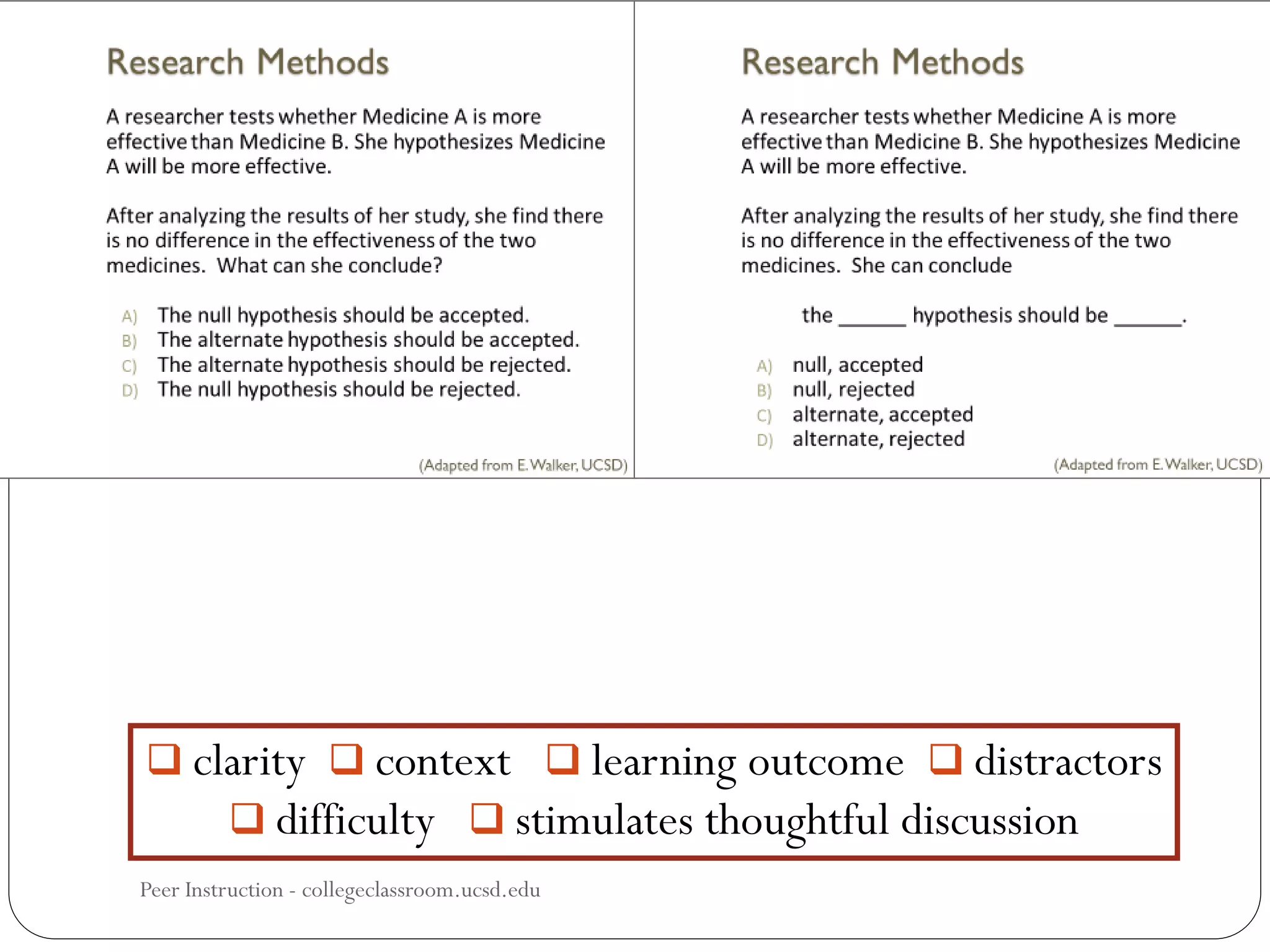
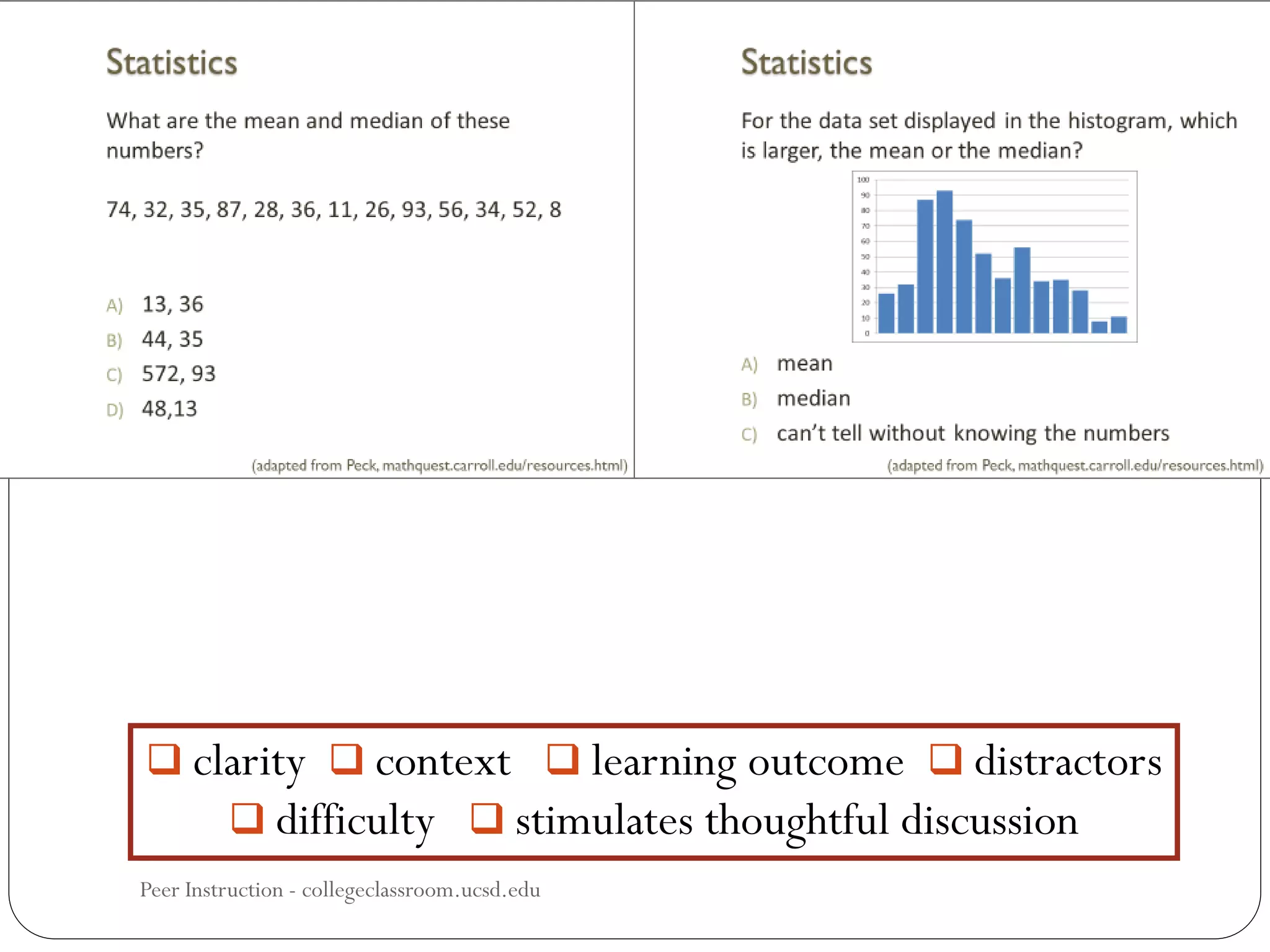
 clarity  context  learning outcome  distractors
 difficulty  stimulates thoughtful discussion
http://tinyurl.com/zpbzrfr
Try to identify at least one characteristic that makes each
question good (or bad).
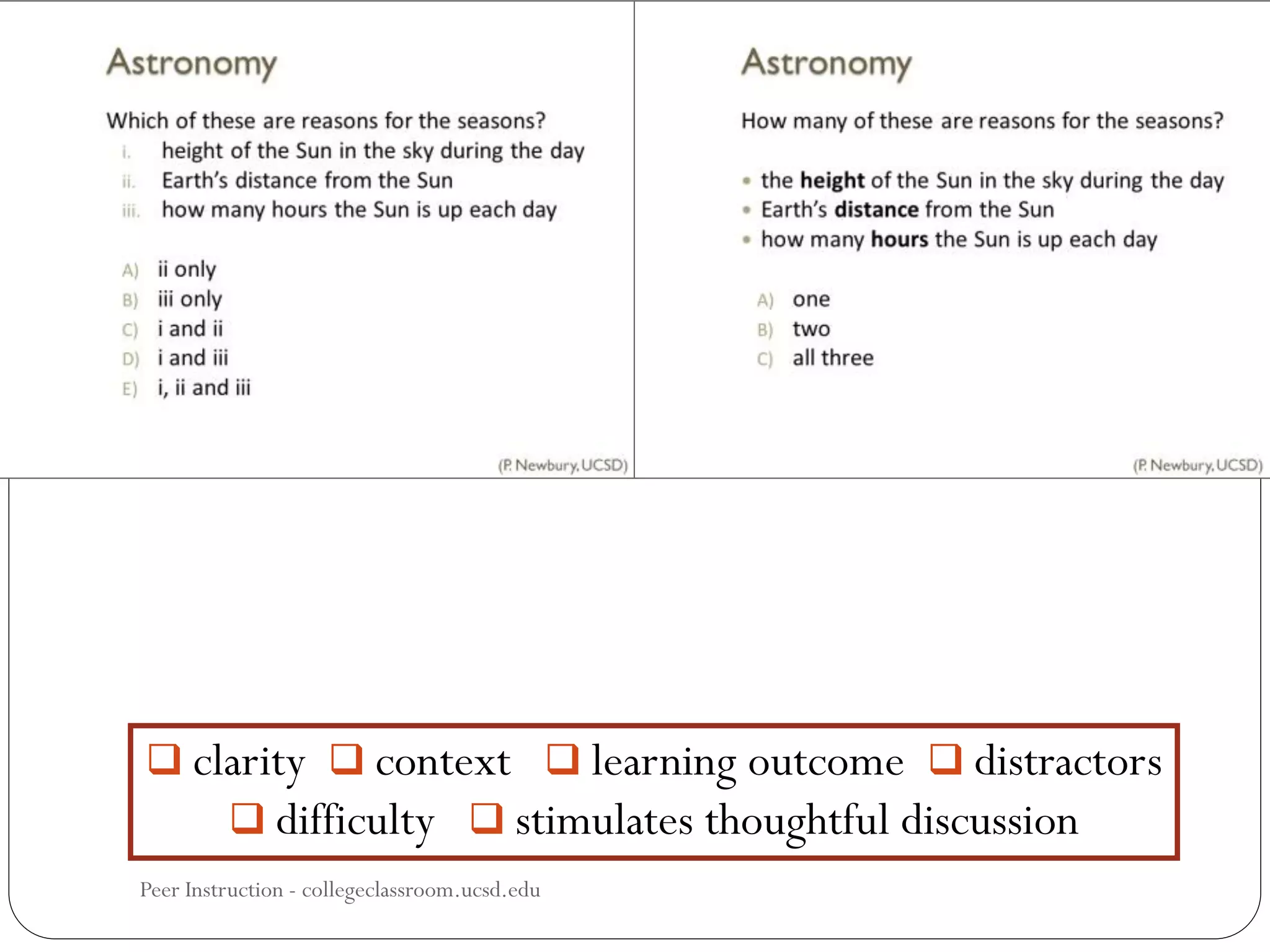
 clarity  context  learning outcome  distractors
 difficulty  stimulates thoughtful discussion
Peer Instruction - collegeclassroom.ucsd.edu
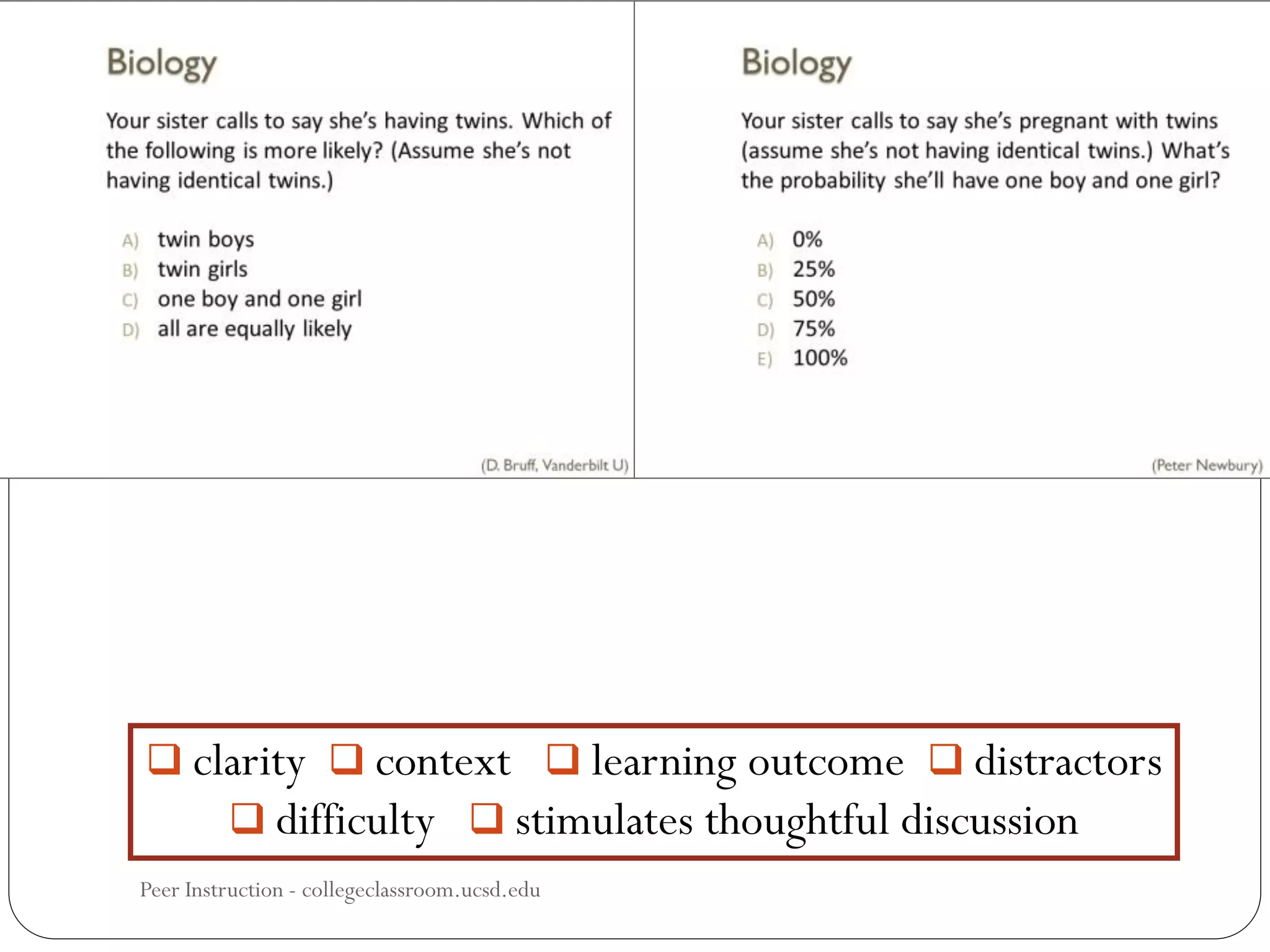
 clarity  context  learning outcome  distractors
 difficulty  stimulates thoughtful discussion
Peer Instruction - collegeclassroom.ucsd.edu
 clarity  context  learning outcome  distractors
 difficulty  stimulates thoughtful discussion
Peer Instruction - collegeclassroom.ucsd.edu
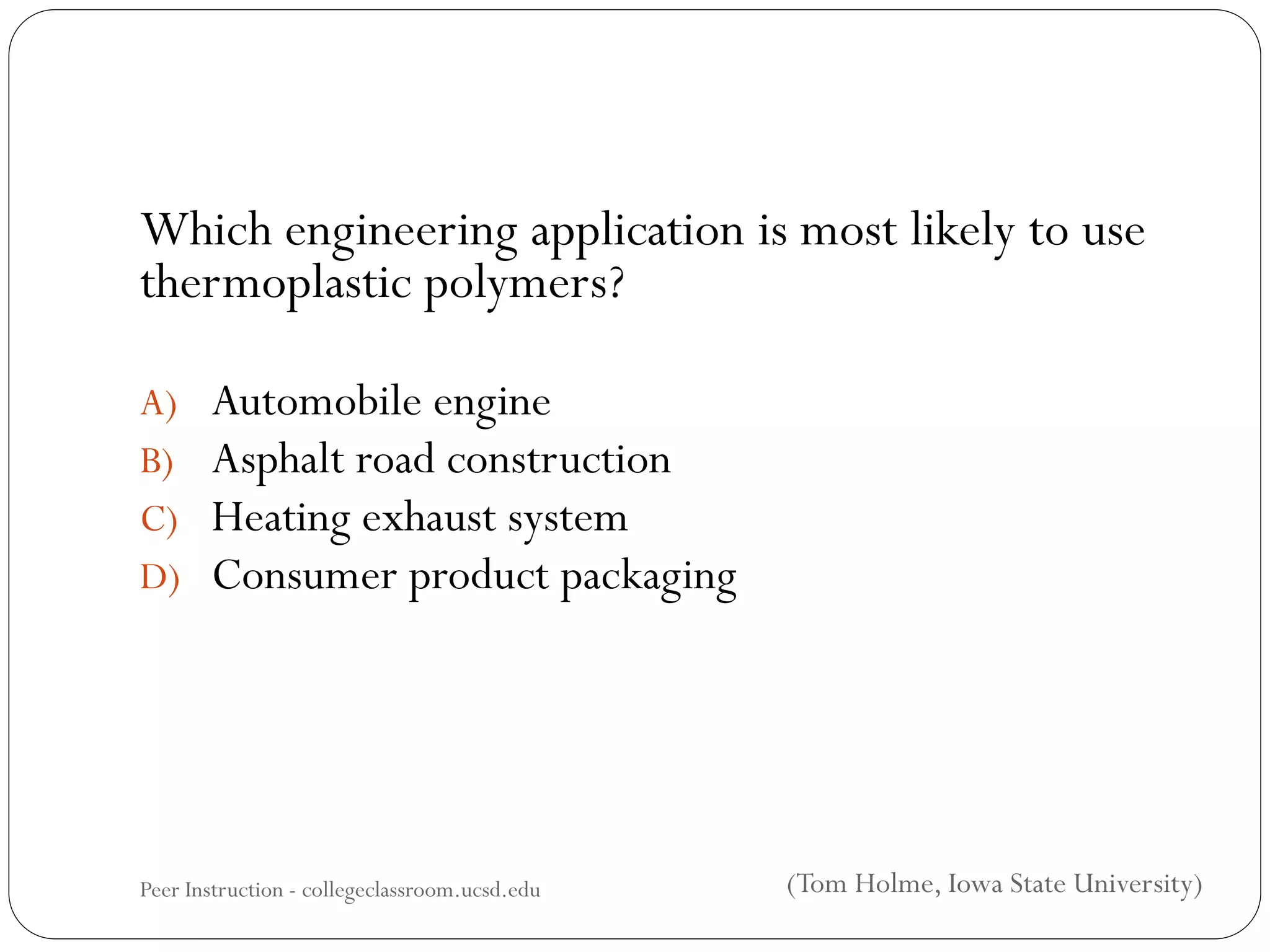
Which engineering application is most likely to use
thermoplastic polymers?
A) Automobile engine
B) Asphalt road construction
C) Heating exhaust system
D) Consumer product packaging
Peer Instruction - collegeclassroom.ucsd.edu (Tom Holme, Iowa State University)
 clarity  context  learning outcome  distractors
 difficulty  stimulates thoughtful discussion
Peer Instruction - collegeclassroom.ucsd.edu
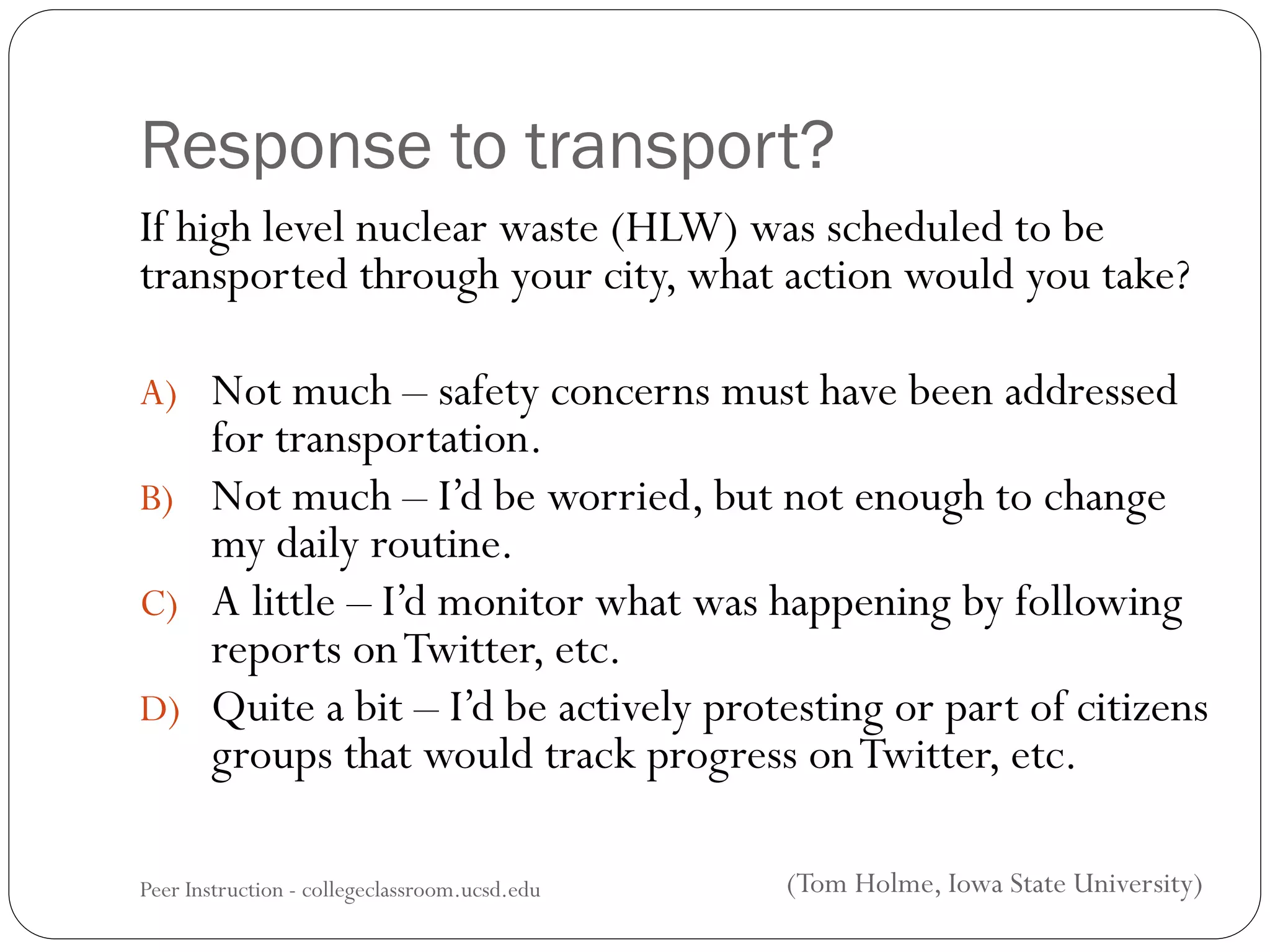
Response to transport?
If high level nuclear waste (HLW) was scheduled to be
transported through your city, what action would you take?
A) Not much – safety concerns must have been addressed
for transportation.
B) Not much – I’d be worried, but not enough to change
my daily routine.
C) A little – I’d monitor what was happening by following
reports onTwitter, etc.
D) Quite a bit – I’d be actively protesting or part of citizens
groups that would track progress onTwitter, etc.
Peer Instruction - collegeclassroom.ucsd.edu (Tom Holme, Iowa State University)
 clarity  context  learning outcome  distractors
 difficulty  stimulates thoughtful discussion
Peer Instruction - collegeclassroom.ucsd.edu
 clarity  context  learning outcome  distractors
 difficulty  stimulates thoughtful discussion
Peer Instruction - collegeclassroom.ucsd.edu
In natural critical learning environments
Peer Instruction - collegeclassroom.ucsd.edu
“students encounter safe yet challenging conditions in
which they can try, fail, receive feedback, and try again
without facing a summative evaluation.”[1]
try
fail
receive
feedback
References
Peer Instruction - collegeclassroom.ucsd.edu
1. Eagan, M. K., Stolzenberg, E. B., Berdan Lozano, J.,Aragon, M. C., Suchard,
M. R., & Hurtado, S. (2014). Undergraduate teaching faculty:The 2013–2014
HERI Faculty Survey. LosAngeles: Higher Education Research Institute,
UCLA. www.heri.ucla.edu
2. Derek Bruff, Henry (Rique) Campa, III,Trina McMahon, Bennett Goldberg
(2014).“An Introduction to Evidence-Based Undergraduate STEMTeaching”
(coursera MOOC) class.coursera.org/stemteaching-001
3. Eddy, S.L., and Hogan, K.A. (2014). Getting Under the Hood: How and for
Whom Does Increasing Course StructureWork? CBE Life Sci Educ vol.13 no.3
453-468
doi: 10.1187/cbe.14-03-0050

CIRTL Spring 2016 The College Classroom Meeting 6 - Peer Instruction

  • 1.
    CIRTL – TheCollege Classroom Meeting 6: Cooperative Learning and Peer Instruction March 3, 2016 Unless otherwise noted, content is licensed under a Creative CommonsAttribution- 3.0 License. Peter Newbury Center for EngagedTeaching, UC San Diego pnewbury@ucsd.edu Tom Holme Department of Chemistry, Iowa State University taholme@iastate.edu collegeclassroom.ucsd.edu
  • 2.
    Scholarly approach toteaching: (also known as Backward Design) Peer Instruction - collegeclassroom.ucsd.edu CarlWieman Science Education Initiative cwsei.ubc.ca What should students learn?learning outcomes assessment active learning What should students learn? What are students learning? What instructional strategies help students learn?
  • 3.
    Peer Instruction -collegeclassroom.ucsd.edu active learning cooperative learning
  • 4.
    Cooperative Learning[2] Peer Instruction- collegeclassroom.ucsd.edu Cooperative learning is the instructional use of small groups so that students work together to maximize their own and each other’s learning. (Rique Campa) constructivism social constructivism recognizes that knowledge is constructed in the mind of the learner by the learner ([3], p.262) implies that this “building” process is aided through cooperative social interactions ([3], p. 262)
  • 5.
    Key to successfulcooperative learning Peer Instruction - collegeclassroom.ucsd.edu You need to teach the students how to work effectively as a team. You can’t leave it up to them to figure out  positive team member traits  team-building, management, conflict-resolution skills  how to remain inquiry-based: asking questions of each other, making recommendations, receiving feedback  how to make effective, professional presentations
  • 6.
    What to watchfor and what to do about it Peer Instruction - collegeclassroom.ucsd.edu  lack of group maturity insufficient guidance and training from instructor about how to work together  “free-riding” instructor hasn’t built in enough individual accountability  loss of motivation instructor needs to stay in touch with groups frequently  lack of skills and abilities instructor needs to create groups with more diverse skills and abilities
  • 7.
    Instructors must providestructure Peer Instruction - collegeclassroom.ucsd.edu Goal: all students practice thinking and communicating in expert-like ways Challenge: every student needs to learn both the content and the expert-like behaviors Solution: provide structure so every student practices expert-like behaviors and learn the content
  • 8.
    What do younotice? Peer Instruction - collegeclassroom.ucsd.edu Eddy, S.L., and Hogan, K.A. (2014). Getting Under the Hood: How and forWhom Does Increasing Course StructureWork? CBE Life Sci Educ vol.13 no.3 453-468 doi: 10.1187/cbe.14-03-0050
  • 9.
    Peer Instruction -collegeclassroom.ucsd.edu active learning cooperative learning peer instruction
  • 10.
    Peer Instruction -collegeclassroom.ucsd.edu
  • 11.
    (Question: Sujatha Raghufrom Braincandy via LearningCatalytics) (Image: CIM9926 by number657 on flickr CC) Discussion (peer instruction) Melt chocolate over low heat. Remove the chocolate from the heat.What will happen to the chocolate? A) It will condense. B) It will evaporate. C) It will freeze. Peer Instruction - collegeclassroom.ucsd.edu
  • 12.
    Typical Episode ofPeer Instruction Peer Instruction - collegeclassroom.ucsd.edu 1. Instructor poses a conceptually-challenging multiple-choice question. 2. Students think about question on their own and vote using clickers, colored ABCD cards, smartphones,… 3. The instructor asks students to turn to their neighbors and “convince them you’re right.” 4. After that “peer instruction”, students may vote again. 5. The instructor leads a class-wide discussion concluding with why the right answer(s) is right and the wrong answers are wrong.
  • 13.
    Peer instruction issuccessful when Peer Instruction - collegeclassroom.ucsd.edu  students teach each other while they may still hold or remember their novice preconceptions  students discuss the concepts in their own (novice) language  each student finds out what they (don’t) know  the instructor finds out what the students (don’t) know and reacts, building on their initial understanding and preconceptions. students practice how to think, communicate like experts
  • 14.
    Peer Instruction -collegeclassroom.ucsd.edu 1. identifying key concepts, learning outcomes, misconceptions 2. creating multiple-choice questions that require deeper thinking 3. facilitating episodes of peer instruction that spark and support expert-like thinking 4. leading a class-wide discussion to clarify concepts, resolve misconceptions 5. reflecting on the question: note curious things you overheard, how they voted, etc. so next year’s peer instruction will be better before class during class after class Effective peer instruction requires
  • 15.
    t h el e a r n i n g c y c l e Peer instruction helps students learn Peer Instruction - collegeclassroom.ucsd.edu BEFORE DURING AFTER setting up instruction developing knowledge assessing learning Adapted from Rosie Piller, Ian Beatty, Stephanie Chasteen
  • 16.
    t h el e a r n i n g c y c l e Peer instruction helps students learn Peer Instruction - collegeclassroom.ucsd.edu BEFORE DURING AFTER setting up instruction developing knowledge assessing learning Adapted from Rosie Piller, Ian Beatty, Stephanie Chasteen
  • 17.
    t h el e a r n i n g c y c l e Peer instruction helps students learn Peer Instruction - collegeclassroom.ucsd.edu BEFORE DURING AFTER setting up instruction developing knowledge assessing learning Adapted from Rosie Piller, Ian Beatty, Stephanie Chasteen The students have not resolved the concept. But they know it exists and why it’s interesting.
  • 18.
    t h el e a r n i n g c y c l e Peer instruction helps students learn Peer Instruction - collegeclassroom.ucsd.edu BEFORE DURING AFTER setting up instruction developing knowledge assessing learning Adapted from Rosie Piller, Ian Beatty, Stephanie Chasteen
  • 19.
    t h el e a r n i n g c y c l e Peer instruction helps students learn Peer Instruction - collegeclassroom.ucsd.edu BEFORE DURING AFTER setting up instruction developing knowledge assessing learning Adapted from Rosie Piller, Ian Beatty, Stephanie Chasteen Students have had opportunities to try, fail, receive feedback and try again without facing a summative evaluation.
  • 20.
    t h el e a r n i n g c y c l e Peer instruction helps students learn Peer Instruction - collegeclassroom.ucsd.edu BEFORE DURING AFTER setting up instruction developing knowledge assessing learning Adapted from Rosie Piller, Ian Beatty, Stephanie Chasteen
  • 21.
    Writing Good Peer InstructionQuestions Peer Instruction - collegeclassroom.ucsd.edu
  • 22.
    clarity Students wasteno effort trying to figure out what’s being asked. context Is this topic currently being covered in class? learning outcome Does the question make students do the right things to demonstrate they grasp the concept? distractors What do the “wrong” answers tell you about students’ thinking? difficulty Is the question too easy? too hard? stimulates thoughtful discussion Will the question engage the students and spark thoughtful discussions?Are there openings for you to continue the discussion? What makes a good question? Peer Instruction - collegeclassroom.ucsd.edu (Adapted from Stephanie Chasteen, CU Boulder)
  • 23.
    Sample Questions Peer Instruction- collegeclassroom.ucsd.edu With others in your breakout room, open this link in your browsers and look through the collection of questions (start with the questions in subjects you’re familiar with.) Some of these questions are deliberately bad!  clarity  context  learning outcome  distractors  difficulty  stimulates thoughtful discussion http://tinyurl.com/zpbzrfr Try to identify at least one characteristic that makes each question good (or bad).
  • 24.
     clarity context  learning outcome  distractors  difficulty  stimulates thoughtful discussion Peer Instruction - collegeclassroom.ucsd.edu
  • 25.
     clarity context  learning outcome  distractors  difficulty  stimulates thoughtful discussion Peer Instruction - collegeclassroom.ucsd.edu
  • 26.
     clarity context  learning outcome  distractors  difficulty  stimulates thoughtful discussion Peer Instruction - collegeclassroom.ucsd.edu
  • 27.
    Which engineering applicationis most likely to use thermoplastic polymers? A) Automobile engine B) Asphalt road construction C) Heating exhaust system D) Consumer product packaging Peer Instruction - collegeclassroom.ucsd.edu (Tom Holme, Iowa State University)
  • 28.
     clarity context  learning outcome  distractors  difficulty  stimulates thoughtful discussion Peer Instruction - collegeclassroom.ucsd.edu
  • 29.
    Response to transport? Ifhigh level nuclear waste (HLW) was scheduled to be transported through your city, what action would you take? A) Not much – safety concerns must have been addressed for transportation. B) Not much – I’d be worried, but not enough to change my daily routine. C) A little – I’d monitor what was happening by following reports onTwitter, etc. D) Quite a bit – I’d be actively protesting or part of citizens groups that would track progress onTwitter, etc. Peer Instruction - collegeclassroom.ucsd.edu (Tom Holme, Iowa State University)
  • 30.
     clarity context  learning outcome  distractors  difficulty  stimulates thoughtful discussion Peer Instruction - collegeclassroom.ucsd.edu
  • 31.
     clarity context  learning outcome  distractors  difficulty  stimulates thoughtful discussion Peer Instruction - collegeclassroom.ucsd.edu
  • 32.
    In natural criticallearning environments Peer Instruction - collegeclassroom.ucsd.edu “students encounter safe yet challenging conditions in which they can try, fail, receive feedback, and try again without facing a summative evaluation.”[1] try fail receive feedback
  • 33.
    References Peer Instruction -collegeclassroom.ucsd.edu 1. Eagan, M. K., Stolzenberg, E. B., Berdan Lozano, J.,Aragon, M. C., Suchard, M. R., & Hurtado, S. (2014). Undergraduate teaching faculty:The 2013–2014 HERI Faculty Survey. LosAngeles: Higher Education Research Institute, UCLA. www.heri.ucla.edu 2. Derek Bruff, Henry (Rique) Campa, III,Trina McMahon, Bennett Goldberg (2014).“An Introduction to Evidence-Based Undergraduate STEMTeaching” (coursera MOOC) class.coursera.org/stemteaching-001 3. Eddy, S.L., and Hogan, K.A. (2014). Getting Under the Hood: How and for Whom Does Increasing Course StructureWork? CBE Life Sci Educ vol.13 no.3 453-468 doi: 10.1187/cbe.14-03-0050