

Peer-to-peer: past, present, future
Cristina Cărbunaru
16 February 2011
Peer-to-peer
   Internet today
    ◦ Large number of hosts
    ◦ Large amount of content
 Significant challenges for traditional
  client-server architectures
 Make use of the inter-connectivity of
  the nodes in the Internet
    ◦ Alleviate the load from servers


                                           2
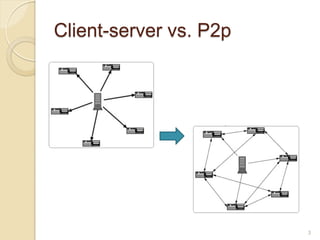
Client-server vs. P2p


                        3
The Peer
   Double function:
    ◦ Client - consumer
    ◦ Server - producer
 Incentives to offer service, not just
  benefit from service
 More peers means more capacity
  added to the system


                                          4
P2p Goals
 Reduced central control
 Heterogeneity
 Flat topology
 Autonomy
 Fault resilience
…


                            5
History
   File sharing applications
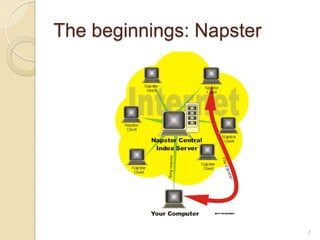
    ◦   1999: Napster
    ◦   Gnutella, Kazaa, Freenet
    ◦   2001: BitTorrent (Bram Cohen)
    ◦   Multiple variations of p2p programs
   Nowadays:
    ◦ File sharing – among individual users or in
      the data centers
    ◦ Media streaming – on-demand or live content
    ◦ Communication – Skype!
                                                6
The beginnings: Napster


                          7
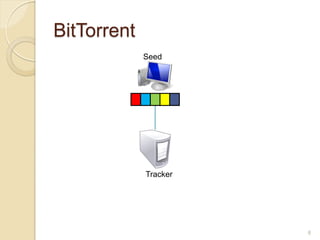
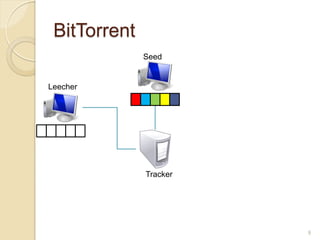
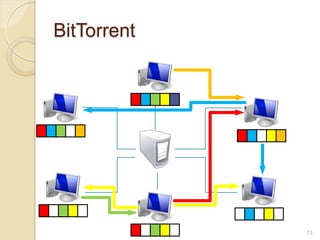
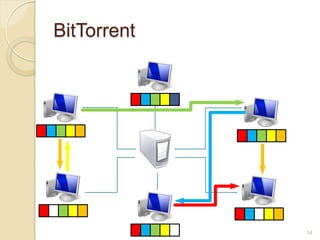
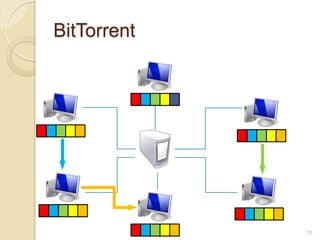
BitTorrent
             Seed


             Tracker


                       8
BitTorrent
              Seed


Leecher


              Tracker


                        9
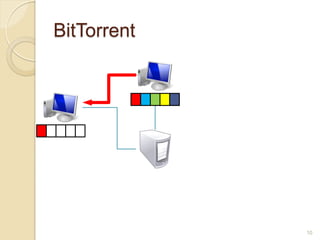
BitTorrent


             10
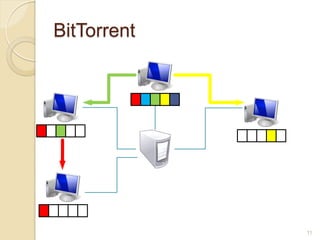
BitTorrent


             11
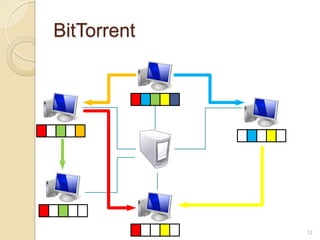
BitTorrent


             12
BitTorrent


             13
BitTorrent


             14
BitTorrent


             15
BitTorrent


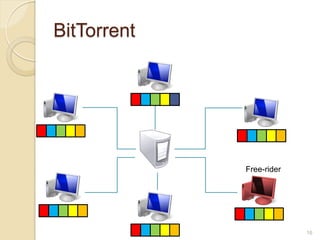
             Free-rider


                          16
Swarm Behavior
   Incentive mechanisms
    ◦ Why offer service?
   Flash crowd
    ◦ Large number of peers choke the
      performance
   Steady state
    ◦ Number of peers stays constant over time
    ◦ Easy to predict performance
   Lifetime
    ◦ When and why is the torrent dying?
   ...

                                                 17
Peer Behavior
   Free riding
    ◦ Evaluate performance loss
    ◦ Methods to prevent
   Best results with minimum of effort
    ◦ Cheating, but not exactly
   Clustering of peers
    ◦ Peers download/upload to similar bandwidth
      peers
   Security of content
    ◦ Malicious data
   Connectivity
    ◦ NAT boxes

                                                   18
Approaches
   Measurement
    ◦ Real swarms
    ◦ Experimental platforms: PlanetLab, EmuLab
   Simulation
   Modeling
   Proposing new p2p protocols that solve
    different problems
    ◦ Proportional upload bandwidth: PropShare
    ◦ Amount of data transferred: Avalanche
    ◦ Upload bandwidth allocation among peers to
      get the best download speed: BitTyrant

                                                   19
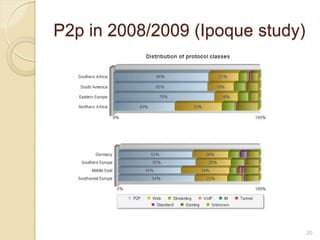
P2p in 2008/2009 (Ipoque study)


                                  20
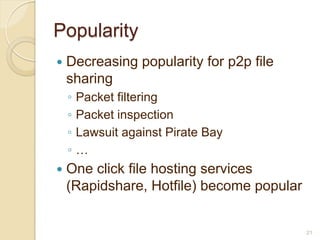
Popularity
   Decreasing popularity for p2p file
    sharing
    ◦   Packet filtering
    ◦   Packet inspection
    ◦   Lawsuit against Pirate Bay
    ◦   …
   One click file hosting services
    (Rapidshare, Hotfile) become popular


                                           21
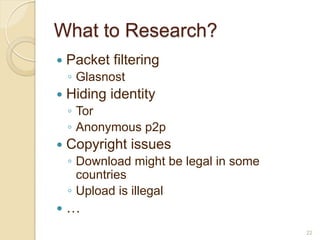
What to Research?
   Packet filtering
    ◦ Glasnost
   Hiding identity
    ◦ Tor
    ◦ Anonymous p2p
   Copyright issues
    ◦ Download might be legal in some
      countries
    ◦ Upload is illegal
   …
                                        22
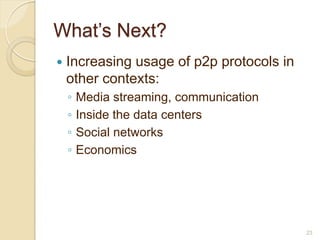
What’s Next?
   Increasing usage of p2p protocols in
    other contexts:
    ◦   Media streaming, communication
    ◦   Inside the data centers
    ◦   Social networks
    ◦   Economics


                                           23
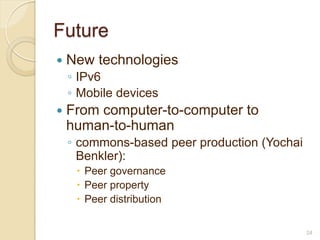
Future
   New technologies
    ◦ IPv6
    ◦ Mobile devices
   From computer-to-computer to
    human-to-human
    ◦ commons-based peer production (Yochai
      Benkler):
      Peer governance
      Peer property
      Peer distribution

                                              24
Conclusions
   Successful piece of research
    ◦ P2p transcended computer science
   Changed the way we share
    ◦ Files
    ◦ Knowledge
    ◦ Peer generated content
   P2p is here to stay!


                                         25
Questions?


        Thank you!


                     26

CSTalks - Peer-to-peer - 16 Feb

  • 1.
    Peer-to-peer: past, present,future Cristina Cărbunaru 16 February 2011
  • 2.
    Peer-to-peer  Internet today ◦ Large number of hosts ◦ Large amount of content  Significant challenges for traditional client-server architectures  Make use of the inter-connectivity of the nodes in the Internet ◦ Alleviate the load from servers 2
  • 3.
  • 4.
    The Peer  Double function: ◦ Client - consumer ◦ Server - producer  Incentives to offer service, not just benefit from service  More peers means more capacity added to the system 4
  • 5.
    P2p Goals  Reducedcentral control  Heterogeneity  Flat topology  Autonomy  Fault resilience … 5
  • 6.
    History  File sharing applications ◦ 1999: Napster ◦ Gnutella, Kazaa, Freenet ◦ 2001: BitTorrent (Bram Cohen) ◦ Multiple variations of p2p programs  Nowadays: ◦ File sharing – among individual users or in the data centers ◦ Media streaming – on-demand or live content ◦ Communication – Skype! 6
  • 7.
  • 8.
    BitTorrent Seed Tracker 8
  • 9.
    BitTorrent Seed Leecher Tracker 9
  • 10.
  • 11.
  • 12.
  • 13.
  • 14.
  • 15.
  • 16.
    BitTorrent Free-rider 16
  • 17.
    Swarm Behavior  Incentive mechanisms ◦ Why offer service?  Flash crowd ◦ Large number of peers choke the performance  Steady state ◦ Number of peers stays constant over time ◦ Easy to predict performance  Lifetime ◦ When and why is the torrent dying?  ... 17
  • 18.
    Peer Behavior  Free riding ◦ Evaluate performance loss ◦ Methods to prevent  Best results with minimum of effort ◦ Cheating, but not exactly  Clustering of peers ◦ Peers download/upload to similar bandwidth peers  Security of content ◦ Malicious data  Connectivity ◦ NAT boxes 18
  • 19.
    Approaches  Measurement ◦ Real swarms ◦ Experimental platforms: PlanetLab, EmuLab  Simulation  Modeling  Proposing new p2p protocols that solve different problems ◦ Proportional upload bandwidth: PropShare ◦ Amount of data transferred: Avalanche ◦ Upload bandwidth allocation among peers to get the best download speed: BitTyrant 19
  • 20.
    P2p in 2008/2009(Ipoque study) 20
  • 21.
    Popularity  Decreasing popularity for p2p file sharing ◦ Packet filtering ◦ Packet inspection ◦ Lawsuit against Pirate Bay ◦ …  One click file hosting services (Rapidshare, Hotfile) become popular 21
  • 22.
    What to Research?  Packet filtering ◦ Glasnost  Hiding identity ◦ Tor ◦ Anonymous p2p  Copyright issues ◦ Download might be legal in some countries ◦ Upload is illegal  … 22
  • 23.
    What’s Next?  Increasing usage of p2p protocols in other contexts: ◦ Media streaming, communication ◦ Inside the data centers ◦ Social networks ◦ Economics 23
  • 24.
    Future  New technologies ◦ IPv6 ◦ Mobile devices  From computer-to-computer to human-to-human ◦ commons-based peer production (Yochai Benkler):  Peer governance  Peer property  Peer distribution 24
  • 25.
    Conclusions  Successful piece of research ◦ P2p transcended computer science  Changed the way we share ◦ Files ◦ Knowledge ◦ Peer generated content  P2p is here to stay! 25
  • 26.
    Questions? Thank you! 26