NEONATAL HYPOGLYCEMIA
Mohd. Arif Khan
1st year PG student
Department of Pediatrics
INTRODUCTION
• Common metabolic problem encountered in nicu.
• Blood glucose levels (BGL) in newborns are generally
lower than older children & adult.
• Fetal glucose level is maintained at 2/3rd of maternal Blood
glucose by trans-placental route.
• BGL falls in First 1 to 2 hrs, then increases and stabilizes by
age of 3 to 4 hrs.
DEFINITION
•There is no universal definition of neonatal hypoglycemia.

•BGL range varies with certain factors like gestational age,
birth-weight, feeding status, body stores and
presence/absence of a disease.
•WHO defines hypoglycemia as BGL below 45mg/dl.
•Cornblath in 2000, recommended the use of operational
threshold for hypoglycemia.
OPERATIONAL THRESHOLD
 It is defined as that concentration of plasma or BGL at
which clinicians consider intervention.
 In Healthy term infants
• < 24hrs of age- 30 to 35 mg/dl is acceptable at once.
• > 24 hrs and infant with abnormal signs and symptoms-
threshold is increased to 45 to 50 mg/dl.
 Asymptomatic infants with risk factors –threshold is
36mg/dl.
 For any baby – if BGL is <20- 25 mg/dl, iv glucose needed.
ETIOLOGY
 Hyperinsulinemic hypoglycaemia: is the major cause of
recurrent/ persistent hypoglycaemia which is associated with
increased utilisation of blood glucose and inhibits
glycogenolysis & gluconeogenesis. Conditions are:-
•Infant of diabetic mother (IDM)
•ATP sensitive potassium channel defects
•Erythroblastosis
•Beckwith-Wiedemann syndrome
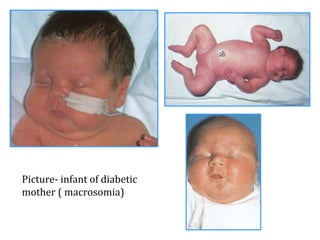
Infant of diabetic mum
“Cherubic” facies
Picture- infant of diabetic
mother ( macrosomia)
•Islet-cell dysmaturity
•Insulin-producing tumours (nesidioblastosis, islet-cell
adenoma)
•Maternal drugs like beta-sympathomimetics
(terbutaline)
•Abrupt cessation of high-glucose infusions
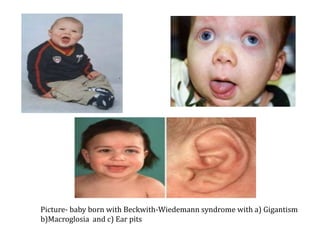
Picture- baby born with Beckwith-Wiedemann syndrome with a) Gigantism
b)Macroglosia and c) Ear pits
Decreased production/stores
•Prematurity
•Intrauterine growth retardation(IUGR)
•Inadequate caloric intake
•Delayed onset of feeding
Increased utilisation and/or decreased production
a) Perinatal Stress includes-
•Sepsis
•Shock
•Asphyxia
•Hypothermia
•Post-resuscitation
•Respiratory distress
b) Inborn error of metabolism includes
•Glycogen storage disease
•Fructose intolerance
•Galactosemia
•Maple syrup urine disease
•Propionic acidemia
•Methylmalonic acidemia
•Tyrosinemia
•Glutaric acidemia type 2
•Ethylmalonic adipic aciduria
c) Endocrine causes:
•Adrenal insufficiency
•Hypothalamic deficiency
•Congenital hypopituitarism
•Glucagon deficiency
•Epinephrine deficiency
Polycythemia
Maternal therapy with beta blockers like labetalol or
propanolol
Exchange transfusion
Clinical Manifestations
•Patients are mostly asymptomatic or may present with some
nonspecific symptoms like:-
•Lethargy
•Irritability
•Hypotonia or limpness
•Sweating, tremors, jitteriness, abnormal cry (weak / high pitched)
•Hypothermia
•Poor feeding, vomiting
•Apnoea, irregular respiration, respiratory distress, cyanosis
•Tachycardia, CCF
•Seizures, coma
Screening in High Risk Infants
•Indications for blood glucose screening are:-
•Low birth weight <2000 grams
•Preterm infants <35 weeks
•SGA and LGA
•Infants of diabetic mother
•Infants of Rh-hemolytic disease
•Infants born to mother of receiving beta-
sympathomimetics like terbutaline or oral hypoglycemic
•Infants with morphological IUGR
•Any sick neonate with birth asphyxia, sepsis, shock etc.
•Infants on total parenteral nutrition
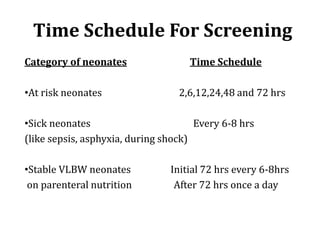
Time Schedule For Screening
Category of neonates Time Schedule
•At risk neonates 2,6,12,24,48 and 72 hrs
•Sick neonates Every 6-8 hrs
(like sepsis, asphyxia, during shock)
•Stable VLBW neonates Initial 72 hrs every 6-8hrs
on parenteral nutrition After 72 hrs once a day
Diagnosis
Symptoms of hypoglycemia are nonspecific -
•Tremors, jitteriness or irritability
•Seizures, coma
•Lethargy and limpness
•Apnea
•Weak or high pitched cry
•Cyanosis
•Many neonates are asymptomatic
Screening of high risk infants.
Reagent strips with reflectance meter:- reagent strips are
of unproven reliability because
•Reagent strips measure whole blood glucose which is 15%
lower than plasma levels.
•Reagent strips provide false positive and false negative
results.
•A valid confirmatory laboratory glucose test is required
before to diagnose as hypoglycemia.
•One should not wait for lab glucose confirmation if blood
glucose is <45 mg/dl, treatment should be started
immediately.
Laboratory Diagnosis:-
•It is most accurate method to determine blood glucose level.
•It is done by glucose oxidase(calorimetric) method or
glucose electrode method.
•It is should be done immediately to prevent glycolysis.
Glucose level can fall @18 mg/dl/hr.
Critical Lab Test:- most hypoglycemia resolve in 2-3 days.
•If requirement of GIR is >8-10 mg/kg/min or hypoglycemia
persists >1 week suggests increased utilization of glucose
due to hyperinsulinism.
•Endocrine evaluation is necessary to evaluate
hyperinsulinism.
•Criteria of hyperinsulinism based on hyperinsulinemia
(insulin >2 μU/ml), hypoketonemia (β-hydroxybutyrate <2
mmol/L) and hypofattyacidemia (FFA levels <1.5 mmol/L).
•Critical lab test includes-
•Glucose
•Insulin
•Cortisol levels
•Beta-hydroxybutyrate and free fatty acid levels
•If insulin level is normal then look for other causes of
persistent hypoglycemia such as inborn error of metabolism.
This includes-
•Growth hormone
•Adrenocorticotropic hormone(ACTH)
•Thyroxin (T4) and TSH
•Glucagon
•Plasma amino acids
•Urine ketones
•Urine-reducing substance
•Urine amino acids
•Urine organic acids
•Genetic testing for mutations like SUR1 and Kir6.2
Differential Diagnosis
If symptoms persist after glucose concentration is normal
then consider other etiologies such as:-
Sepsis
Metabolic abnormalities
•Hypocalcaemia
•Hyponatremia or Hypernatremia
•Hypomagnesaemia
•Pyridoxine deficiency
Adrenal insufficiency
Renal failure
Liver failure
Heart failure
CNS disease
Management
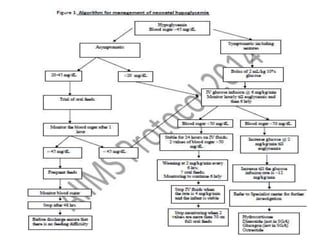
Management of Asymptomatic Hypoglycemia-
Breastfeeding – DBM is the best option to prevent hypoglycemia. If
infant is unable to suck EBM or Formula feed can be given.
If BGL is 20-45 mg/dl then
•Give trial of oral feeds (EBM or Formula feed) and repeat blood
glucose after 1hr
•If BGL is >45 mg/dl, 2 hourly feeds is ensured with 6 hourly
monitoring of BGL for 48 hrs target BGL is 50-120 mg/dl.
•If repeat BGL is <45 mg/dl IV dextrose is started and further
management is as for symptomatic hypoglycemia.
If BGL is <20 mg/dl then
•Start IV dextrose @6 mg/kg/min and subsequently
managed as for symptomatic hypoglycemia.
Management of Symptomatic Hypoglycemia:-
•All symptomatic infants should be treated with IV fluids.
•Indication of IV therapy-
1. Inability to tolerate oral feeding
2. Symptomatic hypoglycemia
3. Oral feeding do not maintain normal BGL
4. BGL is <20 mg/dl
Infants with symptomatic hypoglycemia including seizures
should given a bolus of 10% dextrose @2 ml/ kg and followed
by continuous glucose infusion @6-8 mg/kg/min.
BGL should be checked after 30-60 min and then every 6
hourly until BGL is >50 mg/dl.
If BGL remains <45 mg/dl despite bolus and glucose infusion,
increase GIR @2 mg/kg/min every 15-30 min until a
maximum of 12mg/kg/min.
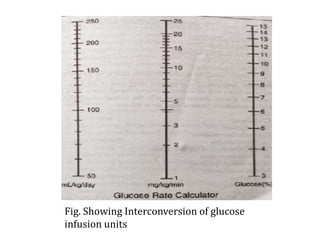
•GIR is calculated by following formula-
GIR(mg/kg/min) = % dextrose x ml/kg/day
144
•After 24hrs of IV dextrose 1 or 2 consecutive BGL are >50
mg/dl, infusion can be tapered @2 mg/kg/min every 6 hrly
with BGL monitoring. It has to be accompanied by
concomitant increase in oral feeds.
•Once the rate of 4mg/kg/min of infusion is achieved and
oral intake is adequate with BGL >50 mg/dl, infusion can be
stopped.
•Central venous line is needed if GIR requirement is >12
mg/kg/min due to risk of thrombophlebitis.
•Do not stop glucose infusion abruptly this causes rebound
hypoglycemia.
Fig. Showing Interconversion of glucose
infusion units
Resistant /Recurrent
Hypoglycemia
•It is condition in which infant is fails to maintain normal BGL
despite giving GIR of 12 mg/kg/min or when stabilization is
not achieved by 7 days of therapy.
•Besides increasing GIR certain drugs can be used in this
condition. Before starting these drugs send the samples
included in crirtical lab test.
•Drugs that used are following-
• Hydrocortisone @5mg/kg/day in 2 divided doses IV or
PO for 24-48 hours. Hydrocortisone reduces peripheral
glucose utilization, increases gluconeogenesis and
increases the effect of glucagon.
•Diazoxide @5-8 mg/kg/day in divided doses of 8-12
hourly. It inhibits the insulin release by acting as a ATP-
sensitive potassium channel agonist in normal
pancreatic beta-cells. It takes 5 days for a positive effect.
•Octreotide @5-20 mcg/kg/day IV or SC divided every 6-8
hourly. A long acting somatostatin that inhibits insulin
secretion.
•Glucagon @0.025-0.2 mg/kg IM, SC or IV max dose 1 mg
is rarely used. It acts by enhancing gluconeogenesis,
mobilizing hepatic glycogen stores and promoting
ketogenesis. Adverse effects are vomiting, diarrhea and
hypokalemia.
Follow Up & Outcome
Outcome of hypoglycemia depends on
•Duration of hypoglycemia
•Cerebral utilization of glucose
•Cerebral blood flow
• Degree of hypoglycemia
Some have no long term sequelae.
Symptomatic / severe / persistent hypoglycaemia may
results in,
•Abnormal neurointellectual development
•Cerebral palsy
•Epilepsy
•Cognitive impairment
•Visual problems
•Developmental & behavioural disorders
These infants should be assessed at 1 month for
vision/eye evaluation and at 3,6,9,12 and 18 month for
growth, neurodevelopment, vision and hearing loss.
Vision can be assessed by Teller equity card and hearing
assessment by BERA.
MRI at 4-6 weeks provides a good estimate to
hypoglycemic injury. MRI exhibit a typical pattern of CNS
injury in the pareito-occipital cortex and subcortical white
matter.
THANK YOU

Neonatal hypoglycemia arif

  • 1.
    NEONATAL HYPOGLYCEMIA Mohd. ArifKhan 1st year PG student Department of Pediatrics
  • 2.
    INTRODUCTION • Common metabolicproblem encountered in nicu. • Blood glucose levels (BGL) in newborns are generally lower than older children & adult. • Fetal glucose level is maintained at 2/3rd of maternal Blood glucose by trans-placental route. • BGL falls in First 1 to 2 hrs, then increases and stabilizes by age of 3 to 4 hrs.
  • 3.
    DEFINITION •There is nouniversal definition of neonatal hypoglycemia. •BGL range varies with certain factors like gestational age, birth-weight, feeding status, body stores and presence/absence of a disease. •WHO defines hypoglycemia as BGL below 45mg/dl. •Cornblath in 2000, recommended the use of operational threshold for hypoglycemia.
  • 4.
    OPERATIONAL THRESHOLD  Itis defined as that concentration of plasma or BGL at which clinicians consider intervention.  In Healthy term infants • < 24hrs of age- 30 to 35 mg/dl is acceptable at once. • > 24 hrs and infant with abnormal signs and symptoms- threshold is increased to 45 to 50 mg/dl.  Asymptomatic infants with risk factors –threshold is 36mg/dl.  For any baby – if BGL is <20- 25 mg/dl, iv glucose needed.
  • 5.
    ETIOLOGY  Hyperinsulinemic hypoglycaemia:is the major cause of recurrent/ persistent hypoglycaemia which is associated with increased utilisation of blood glucose and inhibits glycogenolysis & gluconeogenesis. Conditions are:- •Infant of diabetic mother (IDM) •ATP sensitive potassium channel defects •Erythroblastosis •Beckwith-Wiedemann syndrome
  • 6.
    Infant of diabeticmum “Cherubic” facies Picture- infant of diabetic mother ( macrosomia)
  • 7.
    •Islet-cell dysmaturity •Insulin-producing tumours(nesidioblastosis, islet-cell adenoma) •Maternal drugs like beta-sympathomimetics (terbutaline) •Abrupt cessation of high-glucose infusions
  • 8.
    Picture- baby bornwith Beckwith-Wiedemann syndrome with a) Gigantism b)Macroglosia and c) Ear pits
  • 9.
    Decreased production/stores •Prematurity •Intrauterine growthretardation(IUGR) •Inadequate caloric intake •Delayed onset of feeding Increased utilisation and/or decreased production a) Perinatal Stress includes- •Sepsis •Shock •Asphyxia •Hypothermia •Post-resuscitation •Respiratory distress
  • 10.
    b) Inborn errorof metabolism includes •Glycogen storage disease •Fructose intolerance •Galactosemia •Maple syrup urine disease •Propionic acidemia •Methylmalonic acidemia •Tyrosinemia •Glutaric acidemia type 2
  • 11.
    •Ethylmalonic adipic aciduria c)Endocrine causes: •Adrenal insufficiency •Hypothalamic deficiency •Congenital hypopituitarism •Glucagon deficiency •Epinephrine deficiency Polycythemia
  • 12.
    Maternal therapy withbeta blockers like labetalol or propanolol Exchange transfusion
  • 13.
    Clinical Manifestations •Patients aremostly asymptomatic or may present with some nonspecific symptoms like:- •Lethargy •Irritability •Hypotonia or limpness •Sweating, tremors, jitteriness, abnormal cry (weak / high pitched) •Hypothermia •Poor feeding, vomiting •Apnoea, irregular respiration, respiratory distress, cyanosis •Tachycardia, CCF •Seizures, coma
  • 14.
    Screening in HighRisk Infants •Indications for blood glucose screening are:- •Low birth weight <2000 grams •Preterm infants <35 weeks •SGA and LGA •Infants of diabetic mother •Infants of Rh-hemolytic disease
  • 15.
    •Infants born tomother of receiving beta- sympathomimetics like terbutaline or oral hypoglycemic •Infants with morphological IUGR •Any sick neonate with birth asphyxia, sepsis, shock etc. •Infants on total parenteral nutrition
  • 16.
    Time Schedule ForScreening Category of neonates Time Schedule •At risk neonates 2,6,12,24,48 and 72 hrs •Sick neonates Every 6-8 hrs (like sepsis, asphyxia, during shock) •Stable VLBW neonates Initial 72 hrs every 6-8hrs on parenteral nutrition After 72 hrs once a day
  • 17.
    Diagnosis Symptoms of hypoglycemiaare nonspecific - •Tremors, jitteriness or irritability •Seizures, coma •Lethargy and limpness •Apnea •Weak or high pitched cry •Cyanosis •Many neonates are asymptomatic Screening of high risk infants.
  • 18.
    Reagent strips withreflectance meter:- reagent strips are of unproven reliability because •Reagent strips measure whole blood glucose which is 15% lower than plasma levels. •Reagent strips provide false positive and false negative results. •A valid confirmatory laboratory glucose test is required before to diagnose as hypoglycemia.
  • 19.
    •One should notwait for lab glucose confirmation if blood glucose is <45 mg/dl, treatment should be started immediately. Laboratory Diagnosis:- •It is most accurate method to determine blood glucose level. •It is done by glucose oxidase(calorimetric) method or glucose electrode method. •It is should be done immediately to prevent glycolysis. Glucose level can fall @18 mg/dl/hr.
  • 20.
    Critical Lab Test:-most hypoglycemia resolve in 2-3 days. •If requirement of GIR is >8-10 mg/kg/min or hypoglycemia persists >1 week suggests increased utilization of glucose due to hyperinsulinism. •Endocrine evaluation is necessary to evaluate hyperinsulinism. •Criteria of hyperinsulinism based on hyperinsulinemia (insulin >2 μU/ml), hypoketonemia (β-hydroxybutyrate <2 mmol/L) and hypofattyacidemia (FFA levels <1.5 mmol/L).
  • 21.
    •Critical lab testincludes- •Glucose •Insulin •Cortisol levels •Beta-hydroxybutyrate and free fatty acid levels •If insulin level is normal then look for other causes of persistent hypoglycemia such as inborn error of metabolism. This includes- •Growth hormone •Adrenocorticotropic hormone(ACTH) •Thyroxin (T4) and TSH •Glucagon
  • 22.
    •Plasma amino acids •Urineketones •Urine-reducing substance •Urine amino acids •Urine organic acids •Genetic testing for mutations like SUR1 and Kir6.2
  • 23.
    Differential Diagnosis If symptomspersist after glucose concentration is normal then consider other etiologies such as:- Sepsis Metabolic abnormalities •Hypocalcaemia •Hyponatremia or Hypernatremia •Hypomagnesaemia •Pyridoxine deficiency
  • 24.
    Adrenal insufficiency Renal failure Liverfailure Heart failure CNS disease
  • 25.
    Management Management of AsymptomaticHypoglycemia- Breastfeeding – DBM is the best option to prevent hypoglycemia. If infant is unable to suck EBM or Formula feed can be given. If BGL is 20-45 mg/dl then •Give trial of oral feeds (EBM or Formula feed) and repeat blood glucose after 1hr •If BGL is >45 mg/dl, 2 hourly feeds is ensured with 6 hourly monitoring of BGL for 48 hrs target BGL is 50-120 mg/dl. •If repeat BGL is <45 mg/dl IV dextrose is started and further management is as for symptomatic hypoglycemia.
  • 26.
    If BGL is<20 mg/dl then •Start IV dextrose @6 mg/kg/min and subsequently managed as for symptomatic hypoglycemia.
  • 27.
    Management of SymptomaticHypoglycemia:- •All symptomatic infants should be treated with IV fluids. •Indication of IV therapy- 1. Inability to tolerate oral feeding 2. Symptomatic hypoglycemia 3. Oral feeding do not maintain normal BGL 4. BGL is <20 mg/dl
  • 28.
    Infants with symptomatichypoglycemia including seizures should given a bolus of 10% dextrose @2 ml/ kg and followed by continuous glucose infusion @6-8 mg/kg/min. BGL should be checked after 30-60 min and then every 6 hourly until BGL is >50 mg/dl. If BGL remains <45 mg/dl despite bolus and glucose infusion, increase GIR @2 mg/kg/min every 15-30 min until a maximum of 12mg/kg/min.
  • 29.
    •GIR is calculatedby following formula- GIR(mg/kg/min) = % dextrose x ml/kg/day 144 •After 24hrs of IV dextrose 1 or 2 consecutive BGL are >50 mg/dl, infusion can be tapered @2 mg/kg/min every 6 hrly with BGL monitoring. It has to be accompanied by concomitant increase in oral feeds. •Once the rate of 4mg/kg/min of infusion is achieved and oral intake is adequate with BGL >50 mg/dl, infusion can be stopped.
  • 30.
    •Central venous lineis needed if GIR requirement is >12 mg/kg/min due to risk of thrombophlebitis. •Do not stop glucose infusion abruptly this causes rebound hypoglycemia.
  • 31.
    Fig. Showing Interconversionof glucose infusion units
  • 33.
    Resistant /Recurrent Hypoglycemia •It iscondition in which infant is fails to maintain normal BGL despite giving GIR of 12 mg/kg/min or when stabilization is not achieved by 7 days of therapy. •Besides increasing GIR certain drugs can be used in this condition. Before starting these drugs send the samples included in crirtical lab test.
  • 34.
    •Drugs that usedare following- • Hydrocortisone @5mg/kg/day in 2 divided doses IV or PO for 24-48 hours. Hydrocortisone reduces peripheral glucose utilization, increases gluconeogenesis and increases the effect of glucagon. •Diazoxide @5-8 mg/kg/day in divided doses of 8-12 hourly. It inhibits the insulin release by acting as a ATP- sensitive potassium channel agonist in normal pancreatic beta-cells. It takes 5 days for a positive effect.
  • 35.
    •Octreotide @5-20 mcg/kg/dayIV or SC divided every 6-8 hourly. A long acting somatostatin that inhibits insulin secretion. •Glucagon @0.025-0.2 mg/kg IM, SC or IV max dose 1 mg is rarely used. It acts by enhancing gluconeogenesis, mobilizing hepatic glycogen stores and promoting ketogenesis. Adverse effects are vomiting, diarrhea and hypokalemia.
  • 36.
    Follow Up &Outcome Outcome of hypoglycemia depends on •Duration of hypoglycemia •Cerebral utilization of glucose •Cerebral blood flow • Degree of hypoglycemia Some have no long term sequelae.
  • 37.
    Symptomatic / severe/ persistent hypoglycaemia may results in, •Abnormal neurointellectual development •Cerebral palsy •Epilepsy •Cognitive impairment •Visual problems •Developmental & behavioural disorders These infants should be assessed at 1 month for vision/eye evaluation and at 3,6,9,12 and 18 month for growth, neurodevelopment, vision and hearing loss.
  • 38.
    Vision can beassessed by Teller equity card and hearing assessment by BERA. MRI at 4-6 weeks provides a good estimate to hypoglycemic injury. MRI exhibit a typical pattern of CNS injury in the pareito-occipital cortex and subcortical white matter.
  • 39.