FAILURE TO
THRIVE
DR. Habeeb Rehman KM
INTRODUCTION
• Descriptive term rather than a diagnosis
• Used for infants and children upto 3years of age whose
physical growth is significantly less than their peers of
same age and sex.
DEFINITIONS
• Weight for age below 3rd centile for age on the growth
chart or more than two standard deviations below the
mean for children of same age and sex.
• Weight for height less than -2 Z score.
• Weight downcrossed two major centiles in growth chart
in a short time
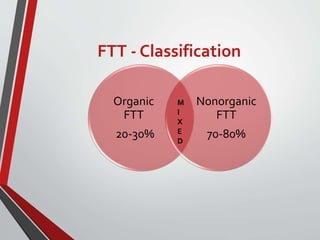
FTT - Classification
Organic
FTT
20-30%
Nonorganic
FTT
70-80%
M
I
X
E
D
FTT - Classification
• NONORGANIC
• Prenatal
• Malnourished mother
• Lack of prenatal bonding
• Postnatal
• Poor feeding skills
• Dysfunctional family
• Difficult parent-child interactions
• DifficultChild
• Abuse/Neglect
3/8/2023 5
• Non organic causes
• Poverty
• Misperceptions or lack of knowledge about diet and feeding
• Lack of breast feeding
• Feeding diluted formula
• Dysfunctional parent-child relationship.
FTT - Classification
• ORGANIC FTT
• Prenatal Causes
• Prematurity and
complications
• Toxic exposure
• Postnatal
• Inadequate intake
• Lack of appetite
• Inability to suck/swallow
3/8/2023 7
• postnatal
• Poor absorption and/or
use of nutrients
• GI disorder (celiac, CF)
• Inborn errors of
metabolism
• Increased metabolic
demand
• Hyperthyroidism
• Chronic Disease
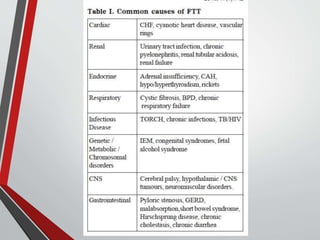
ETIOLOGY
• ORGANIC FTT
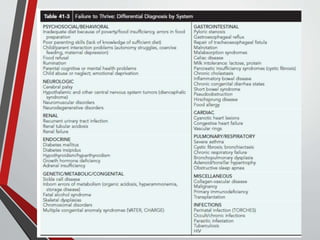
• Gastrointestinal-GER, malabsorption, inflammatory
bowel disease, pyloric stenosis.
• Neurological- mental retardation, cerebral palsy.
• Renal- renal tubular acidosis, chronic renal failure.
• Cardiopulmonary-CHD, cystic fibrosis, asthma
• ORGANIC FTT
• Endocrine- hypothyroidism, diabetes mellitus.
• Infections- chronic parasitic infections of GIT, tuberculosis, HIV
• Genetic- IEM, chromosomal anomalies.
• Miscellaneous – malignancy, lead poisoning
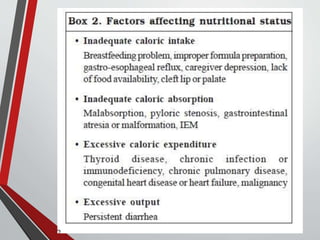
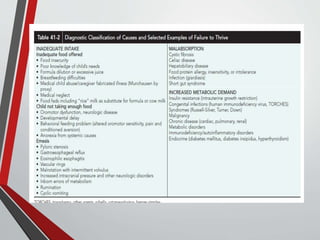
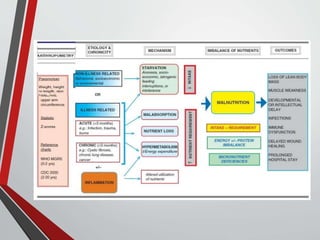
Etiology based on pathophysiology
1. Inadequate nutrient intake
2. Inadequate appetite or inability to eat large amounts
3. Inadequate nutrient absorption or Increased losses
4. Increased nutrient requirements or ineffective
utilization
Etiology based on pathophysiology
Inadequate nutrient intake
• Inappropriate feeding technique
• Disturbed caregiver/child
relationship
• Economic deprivation
• Inappropriate nutrient intake (eg,
excess fruit juice consumption,
factitious food allergy, inappropriate
preparation of formula, inadequate
quantity of food, inappropriate food
for age, neglect, food fads)
• Inappropriate parental knowledge of
appropriate diet for infants and
toddlers
• Insufficient lactation in mother
• Gastroesophageal reflux
• Psychosocial problems
• Mechanical problems (cleft palate,
nasal obstruction, adenoidal
hypertrophy, dental lesions)
• Sucking or swallowing dysfunction
(CNS, neuromuscular, esophageal
motility problems)
Etiology based on pathophysiology
Inadequate appetite or inability to eat large amounts
• Psychosocial problems
• Cardiopulmonary disease
• Hypotonia, muscle weakness, or
hypertonia
• Anorexia of chronic infection or
immune deficiency
• Cerebral palsy
• CNS pathology (eg, tumor,
hydrocephalus)
• Genetic syndrome
• Anemia (eg, iron deficiency)
• Chronic constipation
• Gastrointestinal disorder (eg, pain
from gastroesophageal reflux,
intestinal tract obstruction)
• Craniofacial anomalies (eg, cleft
lip and palate, micrognathia)
Etiology based on pathophysiology
Inadequate nutrient absorption or increased losses
• Malabsorption
• Biliary atresia, cirrhosis
• Vomiting or "spitting up" (related
to infectious gastroenteritis,
increased intracranial pressure,
adrenal insufficiency, or drugs [eg,
purposeful administration of syrup
of ipecac])
• Intestinal tract obstruction (pyloric
stenosis, hernia, malrotation,
intussusception)
• Infectious diarrhea
• Necrotizing enterocolitis or short
bowel syndrome
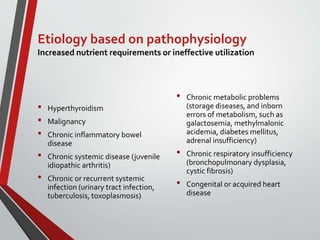
Etiology based on pathophysiology
Increased nutrient requirements or ineffective utilization
• Hyperthyroidism
• Malignancy
• Chronic inflammatory bowel
disease
• Chronic systemic disease (juvenile
idiopathic arthritis)
• Chronic or recurrent systemic
infection (urinary tract infection,
tuberculosis, toxoplasmosis)
• Chronic metabolic problems
(storage diseases, and inborn
errors of metabolism, such as
galactosemia, methylmalonic
acidemia, diabetes mellitus,
adrenal insufficiency)
• Chronic respiratory insufficiency
(bronchopulmonary dysplasia,
cystic fibrosis)
• Congenital or acquired heart
disease
Etiology by age of onset
• Prenatal
• Intrauterine growth restriction
• Prematurity
• prenatal infection
• congenital syndromes
• teratogenic exposures (eg, anticonvulsants, alcohol).
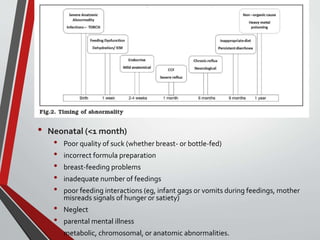
• Neonatal (<1 month)
• Poor quality of suck (whether breast- or bottle-fed)
• incorrect formula preparation
• breast-feeding problems
• inadequate number of feedings
• poor feeding interactions (eg, infant gags or vomits during feedings, mother
misreads signals of hunger or satiety)
• Neglect
• parental mental illness
• metabolic, chromosomal, or anatomic abnormalities.
• 3 to 6 months
• Underfeeding (possibly associated with poverty)
• improper formula preparation
• milk protein intolerance
• oral motor dysfunction
• cystic fibrosis
• congenital heart disease
• gastroesophageal reflux.
• 7 to 12 months
• Feeding problems (inadequate quantity/ frequency, delayed
introduction of solids, intolerance of new foods)
• intestinal parasites.
• >12 months
• highly distractible child
• distracting environment
• acquired illness
• new psychosocial stressor (divorce, job loss, new sibling, death in
the family, etc)
• sensory-based feeding disorders in children with developmental
disorders (eg, autism)
• swallowing dysfunction.
Evaluation of a childwith FTT
• HISTORY
• PHYSICAL EXAMINATION
• ANTHROPOMETRY
• INVESTIGATIONS
History
Prenatal
• General obstetric history
• Recurrent miscarriages
• Use of drugs, smoking
Natal, post-natal
• Prematurity
• Birth weight
• Neonatal asphyxia
• Congenital malformations or
infections.
• Maternal bonding at birth
Evaluation of a child with FTT
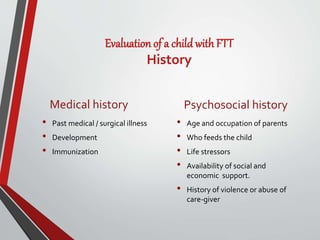
History
Medical history
• Past medical / surgical illness
• Development
• Immunization
Psychosocial history
• Age and occupation of parents
• Who feeds the child
• Life stressors
• Availability of social and
economic support.
• History of violence or abuse of
care-giver
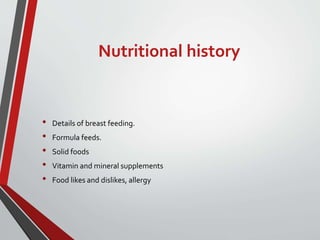
Nutritional history
• Details of breast feeding.
• Formula feeds.
• Solid foods
• Vitamin and mineral supplements
• Food likes and dislikes, allergy
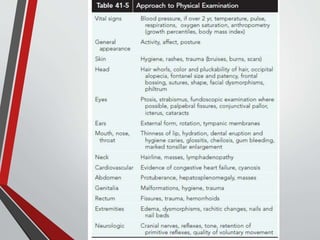
Physical examination
• Signs of PEM
• Signs of vitamin deficiency
• Dysmorphic features
• Serial growth parameters
• Development assessment
• Focussed examination for identifying chronic illnesses
• Signs of possible child abuse
LAB INVESTIGATIONS
• Not usually required if cause is psychosocial
• Donr to rule out Organic cause
• 1st line:- CBC+ESR, URE+CULTURE, Stool r/e
LFT,RFT,RBS, Electrolytes, ca, P,
HIV &TB to be ruled out
2nd line:-TFT, ABG, Celiac disese serology
Urine for metabolic disease
Echo, CXR, USG abdomen
Management
• Child’s diet and eating pattern
• Child’s development stimulation
• Improvement in care-giver skills
• Treatment of underlying disease if any
• Regular and effective follow up.
Diet and eating pattern
• Mothers should be counselled about feeding
problems
• Avoid fruit juices
• Feeding interval should not be > 4hours.
• For older infants and young children meals should last
for about 30 minutes.
• solid foods should be offered before liquids.
• environment distractions should be minimised
• not to be force-fed.
• Catch up growth
• High calorie diet with 1.5 – 2 times the expected calorie.
• Gaining weight at a rate greater than 50th percentile for the age.
Monitoring nutritional therapy
• 1st priority to achieve an ideal weight for age
• 2nd goal is catch up length for age
• Effectiveness of therapy is monitored by gain in weight
Developmental stimulation
• Intensive environmental stimulation
• Foster homes
Other aspects
• Improvement in care-giver skills
• Treatment of underlying disease if any
• Regular and effective follow up.
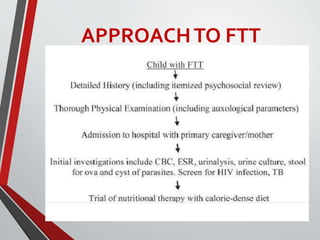
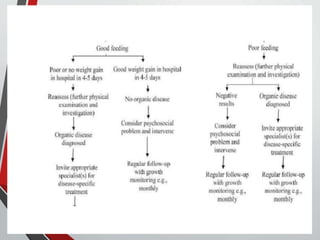
APPROACHTO FTT
FAILURE TO THRIVE.pptx

FAILURE TO THRIVE.pptx

  • 1.
  • 2.
    INTRODUCTION • Descriptive termrather than a diagnosis • Used for infants and children upto 3years of age whose physical growth is significantly less than their peers of same age and sex.
  • 3.
    DEFINITIONS • Weight forage below 3rd centile for age on the growth chart or more than two standard deviations below the mean for children of same age and sex. • Weight for height less than -2 Z score. • Weight downcrossed two major centiles in growth chart in a short time
  • 4.
  • 5.
    FTT - Classification •NONORGANIC • Prenatal • Malnourished mother • Lack of prenatal bonding • Postnatal • Poor feeding skills • Dysfunctional family • Difficult parent-child interactions • DifficultChild • Abuse/Neglect 3/8/2023 5
  • 6.
    • Non organiccauses • Poverty • Misperceptions or lack of knowledge about diet and feeding • Lack of breast feeding • Feeding diluted formula • Dysfunctional parent-child relationship.
  • 7.
    FTT - Classification •ORGANIC FTT • Prenatal Causes • Prematurity and complications • Toxic exposure • Postnatal • Inadequate intake • Lack of appetite • Inability to suck/swallow 3/8/2023 7 • postnatal • Poor absorption and/or use of nutrients • GI disorder (celiac, CF) • Inborn errors of metabolism • Increased metabolic demand • Hyperthyroidism • Chronic Disease
  • 8.
    ETIOLOGY • ORGANIC FTT •Gastrointestinal-GER, malabsorption, inflammatory bowel disease, pyloric stenosis. • Neurological- mental retardation, cerebral palsy. • Renal- renal tubular acidosis, chronic renal failure. • Cardiopulmonary-CHD, cystic fibrosis, asthma
  • 9.
    • ORGANIC FTT •Endocrine- hypothyroidism, diabetes mellitus. • Infections- chronic parasitic infections of GIT, tuberculosis, HIV • Genetic- IEM, chromosomal anomalies. • Miscellaneous – malignancy, lead poisoning
  • 11.
    Etiology based onpathophysiology 1. Inadequate nutrient intake 2. Inadequate appetite or inability to eat large amounts 3. Inadequate nutrient absorption or Increased losses 4. Increased nutrient requirements or ineffective utilization
  • 12.
    Etiology based onpathophysiology Inadequate nutrient intake • Inappropriate feeding technique • Disturbed caregiver/child relationship • Economic deprivation • Inappropriate nutrient intake (eg, excess fruit juice consumption, factitious food allergy, inappropriate preparation of formula, inadequate quantity of food, inappropriate food for age, neglect, food fads) • Inappropriate parental knowledge of appropriate diet for infants and toddlers • Insufficient lactation in mother • Gastroesophageal reflux • Psychosocial problems • Mechanical problems (cleft palate, nasal obstruction, adenoidal hypertrophy, dental lesions) • Sucking or swallowing dysfunction (CNS, neuromuscular, esophageal motility problems)
  • 13.
    Etiology based onpathophysiology Inadequate appetite or inability to eat large amounts • Psychosocial problems • Cardiopulmonary disease • Hypotonia, muscle weakness, or hypertonia • Anorexia of chronic infection or immune deficiency • Cerebral palsy • CNS pathology (eg, tumor, hydrocephalus) • Genetic syndrome • Anemia (eg, iron deficiency) • Chronic constipation • Gastrointestinal disorder (eg, pain from gastroesophageal reflux, intestinal tract obstruction) • Craniofacial anomalies (eg, cleft lip and palate, micrognathia)
  • 14.
    Etiology based onpathophysiology Inadequate nutrient absorption or increased losses • Malabsorption • Biliary atresia, cirrhosis • Vomiting or "spitting up" (related to infectious gastroenteritis, increased intracranial pressure, adrenal insufficiency, or drugs [eg, purposeful administration of syrup of ipecac]) • Intestinal tract obstruction (pyloric stenosis, hernia, malrotation, intussusception) • Infectious diarrhea • Necrotizing enterocolitis or short bowel syndrome
  • 15.
    Etiology based onpathophysiology Increased nutrient requirements or ineffective utilization • Hyperthyroidism • Malignancy • Chronic inflammatory bowel disease • Chronic systemic disease (juvenile idiopathic arthritis) • Chronic or recurrent systemic infection (urinary tract infection, tuberculosis, toxoplasmosis) • Chronic metabolic problems (storage diseases, and inborn errors of metabolism, such as galactosemia, methylmalonic acidemia, diabetes mellitus, adrenal insufficiency) • Chronic respiratory insufficiency (bronchopulmonary dysplasia, cystic fibrosis) • Congenital or acquired heart disease
  • 20.
    Etiology by ageof onset • Prenatal • Intrauterine growth restriction • Prematurity • prenatal infection • congenital syndromes • teratogenic exposures (eg, anticonvulsants, alcohol).
  • 21.
    • Neonatal (<1month) • Poor quality of suck (whether breast- or bottle-fed) • incorrect formula preparation • breast-feeding problems • inadequate number of feedings • poor feeding interactions (eg, infant gags or vomits during feedings, mother misreads signals of hunger or satiety) • Neglect • parental mental illness • metabolic, chromosomal, or anatomic abnormalities.
  • 22.
    • 3 to6 months • Underfeeding (possibly associated with poverty) • improper formula preparation • milk protein intolerance • oral motor dysfunction • cystic fibrosis • congenital heart disease • gastroesophageal reflux.
  • 23.
    • 7 to12 months • Feeding problems (inadequate quantity/ frequency, delayed introduction of solids, intolerance of new foods) • intestinal parasites.
  • 24.
    • >12 months •highly distractible child • distracting environment • acquired illness • new psychosocial stressor (divorce, job loss, new sibling, death in the family, etc) • sensory-based feeding disorders in children with developmental disorders (eg, autism) • swallowing dysfunction.
  • 25.
    Evaluation of achildwith FTT • HISTORY • PHYSICAL EXAMINATION • ANTHROPOMETRY • INVESTIGATIONS
  • 26.
    History Prenatal • General obstetrichistory • Recurrent miscarriages • Use of drugs, smoking Natal, post-natal • Prematurity • Birth weight • Neonatal asphyxia • Congenital malformations or infections. • Maternal bonding at birth
  • 27.
    Evaluation of achild with FTT History Medical history • Past medical / surgical illness • Development • Immunization Psychosocial history • Age and occupation of parents • Who feeds the child • Life stressors • Availability of social and economic support. • History of violence or abuse of care-giver
  • 28.
    Nutritional history • Detailsof breast feeding. • Formula feeds. • Solid foods • Vitamin and mineral supplements • Food likes and dislikes, allergy
  • 31.
    Physical examination • Signsof PEM • Signs of vitamin deficiency • Dysmorphic features • Serial growth parameters • Development assessment • Focussed examination for identifying chronic illnesses • Signs of possible child abuse
  • 33.
    LAB INVESTIGATIONS • Notusually required if cause is psychosocial • Donr to rule out Organic cause • 1st line:- CBC+ESR, URE+CULTURE, Stool r/e LFT,RFT,RBS, Electrolytes, ca, P, HIV &TB to be ruled out 2nd line:-TFT, ABG, Celiac disese serology Urine for metabolic disease Echo, CXR, USG abdomen
  • 34.
    Management • Child’s dietand eating pattern • Child’s development stimulation • Improvement in care-giver skills • Treatment of underlying disease if any • Regular and effective follow up.
  • 35.
    Diet and eatingpattern • Mothers should be counselled about feeding problems • Avoid fruit juices • Feeding interval should not be > 4hours. • For older infants and young children meals should last for about 30 minutes.
  • 36.
    • solid foodsshould be offered before liquids. • environment distractions should be minimised • not to be force-fed. • Catch up growth • High calorie diet with 1.5 – 2 times the expected calorie. • Gaining weight at a rate greater than 50th percentile for the age.
  • 37.
    Monitoring nutritional therapy •1st priority to achieve an ideal weight for age • 2nd goal is catch up length for age • Effectiveness of therapy is monitored by gain in weight
  • 38.
    Developmental stimulation • Intensiveenvironmental stimulation • Foster homes
  • 39.
    Other aspects • Improvementin care-giver skills • Treatment of underlying disease if any • Regular and effective follow up.
  • 40.