Streamlining the Residency
Application and Match Process
Innovations in Applicant Screening & Selection
Zach Jarou, MD | @zachjarou | @DenverEMed | @emresidents | #MedEd
Arnab Sarker, MS4 | @arnabsarker | @UVAEmergencyMed | @DardenMBA
Academic Physicians Section | AMA Interim Meeting | November 10, 2017
Overapplication & Filtering:
Longitudinal Trends in the
(Emergency Medicine) Residency
Application Process
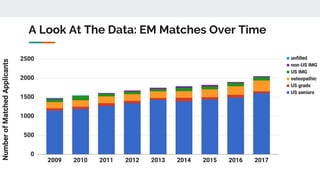
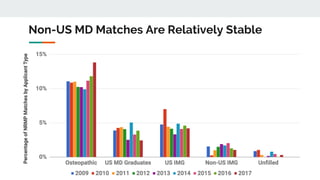
A Look At The Data: EM Matches Over Time
Non-US MD Matches Are Relatively Stable
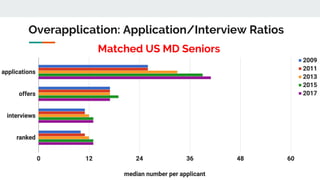
Overapplication: Application/Interview Ratios
Matched US MD Seniors
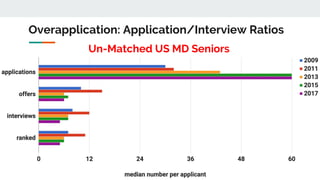
Overapplication: Application/Interview Ratios
Un-Matched US MD Seniors
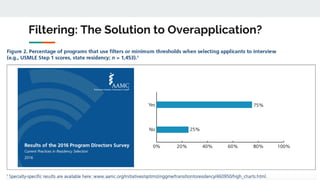
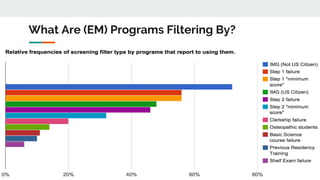
Filtering: The Solution to Overapplication?
What Are (EM) Programs Filtering By?
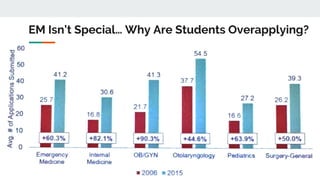
EM Isn’t Special… Why Are Students Overapplying?
#ApplySmarter (Not Harder)
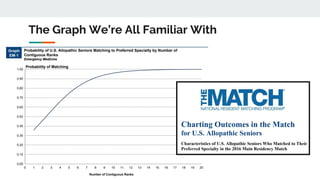
The Graph We’re All Familiar With
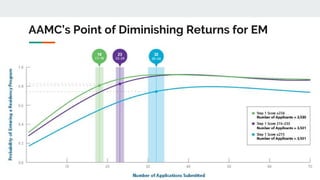
AAMC’s Point of Diminishing Returns for EM
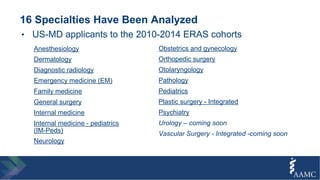
16 Specialties Have Been Analyzed
• US-MD applicants to the 2010-2014 ERAS cohorts
Obstetrics and gynecology
Orthopedic surgery
Otolaryngology
Pathology
Pediatrics
Plastic surgery - Integrated
Psychiatry
Urology – coming soon
Vascular Surgery - Integrated -coming soon
Anesthesiology
Dermatology
Diagnostic radiology
Emergency medicine (EM)
Family medicine
General surgery
Internal medicine
Internal medicine - pediatrics
(IM-Peds)
Neurology
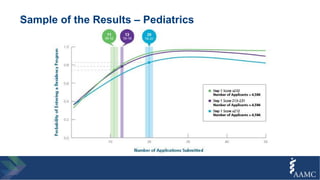
Sample of the Results – Pediatrics
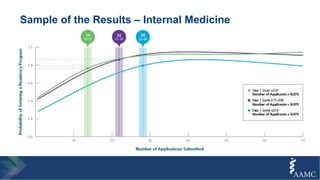
Sample of the Results – Internal Medicine
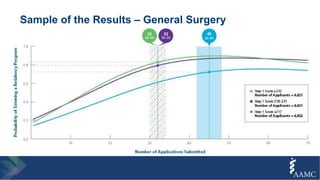
Sample of the Results – General Surgery
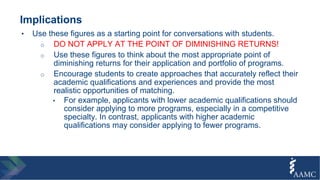
Implications
• Use these figures as a starting point for conversations with students.
o DO NOT APPLY AT THE POINT OF DIMINISHING RETURNS!
o Use these figures to think about the most appropriate point of
diminishing returns for their application and portfolio of programs.
o Encourage students to create approaches that accurately reflect their
academic qualifications and experiences and provide the most
realistic opportunities of matching.
• For example, applicants with lower academic qualifications should
consider applying to more programs, especially in a competitive
specialty. In contrast, applicants with higher academic
qualifications may consider applying to fewer programs.
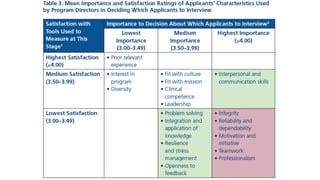
Pain Points:
Program Director Satisfaction
With Tools Used to Decide Which
Applicants to Interview
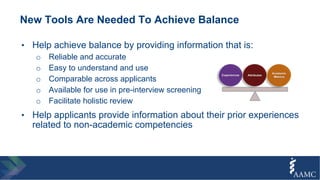
New Tools Are Needed To Achieve Balance
• Help achieve balance by providing information that is:
o Reliable and accurate
o Easy to understand and use
o Comparable across applicants
o Available for use in pre-interview screening
o Facilitate holistic review
• Help applicants provide information about their prior experiences
related to non-academic competencies
20
Revising An Old Tool:
Medical Student Performance
Evaluation (aka Dean’s Letter)
www.aamc.org/mspe
1989
AAMC Committee on Dean’s
Letters tasked to “develop
guidelines on the evaluative
information desired by
program directors” and to
“explore the feasibility of
providing a model format for
deans’ letters.”
2002
A second committee
reaffirmed the original purpose
of the MPSE & made
recommendations to establish
consistency & ongoing QI.
2014
Most recent revision of the
document. Latest version
published in May 2017.
Challenges with the Old MSPE
1. Inconsistency in content and language/terminology
2. Letters are too long to be useful yet insufficiently
transparent to convey an accurate sense of student
performance
3. Missed opportunity to use the letter to highlight salient
experiences and attributes not found elsewhere in the
application
Six Guiding Principles: MSPE Will Provide...
1. Supplemental value to ERAS, transcripts, LoRs
(not simply repeating information presented elsewhere)
2. Increased standardization & transparency
to facilitate review & selection
3. Comparative information on applicants
4. Info about applicant competencies required to be
successful in residency
5. Opportunity for PDs to screen applicants holistically
6. Clear, easy-to-locate, qualitative and quantitative
assessments
Ten Recommended Changes to MSPE
1. Standardize, to the extent possible, information in the
MSPE across schools and present it clearly, concisely,
and in a way that allows it to be easily located.
2. Highlight the six ACGME Core Competencies
3. Include details on professionalism—both deficient and
exemplary performance
4. “Unique” → “Noteworthy” Characteristics
5. Limit “Noteworthy Characteristics to three bullet points
Ten Recommended Changes to MSPE
6. Locate comparative data in body of MSPE.
7. Include information on how final grades and
comparative data are derived.
8. Provide school-wide comparisons if using the final
“adjective” or “overall rating.”
9. Limit MSPE to 7 single-spaced pages (12-point font)
10. Include six sections: Identifying Information,
Noteworthy Characteristics, Academic History,
Academic Progress, Summary, and Medical School
Information.
Take Away: Purpose of the MSPE
The purpose of the MSPE is not to advocate for the student, but rather to provide an
honest and objective summary of the student’s personal attributes, experiences, and
academic accomplishments based, to the greatest degree possible, on verifiable
information and summative evaluations. When possible, comparative assessments of
the student’s attributes, experiences, and accomplishments relative to their
institutional peers should be provided. The MSPE should primarily contain information
about the student’s medical school performance, although a brief summary of
verifiable premedical experiences and achievements can be included when relevant.
The MSPE is a summary letter of evaluation, not a letter of recommendation.
Information presented in the MSPE must be standardized, clear, and concise and
presented in such a way that allows information to be easily located within the
document.
Piloting A New Tool:
AAMC Standardized Video
Interview
www.aamc.org/standardizedvideointerview
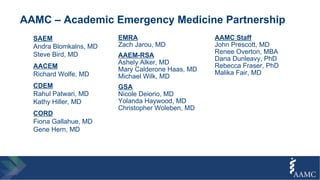
AAMC – Academic Emergency Medicine Partnership
SAEM
Andra Blomkalns, MD
Steve Bird, MD
AACEM
Richard Wolfe, MD
CDEM
Rahul Patwari, MD
Kathy Hiller, MD
CORD
Fiona Gallahue, MD
Gene Hern, MD
EMRA
Zach Jarou, MD
AAEM-RSA
Ashely Alker, MD
Mary Calderone Haas, MD
Michael Wilk, MD
GSA
Nicole Deiorio, MD
Yolanda Haywood, MD
Christopher Woleben, MD
29
AAMC Staff
John Prescott, MD
Renee Overton, MBA
Dana Dunleavy, PhD
Rebecca Fraser, PhD
Malika Fair, MD
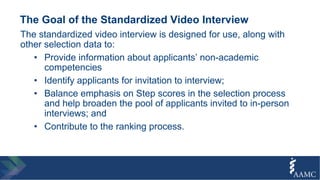
The Goal of the Standardized Video Interview
The standardized video interview is designed for use, along with
other selection data to:
• Provide information about applicants’ non-academic
competencies
• Identify applicants for invitation to interview;
• Balance emphasis on Step scores in the selection process
and help broaden the pool of applicants invited to in-person
interviews; and
• Contribute to the ranking process.
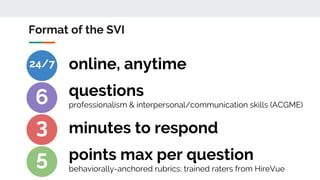
Format of the SVI
24/7
6
3
5
online, anytime
questions
professionalism & interpersonal/communication skills (ACGME)
minutes to respond
points max per question
behaviorally-anchored rubrics; trained raters from HireVue
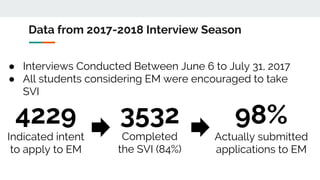
Data from 2017-2018 Interview Season
● Interviews Conducted Between June 6 to July 31, 2017
● All students considering EM were encouraged to take
SVI
4229
Indicated intent
to apply to EM
3532
Completed
the SVI (84%)
98%
Actually submitted
applications to EM
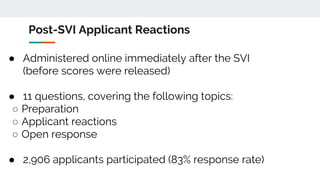
Post-SVI Applicant Reactions
● Administered online immediately after the SVI
(before scores were released)
● 11 questions, covering the following topics:
○ Preparation
○ Applicant reactions
○ Open response
● 2,906 applicants participated (83% response rate)
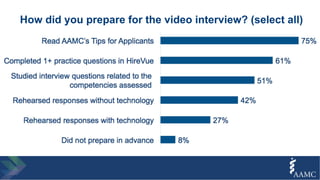
How did you prepare for the video interview? (select all)
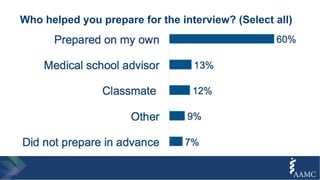
Who helped you prepare for the interview? (Select all)
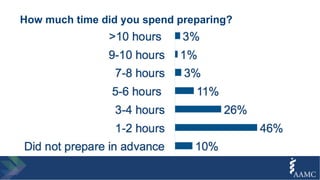
How much time did you spend preparing?
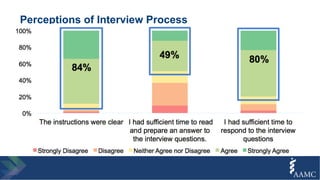
Perceptions of Interview Process
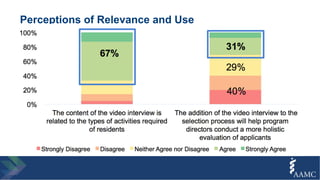
Perceptions of Relevance and Use
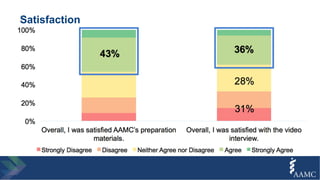
Satisfaction
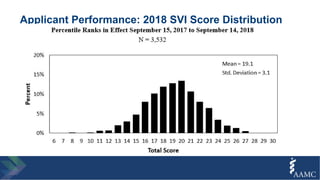
Applicant Performance: 2018 SVI Score Distribution
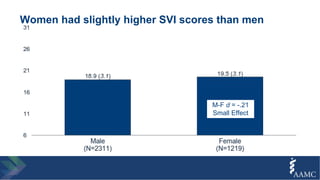
Women had slightly higher SVI scores than men
M-F d = -.21
Small Effect
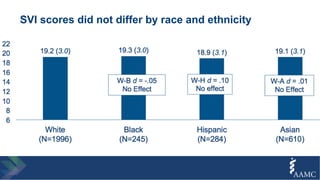
SVI scores did not differ by race and ethnicity
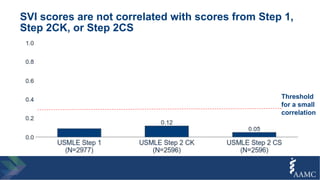
SVI scores are not correlated with scores from Step 1,
Step 2CK, or Step 2CS
Threshold
for a small
correlation
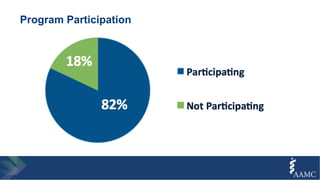
Program Participation
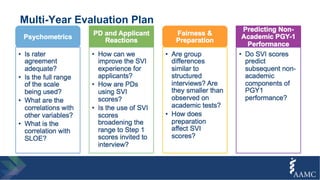
Multi-Year Evaluation Plan
45
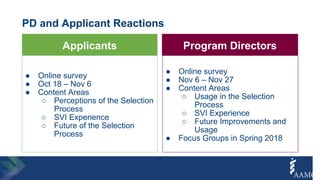
PD and Applicant Reactions
Applicants
● Online survey
● Oct 18 – Nov 6
● Content Areas
○ Perceptions of the Selection
Process
○ SVI Experience
○ Future of the Selection
Process
Program Directors
● Online survey
● Nov 6 – Nov 27
● Content Areas
○ Usage in the Selection
Process
○ SVI Experience
○ Future Improvements and
Usage
● Focus Groups in Spring 2018
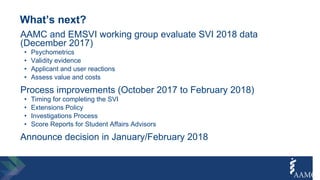
What’s next?
AAMC and EMSVI working group evaluate SVI 2018 data
(December 2017)
• Psychometrics
• Validity evidence
• Applicant and user reactions
• Assess value and costs
Process improvements (October 2017 to February 2018)
• Timing for completing the SVI
• Extensions Policy
• Investigations Process
• Score Reports for Student Affairs Advisors
Announce decision in January/February 2018
Other Specialty-Specific
Application Tools & Requirements
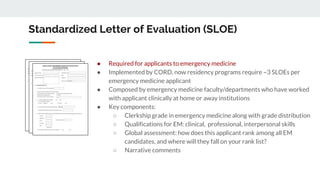
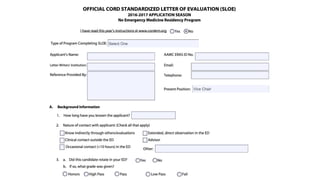
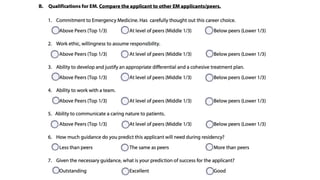
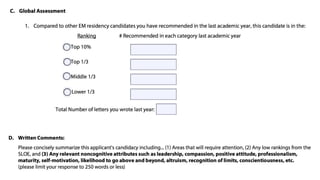
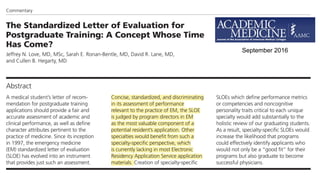
Standardized Letter of Evaluation (SLOE)
● Required for applicants to emergency medicine
● Implemented by CORD, now residency programs require ~3 SLOEs per
emergency medicine applicant
● Composed by emergency medicine faculty/departments who have worked
with applicant clinically at home or away institutions
● Key components:
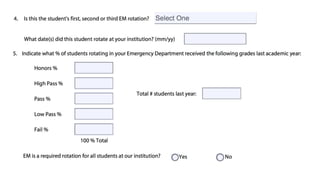
○ Clerkship grade in emergency medicine along with grade distribution
○ Qualifications for EM: clinical, professional, interpersonal skills
○ Global assessment: how does this applicant rank among all EM
candidates, and where will they fall on your rank list?
○ Narrative comments
September 2016
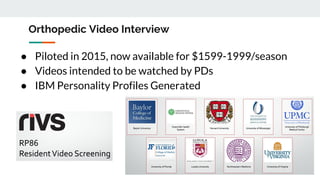
Orthopedic Video Interview
● Piloted in 2015, now available for $1599-1999/season
● Videos intended to be watched by PDs
● IBM Personality Profiles Generated
Otolaryngology Residency Talent Assessment (ORTA)
● Required for applicants to ENT
● Pilot program designed to evaluate
professionalism and interpersonal skills
● Conducted as one hour telephone survey
● Scores from survey are reported to
residency programs
Streamlining the Residency
Application and Match Process
Innovations in Applicant Screening & Selection
Zach Jarou, MD | @zachjarou | @DenverEMed | @emresidents | #MedEd
Arnab Sarker, MS4 | @arnabsarker | @UVAEmergencyMed | @DardenMBA
Academic Physicians Section | AMA Interim Meeting | November 10, 2017

Streamlining the Residency Application and Match Process: Innovations in Applicant Screening & Selection

  • 1.
    Streamlining the Residency Applicationand Match Process Innovations in Applicant Screening & Selection Zach Jarou, MD | @zachjarou | @DenverEMed | @emresidents | #MedEd Arnab Sarker, MS4 | @arnabsarker | @UVAEmergencyMed | @DardenMBA Academic Physicians Section | AMA Interim Meeting | November 10, 2017
  • 2.
    Overapplication & Filtering: LongitudinalTrends in the (Emergency Medicine) Residency Application Process
  • 3.
    A Look AtThe Data: EM Matches Over Time
  • 4.
    Non-US MD MatchesAre Relatively Stable
  • 5.
  • 6.
  • 7.
    Filtering: The Solutionto Overapplication?
  • 8.
    What Are (EM)Programs Filtering By?
  • 9.
    EM Isn’t Special…Why Are Students Overapplying?
  • 10.
  • 11.
    The Graph We’reAll Familiar With
  • 12.
    AAMC’s Point ofDiminishing Returns for EM
  • 13.
    16 Specialties HaveBeen Analyzed • US-MD applicants to the 2010-2014 ERAS cohorts Obstetrics and gynecology Orthopedic surgery Otolaryngology Pathology Pediatrics Plastic surgery - Integrated Psychiatry Urology – coming soon Vascular Surgery - Integrated -coming soon Anesthesiology Dermatology Diagnostic radiology Emergency medicine (EM) Family medicine General surgery Internal medicine Internal medicine - pediatrics (IM-Peds) Neurology
  • 14.
    Sample of theResults – Pediatrics
  • 15.
    Sample of theResults – Internal Medicine
  • 16.
    Sample of theResults – General Surgery
  • 17.
    Implications • Use thesefigures as a starting point for conversations with students. o DO NOT APPLY AT THE POINT OF DIMINISHING RETURNS! o Use these figures to think about the most appropriate point of diminishing returns for their application and portfolio of programs. o Encourage students to create approaches that accurately reflect their academic qualifications and experiences and provide the most realistic opportunities of matching. • For example, applicants with lower academic qualifications should consider applying to more programs, especially in a competitive specialty. In contrast, applicants with higher academic qualifications may consider applying to fewer programs.
  • 18.
    Pain Points: Program DirectorSatisfaction With Tools Used to Decide Which Applicants to Interview
  • 20.
    New Tools AreNeeded To Achieve Balance • Help achieve balance by providing information that is: o Reliable and accurate o Easy to understand and use o Comparable across applicants o Available for use in pre-interview screening o Facilitate holistic review • Help applicants provide information about their prior experiences related to non-academic competencies 20
  • 21.
    Revising An OldTool: Medical Student Performance Evaluation (aka Dean’s Letter) www.aamc.org/mspe
  • 22.
    1989 AAMC Committee onDean’s Letters tasked to “develop guidelines on the evaluative information desired by program directors” and to “explore the feasibility of providing a model format for deans’ letters.” 2002 A second committee reaffirmed the original purpose of the MPSE & made recommendations to establish consistency & ongoing QI. 2014 Most recent revision of the document. Latest version published in May 2017.
  • 23.
    Challenges with theOld MSPE 1. Inconsistency in content and language/terminology 2. Letters are too long to be useful yet insufficiently transparent to convey an accurate sense of student performance 3. Missed opportunity to use the letter to highlight salient experiences and attributes not found elsewhere in the application
  • 24.
    Six Guiding Principles:MSPE Will Provide... 1. Supplemental value to ERAS, transcripts, LoRs (not simply repeating information presented elsewhere) 2. Increased standardization & transparency to facilitate review & selection 3. Comparative information on applicants 4. Info about applicant competencies required to be successful in residency 5. Opportunity for PDs to screen applicants holistically 6. Clear, easy-to-locate, qualitative and quantitative assessments
  • 25.
    Ten Recommended Changesto MSPE 1. Standardize, to the extent possible, information in the MSPE across schools and present it clearly, concisely, and in a way that allows it to be easily located. 2. Highlight the six ACGME Core Competencies 3. Include details on professionalism—both deficient and exemplary performance 4. “Unique” → “Noteworthy” Characteristics 5. Limit “Noteworthy Characteristics to three bullet points
  • 26.
    Ten Recommended Changesto MSPE 6. Locate comparative data in body of MSPE. 7. Include information on how final grades and comparative data are derived. 8. Provide school-wide comparisons if using the final “adjective” or “overall rating.” 9. Limit MSPE to 7 single-spaced pages (12-point font) 10. Include six sections: Identifying Information, Noteworthy Characteristics, Academic History, Academic Progress, Summary, and Medical School Information.
  • 27.
    Take Away: Purposeof the MSPE The purpose of the MSPE is not to advocate for the student, but rather to provide an honest and objective summary of the student’s personal attributes, experiences, and academic accomplishments based, to the greatest degree possible, on verifiable information and summative evaluations. When possible, comparative assessments of the student’s attributes, experiences, and accomplishments relative to their institutional peers should be provided. The MSPE should primarily contain information about the student’s medical school performance, although a brief summary of verifiable premedical experiences and achievements can be included when relevant. The MSPE is a summary letter of evaluation, not a letter of recommendation. Information presented in the MSPE must be standardized, clear, and concise and presented in such a way that allows information to be easily located within the document.
  • 28.
    Piloting A NewTool: AAMC Standardized Video Interview www.aamc.org/standardizedvideointerview
  • 29.
    AAMC – AcademicEmergency Medicine Partnership SAEM Andra Blomkalns, MD Steve Bird, MD AACEM Richard Wolfe, MD CDEM Rahul Patwari, MD Kathy Hiller, MD CORD Fiona Gallahue, MD Gene Hern, MD EMRA Zach Jarou, MD AAEM-RSA Ashely Alker, MD Mary Calderone Haas, MD Michael Wilk, MD GSA Nicole Deiorio, MD Yolanda Haywood, MD Christopher Woleben, MD 29 AAMC Staff John Prescott, MD Renee Overton, MBA Dana Dunleavy, PhD Rebecca Fraser, PhD Malika Fair, MD
  • 30.
    The Goal ofthe Standardized Video Interview The standardized video interview is designed for use, along with other selection data to: • Provide information about applicants’ non-academic competencies • Identify applicants for invitation to interview; • Balance emphasis on Step scores in the selection process and help broaden the pool of applicants invited to in-person interviews; and • Contribute to the ranking process.
  • 31.
    Format of theSVI 24/7 6 3 5 online, anytime questions professionalism & interpersonal/communication skills (ACGME) minutes to respond points max per question behaviorally-anchored rubrics; trained raters from HireVue
  • 32.
    Data from 2017-2018Interview Season ● Interviews Conducted Between June 6 to July 31, 2017 ● All students considering EM were encouraged to take SVI 4229 Indicated intent to apply to EM 3532 Completed the SVI (84%) 98% Actually submitted applications to EM
  • 33.
    Post-SVI Applicant Reactions ●Administered online immediately after the SVI (before scores were released) ● 11 questions, covering the following topics: ○ Preparation ○ Applicant reactions ○ Open response ● 2,906 applicants participated (83% response rate)
  • 34.
    How did youprepare for the video interview? (select all)
  • 35.
    Who helped youprepare for the interview? (Select all)
  • 36.
    How much timedid you spend preparing?
  • 37.
  • 38.
  • 39.
  • 40.
    Applicant Performance: 2018SVI Score Distribution
  • 41.
    Women had slightlyhigher SVI scores than men M-F d = -.21 Small Effect
  • 42.
    SVI scores didnot differ by race and ethnicity
  • 43.
    SVI scores arenot correlated with scores from Step 1, Step 2CK, or Step 2CS Threshold for a small correlation
  • 44.
  • 45.
  • 46.
    PD and ApplicantReactions Applicants ● Online survey ● Oct 18 – Nov 6 ● Content Areas ○ Perceptions of the Selection Process ○ SVI Experience ○ Future of the Selection Process Program Directors ● Online survey ● Nov 6 – Nov 27 ● Content Areas ○ Usage in the Selection Process ○ SVI Experience ○ Future Improvements and Usage ● Focus Groups in Spring 2018
  • 47.
    What’s next? AAMC andEMSVI working group evaluate SVI 2018 data (December 2017) • Psychometrics • Validity evidence • Applicant and user reactions • Assess value and costs Process improvements (October 2017 to February 2018) • Timing for completing the SVI • Extensions Policy • Investigations Process • Score Reports for Student Affairs Advisors Announce decision in January/February 2018
  • 49.
  • 50.
    Standardized Letter ofEvaluation (SLOE) ● Required for applicants to emergency medicine ● Implemented by CORD, now residency programs require ~3 SLOEs per emergency medicine applicant ● Composed by emergency medicine faculty/departments who have worked with applicant clinically at home or away institutions ● Key components: ○ Clerkship grade in emergency medicine along with grade distribution ○ Qualifications for EM: clinical, professional, interpersonal skills ○ Global assessment: how does this applicant rank among all EM candidates, and where will they fall on your rank list? ○ Narrative comments
  • 56.
  • 57.
    Orthopedic Video Interview ●Piloted in 2015, now available for $1599-1999/season ● Videos intended to be watched by PDs ● IBM Personality Profiles Generated
  • 58.
    Otolaryngology Residency TalentAssessment (ORTA) ● Required for applicants to ENT ● Pilot program designed to evaluate professionalism and interpersonal skills ● Conducted as one hour telephone survey ● Scores from survey are reported to residency programs
  • 60.
    Streamlining the Residency Applicationand Match Process Innovations in Applicant Screening & Selection Zach Jarou, MD | @zachjarou | @DenverEMed | @emresidents | #MedEd Arnab Sarker, MS4 | @arnabsarker | @UVAEmergencyMed | @DardenMBA Academic Physicians Section | AMA Interim Meeting | November 10, 2017