CONGENITAL LUNG MALFORMATIONS
MIMICS PNEUMOTHORAX:
An Experience In Tertiary Care Hospital
BRIG GEN DR. MAHBUBA SULTANA, ADVISER SPECIALIST,
Combined Military Hospital, Dhaka
CASE
SCENARIO
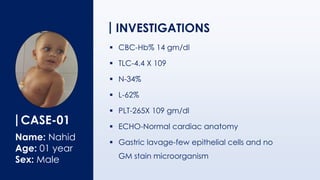
CASE-01
Name: Nahid
Age: 01 year
Sex: Male
CASE-01
Name: Nahid
Age: 01 year
Sex: Male
CHIEF COMPLAINTS
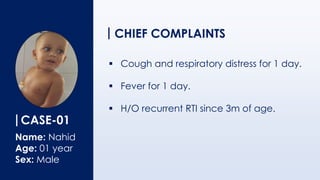
▪ Cough and respiratory distress for 1 day.
▪ Fever for 1 day.
▪ H/O recurrent RTI since 3m of age.
PHYSICAL FINDINGS
▪ Afebrile
▪ Dyspneic
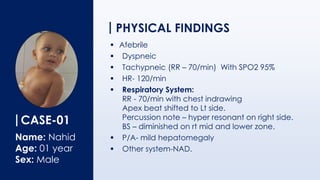
▪ Tachypneic (RR – 70/min) With SPO2 95%
▪ HR- 120/min
▪ Respiratory System:
RR - 70/min with chest indrawing
Apex beat shifted to Lt side.
Percussion note – hyper resonant on right side.
BS – diminished on rt mid and lower zone.
▪ P/A- mild hepatomegaly
▪ Other system-NAD.
CASE-01
Name: Nahid
Age: 01 year
Sex: Male
INVESTIGATIONS
▪ CBC-Hb% 14 gm/dl
▪ TLC-4.4 X 10⁹
▪ N-34%
▪ L-62%
▪ PLT-265X 109 gm/dl
▪ ECHO-Normal cardiac anatomy
▪ Gastric lavage-few epithelial cells and no
GM stain microorganism
CASE-01
Name: Nahid
Age: 01 year
Sex: Male
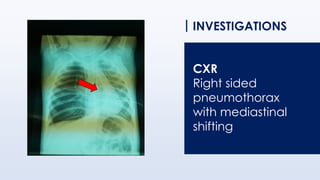
INVESTIGATIONS
CXR
Right sided
pneumothorax
with mediastinal
shifting
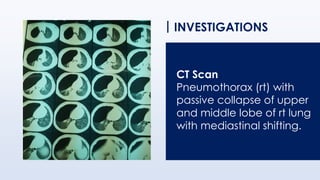
INVESTIGATIONS
CT Scan
Pneumothorax (rt) with
passive collapse of upper
and middle lobe of rt lung
with mediastinal shifting.
TREATMENT
▪ Oxygen inhalation
▪ Antibiotics
▪ Tube thoracostomy
▪ Thoracotomy & excision of
congenital pulmonary cyst
for Case - 01
CASE
SCENARIO
CASE-02
Name: Tahiya
Age: 46 days
Sex: Female
CASE-02
Name: Tahiya
Age: 46 days
Sex: Female
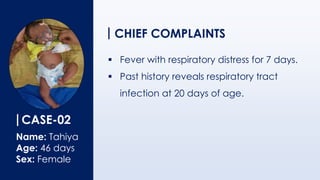
CHIEF COMPLAINTS
▪ Fever with respiratory distress for 7 days.
▪ Past history reveals respiratory tract
infection at 20 days of age.
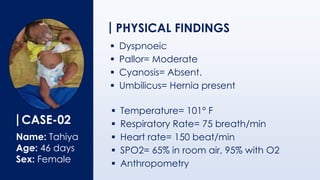
PHYSICAL FINDINGS
▪ Dyspnoeic
▪ Pallor= Moderate
▪ Cyanosis= Absent.
▪ Umbilicus= Hernia present
▪ Temperature= 101° F
▪ Respiratory Rate= 75 breath/min
▪ Heart rate= 150 beat/min
▪ SPO2= 65% in room air, 95% with O2
▪ Anthropometry
CASE-02
Name: Tahiya
Age: 46 days
Sex: Female
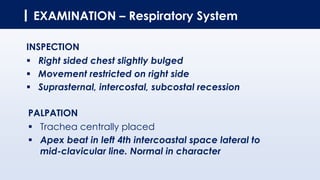
EXAMINATION – Respiratory System
INSPECTION
▪ Right sided chest slightly bulged
▪ Movement restricted on right side
▪ Suprasternal, intercostal, subcostal recession
PALPATION
▪ Trachea centrally placed
▪ Apex beat in left 4th intercoastal space lateral to
mid-clavicular line. Normal in character
EXAMINATION – Respiratory System
PERCUSSION
▪ Hyper-resonance on right side of the chest.
AUSCULTATION
▪ Breath sound absent on right side.
▪ On left side vesicular breath sound with no added sound.
DIAGNOSIS
PROVISIONAL
for Case - 02
Pneumonia with
Pneumothorax (right)
DIFFERENTIAL
▪ Congenital Lobar Emphysema
▪ Congenital Cystic Adenomatoid
Malformation (CCAM)
INVESTIGATIONS
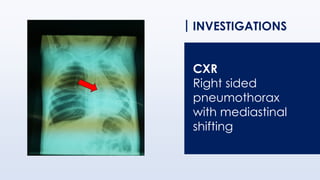
CXR
Right sided
pneumothorax
with mediastinal
shifting
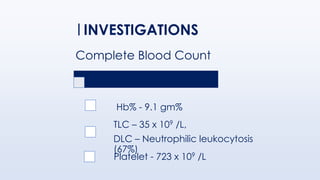
Complete Blood Count
Hb% - 9.1 gm%
TLC – 35 x 109 /L,
DLC – Neutrophilic leukocytosis
(67%)
Platelet - 723 x 109 /L
INVESTIGATIONS
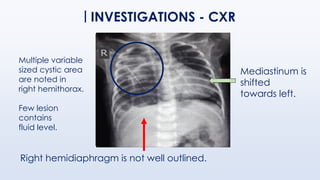
INVESTIGATIONS - CXR
Mediastinum is
shifted
towards left.
Right hemidiaphragm is not well outlined.
Multiple variable
sized cystic area
are noted in
right hemithorax.
Few lesion
contains
fluid level.
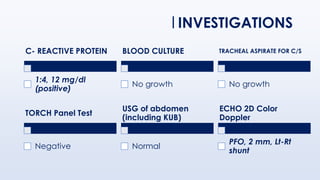
C- REACTIVE PROTEIN
1:4, 12 mg/dl
(positive)
BLOOD CULTURE
No growth
TRACHEAL ASPIRATE FOR C/S
No growth
INVESTIGATIONS
TORCH Panel Test
Negative
USG of abdomen
(including KUB)
Normal
ECHO 2D Color
Doppler
PFO, 2 mm, Lt-Rt
shunt
INVESTIGATIONS
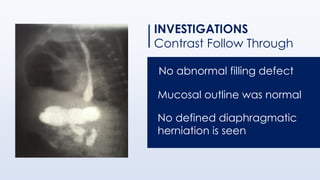
Contrast Follow Through
No abnormal filling defect
Mucosal outline was normal
No defined diaphragmatic
herniation is seen
INVESTIGATIONS
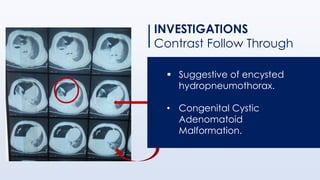
Contrast Follow Through
▪ Suggestive of encysted
hydropneumothorax.
• Congenital Cystic
Adenomatoid
Malformation.
TREATMENT
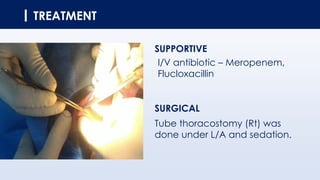
SUPPORTIVE
I/V antibiotic – Meropenem,
Flucloxacillin
SURGICAL
Tube thoracostomy (Rt) was
done under L/A and sedation.
TREATMENT
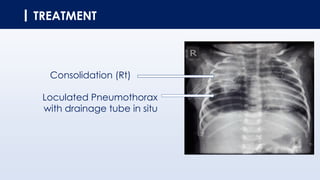
Consolidation (Rt)
Loculated Pneumothorax
with drainage tube in situ
TREATMENT - DEFINITIVE
Name of Operation – Exploratory Thoracotomy with
Excision of Multiple Congenital cysts.
▪ Baby was placed on mechanical ventilation
▪ Antibiotics
Inj. Meropenem
Inj. Metronidazole
Inj. Vancomycin
INVESTIGATIONS
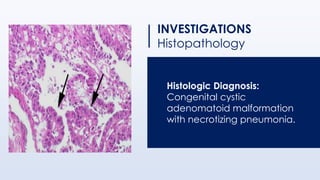
Histopathology
Histologic Diagnosis:
Congenital cystic
adenomatoid malformation
with necrotizing pneumonia.
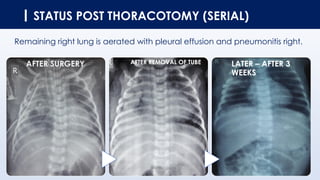
STATUS POST THORACOTOMY (SERIAL)
Remaining right lung is aerated with pleural effusion and pneumonitis right.
AFTER SURGERY AFTER REMOVAL OF TUBE LATER – AFTER 3
WEEKS
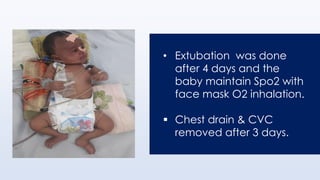
• Extubation was done
after 4 days and the
baby maintain Spo2 with
face mask O2 inhalation.
▪ Chest drain & CVC
removed after 3 days.
FINAL
DIAGNOSIS
Congenital Cystic Adenomatoid
Malformation with necrotizing
pneumonia (CPAM)
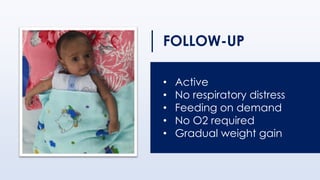
• Active
• No respiratory distress
• Feeding on demand
• No O2 required
• Gradual weight gain
FOLLOW-UP
CASE
SCENARIO
CASE-03
Name: Noor
Age: 12 months
Sex: Female
CASE-03
Name: Noor
Age: 12 months
Sex: Female
CHIEF COMPLAINTS
▪ Cough for 20 days
▪ Low grade irregular fever for 20 days
CASE-03
Name: Noor
Age: 12 months
Sex: Female
PHYSICAL FINDINGS
▪ O/E-
▪ Stable clinically
▪ Afebrile
▪ No lymphadenopathy
▪ BCG mark present
▪ R/R- 24/min
▪ HR-120beats/min
EXAMINATION – Respiratory System
INSPECTION
▪ Normal present
PALPATION
▪ Normal
EXAMINATION – Respiratory System
PERCUSSION
▪ Hyper-resonance on right side
AUSCULTATION
▪ Breath sound diminished on rt side. Vesicular with
crepitations present
▪ Left side normal
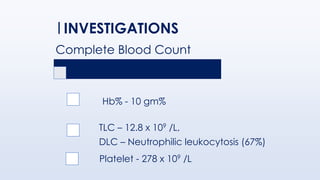
Complete Blood Count
Hb% - 10 gm%
TLC – 12.8 x 10⁹ /L,
DLC – Neutrophilic leukocytosis (67%)
Platelet - 278 x 109 /L
INVESTIGATIONS
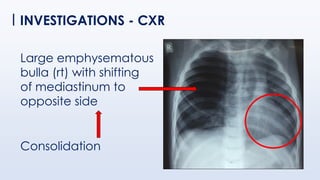
INVESTIGATIONS - CXR
Large emphysematous
bulla (rt) with shifting
of mediastinum to
opposite side
Consolidation
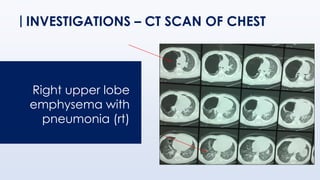
INVESTIGATIONS – CT SCAN OF CHEST
Right upper lobe
emphysema with
pneumonia (rt)
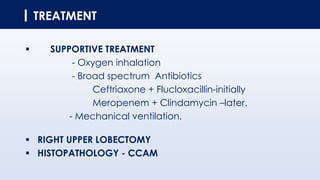
TREATMENT
▪ SUPPORTIVE TREATMENT
- Oxygen inhalation
- Broad spectrum Antibiotics
Ceftriaxone + Flucloxacillin-initially
Meropenem + Clindamycin –later.
- Mechanical ventilation.
▪ RIGHT UPPER LOBECTOMY
▪ HISTOPATHOLOGY - CCAM
CONGENITAL LUNG
MALFORMATION
CONGENITAL LUNG
MALFORMATION
▪ Advances in prenatal and postnatal diagnosis,
perioperative management and postoperative
care have dramatically increase the number of
scientific reports on congenital pulmonary
malformations (CPM).
▪ Nearly all CPM are diagnosed before birth
mostly by antenatal ultrasonography.
▪ After delivery most infants do well and remain
asymptomatic for a long time.
• Prenatal diagnosis is sometimes missed
and detection may occur later,
incidentally in the process of diagnostic
workup of unexplained recurrent or
persistent respiratory symptoms and signs.
• Sometimes they may present with
pneumothorax like symptoms.
CONGENITAL LUNG
MALFORMATION
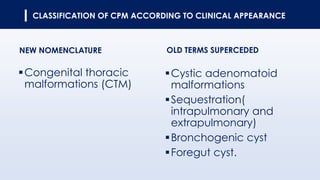
CLASSIFICATION OF CPM ACCORDING TO CLINICAL APPEARANCE
NEW NOMENCLATURE OLD TERMS SUPERCEDED
▪Congenital thoracic
malformations (CTM)
▪Cystic adenomatoid
malformations
▪Sequestration(
intrapulmonary and
extrapulmonary)
▪Bronchogenic cyst
▪Foregut cyst.
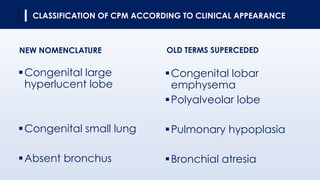
CLASSIFICATION OF CPM ACCORDING TO CLINICAL APPEARANCE
NEW NOMENCLATURE OLD TERMS SUPERCEDED
▪Congenital large
hyperlucent lobe
▪Congenital small lung
▪Absent bronchus
▪Congenital lobar
emphysema
▪Polyalveolar lobe
▪Pulmonary hypoplasia
▪Bronchial atresia
WHAT IS CCAM?
▪ Rare pulmonary developmental hamarto-matous
abnormality.
▪ Comprised of pulmonary tissue with abnormal
bronchial proliferation.
▪ The fundamental pathologic feature of the lesion is
adenomatoid proliferation of bronchioles that form
cysts at the expense of normal alveoli.
CONGENITAL LOBAR EMPHYSEMA (CLE)
▪ Congenital lobar emphysema (CLE) characterized by unilobar
alveolar distension secondary to bronchomalacia or absent
cartilage is a rare condition.
▪ This disease presents as respiratory distress due to the ventilation
perfusion mismatch as a result of the hyper inflated lung causing
compression atelectasis on the ipsilateral or the contralateral
side with mediastinal shift.
▪ The incidence of left upper lobe involvement is 43%, right middle
lobe 32%, right upper lobe 20%, and bilateral involvement 20%.
CONGENITAL LUNG CYST
Bronchogenic cysts are congenital malformations
of the bronchial tree (a type of bronchopulmonary
foregut malformation).
They can present as a mediastinal mass that may
enlarge and cause local compression. It is also
considered the commonest of foregut
duplication cysts.
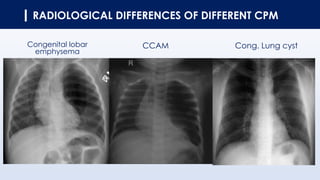
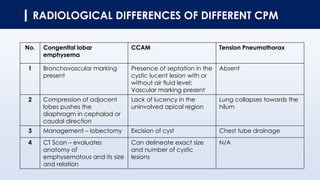
RADIOLOGICAL DIFFERENCES OF DIFFERENT CPM
Congenital lobar
emphysema
CCAM Cong. Lung cyst
RADIOLOGICAL DIFFERENCES OF DIFFERENT CPM
No. Congenital lobar
emphysema
CCAM Tension Pneumothorax
1 Bronchovascular marking
present
Presence of septation in the
cystic lucent lesion with or
without air fluid level;
Vascular marking present
Absent
2 Compression of adjacent
lobes pushes the
diaphragm in cephalad or
caudal direction
Lack of lucency in the
uninvolved apical region
Lung collapses towards the
hilum
3 Management – lobectomy Excision of cyst Chest tube drainage
4 CT Scan – evaluates
anatomy of
emphysematous and its size
and relation
Can delineate exact size
and number of cystic
lesions
N/A
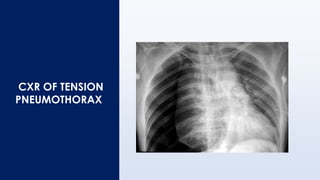
CXR OF TENSION
PNEUMOTHORAX
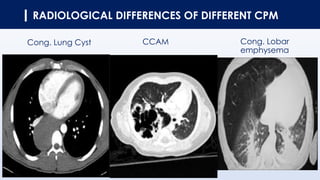
RADIOLOGICAL DIFFERENCES OF DIFFERENT CPM
CCAMCong. Lung Cyst Cong. Lobar
emphysema
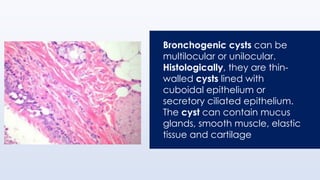
Bronchogenic cysts can be
multilocular or unilocular.
Histologically, they are thin-
walled cysts lined with
cuboidal epithelium or
secretory ciliated epithelium.
The cyst can contain mucus
glands, smooth muscle, elastic
tissue and cartilage
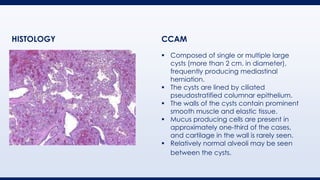
▪ Composed of single or multiple large
cysts (more than 2 cm. in diameter),
frequently producing mediastinal
herniation.
▪ The cysts are lined by ciliated
pseudostratified columnar epithelium.
▪ The walls of the cysts contain prominent
smooth muscle and elastic tissue.
▪ Mucus producing cells are present in
approximately one-third of the cases,
and cartilage in the wall is rarely seen.
▪ Relatively normal alveoli may be seen
between the cysts.
HISTOLOGY CCAM
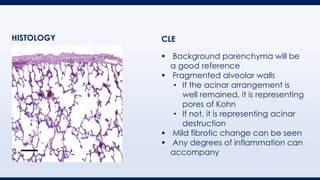
▪ Background parenchyma will be
a good reference
▪ Fragmented alveolar walls
• If the acinar arrangement is
well remained, it is representing
pores of Kohn
• If not, it is representing acinar
destruction
▪ Mild fibrotic change can be seen
▪ Any degrees of inflammation can
accompany
HISTOLOGY CLE
REFERENCES
REFERENCES
CONCLUSION
▪ All pneumothorax in young children are not always simple
pneumothorax.
▪ It should be evaluated thoroughly to rule out congenital
pulmonary malformation.
▪ Clinician must have a high index of suspicion for congenital
pulmonary malformation in the context of respiratory
distress in infancy and early childhood.
▪ Multidisciplinary approach with skilled radiological and
histopathological support can detect congenital lung
disease early, establish definitive treatment and thus
prevent complications.
THANK YOU

Congenital Lung Malformation Mimics Pneumothorax: An Experience in Tertiary Care Hospital

  • 1.
    CONGENITAL LUNG MALFORMATIONS MIMICSPNEUMOTHORAX: An Experience In Tertiary Care Hospital BRIG GEN DR. MAHBUBA SULTANA, ADVISER SPECIALIST, Combined Military Hospital, Dhaka
  • 2.
  • 3.
    CASE-01 Name: Nahid Age: 01year Sex: Male CHIEF COMPLAINTS ▪ Cough and respiratory distress for 1 day. ▪ Fever for 1 day. ▪ H/O recurrent RTI since 3m of age.
  • 4.
    PHYSICAL FINDINGS ▪ Afebrile ▪Dyspneic ▪ Tachypneic (RR – 70/min) With SPO2 95% ▪ HR- 120/min ▪ Respiratory System: RR - 70/min with chest indrawing Apex beat shifted to Lt side. Percussion note – hyper resonant on right side. BS – diminished on rt mid and lower zone. ▪ P/A- mild hepatomegaly ▪ Other system-NAD. CASE-01 Name: Nahid Age: 01 year Sex: Male
  • 5.
    INVESTIGATIONS ▪ CBC-Hb% 14gm/dl ▪ TLC-4.4 X 10⁹ ▪ N-34% ▪ L-62% ▪ PLT-265X 109 gm/dl ▪ ECHO-Normal cardiac anatomy ▪ Gastric lavage-few epithelial cells and no GM stain microorganism CASE-01 Name: Nahid Age: 01 year Sex: Male
  • 6.
  • 7.
    INVESTIGATIONS CT Scan Pneumothorax (rt)with passive collapse of upper and middle lobe of rt lung with mediastinal shifting.
  • 8.
    TREATMENT ▪ Oxygen inhalation ▪Antibiotics ▪ Tube thoracostomy ▪ Thoracotomy & excision of congenital pulmonary cyst for Case - 01
  • 9.
  • 10.
    CASE-02 Name: Tahiya Age: 46days Sex: Female CHIEF COMPLAINTS ▪ Fever with respiratory distress for 7 days. ▪ Past history reveals respiratory tract infection at 20 days of age.
  • 11.
    PHYSICAL FINDINGS ▪ Dyspnoeic ▪Pallor= Moderate ▪ Cyanosis= Absent. ▪ Umbilicus= Hernia present ▪ Temperature= 101° F ▪ Respiratory Rate= 75 breath/min ▪ Heart rate= 150 beat/min ▪ SPO2= 65% in room air, 95% with O2 ▪ Anthropometry CASE-02 Name: Tahiya Age: 46 days Sex: Female
  • 12.
    EXAMINATION – RespiratorySystem INSPECTION ▪ Right sided chest slightly bulged ▪ Movement restricted on right side ▪ Suprasternal, intercostal, subcostal recession PALPATION ▪ Trachea centrally placed ▪ Apex beat in left 4th intercoastal space lateral to mid-clavicular line. Normal in character
  • 13.
    EXAMINATION – RespiratorySystem PERCUSSION ▪ Hyper-resonance on right side of the chest. AUSCULTATION ▪ Breath sound absent on right side. ▪ On left side vesicular breath sound with no added sound.
  • 14.
    DIAGNOSIS PROVISIONAL for Case -02 Pneumonia with Pneumothorax (right) DIFFERENTIAL ▪ Congenital Lobar Emphysema ▪ Congenital Cystic Adenomatoid Malformation (CCAM)
  • 15.
  • 16.
    Complete Blood Count Hb%- 9.1 gm% TLC – 35 x 109 /L, DLC – Neutrophilic leukocytosis (67%) Platelet - 723 x 109 /L INVESTIGATIONS
  • 17.
    INVESTIGATIONS - CXR Mediastinumis shifted towards left. Right hemidiaphragm is not well outlined. Multiple variable sized cystic area are noted in right hemithorax. Few lesion contains fluid level.
  • 18.
    C- REACTIVE PROTEIN 1:4,12 mg/dl (positive) BLOOD CULTURE No growth TRACHEAL ASPIRATE FOR C/S No growth INVESTIGATIONS TORCH Panel Test Negative USG of abdomen (including KUB) Normal ECHO 2D Color Doppler PFO, 2 mm, Lt-Rt shunt
  • 19.
    INVESTIGATIONS Contrast Follow Through Noabnormal filling defect Mucosal outline was normal No defined diaphragmatic herniation is seen
  • 20.
    INVESTIGATIONS Contrast Follow Through ▪Suggestive of encysted hydropneumothorax. • Congenital Cystic Adenomatoid Malformation.
  • 21.
    TREATMENT SUPPORTIVE I/V antibiotic –Meropenem, Flucloxacillin SURGICAL Tube thoracostomy (Rt) was done under L/A and sedation.
  • 22.
  • 23.
    TREATMENT - DEFINITIVE Nameof Operation – Exploratory Thoracotomy with Excision of Multiple Congenital cysts. ▪ Baby was placed on mechanical ventilation ▪ Antibiotics Inj. Meropenem Inj. Metronidazole Inj. Vancomycin
  • 24.
  • 25.
    STATUS POST THORACOTOMY(SERIAL) Remaining right lung is aerated with pleural effusion and pneumonitis right. AFTER SURGERY AFTER REMOVAL OF TUBE LATER – AFTER 3 WEEKS
  • 26.
    • Extubation wasdone after 4 days and the baby maintain Spo2 with face mask O2 inhalation. ▪ Chest drain & CVC removed after 3 days.
  • 27.
  • 28.
    • Active • Norespiratory distress • Feeding on demand • No O2 required • Gradual weight gain FOLLOW-UP
  • 29.
  • 30.
    CASE-03 Name: Noor Age: 12months Sex: Female CHIEF COMPLAINTS ▪ Cough for 20 days ▪ Low grade irregular fever for 20 days
  • 31.
    CASE-03 Name: Noor Age: 12months Sex: Female PHYSICAL FINDINGS ▪ O/E- ▪ Stable clinically ▪ Afebrile ▪ No lymphadenopathy ▪ BCG mark present ▪ R/R- 24/min ▪ HR-120beats/min
  • 32.
    EXAMINATION – RespiratorySystem INSPECTION ▪ Normal present PALPATION ▪ Normal
  • 33.
    EXAMINATION – RespiratorySystem PERCUSSION ▪ Hyper-resonance on right side AUSCULTATION ▪ Breath sound diminished on rt side. Vesicular with crepitations present ▪ Left side normal
  • 34.
    Complete Blood Count Hb%- 10 gm% TLC – 12.8 x 10⁹ /L, DLC – Neutrophilic leukocytosis (67%) Platelet - 278 x 109 /L INVESTIGATIONS
  • 35.
    INVESTIGATIONS - CXR Largeemphysematous bulla (rt) with shifting of mediastinum to opposite side Consolidation
  • 36.
    INVESTIGATIONS – CTSCAN OF CHEST Right upper lobe emphysema with pneumonia (rt)
  • 37.
    TREATMENT ▪ SUPPORTIVE TREATMENT -Oxygen inhalation - Broad spectrum Antibiotics Ceftriaxone + Flucloxacillin-initially Meropenem + Clindamycin –later. - Mechanical ventilation. ▪ RIGHT UPPER LOBECTOMY ▪ HISTOPATHOLOGY - CCAM
  • 38.
  • 39.
    CONGENITAL LUNG MALFORMATION ▪ Advancesin prenatal and postnatal diagnosis, perioperative management and postoperative care have dramatically increase the number of scientific reports on congenital pulmonary malformations (CPM). ▪ Nearly all CPM are diagnosed before birth mostly by antenatal ultrasonography. ▪ After delivery most infants do well and remain asymptomatic for a long time.
  • 40.
    • Prenatal diagnosisis sometimes missed and detection may occur later, incidentally in the process of diagnostic workup of unexplained recurrent or persistent respiratory symptoms and signs. • Sometimes they may present with pneumothorax like symptoms. CONGENITAL LUNG MALFORMATION
  • 41.
    CLASSIFICATION OF CPMACCORDING TO CLINICAL APPEARANCE NEW NOMENCLATURE OLD TERMS SUPERCEDED ▪Congenital thoracic malformations (CTM) ▪Cystic adenomatoid malformations ▪Sequestration( intrapulmonary and extrapulmonary) ▪Bronchogenic cyst ▪Foregut cyst.
  • 42.
    CLASSIFICATION OF CPMACCORDING TO CLINICAL APPEARANCE NEW NOMENCLATURE OLD TERMS SUPERCEDED ▪Congenital large hyperlucent lobe ▪Congenital small lung ▪Absent bronchus ▪Congenital lobar emphysema ▪Polyalveolar lobe ▪Pulmonary hypoplasia ▪Bronchial atresia
  • 44.
    WHAT IS CCAM? ▪Rare pulmonary developmental hamarto-matous abnormality. ▪ Comprised of pulmonary tissue with abnormal bronchial proliferation. ▪ The fundamental pathologic feature of the lesion is adenomatoid proliferation of bronchioles that form cysts at the expense of normal alveoli.
  • 45.
    CONGENITAL LOBAR EMPHYSEMA(CLE) ▪ Congenital lobar emphysema (CLE) characterized by unilobar alveolar distension secondary to bronchomalacia or absent cartilage is a rare condition. ▪ This disease presents as respiratory distress due to the ventilation perfusion mismatch as a result of the hyper inflated lung causing compression atelectasis on the ipsilateral or the contralateral side with mediastinal shift. ▪ The incidence of left upper lobe involvement is 43%, right middle lobe 32%, right upper lobe 20%, and bilateral involvement 20%.
  • 46.
    CONGENITAL LUNG CYST Bronchogeniccysts are congenital malformations of the bronchial tree (a type of bronchopulmonary foregut malformation). They can present as a mediastinal mass that may enlarge and cause local compression. It is also considered the commonest of foregut duplication cysts.
  • 47.
    RADIOLOGICAL DIFFERENCES OFDIFFERENT CPM Congenital lobar emphysema CCAM Cong. Lung cyst
  • 48.
    RADIOLOGICAL DIFFERENCES OFDIFFERENT CPM No. Congenital lobar emphysema CCAM Tension Pneumothorax 1 Bronchovascular marking present Presence of septation in the cystic lucent lesion with or without air fluid level; Vascular marking present Absent 2 Compression of adjacent lobes pushes the diaphragm in cephalad or caudal direction Lack of lucency in the uninvolved apical region Lung collapses towards the hilum 3 Management – lobectomy Excision of cyst Chest tube drainage 4 CT Scan – evaluates anatomy of emphysematous and its size and relation Can delineate exact size and number of cystic lesions N/A
  • 49.
  • 50.
    RADIOLOGICAL DIFFERENCES OFDIFFERENT CPM CCAMCong. Lung Cyst Cong. Lobar emphysema
  • 51.
    Bronchogenic cysts canbe multilocular or unilocular. Histologically, they are thin- walled cysts lined with cuboidal epithelium or secretory ciliated epithelium. The cyst can contain mucus glands, smooth muscle, elastic tissue and cartilage
  • 52.
    ▪ Composed ofsingle or multiple large cysts (more than 2 cm. in diameter), frequently producing mediastinal herniation. ▪ The cysts are lined by ciliated pseudostratified columnar epithelium. ▪ The walls of the cysts contain prominent smooth muscle and elastic tissue. ▪ Mucus producing cells are present in approximately one-third of the cases, and cartilage in the wall is rarely seen. ▪ Relatively normal alveoli may be seen between the cysts. HISTOLOGY CCAM
  • 53.
    ▪ Background parenchymawill be a good reference ▪ Fragmented alveolar walls • If the acinar arrangement is well remained, it is representing pores of Kohn • If not, it is representing acinar destruction ▪ Mild fibrotic change can be seen ▪ Any degrees of inflammation can accompany HISTOLOGY CLE
  • 54.
  • 55.
  • 56.
    CONCLUSION ▪ All pneumothoraxin young children are not always simple pneumothorax. ▪ It should be evaluated thoroughly to rule out congenital pulmonary malformation. ▪ Clinician must have a high index of suspicion for congenital pulmonary malformation in the context of respiratory distress in infancy and early childhood. ▪ Multidisciplinary approach with skilled radiological and histopathological support can detect congenital lung disease early, establish definitive treatment and thus prevent complications.
  • 57.