Imaging the chest in traumaImaging the chest in trauma
Chest traumaChest trauma
Blunt
Penetrating
Trauma Chest RadiographTrauma Chest Radiograph
Usually AP,
often supine,
frequently in
poor
inspiration.
CT ChestCT Chest
Fractures and DislocationsFractures and Dislocations
Spine
Ribs
Clavicles
Sternum
Shoulders
Spine InjuriesSpine Injuries
Loss of alignment,
fractures and
paraspinal hematoma.
Rib FracturesRib Fractures
Indicator of underlying
pleura, lung, liver,
spleen, kidney injuries.
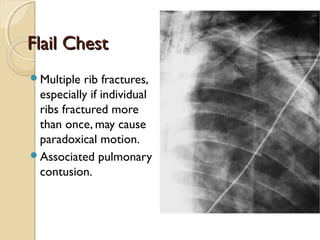
Flail ChestFlail Chest
Multiple rib fractures,
especially if individual
ribs fractured more
than once, may cause
paradoxical motion.
Associated pulmonary
contusion.
Clavicle InjuriesClavicle Injuries
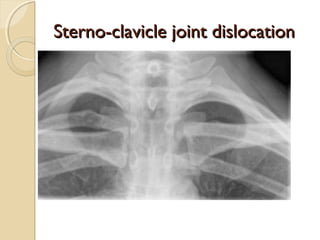
Sterno-clavicle joint dislocationSterno-clavicle joint dislocation
Sterno-clavicle dislocation: CTSterno-clavicle dislocation: CT
Shoulder InjuriesShoulder Injuries
dislocations and
scapula fractures
CT Needed if Scapula Fracture SeenCT Needed if Scapula Fracture Seen
AIR where it shouldnAIR where it shouldn’’t bet be
Pneumothorax
Pneumomediastinum
Subcutaneous emphysema
Systemic venous air embolism
Pneumopericardium
Pneumoperitoneum/retroperitoneum
pnxpnx
PNEUMOTHORAX: CTPNEUMOTHORAX: CT
Much more sensitive
Even a small traumatic pneumothorax is
important, especially if patient
mechanically ventilated or going to OR:
A simple pneumothorax can be
converted into a life- threatening tension
pneumothorax.
PNEUMOTHORAX: CTPNEUMOTHORAX: CT
Pneumothorax: SimplePneumothorax: Simple
Erect AP/PA view best
Visceral pleural line
No vessels or markings
Variable degree of lung collapse
No shift
PNEUMOTHORAX: SimplePNEUMOTHORAX: Simple
PNEUMOTHORAX: TensionPNEUMOTHORAX: Tension
Erect AP/PA view best
Shift of mediastinum/heart/trachea away
from PTX side
Depressed hemidiaphragm
Degree of lung collapse is variable
PNEUMOTHORAX: TensionPNEUMOTHORAX: Tension
PNEUMOTHORAX: SupinePNEUMOTHORAX: Supine
Supine AP view has limited sensitivity: 50%
Deep sulcus sign
Too sharp heart border/hemidiaphragm sign
Increased lucency over lower chest
Cant see vessels
PNEUMOTHORAX: OpenPNEUMOTHORAX: Open
- Gunshot or other wound (hole > 2/3 tracheal diameter) +/-
exit wound
- Air enters the wound rather than trachea and leads to
hypoxia.
- Unequal breath sounds
PNEUMOMEDIASTIUMPNEUMOMEDIASTIUM
Usually from ruptured alveoli.
Can also be from trachea, bronchi,
esophagus, bowel and neck injuries.
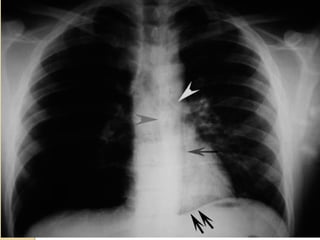
Air forms linear / curvilinear lucencies outlining mediastinal
contours :
Air anterior to pericardium: pneumopericardium
Air around pulmonary artery and main branches: ring around
artery sign
Air outlining major aortic branches: tubular artery sign
Air outlining bronchial wall: double bronchial wall sign
Continuous diaphragm sign: due to air trapped posterior to
pericardium
V sign of Naclerios: “V” sign at aortic-diaphragm junction
Paediatric pneumomediastinum: may have slightly different
appearances:
elevated thymus: thymic wing sign
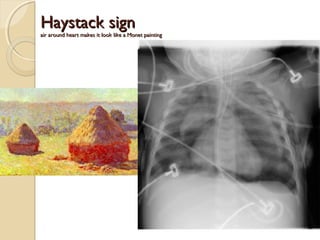
air crossing the superior mediastinum: haystack sign
Ring around the artery signRing around the artery sign
V sign of nacleriosV sign of naclerios
PneumopericardiumPneumopericardium
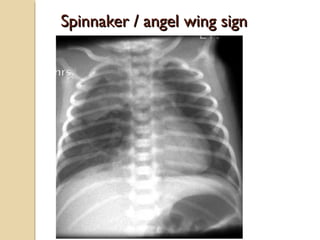
Spinnaker / angel wing signSpinnaker / angel wing sign
Haystack signHaystack sign
air around heart makes it look like a Monet paintingair around heart makes it look like a Monet painting
PNEUMOMEDIASTINUM: CTPNEUMOMEDIASTINUM: CT
Tracheal / bronchial tearsTracheal / bronchial tears
• Most common site - near the carina, because the airway is fixed
and subject to shear injury.
• Tears within the mediastinal pleura – pneumomediastinum
• Tears beyond the mediastinal pleura - pneumothorax.
• Left main bronchus : has a longer mediastinal course than the
right main bronchus & so injury - more likely to cause a
pneumomediastinum & vice versa.
• Severe injuries, both a pneumomediastinum and a
pneumothorax may be present.
Fallen Lung signFallen Lung sign
With complete laceration of the main bronchus, the bronchus may become partially
or completely detached, allowing the lung to fall into a dependent lateral position
PneumoperitoneumPneumoperitoneum
.
PneumoretroperitoneumPneumoretroperitoneum
HEMOTHORAXHEMOTHORAX
Venous or arterial bleeding
Can miss hundreds of cc’s on supine film
HEMOTHORAXHEMOTHORAX
CT: HEMOTHORAXCT: HEMOTHORAX
35-70 HU
PULMONARY CONTUSION andPULMONARY CONTUSION and
LACERATIONLACERATION
Contusion: Blood in intact lung
parenchyma. Non-penetrating.
Laceration: Blood in torn lung
parenchyma
Can’t tell difference on chest film.
Contusions peak in 2-3 days, begin to
resolve in a week; lacerations take much
longer to resolve and may leave scars
ContusionContusion
• Manifest at the time of the initial examination
• Little tendency to increase in severity with subsequent
examinations.
• Radiographic clearing within 48 hours.
• Features are often not localised in a lobar or segmental
pattern.
Plain film Not sensitive.
• Faint patchy consolidative following history of blunt trauma.
• CT – focal, non segmental parenchymal opacification.
• Can have sub-pleural sparing with smaller contusions
• Commoner posteriorly and in lower lobes.
LacerationsLacerations
• Almost always have concurrent contusion
• Pathology
Classification:
Type I - compression rupture: most common type of laceration that usually occurs
as a 2-8 cm lesion in the central lung
Type II - compression shear: occurs after sudden compression of the lower chest
when the lung suffers from a shear injury to the spine
Type III - direct puncture / rib penetration: occur with a penetrating fractured rib;
these lesions are commonly multiple
Type IV - adhesion tears: occurs in sudden injuries of the chest wall where prior
pleuropulmonary adhesions had been created
•Pattern can be similar to contusion
•Often have added rib fractures & pneumothorax
CT
•Regions of pulmonary contusion with added blebs
(pneumatoceles) with air fluid levels.
•Due to normal pulmonary elastic recoil, lung tissues
surrounding a laceration often pull back from the laceration
which manifesting at CT as a round or oval cavity, instead of
having the linear appearance in other solid organs.
•Severe laceration have gross disruption of lung parenchymal
architecture.
DIAPHRAGM InjuriesDIAPHRAGM Injuries
5% of major blunt
trauma, also thoraco-
abdominal
penetrating trauma
Left clinically injured
more than right
60/40
Sensitivity of Chest
film 40%. CT better,
but still misses some
Hard signs: NGT
through g.e. junction
then up into chest,
and hollow viscus
above diaphragm
Soft signs: Indistinct
diaphragm, effusion,
atelectasis
Position of NG TubePosition of NG Tube
Gut in ChestGut in Chest
Vascular InjuryVascular Injury
Signs of mediastinal haematoma:
widened mediastinum
indistinct or abnormal aortic contour
deviation of trachea or NGT to the right
depression of left main bronchus
widened paraspinal stripe
CTCT
Indirect signs of aortic injury:
mediastinal haematoma
periaortic fat stranding
CTA : sensitivity 100%; specificity 100%.
Signs of mediastinal haematoma:
abnormal soft tissue density around mediastinal structures
Location – periaortic haematoma than isolated mediastinal
haematoma remote from the aorta.
Signs of aortic injury:
intraluminal filling defect (intimal flap or clot)
abnormal aortic contour (mural haematoma)
Pseudoaneurysm & extravasation of contrast
Imaging in chest trauma

Imaging in chest trauma

  • 1.
    Imaging the chestin traumaImaging the chest in trauma
  • 2.
  • 3.
    Trauma Chest RadiographTraumaChest Radiograph Usually AP, often supine, frequently in poor inspiration.
  • 4.
  • 5.
    Fractures and DislocationsFracturesand Dislocations Spine Ribs Clavicles Sternum Shoulders
  • 6.
    Spine InjuriesSpine Injuries Lossof alignment, fractures and paraspinal hematoma.
  • 7.
    Rib FracturesRib Fractures Indicatorof underlying pleura, lung, liver, spleen, kidney injuries.
  • 8.
    Flail ChestFlail Chest Multiplerib fractures, especially if individual ribs fractured more than once, may cause paradoxical motion. Associated pulmonary contusion.
  • 9.
  • 10.
  • 11.
  • 12.
  • 13.
    CT Needed ifScapula Fracture SeenCT Needed if Scapula Fracture Seen
  • 14.
    AIR where itshouldnAIR where it shouldn’’t bet be Pneumothorax Pneumomediastinum Subcutaneous emphysema Systemic venous air embolism Pneumopericardium Pneumoperitoneum/retroperitoneum
  • 15.
  • 16.
    PNEUMOTHORAX: CTPNEUMOTHORAX: CT Muchmore sensitive Even a small traumatic pneumothorax is important, especially if patient mechanically ventilated or going to OR: A simple pneumothorax can be converted into a life- threatening tension pneumothorax.
  • 17.
  • 18.
    Pneumothorax: SimplePneumothorax: Simple ErectAP/PA view best Visceral pleural line No vessels or markings Variable degree of lung collapse No shift
  • 19.
  • 20.
    PNEUMOTHORAX: TensionPNEUMOTHORAX: Tension ErectAP/PA view best Shift of mediastinum/heart/trachea away from PTX side Depressed hemidiaphragm Degree of lung collapse is variable
  • 21.
  • 22.
    PNEUMOTHORAX: SupinePNEUMOTHORAX: Supine SupineAP view has limited sensitivity: 50% Deep sulcus sign Too sharp heart border/hemidiaphragm sign Increased lucency over lower chest Cant see vessels
  • 26.
    PNEUMOTHORAX: OpenPNEUMOTHORAX: Open -Gunshot or other wound (hole > 2/3 tracheal diameter) +/- exit wound - Air enters the wound rather than trachea and leads to hypoxia. - Unequal breath sounds
  • 27.
    PNEUMOMEDIASTIUMPNEUMOMEDIASTIUM Usually from rupturedalveoli. Can also be from trachea, bronchi, esophagus, bowel and neck injuries.
  • 28.
    Air forms linear/ curvilinear lucencies outlining mediastinal contours : Air anterior to pericardium: pneumopericardium Air around pulmonary artery and main branches: ring around artery sign Air outlining major aortic branches: tubular artery sign Air outlining bronchial wall: double bronchial wall sign Continuous diaphragm sign: due to air trapped posterior to pericardium V sign of Naclerios: “V” sign at aortic-diaphragm junction Paediatric pneumomediastinum: may have slightly different appearances: elevated thymus: thymic wing sign air crossing the superior mediastinum: haystack sign
  • 29.
    Ring around theartery signRing around the artery sign
  • 31.
    V sign ofnacleriosV sign of naclerios
  • 32.
  • 33.
    Spinnaker / angelwing signSpinnaker / angel wing sign
  • 34.
    Haystack signHaystack sign airaround heart makes it look like a Monet paintingair around heart makes it look like a Monet painting
  • 35.
  • 36.
    Tracheal / bronchialtearsTracheal / bronchial tears • Most common site - near the carina, because the airway is fixed and subject to shear injury. • Tears within the mediastinal pleura – pneumomediastinum • Tears beyond the mediastinal pleura - pneumothorax. • Left main bronchus : has a longer mediastinal course than the right main bronchus & so injury - more likely to cause a pneumomediastinum & vice versa. • Severe injuries, both a pneumomediastinum and a pneumothorax may be present.
  • 37.
    Fallen Lung signFallenLung sign With complete laceration of the main bronchus, the bronchus may become partially or completely detached, allowing the lung to fall into a dependent lateral position
  • 38.
  • 39.
  • 40.
    HEMOTHORAXHEMOTHORAX Venous or arterialbleeding Can miss hundreds of cc’s on supine film
  • 41.
  • 44.
  • 46.
    PULMONARY CONTUSION andPULMONARYCONTUSION and LACERATIONLACERATION Contusion: Blood in intact lung parenchyma. Non-penetrating. Laceration: Blood in torn lung parenchyma Can’t tell difference on chest film. Contusions peak in 2-3 days, begin to resolve in a week; lacerations take much longer to resolve and may leave scars
  • 47.
    ContusionContusion • Manifest atthe time of the initial examination • Little tendency to increase in severity with subsequent examinations. • Radiographic clearing within 48 hours. • Features are often not localised in a lobar or segmental pattern. Plain film Not sensitive. • Faint patchy consolidative following history of blunt trauma. • CT – focal, non segmental parenchymal opacification. • Can have sub-pleural sparing with smaller contusions • Commoner posteriorly and in lower lobes.
  • 49.
    LacerationsLacerations • Almost alwayshave concurrent contusion • Pathology Classification: Type I - compression rupture: most common type of laceration that usually occurs as a 2-8 cm lesion in the central lung Type II - compression shear: occurs after sudden compression of the lower chest when the lung suffers from a shear injury to the spine Type III - direct puncture / rib penetration: occur with a penetrating fractured rib; these lesions are commonly multiple Type IV - adhesion tears: occurs in sudden injuries of the chest wall where prior pleuropulmonary adhesions had been created
  • 50.
    •Pattern can besimilar to contusion •Often have added rib fractures & pneumothorax CT •Regions of pulmonary contusion with added blebs (pneumatoceles) with air fluid levels. •Due to normal pulmonary elastic recoil, lung tissues surrounding a laceration often pull back from the laceration which manifesting at CT as a round or oval cavity, instead of having the linear appearance in other solid organs. •Severe laceration have gross disruption of lung parenchymal architecture.
  • 52.
    DIAPHRAGM InjuriesDIAPHRAGM Injuries 5%of major blunt trauma, also thoraco- abdominal penetrating trauma Left clinically injured more than right 60/40 Sensitivity of Chest film 40%. CT better, but still misses some Hard signs: NGT through g.e. junction then up into chest, and hollow viscus above diaphragm Soft signs: Indistinct diaphragm, effusion, atelectasis
  • 53.
    Position of NGTubePosition of NG Tube
  • 54.
  • 57.
    Vascular InjuryVascular Injury Signsof mediastinal haematoma: widened mediastinum indistinct or abnormal aortic contour deviation of trachea or NGT to the right depression of left main bronchus widened paraspinal stripe
  • 59.
    CTCT Indirect signs ofaortic injury: mediastinal haematoma periaortic fat stranding CTA : sensitivity 100%; specificity 100%. Signs of mediastinal haematoma: abnormal soft tissue density around mediastinal structures Location – periaortic haematoma than isolated mediastinal haematoma remote from the aorta. Signs of aortic injury: intraluminal filling defect (intimal flap or clot) abnormal aortic contour (mural haematoma) Pseudoaneurysm & extravasation of contrast

Editor's Notes

  • #31 A P-A chest radiograph showing the mediastinal air lifting the mediastinal pleura off the descending aorta (indicated by a gray arrow). A linear band of air parallels the other border of the descending aorta (indicated by a gray arrowhead). Linear streaks of air surround the left main bronchus “double bronchial wall sign” (indicated by a white arrowhead). All the extent of the left hemidiaphragm is visible. The “continuous diaphragm sign” (indicated by two black arrows) is seen.