1
Electric Vehicle Financing
Saurabh Trivedi
Senior Analyst, Climate Policy Initiative India
2
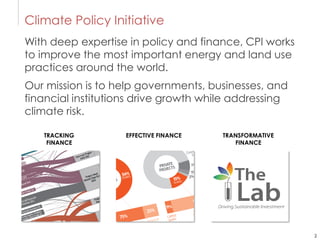
Climate Policy Initiative
With deep expertise in policy and finance, CPI works
to improve the most important energy and land use
practices around the world.
Our mission is to help governments, businesses, and
financial institutions drive growth while addressing
climate risk.
TRACKING
FINANCE
EFFECTIVE FINANCE TRANSFORMATIVE
FINANCE
3
The India Innovation Lab for Green Finance
www.climatefinancelab.org
4
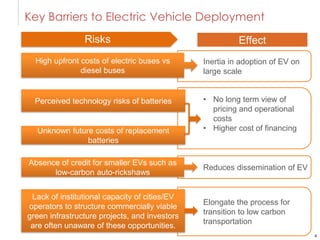
Key Barriers to Electric Vehicle Deployment
Reduces dissemination of EV
EffectRisks
Inertia in adoption of EV on
large scale
High upfront costs of electric buses vs
diesel buses
• No long term view of
pricing and operational
costs
• Higher cost of financing
Perceived technology risks of batteries
Unknown future costs of replacement
batteries
Elongate the process for
transition to low carbon
transportation
Lack of institutional capacity of cities/EV
operators to structure commercially viable
green infrastructure projects, and investors
are often unaware of these opportunities.
Absence of credit for smaller EVs such as
low-carbon auto-rickshaws
5
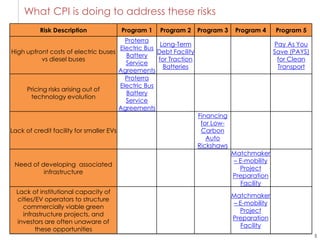
What CPI is doing to address these risks
Risk Description Program 1 Program 2 Program 3 Program 4 Program 5
High upfront costs of electric buses
vs diesel buses
Proterra
Electric Bus
Battery
Service
Agreements
Long-Term
Debt Facility
for Traction
Batteries
Pay As You
Save (PAYS)
for Clean
Transport
Pricing risks arising out of
technology evolution
Proterra
Electric Bus
Battery
Service
Agreements
Lack of credit facility for smaller EVs
Financing
for Low-
Carbon
Auto
Rickshaws
Need of developing associated
infrastructure
Matchmaker
– E-mobility
Project
Preparation
Facility
Lack of institutional capacity of
cities/EV operators to structure
commercially viable green
infrastructure projects, and
investors are often unaware of
these opportunities
Matchmaker
– E-mobility
Project
Preparation
Facility
6
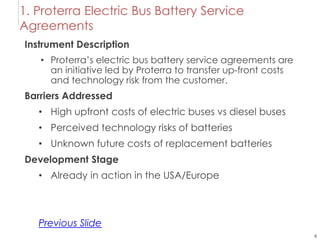
1. Proterra Electric Bus Battery Service
Agreements
Instrument Description
• Proterra’s electric bus battery service agreements are
an initiative led by Proterra to transfer up-front costs
and technology risk from the customer.
Barriers Addressed
• High upfront costs of electric buses vs diesel buses
• Perceived technology risks of batteries
• Unknown future costs of replacement batteries
Development Stage
• Already in action in the USA/Europe
Previous Slide
7
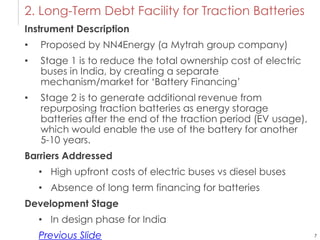
2. Long-Term Debt Facility for Traction Batteries
Instrument Description
• Proposed by NN4Energy (a Mytrah group company)
• Stage 1 is to reduce the total ownership cost of electric
buses in India, by creating a separate
mechanism/market for ‘Battery Financing’
• Stage 2 is to generate additional revenue from
repurposing traction batteries as energy storage
batteries after the end of the traction period (EV usage),
which would enable the use of the battery for another
5-10 years.
Barriers Addressed
• High upfront costs of electric buses vs diesel buses
• Absence of long term financing for batteries
Development Stage
• In design phase for India
Previous Slide
8
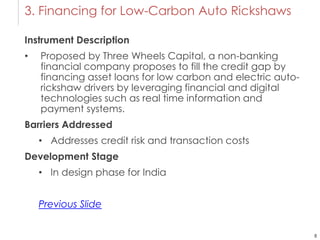
3. Financing for Low-Carbon Auto Rickshaws
Instrument Description
• Proposed by Three Wheels Capital, a non-banking
financial company proposes to fill the credit gap by
financing asset loans for low carbon and electric auto-
rickshaw drivers by leveraging financial and digital
technologies such as real time information and
payment systems.
Barriers Addressed
• Addresses credit risk and transaction costs
Development Stage
• In design phase for India
Previous Slide
9
4. Pay As You Save (PAYS) for Clean Transport
Instrument Description
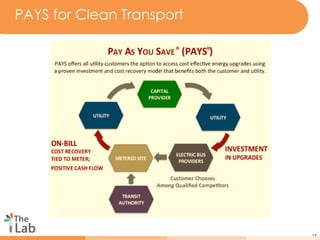
• Proposed by Clean Energy Works, PAYS for clean
transport idea aims to accelerate clean transit in cities,
by lowering the upfront costs of electric buses via a Pay-
As-You-Save mechanism where a utility invests in the
upfront upgrades – on-board batteries and charging
stations – and recovers those costs with a charge on the
customer’s bill that is less than the estimated savings.
Barriers Addressed
• High upfront costs of electric buses
Development Stage
• In design phase for Africa and India
Previous Slide
10
5. Matchmaker – E-mobility Project Preparation
Facility
Instrument Description
• Proposed by Carbon Disclosure Project (CDP) aims to
help green infrastructure projects especially across cities
get access to capital by connecting urban entities with
various investor classes, while providing project
preparation support to make them commercially viable.
Barriers Addressed
• Lack of institutional capacity of cities/EV operators to
structure commercially viable green infrastructure
projects
• Unawareness of investors about such projects
Development Stage
• In design phase for Indian cities
• Already working closely with J&K government
Previous Slide
11
Thanks…
12
Backup Slides
13
Instrument Mechanics
Matchmaker
Service
Energy / Energy
efficiency
Urban mobility
Waste
management
Water
management
Housing
Commercial
viability
Development
impact
Operational
stability Financial Technical
Market
assessment
Legal
Investor
subscriptions
Project
Preparation
Services required to
make project bankable
Grants
• Project overview
• Projected impact
• Finance
• Barriers and risk
• Strategic policy
framework
• Investor data
reporting
• Foundations
• Government institutions
• Others
City Project
What projects are
needed & feasible?
14
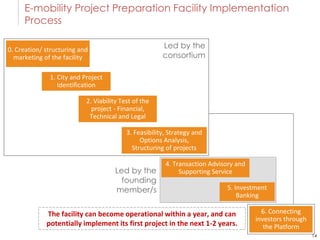
E-mobility Project Preparation Facility Implementation
Process
14
0. Creation/ structuring and
marketing of the facility
1. City and Project
Identification
2. Viability Test of the
project - Financial,
Technical and Legal
3. Feasibility, Strategy and
Options Analysis,
Structuring of projects
4. Transaction Advisory and
Supporting Service
5. Investment
Banking
6. Connecting
investors through
the Platform
Led by the
consortium
Led by the
founding
member/s
The facility can become operational within a year, and can
potentially implement its first project in the next 1-2 years.
15
PAYS for Clean Transport
16
Catalytic Finance Interventions
The US-India Clean Energy Finance Facility
(USICEF) works to meet the growing demand for
electricity within India’s rapidly expanding
economy as India’s first facility to help promising
distributed solar projects develop into viable
investment opportunities, via essential early-stage
project preparation support.
The US-India Catalytic Finance Program (USCISF)
aims to fillip the distributed renewable energy
sector through development of financial
interventions that can mobilize private capital, thus
assisting in India’s policy targets of achieving 40
GW installed capacity in the DRE sector by 2022.
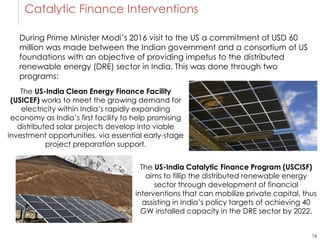
During Prime Minister Modi’s 2016 visit to the US a commitment of USD 60
million was made between the Indian government and a consortium of US
foundations with an objective of providing impetus to the distributed
renewable energy (DRE) sector in India. This was done through two
programs:
17
US-India Clean Energy Finance (USICEF)
India’s first project preparation facility to scale up distributed
solar power projects and drive long-term financing
18
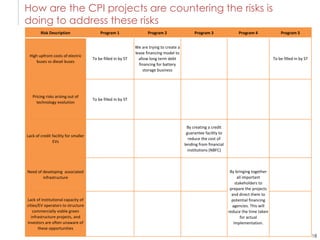
How are the CPI projects are countering the risks is
doing to address these risks
Risk Description Program 1 Program 2 Program 3 Program 4 Program 5
High upfront costs of electric
buses vs diesel buses
To be filled in by ST
We are trying to create a
lease financing model to
allow long term debt
financing for battery
storage business
To be filled in by ST
Pricing risks arising out of
technology evolution
To be filled in by ST
Lack of credit facility for smaller
EVs
By creating a credit
guarantee facility to
reduce the cost of
lending from financial
institutions (NBFC)
Need of developing associated
infrastructure
By bringing together
all important
stakeholders to
prepare the projects
and direct them to
potential financing
agencies. This will
reduce the time taken
for actual
implementation.
Lack of institutional capacity of
cities/EV operators to structure
commercially viable green
infrastructure projects, and
investors are often unaware of
these opportunities

CK2018: Electric Vehicle Financing

  • 1.
    1 Electric Vehicle Financing SaurabhTrivedi Senior Analyst, Climate Policy Initiative India
  • 2.
    2 Climate Policy Initiative Withdeep expertise in policy and finance, CPI works to improve the most important energy and land use practices around the world. Our mission is to help governments, businesses, and financial institutions drive growth while addressing climate risk. TRACKING FINANCE EFFECTIVE FINANCE TRANSFORMATIVE FINANCE
  • 3.
    3 The India InnovationLab for Green Finance www.climatefinancelab.org
  • 4.
    4 Key Barriers toElectric Vehicle Deployment Reduces dissemination of EV EffectRisks Inertia in adoption of EV on large scale High upfront costs of electric buses vs diesel buses • No long term view of pricing and operational costs • Higher cost of financing Perceived technology risks of batteries Unknown future costs of replacement batteries Elongate the process for transition to low carbon transportation Lack of institutional capacity of cities/EV operators to structure commercially viable green infrastructure projects, and investors are often unaware of these opportunities. Absence of credit for smaller EVs such as low-carbon auto-rickshaws
  • 5.
    5 What CPI isdoing to address these risks Risk Description Program 1 Program 2 Program 3 Program 4 Program 5 High upfront costs of electric buses vs diesel buses Proterra Electric Bus Battery Service Agreements Long-Term Debt Facility for Traction Batteries Pay As You Save (PAYS) for Clean Transport Pricing risks arising out of technology evolution Proterra Electric Bus Battery Service Agreements Lack of credit facility for smaller EVs Financing for Low- Carbon Auto Rickshaws Need of developing associated infrastructure Matchmaker – E-mobility Project Preparation Facility Lack of institutional capacity of cities/EV operators to structure commercially viable green infrastructure projects, and investors are often unaware of these opportunities Matchmaker – E-mobility Project Preparation Facility
  • 6.
    6 1. Proterra ElectricBus Battery Service Agreements Instrument Description • Proterra’s electric bus battery service agreements are an initiative led by Proterra to transfer up-front costs and technology risk from the customer. Barriers Addressed • High upfront costs of electric buses vs diesel buses • Perceived technology risks of batteries • Unknown future costs of replacement batteries Development Stage • Already in action in the USA/Europe Previous Slide
  • 7.
    7 2. Long-Term DebtFacility for Traction Batteries Instrument Description • Proposed by NN4Energy (a Mytrah group company) • Stage 1 is to reduce the total ownership cost of electric buses in India, by creating a separate mechanism/market for ‘Battery Financing’ • Stage 2 is to generate additional revenue from repurposing traction batteries as energy storage batteries after the end of the traction period (EV usage), which would enable the use of the battery for another 5-10 years. Barriers Addressed • High upfront costs of electric buses vs diesel buses • Absence of long term financing for batteries Development Stage • In design phase for India Previous Slide
  • 8.
    8 3. Financing forLow-Carbon Auto Rickshaws Instrument Description • Proposed by Three Wheels Capital, a non-banking financial company proposes to fill the credit gap by financing asset loans for low carbon and electric auto- rickshaw drivers by leveraging financial and digital technologies such as real time information and payment systems. Barriers Addressed • Addresses credit risk and transaction costs Development Stage • In design phase for India Previous Slide
  • 9.
    9 4. Pay AsYou Save (PAYS) for Clean Transport Instrument Description • Proposed by Clean Energy Works, PAYS for clean transport idea aims to accelerate clean transit in cities, by lowering the upfront costs of electric buses via a Pay- As-You-Save mechanism where a utility invests in the upfront upgrades – on-board batteries and charging stations – and recovers those costs with a charge on the customer’s bill that is less than the estimated savings. Barriers Addressed • High upfront costs of electric buses Development Stage • In design phase for Africa and India Previous Slide
  • 10.
    10 5. Matchmaker –E-mobility Project Preparation Facility Instrument Description • Proposed by Carbon Disclosure Project (CDP) aims to help green infrastructure projects especially across cities get access to capital by connecting urban entities with various investor classes, while providing project preparation support to make them commercially viable. Barriers Addressed • Lack of institutional capacity of cities/EV operators to structure commercially viable green infrastructure projects • Unawareness of investors about such projects Development Stage • In design phase for Indian cities • Already working closely with J&K government Previous Slide
  • 11.
  • 12.
  • 13.
    13 Instrument Mechanics Matchmaker Service Energy /Energy efficiency Urban mobility Waste management Water management Housing Commercial viability Development impact Operational stability Financial Technical Market assessment Legal Investor subscriptions Project Preparation Services required to make project bankable Grants • Project overview • Projected impact • Finance • Barriers and risk • Strategic policy framework • Investor data reporting • Foundations • Government institutions • Others City Project What projects are needed & feasible?
  • 14.
    14 E-mobility Project PreparationFacility Implementation Process 14 0. Creation/ structuring and marketing of the facility 1. City and Project Identification 2. Viability Test of the project - Financial, Technical and Legal 3. Feasibility, Strategy and Options Analysis, Structuring of projects 4. Transaction Advisory and Supporting Service 5. Investment Banking 6. Connecting investors through the Platform Led by the consortium Led by the founding member/s The facility can become operational within a year, and can potentially implement its first project in the next 1-2 years.
  • 15.
  • 16.
    16 Catalytic Finance Interventions TheUS-India Clean Energy Finance Facility (USICEF) works to meet the growing demand for electricity within India’s rapidly expanding economy as India’s first facility to help promising distributed solar projects develop into viable investment opportunities, via essential early-stage project preparation support. The US-India Catalytic Finance Program (USCISF) aims to fillip the distributed renewable energy sector through development of financial interventions that can mobilize private capital, thus assisting in India’s policy targets of achieving 40 GW installed capacity in the DRE sector by 2022. During Prime Minister Modi’s 2016 visit to the US a commitment of USD 60 million was made between the Indian government and a consortium of US foundations with an objective of providing impetus to the distributed renewable energy (DRE) sector in India. This was done through two programs:
  • 17.
    17 US-India Clean EnergyFinance (USICEF) India’s first project preparation facility to scale up distributed solar power projects and drive long-term financing
  • 18.
    18 How are theCPI projects are countering the risks is doing to address these risks Risk Description Program 1 Program 2 Program 3 Program 4 Program 5 High upfront costs of electric buses vs diesel buses To be filled in by ST We are trying to create a lease financing model to allow long term debt financing for battery storage business To be filled in by ST Pricing risks arising out of technology evolution To be filled in by ST Lack of credit facility for smaller EVs By creating a credit guarantee facility to reduce the cost of lending from financial institutions (NBFC) Need of developing associated infrastructure By bringing together all important stakeholders to prepare the projects and direct them to potential financing agencies. This will reduce the time taken for actual implementation. Lack of institutional capacity of cities/EV operators to structure commercially viable green infrastructure projects, and investors are often unaware of these opportunities