
Peace and Conflict Resolution
Bases of conflicts - Positive and
negative aspects of conflicts
By
M.VIJAYALAKSHMI
Assistant Professor
Objectives
At the end of the course the student teacher will
1. Understand the concept of peace education.
2. Understand the dynamics of transformation of
violence into Peace.
3. Understand the nature of conflicts and their
resolution.
4. Imbibe the knowledge, attitudes and skills
needed to achieve and sustain a global culture
of peace.
5. Adopt peace education in the curriculum.
Unit – 4:
Peace and Conflict Resolution
4.1 Bases of conflicts - Positive and negative
aspects of conflicts
4.2 Types of conflict -Learning of conflict
management and conflict resolution
4.3 Role of Peace Education in resolving conflict
4.4 Reducing conflicts among students
Unit – 4:
Peace and Conflict Resolution
4.1 Bases of conflicts - Positive
and negative aspects of conflicts
Peace and Conflict
• How beautiful is all this visible world! How
glorious in its action and itself. But we, who
name ourselves its sovereigns, we, half dust,
half deity, alike unfit To sink or soar, with our
mixed essence make A conflict of its
elements, and breathe The breath of
degradation and of pride. —Rochdale
• Conflict can be seen simply is a distinct
category of social behavior as two parties
trying to get something they both cannot
have.
• Moreover, conflict can be apprehended as a
potentiality or a situation, as a structure or a
manifestation, as an event or a process.
• Peace is desired by overwhelming majority of
human beings and it is few who want to
perpetuate violence, war and conflict.
• In everyday life, conflict is encountered at all
levels of human relationships which is
frequently compared to dispute, contrasts of
interest, power and the use of violence.
• We must remember that violence and conflict
are perpetrated by powerful vested interests
whether they are local, regional, national or
international.
• The peace researcher Ulrike C. Wasmuth
defines conflict therefore as a “Social
condition, in which at least two parties
(individuals, groups, states) are involved who
(a) pursue different, incompatible aims, in
relation to the originating point, or who
pursue the same aim, but one which can only
be achieved by a single party and/or (b) who
attempt to use different, incompatible
means, in relation to the originating point, in
order to achieve a specific aim. ”
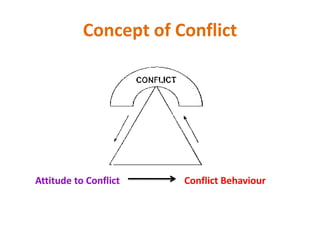
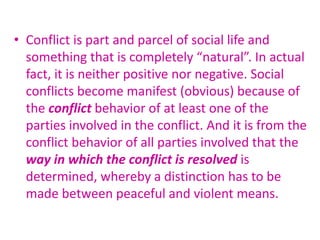
Concept of Conflict
Attitude to Conflict Conflict Behaviour
• Conflict is part and parcel of social life and
something that is completely “natural”. In actual
fact, it is neither positive nor negative. Social
conflicts become manifest (obvious) because of
the conflict behavior of at least one of the
parties involved in the conflict. And it is from the
conflict behavior of all parties involved that the
way in which the conflict is resolved is
determined, whereby a distinction has to be
made between peaceful and violent means.
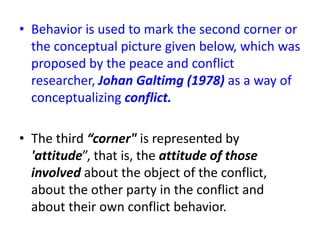
• Behavior is used to mark the second corner or
the conceptual picture given below, which was
proposed by the peace and conflict
researcher, Johan Galtimg (1978) as a way of
conceptualizing conflict.
• The third “corner" is represented by
'attitude”, that is, the attitude of those
involved about the object of the conflict,
about the other party in the conflict and
about their own conflict behavior.
Conflict: Meaning
• A conflict is more than a mere disagreement
— it is a situation in which people perceive a
threat (physical, emotional, power, status,
etc.) to their well-being.
• The term ‘conflict' in some societies refers to
physical violence, while in others it indicates a
clash of ideas or perspectives.
• Conflict inherently involves some sense of
struggle or incompatibility or perceived
difference among values, goals, or desires.
Conflict: Definitions
• The dictionary defines “conflict” as “a struggle
to resist or overcome; contest of opposing
forces or powers; strife; battle; a state or
condition of opposition; antagonism; discord;
a painful tension set up by a clash between
opposed and contradictory impulses.”
Conflict: Characteristics
• Interdependence — those involved need
something from each other;
• Blame — the parties attribute the cause of the
dispute to the behavior, attitude, beliefs, and so
on of the other;
• Anger - the situation causes one or both parties
to experience significant emotional reaction, in
the form of anger;
• Actual problems — the behavior of those
involved in the conflict leads to problems for
themselves and others.
- Dana (2000)
Bases of Conflicts
• Conflicts are often perceived as battles
required to be won.
• They often produce an internal conflictual
dynamic which makes peaceful, constructive
and non-violent settlement difficult or
impossible.
• Conflict can arise between several characters
as conflict is defined “as natural
disagreement resulting from individuals or
groups that differ in beliefs, attitudes, values
or needs”.
• If people create a society that doesn’t see
‘difference’ and ‘diversity’ as problems but as
valuable for social growth, many causes of
conflict disappear.
• Much conflict can be avoided by
understanding the most basic elements of
human behavior so that we can deal more
effectively with potential conflict situations.
• Personality differences are a primary cause of
conflict.
• People in conflict usually perceive that they
have too little power and self-esteem and that
the other party has too much.
• Of course with each person thinking and
feeling this way, something needs to be
adjusted.
Positive and Negative Aspects of Conflicts
• Conflict can be a negative when ignored; however, if it
is managed properly conflict can have many positive
aspects.
• Conflict is constructive when people involved have a
positive learning experience from the event.
• Constructive conflict contributes to creativity and
innovation.
• On the other hand, destructive conflict often manifests
itself as personal, vindictive, and it can be source of
immense pain.
• If conflict is not managed, it can have many negative
aspects.
Positive Aspects
• Forces the parties involved to examine a
problem and work toward a solution.
• Can help people to gain new information and
new ways of looking at things — can force us
to explore new ideas.
• When it occurs in groups, working together to
solve a problem can increase cohesiveness
within the group.
• Confronting and wanting to solve a problem
indicates a concern, commitment, and a
desire to preserve the relationship.
• Learn more about the people involved and
grow with each conflict experience
• Defines issues and provides opportunities to
resolve these issues
• Increases group cohesion leads to alliances
with other groups
Negative aspects
• Conflict can lead to negative feelings between
the parties involved.
• Can lead individuals or groups to close
themselves off from one another (sets a bad
precedent for future dealings with the
conflicting party).
• Can waste time and energy if poor conflict
style is used.
• Become less motivated and inactive
• Confused by differences of opinions
• Increases inter-group tension and diverts
attention from objectives
• Causes negative emotions and possibly violent
behavior
• Creates the desire to abandon the problem
situation for a safer subject
• Creates or increases antagonism
• Causes stress and frustration
Sources are taken from
•Slidesharenet.com
•Web sources

Peace and Conflict Resolution

  • 1.
    Peace and ConflictResolution Bases of conflicts - Positive and negative aspects of conflicts By M.VIJAYALAKSHMI Assistant Professor
  • 2.
    Objectives At the endof the course the student teacher will 1. Understand the concept of peace education. 2. Understand the dynamics of transformation of violence into Peace. 3. Understand the nature of conflicts and their resolution. 4. Imbibe the knowledge, attitudes and skills needed to achieve and sustain a global culture of peace. 5. Adopt peace education in the curriculum.
  • 3.
    Unit – 4: Peaceand Conflict Resolution 4.1 Bases of conflicts - Positive and negative aspects of conflicts 4.2 Types of conflict -Learning of conflict management and conflict resolution 4.3 Role of Peace Education in resolving conflict 4.4 Reducing conflicts among students
  • 4.
    Unit – 4: Peaceand Conflict Resolution 4.1 Bases of conflicts - Positive and negative aspects of conflicts
  • 5.
    Peace and Conflict •How beautiful is all this visible world! How glorious in its action and itself. But we, who name ourselves its sovereigns, we, half dust, half deity, alike unfit To sink or soar, with our mixed essence make A conflict of its elements, and breathe The breath of degradation and of pride. —Rochdale
  • 6.
    • Conflict canbe seen simply is a distinct category of social behavior as two parties trying to get something they both cannot have. • Moreover, conflict can be apprehended as a potentiality or a situation, as a structure or a manifestation, as an event or a process. • Peace is desired by overwhelming majority of human beings and it is few who want to perpetuate violence, war and conflict.
  • 7.
    • In everydaylife, conflict is encountered at all levels of human relationships which is frequently compared to dispute, contrasts of interest, power and the use of violence. • We must remember that violence and conflict are perpetrated by powerful vested interests whether they are local, regional, national or international.
  • 8.
    • The peaceresearcher Ulrike C. Wasmuth defines conflict therefore as a “Social condition, in which at least two parties (individuals, groups, states) are involved who (a) pursue different, incompatible aims, in relation to the originating point, or who pursue the same aim, but one which can only be achieved by a single party and/or (b) who attempt to use different, incompatible means, in relation to the originating point, in order to achieve a specific aim. ”
  • 9.
    Concept of Conflict Attitudeto Conflict Conflict Behaviour
  • 10.
    • Conflict ispart and parcel of social life and something that is completely “natural”. In actual fact, it is neither positive nor negative. Social conflicts become manifest (obvious) because of the conflict behavior of at least one of the parties involved in the conflict. And it is from the conflict behavior of all parties involved that the way in which the conflict is resolved is determined, whereby a distinction has to be made between peaceful and violent means.
  • 11.
    • Behavior isused to mark the second corner or the conceptual picture given below, which was proposed by the peace and conflict researcher, Johan Galtimg (1978) as a way of conceptualizing conflict. • The third “corner" is represented by 'attitude”, that is, the attitude of those involved about the object of the conflict, about the other party in the conflict and about their own conflict behavior.
  • 12.
    Conflict: Meaning • Aconflict is more than a mere disagreement — it is a situation in which people perceive a threat (physical, emotional, power, status, etc.) to their well-being.
  • 13.
    • The term‘conflict' in some societies refers to physical violence, while in others it indicates a clash of ideas or perspectives. • Conflict inherently involves some sense of struggle or incompatibility or perceived difference among values, goals, or desires.
  • 14.
    Conflict: Definitions • Thedictionary defines “conflict” as “a struggle to resist or overcome; contest of opposing forces or powers; strife; battle; a state or condition of opposition; antagonism; discord; a painful tension set up by a clash between opposed and contradictory impulses.”
  • 15.
    Conflict: Characteristics • Interdependence— those involved need something from each other; • Blame — the parties attribute the cause of the dispute to the behavior, attitude, beliefs, and so on of the other; • Anger - the situation causes one or both parties to experience significant emotional reaction, in the form of anger; • Actual problems — the behavior of those involved in the conflict leads to problems for themselves and others. - Dana (2000)
  • 16.
    Bases of Conflicts •Conflicts are often perceived as battles required to be won. • They often produce an internal conflictual dynamic which makes peaceful, constructive and non-violent settlement difficult or impossible.
  • 17.
    • Conflict canarise between several characters as conflict is defined “as natural disagreement resulting from individuals or groups that differ in beliefs, attitudes, values or needs”. • If people create a society that doesn’t see ‘difference’ and ‘diversity’ as problems but as valuable for social growth, many causes of conflict disappear.
  • 18.
    • Much conflictcan be avoided by understanding the most basic elements of human behavior so that we can deal more effectively with potential conflict situations. • Personality differences are a primary cause of conflict.
  • 19.
    • People inconflict usually perceive that they have too little power and self-esteem and that the other party has too much. • Of course with each person thinking and feeling this way, something needs to be adjusted.
  • 20.
    Positive and NegativeAspects of Conflicts • Conflict can be a negative when ignored; however, if it is managed properly conflict can have many positive aspects. • Conflict is constructive when people involved have a positive learning experience from the event. • Constructive conflict contributes to creativity and innovation. • On the other hand, destructive conflict often manifests itself as personal, vindictive, and it can be source of immense pain. • If conflict is not managed, it can have many negative aspects.
  • 21.
    Positive Aspects • Forcesthe parties involved to examine a problem and work toward a solution. • Can help people to gain new information and new ways of looking at things — can force us to explore new ideas. • When it occurs in groups, working together to solve a problem can increase cohesiveness within the group.
  • 22.
    • Confronting andwanting to solve a problem indicates a concern, commitment, and a desire to preserve the relationship. • Learn more about the people involved and grow with each conflict experience • Defines issues and provides opportunities to resolve these issues • Increases group cohesion leads to alliances with other groups
  • 23.
    Negative aspects • Conflictcan lead to negative feelings between the parties involved. • Can lead individuals or groups to close themselves off from one another (sets a bad precedent for future dealings with the conflicting party). • Can waste time and energy if poor conflict style is used. • Become less motivated and inactive
  • 24.
    • Confused bydifferences of opinions • Increases inter-group tension and diverts attention from objectives • Causes negative emotions and possibly violent behavior • Creates the desire to abandon the problem situation for a safer subject • Creates or increases antagonism • Causes stress and frustration
  • 25.
    Sources are takenfrom •Slidesharenet.com •Web sources