Thomas Ziehe(B. 1947)Youth, Culture, & SchoolProgrammeClass discussion – the ideas of ZieheInterview (clip) + active listening“Centre the Circle”3 difficulties in the area of education according to ZieheA short clip concerning the concept of the panopticon
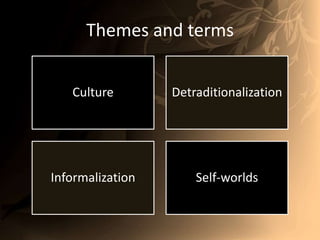
Themes and terms
CulturePopular culture is now the leading culture and is widely accepted by all generationsProblem: The expansion of popular culture is relativating the position of high culture. High culture is being marginalized The mental distance for young people towards high culture is significant. High culture appears strange. High culture is no longer the normative roof. You are not supposed to relate to it. The individuals become cultural self suppliers (constructing self-worlds).
Self-worldsThe change in the view of culture results both in more freedom but also more distance to other domainsThe self-world becomes the only criteria. The self-world is a very artificial construction. Self-worlds existed before but now they are in the centre so to speakA self-world is a construction of tunnels of relevanceThey give an optional view towards the worldParadox: more access to and a more liberal attitude towards culture – at the same time  greater danger of a narrow construction of self-worlds.
DetraditionalizationYoung people feel included in popular culture – but rather excluded from institutional cultureThe institutions no longer have the power to form the students– they are allowed (at least internally) to say “no”They can bring popular culture into the institutions School becomes informal. Both liberating and conflictive
Mental self-referenceThe modern mental self-reference means letting all expectations of and requests from the outside world pass through a subjective filterSelf-reference and discussions of relations become part of everyday interactionIn this way, the mental has become a public space.Aspire a certain type of self-doubt
Ziehe interviewActive listeningNote what impact the changes in society that Ziehe describes have on education and teaching (the changes in culture, tradition, etc.)What are the solutions? 7
Center the CircleWhat part of Ziehe’s social diagnosis is still adequate today? Is his description of youth compatible with young people of today? Depending on your views what can you agree upon should be done by teachers and schools to cope with these challenges? 8
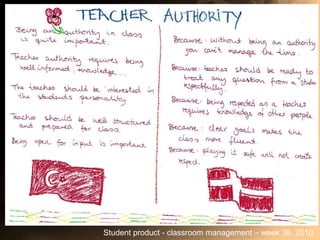
Student product - classroom management – week 38, 2010
Ziehe – the optimistBefore pointing out three difficulties concerning the above – a cognitive, a social, and a subjective, Ziehe makes clear that:He is pointing out difficulties in order to give a relief. Relief for teachers to avoid resignation. To prevent the thought of being a professional fiasco. Not a complaint.Not trying to blame anyone.Many adults have a complaint position and the children are fed up with it.  The atmosphere in school must not be polluted by blame
Problem 1: Students are unused to cognitive strangenessStudents less and less meet a strangeness they can accept.Students search for an immediate relevance to their self-worldQuickly categorizes strangeness as being dull, senseless, or making them feel uneasy. Students don’t know the language of school books (language barriers).Teachers try to make the contend plausible – they try to please the studentsPositive that the teacher tries to motivate.  Students say less (even in universities). Results in teacher-centred teaching (involuntarily) “It was alright – why should we talk about it? Problem with discursiveness. Felt as a problem for the young people.Dream of transcending their own self-worlds. They wish to learn how to enter a new discourse.
Problem 2: high level of informalization& under-structure. The informality comes to a degree that results in hard work for the teacher. Phenomena of being under-structuredADD (Attention Deficit Disorder)becomes the “normal” way of being.Students are skilful in areas as needed in games and on the internet but struggle with structure (I.e. For instance structuring a text)It is a problem to internalise institutional structures. Counter desires:- stable relations, integrations and support- for some sort of shielding in relation to continually being observed by society and authorities- for normative clarity, distinct rules of orientation, security and barriersStudents can see that structures are a means to calmness.
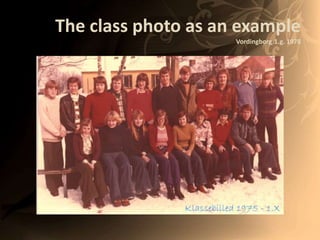
The class photo as an exampleVordingborg 1.g. 1978
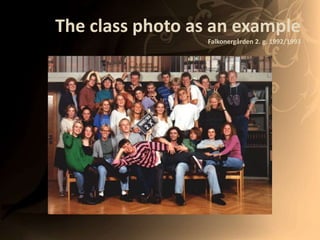
The class photo as an exampleFalkonergården 2. g. 1992/1993
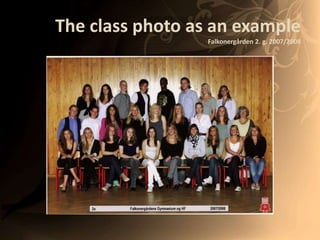
The class photo as an exampleFalkonergården2. g. 2007/2008
Problem 3: Motivational conflict or subjectivationThe degree of self-observation is immense in today’s world.High level of self-conversation (still young people are highly competent when dealing with  relations) Harder to decide for something - harder to engage in something fully. “It is of no use to listen to my inner voice – they are to many of them....“ To motivate yourself is becoming hard work and this is the way school is going (more democratic schools etc.) Motivating yourself is exhausting. Confronted with a shame-conflict (not the same as guilt - my wishes are not legitimate, is it sinful) concerns self-value “Am I good enough?” Change from a morale modus (what is forbidden) to psycho-hygienical modus (what is good for your development) humane and nice but students feel exposed.  Abstract wish for being perfect – hard time to bear with an object that is not perfect not tolerant to your own not-knowing. Teachers have a hard time being helpful without pressing too hard. Reverse wish: high longing for pride.
How to deal with difficulties in schoolDealing with strangenessTake them into account without blaming - work with the acceptance of strangeness. Do not only relate to self worlds. Use “well-dozed strangeness”. School should not excuse its own strangeness. The teacher is a guide in strange sense areas (with tact, making it bearable what students do not understand) . Aim: To better the image of strangeness.
How to deal with difficulties in schoolUsing structure productivelyStructure does not have to be bureaucratic. But can diminish diffusion. Rules can be productive. Outer structures give chances to build up inner structures. Older generations deconstructured all the time. We must accept that the pupils of today do not feel that way. The teacher can be seen as a master of ceremony (setting up structure)
How to deal with difficulties in schoolNot fixating on motivationPut aside the ambivalence of the students. We should not fixate only on student motivation. Install an enjoyment for future learning.The teacher is a bit of an actor. Needs style. Animated to leave their self-world now and then Graceful authority.
Panopticon

Pædagogik 29.4 week 39 notes ziehe

  • 1.
    Thomas Ziehe(B. 1947)Youth,Culture, & SchoolProgrammeClass discussion – the ideas of ZieheInterview (clip) + active listening“Centre the Circle”3 difficulties in the area of education according to ZieheA short clip concerning the concept of the panopticon
  • 2.
  • 3.
    CulturePopular culture isnow the leading culture and is widely accepted by all generationsProblem: The expansion of popular culture is relativating the position of high culture. High culture is being marginalized The mental distance for young people towards high culture is significant. High culture appears strange. High culture is no longer the normative roof. You are not supposed to relate to it. The individuals become cultural self suppliers (constructing self-worlds).
  • 4.
    Self-worldsThe change inthe view of culture results both in more freedom but also more distance to other domainsThe self-world becomes the only criteria. The self-world is a very artificial construction. Self-worlds existed before but now they are in the centre so to speakA self-world is a construction of tunnels of relevanceThey give an optional view towards the worldParadox: more access to and a more liberal attitude towards culture – at the same time greater danger of a narrow construction of self-worlds.
  • 5.
    DetraditionalizationYoung people feelincluded in popular culture – but rather excluded from institutional cultureThe institutions no longer have the power to form the students– they are allowed (at least internally) to say “no”They can bring popular culture into the institutions School becomes informal. Both liberating and conflictive
  • 6.
    Mental self-referenceThe modernmental self-reference means letting all expectations of and requests from the outside world pass through a subjective filterSelf-reference and discussions of relations become part of everyday interactionIn this way, the mental has become a public space.Aspire a certain type of self-doubt
  • 7.
    Ziehe interviewActive listeningNotewhat impact the changes in society that Ziehe describes have on education and teaching (the changes in culture, tradition, etc.)What are the solutions? 7
  • 8.
    Center the CircleWhatpart of Ziehe’s social diagnosis is still adequate today? Is his description of youth compatible with young people of today? Depending on your views what can you agree upon should be done by teachers and schools to cope with these challenges? 8
  • 9.
    Student product -classroom management – week 38, 2010
  • 10.
    Ziehe – theoptimistBefore pointing out three difficulties concerning the above – a cognitive, a social, and a subjective, Ziehe makes clear that:He is pointing out difficulties in order to give a relief. Relief for teachers to avoid resignation. To prevent the thought of being a professional fiasco. Not a complaint.Not trying to blame anyone.Many adults have a complaint position and the children are fed up with it. The atmosphere in school must not be polluted by blame
  • 11.
    Problem 1: Studentsare unused to cognitive strangenessStudents less and less meet a strangeness they can accept.Students search for an immediate relevance to their self-worldQuickly categorizes strangeness as being dull, senseless, or making them feel uneasy. Students don’t know the language of school books (language barriers).Teachers try to make the contend plausible – they try to please the studentsPositive that the teacher tries to motivate. Students say less (even in universities). Results in teacher-centred teaching (involuntarily) “It was alright – why should we talk about it? Problem with discursiveness. Felt as a problem for the young people.Dream of transcending their own self-worlds. They wish to learn how to enter a new discourse.
  • 12.
    Problem 2: highlevel of informalization& under-structure. The informality comes to a degree that results in hard work for the teacher. Phenomena of being under-structuredADD (Attention Deficit Disorder)becomes the “normal” way of being.Students are skilful in areas as needed in games and on the internet but struggle with structure (I.e. For instance structuring a text)It is a problem to internalise institutional structures. Counter desires:- stable relations, integrations and support- for some sort of shielding in relation to continually being observed by society and authorities- for normative clarity, distinct rules of orientation, security and barriersStudents can see that structures are a means to calmness.
  • 13.
    The class photoas an exampleVordingborg 1.g. 1978
  • 14.
    The class photoas an exampleFalkonergården 2. g. 1992/1993
  • 15.
    The class photoas an exampleFalkonergården2. g. 2007/2008
  • 16.
    Problem 3: Motivationalconflict or subjectivationThe degree of self-observation is immense in today’s world.High level of self-conversation (still young people are highly competent when dealing with relations) Harder to decide for something - harder to engage in something fully. “It is of no use to listen to my inner voice – they are to many of them....“ To motivate yourself is becoming hard work and this is the way school is going (more democratic schools etc.) Motivating yourself is exhausting. Confronted with a shame-conflict (not the same as guilt - my wishes are not legitimate, is it sinful) concerns self-value “Am I good enough?” Change from a morale modus (what is forbidden) to psycho-hygienical modus (what is good for your development) humane and nice but students feel exposed. Abstract wish for being perfect – hard time to bear with an object that is not perfect not tolerant to your own not-knowing. Teachers have a hard time being helpful without pressing too hard. Reverse wish: high longing for pride.
  • 17.
    How to dealwith difficulties in schoolDealing with strangenessTake them into account without blaming - work with the acceptance of strangeness. Do not only relate to self worlds. Use “well-dozed strangeness”. School should not excuse its own strangeness. The teacher is a guide in strange sense areas (with tact, making it bearable what students do not understand) . Aim: To better the image of strangeness.
  • 18.
    How to dealwith difficulties in schoolUsing structure productivelyStructure does not have to be bureaucratic. But can diminish diffusion. Rules can be productive. Outer structures give chances to build up inner structures. Older generations deconstructured all the time. We must accept that the pupils of today do not feel that way. The teacher can be seen as a master of ceremony (setting up structure)
  • 19.
    How to dealwith difficulties in schoolNot fixating on motivationPut aside the ambivalence of the students. We should not fixate only on student motivation. Install an enjoyment for future learning.The teacher is a bit of an actor. Needs style. Animated to leave their self-world now and then Graceful authority.
  • 20.