Inspiring the next generation of leaders, thinkers and problem-solvers
derek@futuremakers.nz
@dwenmoth
www.futuremakers.nz
http://www.wenmoth.net
Future Focused
Learning
Masterton Schools TOD, 1 April 2020
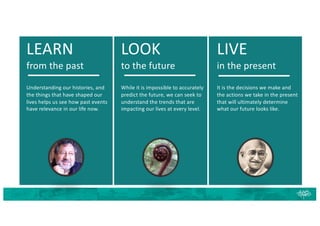
LEARN
from the past
Understanding our histories, and
the things that have shaped our
lives helps us see how past events
have relevance in our life now.
LOOK
to the future
While it is impossible to accurately
predict the future, we can seek to
understand the trends that are
impacting our lives at every level.
LIVE
in the present
It is the decisions we make and
the actions we take in the present
that will ultimately determine
what our future looks like.
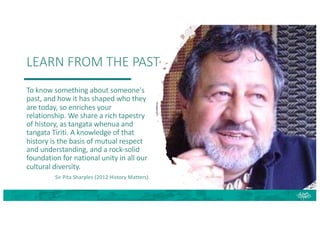
LEARN FROM THE PAST
To know something about someone's
past, and how it has shaped who they
are today, so enriches your
relationship. We share a rich tapestry
of history, as tangata whenua and
tangata Tiriti. A knowledge of that
history is the basis of mutual respect
and understanding, and a rock-solid
foundation for national unity in all our
cultural diversity.
Sir Pita Sharples (2012 History Matters).
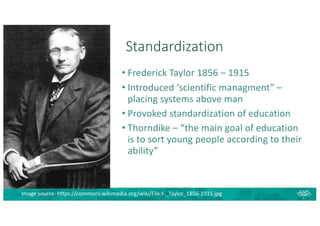
Standardization
• Frederick Taylor 1856 – 1915
• Introduced ‘scientific managment” –
placing systems above man
• Provoked standardization of education
• Thorndike – “the main goal of education
is to sort young people according to their
ability”
Image source: https://commons.wikimedia.org/wiki/File:F._Taylor_1856-1915.jpg
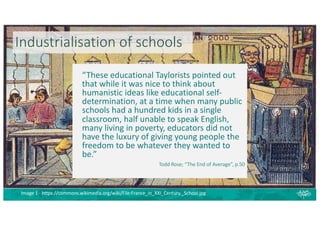
Industrialisation of schools
“These educational Taylorists pointed out
that while it was nice to think about
humanistic ideas like educational self-
determination, at a time when many public
schools had a hundred kids in a single
classroom, half unable to speak English,
many living in poverty, educators did not
have the luxury of giving young people the
freedom to be whatever they wanted to
be.”
Todd Rose; “The End of Average”, p.50
Image 1 - https://commons.wikimedia.org/wiki/File:France_in_XXI_Century._School.jpg
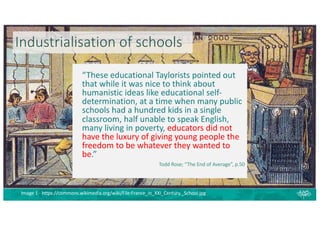
Industrialisation of schools
“These educational Taylorists pointed out
that while it was nice to think about
humanistic ideas like educational self-
determination, at a time when many public
schools had a hundred kids in a single
classroom, half unable to speak English,
many living in poverty, educators did not
have the luxury of giving young people the
freedom to be whatever they wanted to
be.”
Todd Rose; “The End of Average”, p.50
Image 1 - https://commons.wikimedia.org/wiki/File:France_in_XXI_Century._School.jpg
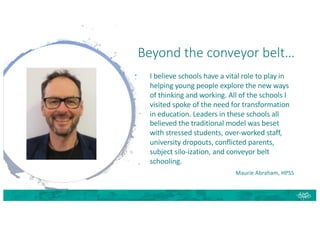
Beyond the conveyor belt…
I believe schools have a vital role to play in
helping young people explore the new ways
of thinking and working. All of the schools I
visited spoke of the need for transformation
in education. Leaders in these schools all
believed the traditional model was beset
with stressed students, over-worked staff,
university dropouts, conflicted parents,
subject silo-ization, and conveyor belt
schooling.
Maurie Abraham, HPSS
Education Exposed
https://wenmoth.net/2020/07/18/why-innovate-teaching-and-learning/
“The global COVID-19 pandemic has pulled back the curtain
on what our kids are doing at school and exposed
weaknesses in many of the philosophical understandings
that guide our work (both explicitly and implicitly), and in
the structures and processes that define how we work with
our students and the expectations we have of them etc.”
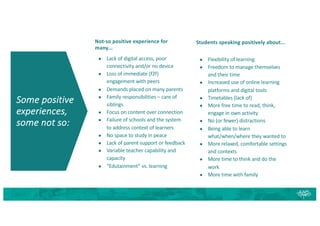
Some positive
experiences,
some not so:
Not-so positive experience for
many...
● Lack of digital access, poor
connectivity and/or no device
● Loss of immediate (f2f)
engagement with peers
● Demands placed on many parents
● Family responsibilities – care of
siblings
● Focus on content over connection
● Failure of schools and the system
to address context of learners
● No space to study in peace
● Lack of parent support or feedback
● Variable teacher capability and
capacity
● “Edutainment” vs. learning
Students speaking positively about...
● Flexibility of learning
● Freedom to manage themselves
and their time
● Increased use of online learning
platforms and digital tools
● Timetables (lack of)
● More free time to read, think,
engage in own activity
● No (or fewer) distractions
● Being able to learn
what/when/where they wanted to
● More relaxed, comfortable settings
and contexts
● More time to think and do the
work
● More time with family
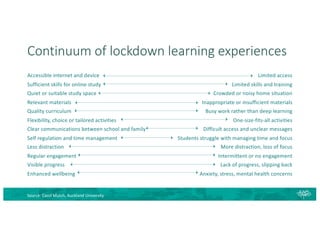
Continuum of lockdown learning experiences
Accessible internet and device
Sufficient skills for online study
Quiet or suitable study space
Relevant materials
Quality curriculum
Flexibility, choice or tailored activities
Clear communications between school and family
Self regulation and time management
Less distraction
Regular engagement
Visible progress
Enhanced wellbeing
Limited access
Limited skills and training
Crowded or noisy home situation
Inappropriate or insufficient materials
Busy work rather than deep learning
One-size-fits-all activities
Difficult access and unclear messages
Students struggle with managing time and focus
More distraction, loss of focus
Intermittent or no engagement
Lack of progress, slipping back
Anxiety, stress, mental health concerns
Source: Carol Mutch, Auckland University
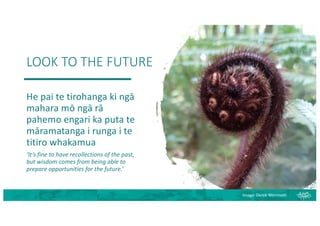
LOOK TO THE FUTURE
He pai te tirohanga ki ngā
mahara mō ngā rā
pahemo engari ka puta te
māramatanga i runga i te
titiro whakamua
‘It’s fine to have recollections of the past,
but wisdom comes from being able to
prepare opportunities for the future.’
Image: Derek Wenmoth
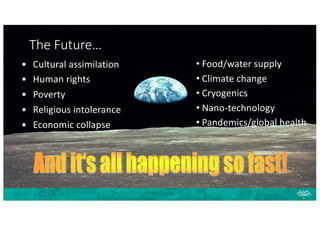
The Future…
• Food/water supply
• Climate change
• Cryogenics
• Nano-technology
• Pandemics/global health
• Cultural assimilation
• Human rights
• Poverty
• Religious intolerance
• Economic collapse
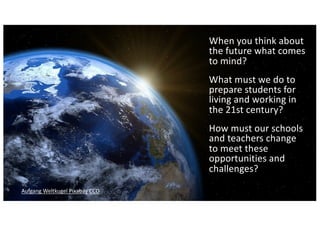
Our changing world
When you think about
the future what comes
to mind?
What must we do to
prepare students for
living and working in
the 21st century?
How must our schools
and teachers change
to meet these
opportunities and
challenges?
Aufgang Weltkugel Pixabay CCO
“To help students address
unknown future problems,
curricula need to focus on
areas with the highest
transfer value – in other
words, they need to give
priority to knowledge, skills
and attitudes that can be
learned in one context and
applied to others.”
Andreas Schleicher, OECD
https://www.teachermagazine.com/au_en/articles/preparing-learners-for-a-pandemic-and-a-more-uncertain-world
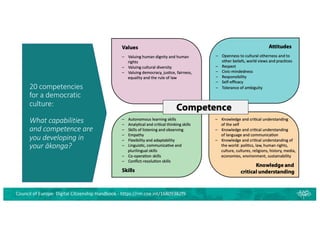
20 competencies
for a democratic
culture:
What capabilities
and competence are
you developing in
your ākonga?
Council of Europe: Digital Citizenship Handbook - https://rm.coe.int/16809382f9
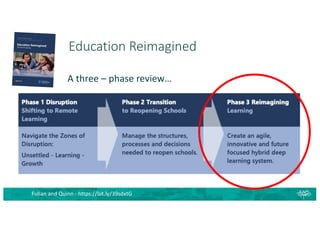
Education Reimagined
Fullan and Quinn - https://bit.ly/39sdxtG
A three – phase review…
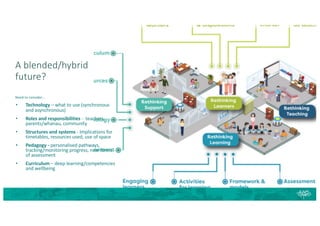
A blended/hybrid
future?
Need to consider…
• Technology – what to use (synchronous
and asynchronous)
• Roles and responsibilities - teachers,
parents/whanau, community
• Structures and systems - Implications for
timetables, resources used, use of space
• Pedagogy - personalised pathways,
tracking/monitoring progress, new forms
of assessment
• Curriculum – deep learning/competencies
and wellbeing
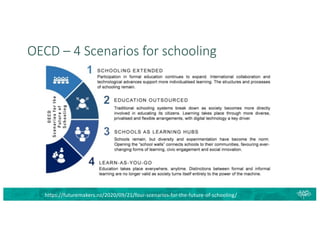
OECD – 4 Scenarios for schooling
https://futuremakers.nz/2020/09/21/four-scenarios-for-the-future-of-schooling/
http://www.oecd.org/education/schooling-redesigned-9789264245914-en.htm
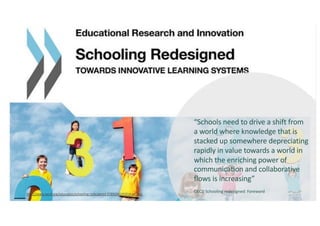
“Schools need to drive a shift from
a world where knowledge that is
stacked up somewhere depreciating
rapidly in value towards a world in
which the enriching power of
communication and collaborative
flows is increasing”
OECD Schooling redesigned: Foreword
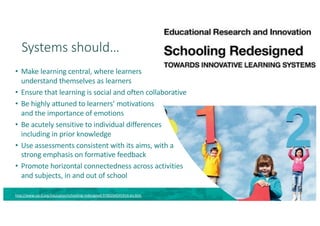
Systems should…
• Make learning central, where learners
understand themselves as learners
• Ensure that learning is social and often collaborative
• Be highly attuned to learners’ motivations
and the importance of emotions
• Be acutely sensitive to individual differences
including in prior knowledge
• Use assessments consistent with its aims, with a
strong emphasis on formative feedback
• Promote horizontal connectedness across activities
and subjects, in and out of school
http://www.oecd.org/education/schooling-redesigned-9789264245914-en.htm
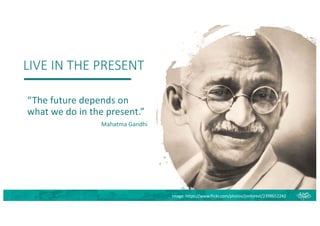
LIVE IN THE PRESENT
“The future depends on
what we do in the present.”
Mahatma Gandhi
Image: https://www.flickr.com/photos/jimforest/2398652242
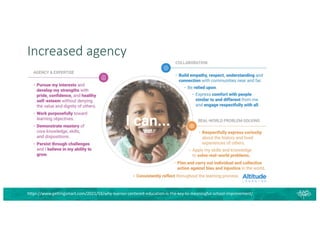
Increased agency
https://www.gettingsmart.com/2021/03/why-learner-centered-education-is-the-key-to-meaningful-school-improvement/
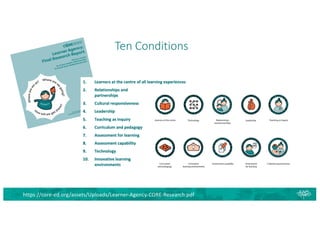
Ten Conditions
https://core-ed.org/assets/Uploads/Learner-Agency-CORE-Research.pdf
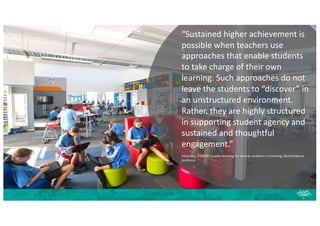
“Sustained higher achievement is
possible when teachers use
approaches that enable students
to take charge of their own
learning. Such approaches do not
leave the students to “discover” in
an unstructured environment.
Rather, they are highly structured
in supporting student agency and
sustained and thoughtful
engagement.”
Alton-Lee, A (2003) Quality teaching for diverse students in schooling; Best Evidence
Synthesis
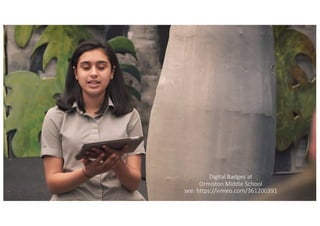
Digital Badges at
Ormiston Middle School
see: https://vimeo.com/361200391
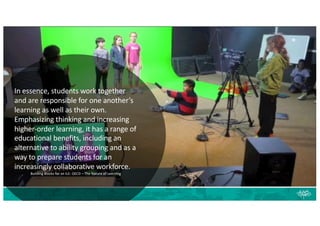
In essence, students work together
and are responsible for one another’s
learning as well as their own.
Emphasizing thinking and increasing
higher-order learning, it has a range of
educational benefits, including an
alternative to ability grouping and as a
way to prepare students for an
increasingly collaborative workforce.
Building Blocks for an ILE: OECD – The Nature of Learning
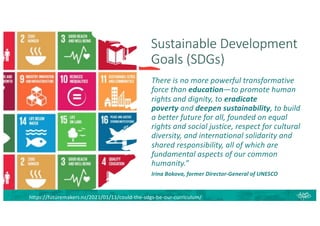
Sustainable Development
Goals (SDGs)
There is no more powerful transformative
force than education—to promote human
rights and dignity, to eradicate
poverty and deepen sustainability, to build
a better future for all, founded on equal
rights and social justice, respect for cultural
diversity, and international solidarity and
shared responsibility, all of which are
fundamental aspects of our common
humanity.”
Irina Bokova, former Director-General of UNESCO
https://futuremakers.nz/2021/01/11/could-the-sdgs-be-our-curriculum/
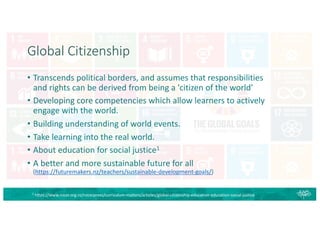
Global Citizenship
• Transcends political borders, and assumes that responsibilities
and rights can be derived from being a 'citizen of the world’
• Developing core competencies which allow learners to actively
engage with the world.
• Building understanding of world events.
• Take learning into the real world.
• About education for social justice1
• A better and more sustainable future for all
(https://futuremakers.nz/teachers/sustainable-development-goals/)
1
https://www.nzcer.org.nz/nzcerpress/curriculum-matters/articles/global-citizenship-education-education-social-justice
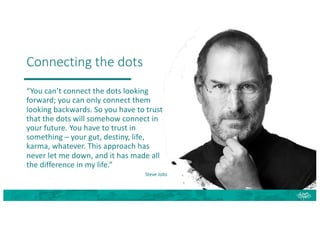
Connecting the dots
“You can’t connect the dots looking
forward; you can only connect them
looking backwards. So you have to trust
that the dots will somehow connect in
your future. You have to trust in
something – your gut, destiny, life,
karma, whatever. This approach has
never let me down, and it has made all
the difference in my life.”
Steve Jobs
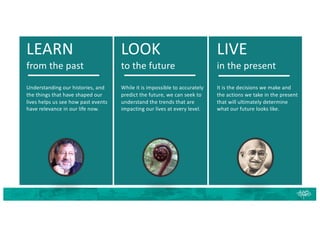
LEARN
from the past
Understanding our histories, and
the things that have shaped our
lives helps us see how past events
have relevance in our life now.
LIVE
in the present
It is the decisions we make and
the actions we take in the present
that will ultimately determine
what our future looks like.
LOOK
to the future
While it is impossible to accurately
predict the future, we can seek to
understand the trends that are
impacting our lives at every level.
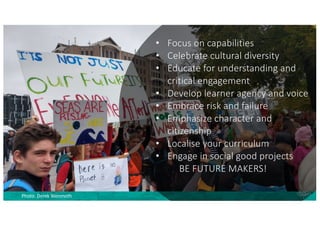
Photo: Derek Wenmoth
• Focus on capabilities
• Celebrate cultural diversity
• Educate for understanding and
critical engagement
• Develop learner agency and voice
• Embrace risk and failure
• Emphasize character and
citizenship
• Localise your curriculum
• Engage in social good projects
BE FUTURE MAKERS!
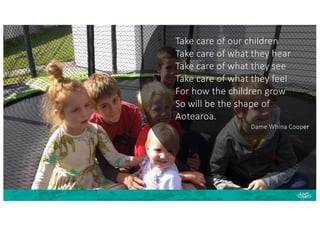
Take care of our children
Take care of what they hear
Take care of what they see
Take care of what they feel
For how the children grow
So will be the shape of
Aotearoa.
Dame Whina Cooper
Thank You
derek@futuremakers.nz
@dwenmoth
www.futuremakers.nz
http://www.wenmoth.net

Future Focused Learning

  • 1.
    Inspiring the nextgeneration of leaders, thinkers and problem-solvers derek@futuremakers.nz @dwenmoth www.futuremakers.nz http://www.wenmoth.net Future Focused Learning Masterton Schools TOD, 1 April 2020
  • 3.
    LEARN from the past Understandingour histories, and the things that have shaped our lives helps us see how past events have relevance in our life now. LOOK to the future While it is impossible to accurately predict the future, we can seek to understand the trends that are impacting our lives at every level. LIVE in the present It is the decisions we make and the actions we take in the present that will ultimately determine what our future looks like.
  • 4.
    LEARN FROM THEPAST To know something about someone's past, and how it has shaped who they are today, so enriches your relationship. We share a rich tapestry of history, as tangata whenua and tangata Tiriti. A knowledge of that history is the basis of mutual respect and understanding, and a rock-solid foundation for national unity in all our cultural diversity. Sir Pita Sharples (2012 History Matters).
  • 5.
    Standardization • Frederick Taylor1856 – 1915 • Introduced ‘scientific managment” – placing systems above man • Provoked standardization of education • Thorndike – “the main goal of education is to sort young people according to their ability” Image source: https://commons.wikimedia.org/wiki/File:F._Taylor_1856-1915.jpg
  • 6.
    Industrialisation of schools “Theseeducational Taylorists pointed out that while it was nice to think about humanistic ideas like educational self- determination, at a time when many public schools had a hundred kids in a single classroom, half unable to speak English, many living in poverty, educators did not have the luxury of giving young people the freedom to be whatever they wanted to be.” Todd Rose; “The End of Average”, p.50 Image 1 - https://commons.wikimedia.org/wiki/File:France_in_XXI_Century._School.jpg
  • 7.
    Industrialisation of schools “Theseeducational Taylorists pointed out that while it was nice to think about humanistic ideas like educational self- determination, at a time when many public schools had a hundred kids in a single classroom, half unable to speak English, many living in poverty, educators did not have the luxury of giving young people the freedom to be whatever they wanted to be.” Todd Rose; “The End of Average”, p.50 Image 1 - https://commons.wikimedia.org/wiki/File:France_in_XXI_Century._School.jpg
  • 8.
    Beyond the conveyorbelt… I believe schools have a vital role to play in helping young people explore the new ways of thinking and working. All of the schools I visited spoke of the need for transformation in education. Leaders in these schools all believed the traditional model was beset with stressed students, over-worked staff, university dropouts, conflicted parents, subject silo-ization, and conveyor belt schooling. Maurie Abraham, HPSS
  • 9.
    Education Exposed https://wenmoth.net/2020/07/18/why-innovate-teaching-and-learning/ “The globalCOVID-19 pandemic has pulled back the curtain on what our kids are doing at school and exposed weaknesses in many of the philosophical understandings that guide our work (both explicitly and implicitly), and in the structures and processes that define how we work with our students and the expectations we have of them etc.”
  • 10.
    Some positive experiences, some notso: Not-so positive experience for many... ● Lack of digital access, poor connectivity and/or no device ● Loss of immediate (f2f) engagement with peers ● Demands placed on many parents ● Family responsibilities – care of siblings ● Focus on content over connection ● Failure of schools and the system to address context of learners ● No space to study in peace ● Lack of parent support or feedback ● Variable teacher capability and capacity ● “Edutainment” vs. learning Students speaking positively about... ● Flexibility of learning ● Freedom to manage themselves and their time ● Increased use of online learning platforms and digital tools ● Timetables (lack of) ● More free time to read, think, engage in own activity ● No (or fewer) distractions ● Being able to learn what/when/where they wanted to ● More relaxed, comfortable settings and contexts ● More time to think and do the work ● More time with family
  • 11.
    Continuum of lockdownlearning experiences Accessible internet and device Sufficient skills for online study Quiet or suitable study space Relevant materials Quality curriculum Flexibility, choice or tailored activities Clear communications between school and family Self regulation and time management Less distraction Regular engagement Visible progress Enhanced wellbeing Limited access Limited skills and training Crowded or noisy home situation Inappropriate or insufficient materials Busy work rather than deep learning One-size-fits-all activities Difficult access and unclear messages Students struggle with managing time and focus More distraction, loss of focus Intermittent or no engagement Lack of progress, slipping back Anxiety, stress, mental health concerns Source: Carol Mutch, Auckland University
  • 12.
    LOOK TO THEFUTURE He pai te tirohanga ki ngā mahara mō ngā rā pahemo engari ka puta te māramatanga i runga i te titiro whakamua ‘It’s fine to have recollections of the past, but wisdom comes from being able to prepare opportunities for the future.’ Image: Derek Wenmoth
  • 13.
    The Future… • Food/watersupply • Climate change • Cryogenics • Nano-technology • Pandemics/global health • Cultural assimilation • Human rights • Poverty • Religious intolerance • Economic collapse
  • 14.
    Our changing world Whenyou think about the future what comes to mind? What must we do to prepare students for living and working in the 21st century? How must our schools and teachers change to meet these opportunities and challenges? Aufgang Weltkugel Pixabay CCO
  • 15.
    “To help studentsaddress unknown future problems, curricula need to focus on areas with the highest transfer value – in other words, they need to give priority to knowledge, skills and attitudes that can be learned in one context and applied to others.” Andreas Schleicher, OECD https://www.teachermagazine.com/au_en/articles/preparing-learners-for-a-pandemic-and-a-more-uncertain-world
  • 16.
    20 competencies for ademocratic culture: What capabilities and competence are you developing in your ākonga? Council of Europe: Digital Citizenship Handbook - https://rm.coe.int/16809382f9
  • 17.
    Education Reimagined Fullan andQuinn - https://bit.ly/39sdxtG A three – phase review…
  • 18.
    A blended/hybrid future? Need toconsider… • Technology – what to use (synchronous and asynchronous) • Roles and responsibilities - teachers, parents/whanau, community • Structures and systems - Implications for timetables, resources used, use of space • Pedagogy - personalised pathways, tracking/monitoring progress, new forms of assessment • Curriculum – deep learning/competencies and wellbeing
  • 19.
    OECD – 4Scenarios for schooling https://futuremakers.nz/2020/09/21/four-scenarios-for-the-future-of-schooling/
  • 20.
    http://www.oecd.org/education/schooling-redesigned-9789264245914-en.htm “Schools need todrive a shift from a world where knowledge that is stacked up somewhere depreciating rapidly in value towards a world in which the enriching power of communication and collaborative flows is increasing” OECD Schooling redesigned: Foreword
  • 21.
    Systems should… • Makelearning central, where learners understand themselves as learners • Ensure that learning is social and often collaborative • Be highly attuned to learners’ motivations and the importance of emotions • Be acutely sensitive to individual differences including in prior knowledge • Use assessments consistent with its aims, with a strong emphasis on formative feedback • Promote horizontal connectedness across activities and subjects, in and out of school http://www.oecd.org/education/schooling-redesigned-9789264245914-en.htm
  • 22.
    LIVE IN THEPRESENT “The future depends on what we do in the present.” Mahatma Gandhi Image: https://www.flickr.com/photos/jimforest/2398652242
  • 23.
  • 24.
  • 26.
    “Sustained higher achievementis possible when teachers use approaches that enable students to take charge of their own learning. Such approaches do not leave the students to “discover” in an unstructured environment. Rather, they are highly structured in supporting student agency and sustained and thoughtful engagement.” Alton-Lee, A (2003) Quality teaching for diverse students in schooling; Best Evidence Synthesis
  • 27.
    Digital Badges at OrmistonMiddle School see: https://vimeo.com/361200391
  • 29.
    In essence, studentswork together and are responsible for one another’s learning as well as their own. Emphasizing thinking and increasing higher-order learning, it has a range of educational benefits, including an alternative to ability grouping and as a way to prepare students for an increasingly collaborative workforce. Building Blocks for an ILE: OECD – The Nature of Learning
  • 31.
    Sustainable Development Goals (SDGs) Thereis no more powerful transformative force than education—to promote human rights and dignity, to eradicate poverty and deepen sustainability, to build a better future for all, founded on equal rights and social justice, respect for cultural diversity, and international solidarity and shared responsibility, all of which are fundamental aspects of our common humanity.” Irina Bokova, former Director-General of UNESCO https://futuremakers.nz/2021/01/11/could-the-sdgs-be-our-curriculum/
  • 32.
    Global Citizenship • Transcendspolitical borders, and assumes that responsibilities and rights can be derived from being a 'citizen of the world’ • Developing core competencies which allow learners to actively engage with the world. • Building understanding of world events. • Take learning into the real world. • About education for social justice1 • A better and more sustainable future for all (https://futuremakers.nz/teachers/sustainable-development-goals/) 1 https://www.nzcer.org.nz/nzcerpress/curriculum-matters/articles/global-citizenship-education-education-social-justice
  • 33.
    Connecting the dots “Youcan’t connect the dots looking forward; you can only connect them looking backwards. So you have to trust that the dots will somehow connect in your future. You have to trust in something – your gut, destiny, life, karma, whatever. This approach has never let me down, and it has made all the difference in my life.” Steve Jobs
  • 34.
    LEARN from the past Understandingour histories, and the things that have shaped our lives helps us see how past events have relevance in our life now. LIVE in the present It is the decisions we make and the actions we take in the present that will ultimately determine what our future looks like. LOOK to the future While it is impossible to accurately predict the future, we can seek to understand the trends that are impacting our lives at every level.
  • 35.
    Photo: Derek Wenmoth •Focus on capabilities • Celebrate cultural diversity • Educate for understanding and critical engagement • Develop learner agency and voice • Embrace risk and failure • Emphasize character and citizenship • Localise your curriculum • Engage in social good projects BE FUTURE MAKERS!
  • 36.
    Take care ofour children Take care of what they hear Take care of what they see Take care of what they feel For how the children grow So will be the shape of Aotearoa. Dame Whina Cooper
  • 37.