CosmopolitanpedagogyKlafki & KempProgrammeWarm up – Classical dilemmasCase - Theory and practiceClass parliament – what to learn? LunchCosmopolitan education – Klafki  & KempRelating to practice - Consequences for the classroompracticeCases
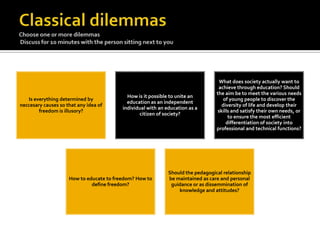
Classical dilemmasChooseoneor more dilemmasDiscuss for 10 minuteswith the person sittingnext to you
Case: Theory & practiceDo you agree or disagree with D?Are there different ways that scholarship and research in education can relate to educational practice? Should curriculum and classroom research aim to tell practitioners “how to do it”?Can you think of one thing you’ve learned in this class that will make a difference in you as a teacher?
ClassparliamentFormulate the general learningobjective of educational studiesDiscuss in groups of threeA spokesperson enters the parliamentA discussion between the spokespersons takes placeThe rest of the group members act as referentsThe procedure is repeated until a satisfactory result is met
Wolfgang Klafki (1927-)Klafki's characteristic of education as on the one hand "opening up the world" (material education) and on the other hand "creating openness in the individual" (formal education)“Exemplary teaching”  - categorical formation
Core problems of the modernworld and education6 intermeshed problexesTechnical-industrial developmentGlobal economyFurther-reaching information & communications systemsWeapons with ever greater destructive potentialThe knowledge of the natural basis of human existenceKnowledge of responsible policies no longer can be made sufficiently by individuals, societies, states or even blocs of states
The aim of educationEducation has to become universal in scopeWould be wrong to say that these problems are only for adults as they do affect the lives of children and youthThe development of  an international awareness of problems should begin at a very early age
Cosmopolitaneducation & the curriculumNecessary and possible to set down a block of internationally significant general topics in the school curricula of all states and societiesShould take up a large amount of space (25%-40% of the curriculum)Concern key problems of the modern world – forming a common core content of international education
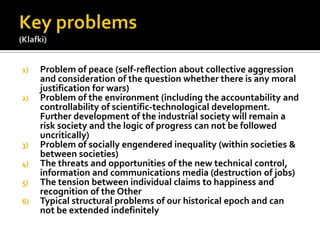
Key problems(Klafki)Problem of peace (self-reflection about collective aggression and consideration of the question whether there is any moral justification for wars)Problem of the environment (including the accountability and controllability of scientific-technological development. Further development of the industrial society will remain a risk society and the logic of progress can not be followed uncritically)Problem of socially engendered inequality (within societies & between societies)The threats and opportunities of the new technical control, information and communications media (destruction of jobs)The tension between individual claims to happiness and recognition of the OtherTypical structural problems of our historical epoch and can not be extended indefinitely
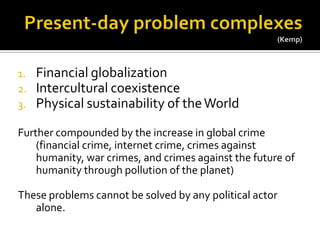
Present-day problem complexes(Kemp)Financial globalizationIntercultural coexistence Physical sustainability of the WorldFurther compounded by the increase in global crime (financial crime, internet crime, crimes against humanity, war crimes, and crimes against the future of humanity through pollution of the planet)These problems cannot be solved by any political actor alone.
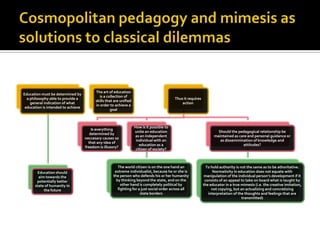
Cosmopolitan pedagogy and mimesis as solutions to classical dilemmas
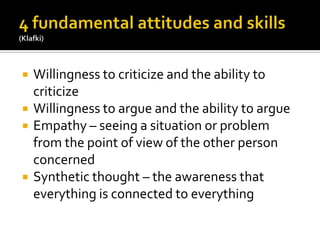
4 fundamental attitudes and skills(Klafki)Willingness to criticize and the ability to criticizeWillingness to argue and the ability to argueEmpathy – seeing a situation or problem from the point of view of the other person concernedSynthetic thought – the awareness that everything is connected to everything
Consequences for the classroompracticeProblem studies Formation of teacher teamsExemplary teaching and learningMethod-oriented learningAction-oriented teaching (practical learning – reflective processing)Co-operative learning, ability to help others in the learning process, rational forms of dealing with conflicts, ability to put forward one’s own ideas and arguments
CasesIndividual differences and equality of education (is what is good for the society good for the individual?)Whose aims matter? (how should disagreements about aims be handled?)

Cosmopolitan pedagogy

  • 1.
    CosmopolitanpedagogyKlafki & KempProgrammeWarmup – Classical dilemmasCase - Theory and practiceClass parliament – what to learn? LunchCosmopolitan education – Klafki & KempRelating to practice - Consequences for the classroompracticeCases
  • 2.
    Classical dilemmasChooseoneor moredilemmasDiscuss for 10 minuteswith the person sittingnext to you
  • 3.
    Case: Theory &practiceDo you agree or disagree with D?Are there different ways that scholarship and research in education can relate to educational practice? Should curriculum and classroom research aim to tell practitioners “how to do it”?Can you think of one thing you’ve learned in this class that will make a difference in you as a teacher?
  • 4.
    ClassparliamentFormulate the generallearningobjective of educational studiesDiscuss in groups of threeA spokesperson enters the parliamentA discussion between the spokespersons takes placeThe rest of the group members act as referentsThe procedure is repeated until a satisfactory result is met
  • 5.
    Wolfgang Klafki (1927-)Klafki'scharacteristic of education as on the one hand "opening up the world" (material education) and on the other hand "creating openness in the individual" (formal education)“Exemplary teaching” - categorical formation
  • 6.
    Core problems ofthe modernworld and education6 intermeshed problexesTechnical-industrial developmentGlobal economyFurther-reaching information & communications systemsWeapons with ever greater destructive potentialThe knowledge of the natural basis of human existenceKnowledge of responsible policies no longer can be made sufficiently by individuals, societies, states or even blocs of states
  • 7.
    The aim ofeducationEducation has to become universal in scopeWould be wrong to say that these problems are only for adults as they do affect the lives of children and youthThe development of an international awareness of problems should begin at a very early age
  • 8.
    Cosmopolitaneducation & thecurriculumNecessary and possible to set down a block of internationally significant general topics in the school curricula of all states and societiesShould take up a large amount of space (25%-40% of the curriculum)Concern key problems of the modern world – forming a common core content of international education
  • 9.
    Key problems(Klafki)Problem ofpeace (self-reflection about collective aggression and consideration of the question whether there is any moral justification for wars)Problem of the environment (including the accountability and controllability of scientific-technological development. Further development of the industrial society will remain a risk society and the logic of progress can not be followed uncritically)Problem of socially engendered inequality (within societies & between societies)The threats and opportunities of the new technical control, information and communications media (destruction of jobs)The tension between individual claims to happiness and recognition of the OtherTypical structural problems of our historical epoch and can not be extended indefinitely
  • 10.
    Present-day problem complexes(Kemp)FinancialglobalizationIntercultural coexistence Physical sustainability of the WorldFurther compounded by the increase in global crime (financial crime, internet crime, crimes against humanity, war crimes, and crimes against the future of humanity through pollution of the planet)These problems cannot be solved by any political actor alone.
  • 11.
    Cosmopolitan pedagogy andmimesis as solutions to classical dilemmas
  • 12.
    4 fundamental attitudesand skills(Klafki)Willingness to criticize and the ability to criticizeWillingness to argue and the ability to argueEmpathy – seeing a situation or problem from the point of view of the other person concernedSynthetic thought – the awareness that everything is connected to everything
  • 13.
    Consequences for theclassroompracticeProblem studies Formation of teacher teamsExemplary teaching and learningMethod-oriented learningAction-oriented teaching (practical learning – reflective processing)Co-operative learning, ability to help others in the learning process, rational forms of dealing with conflicts, ability to put forward one’s own ideas and arguments
  • 14.
    CasesIndividual differences andequality of education (is what is good for the society good for the individual?)Whose aims matter? (how should disagreements about aims be handled?)