At the end of 15 minutes, the group should be able to:
1. determine the fundamental principles of pragmatism
and reconstructionism and;
2. describe the epistemology, metaphysics, axiology and
logic of pragmatism and reconstructionism and its
application in education.
PRAGMATISM
 Came from Greek word “pragma”, matos
= deed, from prassein = to do
 An American philosophy
 Midway between Idealism and
Naturalism
FOUNDER
CHARLES SANDERS
PEIRCE
1839-1914
Coined the word
“pragmatism” means
practical. Thought must
produce action.
CHIEF EXPONENT
WILLIAM JAMES
1842-1910
“Idea must have practical
and satisfactory results”
EXPONENT
“Experience is not an object
known but an ACTION
PERFORMED”
.
John Dewey
1859-1952
FUNDAMENTAL PRINCIPLES OF
PRAGMATISM
 Theory that works are true
 There is no such thing as ABSOLUTE
knowledge, value and reality
 Man judges what is useful for him
 Man is a highly social character
 Man is a supreme creation in the world
 Life is a laboratory
PRAGMATISM
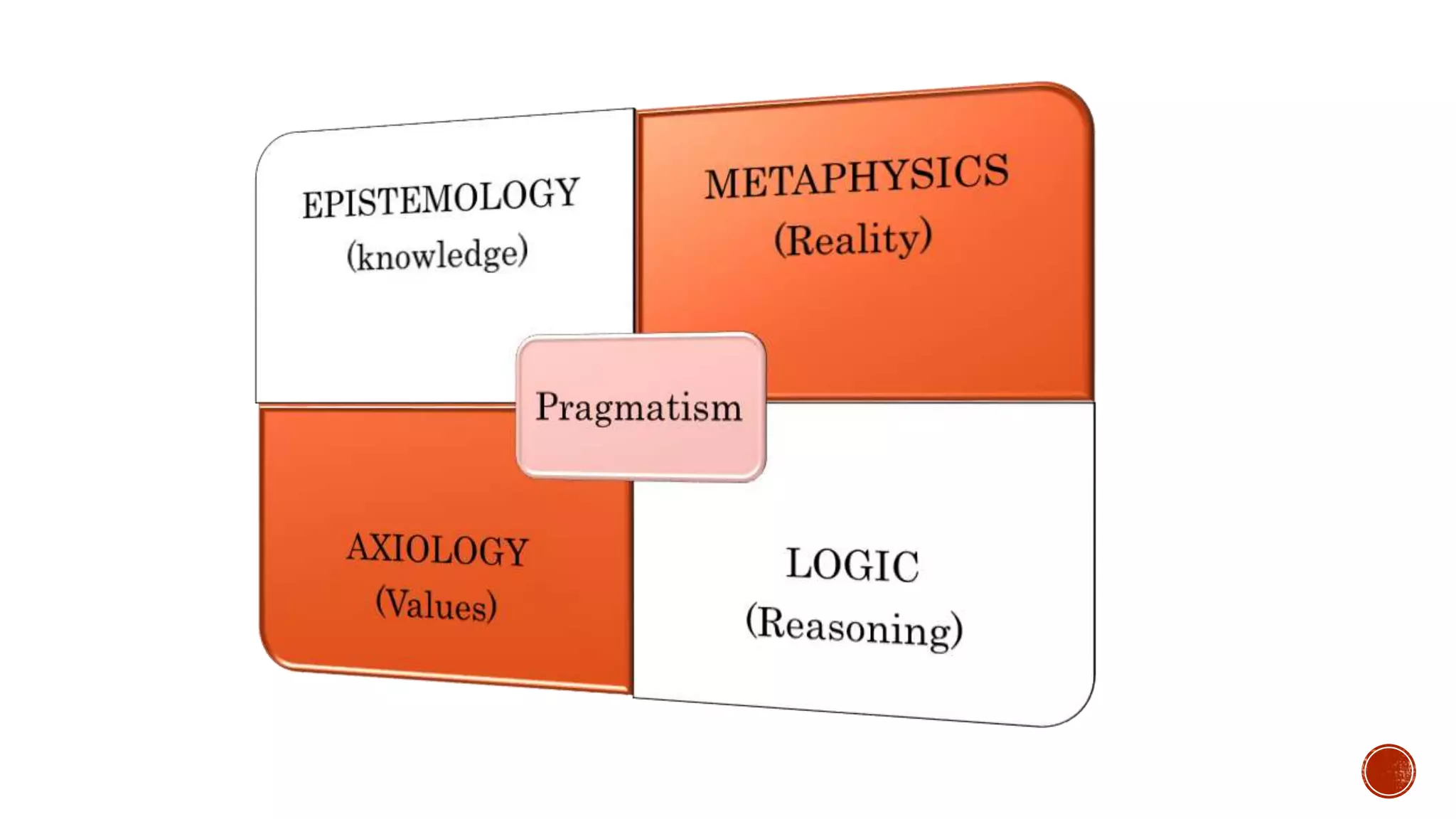
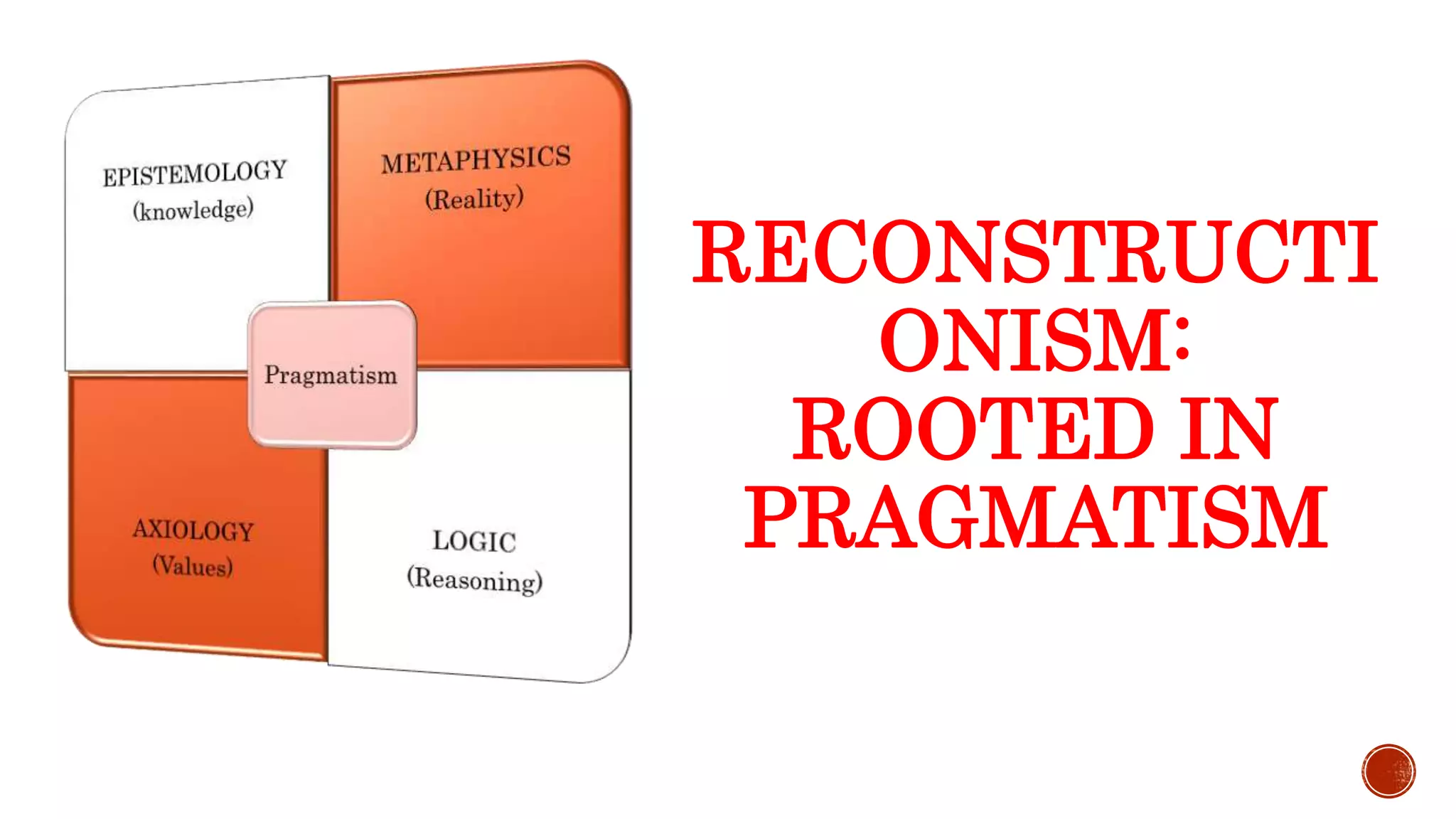
EPISTEMOLOGY
Knowledge comes through experience-based activity
and ideas by acting and reacting with environment.
METAPHYSICS
Reality is the interaction of an individual with
environment or experience = no eternal reality
PRAGMATISM
AXIOLOGY
Man himself creates values. Values are not
predetermined (relative)
LOGIC
Reasoning is based on step by step method.
(experimental = specific to general)
PRAGMATISM VS
IDEALISM
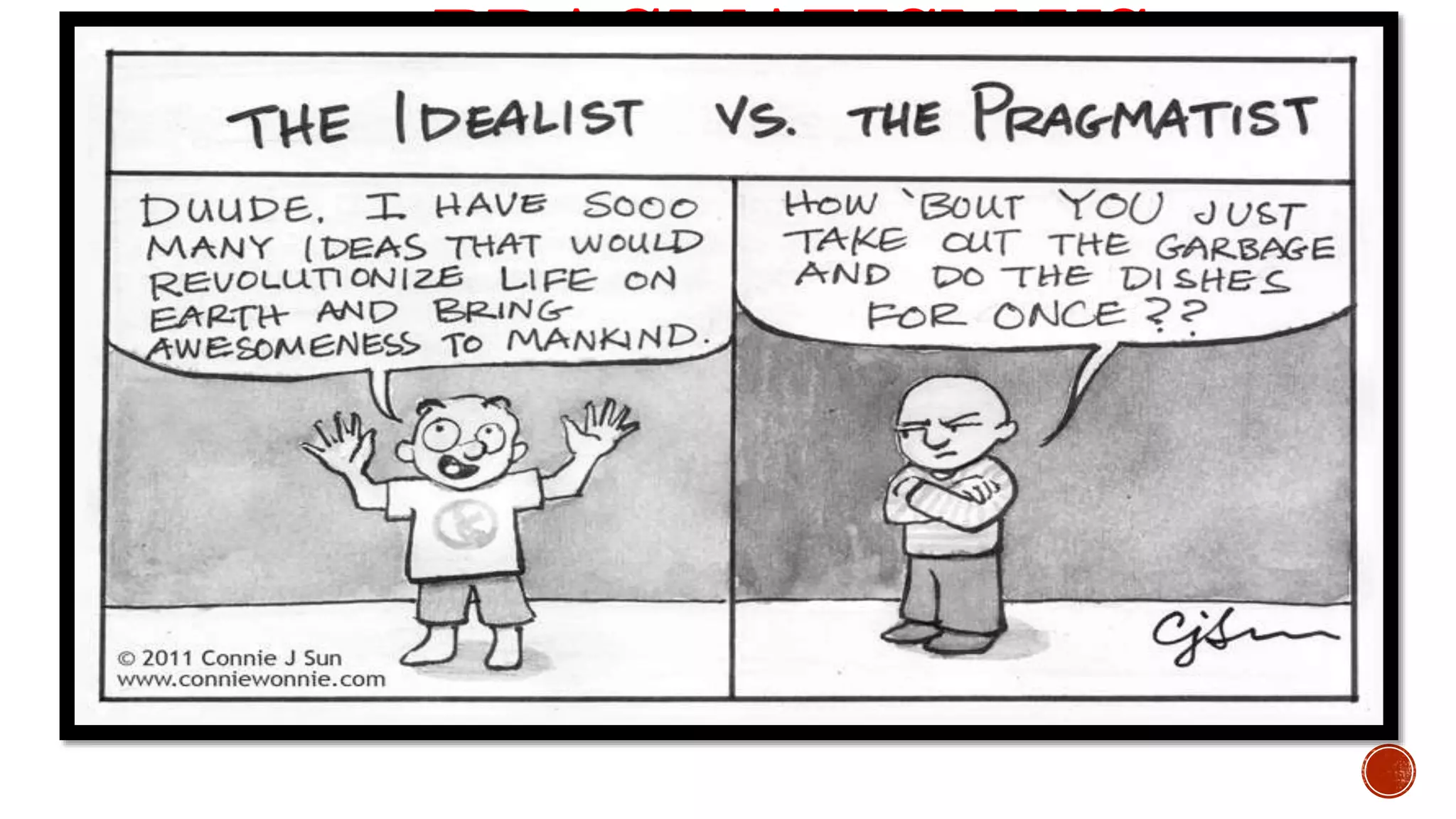
Idealism – knowledge or idea leads to practice
Pragmatism – ideas are constricted from
experience
First comes practice – basis for principles and ideas
to derive
Realism believes in truth – Theory of Truth
According to realism – if an object is
considered hard then it should be hard to all
But pragmatism says – if hard to one then I
should experimentally prove it
PRAGMATISM VS
REALISM
DESCRIPTION
GOAL OF EDUCATION
 Individual growth through processes, experience and
problem solving.
 Develop and apply practical knowledge and skills for
life in a progressive democratic society.
NATURE OF
CURRICULUM
 Learner-centered curriculum
ROLE OF TEACHERS  Facilitator, Guide, Friend
ROLE OF STUDENTS  Active learner, Problem-solvers, Process oriented
TEACHING METHOD  Problem-based learning, Inquiry-based learning,
experiential learning
SUBJECT TAUGHT  Language, Heath, history, geography, physics,
mathematics, sciences, domestic science for girls,
agriculture for boys
RECONSTRUCTI
ONISM:
ROOTED IN
PRAGMATISM
SOCIAL
RECONSTRUCTIONISM
 Theodore Brameld (1904-1987)-the founder of
social reconstructionism, in reaction against the
realities of World War II.
 Emphasizes the addressing of social questions and a quest
to create a better society and worldwide democracy
 Believe that schools should originate policies and progress
which would bring about reform of the social order.
DESCRIPTION
GOAL OF EDUCATION
 Use education to help solve significant social problems
to create a more effective democratic society
NATURE OF
CURRICULUM
 Learner-centered curriculum
ROLE OF TEACHERS  Facilitator, Guide
ROLE OF STUDENTS  Problem-solvers/critical thinkers, socially oriented
TEACHING METHOD  Problem-based learning, cooperative learning,
community-based learning, dialogue/debate
SUBJECT TAUGHT  Politics, Economics, Religion, History (controversial
issues)
THINK ABOUT THIS..

Pragmatism and reconstructionism

  • 2.
    At the endof 15 minutes, the group should be able to: 1. determine the fundamental principles of pragmatism and reconstructionism and; 2. describe the epistemology, metaphysics, axiology and logic of pragmatism and reconstructionism and its application in education.
  • 3.
    PRAGMATISM  Came fromGreek word “pragma”, matos = deed, from prassein = to do  An American philosophy  Midway between Idealism and Naturalism
  • 4.
    FOUNDER CHARLES SANDERS PEIRCE 1839-1914 Coined theword “pragmatism” means practical. Thought must produce action.
  • 5.
    CHIEF EXPONENT WILLIAM JAMES 1842-1910 “Ideamust have practical and satisfactory results”
  • 6.
    EXPONENT “Experience is notan object known but an ACTION PERFORMED” . John Dewey 1859-1952
  • 7.
    FUNDAMENTAL PRINCIPLES OF PRAGMATISM Theory that works are true  There is no such thing as ABSOLUTE knowledge, value and reality  Man judges what is useful for him  Man is a highly social character  Man is a supreme creation in the world  Life is a laboratory
  • 9.
    PRAGMATISM EPISTEMOLOGY Knowledge comes throughexperience-based activity and ideas by acting and reacting with environment. METAPHYSICS Reality is the interaction of an individual with environment or experience = no eternal reality
  • 10.
    PRAGMATISM AXIOLOGY Man himself createsvalues. Values are not predetermined (relative) LOGIC Reasoning is based on step by step method. (experimental = specific to general)
  • 11.
    PRAGMATISM VS IDEALISM Idealism –knowledge or idea leads to practice Pragmatism – ideas are constricted from experience First comes practice – basis for principles and ideas to derive
  • 12.
    Realism believes intruth – Theory of Truth According to realism – if an object is considered hard then it should be hard to all But pragmatism says – if hard to one then I should experimentally prove it PRAGMATISM VS REALISM
  • 13.
    DESCRIPTION GOAL OF EDUCATION Individual growth through processes, experience and problem solving.  Develop and apply practical knowledge and skills for life in a progressive democratic society. NATURE OF CURRICULUM  Learner-centered curriculum ROLE OF TEACHERS  Facilitator, Guide, Friend ROLE OF STUDENTS  Active learner, Problem-solvers, Process oriented TEACHING METHOD  Problem-based learning, Inquiry-based learning, experiential learning SUBJECT TAUGHT  Language, Heath, history, geography, physics, mathematics, sciences, domestic science for girls, agriculture for boys
  • 15.
  • 16.
    SOCIAL RECONSTRUCTIONISM  Theodore Brameld(1904-1987)-the founder of social reconstructionism, in reaction against the realities of World War II.  Emphasizes the addressing of social questions and a quest to create a better society and worldwide democracy  Believe that schools should originate policies and progress which would bring about reform of the social order.
  • 17.
    DESCRIPTION GOAL OF EDUCATION Use education to help solve significant social problems to create a more effective democratic society NATURE OF CURRICULUM  Learner-centered curriculum ROLE OF TEACHERS  Facilitator, Guide ROLE OF STUDENTS  Problem-solvers/critical thinkers, socially oriented TEACHING METHOD  Problem-based learning, cooperative learning, community-based learning, dialogue/debate SUBJECT TAUGHT  Politics, Economics, Religion, History (controversial issues)
  • 19.

Editor's Notes

  • #8 1. Pragmatism asserts that any theory that proves itself more successful in predicting and controlling our world than its rivals can be considered to be nearer the truth. It considers practical consequences or real effects to be vital components of both meaning and truth. More simply, something is true only insofar as it works 2. It arises out of actual living. It does not believe in fixed and eternal values. It is dynamic and ever-changing. It is a revolt against Absolutism. Reality is still in the making. It is never complete. Values are relative. Truth is man made and not ready made. the world is constantly changing and we have to adapt 3. Pragmatism is a utilitarian philosophy, The thing which gives satisfaction is useful. According to this only those ideas and things are true which have a utility for man. 4. People share experience in solving common problems, adapt to each other and to their environment. It promotes social efficacy. 5. Pragmatism believes in the power of God if the existence of God is helpful in the growth of human being otherwise not. It lays stress on action and its consequences. It considers reality as a process of the completion of a task. 6. Pragmatists consider experimental methods as the best means of attaining knowledge. ‘Learning by experience/doing’
  • #10 Knowledge is a result of experience based on environment, things that can be observed and experienced are real. REALITY IS ALWAYS CHANGING.
  • #11 1. In pragmatism, values are derived from the human condition. Since man is a part of his society, the consequences of his actions are either good or bad, according to result
  • #12 The pragmatist lays down standards which are attainable. Pragmatists are practical people. They face problems and try to solve them from practical point of view.
  • #18 Reconstructionsists believe that a “ Utopian Future” is a genuine possibility for mankind if we learn how to intervene and to direct change. They believe that the school should train students to be social activists in the tradition of Gandhi, Martin Luther King, Jr., Ralph Nader and Jesse Jackson