SDS-PAGE
and other
advanced
techniques
SDS PAGE AND OTHER ADVANCED TECHNIQUES
Assignment of
METHODS IN PHARMACEUTICAL RESEARCH (MPR)
PHS CC 1201
Session 2023-2024
Department of Pharmaceutical Sciences
Dr. Harisingh Gour Vishwavidyalaya,Sagar, (M.P.)
(A Central University)
Supervisors:
PROF.ASMITAGAJBHIYE
DR. UDITA AGRAWAL
MR.SHIVAM KORI
Submitted by:
ARYA OJHA
Y23254025
ACKNOWLEGEMENT
Throughout my assignment, I truly appreciate the help and encouragement I received from my teachers
PROF. ASMITA GAJBHIYE, DR. UDITA AGRAWAL and MR. SHIVAM KORI.
TABLE OF CONTENT :
1. INTRODUCTION
2. ABOUT SDS-PAGE
3. GEL PREPARATION
4. PROCEDURE
5. OTHER TECHNIQUES
1. INTRODUCTION
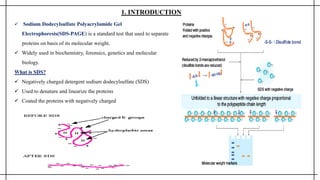
 Sodium Dodecylsulfate Polyacrylamide Gel
Electrophoresis(SDS-PAGE) is a standard test that used to separate
proteins on basis of its molecular weight.
 Widely used in biochemistry, forensics, genetics and molecular
biology.
What is SDS?
 Negatively charged detergent sodium dodecylsulfate (SDS)
 Used to denature and linearize the proteins
 Coated the proteins with negatively charged
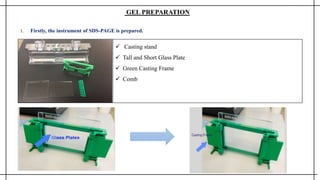
1. Firstly, the instrument of SDS-PAGE is prepared.
GEL PREPARATION
 Casting stand
 Tall and Short Glass Plate
 Green Casting Frame
 Comb
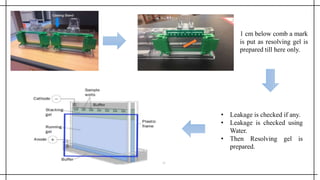
1 cm below comb a mark
is put as resolving gel is
prepared till here only.
• Leakage is checked if any.
• Leakage is checked using
Water.
• Then Resolving gel is
prepared.
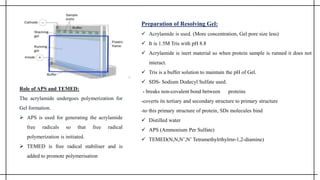
Preparation of Resolving Gel:
 Acrylamide is used. (More concentration, Gel pore size less)
 It is 1.5M Tris with pH 8.8
 Acrylamide is inert material so when protein sample is runned it does not
interact.
 Tris is a buffer solution to maintain the pH of Gel.
 SDS- Sodium Dodecyl Sulfate used.
- breaks non-covalent bond between proteins
-coverts its tertiary and secondary structure to primary structure
-to this primary structure of protein, SDs molecules bind
 Distilled water
 APS (Ammonium Per Sulfate)
 TEMED(N,N,N’,N’ Tetramethylrthylrnr-1,2-diamine)
Role of APS and TEMED:
The acrylamide undergoes polymerization for
Gel formation.
 APS is used for generating the acrylamide
free radicals so that free radical
polymerization is initiated.
 TEMED is free radical stabiliser and is
added to promote polymerisation
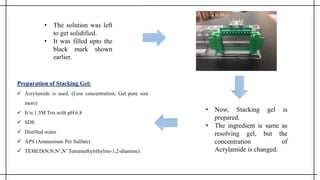
• The solution was left
to get solidified.
• It was filled upto the
black mark shown
earlier.
• Now, Stacking gel is
prepared.
• The ingredient is same as
resolving gel, but the
concentration of
Acrylamide is changed.
Preparation of Stacking Gel:
 Acrylamide is used. (Less concentration, Gel pore size
more)
 It is 1.5M Tris with pH 6.8
 SDS
 Distilled water
 APS (Ammonium Per Sulfate)
 TEMED(N,N,N’,N’ Tetramethylrthylrnr-1,2-diamine)
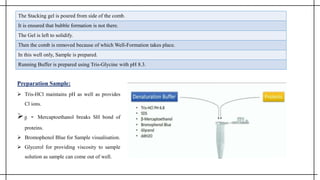
The Stacking gel is poured from side of the comb.
It is ensured that bubble formation is not there.
The Gel is left to solidify.
Then the comb is removed because of which Well-Formation takes place.
In this well only, Sample is prepared.
Running Buffer is prepared using Tris-Glycine with pH 8.3.
Preparation Sample:
 Tris-HCl maintains pH as well as provides
Cl ions.
ᵦ - Mercaptoethanol breaks SH bond of
proteins.
 Bromophenol Blue for Sample visualisation.
 Glycerol for providing viscosity to sample
solution as sample can come out of well.
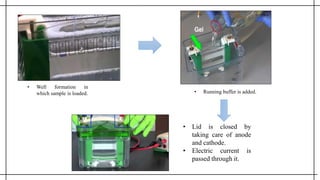
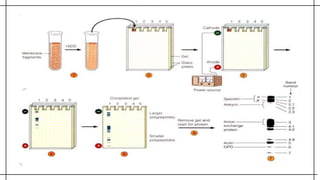
• Well formation in
which sample is loaded.
• Lid is closed by
taking care of anode
and cathode.
• Electric current is
passed through it.
• Running buffer is added.
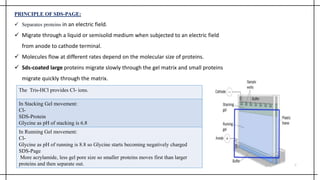
PRINCIPLE OF SDS-PAGE:
 Separates proteins in an electric field.
 Migrate through a liquid or semisolid medium when subjected to an electric field
from anode to cathode terminal.
 Molecules flow at different rates depend on the molecular size of proteins.
 Sds-coated large proteins migrate slowly through the gel matrix and small proteins
migrate quickly through the matrix.
The Tris-HCl provides Cl- ions.
In Stacking Gel movement:
Cl-
SDS-Protein
Glycine as pH of stacking is 6.8
In Running Gel movement:
Cl-
Glycine as pH of running is 8.8 so Glycine starts becoming negatively charged
SDS-Page
More acrylamide, less gel pore size so smaller proteins moves first than larger
proteins and then separate out.
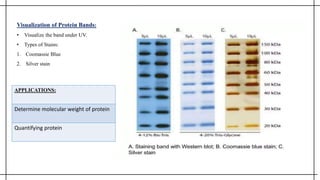
Visualization of Protein Bands:
• Visualize the band under UV.
• Types of Stains:
1. Coomassie Blue
2. Silver stain
APPLICATIONS:
Determine molecular weight of protein
Quantifying protein
2. OTHER TECHNIQUES
TECHNIQUES
AGAROSE GEL
ELECTROPHORESIS
STARCH GEL
ELECTROPHORESIS
2-D PAGE
ELECTROPHORESIS
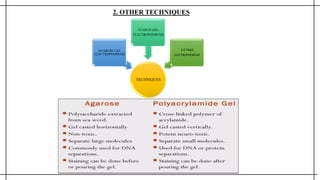
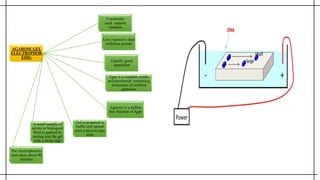
AGAROSE GEL
ELECTROPHOR
ESIS:
Commonly
used support
medium
Less expensive than
cellulose acetate
Equally good
separation
Agar is a complex acidic
polysaccharide containing
monomers of sulfated
galactose
Agarose is a sulfate
free fraction of Agar
Gel is prepared in
buffer and spread
over a microscopic
slide
A small sample of
serum or biological
fluid is applied by
cutting into the gel
with a sharp edge
The electrophoretic
rum takes about 90
minutes
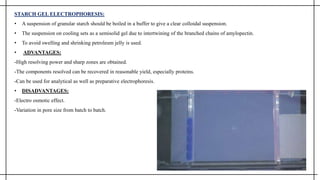
STARCH GEL ELECTROPHORESIS:
• A suspension of granular starch should be boiled in a buffer to give a clear colloidal suspension.
• The suspension on cooling sets as a semisolid gel due to intertwining of the branched chains of amylopectin.
• To avoid swelling and shrinking petroleum jelly is used.
• ADVANTAGES:
-High resolving power and sharp zones are obtained.
-The components resolved can be recovered in reasonable yield, especially proteins.
-Can be used for analytical as well as preparative electrophoresis.
• DISADVANTAGES:
-Electro osmotic effect.
-Variation in pore size from batch to batch.
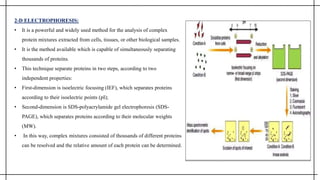
2-D ELECTROPHORESIS:
• It is a powerful and widely used method for the analysis of complex
protein mixtures extracted from cells, tissues, or other biological samples.
• It is the method available which is capable of simultaneously separating
thousands of proteins.
• This technique separate proteins in two steps, according to two
independent properties:
• First-dimension is isoelectric focusing (IEF), which separates proteins
according to their isoelectric points (pI);
• Second-dimension is SDS-polyacrylamide gel electrophoresis (SDS-
PAGE), which separates proteins according to their molecular weights
(MW).
• In this way, complex mixtures consisted of thousands of different proteins
can be resolved and the relative amount of each protein can be determined.
1. Shankar S, " Textbook of Pharmaceutical Analysis", Rx Publications , 5th edition, 2018, Pg no: 28-1:28-8
2. Gondo Y, Fukumura R, Murata T, Makino S. Next-generation gene targeting in the mouse for functional genomics.
BMB Rep. 2009:42:315-23.
3. Wang X. A PCR-based platform for microRNA expression profiling studies. RNA. 2009:15:716-23.
4. Dholariya S, Sonagra A, “Electrophoresis”, Statpearls publishing, 2023, Pg.no 100-167
5. Lee PY, Costumbrado J, Hsu CY, Kim YH. Agarose gel electrophoresis for the separation of DNA fragments. J Vis
Exp. 2012 Apr 20;(62):3923
REFERENCES:
mpr-SDS PAGE and other advanced techniques.pptx

mpr-SDS PAGE and other advanced techniques.pptx

  • 1.
  • 2.
    SDS PAGE ANDOTHER ADVANCED TECHNIQUES Assignment of METHODS IN PHARMACEUTICAL RESEARCH (MPR) PHS CC 1201 Session 2023-2024 Department of Pharmaceutical Sciences Dr. Harisingh Gour Vishwavidyalaya,Sagar, (M.P.) (A Central University) Supervisors: PROF.ASMITAGAJBHIYE DR. UDITA AGRAWAL MR.SHIVAM KORI Submitted by: ARYA OJHA Y23254025
  • 3.
    ACKNOWLEGEMENT Throughout my assignment,I truly appreciate the help and encouragement I received from my teachers PROF. ASMITA GAJBHIYE, DR. UDITA AGRAWAL and MR. SHIVAM KORI.
  • 4.
    TABLE OF CONTENT: 1. INTRODUCTION 2. ABOUT SDS-PAGE 3. GEL PREPARATION 4. PROCEDURE 5. OTHER TECHNIQUES
  • 5.
    1. INTRODUCTION  SodiumDodecylsulfate Polyacrylamide Gel Electrophoresis(SDS-PAGE) is a standard test that used to separate proteins on basis of its molecular weight.  Widely used in biochemistry, forensics, genetics and molecular biology. What is SDS?  Negatively charged detergent sodium dodecylsulfate (SDS)  Used to denature and linearize the proteins  Coated the proteins with negatively charged
  • 6.
    1. Firstly, theinstrument of SDS-PAGE is prepared. GEL PREPARATION  Casting stand  Tall and Short Glass Plate  Green Casting Frame  Comb
  • 7.
    1 cm belowcomb a mark is put as resolving gel is prepared till here only. • Leakage is checked if any. • Leakage is checked using Water. • Then Resolving gel is prepared.
  • 8.
    Preparation of ResolvingGel:  Acrylamide is used. (More concentration, Gel pore size less)  It is 1.5M Tris with pH 8.8  Acrylamide is inert material so when protein sample is runned it does not interact.  Tris is a buffer solution to maintain the pH of Gel.  SDS- Sodium Dodecyl Sulfate used. - breaks non-covalent bond between proteins -coverts its tertiary and secondary structure to primary structure -to this primary structure of protein, SDs molecules bind  Distilled water  APS (Ammonium Per Sulfate)  TEMED(N,N,N’,N’ Tetramethylrthylrnr-1,2-diamine) Role of APS and TEMED: The acrylamide undergoes polymerization for Gel formation.  APS is used for generating the acrylamide free radicals so that free radical polymerization is initiated.  TEMED is free radical stabiliser and is added to promote polymerisation
  • 9.
    • The solutionwas left to get solidified. • It was filled upto the black mark shown earlier. • Now, Stacking gel is prepared. • The ingredient is same as resolving gel, but the concentration of Acrylamide is changed. Preparation of Stacking Gel:  Acrylamide is used. (Less concentration, Gel pore size more)  It is 1.5M Tris with pH 6.8  SDS  Distilled water  APS (Ammonium Per Sulfate)  TEMED(N,N,N’,N’ Tetramethylrthylrnr-1,2-diamine)
  • 10.
    The Stacking gelis poured from side of the comb. It is ensured that bubble formation is not there. The Gel is left to solidify. Then the comb is removed because of which Well-Formation takes place. In this well only, Sample is prepared. Running Buffer is prepared using Tris-Glycine with pH 8.3. Preparation Sample:  Tris-HCl maintains pH as well as provides Cl ions. ᵦ - Mercaptoethanol breaks SH bond of proteins.  Bromophenol Blue for Sample visualisation.  Glycerol for providing viscosity to sample solution as sample can come out of well.
  • 11.
    • Well formationin which sample is loaded. • Lid is closed by taking care of anode and cathode. • Electric current is passed through it. • Running buffer is added.
  • 12.
    PRINCIPLE OF SDS-PAGE: Separates proteins in an electric field.  Migrate through a liquid or semisolid medium when subjected to an electric field from anode to cathode terminal.  Molecules flow at different rates depend on the molecular size of proteins.  Sds-coated large proteins migrate slowly through the gel matrix and small proteins migrate quickly through the matrix. The Tris-HCl provides Cl- ions. In Stacking Gel movement: Cl- SDS-Protein Glycine as pH of stacking is 6.8 In Running Gel movement: Cl- Glycine as pH of running is 8.8 so Glycine starts becoming negatively charged SDS-Page More acrylamide, less gel pore size so smaller proteins moves first than larger proteins and then separate out.
  • 13.
    Visualization of ProteinBands: • Visualize the band under UV. • Types of Stains: 1. Coomassie Blue 2. Silver stain APPLICATIONS: Determine molecular weight of protein Quantifying protein
  • 15.
    2. OTHER TECHNIQUES TECHNIQUES AGAROSEGEL ELECTROPHORESIS STARCH GEL ELECTROPHORESIS 2-D PAGE ELECTROPHORESIS
  • 16.
    AGAROSE GEL ELECTROPHOR ESIS: Commonly used support medium Lessexpensive than cellulose acetate Equally good separation Agar is a complex acidic polysaccharide containing monomers of sulfated galactose Agarose is a sulfate free fraction of Agar Gel is prepared in buffer and spread over a microscopic slide A small sample of serum or biological fluid is applied by cutting into the gel with a sharp edge The electrophoretic rum takes about 90 minutes
  • 17.
    STARCH GEL ELECTROPHORESIS: •A suspension of granular starch should be boiled in a buffer to give a clear colloidal suspension. • The suspension on cooling sets as a semisolid gel due to intertwining of the branched chains of amylopectin. • To avoid swelling and shrinking petroleum jelly is used. • ADVANTAGES: -High resolving power and sharp zones are obtained. -The components resolved can be recovered in reasonable yield, especially proteins. -Can be used for analytical as well as preparative electrophoresis. • DISADVANTAGES: -Electro osmotic effect. -Variation in pore size from batch to batch.
  • 18.
    2-D ELECTROPHORESIS: • Itis a powerful and widely used method for the analysis of complex protein mixtures extracted from cells, tissues, or other biological samples. • It is the method available which is capable of simultaneously separating thousands of proteins. • This technique separate proteins in two steps, according to two independent properties: • First-dimension is isoelectric focusing (IEF), which separates proteins according to their isoelectric points (pI); • Second-dimension is SDS-polyacrylamide gel electrophoresis (SDS- PAGE), which separates proteins according to their molecular weights (MW). • In this way, complex mixtures consisted of thousands of different proteins can be resolved and the relative amount of each protein can be determined.
  • 19.
    1. Shankar S," Textbook of Pharmaceutical Analysis", Rx Publications , 5th edition, 2018, Pg no: 28-1:28-8 2. Gondo Y, Fukumura R, Murata T, Makino S. Next-generation gene targeting in the mouse for functional genomics. BMB Rep. 2009:42:315-23. 3. Wang X. A PCR-based platform for microRNA expression profiling studies. RNA. 2009:15:716-23. 4. Dholariya S, Sonagra A, “Electrophoresis”, Statpearls publishing, 2023, Pg.no 100-167 5. Lee PY, Costumbrado J, Hsu CY, Kim YH. Agarose gel electrophoresis for the separation of DNA fragments. J Vis Exp. 2012 Apr 20;(62):3923 REFERENCES: