PHARMACEUTICS –PCT122
CALCULATIONS 2
PCT 122
2023
LEARNING OBJECTIVES
UNDERSTAND PHARMACEUTICAL CALCULATIONS AS :
Expressions of percent weight-in-volume, percent volume-in -
volume, and percent weight-in-weight.
Expression of ratio strength
Dilution and concentrated liquids.
Triturations
Alligations
PERCENTAGE CONCENTRATION
& RATIO STRENGTH
Definition of the percentage concentrations of active and inactive
constituents in various types of pharmaceutical preparations as
per United States Pharmacopeia.
Percent weight-in-volume (w/v) : the number of grams of a constituent
in 100ml of solution or liquid preparation.
It is used regardless of whether water or another liquid is the solvent or
vehicle.
Expressed as: % w/v.
Percent volume-in-volume (v/v) :the number of milliliters of a
constituent in 100 ml of solution or liquid preparation.
Expressed as: % v/v.
 Percent weight-in-weight (w/w) : the number of grams of a constituent
in 100 g of solution or preparation.
Expressed as: % w/w.
The term percent or the symbol %, when used without
qualification means:
• For solutions or suspensions of solids in liquids, percent weight-in-
volume.
• for solutions of liquids in liquids, percent volume-in-volume.
• for mixtures of solids or semisolids, percent weight-in-weight.
• For solutions of gases in liquids, percent weight-in-volume
 PERCENTAGE WEIGHT-IN-VOLUME
Represent grams of a solute or constituent in 100 mL of solution or
liquid preparation.
For solution to conform to definition: convert all common weights to
grams and volumes to millilitres.
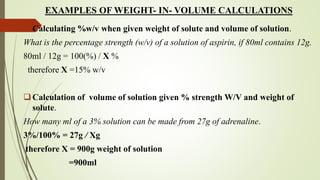
EXAMPLES OF WEIGHT- IN- VOLUME CALCULATIONS
Calculating %w/v when given weight of solute and volume of solution.
What is the percentage strength (w/v) of a solution of aspirin, if 80ml contains 12g.
80ml / 12g = 100(%) / X %
therefore X =15% w/v
Calculation of volume of solution given % strength W/V and weight of
solute.
How many ml of a 3% solution can be made from 27g of adrenaline.
3%/100% = 27g / Xg
therefore X = 900g weight of solution
=900ml
 PERCENTAGE VOLUME-IN-VOLUME
Percentage indicates the number of parts by volume of an ingredient
contained in the total volume of the solution or liquid preparation
considered as 100 parts by volume.
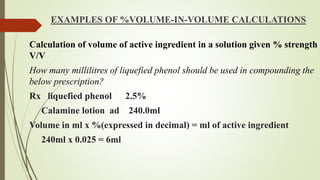
EXAMPLES OF %VOLUME-IN-VOLUME CALCULATIONS
Calculation of volume of active ingredient in a solution given % strength
V/V
How many millilitres of liquefied phenol should be used in compounding the
below prescription?
Rx liquefied phenol 2.5%
Calamine lotion ad 240.0ml
Volume in ml x %(expressed in decimal) = ml of active ingredient
240ml x 0.025 = 6ml
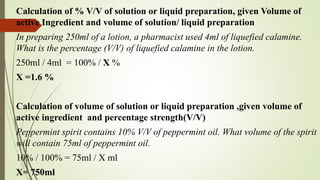
Calculation of % V/V of solution or liquid preparation, given Volume of
active Ingredient and volume of solution/ liquid preparation
In preparing 250ml of a lotion, a pharmacist used 4ml of liquefied calamine.
What is the percentage (V/V) of liquefied calamine in the lotion.
250ml / 4ml = 100% / X %
X =1.6 %
Calculation of volume of solution or liquid preparation ,given volume of
active ingredient and percentage strength(V/V)
Peppermint spirit contains 10% V/V of peppermint oil. What volume of the spirit
will contain 75ml of peppermint oil.
10% / 100% = 75ml / X ml
X= 750ml
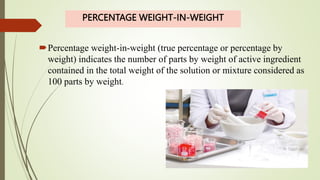
PERCENTAGE WEIGHT-IN-WEIGHT
Percentage weight-in-weight (true percentage or percentage by
weight) indicates the number of parts by weight of active ingredient
contained in the total weight of the solution or mixture considered as
100 parts by weight.
Examples of %Weight-in-Weight Calculations
Calculation of weight of active ingredient in weight of solution or
liquid preparation, given its W/W percentage strength.
How many grams of phenol should be used to prepare 240g of a 5%
(W/W) solution in water.
Weight in sol in g x %( expressed in decimal) = g of solute
240g X 0.05 = 12g
Calculation of weight of either active ingredient or diluent ,given
weight of the other and % strength (w/w) of the solution or liquid
preparations. (NB-weight of API and diluent are proportional to
their percentage)
How many grams of drug z should be dissolved in 240ml of water to
make 4% (w/w) solution.
100% - 4% = 96% weight of water
96% / 4% = 240g / X g
X = 10g
Calculation of % strength (w/w) of a solution of liquid preparation,
given the weight of active ingredient and weight of solution.
If 1500g of a solution contains 75g of drug substance , what is the %
strength(w/w) of the solution.
1500g/75g =100%/ X %
X=5%
Calculation of weight of a solution or liquid prep ,given weight of
API and % strength(w/w)
What weight of a 5% (w/w) solution can be prepared from 2g API?
5%/100% = 2g /Xg
X= 40g
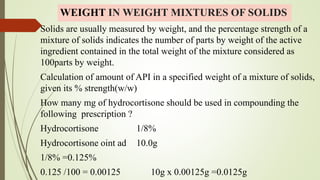
WEIGHT IN WEIGHT MIXTURES OF SOLIDS
Solids are usually measured by weight, and the percentage strength of a
mixture of solids indicates the number of parts by weight of the active
ingredient contained in the total weight of the mixture considered as
100parts by weight.
Calculation of amount of API in a specified weight of a mixture of solids,
given its % strength(w/w)
How many mg of hydrocortisone should be used in compounding the
following prescription ?
Hydrocortisone 1/8%
Hydrocortisone oint ad 10.0g
1/8% =0.125%
0.125 /100 = 0.00125 10g x 0.00125g =0.0125g
RATIO STRENGTH
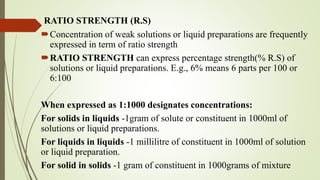
RATIO STRENGTH (R.S)
Concentration of weak solutions or liquid preparations are frequently
expressed in term of ratio strength
RATIO STRENGTH can express percentage strength(% R.S) of
solutions or liquid preparations. E.g., 6% means 6 parts per 100 or
6:100
When expressed as 1:1000 designates concentrations:
For solids in liquids -1gram of solute or constituent in 1000ml of
solutions or liquid preparations.
For liquids in liquids -1 millilitre of constituent in 1000ml of solution
or liquid preparation.
For solid in solids -1 gram of constituent in 1000grams of mixture
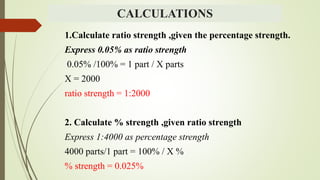
CALCULATIONS
1.Calculate ratio strength ,given the percentage strength.
Express 0.05% as ratio strength
0.05% /100% = 1 part / X parts
X = 2000
ratio strength = 1:2000
2. Calculate % strength ,given ratio strength
Express 1:4000 as percentage strength
4000 parts/1 part = 100% / X %
% strength = 0.025%
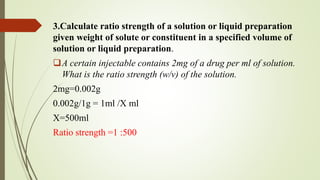
3.Calculate ratio strength of a solution or liquid preparation
given weight of solute or constituent in a specified volume of
solution or liquid preparation.
A certain injectable contains 2mg of a drug per ml of solution.
What is the ratio strength (w/v) of the solution.
2mg=0.002g
0.002g/1g = 1ml /X ml
X=500ml
Ratio strength =1 :500
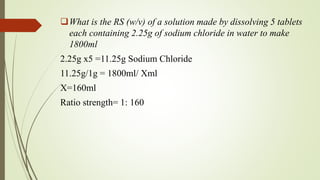
What is the RS (w/v) of a solution made by dissolving 5 tablets
each containing 2.25g of sodium chloride in water to make
1800ml
2.25g x5 =11.25g Sodium Chloride
11.25g/1g = 1800ml/ Xml
X=160ml
Ratio strength= 1: 160
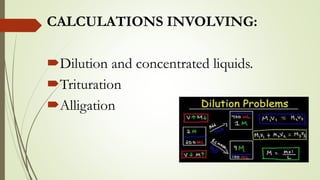
CALCULATIONS INVOLVING:
Dilution and concentrated liquids.
Trituration
Alligation
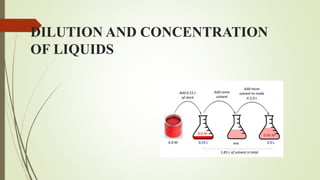
DILUTION AND CONCENTRATION
OF LIQUIDS
Dilution : addition of diluent or admixtures with solutions or
mixtures of lower strength.
Concentrated: addition of active ingredient or admixtures with
solutions of greater strength.
TWO RULES APPLIED simplifying calculations:
When ratio strength are given, convert them to percentage strength
before setting up a proportion. e.g.,
1/10 : 1/500 to 10 (%) : 0.2 (%)
Whenever proportional parts enter a calculation, reduce them to
lowest terms.e.g., 75parts: 25parts
simplified to 3 parts:1 parts.
Calculating the percentage or ratio strength of a solution made by
diluting or concentrating a solution of a given quantity and strength.
e.g.
If 500ml of a 15% v/v solution of methyl salicylate in alcohol are diluted to
1500ml, what will be the percentage strength (V/V)
1500ml/500ml = 15%/X%
% strength=5%
OR
(Quantity1 ) x (concentration 1) = (quantity 2) x (concentration 2)
500ml x 15% = 1500ml x (X%)
% strength = 5%
Calculating the amount of solution of desired strength that can be
made by diluting or concentrating a specified quantity of a solution
given the strength.
Example: How many grams of 10% (W/w) ammonia solution can be
made from 1800g of 28% w/w strong ammonia solution?
10%/28% = 1800g/ zg
Amount of Ammonia soln = 5040g
OR
1800g x 28% = zg x 10%
Amount of Ammonia soln = 5040g
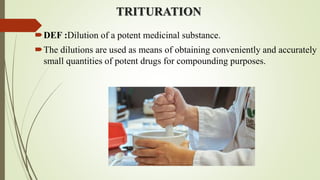
TRITURATION
DEF :Dilution of a potent medicinal substance.
The dilutions are used as means of obtaining conveniently and accurately
small quantities of potent drugs for compounding purposes.
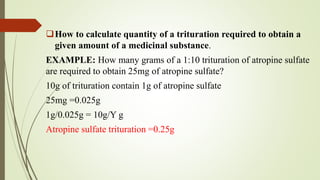
How to calculate quantity of a trituration required to obtain a
given amount of a medicinal substance.
EXAMPLE: How many grams of a 1:10 trituration of atropine sulfate
are required to obtain 25mg of atropine sulfate?
10g of trituration contain 1g of atropine sulfate
25mg =0.025g
1g/0.025g = 10g/Y g
Atropine sulfate trituration =0.25g
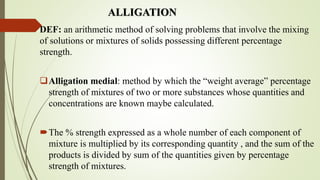
ALLIGATION
DEF: an arithmetic method of solving problems that involve the mixing
of solutions or mixtures of solids possessing different percentage
strength.
Alligation medial: method by which the “weight average” percentage
strength of mixtures of two or more substances whose quantities and
concentrations are known maybe calculated.
The % strength expressed as a whole number of each component of
mixture is multiplied by its corresponding quantity , and the sum of the
products is divided by sum of the quantities given by percentage
strength of mixtures.
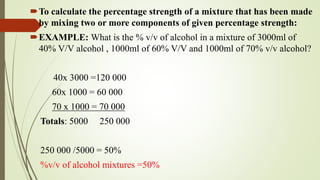
To calculate the percentage strength of a mixture that has been made
by mixing two or more components of given percentage strength:
EXAMPLE: What is the % v/v of alcohol in a mixture of 3000ml of
40% V/V alcohol , 1000ml of 60% V/V and 1000ml of 70% v/v alcohol?
40x 3000 =120 000
60x 1000 = 60 000
70 x 1000 = 70 000
Totals: 5000 250 000
250 000 /5000 = 50%
%v/v of alcohol mixtures =50%
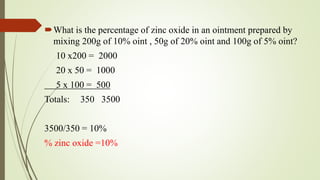
What is the percentage of zinc oxide in an ointment prepared by
mixing 200g of 10% oint , 50g of 20% oint and 100g of 5% oint?
10 x200 = 2000
20 x 50 = 1000
5 x 100 = 500
Totals: 350 3500
3500/350 = 10%
% zinc oxide =10%
Alligation alternate :
Method by which number of parts of two or more components of a
given strength can be calculated ,given the strength when they are
mixed to prepare a mixture of desired strength.
o Finding relative amounts of solutions or other substances of
different strengths that should be used to make a mixture of
required strength.
NB:
Difference between the strength of the stronger components(95%) and the
desired strength (70%) indicates the number of parts of the weaker conc to be
used. [25parts]
Difference between desired strength (70%) and the weaker component (50%)
strength indicates number of parts of the stronger conc to be used. [20 parts]
◦ Example: In what proportion should alcohols of 95% and 50%
strengths be mixed to make 70 %?
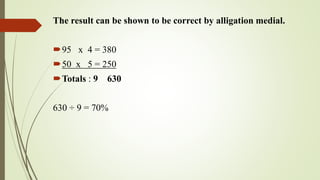
The result can be shown to be correct by alligation medial.
95 x 4 = 380
50 x 5 = 250
Totals : 9 630
630 ÷ 9 = 70%
REFERENCES
1. Stocklosa Mitchell & Ansel Howard (1991). Pharmaceutical
calculations 9th Edition(pg. 74-95 , 143-173, 284-289), Lea & Febiger,
600 Washington Square, Philadelphia
2. Howard C. Ansel;– Ansel (2010). Pharmaceutical Calculations 13th ,
Lippincott Williams & Wilkins.
PRACTICE QUESTIONS
PERCENTAGE CONCENTRATION & RATIO STRENGTH
1. How many grams of podophyllin resin should be used to compound
the prescription.
Podophylin resin 25%
Compd Benzoic Tincture ad 30.0ml
2. How many grams of amitriptyline should be used in compounding the
prescription.
Amitriptyline 5%
Glycerin ad 60.0ml
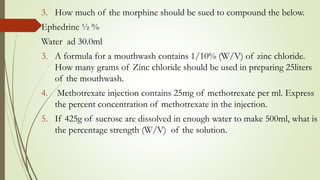
3. How much of the morphine should be sued to compound the below.
Ephedrine ½ %
Water ad 30.0ml
3. A formula for a mouthwash contains 1/10% (W/V) of zinc chloride.
How many grams of Zinc chloride should be used in preparing 25liters
of the mouthwash.
4. Methotrexate injection contains 25mg of methotrexate per ml. Express
the percent concentration of methotrexate in the injection.
5. If 425g of sucrose are dissolved in enough water to make 500ml, what is
the percentage strength (W/V) of the solution.
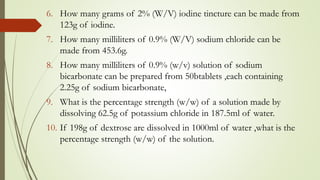
6. How many grams of 2% (W/V) iodine tincture can be made from
123g of iodine.
7. How many milliliters of 0.9% (W/V) sodium chloride can be
made from 453.6g.
8. How many milliliters of 0.9% (w/v) solution of sodium
bicarbonate can be prepared from 50btablets ,each containing
2.25g of sodium bicarbonate,
9. What is the percentage strength (w/w) of a solution made by
dissolving 62.5g of potassium chloride in 187.5ml of water.
10. If 198g of dextrose are dissolved in 1000ml of water ,what is the
percentage strength (w/w) of the solution.
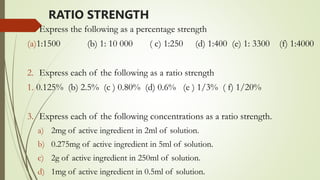
RATIO STRENGTH
1. Express the following as a percentage strength
(a)1:1500 (b) 1: 10 000 ( c) 1:250 (d) 1:400 (e) 1: 3300 (f) 1:4000
2. Express each of the following as a ratio strength
1. 0.125% (b) 2.5% (c ) 0.80% (d) 0.6% (e ) 1/3% ( f) 1/20%
3. Express each of the following concentrations as a ratio strength.
a) 2mg of active ingredient in 2ml of solution.
b) 0.275mg of active ingredient in 5ml of solution.
c) 2g of active ingredient in 250ml of solution.
d) 1mg of active ingredient in 0.5ml of solution.
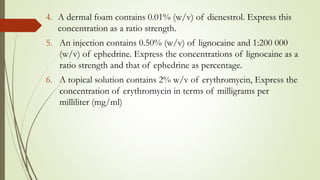
4. A dermal foam contains 0.01% (w/v) of dienestrol. Express this
concentration as a ratio strength.
5. An injection contains 0.50% (w/v) of lignocaine and 1:200 000
(w/v) of ephedrine. Express the concentrations of lignocaine as a
ratio strength and that of ephedrine as percentage.
6. A topical solution contains 2% w/v of erythromycin, Express the
concentration of erythromycin in terms of milligrams per
milliliter (mg/ml)
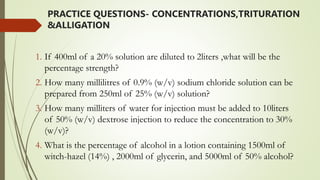
PRACTICE QUESTIONS- CONCENTRATIONS,TRITURATION
&ALLIGATION
1. If 400ml of a 20% solution are diluted to 2liters ,what will be the
percentage strength?
2. How many millilitres of 0.9% (w/v) sodium chloride solution can be
prepared from 250ml of 25% (w/v) solution?
3. How many milliters of water for injection must be added to 10liters
of 50% (w/v) dextrose injection to reduce the concentration to 30%
(w/v)?
4. What is the percentage of alcohol in a lotion containing 1500ml of
witch-hazel (14%) , 2000ml of glycerin, and 5000ml of 50% alcohol?
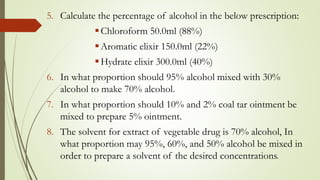
5. Calculate the percentage of alcohol in the below prescription:
Chloroform 50.0ml (88%)
Aromatic elixir 150.0ml (22%)
Hydrate elixir 300.0ml (40%)
6. In what proportion should 95% alcohol mixed with 30%
alcohol to make 70% alcohol.
7. In what proportion should 10% and 2% coal tar ointment be
mixed to prepare 5% ointment.
8. The solvent for extract of vegetable drug is 70% alcohol, In
what proportion may 95%, 60%, and 50% alcohol be mixed in
order to prepare a solvent of the desired concentrations.

PCT CALCULATIONS 2.pptx

  • 1.
  • 2.
    LEARNING OBJECTIVES UNDERSTAND PHARMACEUTICALCALCULATIONS AS : Expressions of percent weight-in-volume, percent volume-in - volume, and percent weight-in-weight. Expression of ratio strength Dilution and concentrated liquids. Triturations Alligations
  • 3.
  • 4.
    Definition of thepercentage concentrations of active and inactive constituents in various types of pharmaceutical preparations as per United States Pharmacopeia. Percent weight-in-volume (w/v) : the number of grams of a constituent in 100ml of solution or liquid preparation. It is used regardless of whether water or another liquid is the solvent or vehicle. Expressed as: % w/v.
  • 5.
    Percent volume-in-volume (v/v):the number of milliliters of a constituent in 100 ml of solution or liquid preparation. Expressed as: % v/v.  Percent weight-in-weight (w/w) : the number of grams of a constituent in 100 g of solution or preparation. Expressed as: % w/w.
  • 6.
    The term percentor the symbol %, when used without qualification means: • For solutions or suspensions of solids in liquids, percent weight-in- volume. • for solutions of liquids in liquids, percent volume-in-volume. • for mixtures of solids or semisolids, percent weight-in-weight. • For solutions of gases in liquids, percent weight-in-volume
  • 7.
     PERCENTAGE WEIGHT-IN-VOLUME Representgrams of a solute or constituent in 100 mL of solution or liquid preparation. For solution to conform to definition: convert all common weights to grams and volumes to millilitres.
  • 8.
    EXAMPLES OF WEIGHT-IN- VOLUME CALCULATIONS Calculating %w/v when given weight of solute and volume of solution. What is the percentage strength (w/v) of a solution of aspirin, if 80ml contains 12g. 80ml / 12g = 100(%) / X % therefore X =15% w/v Calculation of volume of solution given % strength W/V and weight of solute. How many ml of a 3% solution can be made from 27g of adrenaline. 3%/100% = 27g / Xg therefore X = 900g weight of solution =900ml
  • 9.
     PERCENTAGE VOLUME-IN-VOLUME Percentageindicates the number of parts by volume of an ingredient contained in the total volume of the solution or liquid preparation considered as 100 parts by volume.
  • 10.
    EXAMPLES OF %VOLUME-IN-VOLUMECALCULATIONS Calculation of volume of active ingredient in a solution given % strength V/V How many millilitres of liquefied phenol should be used in compounding the below prescription? Rx liquefied phenol 2.5% Calamine lotion ad 240.0ml Volume in ml x %(expressed in decimal) = ml of active ingredient 240ml x 0.025 = 6ml
  • 11.
    Calculation of %V/V of solution or liquid preparation, given Volume of active Ingredient and volume of solution/ liquid preparation In preparing 250ml of a lotion, a pharmacist used 4ml of liquefied calamine. What is the percentage (V/V) of liquefied calamine in the lotion. 250ml / 4ml = 100% / X % X =1.6 % Calculation of volume of solution or liquid preparation ,given volume of active ingredient and percentage strength(V/V) Peppermint spirit contains 10% V/V of peppermint oil. What volume of the spirit will contain 75ml of peppermint oil. 10% / 100% = 75ml / X ml X= 750ml
  • 12.
    PERCENTAGE WEIGHT-IN-WEIGHT Percentage weight-in-weight(true percentage or percentage by weight) indicates the number of parts by weight of active ingredient contained in the total weight of the solution or mixture considered as 100 parts by weight.
  • 13.
    Examples of %Weight-in-WeightCalculations Calculation of weight of active ingredient in weight of solution or liquid preparation, given its W/W percentage strength. How many grams of phenol should be used to prepare 240g of a 5% (W/W) solution in water. Weight in sol in g x %( expressed in decimal) = g of solute 240g X 0.05 = 12g
  • 14.
    Calculation of weightof either active ingredient or diluent ,given weight of the other and % strength (w/w) of the solution or liquid preparations. (NB-weight of API and diluent are proportional to their percentage) How many grams of drug z should be dissolved in 240ml of water to make 4% (w/w) solution. 100% - 4% = 96% weight of water 96% / 4% = 240g / X g X = 10g
  • 15.
    Calculation of %strength (w/w) of a solution of liquid preparation, given the weight of active ingredient and weight of solution. If 1500g of a solution contains 75g of drug substance , what is the % strength(w/w) of the solution. 1500g/75g =100%/ X % X=5% Calculation of weight of a solution or liquid prep ,given weight of API and % strength(w/w) What weight of a 5% (w/w) solution can be prepared from 2g API? 5%/100% = 2g /Xg X= 40g
  • 16.
    WEIGHT IN WEIGHTMIXTURES OF SOLIDS Solids are usually measured by weight, and the percentage strength of a mixture of solids indicates the number of parts by weight of the active ingredient contained in the total weight of the mixture considered as 100parts by weight. Calculation of amount of API in a specified weight of a mixture of solids, given its % strength(w/w) How many mg of hydrocortisone should be used in compounding the following prescription ? Hydrocortisone 1/8% Hydrocortisone oint ad 10.0g 1/8% =0.125% 0.125 /100 = 0.00125 10g x 0.00125g =0.0125g
  • 17.
  • 18.
    RATIO STRENGTH (R.S) Concentrationof weak solutions or liquid preparations are frequently expressed in term of ratio strength RATIO STRENGTH can express percentage strength(% R.S) of solutions or liquid preparations. E.g., 6% means 6 parts per 100 or 6:100 When expressed as 1:1000 designates concentrations: For solids in liquids -1gram of solute or constituent in 1000ml of solutions or liquid preparations. For liquids in liquids -1 millilitre of constituent in 1000ml of solution or liquid preparation. For solid in solids -1 gram of constituent in 1000grams of mixture
  • 19.
    CALCULATIONS 1.Calculate ratio strength,given the percentage strength. Express 0.05% as ratio strength 0.05% /100% = 1 part / X parts X = 2000 ratio strength = 1:2000 2. Calculate % strength ,given ratio strength Express 1:4000 as percentage strength 4000 parts/1 part = 100% / X % % strength = 0.025%
  • 20.
    3.Calculate ratio strengthof a solution or liquid preparation given weight of solute or constituent in a specified volume of solution or liquid preparation. A certain injectable contains 2mg of a drug per ml of solution. What is the ratio strength (w/v) of the solution. 2mg=0.002g 0.002g/1g = 1ml /X ml X=500ml Ratio strength =1 :500
  • 21.
    What is theRS (w/v) of a solution made by dissolving 5 tablets each containing 2.25g of sodium chloride in water to make 1800ml 2.25g x5 =11.25g Sodium Chloride 11.25g/1g = 1800ml/ Xml X=160ml Ratio strength= 1: 160
  • 22.
    CALCULATIONS INVOLVING: Dilution andconcentrated liquids. Trituration Alligation
  • 23.
  • 24.
    Dilution : additionof diluent or admixtures with solutions or mixtures of lower strength. Concentrated: addition of active ingredient or admixtures with solutions of greater strength. TWO RULES APPLIED simplifying calculations: When ratio strength are given, convert them to percentage strength before setting up a proportion. e.g., 1/10 : 1/500 to 10 (%) : 0.2 (%) Whenever proportional parts enter a calculation, reduce them to lowest terms.e.g., 75parts: 25parts simplified to 3 parts:1 parts.
  • 25.
    Calculating the percentageor ratio strength of a solution made by diluting or concentrating a solution of a given quantity and strength. e.g. If 500ml of a 15% v/v solution of methyl salicylate in alcohol are diluted to 1500ml, what will be the percentage strength (V/V) 1500ml/500ml = 15%/X% % strength=5% OR (Quantity1 ) x (concentration 1) = (quantity 2) x (concentration 2) 500ml x 15% = 1500ml x (X%) % strength = 5%
  • 26.
    Calculating the amountof solution of desired strength that can be made by diluting or concentrating a specified quantity of a solution given the strength. Example: How many grams of 10% (W/w) ammonia solution can be made from 1800g of 28% w/w strong ammonia solution? 10%/28% = 1800g/ zg Amount of Ammonia soln = 5040g OR 1800g x 28% = zg x 10% Amount of Ammonia soln = 5040g
  • 27.
    TRITURATION DEF :Dilution ofa potent medicinal substance. The dilutions are used as means of obtaining conveniently and accurately small quantities of potent drugs for compounding purposes.
  • 28.
    How to calculatequantity of a trituration required to obtain a given amount of a medicinal substance. EXAMPLE: How many grams of a 1:10 trituration of atropine sulfate are required to obtain 25mg of atropine sulfate? 10g of trituration contain 1g of atropine sulfate 25mg =0.025g 1g/0.025g = 10g/Y g Atropine sulfate trituration =0.25g
  • 29.
    ALLIGATION DEF: an arithmeticmethod of solving problems that involve the mixing of solutions or mixtures of solids possessing different percentage strength. Alligation medial: method by which the “weight average” percentage strength of mixtures of two or more substances whose quantities and concentrations are known maybe calculated. The % strength expressed as a whole number of each component of mixture is multiplied by its corresponding quantity , and the sum of the products is divided by sum of the quantities given by percentage strength of mixtures.
  • 30.
    To calculate thepercentage strength of a mixture that has been made by mixing two or more components of given percentage strength: EXAMPLE: What is the % v/v of alcohol in a mixture of 3000ml of 40% V/V alcohol , 1000ml of 60% V/V and 1000ml of 70% v/v alcohol? 40x 3000 =120 000 60x 1000 = 60 000 70 x 1000 = 70 000 Totals: 5000 250 000 250 000 /5000 = 50% %v/v of alcohol mixtures =50%
  • 31.
    What is thepercentage of zinc oxide in an ointment prepared by mixing 200g of 10% oint , 50g of 20% oint and 100g of 5% oint? 10 x200 = 2000 20 x 50 = 1000 5 x 100 = 500 Totals: 350 3500 3500/350 = 10% % zinc oxide =10%
  • 32.
    Alligation alternate : Methodby which number of parts of two or more components of a given strength can be calculated ,given the strength when they are mixed to prepare a mixture of desired strength. o Finding relative amounts of solutions or other substances of different strengths that should be used to make a mixture of required strength.
  • 33.
    NB: Difference between thestrength of the stronger components(95%) and the desired strength (70%) indicates the number of parts of the weaker conc to be used. [25parts] Difference between desired strength (70%) and the weaker component (50%) strength indicates number of parts of the stronger conc to be used. [20 parts] ◦ Example: In what proportion should alcohols of 95% and 50% strengths be mixed to make 70 %?
  • 34.
    The result canbe shown to be correct by alligation medial. 95 x 4 = 380 50 x 5 = 250 Totals : 9 630 630 ÷ 9 = 70%
  • 36.
    REFERENCES 1. Stocklosa Mitchell& Ansel Howard (1991). Pharmaceutical calculations 9th Edition(pg. 74-95 , 143-173, 284-289), Lea & Febiger, 600 Washington Square, Philadelphia 2. Howard C. Ansel;– Ansel (2010). Pharmaceutical Calculations 13th , Lippincott Williams & Wilkins.
  • 37.
    PRACTICE QUESTIONS PERCENTAGE CONCENTRATION& RATIO STRENGTH 1. How many grams of podophyllin resin should be used to compound the prescription. Podophylin resin 25% Compd Benzoic Tincture ad 30.0ml 2. How many grams of amitriptyline should be used in compounding the prescription. Amitriptyline 5% Glycerin ad 60.0ml
  • 38.
    3. How muchof the morphine should be sued to compound the below. Ephedrine ½ % Water ad 30.0ml 3. A formula for a mouthwash contains 1/10% (W/V) of zinc chloride. How many grams of Zinc chloride should be used in preparing 25liters of the mouthwash. 4. Methotrexate injection contains 25mg of methotrexate per ml. Express the percent concentration of methotrexate in the injection. 5. If 425g of sucrose are dissolved in enough water to make 500ml, what is the percentage strength (W/V) of the solution.
  • 39.
    6. How manygrams of 2% (W/V) iodine tincture can be made from 123g of iodine. 7. How many milliliters of 0.9% (W/V) sodium chloride can be made from 453.6g. 8. How many milliliters of 0.9% (w/v) solution of sodium bicarbonate can be prepared from 50btablets ,each containing 2.25g of sodium bicarbonate, 9. What is the percentage strength (w/w) of a solution made by dissolving 62.5g of potassium chloride in 187.5ml of water. 10. If 198g of dextrose are dissolved in 1000ml of water ,what is the percentage strength (w/w) of the solution.
  • 40.
    RATIO STRENGTH 1. Expressthe following as a percentage strength (a)1:1500 (b) 1: 10 000 ( c) 1:250 (d) 1:400 (e) 1: 3300 (f) 1:4000 2. Express each of the following as a ratio strength 1. 0.125% (b) 2.5% (c ) 0.80% (d) 0.6% (e ) 1/3% ( f) 1/20% 3. Express each of the following concentrations as a ratio strength. a) 2mg of active ingredient in 2ml of solution. b) 0.275mg of active ingredient in 5ml of solution. c) 2g of active ingredient in 250ml of solution. d) 1mg of active ingredient in 0.5ml of solution.
  • 41.
    4. A dermalfoam contains 0.01% (w/v) of dienestrol. Express this concentration as a ratio strength. 5. An injection contains 0.50% (w/v) of lignocaine and 1:200 000 (w/v) of ephedrine. Express the concentrations of lignocaine as a ratio strength and that of ephedrine as percentage. 6. A topical solution contains 2% w/v of erythromycin, Express the concentration of erythromycin in terms of milligrams per milliliter (mg/ml)
  • 42.
    PRACTICE QUESTIONS- CONCENTRATIONS,TRITURATION &ALLIGATION 1.If 400ml of a 20% solution are diluted to 2liters ,what will be the percentage strength? 2. How many millilitres of 0.9% (w/v) sodium chloride solution can be prepared from 250ml of 25% (w/v) solution? 3. How many milliters of water for injection must be added to 10liters of 50% (w/v) dextrose injection to reduce the concentration to 30% (w/v)? 4. What is the percentage of alcohol in a lotion containing 1500ml of witch-hazel (14%) , 2000ml of glycerin, and 5000ml of 50% alcohol?
  • 43.
    5. Calculate thepercentage of alcohol in the below prescription: Chloroform 50.0ml (88%) Aromatic elixir 150.0ml (22%) Hydrate elixir 300.0ml (40%) 6. In what proportion should 95% alcohol mixed with 30% alcohol to make 70% alcohol. 7. In what proportion should 10% and 2% coal tar ointment be mixed to prepare 5% ointment. 8. The solvent for extract of vegetable drug is 70% alcohol, In what proportion may 95%, 60%, and 50% alcohol be mixed in order to prepare a solvent of the desired concentrations.