DRUG CALCULATIONS FOR
HEALTHCARE PROFESSIONALS’
Prepared And Presented By:
Mahamudu Nafah Ibrahim
(RGN, AMP- GCNM)
INTRODUCTION
• Drug calculation questions are a major concern for most
healthcare professionals.
• The vast majority of calculations are relatively
straightforward and you will not need to perform any
complex calculations very often.
• But many professionals still struggle with basic calculations.
• The aim of course is not to demean or offend anyone, but to
recall and explain the basics.
• It is vital that any person performing dose calculations can
understand and explain how the final dose is actually
arrived at through the calculation.
NMC-UK Standards for Medicines Management (2008
)
INTRODUCTION CON’T…
The use of calculators to
determine the volume or
quantity of medication should
not act as a substitute for
arithmetical knowledge and
skill.
THE BASICS
•Skill is required to:
extract the correct numbers from the clinical situation;
place them correctly in the formula;
perform the arithmetic; and
translate the answer back to the clinical context to find
the meaning of the number and
the the action to be taken.
•To be certain about an answer you must have ‘sense
of number’.
THE BASICS CON’T…
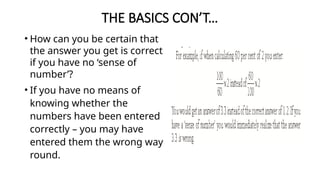
• How can you be certain that
the answer you get is correct
if you have no ‘sense of
number’?
• If you have no means of
knowing whether the
numbers have been entered
correctly – you may have
entered them the wrong way
round.
THE BASICS CON’T…
• Ability to put your answer back into the correct clinical context.
• You may have entered the numbers correctly into your formula and
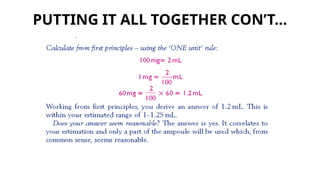
calculator and arrived at the correct answer of 1.2 – but what does it
mean?
• You might mistakenly believe that you need to give 1.2 ampoules
instead of 1.2mL.
• If so, you would need to work out the volume to be drawn up which
equals 1.2 ampoules – more calculations and more potential
mistakes!
• All this may seem unbelievable – but these things do happen.
THE BASICS CON’T…
ESTIMATION OF ANSWERS
• Looking at a drug calculation
with a ‘sense of number’
means that we can often
have a ‘rough idea’ or
estimate of the answer.
• Simple techniques of
halving, doubling, addition
and multiplication can be
used.
For example:
• You have: 200mg in 10mL
• From this, you can easily work
out the following equivalents:
• 100mg in 5mL (by halving)
• 50mg in 2.5mL (by halving again)
• 150mg in 7.5mL (by addition:
100mg + 50mg and 5mL + 2.5mL)
THE BASICS CON’T…
If estimation is not
possible, then rely
on experience and
common sense.
EXPERIENCE AND COMMON SENSE
If your answer means that you
would need six ampoules of
an injection for your
calculated dose, then common
sense should dictate that this
is not normal practice.
THE BASICS CON’T…
THE ‘ONE UNIT’ RULE
• Various methods are
available for drug
calculations.
• Using the ‘one unit rule’ will
enable you to work from
first principles and have a
‘sense of number’.
• The rule works by
proportion: what you do to
one side of an equation, do
the same to the other side.
CHECKING YOUR ANSWER
ASK: Does It Seem Reasonable?
• It is good practice to have a
rough idea of the answer first to
enable you check your final
calculated answer.
• If the answer you get is outside
this range, then your answer is
wrong and you should re-check
your calculations.
THE BASICS CON’T…
DETERMINING WHETHER YOUR ANSWER IS REASONABLE OR NOT?
The maximum you should give a patient for any one dose:
• TABLETS Not more than 4*
• LIQUIDS Anything from 5mL to 20mL
• INJECTIONS Anything from 1mL to 10mL
*An exception to this would be prednisolone. Some doses of
prednisolone may mean the patient taking up to 10 tablets at any
one time.
PUTTING IT ALL TOGETHER
Consider the following
situation:
 You have an injection of pethidine
with the strength of 100mg per 2mL
and you need to give a dose of 60mg.
PUTTING IT ALL TOGETHER
• First – have a rough idea of your answer by estimation.
• By looking at what you have – 100mg in 2mL, you can
assume the following:
• The dose you want (60 mg) < 2mL (2mL = 100 mg).
• more than 1mL (1mL = 50mg – by halving)
• less than 1.5 mL (0.5 mL = 25 mg – by halving and
addition: 1mL + 0.5mL = 75 mg)
• less than 1.25 mL (0.25 mL = 12.5 mg – by halving and
addition 1 + 0.25mL = 62.5 mg)
• From the above, you would estimate that your
answer would be within the range 1–1.25 mL.
PUTTING IT ALL TOGETHER CON’T…
MINIMIZING ERRORS
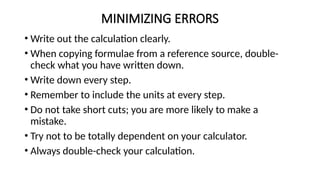
• Write out the calculation clearly.
• When copying formulae from a reference source, double-
check what you have written down.
• Write down every step.
• Remember to include the units at every step.
• Do not take short cuts; you are more likely to make a
mistake.
• Try not to be totally dependent on your calculator.
• Always double-check your calculation.
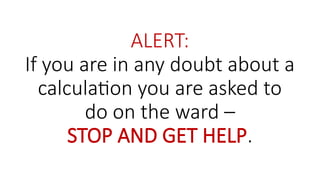
ALERT:
If you are in any doubt about a
calculation you are asked to
do on the ward –
STOP AND GET HELP.
BASIC MATHEMATICAL CONCEPTS
• Arithmetic symbols
• Basic maths
• Long multiplication
• Long division
• Rules of arithmetic
• Fractions and decimals
• Reducing or simplifying fractions
• Equivalent fractions
• Adding and subtracting fractions
• Multiplying fractions
• Dividing fractions
• Multiplying decimals
• Dividing decimals
• Rounding of decimal numbers
• Converting decimals to fractions
• Roman numerals
• Powers or exponentials
• Using a calculator
• Powers and calculators
• Estimating answers
• Converting fractions to decimals
PER CENT AND PERCENTAGES
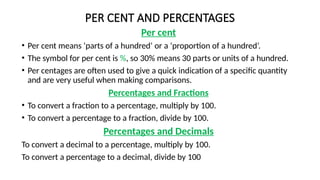
Per cent
• Per cent means ‘parts of a hundred’ or a ‘proportion of a hundred’.
• The symbol for per cent is %, so 30% means 30 parts or units of a hundred.
• Per centages are often used to give a quick indication of a specific quantity
and are very useful when making comparisons.
Percentages and Fractions
• To convert a fraction to a percentage, multiply by 100.
• To convert a percentage to a fraction, divide by 100.
Percentages and Decimals
To convert a decimal to a percentage, multiply by 100.
To convert a percentage to a decimal, divide by 100
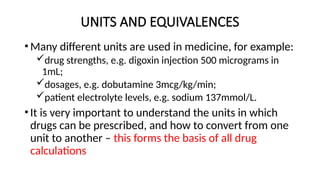
UNITS AND EQUIVALENCES
•Many different units are used in medicine, for example:
drug strengths, e.g. digoxin injection 500 micrograms in
1mL;
dosages, e.g. dobutamine 3mcg/kg/min;
patient electrolyte levels, e.g. sodium 137mmol/L.
•It is very important to understand the units in which
drugs can be prescribed, and how to convert from one
unit to another – this forms the basis of all drug
calculations
SI (Système Internationale) UNITS
• SI is another name for the metric system of measurement.
• The aim of metrication is to make calculations easier than with the
imperial system (ounces, pounds, stones, inches, pints, etc.).
• SI units are generally accepted in the United Kingdom and many other
countries for use in medical practice and pharmacy.
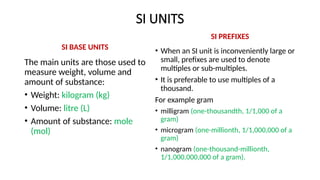
SI UNITS
SI BASE UNITS
The main units are those used to
measure weight, volume and
amount of substance:
• Weight: kilogram (kg)
• Volume: litre (L)
• Amount of substance: mole
(mol)
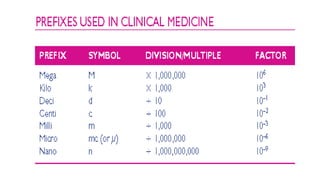
SI PREFIXES
• When an SI unit is inconveniently large or
small, prefixes are used to denote
multiples or sub-multiples.
• It is preferable to use multiples of a
thousand.
For example gram
• milligram (one-thousandth, 1/1,000 of a
gram)
• microgram (one-millionth, 1/1,000,000 of a
gram)
• nanogram (one-thousand-millionth,
1/1,000,000,000 of a gram).
SI UNITS CON’T…
In practice, drug strengths and dosages can be expressed in various
ways:
• The main prefixes you will come across on the ward are mega-,
milli-, micro- and nano-.
Benzylpenicillin = megaunits (1 mega-unit means 1 million units of
activity).
Small volumes of liquids = millilitres (mL) and are used to describe small
dosages, e.g. lactulose, 10mL to be given three times a day.
Drug strengths = milligrams (mg), e.g. furosemide (frusemide) 40mg
tablets.
Very small strengths = micrograms or nanograms, e.g. digoxin 125
microgram tablets; alfacalcidol 250 nanogram capsules.
UNITS & EQUIVALENCES
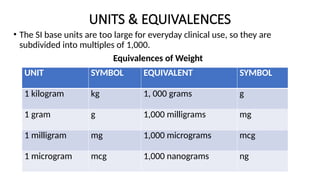
• The SI base units are too large for everyday clinical use, so they are
subdivided into multiples of 1,000.
Equivalences of Weight
UNIT SYMBOL EQUIVALENT SYMBOL
1 kilogram kg 1, 000 grams g
1 gram g 1,000 milligrams mg
1 milligram mg 1,000 micrograms mcg
1 microgram mcg 1,000 nanograms ng
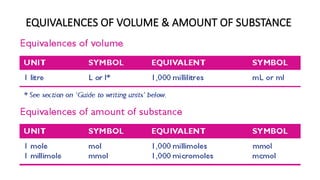
EQUIVALENCES OF VOLUME & AMOUNT OF SUBSTANCE
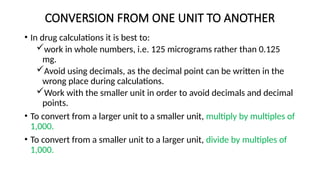
CONVERSION FROM ONE UNIT TO ANOTHER
• In drug calculations it is best to:
work in whole numbers, i.e. 125 micrograms rather than 0.125
mg.
Avoid using decimals, as the decimal point can be written in the
wrong place during calculations.
Work with the smaller unit in order to avoid decimals and decimal
points.
• To convert from a larger unit to a smaller unit, multiply by multiples of
1,000.
• To convert from a smaller unit to a larger unit, divide by multiples of
1,000.
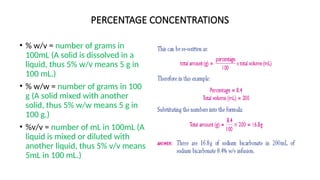
PERCENTAGE CONCENTRATIONS
• % w/v = number of grams in
100mL (A solid is dissolved in a
liquid, thus 5% w/v means 5 g in
100 mL.)
• % w/w = number of grams in 100
g (A solid mixed with another
solid, thus 5% w/w means 5 g in
100 g.)
• %v/v = number of mL in 100mL (A
liquid is mixed or diluted with
another liquid, thus 5% v/v means
5mL in 100 mL.)
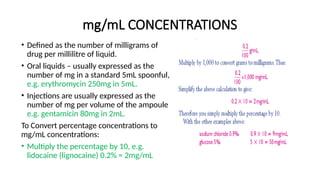
mg/mL CONCENTRATIONS
• Defined as the number of milligrams of
drug per millilitre of liquid.
• Oral liquids – usually expressed as the
number of mg in a standard 5mL spoonful,
e.g. erythromycin 250mg in 5mL.
• Injections are usually expressed as the
number of mg per volume of the ampoule
e.g. gentamicin 80mg in 2mL.
To Convert percentage concentrations to
mg/mL concentrations:
• Multiply the percentage by 10, e.g.
lidocaine (lignocaine) 0.2% = 2mg/mL
DOSAGE CALCULATIONS
TABLETS & CAPSULES
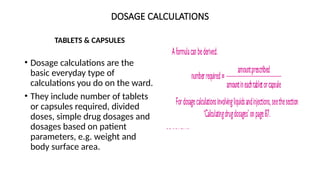
• Dosage calculations are the
basic everyday type of
calculations you do on the ward.
• They include number of tablets
or capsules required, divided
doses, simple drug dosages and
dosages based on patient
parameters, e.g. weight and
body surface area.
DOSAGE CALCULATIONS CON’T…
BY BODY WEIGHT & SURFACE AREA
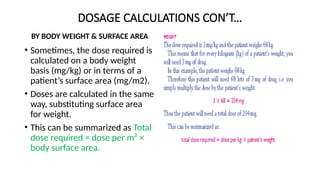
• Sometimes, the dose required is
calculated on a body weight
basis (mg/kg) or in terms of a
patient’s surface area (mg/m2).
• Doses are calculated in the same
way, substituting surface area
for weight.
• This can be summarized as Total
dose required = dose per m² ×
body surface area.
DOSAGE CALCULATIONS CON’T…
BY MOUTH (LIQUIDS)
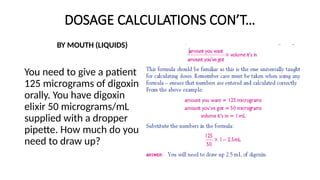
You need to give a patient
125 micrograms of digoxin
orally. You have digoxin
elixir 50 micrograms/mL
supplied with a dropper
pipette. How much do you
need to draw up?
DISPLACEMENT VALUES OR VOLUMES
• What is displacement?
• This volume difference between final volume of a
reconstituted drug and the amount of water added to it.
• Is displacement important in medicine?
• For most patients this does not matter because the whole
vial is administered. However it can be very important when
you want to give a dose that is less than the total contents of
the vial.
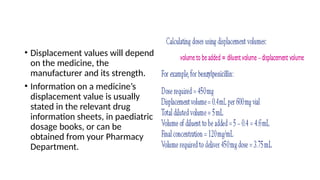
• Displacement values will depend
on the medicine, the
manufacturer and its strength.
• Information on a medicine’s
displacement value is usually
stated in the relevant drug
information sheets, in paediatric
dosage books, or can be
obtained from your Pharmacy
Department.
INFUSION RATE CALCULATIONS
• There are two types of infusion rate calculations to be
considered: those involving drops/min and those involving
mL/hour.
• The first (drops/min) is mainly encountered when infusions
are given under gravity as with fluid replacement.
• The second (mL/hour) is encountered when infusions have to
be given accurately or in small volumes using infusion or
syringe pumps – particularly if drugs have to be given as
infusions.
INFUSION RATE CALCULATIONS
GIVING SETS
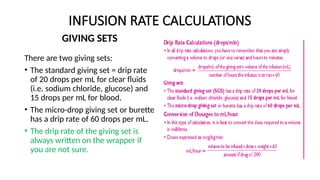
There are two giving sets:
• The standard giving set = drip rate
of 20 drops per mL for clear fluids
(i.e. sodium chloride, glucose) and
15 drops per mL for blood.
• The micro-drop giving set or burette
has a drip rate of 60 drops per mL.
• The drip rate of the giving set is
always written on the wrapper if
you are not sure.
INFUSION RATE CALCULATIONS
Thank you
REFERENCES

DRUG CALCULATIONS FOR PROFESSIONALS'.pptx

  • 1.
    DRUG CALCULATIONS FOR HEALTHCAREPROFESSIONALS’ Prepared And Presented By: Mahamudu Nafah Ibrahim (RGN, AMP- GCNM)
  • 2.
    INTRODUCTION • Drug calculationquestions are a major concern for most healthcare professionals. • The vast majority of calculations are relatively straightforward and you will not need to perform any complex calculations very often. • But many professionals still struggle with basic calculations. • The aim of course is not to demean or offend anyone, but to recall and explain the basics. • It is vital that any person performing dose calculations can understand and explain how the final dose is actually arrived at through the calculation.
  • 3.
    NMC-UK Standards forMedicines Management (2008 ) INTRODUCTION CON’T… The use of calculators to determine the volume or quantity of medication should not act as a substitute for arithmetical knowledge and skill.
  • 4.
    THE BASICS •Skill isrequired to: extract the correct numbers from the clinical situation; place them correctly in the formula; perform the arithmetic; and translate the answer back to the clinical context to find the meaning of the number and the the action to be taken. •To be certain about an answer you must have ‘sense of number’.
  • 5.
    THE BASICS CON’T… •How can you be certain that the answer you get is correct if you have no ‘sense of number’? • If you have no means of knowing whether the numbers have been entered correctly – you may have entered them the wrong way round.
  • 6.
    THE BASICS CON’T… •Ability to put your answer back into the correct clinical context. • You may have entered the numbers correctly into your formula and calculator and arrived at the correct answer of 1.2 – but what does it mean? • You might mistakenly believe that you need to give 1.2 ampoules instead of 1.2mL. • If so, you would need to work out the volume to be drawn up which equals 1.2 ampoules – more calculations and more potential mistakes! • All this may seem unbelievable – but these things do happen.
  • 7.
    THE BASICS CON’T… ESTIMATIONOF ANSWERS • Looking at a drug calculation with a ‘sense of number’ means that we can often have a ‘rough idea’ or estimate of the answer. • Simple techniques of halving, doubling, addition and multiplication can be used. For example: • You have: 200mg in 10mL • From this, you can easily work out the following equivalents: • 100mg in 5mL (by halving) • 50mg in 2.5mL (by halving again) • 150mg in 7.5mL (by addition: 100mg + 50mg and 5mL + 2.5mL)
  • 8.
    THE BASICS CON’T… Ifestimation is not possible, then rely on experience and common sense. EXPERIENCE AND COMMON SENSE If your answer means that you would need six ampoules of an injection for your calculated dose, then common sense should dictate that this is not normal practice.
  • 9.
    THE BASICS CON’T… THE‘ONE UNIT’ RULE • Various methods are available for drug calculations. • Using the ‘one unit rule’ will enable you to work from first principles and have a ‘sense of number’. • The rule works by proportion: what you do to one side of an equation, do the same to the other side. CHECKING YOUR ANSWER ASK: Does It Seem Reasonable? • It is good practice to have a rough idea of the answer first to enable you check your final calculated answer. • If the answer you get is outside this range, then your answer is wrong and you should re-check your calculations.
  • 10.
    THE BASICS CON’T… DETERMININGWHETHER YOUR ANSWER IS REASONABLE OR NOT? The maximum you should give a patient for any one dose: • TABLETS Not more than 4* • LIQUIDS Anything from 5mL to 20mL • INJECTIONS Anything from 1mL to 10mL *An exception to this would be prednisolone. Some doses of prednisolone may mean the patient taking up to 10 tablets at any one time.
  • 11.
    PUTTING IT ALLTOGETHER Consider the following situation:  You have an injection of pethidine with the strength of 100mg per 2mL and you need to give a dose of 60mg.
  • 12.
    PUTTING IT ALLTOGETHER • First – have a rough idea of your answer by estimation. • By looking at what you have – 100mg in 2mL, you can assume the following: • The dose you want (60 mg) < 2mL (2mL = 100 mg). • more than 1mL (1mL = 50mg – by halving) • less than 1.5 mL (0.5 mL = 25 mg – by halving and addition: 1mL + 0.5mL = 75 mg) • less than 1.25 mL (0.25 mL = 12.5 mg – by halving and addition 1 + 0.25mL = 62.5 mg) • From the above, you would estimate that your answer would be within the range 1–1.25 mL.
  • 13.
    PUTTING IT ALLTOGETHER CON’T…
  • 14.
    MINIMIZING ERRORS • Writeout the calculation clearly. • When copying formulae from a reference source, double- check what you have written down. • Write down every step. • Remember to include the units at every step. • Do not take short cuts; you are more likely to make a mistake. • Try not to be totally dependent on your calculator. • Always double-check your calculation.
  • 15.
    ALERT: If you arein any doubt about a calculation you are asked to do on the ward – STOP AND GET HELP.
  • 16.
    BASIC MATHEMATICAL CONCEPTS •Arithmetic symbols • Basic maths • Long multiplication • Long division • Rules of arithmetic • Fractions and decimals • Reducing or simplifying fractions • Equivalent fractions • Adding and subtracting fractions • Multiplying fractions • Dividing fractions • Multiplying decimals • Dividing decimals • Rounding of decimal numbers • Converting decimals to fractions • Roman numerals • Powers or exponentials • Using a calculator • Powers and calculators • Estimating answers • Converting fractions to decimals
  • 17.
    PER CENT ANDPERCENTAGES Per cent • Per cent means ‘parts of a hundred’ or a ‘proportion of a hundred’. • The symbol for per cent is %, so 30% means 30 parts or units of a hundred. • Per centages are often used to give a quick indication of a specific quantity and are very useful when making comparisons. Percentages and Fractions • To convert a fraction to a percentage, multiply by 100. • To convert a percentage to a fraction, divide by 100. Percentages and Decimals To convert a decimal to a percentage, multiply by 100. To convert a percentage to a decimal, divide by 100
  • 18.
    UNITS AND EQUIVALENCES •Manydifferent units are used in medicine, for example: drug strengths, e.g. digoxin injection 500 micrograms in 1mL; dosages, e.g. dobutamine 3mcg/kg/min; patient electrolyte levels, e.g. sodium 137mmol/L. •It is very important to understand the units in which drugs can be prescribed, and how to convert from one unit to another – this forms the basis of all drug calculations
  • 19.
    SI (Système Internationale)UNITS • SI is another name for the metric system of measurement. • The aim of metrication is to make calculations easier than with the imperial system (ounces, pounds, stones, inches, pints, etc.). • SI units are generally accepted in the United Kingdom and many other countries for use in medical practice and pharmacy.
  • 20.
    SI UNITS SI BASEUNITS The main units are those used to measure weight, volume and amount of substance: • Weight: kilogram (kg) • Volume: litre (L) • Amount of substance: mole (mol) SI PREFIXES • When an SI unit is inconveniently large or small, prefixes are used to denote multiples or sub-multiples. • It is preferable to use multiples of a thousand. For example gram • milligram (one-thousandth, 1/1,000 of a gram) • microgram (one-millionth, 1/1,000,000 of a gram) • nanogram (one-thousand-millionth, 1/1,000,000,000 of a gram).
  • 22.
    SI UNITS CON’T… Inpractice, drug strengths and dosages can be expressed in various ways: • The main prefixes you will come across on the ward are mega-, milli-, micro- and nano-. Benzylpenicillin = megaunits (1 mega-unit means 1 million units of activity). Small volumes of liquids = millilitres (mL) and are used to describe small dosages, e.g. lactulose, 10mL to be given three times a day. Drug strengths = milligrams (mg), e.g. furosemide (frusemide) 40mg tablets. Very small strengths = micrograms or nanograms, e.g. digoxin 125 microgram tablets; alfacalcidol 250 nanogram capsules.
  • 23.
    UNITS & EQUIVALENCES •The SI base units are too large for everyday clinical use, so they are subdivided into multiples of 1,000. Equivalences of Weight UNIT SYMBOL EQUIVALENT SYMBOL 1 kilogram kg 1, 000 grams g 1 gram g 1,000 milligrams mg 1 milligram mg 1,000 micrograms mcg 1 microgram mcg 1,000 nanograms ng
  • 24.
    EQUIVALENCES OF VOLUME& AMOUNT OF SUBSTANCE
  • 25.
    CONVERSION FROM ONEUNIT TO ANOTHER • In drug calculations it is best to: work in whole numbers, i.e. 125 micrograms rather than 0.125 mg. Avoid using decimals, as the decimal point can be written in the wrong place during calculations. Work with the smaller unit in order to avoid decimals and decimal points. • To convert from a larger unit to a smaller unit, multiply by multiples of 1,000. • To convert from a smaller unit to a larger unit, divide by multiples of 1,000.
  • 26.
    PERCENTAGE CONCENTRATIONS • %w/v = number of grams in 100mL (A solid is dissolved in a liquid, thus 5% w/v means 5 g in 100 mL.) • % w/w = number of grams in 100 g (A solid mixed with another solid, thus 5% w/w means 5 g in 100 g.) • %v/v = number of mL in 100mL (A liquid is mixed or diluted with another liquid, thus 5% v/v means 5mL in 100 mL.)
  • 27.
    mg/mL CONCENTRATIONS • Definedas the number of milligrams of drug per millilitre of liquid. • Oral liquids – usually expressed as the number of mg in a standard 5mL spoonful, e.g. erythromycin 250mg in 5mL. • Injections are usually expressed as the number of mg per volume of the ampoule e.g. gentamicin 80mg in 2mL. To Convert percentage concentrations to mg/mL concentrations: • Multiply the percentage by 10, e.g. lidocaine (lignocaine) 0.2% = 2mg/mL
  • 28.
    DOSAGE CALCULATIONS TABLETS &CAPSULES • Dosage calculations are the basic everyday type of calculations you do on the ward. • They include number of tablets or capsules required, divided doses, simple drug dosages and dosages based on patient parameters, e.g. weight and body surface area.
  • 29.
    DOSAGE CALCULATIONS CON’T… BYBODY WEIGHT & SURFACE AREA • Sometimes, the dose required is calculated on a body weight basis (mg/kg) or in terms of a patient’s surface area (mg/m2). • Doses are calculated in the same way, substituting surface area for weight. • This can be summarized as Total dose required = dose per m² × body surface area.
  • 30.
    DOSAGE CALCULATIONS CON’T… BYMOUTH (LIQUIDS) You need to give a patient 125 micrograms of digoxin orally. You have digoxin elixir 50 micrograms/mL supplied with a dropper pipette. How much do you need to draw up?
  • 31.
    DISPLACEMENT VALUES ORVOLUMES • What is displacement? • This volume difference between final volume of a reconstituted drug and the amount of water added to it. • Is displacement important in medicine? • For most patients this does not matter because the whole vial is administered. However it can be very important when you want to give a dose that is less than the total contents of the vial.
  • 32.
    • Displacement valueswill depend on the medicine, the manufacturer and its strength. • Information on a medicine’s displacement value is usually stated in the relevant drug information sheets, in paediatric dosage books, or can be obtained from your Pharmacy Department.
  • 33.
    INFUSION RATE CALCULATIONS •There are two types of infusion rate calculations to be considered: those involving drops/min and those involving mL/hour. • The first (drops/min) is mainly encountered when infusions are given under gravity as with fluid replacement. • The second (mL/hour) is encountered when infusions have to be given accurately or in small volumes using infusion or syringe pumps – particularly if drugs have to be given as infusions.
  • 34.
    INFUSION RATE CALCULATIONS GIVINGSETS There are two giving sets: • The standard giving set = drip rate of 20 drops per mL for clear fluids (i.e. sodium chloride, glucose) and 15 drops per mL for blood. • The micro-drop giving set or burette has a drip rate of 60 drops per mL. • The drip rate of the giving set is always written on the wrapper if you are not sure.
  • 35.
  • 36.
  • 37.

Editor's Notes

  • #3 There is a risk that calculators and formulae can be used without a basic understanding of what exactly the numbers being entered actually mean; consequently there is a potential for mistakes. Working from first principles and using basic arithmetical skills allows you to have a ‘sense of number’ and in doing so reduces the risk of making mistakes.
  • #6 Another advantage of working from first principles is that you can put your answer back into the correct clinical context. You may have entered the numbers correctly into your formula and calculator and arrived at the correct answer of 1.2 – but what does it mean? You might mistakenly believe that you need to give 1.2 ampoules instead of 1.2mL. If so, you would need to work out the volume to be drawn up which equals 1.2 ampoules – more calculations and more potential mistakes! All this may seem unbelievable – but these things do happen
  • #9 Various methods are available for drug calculations – we will be using the ‘ONE unit’ rule throughout this book. Using it will enable you to work from first principles and have a ‘sense of number’. The rule works by proportion: what you do to one side of an equation, do the same to the other side. In whatever the type of calculation you are doing, it is always best to make what you’ve got equal to one and then multiply by what you want – hence the name
  • #10 The following guide may be useful in helping you to decide whether your answer is reasonable or not. Any answer outside these ranges probably means that you have calculated the wrong answer. The maximum you should give a patient for any one dose: TABLETS Not more than 4* LIQUIDS Anything from 5mL to 20mL INJECTIONS Anything from 1mL to 10mL *An exception to this would be prednisolone. Some doses of prednisolone may mean the patient taking up to 10 tablets at any one time. Even with prednisolone, it is important to check the dose and the number of tablets.
  • #14 MINIMIZING ERRORS • Write out the calculation clearly. It is all too easy to end up reading from the wrong line. If you are copying formulae from a reference source, double-check what you have written down. • Write down every step. • Remember to include the units at every step; this will avoid any confusion over what your answer actually means. • Do not take short cuts; you are more likely to make a mistake. • Try not to be totally dependent on your calculator. Have an approximate idea of what the answer should be. Then, if you happen to hit the wrong button on the calculator you are more likely to be aware that an error has been made. • Finally, always double-check your calculation. There is frequently more than one way of doing a calculation, so if you get the same answer by two different methods the chances are that your answer will be correct. Alternatively, try working it in reverse and see if you get the numbers you started with.
  • #16 Before dealing with any drug calculations, we will briefly go over a few basic mathematical concepts that may be helpful in some calculations. This chapter is designed for those who might want to refresh their memories, particularly those who are returning to healthcare after a long absence.
  • #17 The per cent or percentage is a common way of expressing the amount of something, and is very useful for comparing different quantities. It is unlikely that you will need to calculate the percentage of something on the ward. It is more likely that you will need to know how much drug is in a solution given as a percentage, e.g. an infusion containing potassium 0.3%.
  • #19 SI stands for Système Internationale (d’Unités), and is another name for the metric system of measurement. The aim of metrication is to make calculations easier than with the imperial system (ounces, pounds, stones, inches, pints, etc.). SI units are generally accepted in the United Kingdom and many other countries for use in medical practice and pharmacy
  • #22 The main prefixes you will come across on the ward are mega-, milli-, micro- and nano-. In practice, drug strengths and dosages can be expressed in various ways: Benzylpenicillin quantities are sometimes expressed in terms of megaunits (1 mega-unit means 1 million units of activity). Each vial contains benzylpenicillin 600mg, which equals 1 mega-unit. Small volumes of liquids are often expressed in millilitres (mL) and are used to describe small dosages, e.g. lactulose, 10mL to be given three times a day. Drug strengths are usually expressed in milligrams (mg), e.g. furosemide (frusemide) 40mg tablets. When the amount of drug in a tablet or other formulation is very small, strengths are expressed in micrograms or even nanograms, e.g. digoxin 125 microgram tablets; alfacalcidol 250 nanogram capsules.
  • #24 Moles and millimoles are the terms used by chemists when measuring quantities of certain substances or chemicals; they are more accurate than using grams.
  • #25 In drug calculations, it is best to work in whole numbers, i.e. 125 micrograms rather than 0.125 mg, as fewer mistakes are then made. Avoid using decimals, as the decimal point can be written in the wrong place during calculations. A decimal point in the wrong place can mean 10-fold or even 100-fold errors. It is always best to work with the smaller unit in order to avoid decimals and decimal points, so you need to be able to convert easily from one unit to another. In general: • To convert from a larger unit to a smaller unit, multiply by multiples of 1,000. • To convert from a smaller unit to a larger unit, divide by multiples of 1,000. For each multiplication or division by 1,000, the decimal point moves three places, either to the right or left depending upon whether you are converting from a larger unit to a smaller unit or vice versa. There are two methods for converting units: moving the decimal point or by using boxes which is an easy way to multiply or divide by a thousand.
  • #26 The most common method you will come across is the percentage concentration w/v (weight in volume). This is used when a solid is dissolved in a liquid and means the number of grams dissolved in 100mL: % w/v = number of grams in 100mL (Thus 5% w/v means 5g in 100mL.) Another type of concentration you might come across is the percentage concentration w/w (weight in weight). This is used when a solid is mixed with another solid, e.g. in creams and ointments, and means the number of grams in 100g: % w/w = number of grams in 100 g (Thus 5% w/w means 5g in 100g.) Another is the percentage concentration v/v (volume in volume). This is used when a liquid is mixed or diluted with another liquid, and means the number of millilitres (mL) in 100mL: % v/v = number of mL in 100mL (Thus 5% v/v means 5mL in 100mL.) The most common percentage concentration you will encounter is the percentage w/v or ‘weight in volume’ and therefore this will be the one considered here.
  • #27 Another way of expressing the amount or concentration of drug in a solution, usually for oral or parenteral administration, is in mg/mL, i.e. number of milligrams of drug per mL of liquid. This is the most common way of expressing the amount of drug in a solution. For oral liquids, it is usually expressed as the number of milligrams in a standard 5mL spoonful, e.g. amoxicillin (amoxycillin) 250mg in 5mL. For oral doses that are less than 5mL an oral syringe would be used (see the section ‘Administration of medicines’ in Chapter 9 ‘Action and administration of medicines’, page xx). For injections, it is usually expressed as the number of milligrams per volume of the ampoule (1mL, 2mL, 5mL, 10mL and 20mL), e.g. gentamicin 80mg in 2mL. However, injections may still be expressed as the number of milligrams per mL, e.g. furosemide (frusemide) 10mg/mL, 2mL – particularly in old reference sources.
  • #29 When using this method of calculation, the actual body weight should be used. However, in the case of obese children, the child may receive an artificially high dose. The reason for this is that fat tissue plays virtually no part in metabolism, and the dose must be estimated on lean or ideal body weight. As a rule of thumb, doses should be reduced by approximately 25% for obese children.
  • #31 Dry powder injections need to be reconstituted with a diluent before they are used. Sometimes the final volume of the injection will be greater than the volume of liquid that was added to the powder. This volume difference is called the injection’s displacement value. If you take ordinary salt and dissolve it in some water, the resultant solution will have a greater volume than before. The salt appears to ‘displace’ some water increasing the volume. Antibiotic suspensions are good examples to illustrate displacement. For example, to make up 100mL of amoxicillin (amoxycillin) suspension, only 68 mL of water needs to be added. The amoxicillin (amoxycillin) powder must therefore displace 32mL of water, i.e. 100 – 68 = 32mL. For most patients this does not matter because the whole vial is administered. However it can be very important when you want to give a dose that is less than the total contents of the vial – a frequent occurrence in Paediatrics and neonatology.
  • #33 Giving sets There are two giving sets: • The standard giving set (SGS) has a drip rate of 20 drops per mL for clear fluids (i.e. sodium chloride, glucose) and 15 drops per mL for blood. • The micro-drop giving set or burette has a drip rate of 60 drops per mL. The drip rate of the giving set is always written on the wrapper if you are not sure.