BY:
PHARM D
SPRING 15
TINCTURES
Tinctures:
■ These are liquid extracts which are alcoholic or hydro-alcoholic solutions of
non-volatile drug of vegetable and chemical origin.
■ Contain 1 part of drug in 5 parts of solvent.
■ Alcohol content may vary from 25-60 % ( US proof )
Example:
1. Opium tincture : 17-21%
2. Benzoin tincture : 74-80%
■ In herbal medicine, alcoholic tinctures are made with various ethanol concentrations,
25% being the most common.
■ Alcoholic concentration could be as high as 90–95%
Example:
Tincture of calendula is commonly tinctured at either 25% or 90% ethanol.The
alcohol content also acts as a preservative. It is widely employed as solvent for extraction.
Selectionof solvent:
There are three basic menstrums, or solvents used to extract the chemical compounds of herbs
in tinctures, alcohol, glycerin, and vinegar.
Alcohol:
 The alcohol content acts as a preservative.
 Alcohol is the most used solvent because it can extract :
• Fats
• Resins
• Waxes
• Most alkaloids
• Some volatile oils
• Many other plant compounds.
 The alcohol also helps the herbs to assimilate quickly into your body
and preserves the formula , which gives it an almost indefinite shelf
life (over 5 years).
 Alcohol can be use orally as well as topically.
Oral: Orange peel tincture.
Topical: Iodine tincture
 Most drugs are only soluble in alcohol but not in water.
Example:
Diosgenin in Discorea villousa (wild yam) is only soluble in alcohol
and not in water.
 Using an 80 to 100 proof alcohol such as vodka, brandy provides the alcohol-water ratio you
need without having to add anything.
Disadvantages of Alcohol:
 Ethanol has a tendency to denature some organic compounds, rendering them so changed as to be
ineffective.
 If biologically viable component is denatured, it will reduce or negate its prior biological viability.
Common among them is:
• Proteins
• Aromatic components
Caution:
Ether and propylene glycol based tinctures are not suitable for internal consumption, although they
are used in preparations for external use, such as personal care creams and ointments.
Glycerin:
 Glycerin tinctures are similar to standard tinctures, the solvent employed being a solution of
glycerin (glycerin, glycerol), and water.
 Used in the formulations for non-alcoholic patients.
 A better solvent for tannins rather than alcohols.
Disadvantages:
 A poorer preservative
 Allowing for the higher concentration required, glycerin tinctures cost more only suitable for
small scale production.
Presence of
active
Medicated
Non-
medicated
Methods of
application
Oral
Topical
Tinctures can be classified on the basis of:
Tinctures can be prepared by three methods :
 Maceration
By this process we can prepare
• Tincture of Orange
• Tincture of Benzoin
• Tincture of Opium
 Percolation
We can prepare the following
• Tincture of Ginger
• Tincture of Belladona
• Tincture of Digitalis
• Tincture of Opium
 By simple solution
Can be formulated by chemical reaction or by dilution.
• Tincture of Iodine
Some pharmaceutical important tinctures are:
Tincture of Orange:
Sweet Orange PeelTincture is prepared from sweet orange peel , which is the outer rind
of the non-artificially colored , fresh, riped fruit.
Preparation:
• Take fresh peel of orange use 90% alcohol as menstruum.
• Maecerate for 7 days.
• Press the marc.
• Mix the strained and expressed liquid.
• Filter the impurities.
Uses:
•Employed exclusively as a flavoring agent.
Tincture of Benzoin:
Tincture of Benzoin is a pungent solution of benzoin resin in alcohol.
Preparation:
• Crush the benzoin in suitable particles.
• Macerate it for 24 hours with 90% alcohol.
• Do not press the marc
• Filter it to remove gummy substances or components.
• Adjust the volume by adding alcohol to the marc.
Uses:
It is used:
• As stimulant
• To treat acute and chronic laryngitis and bronchitis it is inhaled after dilution.
• Applied with advantage to irritable ulcers, bed-sores and allay itching of eczema.
• In dentistry, benzoin is used for swollen gums and herpes sores in the mouth
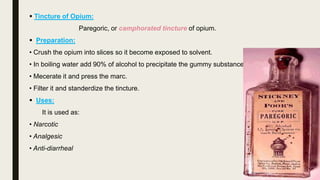
 Tincture of Opium:
Paregoric, or camphorated tincture of opium.
 Preparation:
• Crush the opium into slices so it become exposed to solvent.
• In boiling water add 90% of alcohol to precipitate the gummy substances.
• Mecerate it and press the marc.
• Filter it and standerdize the tincture.
 Uses:
It is used as:
• Narcotic
• Analgesic
• Anti-diarrheal
 Tincture of Iodine:
It is usually 2–7% elemental iodine, along with potassium iodide or sodium iodide,
dissolved in a mixture of ethanol and water.
 Preparation:
Iodine Tincture contains , in each 100ml
<1.8g and not >2.2g of iodine (I)
< 2.1g and not > 2.6g of sodium iodide (NaI).
• Dissolve 20g of Iodine and 24g of Sodium Iodide in 500ml of Alcohol
• Mix it properly
• Add Purified Water to make the product measure 1000mL
 Uses:
• As a disinfectant for
• Water
• Wounds
• Sanitizing surface of fruits and vegetables.
Storage:
• Store at cool and dry place.
• Keep it away from sunlight.
• Store in air tight containers.
• Use amber coloured bottles.
Labeling:
• Active ingredient used
• Label states the Latin binomial and the official name.
• Warnings
• Storage.
• Dosage
• Method of application.
• If it is for topical application do mention
FOR EXTERNAL USE ONLY
References:
https://oddsandhens.com/2014/01/23/how-to-make-a-lavender-
herbal-tincture/
http://www.henriettes-herb.com/eclectic/kings/styrax-benz_tinc.html
http://www.newdruginfo.com/pharmacopeia/usp28/v28230/usp28nf23
s0_m58748.htm
 http://www.ehow.com/how_5605579_make-tincture-iodine.html

Tinctures

  • 1.
  • 2.
  • 3.
    Tinctures: ■ These areliquid extracts which are alcoholic or hydro-alcoholic solutions of non-volatile drug of vegetable and chemical origin. ■ Contain 1 part of drug in 5 parts of solvent. ■ Alcohol content may vary from 25-60 % ( US proof ) Example: 1. Opium tincture : 17-21% 2. Benzoin tincture : 74-80% ■ In herbal medicine, alcoholic tinctures are made with various ethanol concentrations, 25% being the most common. ■ Alcoholic concentration could be as high as 90–95% Example: Tincture of calendula is commonly tinctured at either 25% or 90% ethanol.The alcohol content also acts as a preservative. It is widely employed as solvent for extraction.
  • 4.
    Selectionof solvent: There arethree basic menstrums, or solvents used to extract the chemical compounds of herbs in tinctures, alcohol, glycerin, and vinegar. Alcohol:  The alcohol content acts as a preservative.  Alcohol is the most used solvent because it can extract : • Fats • Resins • Waxes • Most alkaloids • Some volatile oils • Many other plant compounds.
  • 5.
     The alcoholalso helps the herbs to assimilate quickly into your body and preserves the formula , which gives it an almost indefinite shelf life (over 5 years).  Alcohol can be use orally as well as topically. Oral: Orange peel tincture. Topical: Iodine tincture  Most drugs are only soluble in alcohol but not in water. Example: Diosgenin in Discorea villousa (wild yam) is only soluble in alcohol and not in water.
  • 6.
     Using an80 to 100 proof alcohol such as vodka, brandy provides the alcohol-water ratio you need without having to add anything.
  • 7.
    Disadvantages of Alcohol: Ethanol has a tendency to denature some organic compounds, rendering them so changed as to be ineffective.  If biologically viable component is denatured, it will reduce or negate its prior biological viability. Common among them is: • Proteins • Aromatic components Caution: Ether and propylene glycol based tinctures are not suitable for internal consumption, although they are used in preparations for external use, such as personal care creams and ointments.
  • 8.
    Glycerin:  Glycerin tincturesare similar to standard tinctures, the solvent employed being a solution of glycerin (glycerin, glycerol), and water.  Used in the formulations for non-alcoholic patients.  A better solvent for tannins rather than alcohols. Disadvantages:  A poorer preservative  Allowing for the higher concentration required, glycerin tinctures cost more only suitable for small scale production.
  • 9.
  • 10.
    Tinctures can beprepared by three methods :  Maceration By this process we can prepare • Tincture of Orange • Tincture of Benzoin • Tincture of Opium  Percolation We can prepare the following • Tincture of Ginger • Tincture of Belladona • Tincture of Digitalis • Tincture of Opium  By simple solution Can be formulated by chemical reaction or by dilution. • Tincture of Iodine
  • 11.
    Some pharmaceutical importanttinctures are: Tincture of Orange: Sweet Orange PeelTincture is prepared from sweet orange peel , which is the outer rind of the non-artificially colored , fresh, riped fruit. Preparation: • Take fresh peel of orange use 90% alcohol as menstruum. • Maecerate for 7 days. • Press the marc. • Mix the strained and expressed liquid. • Filter the impurities. Uses: •Employed exclusively as a flavoring agent.
  • 12.
    Tincture of Benzoin: Tinctureof Benzoin is a pungent solution of benzoin resin in alcohol. Preparation: • Crush the benzoin in suitable particles. • Macerate it for 24 hours with 90% alcohol. • Do not press the marc • Filter it to remove gummy substances or components. • Adjust the volume by adding alcohol to the marc. Uses: It is used: • As stimulant • To treat acute and chronic laryngitis and bronchitis it is inhaled after dilution. • Applied with advantage to irritable ulcers, bed-sores and allay itching of eczema. • In dentistry, benzoin is used for swollen gums and herpes sores in the mouth
  • 13.
     Tincture ofOpium: Paregoric, or camphorated tincture of opium.  Preparation: • Crush the opium into slices so it become exposed to solvent. • In boiling water add 90% of alcohol to precipitate the gummy substances. • Mecerate it and press the marc. • Filter it and standerdize the tincture.  Uses: It is used as: • Narcotic • Analgesic • Anti-diarrheal
  • 14.
     Tincture ofIodine: It is usually 2–7% elemental iodine, along with potassium iodide or sodium iodide, dissolved in a mixture of ethanol and water.  Preparation: Iodine Tincture contains , in each 100ml <1.8g and not >2.2g of iodine (I) < 2.1g and not > 2.6g of sodium iodide (NaI). • Dissolve 20g of Iodine and 24g of Sodium Iodide in 500ml of Alcohol • Mix it properly • Add Purified Water to make the product measure 1000mL  Uses: • As a disinfectant for • Water • Wounds • Sanitizing surface of fruits and vegetables.
  • 15.
    Storage: • Store atcool and dry place. • Keep it away from sunlight. • Store in air tight containers. • Use amber coloured bottles.
  • 16.
    Labeling: • Active ingredientused • Label states the Latin binomial and the official name. • Warnings • Storage. • Dosage • Method of application. • If it is for topical application do mention FOR EXTERNAL USE ONLY
  • 17.