INTRODUCTION TO PHARMACEUTICS
PCT122
DOSAGE FORMS –LECTURE 2
2023
Recap !!!
• Give the 5 historical eras of pharmacy
• Define the following terms (Pharmacy. Pharmaceutics, Dosage
form, Drug, Active Pharmaceutical Ingredient , Excipient)
• How are pharmaceutical dosage forms classified.
• Why design different dosage forms.
• Give three major considerations in the design of dosage forms.
• Give desirable properties of dosage forms.
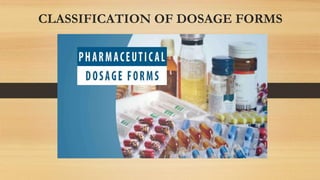
CLASSIFICATION OF DOSAGE FORMS
LEARNING OUTCOMES
By the end of the class you should be able to:
Classify different pharmaceutical dosage forms
List examples for each class of dosage form design
List excipients used in pharmaceutical dosage forms
design.
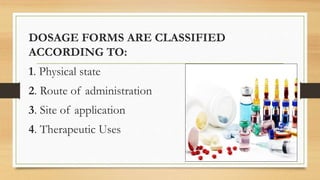
DOSAGE FORMS ARE CLASSIFIED
ACCORDING TO:
1. Physical state
2. Route of administration
3. Site of application
4. Therapeutic Uses
1. CLASSIFICATION
ACCORDING TO
PHYSICAL STATE
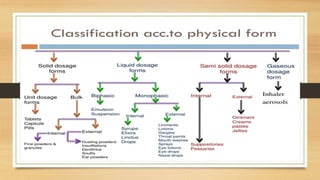
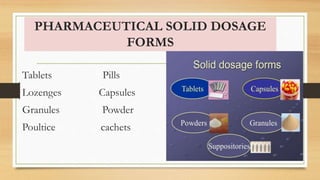
PHARMACEUTICAL SOLID DOSAGE
FORMS
Tablets Pills
Lozenges Capsules
Granules Powder
Poultice cachets
• Powders: contain finely divided particles in micron size.
• Tablets: compressed ,contain therapeutic active ingredients and
excipients.
• Granules: made up of agglomeration of smaller particles of
powders..
• Capsules: therapeutic active ingredient granules are enclosed within
a hard or soft soluble shell.
• Lozenges: contains sugar and gum used to medicate mouth and
throat.
• Suppositories: contains medicaments with suitable suppository base
that inserted in to the body cavities other than mouth, like rectum,
nose, ear.
• Poultices: converted to paste like preparation used externally in the
skin to reduce inflammation.
• Pills: Small tablet containing excipients.
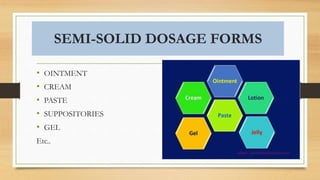
SEMI-SOLID DOSAGE FORMS
• OINTMENT
• CREAM
• PASTE
• SUPPOSITORIES
• GEL
Etc..
Definitions: Semisolid dosage forms
 Ointments: external use formulation with suitable ointment base
with or without medicaments.
 Creams: external use dosage form containing or without
medicaments with a suitable fatty base.
 Paste: formulation for external use containing high proportion of
finely powdered medicaments with suitable fatty base.
Semisolid dosage forms cntd’
 Gels: Transparent semisolid dosage forms for external use
containing hydrophilic or hydrophobic base with gelling
agents.
 Poultices: formulation for external use containing
medicaments applied to the skin to hold the dressing and
protective.
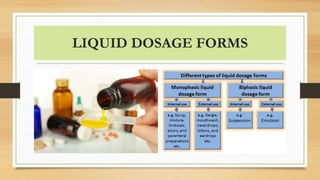
LIQUID DOSAGE FORMS
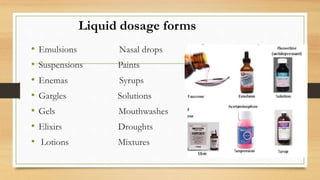
Liquid dosage forms
• Emulsions Nasal drops
• Suspensions Paints
• Enemas Syrups
• Gargles Solutions
• Gels Mouthwashes
• Elixirs Droughts
• Lotions Mixtures
Definitions: Liquid dosage forms
• Elixirs: oral preparation containing medicaments with suitable
excipients.
• Emulsions: Biphasic liquid dosage form containing
medicaments in which fine oil globules dispersed in continuous
phase.
• Suspensions: Biphasic liquid dosage form containing
medicaments in which fine solid particles suspended in
continuous phase.
• Solutions : Clear liquid preparation containing with or without
medicaments used as internal or external preparation.
• Syrups: Sweet, viscous, concentrated liquid preparations
containing with or without sugar and medicaments.
• Mixtures: Liquid oral preparations containing one or more
medicaments.
• Nasal drops: contains medicaments that are instilled in to the
nose with a dropper used to treat nose infections and blockage
of nose
• Mouth wash: Concentrated aqueous solutions for external
use used to treat mouth infections and oral hygiene
• Enemas: preparation for rectal administration containing
medicaments.
• Gargles: Concentrated aqueous solutions for external use,
used to treat throat infections
• Gels: Aqueous colloidal suspensions containing
medicaments.e.g antacid gel
• Linctuses: Viscous, liquid oral preparations used to relief
cough.
• Lotion: Liquid preparations for external application usually
applied without friction.
• Collodions: external use ,having nitro cellulose used to protect
the skin.
• Liniments: Liquid preparations for external application usually
applied with friction.
• Paints: for external application to the skin or mucous
membrane with soft brush.
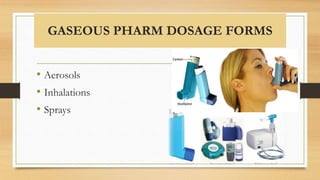
GASEOUS PHARM DOSAGE FORMS
• Aerosols
• Inhalations
• Sprays
Definitions: Gaseous dosage forms
• Aerosols: dispersion of fine solid or liquid particles in gas used to
apply drug to respiratory tract using atomizer.
• Inhalations: Internal liquid preparations containing medicaments
either dispersed or suspended in the propellant.
• Sprays: Gaseous preparations of drugs containing alcohol applied
to mucous membrane of nose or throat with atomizer or nebulizer.
2. CLASSIFICATION BASED ON
ROUTE OF ADMINISTRATION
• The absorption pattern of drugs varies considerably with
different administration routes.
• Dosage forms are designed to provide the drug in a
suitable form for absorption from each selected route of
administration.
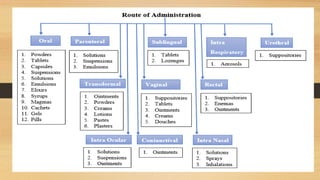
• Oral : placed in the mouth and swallowed. Most frequently used
route for drug administration
• Parenteral: involves introducing the drug in form of solution or
suspension into the body various sites using syringe and needle.
• Rectal/Vaginal : administration by rectal or vaginal route.
• Sublingual/buccal :drug is placed under the tongue (sublingual
route) OR between gums and inner lining of the cheek (buccal
route)
• Intra-ocular- administration into the eye.
• Intra-nasal : Administration through the nasal cavity.
• Transdermal/topical : Drugs are applied topically, that is to
the skin, mainly for local action.
• Respiratory :Drugs may be inhaled as gases.
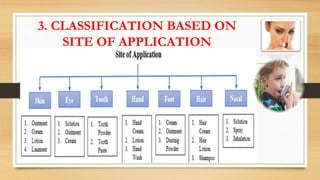
3. CLASSIFICATION BASED ON
SITE OF APPLICATION
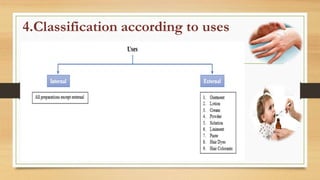
4.Classification according to uses
Summary
• Classify different dosage forms
• List examples of each dosage form
• State the need for different dosage forms
• List the importance of dosage forms
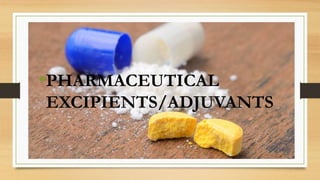
•PHARMACEUTICAL
EXCIPIENTS/ADJUVANTS
What are pharmaceutical excipients??
PURPOSE OF EXCIPIENTS
Provide bulk to the formulation.
Facilitate drug absorption or solubility and other pharmacokinetic
considerations. (bioavailability)
Aid in handling of Active Ingredient during manufacturing .
Provide stability of the active ingredient in the dosage form
including protection from degradation/ denaturation.
Purpose cntd’
Patient acceptability.
To enhance the overall safety or function of the product during
storage or use.
Facilitating administration of the drug by the intended route.
 To aid the manufacturing process.
NB: The properties of final dosage form are highly dependent on the excipients
chosen, their concentration and interaction with both active compound and each
other.
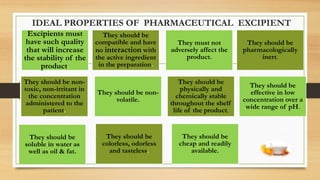
IDEAL PROPERTIES OF PHARMACEUTICAL EXCIPIENT
Excipients must
have such quality
that will increase
the stability of the
product.
They should be
compatible and have
no interaction with
the active ingredient
in the preparation.
They must not
adversely affect the
product.
They should be
pharmacologically
inert.
They should be non-
toxic, non-irritant in
the concentration
administered to the
patient.
They should be non-
volatile.
They should be
physically and
chemically stable
throughout the shelf
life of the product.
They should be
effective in low
concentration over a
wide range of pH.
They should be
soluble in water as
well as oil & fat.
They should be
colorless, odorless
and tasteless.
They should be
cheap and readily
available.
CLASSIFICATION OF EXCIPIENTS
BASED ON:
Source of origin: such as plant, animal, mineral, and synthetic-based.
 functional role in formulation (pharmaceutical use):e.g. binders,
diluents, disintegrates, fillers or bulking agents, glidants, lubricants,
coloring agents, preservatives etc.
 chemical substituents present in the excipients: such as alcohols,
acids, esters, carbohydrates, glycerides, halogenated derivatives,
mercury salts etc.
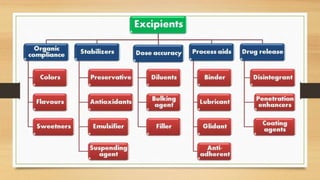
•MAIN CLASSIFICATION
Based on functions they perform in the
pharmaceutical dosage form.
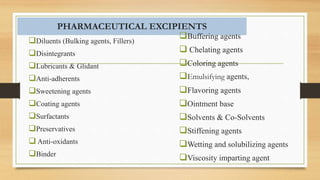
PHARMACEUTICAL EXCIPIENTS
Diluents (Bulking agents, Fillers)
Disintegrants
Lubricants & Glidant
Anti-adherents
Sweetening agents
Coating agents
Surfactants
Preservatives
 Anti-oxidants
Binder
Buffering agents
 Chelating agents
Coloring agents
Emulsifying agents,
Flavoring agents
Ointment base
Solvents & Co-Solvents
Stiffening agents
Wetting and solubilizing agents
Viscosity imparting agent
 BINDERS:
• Hold the ingredients together .Ensure that tablets and granules can
be formed with required mechanical strength and give volume to
low active dose tablets. helps to maintain the inter-particle bonding strength
and to achieve mechanical strength.
39
 BINDERS:
Classification and examples based on their application:
Solution binders are dissolved in a solvent (for example water or
alcohol can be used in wet granulation processes).e.g. gelatine, cellulose,
cellulose derivatives, starch, sucrose and polyethylene glycol.
 Dry binders -added to the powder blend, after a wet granulation step,
or part of a direct powder compression (DC) formula e.g. include
cellulose, methyl cellulose and polyethylene glycol.
40
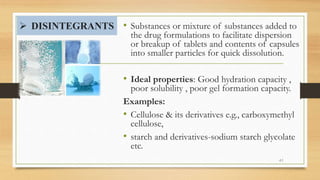
 DISINTEGRANTS • Substances or mixture of substances added to
the drug formulations to facilitate dispersion
or breakup of tablets and contents of capsules
into smaller particles for quick dissolution.
• Ideal properties: Good hydration capacity ,
poor solubility , poor gel formation capacity.
Examples:
• Cellulose & its derivatives e.g., carboxymethyl
cellulose,
• starch and derivatives-sodium starch glycolate
etc.
41
 COATING AGENT
42
Coating is a process by which an essentially dry, outer layer of coating
material is applied to the surface of a dosage form.
• Function of coating agents:
• protecting the drug from environmental moisture, light, or the acidic
environment of the stomach.
• Protection, taste and odour masking, elegance, ease of swallowing,
dosage identification.
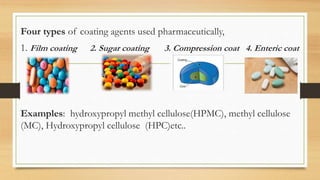
Four types of coating agents used pharmaceutically,
1. Film coating 2. Sugar coating 3. Compression coat 4. Enteric coat
Examples: hydroxypropyl methyl cellulose(HPMC), methyl cellulose
(MC), Hydroxypropyl cellulose (HPC)etc..
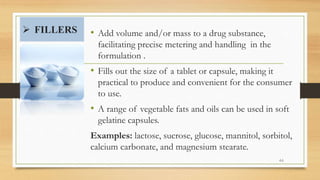
 FILLERS • Add volume and/or mass to a drug substance,
facilitating precise metering and handling in the
formulation .
• Fills out the size of a tablet or capsule, making it
practical to produce and convenient for the consumer
to use.
• A range of vegetable fats and oils can be used in soft
gelatine capsules.
Examples: lactose, sucrose, glucose, mannitol, sorbitol,
calcium carbonate, and magnesium stearate.
44
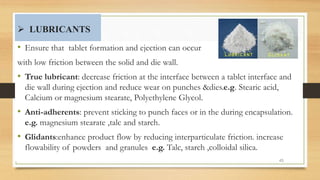
 LUBRICANTS
• Ensure that tablet formation and ejection can occur
with low friction between the solid and die wall.
• True lubricant: decrease friction at the interface between a tablet interface and
die wall during ejection and reduce wear on punches &dies.e.g. Stearic acid,
Calcium or magnesium stearate, Polyethylene Glycol.
• Anti-adherents: prevent sticking to punch faces or in the during encapsulation.
e.g. magnesium stearate ,talc and starch.
• Glidants:enhance product flow by reducing interparticulate friction. increase
flowability of powders and granules e.g. Talc, starch ,colloidal silica.
45
 PRESERVATIVES
• Protects the product against microbial proliferation but does not
compromise product performance.
Requirements:
• Exert a wide spectrum of antimicrobial activity at low inclusion
levels/concentration.
• Maintain activity throughout product manufacture, shelf life and during
usage.
Examples: Methyl & Ethyl or Propyl paraben
Benzoic acid & its salts, Sorbic acid and its salts. 46
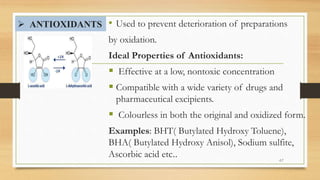
 ANTIOXIDANTS • Used to prevent deterioration of preparations
by oxidation.
Ideal Properties of Antioxidants:
 Effective at a low, nontoxic concentration
 Compatible with a wide variety of drugs and
pharmaceutical excipients.
 Colourless in both the original and oxidized form.
Examples: BHT( Butylated Hydroxy Toluene),
BHA( Butylated Hydroxy Anisol), Sodium sulfite,
Ascorbic acid etc.. 47
 SWEETENING AGENTS
• Used to impart a pleasant taste to a preparation
(palatability).
• Mostly employed in liquid formulations designed for
oral administration.
Examples:
sucrose, liquid glucose, glycerol, sorbitol, saccharin
sodium and aspartame.
The use of sugars in oral formulations for children
and patients with diabetes mellitus is to be avoided.
48
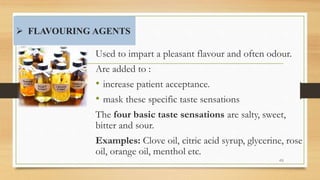
 FLAVOURING AGENTS
Used to impart a pleasant flavour and often odour.
Are added to :
• increase patient acceptance.
• mask these specific taste sensations
The four basic taste sensations are salty, sweet,
bitter and sour.
Examples: Clove oil, citric acid syrup, glycerine, rose
oil, orange oil, menthol etc.
49
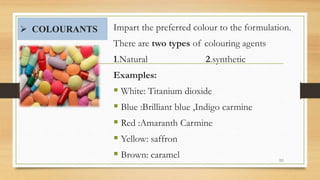
 COLOURANTS Impart the preferred colour to the formulation.
There are two types of colouring agents
1.Natural 2.synthetic
Examples:
 White: Titanium dioxide
 Blue :Brilliant blue ,Indigo carmine
 Red :Amaranth Carmine
 Yellow: saffron
 Brown: caramel 50
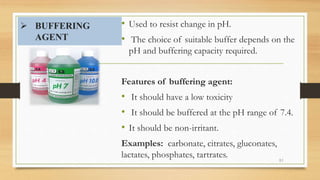
 BUFFERING
AGENT
• Used to resist change in pH.
• The choice of suitable buffer depends on the
pH and buffering capacity required.
Features of buffering agent:
• It should have a low toxicity
• It should be buffered at the pH range of 7.4.
• It should be non-irritant.
Examples: carbonate, citrates, gluconates,
lactates, phosphates, tartrates. 51
 CHELATING AGENTS
• Substance that forms stable water-soluble complexes (chelates) with
metals/ions .
• Are used in some liquid pharmaceuticals as stabilizers to complex heavy
metals that might promote instability.
Examples:
• ethylene diamine
• ethylene diamine tetraacetic acid
52
 VISCOSITY IMPARTING AGENTS
• These agents are used when it is desirable to increase or decrease the
viscosity of a liquid either to serve as adjacent for palatability or to improve
pour ability.
• They are also called thickening agents.
Viscosity imparting agents are of two types:
 Viscosity modifier- decrease the viscosity
Viscosity enhancer- increase the viscosity
Examples: Hydroxyethyl cellulose. Hydroxypropyl methylcellulose,
Methylcellulose, Polyvinyl alcohol ,Polyvinylpyrrolidone 53
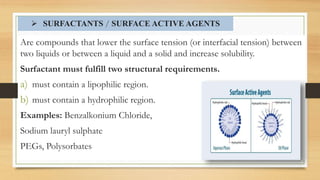
 SURFACTANTS / SURFACE ACTIVE AGENTS
Are compounds that lower the surface tension (or interfacial tension) between
two liquids or between a liquid and a solid and increase solubility.
Surfactant must fulfill two structural requirements.
a) must contain a lipophilic region.
b) must contain a hydrophilic region.
Examples: Benzalkonium Chloride,
Sodium lauryl sulphate
PEGs, Polysorbates
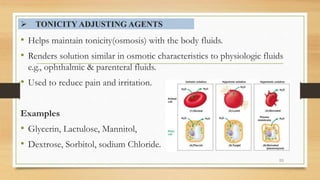
 TONICITY ADJUSTING AGENTS
• Helps maintain tonicity(osmosis) with the body fluids.
• Renders solution similar in osmotic characteristics to physiologic fluids
e.g., ophthalmic & parenteral fluids.
• Used to reduce pain and irritation.
Examples
• Glycerin, Lactulose, Mannitol,
• Dextrose, Sorbitol, sodium Chloride.
55
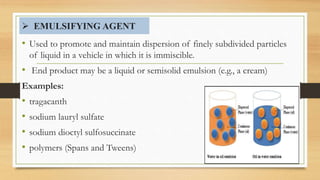
 EMULSIFYING AGENT
• Used to promote and maintain dispersion of finely subdivided particles
of liquid in a vehicle in which it is immiscible.
• End product may be a liquid or semisolid emulsion (e.g., a cream)
Examples:
• tragacanth
• sodium lauryl sulfate
• sodium dioctyl sulfosuccinate
• polymers (Spans and Tweens)
56
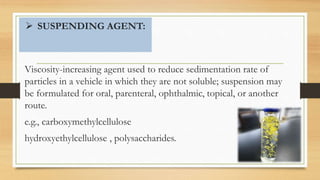
 SUSPENDING AGENT:
Viscosity-increasing agent used to reduce sedimentation rate of
particles in a vehicle in which they are not soluble; suspension may
be formulated for oral, parenteral, ophthalmic, topical, or another
route.
e.g., carboxymethylcellulose
hydroxyethylcellulose , polysaccharides.
HUMECTANTS
Used to prevent drying of preparations, particularly ointments and
creams.
e.g., glycerol, propyl glycol, sorbitol,
Sodium lactate.
58
• Substance that can dissolve a solute (a chemically different liquid , solid
or gas) resulting in solution.
• A solvent is usually a liquid, but it can also be solid or a gas.
• A solvent never changes its state forming a solution.
They are classified as:
• Polar
• Nonpolar 59
PHARMACEUTICAL SOLVENTS
SOLVENTS FOR LIQUID PREPARATIONS
Aqueous solvent
 Distilled water , water for injections ,
Non-aqueous solvents
 Alcohol
 Glycerin
 Propylene glycol
 Polyethylene glycol (PEG)
 Dimethyl Sulfoxide (DMSO)
 Fatty oils 60
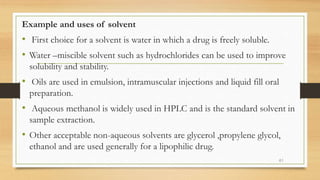
Example and uses of solvent
• First choice for a solvent is water in which a drug is freely soluble.
• Water –miscible solvent such as hydrochlorides can be used to improve
solubility and stability.
• Oils are used in emulsion, intramuscular injections and liquid fill oral
preparation.
• Aqueous methanol is widely used in HPLC and is the standard solvent in
sample extraction.
• Other acceptable non-aqueous solvents are glycerol ,propylene glycol,
ethanol and are used generally for a lipophilic drug.
61
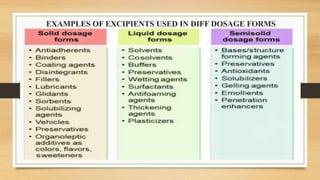
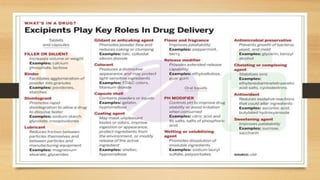
EXAMPLES OF EXCIPIENTS USED IN DIFF DOSAGE FORMS
Thank you !
NB: SELF – STUDY
Weighing and measuring in Pharmacy
Explain the standard metric units and meanings of the prefixes most used in
metric measurement.
 Be able to convert from one metric unit to another (e.g., grams to milligrams).
Know difference between Dispensing balance & Analytical balance
Basic Calculations Used in Pharmacy Practice (volume & capacity)
64

PCT122 LECTURE 2 2023.pptx

  • 1.
  • 2.
    Recap !!! • Givethe 5 historical eras of pharmacy • Define the following terms (Pharmacy. Pharmaceutics, Dosage form, Drug, Active Pharmaceutical Ingredient , Excipient) • How are pharmaceutical dosage forms classified. • Why design different dosage forms. • Give three major considerations in the design of dosage forms. • Give desirable properties of dosage forms.
  • 3.
  • 4.
    LEARNING OUTCOMES By theend of the class you should be able to: Classify different pharmaceutical dosage forms List examples for each class of dosage form design List excipients used in pharmaceutical dosage forms design.
  • 5.
    DOSAGE FORMS ARECLASSIFIED ACCORDING TO: 1. Physical state 2. Route of administration 3. Site of application 4. Therapeutic Uses
  • 6.
  • 8.
    PHARMACEUTICAL SOLID DOSAGE FORMS TabletsPills Lozenges Capsules Granules Powder Poultice cachets
  • 9.
    • Powders: containfinely divided particles in micron size. • Tablets: compressed ,contain therapeutic active ingredients and excipients. • Granules: made up of agglomeration of smaller particles of powders.. • Capsules: therapeutic active ingredient granules are enclosed within a hard or soft soluble shell.
  • 10.
    • Lozenges: containssugar and gum used to medicate mouth and throat. • Suppositories: contains medicaments with suitable suppository base that inserted in to the body cavities other than mouth, like rectum, nose, ear. • Poultices: converted to paste like preparation used externally in the skin to reduce inflammation. • Pills: Small tablet containing excipients.
  • 11.
    SEMI-SOLID DOSAGE FORMS •OINTMENT • CREAM • PASTE • SUPPOSITORIES • GEL Etc..
  • 12.
    Definitions: Semisolid dosageforms  Ointments: external use formulation with suitable ointment base with or without medicaments.  Creams: external use dosage form containing or without medicaments with a suitable fatty base.  Paste: formulation for external use containing high proportion of finely powdered medicaments with suitable fatty base.
  • 13.
    Semisolid dosage formscntd’  Gels: Transparent semisolid dosage forms for external use containing hydrophilic or hydrophobic base with gelling agents.  Poultices: formulation for external use containing medicaments applied to the skin to hold the dressing and protective.
  • 14.
  • 15.
    Liquid dosage forms •Emulsions Nasal drops • Suspensions Paints • Enemas Syrups • Gargles Solutions • Gels Mouthwashes • Elixirs Droughts • Lotions Mixtures
  • 16.
    Definitions: Liquid dosageforms • Elixirs: oral preparation containing medicaments with suitable excipients. • Emulsions: Biphasic liquid dosage form containing medicaments in which fine oil globules dispersed in continuous phase. • Suspensions: Biphasic liquid dosage form containing medicaments in which fine solid particles suspended in continuous phase.
  • 17.
    • Solutions :Clear liquid preparation containing with or without medicaments used as internal or external preparation. • Syrups: Sweet, viscous, concentrated liquid preparations containing with or without sugar and medicaments. • Mixtures: Liquid oral preparations containing one or more medicaments. • Nasal drops: contains medicaments that are instilled in to the nose with a dropper used to treat nose infections and blockage of nose
  • 18.
    • Mouth wash:Concentrated aqueous solutions for external use used to treat mouth infections and oral hygiene • Enemas: preparation for rectal administration containing medicaments. • Gargles: Concentrated aqueous solutions for external use, used to treat throat infections • Gels: Aqueous colloidal suspensions containing medicaments.e.g antacid gel • Linctuses: Viscous, liquid oral preparations used to relief cough.
  • 19.
    • Lotion: Liquidpreparations for external application usually applied without friction. • Collodions: external use ,having nitro cellulose used to protect the skin. • Liniments: Liquid preparations for external application usually applied with friction. • Paints: for external application to the skin or mucous membrane with soft brush.
  • 20.
    GASEOUS PHARM DOSAGEFORMS • Aerosols • Inhalations • Sprays
  • 21.
    Definitions: Gaseous dosageforms • Aerosols: dispersion of fine solid or liquid particles in gas used to apply drug to respiratory tract using atomizer. • Inhalations: Internal liquid preparations containing medicaments either dispersed or suspended in the propellant. • Sprays: Gaseous preparations of drugs containing alcohol applied to mucous membrane of nose or throat with atomizer or nebulizer.
  • 22.
    2. CLASSIFICATION BASEDON ROUTE OF ADMINISTRATION • The absorption pattern of drugs varies considerably with different administration routes. • Dosage forms are designed to provide the drug in a suitable form for absorption from each selected route of administration.
  • 24.
    • Oral :placed in the mouth and swallowed. Most frequently used route for drug administration • Parenteral: involves introducing the drug in form of solution or suspension into the body various sites using syringe and needle. • Rectal/Vaginal : administration by rectal or vaginal route. • Sublingual/buccal :drug is placed under the tongue (sublingual route) OR between gums and inner lining of the cheek (buccal route)
  • 25.
    • Intra-ocular- administrationinto the eye. • Intra-nasal : Administration through the nasal cavity. • Transdermal/topical : Drugs are applied topically, that is to the skin, mainly for local action. • Respiratory :Drugs may be inhaled as gases.
  • 26.
    3. CLASSIFICATION BASEDON SITE OF APPLICATION
  • 27.
  • 28.
    Summary • Classify differentdosage forms • List examples of each dosage form • State the need for different dosage forms • List the importance of dosage forms
  • 29.
  • 30.
  • 31.
    PURPOSE OF EXCIPIENTS Providebulk to the formulation. Facilitate drug absorption or solubility and other pharmacokinetic considerations. (bioavailability) Aid in handling of Active Ingredient during manufacturing . Provide stability of the active ingredient in the dosage form including protection from degradation/ denaturation.
  • 32.
    Purpose cntd’ Patient acceptability. Toenhance the overall safety or function of the product during storage or use. Facilitating administration of the drug by the intended route.  To aid the manufacturing process. NB: The properties of final dosage form are highly dependent on the excipients chosen, their concentration and interaction with both active compound and each other.
  • 33.
    IDEAL PROPERTIES OFPHARMACEUTICAL EXCIPIENT Excipients must have such quality that will increase the stability of the product. They should be compatible and have no interaction with the active ingredient in the preparation. They must not adversely affect the product. They should be pharmacologically inert. They should be non- toxic, non-irritant in the concentration administered to the patient. They should be non- volatile. They should be physically and chemically stable throughout the shelf life of the product. They should be effective in low concentration over a wide range of pH. They should be soluble in water as well as oil & fat. They should be colorless, odorless and tasteless. They should be cheap and readily available.
  • 34.
    CLASSIFICATION OF EXCIPIENTS BASEDON: Source of origin: such as plant, animal, mineral, and synthetic-based.  functional role in formulation (pharmaceutical use):e.g. binders, diluents, disintegrates, fillers or bulking agents, glidants, lubricants, coloring agents, preservatives etc.  chemical substituents present in the excipients: such as alcohols, acids, esters, carbohydrates, glycerides, halogenated derivatives, mercury salts etc.
  • 35.
    •MAIN CLASSIFICATION Based onfunctions they perform in the pharmaceutical dosage form.
  • 38.
    PHARMACEUTICAL EXCIPIENTS Diluents (Bulkingagents, Fillers) Disintegrants Lubricants & Glidant Anti-adherents Sweetening agents Coating agents Surfactants Preservatives  Anti-oxidants Binder Buffering agents  Chelating agents Coloring agents Emulsifying agents, Flavoring agents Ointment base Solvents & Co-Solvents Stiffening agents Wetting and solubilizing agents Viscosity imparting agent
  • 39.
     BINDERS: • Holdthe ingredients together .Ensure that tablets and granules can be formed with required mechanical strength and give volume to low active dose tablets. helps to maintain the inter-particle bonding strength and to achieve mechanical strength. 39
  • 40.
     BINDERS: Classification andexamples based on their application: Solution binders are dissolved in a solvent (for example water or alcohol can be used in wet granulation processes).e.g. gelatine, cellulose, cellulose derivatives, starch, sucrose and polyethylene glycol.  Dry binders -added to the powder blend, after a wet granulation step, or part of a direct powder compression (DC) formula e.g. include cellulose, methyl cellulose and polyethylene glycol. 40
  • 41.
     DISINTEGRANTS •Substances or mixture of substances added to the drug formulations to facilitate dispersion or breakup of tablets and contents of capsules into smaller particles for quick dissolution. • Ideal properties: Good hydration capacity , poor solubility , poor gel formation capacity. Examples: • Cellulose & its derivatives e.g., carboxymethyl cellulose, • starch and derivatives-sodium starch glycolate etc. 41
  • 42.
     COATING AGENT 42 Coatingis a process by which an essentially dry, outer layer of coating material is applied to the surface of a dosage form. • Function of coating agents: • protecting the drug from environmental moisture, light, or the acidic environment of the stomach. • Protection, taste and odour masking, elegance, ease of swallowing, dosage identification.
  • 43.
    Four types ofcoating agents used pharmaceutically, 1. Film coating 2. Sugar coating 3. Compression coat 4. Enteric coat Examples: hydroxypropyl methyl cellulose(HPMC), methyl cellulose (MC), Hydroxypropyl cellulose (HPC)etc..
  • 44.
     FILLERS •Add volume and/or mass to a drug substance, facilitating precise metering and handling in the formulation . • Fills out the size of a tablet or capsule, making it practical to produce and convenient for the consumer to use. • A range of vegetable fats and oils can be used in soft gelatine capsules. Examples: lactose, sucrose, glucose, mannitol, sorbitol, calcium carbonate, and magnesium stearate. 44
  • 45.
     LUBRICANTS • Ensurethat tablet formation and ejection can occur with low friction between the solid and die wall. • True lubricant: decrease friction at the interface between a tablet interface and die wall during ejection and reduce wear on punches &dies.e.g. Stearic acid, Calcium or magnesium stearate, Polyethylene Glycol. • Anti-adherents: prevent sticking to punch faces or in the during encapsulation. e.g. magnesium stearate ,talc and starch. • Glidants:enhance product flow by reducing interparticulate friction. increase flowability of powders and granules e.g. Talc, starch ,colloidal silica. 45
  • 46.
     PRESERVATIVES • Protectsthe product against microbial proliferation but does not compromise product performance. Requirements: • Exert a wide spectrum of antimicrobial activity at low inclusion levels/concentration. • Maintain activity throughout product manufacture, shelf life and during usage. Examples: Methyl & Ethyl or Propyl paraben Benzoic acid & its salts, Sorbic acid and its salts. 46
  • 47.
     ANTIOXIDANTS •Used to prevent deterioration of preparations by oxidation. Ideal Properties of Antioxidants:  Effective at a low, nontoxic concentration  Compatible with a wide variety of drugs and pharmaceutical excipients.  Colourless in both the original and oxidized form. Examples: BHT( Butylated Hydroxy Toluene), BHA( Butylated Hydroxy Anisol), Sodium sulfite, Ascorbic acid etc.. 47
  • 48.
     SWEETENING AGENTS •Used to impart a pleasant taste to a preparation (palatability). • Mostly employed in liquid formulations designed for oral administration. Examples: sucrose, liquid glucose, glycerol, sorbitol, saccharin sodium and aspartame. The use of sugars in oral formulations for children and patients with diabetes mellitus is to be avoided. 48
  • 49.
     FLAVOURING AGENTS Usedto impart a pleasant flavour and often odour. Are added to : • increase patient acceptance. • mask these specific taste sensations The four basic taste sensations are salty, sweet, bitter and sour. Examples: Clove oil, citric acid syrup, glycerine, rose oil, orange oil, menthol etc. 49
  • 50.
     COLOURANTS Impartthe preferred colour to the formulation. There are two types of colouring agents 1.Natural 2.synthetic Examples:  White: Titanium dioxide  Blue :Brilliant blue ,Indigo carmine  Red :Amaranth Carmine  Yellow: saffron  Brown: caramel 50
  • 51.
     BUFFERING AGENT • Usedto resist change in pH. • The choice of suitable buffer depends on the pH and buffering capacity required. Features of buffering agent: • It should have a low toxicity • It should be buffered at the pH range of 7.4. • It should be non-irritant. Examples: carbonate, citrates, gluconates, lactates, phosphates, tartrates. 51
  • 52.
     CHELATING AGENTS •Substance that forms stable water-soluble complexes (chelates) with metals/ions . • Are used in some liquid pharmaceuticals as stabilizers to complex heavy metals that might promote instability. Examples: • ethylene diamine • ethylene diamine tetraacetic acid 52
  • 53.
     VISCOSITY IMPARTINGAGENTS • These agents are used when it is desirable to increase or decrease the viscosity of a liquid either to serve as adjacent for palatability or to improve pour ability. • They are also called thickening agents. Viscosity imparting agents are of two types:  Viscosity modifier- decrease the viscosity Viscosity enhancer- increase the viscosity Examples: Hydroxyethyl cellulose. Hydroxypropyl methylcellulose, Methylcellulose, Polyvinyl alcohol ,Polyvinylpyrrolidone 53
  • 54.
     SURFACTANTS /SURFACE ACTIVE AGENTS Are compounds that lower the surface tension (or interfacial tension) between two liquids or between a liquid and a solid and increase solubility. Surfactant must fulfill two structural requirements. a) must contain a lipophilic region. b) must contain a hydrophilic region. Examples: Benzalkonium Chloride, Sodium lauryl sulphate PEGs, Polysorbates
  • 55.
     TONICITY ADJUSTINGAGENTS • Helps maintain tonicity(osmosis) with the body fluids. • Renders solution similar in osmotic characteristics to physiologic fluids e.g., ophthalmic & parenteral fluids. • Used to reduce pain and irritation. Examples • Glycerin, Lactulose, Mannitol, • Dextrose, Sorbitol, sodium Chloride. 55
  • 56.
     EMULSIFYING AGENT •Used to promote and maintain dispersion of finely subdivided particles of liquid in a vehicle in which it is immiscible. • End product may be a liquid or semisolid emulsion (e.g., a cream) Examples: • tragacanth • sodium lauryl sulfate • sodium dioctyl sulfosuccinate • polymers (Spans and Tweens) 56
  • 57.
     SUSPENDING AGENT: Viscosity-increasingagent used to reduce sedimentation rate of particles in a vehicle in which they are not soluble; suspension may be formulated for oral, parenteral, ophthalmic, topical, or another route. e.g., carboxymethylcellulose hydroxyethylcellulose , polysaccharides.
  • 58.
    HUMECTANTS Used to preventdrying of preparations, particularly ointments and creams. e.g., glycerol, propyl glycol, sorbitol, Sodium lactate. 58
  • 59.
    • Substance thatcan dissolve a solute (a chemically different liquid , solid or gas) resulting in solution. • A solvent is usually a liquid, but it can also be solid or a gas. • A solvent never changes its state forming a solution. They are classified as: • Polar • Nonpolar 59 PHARMACEUTICAL SOLVENTS
  • 60.
    SOLVENTS FOR LIQUIDPREPARATIONS Aqueous solvent  Distilled water , water for injections , Non-aqueous solvents  Alcohol  Glycerin  Propylene glycol  Polyethylene glycol (PEG)  Dimethyl Sulfoxide (DMSO)  Fatty oils 60
  • 61.
    Example and usesof solvent • First choice for a solvent is water in which a drug is freely soluble. • Water –miscible solvent such as hydrochlorides can be used to improve solubility and stability. • Oils are used in emulsion, intramuscular injections and liquid fill oral preparation. • Aqueous methanol is widely used in HPLC and is the standard solvent in sample extraction. • Other acceptable non-aqueous solvents are glycerol ,propylene glycol, ethanol and are used generally for a lipophilic drug. 61
  • 62.
    EXAMPLES OF EXCIPIENTSUSED IN DIFF DOSAGE FORMS
  • 63.
  • 64.
    NB: SELF –STUDY Weighing and measuring in Pharmacy Explain the standard metric units and meanings of the prefixes most used in metric measurement.  Be able to convert from one metric unit to another (e.g., grams to milligrams). Know difference between Dispensing balance & Analytical balance Basic Calculations Used in Pharmacy Practice (volume & capacity) 64