Lecture 8
Percentage, Ratio Strength, and Other Expressions of
Concentration
Laith Al-Asadi
Percentage
 The term percent and its corresponding sign (%) mean ‘‘by
the hundred’’ or ‘‘in a hundred,’’ and percentage means
‘‘rate per hundred’’; so 50 percent (or 50%) and a
percentage of 50 are equivalent expressions.
 A percent may also be expressed as a ratio, represented as a
common or decimal fraction. For example, 50% means 50
parts in 100 of the same kind, and may be expressed as
50⁄100 or 0.50.
 Percent, therefore, is simply another fraction of such
frequent and familiar use that its numerator is expressed
but its denominator is left understood. It should be noted
that percent is always an abstract quantity and that, as
such, it may be applied to anything.
Percentage
 For the purposes of computation, percent are usually
changed to equivalent decimal fractions.
 This change is made by dropping the percent sign (%) and
dividing the expressed numerator by 100.
 Thus, 12.5% 12.5 /100, or 0.125; and 0.05% 0.05 /100, or
0.0005. We must not forget that in the reverse process
(changing a decimal to a percent), the decimal is
multiplied by 100 and the percent sign (%) is affixed.
 Percentage is an essential part of pharmaceutical
calculations. The pharmacist encounters it frequently and
uses it as a convenient means of expressing the
concentration of an active or inactive material in a
pharmaceutical preparation.
Percentage preparations
 The percentage concentrations of active and inactive
constituents in various types of pharmaceutical preparations are
defined as follows by the United States Pharmacopeia:
 Percent weight-in-volume (w/v) expresses the number of
grams of a constituent in 100 mL of solution or liquid
preparation and is used regardless of whether water or another
liquid is the solvent or vehicle. Expressed as: % w/v.
 Percent volume-in-volume (v/v) expresses the number of
milliliters of a constituent in 100 mL of solution or liquid
preparation. Expressed as: % v/v.
 Percent weight-in-weight (w/w) expresses the number of
grams of a constituent in 100 g of solution or preparation.
Expressed as: % w/w.
Percentage preparations
 The term percent, or the symbol %, when used
without qualification means:
for solutions or suspensions of solids in liquids,
percent weight-in-volume.
for solutions of liquids in liquids, percent volume-
in-volume.
for mixtures of solids or semisolids, percent
weight-in-weight.
for solutions of gases in liquids, percent weight-in-
volume.
Percentage Weight-in-Volume
 In a true expression of percentage (i.e., parts per 100 parts),
the percentage of a liquid preparation (e.g., solution,
suspension, lotion) would represent the grams of solute or
constituent in 100 g of the liquid preparation. However, in
practice, the pharmacist most frequently uses a different
definition of percentage for solutions and for other liquid
preparations, one in which the parts of the percentage
represent grams of a solute or constituent in 100 mL of
solution or liquid preparation.
 Indeed, in weight-in-volume expressions, the ‘‘correct’’
strength of a 1% (w/v) solution or other liquid
preparation is defined as containing 1 g of constituent
in 100 mL of product.
Percentage Weight-in-Volume
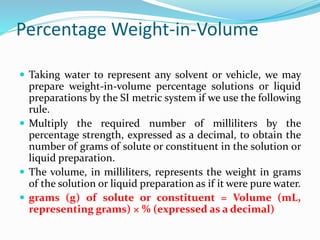
 Taking water to represent any solvent or vehicle, we may
prepare weight-in-volume percentage solutions or liquid
preparations by the SI metric system if we use the following
rule.
 Multiply the required number of milliliters by the
percentage strength, expressed as a decimal, to obtain the
number of grams of solute or constituent in the solution or
liquid preparation.
 The volume, in milliliters, represents the weight in grams
of the solution or liquid preparation as if it were pure water.
 grams (g) of solute or constituent = Volume (mL,
representing grams) × % (expressed as a decimal)
Example 1
 How many grams of dextrose are required to prepare
4000 mL of a 5% solution?
Solution
4000 mL represents 4000 g of solution
5% = 0.05
4000 g × 0.05 = 200 g answer
Example 2
 How many grams of potassium permanganate should
be used in compounding the following prescription?
Potassium Permanganate 0.02%
Purified Water ad 250 mL
Sig. as directed.
solution
250 mL represents 250 g of solution
0.02% = 0.0002
250 g × 0.0002 0.05 g. answer
Example 3
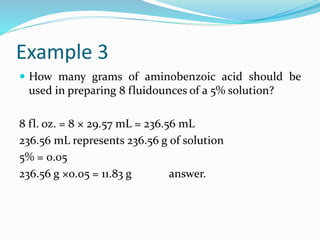
 How many grams of aminobenzoic acid should be
used in preparing 8 fluidounces of a 5% solution?
8 fl. oz. = 8 × 29.57 mL = 236.56 mL
236.56 mL represents 236.56 g of solution
5% = 0.05
236.56 g ×0.05 = 11.83 g answer.
Example 3
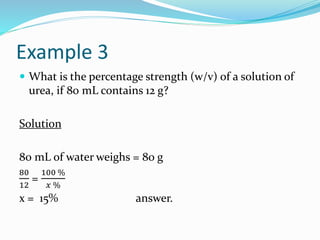
 What is the percentage strength (w/v) of a solution of
urea, if 80 mL contains 12 g?
Solution
80 mL of water weighs = 80 g
80
12
=
100 %
𝑥 %
x = 15% answer.
Percentage Volume-in-Volume
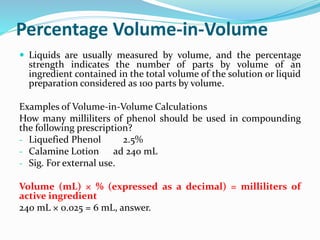
 Liquids are usually measured by volume, and the percentage
strength indicates the number of parts by volume of an
ingredient contained in the total volume of the solution or liquid
preparation considered as 100 parts by volume.
Examples of Volume-in-Volume Calculations
How many milliliters of phenol should be used in compounding
the following prescription?
- Liquefied Phenol 2.5%
- Calamine Lotion ad 240 mL
- Sig. For external use.
Volume (mL) × % (expressed as a decimal) = milliliters of
active ingredient
240 mL × 0.025 = 6 mL, answer.
 In preparing 250 mL of a certain lotion, a pharmacist
used 4 mL of liquefied phenol. What was the
percentage (v/v) of liquefied phenol in the lotion?
4 ml 250 ml
X ml 100 ml
X= 100 × 4 / 250 = 1.6 ml
 What is the percentage strength v/v of a solution of
800 g of a liquid with a specific gravity of 0.80 in
enough water to make 4000 mL?
800 g of water measures 800 mL
800 mL ÷ 0.800 = 1000 mL of active ingredient
4000 (mL) 100 (%)
1000 (mL) x (%)
x = 25%, answer.
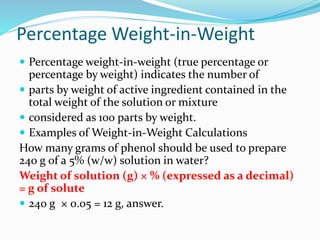
Percentage Weight-in-Weight
 Percentage weight-in-weight (true percentage or
percentage by weight) indicates the number of
 parts by weight of active ingredient contained in the
total weight of the solution or mixture
 considered as 100 parts by weight.
 Examples of Weight-in-Weight Calculations
How many grams of phenol should be used to prepare
240 g of a 5% (w/w) solution in water?
Weight of solution (g) × % (expressed as a decimal)
= g of solute
 240 g × 0.05 = 12 g, answer.
 How many grams of a drug substance are required to
make 120 mL of a 20% (w/w) solution having a specific
gravity of 1.15?
Solution
120 mL of water weighs 120 g
120 g × 1.15 = 138 g, weight of 120 mL of solution
138 g × 0.20 = 27.6 g plus enough water to make 120 mL,
answer.
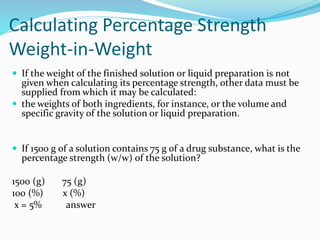
Calculating Percentage Strength
Weight-in-Weight
 If the weight of the finished solution or liquid preparation is not
given when calculating its percentage strength, other data must be
supplied from which it may be calculated:
 the weights of both ingredients, for instance, or the volume and
specific gravity of the solution or liquid preparation.
 If 1500 g of a solution contains 75 g of a drug substance, what is the
percentage strength (w/w) of the solution?
1500 (g) 75 (g)
100 (%) x (%)
x = 5% answer
example
 If 5 g of boric acid is added to 100 mL of water, what is the
percentage strength (w/w) of the solution?
100 mL of water weighs 100 g
100 g + 5 g = 105 g, weight of solution
105 (g) 5 (g)
100 (%) x (%)
x = 4.76%, answer
Ratio Strength
 The concentrations of weak solutions are frequently
expressed in terms of ratio strength. Because all
percentages are a ratio of parts per hundred, ratio
strength is merely another way of expressing the
percentage strength of solutions or liquid preparations
(and, less frequently, of mixtures of solids).
 For example, 5% means 5 parts per 100 or 5/00.
example
1:1000, is used to designate a concentration, it is to be
interpreted as follows:
 For solids in liquids 1 g of solute or constituent in 1000
mL of solution or liquid preparation.
 For liquids in liquids 1 mL of constituent in 1000 mL
of solution or liquid preparation.
 For solids in solids 1 g of constituent in 1000 g of
mixture.
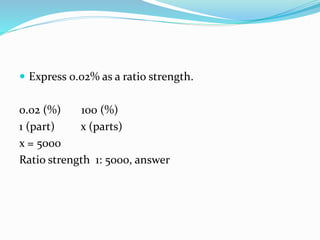
 Express 0.02% as a ratio strength.
0.02 (%) 100 (%)
1 (part) x (parts)
x = 5000
Ratio strength 1: 5000, answer
example
Express 14000 as a percentage strength?
4000 (parts) 1 (part)
100 (%) x (%)
x = 0.025%, answer.
example
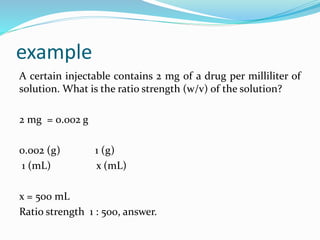
A certain injectable contains 2 mg of a drug per milliliter of
solution. What is the ratio strength (w/v) of the solution?
2 mg = 0.002 g
0.002 (g) 1 (g)
1 (mL) x (mL)
x = 500 mL
Ratio strength 1 : 500, answer.
example
 What is the ratio strength (w/v) of a solution made by
dissolving five tablets, each containing 2.25g of
sodium chloride, in enough water to make 1800 mL?
2.25 g × 5 = 11.25 g of sodium chloride
11.25 (g) 1 (g)
1800 (mL) x (mL)
x = 160 mL
Ratio strength 1 : 160, answer.
 How many grams of potassium permanganate should
be used in preparing 500 mL of a 1:2500 solution?
1 : 2500 means 1 g in 2500 mL of solution
2500 (mL) 500 (mL)
1 (g) x (g)
x = 0.2 g, answer
Parts per Million (PPM) and Parts
per Billion (PPB)
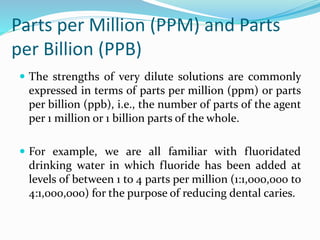
 The strengths of very dilute solutions are commonly
expressed in terms of parts per million (ppm) or parts
per billion (ppb), i.e., the number of parts of the agent
per 1 million or 1 billion parts of the whole.
 For example, we are all familiar with fluoridated
drinking water in which fluoride has been added at
levels of between 1 to 4 parts per million (1:1,000,000 to
4:1,000,000) for the purpose of reducing dental caries.
Example
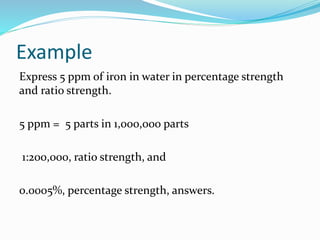
Express 5 ppm of iron in water in percentage strength
and ratio strength.
5 ppm = 5 parts in 1,000,000 parts
1:200,000, ratio strength, and
0.0005%, percentage strength, answers.
Example
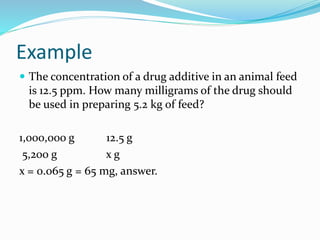
 The concentration of a drug additive in an animal feed
is 12.5 ppm. How many milligrams of the drug should
be used in preparing 5.2 kg of feed?
1,000,000 g 12.5 g
5,200 g x g
x = 0.065 g = 65 mg, answer.

pharmaceutical calculations 8

  • 1.
    Lecture 8 Percentage, RatioStrength, and Other Expressions of Concentration Laith Al-Asadi
  • 2.
    Percentage  The termpercent and its corresponding sign (%) mean ‘‘by the hundred’’ or ‘‘in a hundred,’’ and percentage means ‘‘rate per hundred’’; so 50 percent (or 50%) and a percentage of 50 are equivalent expressions.  A percent may also be expressed as a ratio, represented as a common or decimal fraction. For example, 50% means 50 parts in 100 of the same kind, and may be expressed as 50⁄100 or 0.50.  Percent, therefore, is simply another fraction of such frequent and familiar use that its numerator is expressed but its denominator is left understood. It should be noted that percent is always an abstract quantity and that, as such, it may be applied to anything.
  • 3.
    Percentage  For thepurposes of computation, percent are usually changed to equivalent decimal fractions.  This change is made by dropping the percent sign (%) and dividing the expressed numerator by 100.  Thus, 12.5% 12.5 /100, or 0.125; and 0.05% 0.05 /100, or 0.0005. We must not forget that in the reverse process (changing a decimal to a percent), the decimal is multiplied by 100 and the percent sign (%) is affixed.  Percentage is an essential part of pharmaceutical calculations. The pharmacist encounters it frequently and uses it as a convenient means of expressing the concentration of an active or inactive material in a pharmaceutical preparation.
  • 4.
    Percentage preparations  Thepercentage concentrations of active and inactive constituents in various types of pharmaceutical preparations are defined as follows by the United States Pharmacopeia:  Percent weight-in-volume (w/v) expresses the number of grams of a constituent in 100 mL of solution or liquid preparation and is used regardless of whether water or another liquid is the solvent or vehicle. Expressed as: % w/v.  Percent volume-in-volume (v/v) expresses the number of milliliters of a constituent in 100 mL of solution or liquid preparation. Expressed as: % v/v.  Percent weight-in-weight (w/w) expresses the number of grams of a constituent in 100 g of solution or preparation. Expressed as: % w/w.
  • 5.
    Percentage preparations  Theterm percent, or the symbol %, when used without qualification means: for solutions or suspensions of solids in liquids, percent weight-in-volume. for solutions of liquids in liquids, percent volume- in-volume. for mixtures of solids or semisolids, percent weight-in-weight. for solutions of gases in liquids, percent weight-in- volume.
  • 6.
    Percentage Weight-in-Volume  Ina true expression of percentage (i.e., parts per 100 parts), the percentage of a liquid preparation (e.g., solution, suspension, lotion) would represent the grams of solute or constituent in 100 g of the liquid preparation. However, in practice, the pharmacist most frequently uses a different definition of percentage for solutions and for other liquid preparations, one in which the parts of the percentage represent grams of a solute or constituent in 100 mL of solution or liquid preparation.
  • 7.
     Indeed, inweight-in-volume expressions, the ‘‘correct’’ strength of a 1% (w/v) solution or other liquid preparation is defined as containing 1 g of constituent in 100 mL of product.
  • 8.
    Percentage Weight-in-Volume  Takingwater to represent any solvent or vehicle, we may prepare weight-in-volume percentage solutions or liquid preparations by the SI metric system if we use the following rule.  Multiply the required number of milliliters by the percentage strength, expressed as a decimal, to obtain the number of grams of solute or constituent in the solution or liquid preparation.  The volume, in milliliters, represents the weight in grams of the solution or liquid preparation as if it were pure water.  grams (g) of solute or constituent = Volume (mL, representing grams) × % (expressed as a decimal)
  • 9.
    Example 1  Howmany grams of dextrose are required to prepare 4000 mL of a 5% solution? Solution 4000 mL represents 4000 g of solution 5% = 0.05 4000 g × 0.05 = 200 g answer
  • 10.
    Example 2  Howmany grams of potassium permanganate should be used in compounding the following prescription? Potassium Permanganate 0.02% Purified Water ad 250 mL Sig. as directed. solution 250 mL represents 250 g of solution 0.02% = 0.0002 250 g × 0.0002 0.05 g. answer
  • 11.
    Example 3  Howmany grams of aminobenzoic acid should be used in preparing 8 fluidounces of a 5% solution? 8 fl. oz. = 8 × 29.57 mL = 236.56 mL 236.56 mL represents 236.56 g of solution 5% = 0.05 236.56 g ×0.05 = 11.83 g answer.
  • 12.
    Example 3  Whatis the percentage strength (w/v) of a solution of urea, if 80 mL contains 12 g? Solution 80 mL of water weighs = 80 g 80 12 = 100 % 𝑥 % x = 15% answer.
  • 13.
    Percentage Volume-in-Volume  Liquidsare usually measured by volume, and the percentage strength indicates the number of parts by volume of an ingredient contained in the total volume of the solution or liquid preparation considered as 100 parts by volume. Examples of Volume-in-Volume Calculations How many milliliters of phenol should be used in compounding the following prescription? - Liquefied Phenol 2.5% - Calamine Lotion ad 240 mL - Sig. For external use. Volume (mL) × % (expressed as a decimal) = milliliters of active ingredient 240 mL × 0.025 = 6 mL, answer.
  • 14.
     In preparing250 mL of a certain lotion, a pharmacist used 4 mL of liquefied phenol. What was the percentage (v/v) of liquefied phenol in the lotion? 4 ml 250 ml X ml 100 ml X= 100 × 4 / 250 = 1.6 ml
  • 15.
     What isthe percentage strength v/v of a solution of 800 g of a liquid with a specific gravity of 0.80 in enough water to make 4000 mL? 800 g of water measures 800 mL 800 mL ÷ 0.800 = 1000 mL of active ingredient 4000 (mL) 100 (%) 1000 (mL) x (%) x = 25%, answer.
  • 16.
    Percentage Weight-in-Weight  Percentageweight-in-weight (true percentage or percentage by weight) indicates the number of  parts by weight of active ingredient contained in the total weight of the solution or mixture  considered as 100 parts by weight.  Examples of Weight-in-Weight Calculations How many grams of phenol should be used to prepare 240 g of a 5% (w/w) solution in water? Weight of solution (g) × % (expressed as a decimal) = g of solute  240 g × 0.05 = 12 g, answer.
  • 17.
     How manygrams of a drug substance are required to make 120 mL of a 20% (w/w) solution having a specific gravity of 1.15? Solution 120 mL of water weighs 120 g 120 g × 1.15 = 138 g, weight of 120 mL of solution 138 g × 0.20 = 27.6 g plus enough water to make 120 mL, answer.
  • 18.
    Calculating Percentage Strength Weight-in-Weight If the weight of the finished solution or liquid preparation is not given when calculating its percentage strength, other data must be supplied from which it may be calculated:  the weights of both ingredients, for instance, or the volume and specific gravity of the solution or liquid preparation.  If 1500 g of a solution contains 75 g of a drug substance, what is the percentage strength (w/w) of the solution? 1500 (g) 75 (g) 100 (%) x (%) x = 5% answer
  • 19.
    example  If 5g of boric acid is added to 100 mL of water, what is the percentage strength (w/w) of the solution? 100 mL of water weighs 100 g 100 g + 5 g = 105 g, weight of solution 105 (g) 5 (g) 100 (%) x (%) x = 4.76%, answer
  • 20.
    Ratio Strength  Theconcentrations of weak solutions are frequently expressed in terms of ratio strength. Because all percentages are a ratio of parts per hundred, ratio strength is merely another way of expressing the percentage strength of solutions or liquid preparations (and, less frequently, of mixtures of solids).  For example, 5% means 5 parts per 100 or 5/00.
  • 21.
    example 1:1000, is usedto designate a concentration, it is to be interpreted as follows:  For solids in liquids 1 g of solute or constituent in 1000 mL of solution or liquid preparation.  For liquids in liquids 1 mL of constituent in 1000 mL of solution or liquid preparation.  For solids in solids 1 g of constituent in 1000 g of mixture.
  • 22.
     Express 0.02%as a ratio strength. 0.02 (%) 100 (%) 1 (part) x (parts) x = 5000 Ratio strength 1: 5000, answer
  • 23.
    example Express 14000 asa percentage strength? 4000 (parts) 1 (part) 100 (%) x (%) x = 0.025%, answer.
  • 24.
    example A certain injectablecontains 2 mg of a drug per milliliter of solution. What is the ratio strength (w/v) of the solution? 2 mg = 0.002 g 0.002 (g) 1 (g) 1 (mL) x (mL) x = 500 mL Ratio strength 1 : 500, answer.
  • 25.
    example  What isthe ratio strength (w/v) of a solution made by dissolving five tablets, each containing 2.25g of sodium chloride, in enough water to make 1800 mL? 2.25 g × 5 = 11.25 g of sodium chloride 11.25 (g) 1 (g) 1800 (mL) x (mL) x = 160 mL Ratio strength 1 : 160, answer.
  • 26.
     How manygrams of potassium permanganate should be used in preparing 500 mL of a 1:2500 solution? 1 : 2500 means 1 g in 2500 mL of solution 2500 (mL) 500 (mL) 1 (g) x (g) x = 0.2 g, answer
  • 27.
    Parts per Million(PPM) and Parts per Billion (PPB)  The strengths of very dilute solutions are commonly expressed in terms of parts per million (ppm) or parts per billion (ppb), i.e., the number of parts of the agent per 1 million or 1 billion parts of the whole.  For example, we are all familiar with fluoridated drinking water in which fluoride has been added at levels of between 1 to 4 parts per million (1:1,000,000 to 4:1,000,000) for the purpose of reducing dental caries.
  • 28.
    Example Express 5 ppmof iron in water in percentage strength and ratio strength. 5 ppm = 5 parts in 1,000,000 parts 1:200,000, ratio strength, and 0.0005%, percentage strength, answers.
  • 29.
    Example  The concentrationof a drug additive in an animal feed is 12.5 ppm. How many milligrams of the drug should be used in preparing 5.2 kg of feed? 1,000,000 g 12.5 g 5,200 g x g x = 0.065 g = 65 mg, answer.