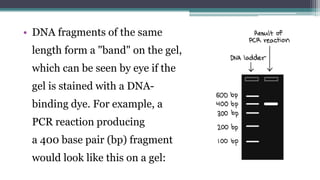
Polymerase chain reaction (PCR) is a common technique used to amplify a specific region of DNA, producing millions of copies. It uses the enzyme Taq polymerase to synthesize new DNA strands from existing DNA templates. The process involves repeated cycles of heating and cooling to denature and separate the DNA strands, allow primers to anneal, and extend new strands. This exponential process results in billions of copies of the target DNA region that can then be analyzed using gel electrophoresis or other techniques. PCR has many applications in research, forensics, genetic testing, and disease diagnosis.