Dividend Policy

What are dividends?
Why do companies pay dividends?
Does dividend policy affect value?
Why could dividends affect value?
What are the influences on the dividend
 decision?
What are dividends?

Cash payments to shareholders
Paid out of after-tax profits
Interim dividend
Final dividend
Final dividend voted on at AGM
Dividends can be paid from past and
 present earnings but cannot be paid from
 any capital reserve
Companies whose external liabilities
 exceed their assets cannot legally pay
 dividends.
Profits vs cash flow
Why do companies pay dividends?

Reward to shareholders?
What is the Total Shareholders’ Return
 (TSR) made up of?
Why else might companies pay dividends?
Do all companies pay the same
amount of dividends?
Amount paid is discretionary
Zero dividend policy
% of after-tax profit
Constant dividend or constantly growing
 dividend
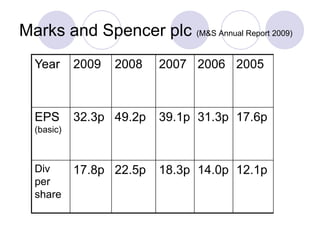
Marks and Spencer plc (M&S Annual Report 2009)
  Year      2009   2008   2007 2006 2005


  EPS       32.3p 49.2p   39.1p 31.3p 17.6p
  (basic)


  Div       17.8p 22.5p   18.3p 14.0p 12.1p
  per
  share
Marks and Spencer dividends

What do you notice about M&S dividends?

What do you think has influenced the level
 of dividends paid to shareholders?
What influences the level of
dividend?
 Variability of profits
 But dividends are cash flows
 Investment opportunities
 Ability/willingness to raise external finance
 Influence of investors
 Nature of business/stage of business in lifecycle
 Market expectations?
Alternatives to cash dividends
 Scrip dividends
  Saves cash
  Lowers gearing
 Share repurchase
  Reduces liquidity
  Increases underlying share value
 Non-pecuniary benefits
  Discounts
  Complementary goods/services
  Eg Channel Tunnel, Legal and General
Do dividends affect Value?
Residual Theory
 Dividend payments depend on the investment
  opportunities available to the firm
 This implies that investors are indifferent
  between dividend payments and increases in
  share prices due to reinvested earnings
 The dividend decision is a passive decision??
Dividend Irrelevance

Modigliani and Miller 1961
  the value of the firm is determined by the
    earnings power of its assets and the split
    between dividends and retained earnings is
    irrelevant.
Shareholders can manufacture their own
 level of dividends
Assumptions
  no tax
  no transaction costs
Why might Dividends affect Value?
Dividends may be preferred to an increase
 in share price
  Certainty
  Liquidity
Tax impact
  Different tax treatments between dividends and
   capital gains
  Clientele effect
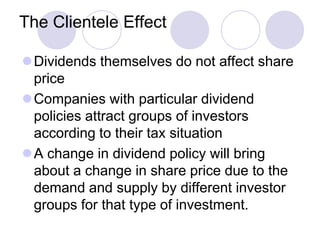
The Clientele Effect

Dividends themselves do not affect share
 price
Companies with particular dividend
 policies attract groups of investors
 according to their tax situation
A change in dividend policy will bring
 about a change in share price due to the
 demand and supply by different investor
 groups for that type of investment.
Why might Dividends affect Value?

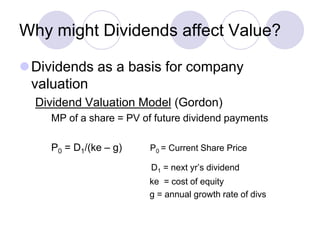
Dividends as a basis for company
 valuation
  Dividend Valuation Model (Gordon)
    MP of a share = PV of future dividend payments

    P0 = D1/(ke – g)    P0 = Current Share Price

                         D1 = next yr’s dividend
                        ke = cost of equity
                        g = annual growth rate of divs
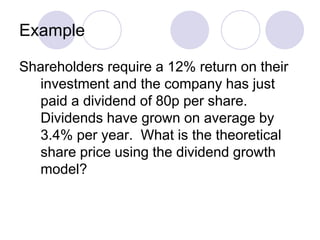
Example

Shareholders require a 12% return on their
  investment and the company has just
  paid a dividend of 80p per share.
  Dividends have grown on average by
  3.4% per year. What is the theoretical
  share price using the dividend growth
  model?
Why might Dividends affect Value?

Something else?
  Market expectations
  Signalling
  Information asymmetry
Signalling Effects

Dividends carry information to the market
 (information asymmetry)
Dividends are usually stable
A change in dividend policy may make
 investors believe that management is
 announcing a change in future profitability
 but …..
Do dividends affect share prices
(value)?
All research is inconclusive
Dividend policy can be observed and
 share prices can be observed
But
Other factors cause movements in share
 prices
It is difficult to separate out the clientele
 effect from the signalling effect
What have we discussed today?

Influences on dividend payments
The debate about the link between
 dividends and share price (value)
Why we cannot answer the question about
 the link between dividends and value

Pcf 2 dividend policy 10 11

  • 1.
    Dividend Policy What aredividends? Why do companies pay dividends? Does dividend policy affect value? Why could dividends affect value? What are the influences on the dividend decision?
  • 2.
    What are dividends? Cashpayments to shareholders Paid out of after-tax profits Interim dividend Final dividend Final dividend voted on at AGM
  • 3.
    Dividends can bepaid from past and present earnings but cannot be paid from any capital reserve Companies whose external liabilities exceed their assets cannot legally pay dividends. Profits vs cash flow
  • 4.
    Why do companiespay dividends? Reward to shareholders? What is the Total Shareholders’ Return (TSR) made up of? Why else might companies pay dividends?
  • 5.
    Do all companiespay the same amount of dividends? Amount paid is discretionary Zero dividend policy % of after-tax profit Constant dividend or constantly growing dividend
  • 6.
    Marks and Spencerplc (M&S Annual Report 2009) Year 2009 2008 2007 2006 2005 EPS 32.3p 49.2p 39.1p 31.3p 17.6p (basic) Div 17.8p 22.5p 18.3p 14.0p 12.1p per share
  • 7.
    Marks and Spencerdividends What do you notice about M&S dividends? What do you think has influenced the level of dividends paid to shareholders?
  • 8.
    What influences thelevel of dividend?  Variability of profits  But dividends are cash flows  Investment opportunities  Ability/willingness to raise external finance  Influence of investors  Nature of business/stage of business in lifecycle  Market expectations?
  • 9.
    Alternatives to cashdividends  Scrip dividends Saves cash Lowers gearing  Share repurchase Reduces liquidity Increases underlying share value  Non-pecuniary benefits Discounts Complementary goods/services Eg Channel Tunnel, Legal and General
  • 10.
    Do dividends affectValue? Residual Theory  Dividend payments depend on the investment opportunities available to the firm  This implies that investors are indifferent between dividend payments and increases in share prices due to reinvested earnings  The dividend decision is a passive decision??
  • 11.
    Dividend Irrelevance Modigliani andMiller 1961 the value of the firm is determined by the earnings power of its assets and the split between dividends and retained earnings is irrelevant. Shareholders can manufacture their own level of dividends Assumptions no tax no transaction costs
  • 12.
    Why might Dividendsaffect Value? Dividends may be preferred to an increase in share price Certainty Liquidity Tax impact Different tax treatments between dividends and capital gains Clientele effect
  • 13.
    The Clientele Effect Dividendsthemselves do not affect share price Companies with particular dividend policies attract groups of investors according to their tax situation A change in dividend policy will bring about a change in share price due to the demand and supply by different investor groups for that type of investment.
  • 14.
    Why might Dividendsaffect Value? Dividends as a basis for company valuation Dividend Valuation Model (Gordon) MP of a share = PV of future dividend payments P0 = D1/(ke – g) P0 = Current Share Price D1 = next yr’s dividend ke = cost of equity g = annual growth rate of divs
  • 15.
    Example Shareholders require a12% return on their investment and the company has just paid a dividend of 80p per share. Dividends have grown on average by 3.4% per year. What is the theoretical share price using the dividend growth model?
  • 16.
    Why might Dividendsaffect Value? Something else? Market expectations Signalling Information asymmetry
  • 17.
    Signalling Effects Dividends carryinformation to the market (information asymmetry) Dividends are usually stable A change in dividend policy may make investors believe that management is announcing a change in future profitability but …..
  • 18.
    Do dividends affectshare prices (value)? All research is inconclusive Dividend policy can be observed and share prices can be observed But Other factors cause movements in share prices It is difficult to separate out the clientele effect from the signalling effect
  • 19.
    What have wediscussed today? Influences on dividend payments The debate about the link between dividends and share price (value) Why we cannot answer the question about the link between dividends and value