How On Earth Do I Get A First?
How On Earth Do I Get A First
Nathan Ghann
@Nathan Ghann
Nathan Ghann
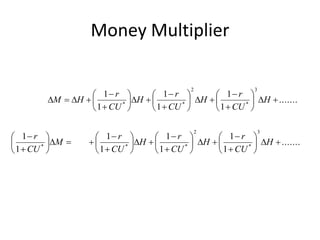
Money Multiplier
.......
1
1
1
1
1
1
1
1
.......
1
1
1
1
1
1
3
*
2
***
3
*
2
**

























































H
CU
r
H
CU
r
H
CU
r
M
CU
r
H
CU
r
H
CU
r
H
CU
r
HM
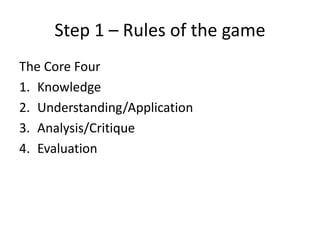
Step 1 – Rules of the game
The Core Four
1. Knowledge
2. Understanding/Application
3. Analysis/Critique
4. Evaluation
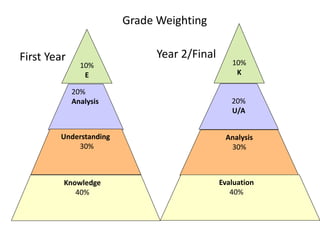
Grade Weighting
10%
E
20%
Analysis
Understanding
30%
Knowledge
40%
20%
U/A
Analysis
30%
Evaluation
40%
10%
K
First Year Year 2/Final
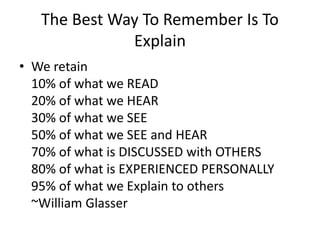
The Best Way To Remember Is To
Explain
• We retain
10% of what we READ
20% of what we HEAR
30% of what we SEE
50% of what we SEE and HEAR
70% of what is DISCUSSED with OTHERS
80% of what is EXPERIENCED PERSONALLY
95% of what we Explain to others
~William Glasser
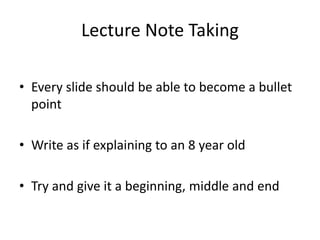
Lecture Note Taking
• Every slide should be able to become a bullet
point
• Write as if explaining to an 8 year old
• Try and give it a beginning, middle and end
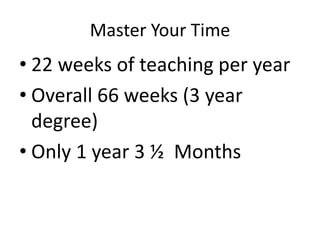
Master Your Time
Master Your Time
• 22 weeks of teaching per year
• Overall 66 weeks (3 year
degree)
• Only 1 year 3 ½ Months
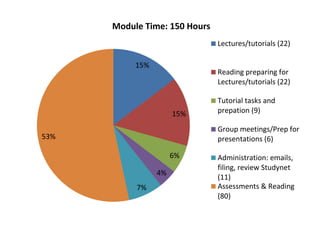
15%
15%
6%
4%
7%
53%
Module Time: 150 Hours
Lectures/tutorials (22)
Reading preparing for
Lectures/tutorials (22)
Tutorial tasks and
prepation (9)
Group meetings/Prep for
presentations (6)
Administration: emails,
filing, review Studynet
(11)
Assessments & Reading
(80)
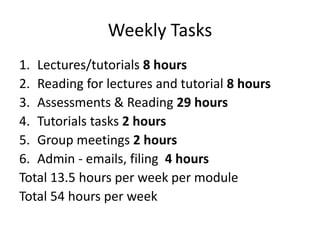
Weekly Tasks
1. Lectures/tutorials 8 hours
2. Reading for lectures and tutorial 8 hours
3. Assessments & Reading 29 hours
4. Tutorials tasks 2 hours
5. Group meetings 2 hours
6. Admin - emails, filing 4 hours
Total 13.5 hours per week per module
Total 54 hours per week
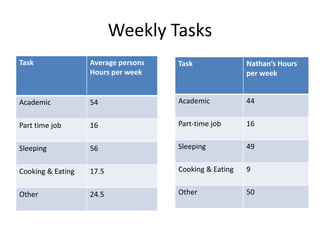
Task Average persons
Hours per week
Academic 54
Part time job 16
Sleeping 56
Cooking & Eating 17.5
Other 24.5
Task Nathan’s Hours
per week
Academic 44
Part-time job 16
Sleeping 49
Cooking & Eating 9
Other 50
Weekly Tasks
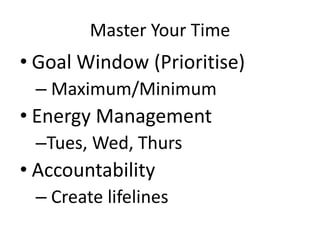
Master Your Time
• Goal Window (Prioritise)
– Maximum/Minimum
• Energy Management
–Tues, Wed, Thurs
• Accountability
– Create lifelines
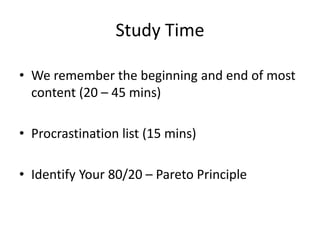
Study Time
• We remember the beginning and end of most
content (20 – 45 mins)
• Procrastination list (15 mins)
• Identify Your 80/20 – Pareto Principle
Top 20% Actions
Coursework Assignments
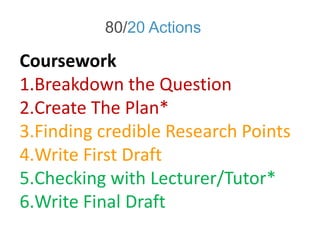
80/20 Actions
Coursework
1.Breakdown the Question
2.Create The Plan*
3.Finding credible Research Points
4.Write First Draft
5.Checking with Lecturer/Tutor*
6.Write Final Draft
Breaking Down The Question
Creating The Plan
Don’t just answer the question answer
their question
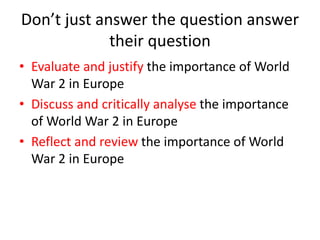
Don’t just answer the question answer
their question
• Evaluate and justify the importance of World
War 2 in Europe
• Discuss and critically analyse the importance
of World War 2 in Europe
• Reflect and review the importance of World
War 2 in Europe
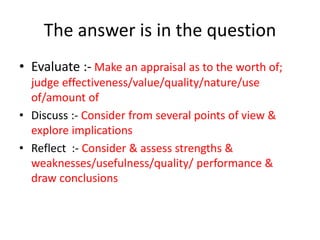
The answer is in the question
• Evaluate :- Make an appraisal as to the worth of;
judge effectiveness/value/quality/nature/use
of/amount of
• Discuss :- Consider from several points of view &
explore implications
• Reflect :- Consider & assess strengths &
weaknesses/usefulness/quality/ performance &
draw conclusions
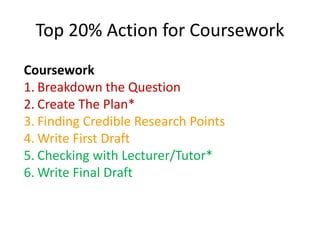
Top 20% Action for Coursework
Coursework
1. Breakdown the Question
2. Create The Plan*
3. Finding Credible Research Points
4. Write First Draft
5. Checking with Lecturer/Tutor*
6. Write Final Draft
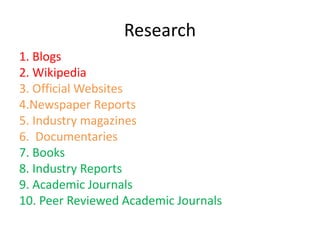
Research
1. Blogs
2. Wikipedia
3. Official Websites
4.Newspaper Reports
5. Industry magazines
6. Documentaries
7. Books
8. Industry Reports
9. Academic Journals
10. Peer Reviewed Academic Journals
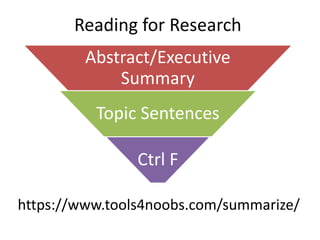
Reading for Research
Abstract/Executive
Summary
Topic Sentences
Ctrl F
https://www.tools4noobs.com/summarize/
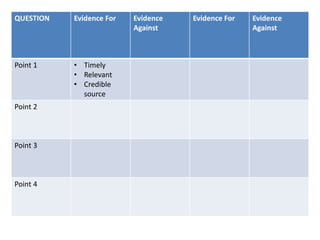
QUESTION Evidence For Evidence
Against
Evidence For Evidence
Against
Point 1 • Timely
• Relevant
• Credible
source
Point 2
Point 3
Point 4
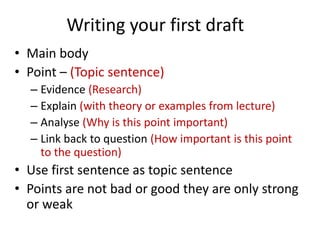
Writing your first draft
• Main body
• Point – (Topic sentence)
– Evidence (Research)
– Explain (with theory or examples from lecture)
– Analyse (Why is this point important)
– Link back to question (How important is this point
to the question)
• Use first sentence as topic sentence
• Points are not bad or good they are only strong
or weak
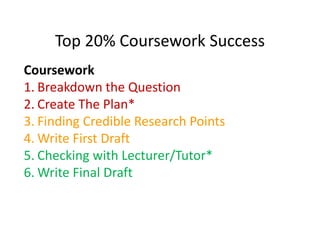
Top 20% Coursework Success
Coursework
1. Breakdown the Question
2. Create The Plan*
3. Finding Credible Research Points
4. Write First Draft
5. Checking with Lecturer/Tutor*
6. Write Final Draft
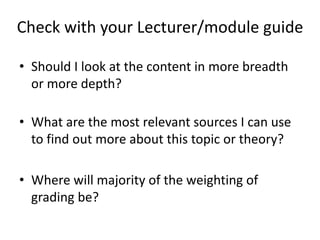
Check with your Lecturer/module guide
• Should I look at the content in more breadth
or more depth?
• What are the most relevant sources I can use
to find out more about this topic or theory?
• Where will majority of the weighting of
grading be?
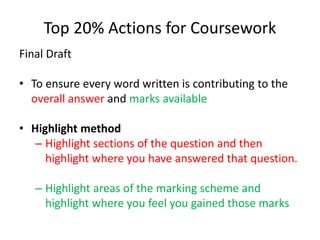
Top 20% Actions for Coursework
Final Draft
• To ensure every word written is contributing to the
overall answer and marks available
• Highlight method
– Highlight sections of the question and then
highlight where you have answered that question.
– Highlight areas of the marking scheme and
highlight where you feel you gained those marks
Top 20% For
Revision and Exams
Top 20% for Revision and Exams
• Do all past tutorial/seminar questions
• Undertake at least one past paper (timed)
• Give yourself triggers & associations
(mnemonics)
Top 20% for Revision and Exams
Define what the cerebrum is and the
explain the functions of the four main
lobes?
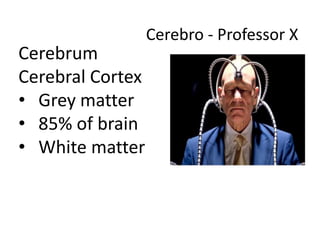
Cerebrum
Cerebral Cortex
• Grey matter
• 85% of brain
• White matter
Cerebro - Professor X
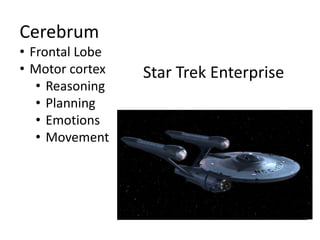
Cerebrum
• Frontal Lobe
• Motor cortex
• Reasoning
• Planning
• Emotions
• Movement
Star Trek Enterprise
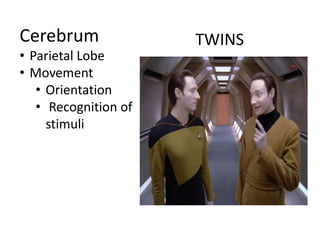
Cerebrum
• Parietal Lobe
• Movement
• Orientation
• Recognition of
stimuli
TWINS
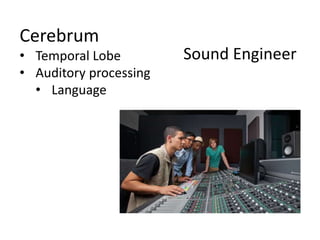
Cerebrum
• Temporal Lobe
• Auditory processing
• Language
Sound Engineer
Cerebrum
• Occitpius
• Visual Processing
Octopus
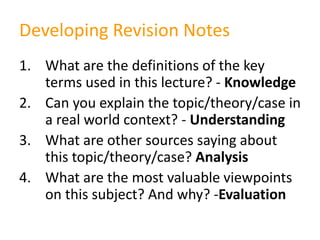
Developing Revision Notes
1. What are the definitions of the key
terms used in this lecture? - Knowledge
2. Can you explain the topic/theory/case in
a real world context? - Understanding
3. What are other sources saying about
this topic/theory/case? Analysis
4. What are the most valuable viewpoints
on this subject? And why? -Evaluation
• Calculate time per question
http://www.oxcoll.com/exam-timing.html
• You may begin
– Breakdown the question
– Write down the plan
– Leave time to go over at the end
Prep for exam questions
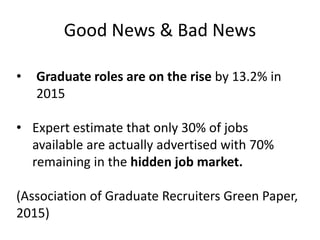
Don’t just look for a job pursue a
career
• Graduate roles are on the rise by 13.2% in
2015
• Expert estimate that only 30% of jobs
available are actually advertised with 70%
remaining in the hidden job market.
(Association of Graduate Recruiters Green Paper,
2015)
Good News & Bad News
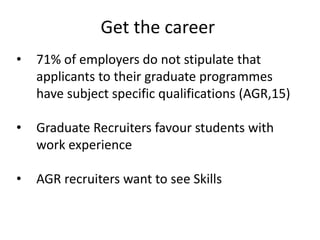
• 71% of employers do not stipulate that
applicants to their graduate programmes
have subject specific qualifications (AGR,15)
• Graduate Recruiters favour students with
work experience
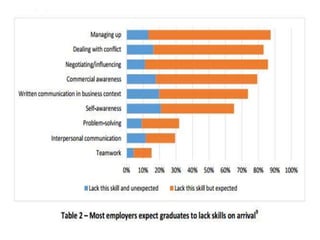
• AGR recruiters want to see Skills
Get the career
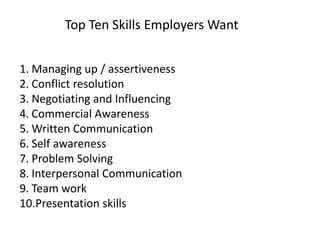
Top Ten Skills Employers Want
1. Managing up / assertiveness

2. Conflict resolution
3. Negotiating and Influencing
4. Commercial Awareness
5. Written Communication
6. Self awareness
7. Problem Solving
8. Interpersonal Communication
9. Team work
10.Presentation skills
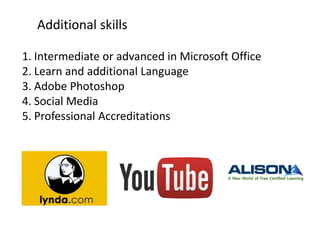
Additional skills
1. Intermediate or advanced in Microsoft Office
2. Learn and additional Language
3. Adobe Photoshop
4. Social Media
5. Professional Accreditations
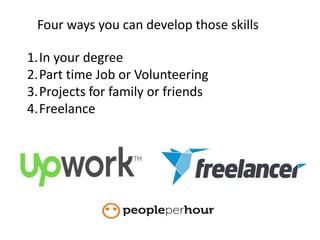
Four ways you can develop those skills
1.In your degree
2.Part time Job or Volunteering
3.Projects for family or friends
4.Freelance
The tools you need and the people you
don’t
Tools you need and the people you
don’t
1) www.vark-learn.com
2) Office 365 and Google Drive online usb
3) Refme – For referencing
4) Google Scholar – For researching
5) Academicearth.org
6) Khan Academy
7) www.oxcoll.com/exam-timing.html
8) https://www.tools4noobs.com/summarize/
Question & Answer

Hoedigaf

  • 1.
    How On EarthDo I Get A First?
  • 2.
    How On EarthDo I Get A First Nathan Ghann @Nathan Ghann Nathan Ghann
  • 3.
  • 4.
    Step 1 –Rules of the game The Core Four 1. Knowledge 2. Understanding/Application 3. Analysis/Critique 4. Evaluation
  • 5.
  • 6.
    The Best WayTo Remember Is To Explain • We retain 10% of what we READ 20% of what we HEAR 30% of what we SEE 50% of what we SEE and HEAR 70% of what is DISCUSSED with OTHERS 80% of what is EXPERIENCED PERSONALLY 95% of what we Explain to others ~William Glasser
  • 7.
    Lecture Note Taking •Every slide should be able to become a bullet point • Write as if explaining to an 8 year old • Try and give it a beginning, middle and end
  • 8.
  • 9.
    Master Your Time •22 weeks of teaching per year • Overall 66 weeks (3 year degree) • Only 1 year 3 ½ Months
  • 10.
    15% 15% 6% 4% 7% 53% Module Time: 150Hours Lectures/tutorials (22) Reading preparing for Lectures/tutorials (22) Tutorial tasks and prepation (9) Group meetings/Prep for presentations (6) Administration: emails, filing, review Studynet (11) Assessments & Reading (80)
  • 11.
    Weekly Tasks 1. Lectures/tutorials8 hours 2. Reading for lectures and tutorial 8 hours 3. Assessments & Reading 29 hours 4. Tutorials tasks 2 hours 5. Group meetings 2 hours 6. Admin - emails, filing 4 hours Total 13.5 hours per week per module Total 54 hours per week
  • 12.
    Task Average persons Hoursper week Academic 54 Part time job 16 Sleeping 56 Cooking & Eating 17.5 Other 24.5 Task Nathan’s Hours per week Academic 44 Part-time job 16 Sleeping 49 Cooking & Eating 9 Other 50 Weekly Tasks
  • 13.
    Master Your Time •Goal Window (Prioritise) – Maximum/Minimum • Energy Management –Tues, Wed, Thurs • Accountability – Create lifelines
  • 14.
    Study Time • Weremember the beginning and end of most content (20 – 45 mins) • Procrastination list (15 mins) • Identify Your 80/20 – Pareto Principle
  • 15.
  • 16.
    80/20 Actions Coursework 1.Breakdown theQuestion 2.Create The Plan* 3.Finding credible Research Points 4.Write First Draft 5.Checking with Lecturer/Tutor* 6.Write Final Draft
  • 17.
    Breaking Down TheQuestion Creating The Plan Don’t just answer the question answer their question
  • 18.
    Don’t just answerthe question answer their question • Evaluate and justify the importance of World War 2 in Europe • Discuss and critically analyse the importance of World War 2 in Europe • Reflect and review the importance of World War 2 in Europe
  • 19.
    The answer isin the question • Evaluate :- Make an appraisal as to the worth of; judge effectiveness/value/quality/nature/use of/amount of • Discuss :- Consider from several points of view & explore implications • Reflect :- Consider & assess strengths & weaknesses/usefulness/quality/ performance & draw conclusions
  • 20.
    Top 20% Actionfor Coursework Coursework 1. Breakdown the Question 2. Create The Plan* 3. Finding Credible Research Points 4. Write First Draft 5. Checking with Lecturer/Tutor* 6. Write Final Draft
  • 21.
    Research 1. Blogs 2. Wikipedia 3.Official Websites 4.Newspaper Reports 5. Industry magazines 6. Documentaries 7. Books 8. Industry Reports 9. Academic Journals 10. Peer Reviewed Academic Journals
  • 22.
    Reading for Research Abstract/Executive Summary TopicSentences Ctrl F https://www.tools4noobs.com/summarize/
  • 23.
    QUESTION Evidence ForEvidence Against Evidence For Evidence Against Point 1 • Timely • Relevant • Credible source Point 2 Point 3 Point 4
  • 24.
    Writing your firstdraft • Main body • Point – (Topic sentence) – Evidence (Research) – Explain (with theory or examples from lecture) – Analyse (Why is this point important) – Link back to question (How important is this point to the question) • Use first sentence as topic sentence • Points are not bad or good they are only strong or weak
  • 25.
    Top 20% CourseworkSuccess Coursework 1. Breakdown the Question 2. Create The Plan* 3. Finding Credible Research Points 4. Write First Draft 5. Checking with Lecturer/Tutor* 6. Write Final Draft
  • 26.
    Check with yourLecturer/module guide • Should I look at the content in more breadth or more depth? • What are the most relevant sources I can use to find out more about this topic or theory? • Where will majority of the weighting of grading be?
  • 27.
    Top 20% Actionsfor Coursework Final Draft • To ensure every word written is contributing to the overall answer and marks available • Highlight method – Highlight sections of the question and then highlight where you have answered that question. – Highlight areas of the marking scheme and highlight where you feel you gained those marks
  • 28.
  • 29.
    Top 20% forRevision and Exams • Do all past tutorial/seminar questions • Undertake at least one past paper (timed) • Give yourself triggers & associations (mnemonics)
  • 30.
    Top 20% forRevision and Exams Define what the cerebrum is and the explain the functions of the four main lobes?
  • 31.
    Cerebrum Cerebral Cortex • Greymatter • 85% of brain • White matter Cerebro - Professor X
  • 32.
    Cerebrum • Frontal Lobe •Motor cortex • Reasoning • Planning • Emotions • Movement Star Trek Enterprise
  • 33.
    Cerebrum • Parietal Lobe •Movement • Orientation • Recognition of stimuli TWINS
  • 34.
    Cerebrum • Temporal Lobe •Auditory processing • Language Sound Engineer
  • 35.
  • 37.
    Developing Revision Notes 1.What are the definitions of the key terms used in this lecture? - Knowledge 2. Can you explain the topic/theory/case in a real world context? - Understanding 3. What are other sources saying about this topic/theory/case? Analysis 4. What are the most valuable viewpoints on this subject? And why? -Evaluation
  • 38.
    • Calculate timeper question http://www.oxcoll.com/exam-timing.html • You may begin – Breakdown the question – Write down the plan – Leave time to go over at the end Prep for exam questions
  • 39.
    Don’t just lookfor a job pursue a career
  • 40.
    • Graduate rolesare on the rise by 13.2% in 2015 • Expert estimate that only 30% of jobs available are actually advertised with 70% remaining in the hidden job market. (Association of Graduate Recruiters Green Paper, 2015) Good News & Bad News
  • 41.
    • 71% ofemployers do not stipulate that applicants to their graduate programmes have subject specific qualifications (AGR,15) • Graduate Recruiters favour students with work experience • AGR recruiters want to see Skills Get the career
  • 44.
    Top Ten SkillsEmployers Want 1. Managing up / assertiveness 2. Conflict resolution 3. Negotiating and Influencing 4. Commercial Awareness 5. Written Communication 6. Self awareness 7. Problem Solving 8. Interpersonal Communication 9. Team work 10.Presentation skills
  • 45.
    Additional skills 1. Intermediateor advanced in Microsoft Office 2. Learn and additional Language 3. Adobe Photoshop 4. Social Media 5. Professional Accreditations
  • 46.
    Four ways youcan develop those skills 1.In your degree 2.Part time Job or Volunteering 3.Projects for family or friends 4.Freelance
  • 47.
    The tools youneed and the people you don’t
  • 48.
    Tools you needand the people you don’t 1) www.vark-learn.com 2) Office 365 and Google Drive online usb 3) Refme – For referencing 4) Google Scholar – For researching 5) Academicearth.org 6) Khan Academy 7) www.oxcoll.com/exam-timing.html 8) https://www.tools4noobs.com/summarize/
  • 49.