FINANCIAL
DERIVATIVES
What are Derivatives?
 A derivative is a financial instrument
whose value is derived from the value of
another asset.
 Example : The value of a gold futures
contract is derived from the value of the
underlying asset i.e. Gold.
 When the price of the underlying changes,
the value of the derivative also changes.
 A derivative is not a product, it is a
contract.
Terminology
 Long position
 Buyer
 Short position
 Seller
 Spot price(market price) – Price of the asset
in the spot market
 Delivery/forward price – Price of the asset
at the delivery date.
Traders in Derivatives Market
There are 3 types of traders in the Derivatives
Market :
 HEDGER
A hedger is someone who faces risk associated with
price movement of an asset and who uses derivatives
as means of reducing risk. They provide economic
balance to the market.
 SPECULATOR
A trader who enters the futures market for pursuit of
profits, accepting risk in the endeavor. They provide
liquidity and depth to the market.
Traders in Derivatives Market
 ARBITRAGER
 A person who simultaneously enters into transactions
in two or more markets to take advantage of the
discrepancies between prices in these markets.
 Arbitrage involves making profits from relative
mispricing.
 Arbitrageurs also help to make markets liquid, ensure
accurate and uniform pricing, and enhance price
stability
 They help in bringing about price uniformity and
discovery.
OTC and Exchange Traded
Derivatives
 OTC
 Over-the-counter (OTC) or off-exchange trading is to
trade financial instruments such as stocks, bonds,
commodities or derivatives directly between two
parties without going through an exchange or other
intermediary.
 The contract between the two parties are privately
negotiated.
 The contract can be tailor-made to the two parties’
liking.
 Over-the-counter markets are uncontrolled,
unregulated and have very few laws. Its more like a
freefall.
Exchange-traded Derivatives
 Exchange traded derivatives contract (ETD) are those
derivatives instruments that are traded via
specialized derivatives exchange or other exchanges.
A derivatives exchange is a market where individuals
trade standardized contracts that have been defined
by the exchange.
 The world's largest derivatives exchanges (by
number of transactions) are the NSE
 There is a very visible and transparent market price
for the derivatives.
Economic benefits of derivatives
 Reduces risk
 Enhance liquidity of the underlying
asset
 Lower transaction costs
 Enhances the price discovery process.
 Portfolio Management
 Provides signals of market
movements
 Facilitates financial markets
integration
Types of Financial
Derivatives
 Future Trading
 Forward Trading
 Options
 Swaps
What is a Forward?
 It is Over The Counter traded derivative
 A forward is a contract in which one party
commits to buy and the other party
commits to sell a specified quantity of an
agreed upon asset for a pre-determined
price at a specific date in the future.
 It is a customised contract, in the sense
that the terms of the contract are agreed
upon by the individual parties.
Forward Contract Example
I agree to sell
600kgs wheat
at Rs.50/kg
after 3 months.
Farmer Bread
Maker
3 months
Later
Farmer
Bread
Maker
600kgs
wheat
Rs.30,000
What are Futures?
 A future is a standardised forward contract.
 It is traded on an organised exchange.
 Standardisations-
- quantity of underlying
- quality of underlying
- delivery dates and procedure
- price quotes
Futures Contract Example
A
B C
D Rs.
10
S Rs.
12
S RS. 10
D Rs.14
D
Rs12
S Rs.14
Profit Rs.
2
Loss
Rs.4
Profit
Rs.2
Market Price/Spot
Price
D1 Rs.10
D2 Rs.12
D3 Rs.
14
Types of Futures Contracts
 Stock Futures Trading (dealing with
shares)
 Commodity Futures Trading (dealing
with gold futures, crude oil futures)
 Index Futures Trading (dealing with
stock market indices)
Closing a Futures Position
 Most futures contracts are not held till
expiry, but closed before that.
 If held till expiry, they are generally
settled by delivery.
 By closing a futures contract before
expiry, the net difference is settled
between traders, without physical
delivery of the underlying.
Terminology
 Contract size – The amount of the asset that has to
be delivered under one contract. All futures are sold
in multiples of lots which is decided by the exchange
board e.g. If the lot size of SBI is 2500 shares, then
one futures contract is necessarily 2500 shares.
 Contract cycle – The period for which a contract
trades. The futures on the NSE have one (near)
month, two (next) months, three (far) months expiry
cycles.
 Expiry date – usually last Thursday of every month or
previous day if Thursday is public holiday.
Terminology
 Strike price – The agreed price of the
deal is called the strike price.
 Cost of carry – Difference between
strike price and current price.
Margins
 A margin is an amount of a money that must
be deposited with the clearing house by both
buyers and sellers in a margin account in
order to open a futures contract.
 It ensures performance of the terms of the
contract.
 Its aim is to minimise the risk of default by
either counterparty.
Margins
 Initial Margin - Deposit that a trader must make
before trading any futures. Usually, 10% of the
contract size.
 Maintenance Margin - When margin reaches a
minimum maintenance level, the trader is
required to bring the margin back to its initial
level. The maintenance margin is generally about
75% of the initial margin.
 Variation Margin - Additional margin required
to bring an account up to the required level.
 Margin call – If amt in the margin A/C falls below
the maintenance level, a margin call is made to
fill the gap.
Marking to Market
 This is the practice of periodically adjusting
the margin account by adding or subtracting
funds based on changes in market value to
reflect the investor’s gain or loss.
 This leads to changes in margin amounts
daily.
 This ensures that there are no defaults by
the parties.
COMPARISON FORWARD
FUTURES
• Trade on organized exchanges No
Yes
• Use standardized contract terms No
Yes
• Use associate clearing houses to
guarantee contract fulfillment No
Yes
• Require margin payments and daily
settlements No
Yes
• Markets are transparent No
Yes
 On 9th Dec 2023, ABC enters into an
agreement with XYZ to buy 15 kilograms of
gold at a certain purity (say 999 purity) in
three months time (9th March 2024). They fix
the price of Gold at the current market price,
which is Rs.7450/- per gram or Rs.74,50,000/-
per kilogram. Hence as per this agreement,
on 9th March 2024, ABC is expected to pay
XYZ a sum of Rs.11.175 Crs (74,50,000/
Kg*15) in return for the 15 kgs of Gold.
Scenario 1 – The price of Gold
goes higher
 Assume on 9th March 2024, the price of gold (999
purity) is trading at Rs.8700/- per gram. ABC
Jeweler’s view on the gold price has come true. At
the time of the agreement, the deal was valued at
Rs 11.175 Crs but now with the increase in Gold
prices, the deal is valued at Rs.13.05 Crs. As per
the agreement, ABC Jewelers is entitled to buy
Gold (999 purity) from XYZ Gold Dealers at a price
they had previously agreed upon i.e. Rs.7450/-
per gram. The increase in Gold price impacts
both parties in the following ways –
Party Action Financial Impact
ABC Jewellers Buys gold from XYZ Gold
Dealers @ Rs.7450/- per gram
ABC saves Rs.1.875 crs
by virtue of this
agreement
XYZ Gold Dealers Obligated to sell Gold to ABC
@ Rs.7450/- per gram
Incurs a financial loss
of Rs.1.875 crores
Takeaways
 If you have a directional view of an assets price, you can
financially benefit from it by entering into a futures
agreement
 To transact in a futures contract one needs to deposit a token
advance called the margin
 When we transact in a futures contract, we digitally sign the
agreement with the counter party, this obligates us to honor
the contract
 The futures price and the spot price of an asset are different,
this is attributable to the futures pricing formula (we will
discuss this topic later)
 One lot refers to the minimum number of shares that needs
to be transacted
 Once we enter into a futures agreement there is no obligation
to stick to the agreement until the contract expires
Takeaways
 Every futures trade requires a margin amount, the margins
are blocked the moment you enter a futures trade
 We can exit the agreement anytime, which means you can
exit the agreement within seconds of entering the
agreement
 When we square off an agreement we are essentially
transferring the risk to someone else
 Once we square off the futures position, margins are
unblocked
 The money that you make or lose in a futures transaction is
credited or debited to your trading account the same day
12. In a futures contract, the buyer’s gain is the sellers loss
and vice versa
What are Options?
 Contracts that give the holder the option to
buy/sell specified quantity of the underlying
assets at a particular price on or before a
specified time period.
 The word “option” means that the holder has
the right but not the obligation to buy/sell
underlying assets.
Types of Options
 Basis of the action Options are of two types –
Call Option and Put Option.
 On the Basis of Timing of Maturity- American
Option and European Option
 Call option give the buyer the right but not the
obligation to buy a given quantity of the
underlying asset, at a given price on or before a
particular date by paying a premium.
 Puts give the buyer the right, but not obligation
to sell a given quantity of the underlying asset at
a given price on or before a particular date by
paying a premium.
Types of Options (cont.)
 The other two types are – European style
options and American style options.
 European style options can be exercised
only on the maturity date of the option, also
known as the expiry date.
 American style options can be exercised at
any time before and on the expiry date.
Call Option Example
Right to buy 100
Reliance shares
at a price of
Rs.300 per share
after 3 months.
CALL
OPTION
Strike
Price
Premium =
Rs.25/share
Amt to buy Call
option = Rs.2500
Current Price =
Rs.250
Suppose after a month,
Market price is Rs.400,
then the option is
exercised i.e. the shares
are bought.
Net gain = 40,000-
30,000- 2500
Suppose after a month,
market price is Rs.200, then
the option is not exercised.
Net Loss = Premium amt
= Rs.2500
Expir
y
date
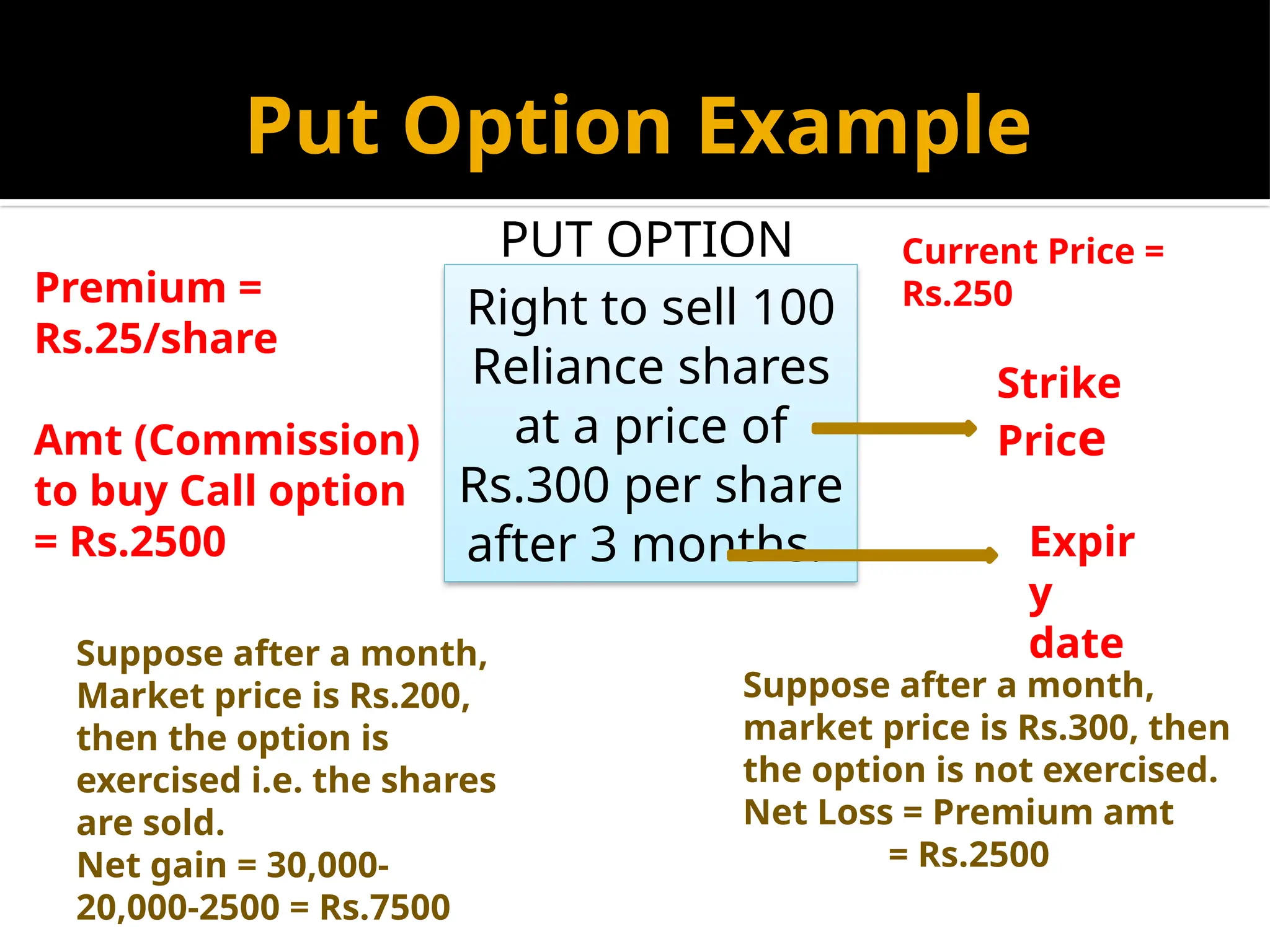
Put Option Example
Right to sell 100
Reliance shares
at a price of
Rs.300 per share
after 3 months.
PUT OPTION
Strike
Price
Premium =
Rs.25/share
Amt (Commission)
to buy Call option
= Rs.2500
Current Price =
Rs.250
Suppose after a month,
Market price is Rs.200,
then the option is
exercised i.e. the shares
are sold.
Net gain = 30,000-
20,000-2500 = Rs.7500
Suppose after a month,
market price is Rs.300, then
the option is not exercised.
Net Loss = Premium amt
= Rs.2500
Expir
y
date
Features of Options
 A fixed maturity date on which they expire. (Expiry
date)
 The price at which the option is exercised is called
the exercise price or strike price.
 The person who writes the option and is the seller is
referred as the “option writer”, and who holds the
option and is the buyer is called “option holder”.
 The premium is the price paid for the option by the
buyer to the seller.
 A clearing house is interposed between the writer
and the buyer which guarantees performance of the
contract.
Options Terminology
 Underlying: Specific security or asset.
 Option premium: Price paid.
 Strike price: Pre-decided price.
 Expiration date: Date on which option
expires.
 Exercise date: Option is exercised.
 Open interest: Total numbers of option
contracts that have not yet been expired.
 Option holder: One who buys option.
 Option writer: One who sells option.
Options Terminology (cont.)
 Option class: All listed options of a type on a
particular instrument.
 Option series: A series that consists of all the
options of a given class with the same expiry
date and strike price. For example, all call
options on Stock X with strike price Y expiring
on the last thursday in March make up one
option series in the exchange on which they
are traded.
 Put-call ratio: The ratio of puts to the calls
traded in the market.
Options Terminology (cont.)
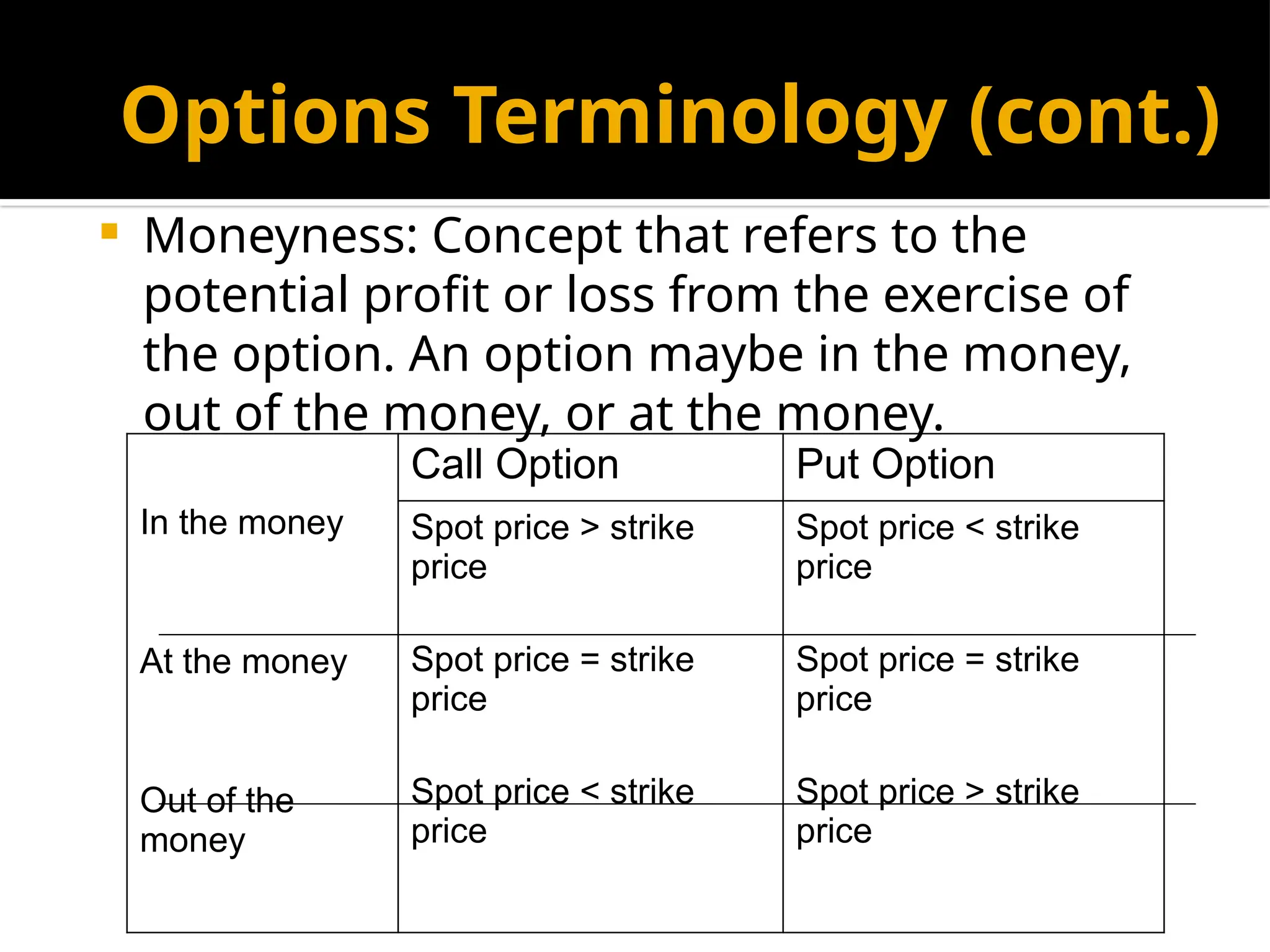
 Moneyness: Concept that refers to the
potential profit or loss from the exercise of
the option. An option maybe in the money,
out of the money, or at the money.
In the money
At the money
Out of the
money
Call Option Put Option
Spot price > strike
price
Spot price = strike
price
Spot price < strike
price
Spot price < strike
price
Spot price = strike
price
Spot price > strike
price
What are SWAPS?
 Swap, in the simplest form, may be defined
as an exchange of future cash flows
between two parties as agreed upon
according to the terms of the contract. The
basis of future cash flow can be exchange
rate for currency/ financial swap, and/or the
interest rate for interest rate swaps.
 Most swaps are traded “Over The Counter”.
 Some are also traded on futures exchange
market.
Historical Background of
SWAPs
• Swap agreements originated from agreements
created in Great Britain in the 1970s to circumvent
foreign exchange controls adopted by the British
government.
• The British government had a policy of taxing foreign
exchange transactions that involved the British
pound, which made it more difficult for capital to
leave the country.
• IBM and the World Bank entered into the first
formalized swap agreement in 1981, when the World
Bank needed to borrow German marks and Swiss
francs to finance its operations, but the governments
of those countries prohibited it from borrowing.
History –contd….l
• During the 2008 financial crisis when
credit default swaps on mortgage-
backed securities (MBS) were cited as
one of the primary contributing factors
to the economic downturn.
INTEREST RATE SWAP
 In an interest rate swap, the parties exchange
cash flows based on a notional principal amount
(this amount is not actually exchanged) in order
to hedge against interest rate risk or to speculate.
For example, say ABC Co. has just issued $1
million in five-year bonds with a variable annual
interest rate defined as the
London Interbank Offered Rate(LIBOR) plus 1.3%
(or 130 basis points). LIBOR is at 1.7%, low for its
historical range, so ABC management is anxious
about an interest rate rise.
INTEREST RATE SWAP
 They find another company, XYZ Inc., that is
willing to pay ABC an annual rate of LIBOR​plus
1.3% on a notional principal of $1 million for 5
years. In other words, XYZ will fund ABC's
interest payments on its latest bond issue. In
exchange, ABC pays XYZ a fixed annual rate of
6% on a notional value of $1 million for five
years. ABC benefits from the swap if rates rise
significantly over the next five years. XYZ
benefits if rates fall, stay flat or rise only
gradually.
SWAPS EXPLAINED WITH THE HELP
OF TWO SCENARIOS
 1) LIBOR rises 0.75% per year, and
 2) LIBOR rises 2% per year.
Scenario 1
 If LIBOR rises by 0.75% per year, Company ABC's total
interest payments to its bond holders over the five-
year period are $225,000. Let's break down the
calculation. At year 1, the interest rate will be 1.7%;
 Year 2 = 1.7% + 0.75% = 2.45%
 Year 3 = 2.45% + 0.75% = 3.2%
 Year 4 = 3.2% + 0.75% = 3.95%
 Year 5 = 3.95% + 0.75% = 4.7%
 $225,000 = $1,000,000 x [(5 x 0.013) + 0.017 + 0.0245
+ 0.032 + 0.0395 + 0.047]
 In other words, $75,000 more than the $150,000 that
ABC would have paid if LIBOR had remained flat:
Scenario 2
 In the second scenario, LIBOR rises by 2% a year.
Therefore, Year 1 interest payments rate is 1.7%;
 Year 2 = 1.7% + 2% = 3.7%
 Year 3 = 3.7% + 2% = 5.7%
 Year 4 = 5.7% + 2% = 7.7%
 Year 5 = 7.7% + 2% = 9.7%
 This brings ABC's total interest payments to bond holders
to $350,000
 $350,000 = $1,000,000 x [(5 x 0.013) + 0.017 + 0.037 +
0.057 + 0.077 + 0.097]
 XYZ pays this amount to ABC, and ABC pays XYZ $300,000
in return. ABC's net gain on the swap is $50,000.
Types of Swaps
There are 2 main types of swaps:
 Plain vanilla fixed for floating swaps
or simply interest rate swaps.
 Fixed for fixed currency swaps
or simply currency swaps.
What is an Interest Rate
Swap?
 A company agrees to pay a pre-determined fixed
interest rate on a notional principal for a fixed
number of years.
 In return, it receives interest at a floating rate on
the same notional principal for the same period of
time.
 The principal is not exchanged. Hence, it is called
a notional amount.
Floating Interest Rate
 LIBOR – London Interbank Offered Rate
 It is the average interest rate estimated
by leading banks in London.
 It is the primary benchmark for short
term interest rates around the world.
 Similarly, we have MIBOR i.e. Mumbai
Interbank Offered Rate.
 It is calculated by the NSE as a weighted
average of lending rates of a group of
banks.
Reducing Cost of Funds
 The most important use of swaps, which seems to
be primarily responsible for the popularity and
growth of swaps, is its potential to save cost for
the firms. An example will illustrate how swaps can
be used to reduce cost.
 Assume that a highly rated Firm AAA can raise
funds in the fixed rate market at 10% and in the
floating rate market at MIBOR + 100 bps. The
current rate of MIBOR is 8%.
 Another firm comparatively lower rated at A can
mobilize capital at 12% and MIBOR + 200 bps in
the fixed rate and floating rate markets
respectively.
 Clearly, Firm AAA has advantage over
Firm A in both kinds of the markets—
fixed and floating—as can be seen below.
Firm AAA Firm A Advantage
AAA
Fixed Rate 10% 12% 200 bps
Floating
Rate
MIBOR+
100 bps
MIBOR+20
0 bps
100 bps
 further assume that Firm AAA is
interested in borrowing at floating rate
(at MIBOR + 100 bps) and Firm A wants
to borrow in the fixed rate market (at
12%). Notice that for lower rated firm
the spread in the fixed rate market is
greater. Both the firms can set up the
swap as follows:
 Firm AAA goes to fixed rate market to borrow at
10% rather than tapping floating rate market at
MIBOR + 100 bps.
 Firm A mobilizes funds from floating rate market
at MIBOR + 200 bps rather than mobilizing from
fixed rate market at 12%.
 Having accessed different market as against
their original choice now Firm AAA and Firm A
enter a swap where (a) Firm AAA pays Firm A
floating at MIBOR + 200 bps (b) Firm A pays Firm
AAA fixed at 11.50%
What is a Currency Swap?
 It is a swap that includes exchange of
principal and interest rates in one
currency for the same in another
currency.
 It is considered to be a foreign
exchange transaction.
 It is not required by law to be shown in
the balance sheets.
 The principal may be exchanged either
at the beginning or at the end of the
 However, if it is exchanged at the end of
the life of the swap, the principal value
may be very different.
 It is generally used to hedge against
exchange rate fluctuations.
Direct Currency Swap
Example
 Firm A is an American company and
wants to borrow €40,000 for 3 years.
 Firm B is a French company and wants
to borrow $60,000 for 3 years.
 Suppose the current exchange rate is
€1 = $1.50.
Direct Currency Swap Example
Firm A Firm B
Bank A Bank B
€
6%
$
7%
€
5%
$
8%
Aim - EURO
Aim -
DOLLAR
7%
5%
7% 5%
$60th €40t
h
Comparative Advantage
 Firm A has a comparative advantage
in borrowing Dollars.
 Firm B has a comparative advantage
in borrowing Euros.
 This comparative advantage helps in
reducing borrowing cost and hedging
against exchange rate fluctuations.
 Thanks

financialderivativesppt-Meaning_an_type[1] [Read-Only].pptx

  • 1.
  • 3.
    What are Derivatives? A derivative is a financial instrument whose value is derived from the value of another asset.  Example : The value of a gold futures contract is derived from the value of the underlying asset i.e. Gold.  When the price of the underlying changes, the value of the derivative also changes.  A derivative is not a product, it is a contract.
  • 4.
    Terminology  Long position Buyer  Short position  Seller  Spot price(market price) – Price of the asset in the spot market  Delivery/forward price – Price of the asset at the delivery date.
  • 5.
    Traders in DerivativesMarket There are 3 types of traders in the Derivatives Market :  HEDGER A hedger is someone who faces risk associated with price movement of an asset and who uses derivatives as means of reducing risk. They provide economic balance to the market.  SPECULATOR A trader who enters the futures market for pursuit of profits, accepting risk in the endeavor. They provide liquidity and depth to the market.
  • 6.
    Traders in DerivativesMarket  ARBITRAGER  A person who simultaneously enters into transactions in two or more markets to take advantage of the discrepancies between prices in these markets.  Arbitrage involves making profits from relative mispricing.  Arbitrageurs also help to make markets liquid, ensure accurate and uniform pricing, and enhance price stability  They help in bringing about price uniformity and discovery.
  • 7.
    OTC and ExchangeTraded Derivatives  OTC  Over-the-counter (OTC) or off-exchange trading is to trade financial instruments such as stocks, bonds, commodities or derivatives directly between two parties without going through an exchange or other intermediary.  The contract between the two parties are privately negotiated.  The contract can be tailor-made to the two parties’ liking.  Over-the-counter markets are uncontrolled, unregulated and have very few laws. Its more like a freefall.
  • 8.
    Exchange-traded Derivatives  Exchangetraded derivatives contract (ETD) are those derivatives instruments that are traded via specialized derivatives exchange or other exchanges. A derivatives exchange is a market where individuals trade standardized contracts that have been defined by the exchange.  The world's largest derivatives exchanges (by number of transactions) are the NSE  There is a very visible and transparent market price for the derivatives.
  • 9.
    Economic benefits ofderivatives  Reduces risk  Enhance liquidity of the underlying asset  Lower transaction costs  Enhances the price discovery process.  Portfolio Management  Provides signals of market movements  Facilitates financial markets integration
  • 10.
    Types of Financial Derivatives Future Trading  Forward Trading  Options  Swaps
  • 11.
    What is aForward?  It is Over The Counter traded derivative  A forward is a contract in which one party commits to buy and the other party commits to sell a specified quantity of an agreed upon asset for a pre-determined price at a specific date in the future.  It is a customised contract, in the sense that the terms of the contract are agreed upon by the individual parties.
  • 12.
    Forward Contract Example Iagree to sell 600kgs wheat at Rs.50/kg after 3 months. Farmer Bread Maker 3 months Later Farmer Bread Maker 600kgs wheat Rs.30,000
  • 13.
    What are Futures? A future is a standardised forward contract.  It is traded on an organised exchange.  Standardisations- - quantity of underlying - quality of underlying - delivery dates and procedure - price quotes
  • 14.
    Futures Contract Example A BC D Rs. 10 S Rs. 12 S RS. 10 D Rs.14 D Rs12 S Rs.14 Profit Rs. 2 Loss Rs.4 Profit Rs.2 Market Price/Spot Price D1 Rs.10 D2 Rs.12 D3 Rs. 14
  • 15.
    Types of FuturesContracts  Stock Futures Trading (dealing with shares)  Commodity Futures Trading (dealing with gold futures, crude oil futures)  Index Futures Trading (dealing with stock market indices)
  • 16.
    Closing a FuturesPosition  Most futures contracts are not held till expiry, but closed before that.  If held till expiry, they are generally settled by delivery.  By closing a futures contract before expiry, the net difference is settled between traders, without physical delivery of the underlying.
  • 17.
    Terminology  Contract size– The amount of the asset that has to be delivered under one contract. All futures are sold in multiples of lots which is decided by the exchange board e.g. If the lot size of SBI is 2500 shares, then one futures contract is necessarily 2500 shares.  Contract cycle – The period for which a contract trades. The futures on the NSE have one (near) month, two (next) months, three (far) months expiry cycles.  Expiry date – usually last Thursday of every month or previous day if Thursday is public holiday.
  • 18.
    Terminology  Strike price– The agreed price of the deal is called the strike price.  Cost of carry – Difference between strike price and current price.
  • 19.
    Margins  A marginis an amount of a money that must be deposited with the clearing house by both buyers and sellers in a margin account in order to open a futures contract.  It ensures performance of the terms of the contract.  Its aim is to minimise the risk of default by either counterparty.
  • 20.
    Margins  Initial Margin- Deposit that a trader must make before trading any futures. Usually, 10% of the contract size.  Maintenance Margin - When margin reaches a minimum maintenance level, the trader is required to bring the margin back to its initial level. The maintenance margin is generally about 75% of the initial margin.  Variation Margin - Additional margin required to bring an account up to the required level.  Margin call – If amt in the margin A/C falls below the maintenance level, a margin call is made to fill the gap.
  • 21.
    Marking to Market This is the practice of periodically adjusting the margin account by adding or subtracting funds based on changes in market value to reflect the investor’s gain or loss.  This leads to changes in margin amounts daily.  This ensures that there are no defaults by the parties.
  • 22.
    COMPARISON FORWARD FUTURES • Tradeon organized exchanges No Yes • Use standardized contract terms No Yes • Use associate clearing houses to guarantee contract fulfillment No Yes • Require margin payments and daily settlements No Yes • Markets are transparent No Yes
  • 23.
     On 9thDec 2023, ABC enters into an agreement with XYZ to buy 15 kilograms of gold at a certain purity (say 999 purity) in three months time (9th March 2024). They fix the price of Gold at the current market price, which is Rs.7450/- per gram or Rs.74,50,000/- per kilogram. Hence as per this agreement, on 9th March 2024, ABC is expected to pay XYZ a sum of Rs.11.175 Crs (74,50,000/ Kg*15) in return for the 15 kgs of Gold.
  • 24.
    Scenario 1 –The price of Gold goes higher  Assume on 9th March 2024, the price of gold (999 purity) is trading at Rs.8700/- per gram. ABC Jeweler’s view on the gold price has come true. At the time of the agreement, the deal was valued at Rs 11.175 Crs but now with the increase in Gold prices, the deal is valued at Rs.13.05 Crs. As per the agreement, ABC Jewelers is entitled to buy Gold (999 purity) from XYZ Gold Dealers at a price they had previously agreed upon i.e. Rs.7450/- per gram. The increase in Gold price impacts both parties in the following ways –
  • 25.
    Party Action FinancialImpact ABC Jewellers Buys gold from XYZ Gold Dealers @ Rs.7450/- per gram ABC saves Rs.1.875 crs by virtue of this agreement XYZ Gold Dealers Obligated to sell Gold to ABC @ Rs.7450/- per gram Incurs a financial loss of Rs.1.875 crores
  • 27.
    Takeaways  If youhave a directional view of an assets price, you can financially benefit from it by entering into a futures agreement  To transact in a futures contract one needs to deposit a token advance called the margin  When we transact in a futures contract, we digitally sign the agreement with the counter party, this obligates us to honor the contract  The futures price and the spot price of an asset are different, this is attributable to the futures pricing formula (we will discuss this topic later)  One lot refers to the minimum number of shares that needs to be transacted  Once we enter into a futures agreement there is no obligation to stick to the agreement until the contract expires
  • 28.
    Takeaways  Every futurestrade requires a margin amount, the margins are blocked the moment you enter a futures trade  We can exit the agreement anytime, which means you can exit the agreement within seconds of entering the agreement  When we square off an agreement we are essentially transferring the risk to someone else  Once we square off the futures position, margins are unblocked  The money that you make or lose in a futures transaction is credited or debited to your trading account the same day 12. In a futures contract, the buyer’s gain is the sellers loss and vice versa
  • 29.
    What are Options? Contracts that give the holder the option to buy/sell specified quantity of the underlying assets at a particular price on or before a specified time period.  The word “option” means that the holder has the right but not the obligation to buy/sell underlying assets.
  • 30.
    Types of Options Basis of the action Options are of two types – Call Option and Put Option.  On the Basis of Timing of Maturity- American Option and European Option  Call option give the buyer the right but not the obligation to buy a given quantity of the underlying asset, at a given price on or before a particular date by paying a premium.  Puts give the buyer the right, but not obligation to sell a given quantity of the underlying asset at a given price on or before a particular date by paying a premium.
  • 31.
    Types of Options(cont.)  The other two types are – European style options and American style options.  European style options can be exercised only on the maturity date of the option, also known as the expiry date.  American style options can be exercised at any time before and on the expiry date.
  • 32.
    Call Option Example Rightto buy 100 Reliance shares at a price of Rs.300 per share after 3 months. CALL OPTION Strike Price Premium = Rs.25/share Amt to buy Call option = Rs.2500 Current Price = Rs.250 Suppose after a month, Market price is Rs.400, then the option is exercised i.e. the shares are bought. Net gain = 40,000- 30,000- 2500 Suppose after a month, market price is Rs.200, then the option is not exercised. Net Loss = Premium amt = Rs.2500 Expir y date
  • 33.
    Put Option Example Rightto sell 100 Reliance shares at a price of Rs.300 per share after 3 months. PUT OPTION Strike Price Premium = Rs.25/share Amt (Commission) to buy Call option = Rs.2500 Current Price = Rs.250 Suppose after a month, Market price is Rs.200, then the option is exercised i.e. the shares are sold. Net gain = 30,000- 20,000-2500 = Rs.7500 Suppose after a month, market price is Rs.300, then the option is not exercised. Net Loss = Premium amt = Rs.2500 Expir y date
  • 35.
    Features of Options A fixed maturity date on which they expire. (Expiry date)  The price at which the option is exercised is called the exercise price or strike price.  The person who writes the option and is the seller is referred as the “option writer”, and who holds the option and is the buyer is called “option holder”.  The premium is the price paid for the option by the buyer to the seller.  A clearing house is interposed between the writer and the buyer which guarantees performance of the contract.
  • 36.
    Options Terminology  Underlying:Specific security or asset.  Option premium: Price paid.  Strike price: Pre-decided price.  Expiration date: Date on which option expires.  Exercise date: Option is exercised.  Open interest: Total numbers of option contracts that have not yet been expired.  Option holder: One who buys option.  Option writer: One who sells option.
  • 37.
    Options Terminology (cont.) Option class: All listed options of a type on a particular instrument.  Option series: A series that consists of all the options of a given class with the same expiry date and strike price. For example, all call options on Stock X with strike price Y expiring on the last thursday in March make up one option series in the exchange on which they are traded.  Put-call ratio: The ratio of puts to the calls traded in the market.
  • 38.
    Options Terminology (cont.) Moneyness: Concept that refers to the potential profit or loss from the exercise of the option. An option maybe in the money, out of the money, or at the money. In the money At the money Out of the money Call Option Put Option Spot price > strike price Spot price = strike price Spot price < strike price Spot price < strike price Spot price = strike price Spot price > strike price
  • 39.
    What are SWAPS? Swap, in the simplest form, may be defined as an exchange of future cash flows between two parties as agreed upon according to the terms of the contract. The basis of future cash flow can be exchange rate for currency/ financial swap, and/or the interest rate for interest rate swaps.  Most swaps are traded “Over The Counter”.  Some are also traded on futures exchange market.
  • 40.
    Historical Background of SWAPs •Swap agreements originated from agreements created in Great Britain in the 1970s to circumvent foreign exchange controls adopted by the British government. • The British government had a policy of taxing foreign exchange transactions that involved the British pound, which made it more difficult for capital to leave the country. • IBM and the World Bank entered into the first formalized swap agreement in 1981, when the World Bank needed to borrow German marks and Swiss francs to finance its operations, but the governments of those countries prohibited it from borrowing.
  • 41.
    History –contd….l • Duringthe 2008 financial crisis when credit default swaps on mortgage- backed securities (MBS) were cited as one of the primary contributing factors to the economic downturn.
  • 42.
    INTEREST RATE SWAP In an interest rate swap, the parties exchange cash flows based on a notional principal amount (this amount is not actually exchanged) in order to hedge against interest rate risk or to speculate. For example, say ABC Co. has just issued $1 million in five-year bonds with a variable annual interest rate defined as the London Interbank Offered Rate(LIBOR) plus 1.3% (or 130 basis points). LIBOR is at 1.7%, low for its historical range, so ABC management is anxious about an interest rate rise.
  • 43.
    INTEREST RATE SWAP They find another company, XYZ Inc., that is willing to pay ABC an annual rate of LIBOR​plus 1.3% on a notional principal of $1 million for 5 years. In other words, XYZ will fund ABC's interest payments on its latest bond issue. In exchange, ABC pays XYZ a fixed annual rate of 6% on a notional value of $1 million for five years. ABC benefits from the swap if rates rise significantly over the next five years. XYZ benefits if rates fall, stay flat or rise only gradually.
  • 44.
    SWAPS EXPLAINED WITHTHE HELP OF TWO SCENARIOS  1) LIBOR rises 0.75% per year, and  2) LIBOR rises 2% per year.
  • 45.
    Scenario 1  IfLIBOR rises by 0.75% per year, Company ABC's total interest payments to its bond holders over the five- year period are $225,000. Let's break down the calculation. At year 1, the interest rate will be 1.7%;  Year 2 = 1.7% + 0.75% = 2.45%  Year 3 = 2.45% + 0.75% = 3.2%  Year 4 = 3.2% + 0.75% = 3.95%  Year 5 = 3.95% + 0.75% = 4.7%  $225,000 = $1,000,000 x [(5 x 0.013) + 0.017 + 0.0245 + 0.032 + 0.0395 + 0.047]  In other words, $75,000 more than the $150,000 that ABC would have paid if LIBOR had remained flat:
  • 46.
    Scenario 2  Inthe second scenario, LIBOR rises by 2% a year. Therefore, Year 1 interest payments rate is 1.7%;  Year 2 = 1.7% + 2% = 3.7%  Year 3 = 3.7% + 2% = 5.7%  Year 4 = 5.7% + 2% = 7.7%  Year 5 = 7.7% + 2% = 9.7%  This brings ABC's total interest payments to bond holders to $350,000  $350,000 = $1,000,000 x [(5 x 0.013) + 0.017 + 0.037 + 0.057 + 0.077 + 0.097]  XYZ pays this amount to ABC, and ABC pays XYZ $300,000 in return. ABC's net gain on the swap is $50,000.
  • 47.
    Types of Swaps Thereare 2 main types of swaps:  Plain vanilla fixed for floating swaps or simply interest rate swaps.  Fixed for fixed currency swaps or simply currency swaps.
  • 48.
    What is anInterest Rate Swap?  A company agrees to pay a pre-determined fixed interest rate on a notional principal for a fixed number of years.  In return, it receives interest at a floating rate on the same notional principal for the same period of time.  The principal is not exchanged. Hence, it is called a notional amount.
  • 49.
    Floating Interest Rate LIBOR – London Interbank Offered Rate  It is the average interest rate estimated by leading banks in London.  It is the primary benchmark for short term interest rates around the world.  Similarly, we have MIBOR i.e. Mumbai Interbank Offered Rate.  It is calculated by the NSE as a weighted average of lending rates of a group of banks.
  • 50.
    Reducing Cost ofFunds  The most important use of swaps, which seems to be primarily responsible for the popularity and growth of swaps, is its potential to save cost for the firms. An example will illustrate how swaps can be used to reduce cost.  Assume that a highly rated Firm AAA can raise funds in the fixed rate market at 10% and in the floating rate market at MIBOR + 100 bps. The current rate of MIBOR is 8%.  Another firm comparatively lower rated at A can mobilize capital at 12% and MIBOR + 200 bps in the fixed rate and floating rate markets respectively.
  • 51.
     Clearly, FirmAAA has advantage over Firm A in both kinds of the markets— fixed and floating—as can be seen below. Firm AAA Firm A Advantage AAA Fixed Rate 10% 12% 200 bps Floating Rate MIBOR+ 100 bps MIBOR+20 0 bps 100 bps
  • 52.
     further assumethat Firm AAA is interested in borrowing at floating rate (at MIBOR + 100 bps) and Firm A wants to borrow in the fixed rate market (at 12%). Notice that for lower rated firm the spread in the fixed rate market is greater. Both the firms can set up the swap as follows:
  • 53.
     Firm AAAgoes to fixed rate market to borrow at 10% rather than tapping floating rate market at MIBOR + 100 bps.  Firm A mobilizes funds from floating rate market at MIBOR + 200 bps rather than mobilizing from fixed rate market at 12%.  Having accessed different market as against their original choice now Firm AAA and Firm A enter a swap where (a) Firm AAA pays Firm A floating at MIBOR + 200 bps (b) Firm A pays Firm AAA fixed at 11.50%
  • 54.
    What is aCurrency Swap?  It is a swap that includes exchange of principal and interest rates in one currency for the same in another currency.  It is considered to be a foreign exchange transaction.  It is not required by law to be shown in the balance sheets.  The principal may be exchanged either at the beginning or at the end of the
  • 55.
     However, ifit is exchanged at the end of the life of the swap, the principal value may be very different.  It is generally used to hedge against exchange rate fluctuations.
  • 56.
    Direct Currency Swap Example Firm A is an American company and wants to borrow €40,000 for 3 years.  Firm B is a French company and wants to borrow $60,000 for 3 years.  Suppose the current exchange rate is €1 = $1.50.
  • 57.
    Direct Currency SwapExample Firm A Firm B Bank A Bank B € 6% $ 7% € 5% $ 8% Aim - EURO Aim - DOLLAR 7% 5% 7% 5% $60th €40t h
  • 58.
    Comparative Advantage  FirmA has a comparative advantage in borrowing Dollars.  Firm B has a comparative advantage in borrowing Euros.  This comparative advantage helps in reducing borrowing cost and hedging against exchange rate fluctuations.
  • 62.