Department of ENTC ,GCOE, Yavatmal
GOVERNMENT COLLEGE OF
ENGINEERING
(Affiliated to DBATU, Lonere)
Dhamangaon Road, Yavatmal - 445106
A SEMINOR REPORT
ON
“PCB Design”
Submitted by
SADGURU KISHOR LONARI
Department of Electronics & Telecommunication Engineering
Government College of Engineering, Yavatmal
2021-22
Department of ENTC ,GCOE, Yavatmal
GOVERNMENT COLLEGE OF
ENGINEERING
DHAMANGAON ROAD, YAVATMAL – 445106
Department of Electronics & Telecommunication
Engineering
CERTIFICATE
Certified that the seminar work entitled
“PCB Design” is a bona fide work carried out by
SADGURU KISHOR LONARI
The report has been approved as it satisfies the academic
requirements in respect of seminar work prescribed for the
course.
........................... … ………………………
Prof. N.M Ingole Prof. P.H. Bhagat
Guided by Head of the Department
Department of ENTC ,GCOE, Yavatmal
ACKNOWLEDGEMENT
It gives us immense pleasure on bringing out the seminar Project report
entitled “PCB Design”. We express our sincere gratitude to Prof.
N.M.Ingole , Head of Department and, to Prof. P. H. Bhagat Project
Guide. We thank them for extending the necessary help,
providing facilities and time to time guidance and motivation. Their
suggestions always motivated us for putting the best efforts on our studies
during the progress of the seminar project. We would like to specially
thank entire staff members of Electronics and Telecommunication
Department for providing us all the laboratory and library facilities during
the project duration.
We would also like to thank Dr.V.B.Waghamare Principal, Government
College of Engineering, Yavatmal and the people who directly or
indirectly helped us in completing this task successfully.
Department of ENTC ,GCOE, Yavatmal
INDEX
Certificates
Acknowledgement
Chapter 1. Introduction
Chapter 2. Types and Implementation
2.1 Why we need PCB
2.2 History of PCB
2.3 Types of PCB Layers
2.4 Components Required For manufacturing PCB
2.5 PCB Types
2.6 Steps for Manufacture PCB
Chapter 3. Result and Analysis
3.1 Applications
3.2. Advantage
3.3 Disadvantages
Chapter 4. Conclusion and Future scope
4.1 Conclusions
4.2 Future Work
Chapter 5. Reference
Department of ENTC ,GCOE, Yavatmal
CHAPTER 1 INTRODUCTION
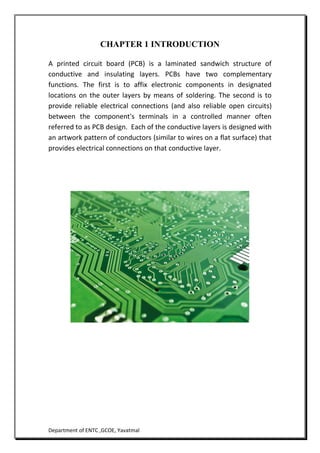
A printed circuit board (PCB) is a laminated sandwich structure of
conductive and insulating layers. PCBs have two complementary
functions. The first is to affix electronic components in designated
locations on the outer layers by means of soldering. The second is to
provide reliable electrical connections (and also reliable open circuits)
between the component's terminals in a controlled manner often
referred to as PCB design. Each of the conductive layers is designed with
an artwork pattern of conductors (similar to wires on a flat surface) that
provides electrical connections on that conductive layer.
Department of ENTC ,GCOE, Yavatmal
CHAPTER 2 TYPES AND IMPLEMENTATION
2.1 Why we need PCB ?
PCBs are inexpensive, and can be highly reliable. They require much
more layout effort and higher initial cost than either wire-wrapped or
point-to-point constructed circuits, but are much cheaper and faster for
high-volume production. Much of the electronics industry's PCB design,
assembly, and quality control needs are set by standards that are
published by the IPC organization.
Printed Circuit Boards are primarily an insulating material used as base,
into which conductive strips are printed. The base material is generally
fiberglass, and the conductive connections are e generally copper and
are made through an etching process.
In short PCB are more light in weight and small in size ,it saves wires .
PCB has very low cost to manufacturing as compare to wired board and
if in any case of any damage , it is very easy to check and replace the
particular component due to fix location of components and traces .
Department of ENTC ,GCOE, Yavatmal
2.2 History of PCB
1925: Charles Ducas, an American inventor, patents the first circuit board design when he
stencils conductive materials onto a flat wooden board.
1936: Paul Eisler develops the first printed circuit board for use in a radio set.
1943: Eisler patents a more advanced PCB design that involves etching the circuits onto
copper foil on glass-reinforced, non-conductive substrate.
1944: The United States and Britain work together to develop proximity fuses for use in
mines, bombs, and artillery shells during WWII.
1948: The United States Army releases PCB technology to the public, prompting widespread
development.
1950s: Transistors are introduced to the electronics market, reducing the overall size of
electronics, and making it easier to incorporate PCBs and dramatically improving electronics
reliability.
1950s-1960s: PCBs evolve into double-sided boards with electrical components on one side
and identification printing on the other. Zinc plates are incorporated into PCB designs and
corrosion-resistant materials and coatings are implemented to prevent degradation.
1960s: The integrated circuit – IC or silicon chip – is introduced into electronic designs,
putting thousands and even tens of thousands of components on a single chip – significantly
improving the power, speed, and reliability of electronics that incorporate these devices
1970s: Printed circuit boards are incorrectly associated with the environmentally harmful
chemical polychlorinated biphenyl, which was also abbreviated as PCB at the time. This
confusion results in public confusion and community health concerns. To reduce confusion,
printed circuit boards (PCBs) are renamed printed wiring boards (PWB) until chemical PCBs
are phased out in the 1990s.
1970s – 1980s: Soldermasks of thin polymer materials are developed to facilitate easier
solder application onto the copper circuits without bridging adjacent circuits, further
increasing circuit density. A photo imageable polymer coating is later developed that can be
applied directly to the circuits, dried, and modified by photo exposure afterward, further
improving circuit density. This becomes a standard manufacturing method for PCBs.
Department of ENTC ,GCOE, Yavatmal
2.3 Types of PCB Layers
PCBs can be single-sided (one copper layer), double-sided (two copper
layers on both sides of one substrate layer), or multi-layer (outer and
inner layers of copper, alternating with layers of substrate). Multi-layer
PCBs allow for much higher component density, because circuit traces
on the inner layers would otherwise take up surface space between
components. The rise in popularity of multilayer PCBs with more than
two, and especially with more than four, copper planes was concurrent
with the adoption of surface mount technology. However, multilayer
PCBs make repair, analysis, and field modification of circuits much more
difficult and usually impractical.
Types of layer
 Single side
 Double side
 Multilayer PCB
Department of ENTC ,GCOE, Yavatmal
2.4 Components Required For manufacturing PCB
 A Thin copper layer is applied on Fibber plate
 Laser Printer or drum Printer
 PCB layout From Easy EDA Software
 Heating Machine (IRON)
 Ferrous Chloride (FeCl2)
 Drill Machine
 Glass stirring Rod
 Glass Beaker
 Soldering Machine
 Flux And Soldering Metal
Department of ENTC ,GCOE, Yavatmal
2.5 PCB Types
In recent years, semiconductor packaging has evolved with an increased
demand for greater functionality, smaller size, and added utility. A
modern PCBA design has two main methods for mounting components
onto a PCB: Through-Hole Mounting and Surface Mounting.
There are mainly Two types
 Through hole Technology
 Surface mount Technology
Department of ENTC ,GCOE, Yavatmal
2.5.1 Through Hole Technology
Through-hole mounting is the process by which component leads are
placed into drilled holes on a bare PCB. The process was standard
practice until the rise of surface mount technology (SMT) in the 1980s,
at which time it was expected to completely phase out through-hole.
Yet, despite a severe drop in popularity over the years, through-hole
technology has proven resilient in the age of SMT, offering a number of
advantages and niche applications: namely, reliability.
Through-hole components are best used for high-reliability products
that require stronger connections between layers. Whereas SMT
components are secured only by solder on the surface of the board,
through-hole component leads run through the board, allowing the
components to withstand more environmental stress. This is why
through-hole technology is commonly used in military and aerospace
products that may experience extreme accelerations, collisions, or high
temperatures. Through-hole technology is also useful in test and
prototyping applications that sometimes require manual adjustments
and replacements.
Overall, through-hole’s complete disappearance from PCB assembly is a
wide misconception. Barring the above uses for through-hole
technology, one should always keep in mind the factors of availability
and cost. Not all components are available as SMD packages, and some
through-hole components are less expensive.
However, that doesn’t negate that fact that, in a modern assembly
facility, through-hole is considered a secondary operation.
Advantages: THM provides stronger mechanical bonds than SMT,
making through-hole ideal for components that might undergo
mechanical stress, such as connectors or transformers. Good for test and
prototyping.
Department of ENTC ,GCOE, Yavatmal
2.5.2 Surface Mount Technology (SMT):
SMT the process by which components are mounted directly onto the
surface of the PCB. Known originally as “planar mounting,” the method
was developed in the 1960s and has grown increasingly popular since
the 1980s. Nowadays, virtually all electronic hardware is manufactured
using SMT. It has become essential to PCB design and manufacturing,
having improved the quality and performance of PCBs overall, and has
reduced the costs of processing and handling greatly.
The key differences between SMT and through-hole mounting are (a)
SMT does not require holes to be drilled through a PCB, (b) SMT
components are much smaller, and (c) SMT components can be
mounted on both side of the board. The ability to fit a high number of
small components on a PCB has allowed for much denser, higher
performing, and smaller PCBs.
Through-hole component leads, which run through the board and
connect a board’s layers, have been replaced by "vias" -- small
components which allow a conductive connection between the different
layers of a PCB, and which essentially act as through-hole leads. Some
surface mount components like BGAs are higher performing
components with shorter leads and more interconnection pins that
allow for higher speeds.
Nomenclature
 There are perhaps too many terms that describe different aspects
of surface mount technology. Here’s what they mean:
 SMA (surface-mount assembly) – a build or module assembled
using SMT.
 SMC (surface-mount components) – components for SMT.
 SMD (surface-mount devices) – active, passive, and
electromechanical components.
 SME (surface-mount equipment) – machines used for SMT.
 SMP (surface mount packages) – SMD case forms.
Department of ENTC ,GCOE, Yavatmal
2.6 Steps for manufacturing PCB
 Print the design and Transfer the traces From prints to board
 Etching
 Drilling
 Assembly
 Soldering
Department of ENTC ,GCOE, Yavatmal
2.6.1 Print the traces and transfer the traces
Transfer of traces is one of the difficult process the steps are following
below :
• Clean the board and cut as per board parameter
• Put the paper and board in a such way that Printed traces at the
side of copper sheet
• Attach the board and paper using tape .
• At last, put heated iron on the paper for 15 minutes
• In the last remove paper slowly
Fig . printed Circuit fig . Attach paper and copper layer
Fig . Print after heating fig . Board after transfer of traces
Department of ENTC ,GCOE, Yavatmal
2.6.2 Etching
2.6.3
• Etching is the process that give us printed circuit board and
remove unwanted copper from copper sheet
1. Create the solution of ferrous chloride and water
2. Put the board in the solution for 30 min and change the position
of board continuously and keep observing is traces also not get
dissolve in it
3. The solution must be in glass or in plastic .
4. And final step is wash the circuit with soap and water
Fig . In the process of Etching
Fig . After The process of Etching
Department of ENTC ,GCOE, Yavatmal
2.6.4 Drilling
o In through hole PCB we have to make drill in our pcb .
o The standard drill size is 0.48 mm diameter
2.6.5 Assembly
o In this process we have assemble all leads of IC and components
that we are going to use ..
Fig . Assembly of Components
Department of ENTC ,GCOE, Yavatmal
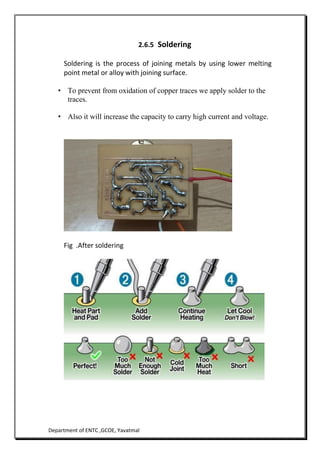
2.6.5 Soldering
Soldering is the process of joining metals by using lower melting
point metal or alloy with joining surface.
• To prevent from oxidation of copper traces we apply solder to the
traces.
• Also it will increase the capacity to carry high current and voltage.
Fig .After soldering
Department of ENTC ,GCOE, Yavatmal
Chapter 3. Result and Analysis
3.1 Applications
 Mobile , Laptop and Telecommunication Equipment
 Research and Development
t
 Medical Technology
 Military and Defence Technology
 Consumer Electronics
 Industrial Equipment
t
 Automotive Components
 Aerospace Components
 Safety and Security Equipment
Department of ENTC ,GCOE, Yavatmal
3.2. Advantage
 Compact size and saving of wire.
 There is no chance of loose connections or short circuit.
 The location of the electronic part is fixed and it is easy
 to simplify components identification and maintenance
of equipment .
 Time for connecting components is save .
 Widely available .
 This board give low electronic noise .
3.3 Disadvantages
 Not easy to repair once damaged
.
 It cannot be updated once get printed .
 The etching process generates chemical which is harmful
effect on the Environment
Department of ENTC ,GCOE, Yavatmal
Chapter 4. Conclusion and Future scope
4.1 Conclusions
PCB: A printed circuit board (PCB) mechanically supports and electrically
connects electronic components using conductive tracks, pads and other
features etched from copper sheets laminated onto a non-conductive
substrate.
4.2 Future Work
In the future PCB DESIGN IS enhanced and then it Is known as
Quantum Computer
Chapter 5. Reference
https://en.m.wikipedia.org/wiki/Printed_circuit_board
https://resources.pcb.cadence.com/blog/2020-an-introductory-multilayer-pcb-design-
tutorial
https://www.4pcb.com/blog/benefits-of-printed-circuit-boards/
https://www.printedcircuits.com/what-is-a-pcb/
https://www.eurocircuits.com/pcb-printed-circuit-board/

PCB desine final.pdf

  • 1.
    Department of ENTC,GCOE, Yavatmal GOVERNMENT COLLEGE OF ENGINEERING (Affiliated to DBATU, Lonere) Dhamangaon Road, Yavatmal - 445106 A SEMINOR REPORT ON “PCB Design” Submitted by SADGURU KISHOR LONARI Department of Electronics & Telecommunication Engineering Government College of Engineering, Yavatmal 2021-22
  • 2.
    Department of ENTC,GCOE, Yavatmal GOVERNMENT COLLEGE OF ENGINEERING DHAMANGAON ROAD, YAVATMAL – 445106 Department of Electronics & Telecommunication Engineering CERTIFICATE Certified that the seminar work entitled “PCB Design” is a bona fide work carried out by SADGURU KISHOR LONARI The report has been approved as it satisfies the academic requirements in respect of seminar work prescribed for the course. ........................... … ……………………… Prof. N.M Ingole Prof. P.H. Bhagat Guided by Head of the Department
  • 3.
    Department of ENTC,GCOE, Yavatmal ACKNOWLEDGEMENT It gives us immense pleasure on bringing out the seminar Project report entitled “PCB Design”. We express our sincere gratitude to Prof. N.M.Ingole , Head of Department and, to Prof. P. H. Bhagat Project Guide. We thank them for extending the necessary help, providing facilities and time to time guidance and motivation. Their suggestions always motivated us for putting the best efforts on our studies during the progress of the seminar project. We would like to specially thank entire staff members of Electronics and Telecommunication Department for providing us all the laboratory and library facilities during the project duration. We would also like to thank Dr.V.B.Waghamare Principal, Government College of Engineering, Yavatmal and the people who directly or indirectly helped us in completing this task successfully.
  • 4.
    Department of ENTC,GCOE, Yavatmal INDEX Certificates Acknowledgement Chapter 1. Introduction Chapter 2. Types and Implementation 2.1 Why we need PCB 2.2 History of PCB 2.3 Types of PCB Layers 2.4 Components Required For manufacturing PCB 2.5 PCB Types 2.6 Steps for Manufacture PCB Chapter 3. Result and Analysis 3.1 Applications 3.2. Advantage 3.3 Disadvantages Chapter 4. Conclusion and Future scope 4.1 Conclusions 4.2 Future Work Chapter 5. Reference
  • 5.
    Department of ENTC,GCOE, Yavatmal CHAPTER 1 INTRODUCTION A printed circuit board (PCB) is a laminated sandwich structure of conductive and insulating layers. PCBs have two complementary functions. The first is to affix electronic components in designated locations on the outer layers by means of soldering. The second is to provide reliable electrical connections (and also reliable open circuits) between the component's terminals in a controlled manner often referred to as PCB design. Each of the conductive layers is designed with an artwork pattern of conductors (similar to wires on a flat surface) that provides electrical connections on that conductive layer.
  • 6.
    Department of ENTC,GCOE, Yavatmal CHAPTER 2 TYPES AND IMPLEMENTATION 2.1 Why we need PCB ? PCBs are inexpensive, and can be highly reliable. They require much more layout effort and higher initial cost than either wire-wrapped or point-to-point constructed circuits, but are much cheaper and faster for high-volume production. Much of the electronics industry's PCB design, assembly, and quality control needs are set by standards that are published by the IPC organization. Printed Circuit Boards are primarily an insulating material used as base, into which conductive strips are printed. The base material is generally fiberglass, and the conductive connections are e generally copper and are made through an etching process. In short PCB are more light in weight and small in size ,it saves wires . PCB has very low cost to manufacturing as compare to wired board and if in any case of any damage , it is very easy to check and replace the particular component due to fix location of components and traces .
  • 7.
    Department of ENTC,GCOE, Yavatmal 2.2 History of PCB 1925: Charles Ducas, an American inventor, patents the first circuit board design when he stencils conductive materials onto a flat wooden board. 1936: Paul Eisler develops the first printed circuit board for use in a radio set. 1943: Eisler patents a more advanced PCB design that involves etching the circuits onto copper foil on glass-reinforced, non-conductive substrate. 1944: The United States and Britain work together to develop proximity fuses for use in mines, bombs, and artillery shells during WWII. 1948: The United States Army releases PCB technology to the public, prompting widespread development. 1950s: Transistors are introduced to the electronics market, reducing the overall size of electronics, and making it easier to incorporate PCBs and dramatically improving electronics reliability. 1950s-1960s: PCBs evolve into double-sided boards with electrical components on one side and identification printing on the other. Zinc plates are incorporated into PCB designs and corrosion-resistant materials and coatings are implemented to prevent degradation. 1960s: The integrated circuit – IC or silicon chip – is introduced into electronic designs, putting thousands and even tens of thousands of components on a single chip – significantly improving the power, speed, and reliability of electronics that incorporate these devices 1970s: Printed circuit boards are incorrectly associated with the environmentally harmful chemical polychlorinated biphenyl, which was also abbreviated as PCB at the time. This confusion results in public confusion and community health concerns. To reduce confusion, printed circuit boards (PCBs) are renamed printed wiring boards (PWB) until chemical PCBs are phased out in the 1990s. 1970s – 1980s: Soldermasks of thin polymer materials are developed to facilitate easier solder application onto the copper circuits without bridging adjacent circuits, further increasing circuit density. A photo imageable polymer coating is later developed that can be applied directly to the circuits, dried, and modified by photo exposure afterward, further improving circuit density. This becomes a standard manufacturing method for PCBs.
  • 8.
    Department of ENTC,GCOE, Yavatmal 2.3 Types of PCB Layers PCBs can be single-sided (one copper layer), double-sided (two copper layers on both sides of one substrate layer), or multi-layer (outer and inner layers of copper, alternating with layers of substrate). Multi-layer PCBs allow for much higher component density, because circuit traces on the inner layers would otherwise take up surface space between components. The rise in popularity of multilayer PCBs with more than two, and especially with more than four, copper planes was concurrent with the adoption of surface mount technology. However, multilayer PCBs make repair, analysis, and field modification of circuits much more difficult and usually impractical. Types of layer  Single side  Double side  Multilayer PCB
  • 9.
    Department of ENTC,GCOE, Yavatmal 2.4 Components Required For manufacturing PCB  A Thin copper layer is applied on Fibber plate  Laser Printer or drum Printer  PCB layout From Easy EDA Software  Heating Machine (IRON)  Ferrous Chloride (FeCl2)  Drill Machine  Glass stirring Rod  Glass Beaker  Soldering Machine  Flux And Soldering Metal
  • 10.
    Department of ENTC,GCOE, Yavatmal 2.5 PCB Types In recent years, semiconductor packaging has evolved with an increased demand for greater functionality, smaller size, and added utility. A modern PCBA design has two main methods for mounting components onto a PCB: Through-Hole Mounting and Surface Mounting. There are mainly Two types  Through hole Technology  Surface mount Technology
  • 11.
    Department of ENTC,GCOE, Yavatmal 2.5.1 Through Hole Technology Through-hole mounting is the process by which component leads are placed into drilled holes on a bare PCB. The process was standard practice until the rise of surface mount technology (SMT) in the 1980s, at which time it was expected to completely phase out through-hole. Yet, despite a severe drop in popularity over the years, through-hole technology has proven resilient in the age of SMT, offering a number of advantages and niche applications: namely, reliability. Through-hole components are best used for high-reliability products that require stronger connections between layers. Whereas SMT components are secured only by solder on the surface of the board, through-hole component leads run through the board, allowing the components to withstand more environmental stress. This is why through-hole technology is commonly used in military and aerospace products that may experience extreme accelerations, collisions, or high temperatures. Through-hole technology is also useful in test and prototyping applications that sometimes require manual adjustments and replacements. Overall, through-hole’s complete disappearance from PCB assembly is a wide misconception. Barring the above uses for through-hole technology, one should always keep in mind the factors of availability and cost. Not all components are available as SMD packages, and some through-hole components are less expensive. However, that doesn’t negate that fact that, in a modern assembly facility, through-hole is considered a secondary operation. Advantages: THM provides stronger mechanical bonds than SMT, making through-hole ideal for components that might undergo mechanical stress, such as connectors or transformers. Good for test and prototyping.
  • 12.
    Department of ENTC,GCOE, Yavatmal 2.5.2 Surface Mount Technology (SMT): SMT the process by which components are mounted directly onto the surface of the PCB. Known originally as “planar mounting,” the method was developed in the 1960s and has grown increasingly popular since the 1980s. Nowadays, virtually all electronic hardware is manufactured using SMT. It has become essential to PCB design and manufacturing, having improved the quality and performance of PCBs overall, and has reduced the costs of processing and handling greatly. The key differences between SMT and through-hole mounting are (a) SMT does not require holes to be drilled through a PCB, (b) SMT components are much smaller, and (c) SMT components can be mounted on both side of the board. The ability to fit a high number of small components on a PCB has allowed for much denser, higher performing, and smaller PCBs. Through-hole component leads, which run through the board and connect a board’s layers, have been replaced by "vias" -- small components which allow a conductive connection between the different layers of a PCB, and which essentially act as through-hole leads. Some surface mount components like BGAs are higher performing components with shorter leads and more interconnection pins that allow for higher speeds. Nomenclature  There are perhaps too many terms that describe different aspects of surface mount technology. Here’s what they mean:  SMA (surface-mount assembly) – a build or module assembled using SMT.  SMC (surface-mount components) – components for SMT.  SMD (surface-mount devices) – active, passive, and electromechanical components.  SME (surface-mount equipment) – machines used for SMT.  SMP (surface mount packages) – SMD case forms.
  • 13.
    Department of ENTC,GCOE, Yavatmal 2.6 Steps for manufacturing PCB  Print the design and Transfer the traces From prints to board  Etching  Drilling  Assembly  Soldering
  • 14.
    Department of ENTC,GCOE, Yavatmal 2.6.1 Print the traces and transfer the traces Transfer of traces is one of the difficult process the steps are following below : • Clean the board and cut as per board parameter • Put the paper and board in a such way that Printed traces at the side of copper sheet • Attach the board and paper using tape . • At last, put heated iron on the paper for 15 minutes • In the last remove paper slowly Fig . printed Circuit fig . Attach paper and copper layer Fig . Print after heating fig . Board after transfer of traces
  • 15.
    Department of ENTC,GCOE, Yavatmal 2.6.2 Etching 2.6.3 • Etching is the process that give us printed circuit board and remove unwanted copper from copper sheet 1. Create the solution of ferrous chloride and water 2. Put the board in the solution for 30 min and change the position of board continuously and keep observing is traces also not get dissolve in it 3. The solution must be in glass or in plastic . 4. And final step is wash the circuit with soap and water Fig . In the process of Etching Fig . After The process of Etching
  • 16.
    Department of ENTC,GCOE, Yavatmal 2.6.4 Drilling o In through hole PCB we have to make drill in our pcb . o The standard drill size is 0.48 mm diameter 2.6.5 Assembly o In this process we have assemble all leads of IC and components that we are going to use .. Fig . Assembly of Components
  • 17.
    Department of ENTC,GCOE, Yavatmal 2.6.5 Soldering Soldering is the process of joining metals by using lower melting point metal or alloy with joining surface. • To prevent from oxidation of copper traces we apply solder to the traces. • Also it will increase the capacity to carry high current and voltage. Fig .After soldering
  • 18.
    Department of ENTC,GCOE, Yavatmal Chapter 3. Result and Analysis 3.1 Applications  Mobile , Laptop and Telecommunication Equipment  Research and Development t  Medical Technology  Military and Defence Technology  Consumer Electronics  Industrial Equipment t  Automotive Components  Aerospace Components  Safety and Security Equipment
  • 19.
    Department of ENTC,GCOE, Yavatmal 3.2. Advantage  Compact size and saving of wire.  There is no chance of loose connections or short circuit.  The location of the electronic part is fixed and it is easy  to simplify components identification and maintenance of equipment .  Time for connecting components is save .  Widely available .  This board give low electronic noise . 3.3 Disadvantages  Not easy to repair once damaged .  It cannot be updated once get printed .  The etching process generates chemical which is harmful effect on the Environment
  • 20.
    Department of ENTC,GCOE, Yavatmal Chapter 4. Conclusion and Future scope 4.1 Conclusions PCB: A printed circuit board (PCB) mechanically supports and electrically connects electronic components using conductive tracks, pads and other features etched from copper sheets laminated onto a non-conductive substrate. 4.2 Future Work In the future PCB DESIGN IS enhanced and then it Is known as Quantum Computer Chapter 5. Reference https://en.m.wikipedia.org/wiki/Printed_circuit_board https://resources.pcb.cadence.com/blog/2020-an-introductory-multilayer-pcb-design- tutorial https://www.4pcb.com/blog/benefits-of-printed-circuit-boards/ https://www.printedcircuits.com/what-is-a-pcb/ https://www.eurocircuits.com/pcb-printed-circuit-board/