Page | 1
ORGANISATION PROFILE
Instrumentation Limited (better known as IL) is a Government of India Enterprise set up in
1964 with the prime objective of attaining self reliance in the field of Control and Automation
for process industry. Today IL is manufacturing and supplying state of the art control equipment
on turnkey basis to various sector of Industry viz. Power, Steel, Fertilizer, Chemical,
Petrochemical, Refineries, Pharmaceutical, Cement, Paper, Textile, Space, and Oil & Gas.
IL has its registered and corporate office at Kota in state of Rajasthan. Manufacturing facilities
are based at Kota and Palakkad in Kerala State. Flow elements, control valve and actuators are
manufactured at Palakkad plant and other items are manufactured at Kota plant. IL’s
manufacturing facilities are accredited with ISO 9001:2008 certification. The marketing network
is widely spread all over India having Branch offices in major cities of Delhi, Kolkata, Chennai,
Mumbai, Jaipur and Secunderabad and Regional offices at Vadodara, Kolkata and Bhilai for
organizing installation and commissioning and related services. Site offices at many project sites
are functioning under these regional offices.
with over Forty five years of experience and a competent and dedicated workforce, IL has
mastered all complexities of control system requirement and can lead you through your project,
from system design, detailed engineering, manufacturing, testing, system integration,
installation, final commissioning to after sales service and customer training. IL has further
diversified in the fields of Power electronics; Telecommunications, Railway Signaling systems,
Defence electronics, IT enabled Products & services, Power Distribution and Transmission, Off-
shore Instrumentation, Security & Surveillance system to have comprehensive range of product
and services.
The present product handling of the company comprises of sophisticated Digital Distributed
Control systems, High Performance Smart Electronic Pressure and Temperature Transmitters,
desk/panel mounted controllers, indicators, recorders and other hardware, liquid and gas
analyzers, with sample handling and conditioning system, annunciation system, panels,
instrument cabinet and racks, Flow elements, Control valves, actuators, power cylinders in
addition to Telecommunication systems, IT based applications, Defence electronics, Railway
signaling systems, Uninterrupted Power Supply Systems(UPS), Solar Dusk Dawn
System(SDDS) etc.
Page | 2
Week 1
1. PRINTED CIRCUIT BOARD
1.1 INTRODUCTION
A printed circuit board, or PCB, is used to mechanically support and electrically connect
electronic components using conductive pathways, tracks or signal traces etched from copper
sheets laminated onto a non-conductive substrate. PCBs can be (one copper layer), double sided
(two copper layers) or multi-layer (outer and inner layers). Multi-layer PCBs allow for much
higher component density. Conductors on different layers are connected with plated-through
holes called vias. Advanced PCBs may contain components - capacitors, resistors or active
devices - embedded in the substrate.
FR-4 glass epoxy is the primary insulating substrate upon which the vast majority of rigid PCBs
are produced. A thin layer of copper foil is laminated to one or both sides of an FR-4 panel.
Circuitry interconnections is etched into copper layers to produce printed circuit boards.
Complex circuits are produced in multiple layers.
Printed circuit boards are used in all but the simplest electronic products. Alternatives to PCBs
include wire wrap and point-to-point construction. PCBs require the additional design effort to
lay out the circuit, but manufacturing and assembly can be automated. Manufacturing circuits
with PCBs is cheaper and faster than with other wiring methods as components are mounted and
wired with one single part. Furthermore, operator wiring errors are eliminated.
When the board has only copper tracks and features, and no circuit elements such as capacitors,
resistors or active devices have been manufactured into the actual substrate of the board, it is
more correctly referred to as printed wiring board (PWB) or etched wiring board. Use of the term
PWB or printed wiring board although more accurate and distinct from what would be known as
a true printed circuit board, has generally fallen by the wayside for many people as the
distinction between circuit and wiring has become blurred. Today printed wiring (circuit) boards
are used in virtually all but the simplest commercially produced electronic devices, and allow
fully automated assembly processes that were not possible or practical in earlier era tag type
circuit assembly processes.
A PCB populated with electronic components is called a printed circuit assembly (PCA), printed
circuit board assembly or PCB Assembly (PCBA). In informal use the term "PCB" is used both
for bare and assembled boards, the context clarifying the meaning. The IPC preferred term for
populated boards is CCA, circuit card assembly. This does not apply to backplanes; assembled
backplanes are called backplane assemblies by the IPC.
Page | 3
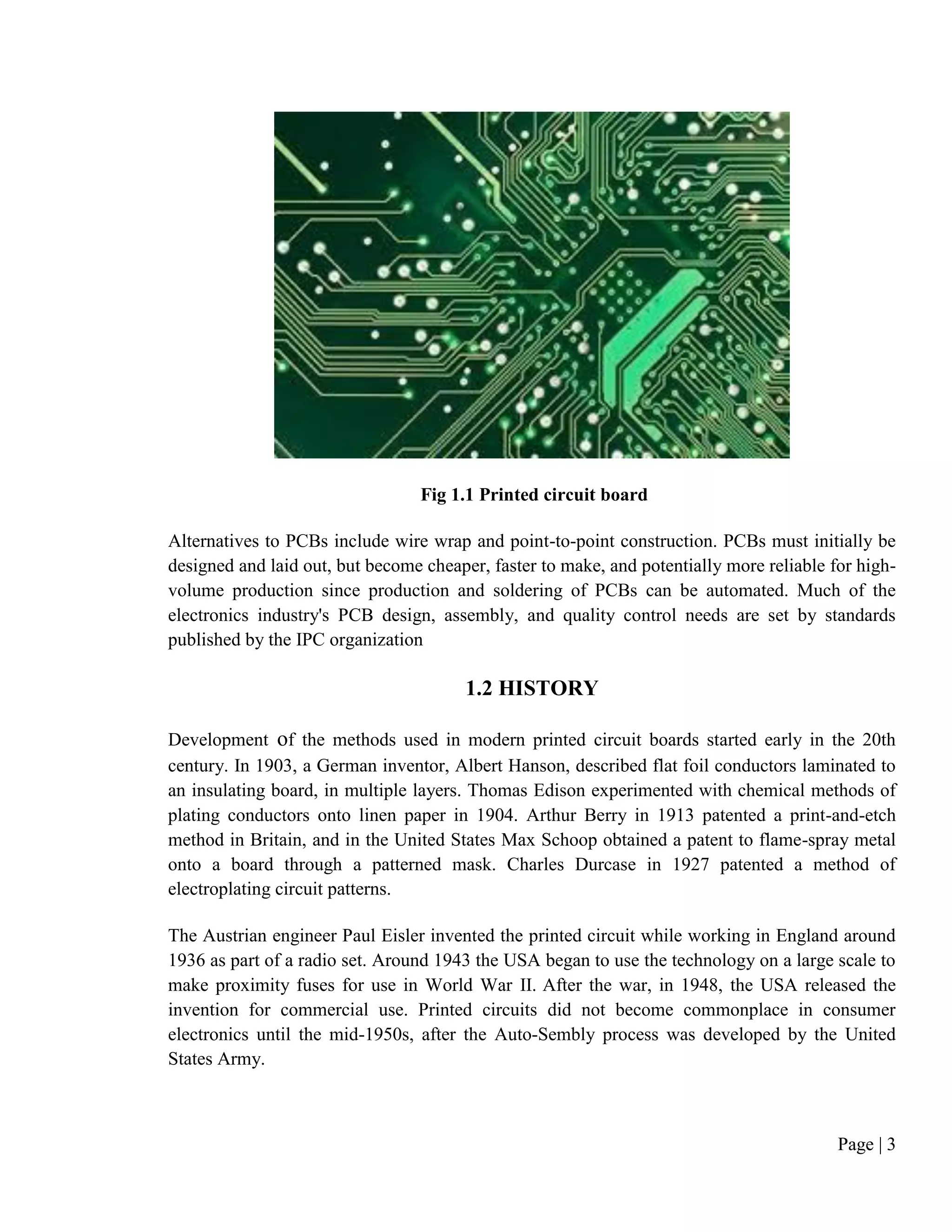
Fig 1.1 Printed circuit board
Alternatives to PCBs include wire wrap and point-to-point construction. PCBs must initially be
designed and laid out, but become cheaper, faster to make, and potentially more reliable for high-
volume production since production and soldering of PCBs can be automated. Much of the
electronics industry's PCB design, assembly, and quality control needs are set by standards
published by the IPC organization
1.2 HISTORY
Development of the methods used in modern printed circuit boards started early in the 20th
century. In 1903, a German inventor, Albert Hanson, described flat foil conductors laminated to
an insulating board, in multiple layers. Thomas Edison experimented with chemical methods of
plating conductors onto linen paper in 1904. Arthur Berry in 1913 patented a print-and-etch
method in Britain, and in the United States Max Schoop obtained a patent to flame-spray metal
onto a board through a patterned mask. Charles Durcase in 1927 patented a method of
electroplating circuit patterns.
The Austrian engineer Paul Eisler invented the printed circuit while working in England around
1936 as part of a radio set. Around 1943 the USA began to use the technology on a large scale to
make proximity fuses for use in World War II. After the war, in 1948, the USA released the
invention for commercial use. Printed circuits did not become commonplace in consumer
electronics until the mid-1950s, after the Auto-Sembly process was developed by the United
States Army.
Page | 4
Before printed circuits (and for a while after their invention), point-to-point construction was
used. For prototypes, or small production runs, wire wrap or turret board can be more efficient.
Predating the printed circuit invention, and similar in spirit, was John Sargrove's 1936–1947
Electronic Circuit Making Equipment (ECME) which sprayed metal onto a Bakelite plastic
board. The ECME could produce 3 radios per minute.
During World War II, the development of the anti-aircraft proximity fuse required an electronic
circuit that could withstand being fired from a gun, and could be produced in quantity. The
Central lab Division of Globe Union submitted a proposal which met the requirements: a ceramic
plate would be screen printed with metallic paint for conductors and carbon material for
resistors, with ceramic disc capacitors and subminiature vacuum tubes soldered in place. The
technique proved viable, and the resulting patent on the process, which was classified by the U.S.
Army, was assigned to Globe Union. It was not until 1984 that the Institute of Electrical and
Electronics Engineers (IEEE) awarded Mr. Harry W. Rubinstein, the former head of Globe
Union's Centralab Division, its coveted Cledo Brunetti Award for early key contributions to the
development of printed components and conductors on a common insulating substrate. As well,
Mr. Rubinstein was honored in 1984 by his alma mater, the University of Wisconsin-Madison,
for his innovations in the technology of printed electronic circuits and the fabrication of
capacitors.
Originally, every electronic component had wire leads, and the PCB had holes drilled for each
wire of each component. The components' leads were then passed through the holes and soldered
to the PCB trace. This method of assembly is called through-hole construction. In 1949, Moe
Abramson and Stanislaus F. Danko of the United States Army Signal Corps developed the Auto-
Sembly process in which component leads were inserted into a copper foil interconnection
pattern and dip soldered. The patent they obtained in 1956 was assigned to the U.S. Army. With
the development of board lamination and etching techniques, this concept evolved into the
standard printed circuit board fabrication process in use today. Soldering could be done
automatically by passing the board over a ripple, or wave, of molten solder in a wave-soldering
machine. However, the wires and holes are wasteful since drilling holes is expensive and the
protruding wires are merely cut off.
From the 1980s small surface mount parts have been used increasingly instead of through-hole
components; this has led to smaller boards for a given functionality and lower production costs,
but with some additional difficulty in servicing faulty boards.
Historically many measurements related to PCB design were specified in multiples of a
thousandth of an inch, often called "mils". For example, DIP and most other through-hole
components have pins located on a grid spacing of 100 thou, in order to be breadboard-friendly.
Surface-mount SOIC components have a pin pitch of 50 thou. SOP components have a pin pitch
Page | 5
of 25 thou. Level B technology recommends a minimum trace width of 8 mils, which allows
"double-track" -- 2 traces between DIP pins.
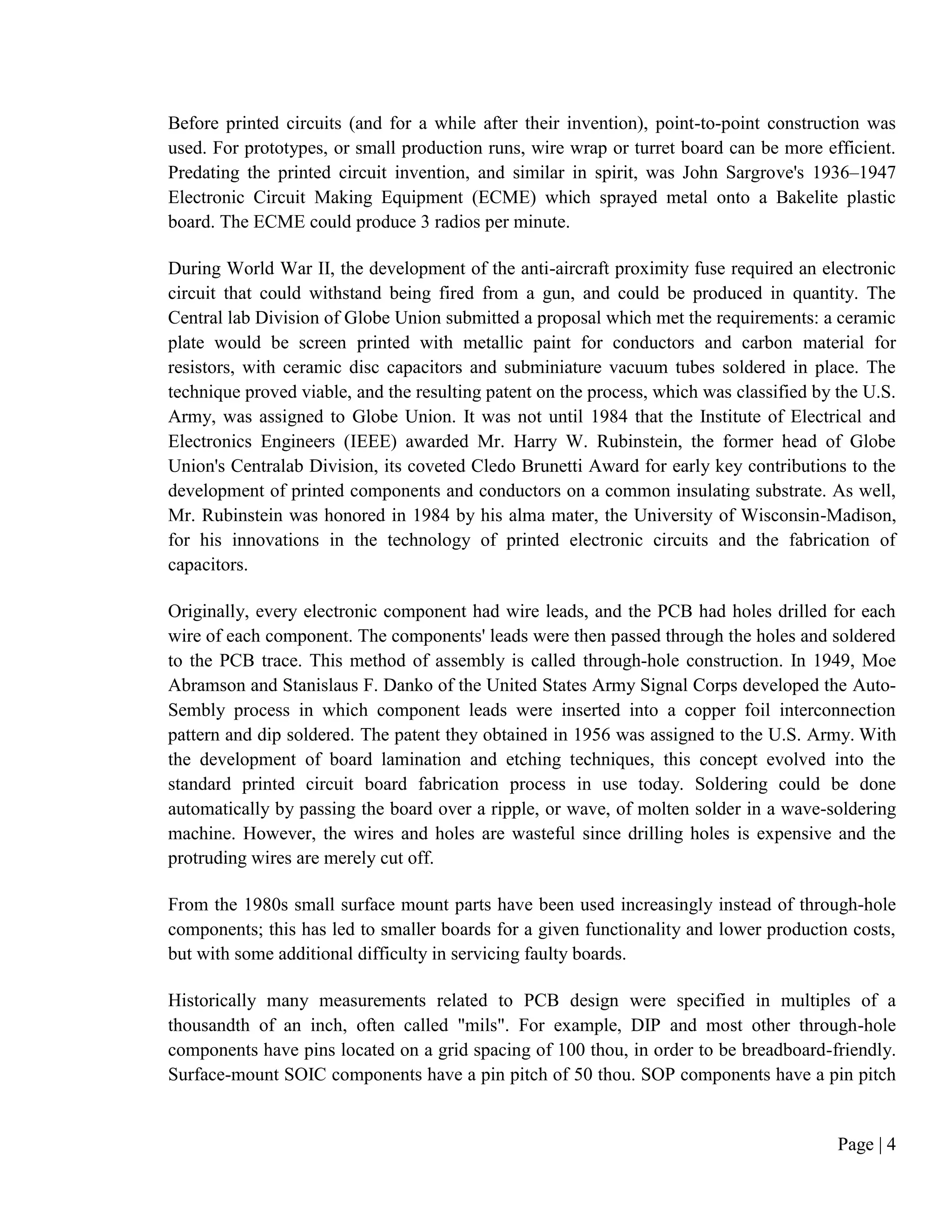
Fig 1.2 The component side of a PCB in a computer mouse;
Some examples for common components and their
reference designation in the legend.
Page | 6
Week 2
2. PCB MANUFACTURING
In manufacturing process, the manufacturing steps are different for different printed circuit board
.like single side, double side, multisided PCB but the most common manufacturing process is
given below.
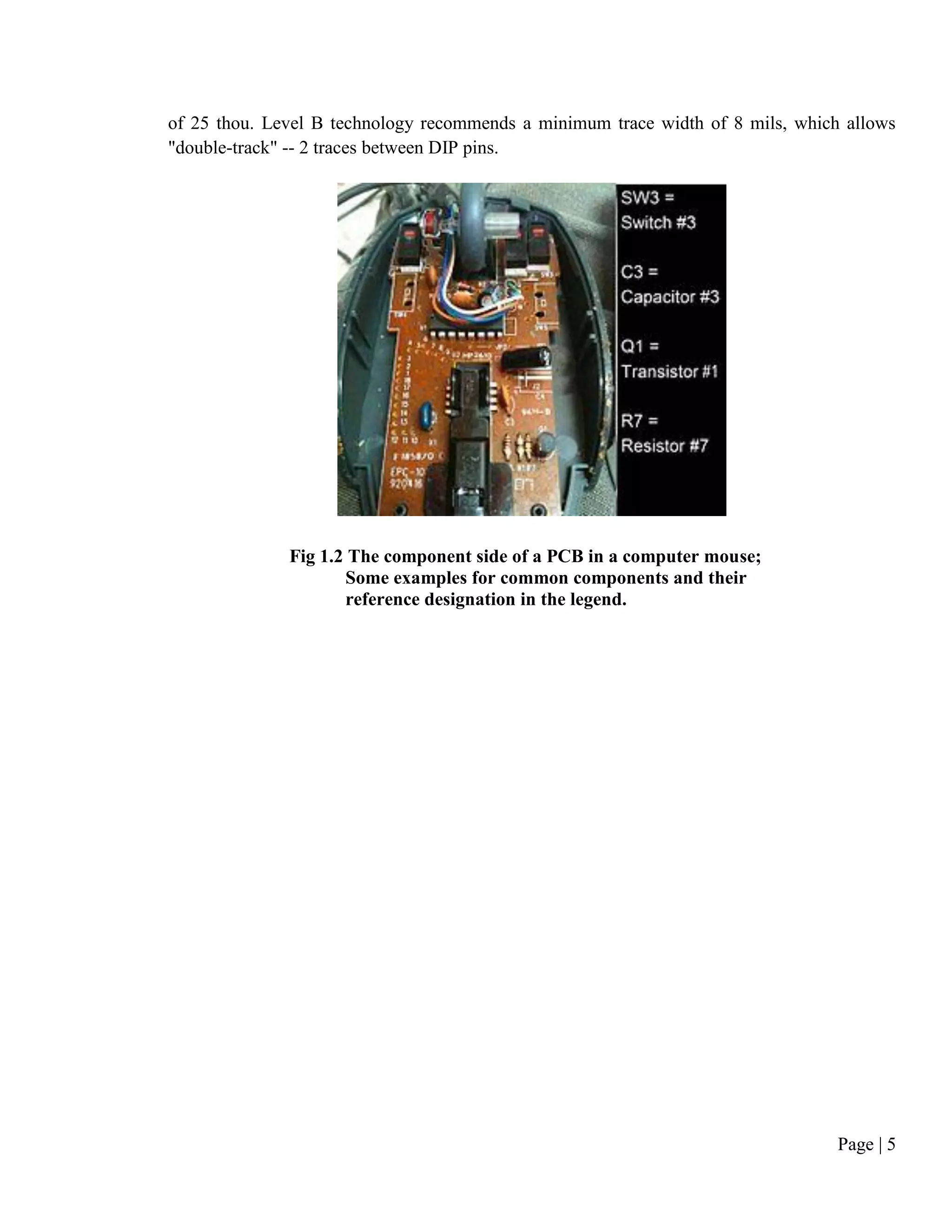
Tab. 2.1.1 PCB Manufacturing Process Steps
CNC CCL CUTTING,PINNING,
STACKING&DRILLING
WET PROCESSING DPS
PIT (D/F)
D/F LAMINATION
EXPOSE & DEVELOPING
WET PROCESSING
CU PLATING
RESIST STRIPPING
ELECTING & TIN STRIPPING
ETCHINGINSPECTION ETECHING INSPECTION
SCREAN PRINTING BRUSHING & S/M PRINTING
PIT(SM) EXPOSE (S/M), DEVELOPING
S M INSPECTION S/M INSPECTION
WET PROCESSING HAL
SCREEN PRINTING L P
CNC V-GROOVE & ROUTING
BBT FIXURE FABRICATION & TESTING
FINAL INSPECTION PCB INSPECTION
PPE PRE PRODUCTION ENGINNERING,(DATA,
FILMS,PANALISATION, CAM WORK )
STORES RAW MATERIALS &GENERAL STORE
ACTIVITIES
MANITENANCE PLANT MAINTENCE
Page | 7
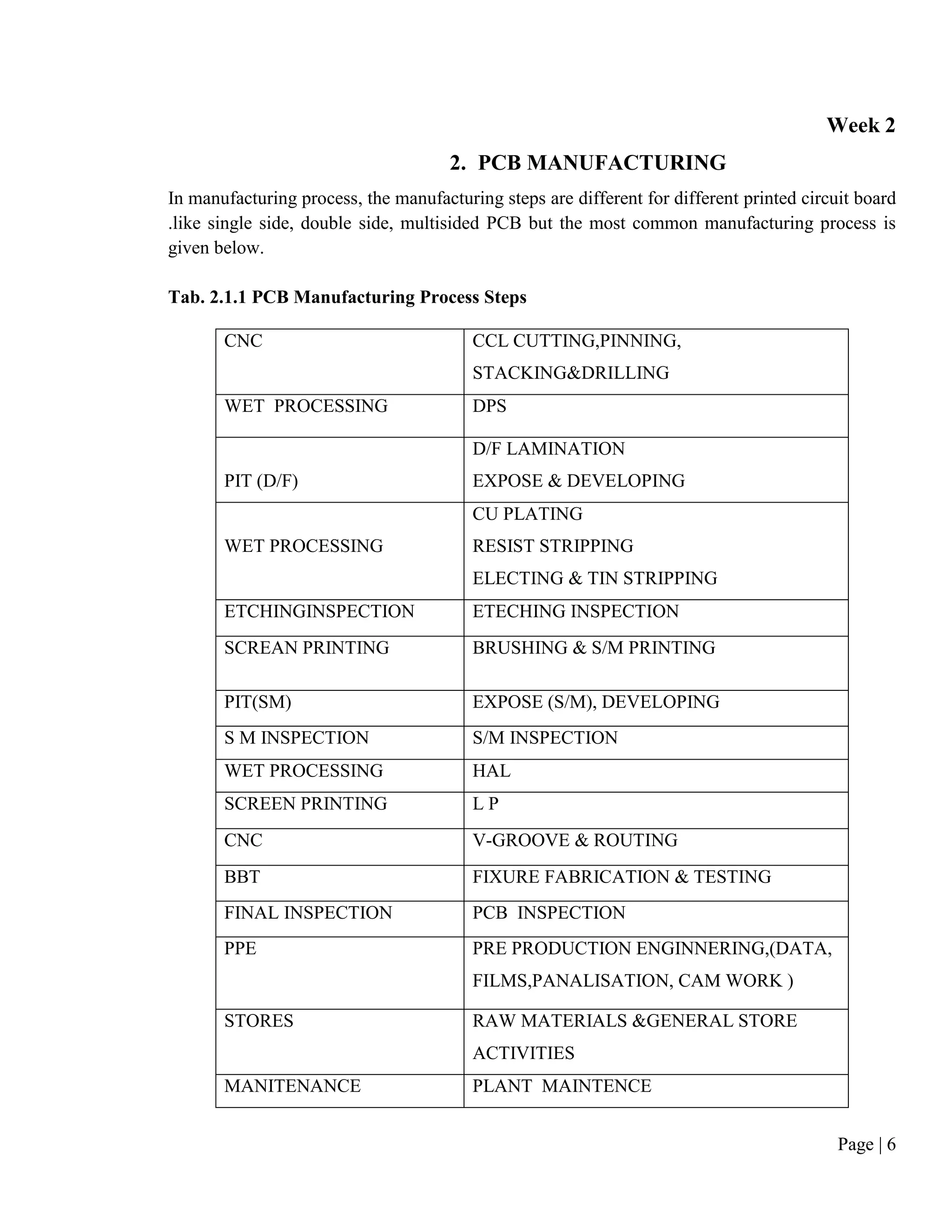
Tab. 2.1.2 Process Sequences for Single, Double and Multi-layer PCB
Single side PCB Double side PCB Multi-layer PCB
File inspection File inspection File inspection
Drill data generation Drill data generation Drill data generation
Cutting Cutting Cutting
Drilling Drilling I/L Tooling Holes
Photo imaging DPS I/L Photo image
Etching Photo imaging I/L Etching
Solder masking PTH Oxide Treatment
HASL Etching Pressing
Legend print Solder Masking Drilling
V-grooving / routing HASL De smear
BBT Legend print DPS
FQC V-grooving / routing Photo image
Stores BBT PTH
FQC Etching
Stores Solder masking
HASL
Legend Printing
V-grooving / routing
BBT
FQC
Stores
Page | 8
2.1 MATERIALS
Excluding exotic products using special materials or processes, all printed circuit boards
manufactured today can be built using the following four items which are usually purchased
from manufacturers:
1. Laminates
2. Copper-clad laminates
3. Resin impregnated B-stage cloth (Pre-preg)
4. Copper foil
2.2 LAMINATES
Laminates are manufactured by curing under pressure and temperature layers of cloth or paper
with thermoset resin to form an integral final piece of uniform thickness. The size can be up to 4
by 8 feet (1.2 by 2.4 m) in width and length. Varying cloth weaves (threads per inch or cm),
cloth thickness, and resin percentage are used to achieve the desired final thickness and dielectric
characteristics.
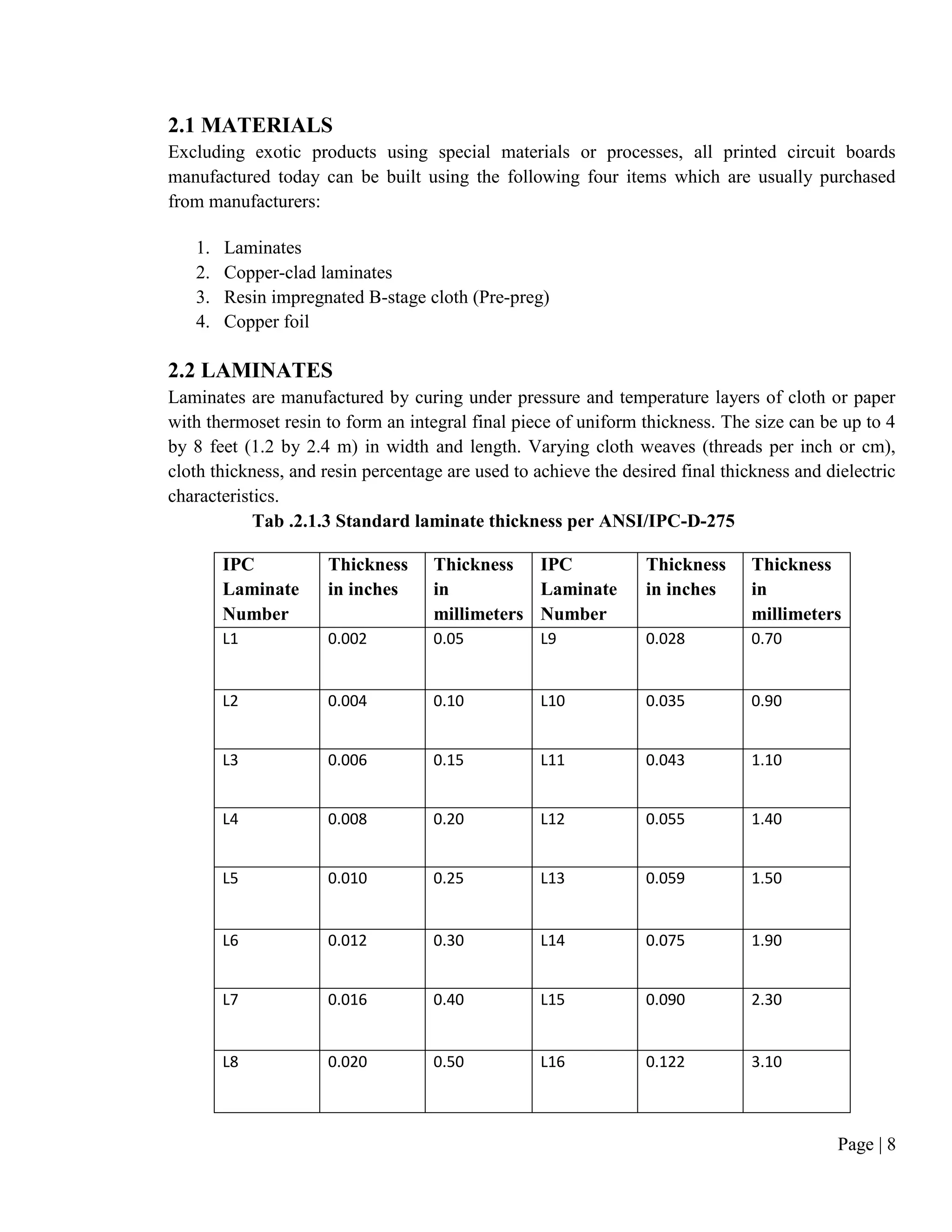
Tab .2.1.3 Standard laminate thickness per ANSI/IPC-D-275
IPC
Laminate
Number
Thickness
in inches
Thickness
in
millimeters
IPC
Laminate
Number
Thickness
in inches
Thickness
in
millimeters
L1 0.002 0.05 L9 0.028 0.70
L2 0.004 0.10 L10 0.035 0.90
L3 0.006 0.15 L11 0.043 1.10
L4 0.008 0.20 L12 0.055 1.40
L5 0.010 0.25 L13 0.059 1.50
L6 0.012 0.30 L14 0.075 1.90
L7 0.016 0.40 L15 0.090 2.30
L8 0.020 0.50 L16 0.122 3.10
Page | 9
2.3 PANELIZATION
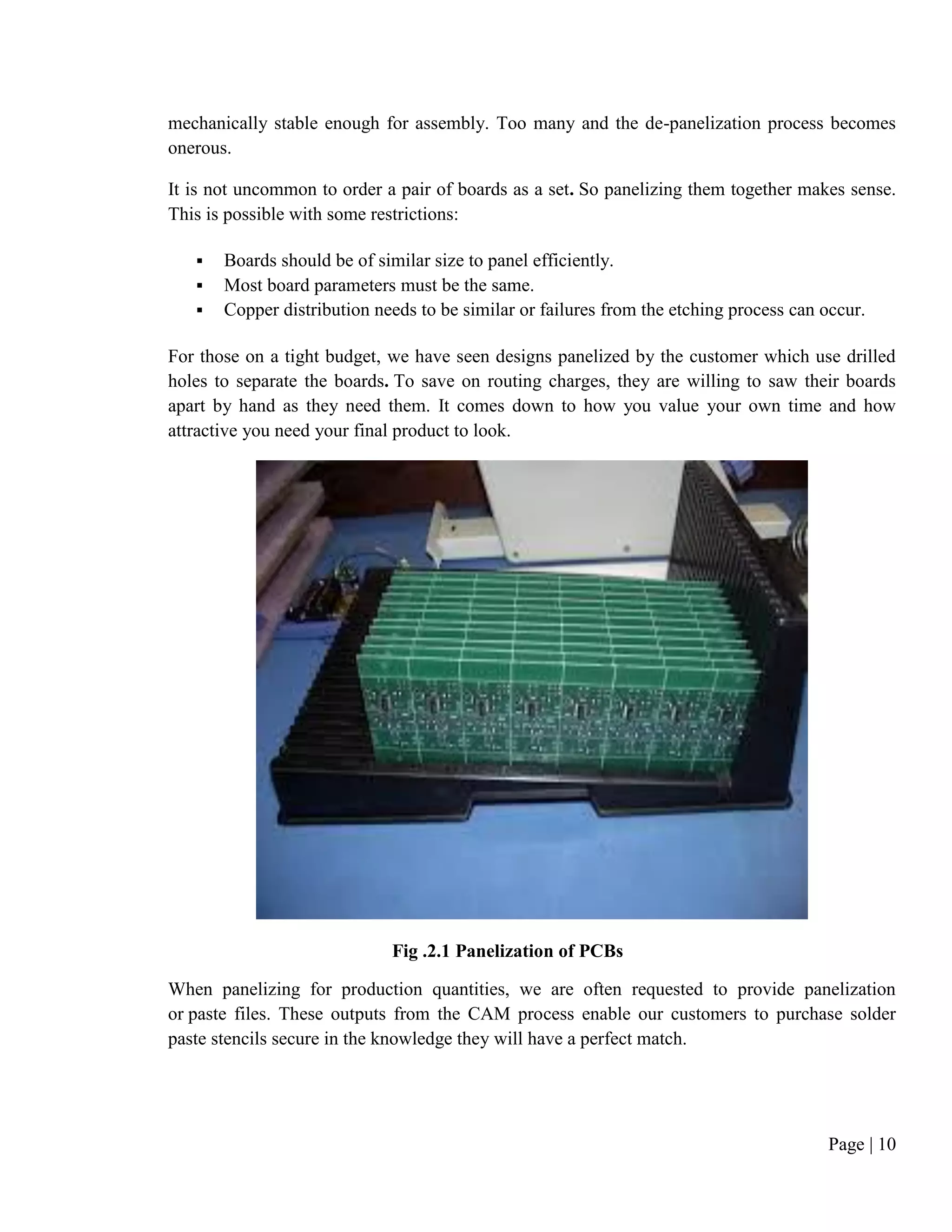
The purpose of Panelization is to secure PCB boards during manufacturing, shipping and
assembly processes while making their separation as painless as possible. A number of identical
circuits are printed on to a larger board (the panel) which can then be handled in the normal way.
The panel is broken apart into individual PCBs when all other processing is complete. Separating
the individual PCBs is frequently aided by drilling or routing perforations along the boundaries
of the individual circuits, much like a sheet of postage stamps. Another method, which takes less
space, is to cut V-shaped grooves across the full dimension of the panel. The individual PCBs
can then be broken apart along this line of weakness.
Panelization can be as simple as a rectangular board tab routed with a 100mil (0.100”) space
between PCB boards and a 500mil (0.50”) border on four edges. Or, it can be as complex as a
panel filled with combination jump v-score / routed rounded polygons.
Some guidelines for panelization are simple for example with routed panels:
 If the PCB is rectangular and all sides have a length greater than 1.00”, add 100 mil
between PCBs and a 400 mil border along the outside.
 If all sides do not have a length greater than 1.00”, add 300 mil between PCBs and a 400
mil border along the outside.
But:
 If the PCB is not rectangular provide a 300 mil space between PCBs
For V-Scoring, use a 20mil space between the PCB board edge and copper pads or traces.
Additionally, provide a 300 mil wide frame on at least two opposing sides.
As with all technical subjects, exceptions abound. For example:
 If a mounted component extends beyond the boundaries of the PCB board, the border
between PCBs needs to include the overhang distance. This ensures the component is not
damaged during de-panelization and doesn’t interfere with neighbouring components on
adjacent PCBs.
 If a particularly heavy component is to be installed, extra material will be required
between PCB boards to ensure the mechanical strength of the panel.
It’s important the clearance between any metal and the edge of the PCB board is a minimum of
5mil for routing and 20mil for v-scoring. Having the metal exposed during routing or v-scoring
could lead to shorts after assembly and the jagged edges are unattractive. The size and shape of
the board will determine how many breakout tabs to use. Too few and the PCB may not be
Page | 10
mechanically stable enough for assembly. Too many and the de-panelization process becomes
onerous.
It is not uncommon to order a pair of boards as a set. So panelizing them together makes sense.
This is possible with some restrictions:
 Boards should be of similar size to panel efficiently.
 Most board parameters must be the same.
 Copper distribution needs to be similar or failures from the etching process can occur.
For those on a tight budget, we have seen designs panelized by the customer which use drilled
holes to separate the boards. To save on routing charges, they are willing to saw their boards
apart by hand as they need them. It comes down to how you value your own time and how
attractive you need your final product to look.
Fig .2.1 Panelization of PCBs
When panelizing for production quantities, we are often requested to provide panelization
or paste files. These outputs from the CAM process enable our customers to purchase solder
paste stencils secure in the knowledge they will have a perfect match.
Page | 11
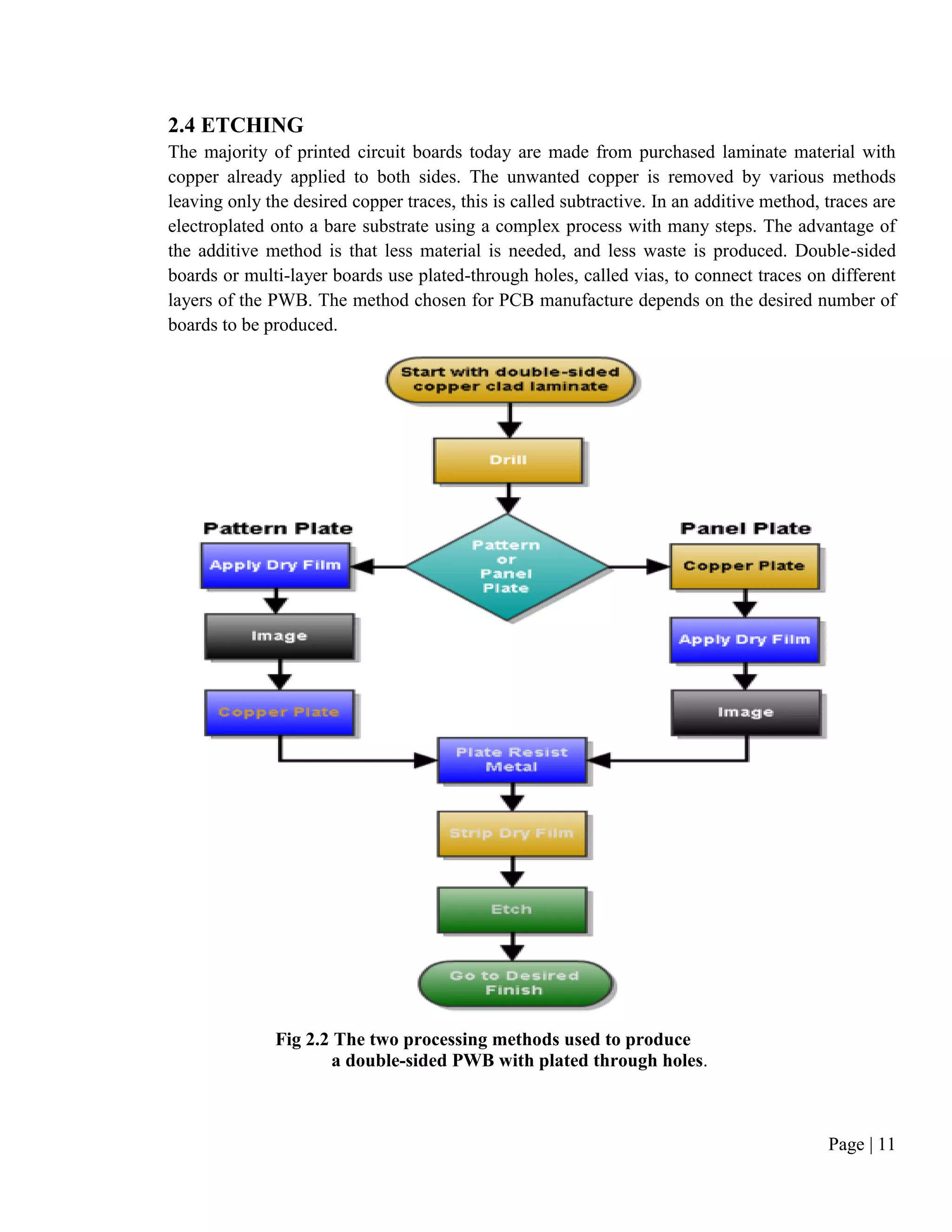
2.4 ETCHING
The majority of printed circuit boards today are made from purchased laminate material with
copper already applied to both sides. The unwanted copper is removed by various methods
leaving only the desired copper traces, this is called subtractive. In an additive method, traces are
electroplated onto a bare substrate using a complex process with many steps. The advantage of
the additive method is that less material is needed, and less waste is produced. Double-sided
boards or multi-layer boards use plated-through holes, called vias, to connect traces on different
layers of the PWB. The method chosen for PCB manufacture depends on the desired number of
boards to be produced.
Fig 2.2 The two processing methods used to produce
a double-sided PWB with plated through holes.
Page | 12
2.5 CHEMICAL ETCHING
Chemical etching is usually done with ammonium persulfate or ferric chloride. For PTH (plated-
through holes), additional steps of electroless deposition are done after the holes are drilled, then
copper is electroplated to build up the thickness, the boards are screened, and plated with
tin/lead. The tin/lead becomes the resist leaving the bare copper to be etched away.
The simplest method, used for small-scale production and often by hobbyists, is immersion
etching, in which the board is submerged in etching solution such as ferric chloride. Compared
with methods used for mass production, the etching time is long. Heat and agitation can be
applied to the bath to speed the etching rate. In bubble etching, air is passed through the etchant
bath to agitate the solution and speed up etching. Splash etching uses a motor-driven paddle to
splash boards with etchant; the process has become commercially obsolete since it is not as fast
as spray etching. In spray etching, the etchant solution is distributed over the boards by nozzles,
and recirculated by pumps. Adjustment of the nozzle pattern, flow rate, temperature, and etchant
composition gives predictable control of etching rates and high production rates.
As more copper is consumed from the boards, the etchant becomes saturated and less effective;
different etchants have different capacities for copper, with some as high as 150 grams of copper
per litre of solution. In commercial use, etchants can be regenerated to restore their activity, and
the dissolved copper recovered and sold. Small-scale etching requires attention to disposal of
used etchant, which is corrosive and toxic due to its metal content.
Fig 2.3 PCBs in process of having copper pattern plated,
notice the blue dry film resist.
The etchant removes copper on all surfaces exposed by the resist. "Undercut" occurs when
etchant attacks the thin edge of copper under the resist; this can reduce conductor widths and
cause open-circuits. Careful control of etch time is required to prevent undercut. Where metallic
plating is used as a resist, it can "overhang" which can cause short-circuits between adjacent
traces when closely spaced. Overhang can be removed by wire-brushing the board after etching.
Page | 13
2.6 LAMINATION
"Multi layer" printed circuit boards have trace layers inside the board. One way to make a 4-layer
PCB is to use a two-sided copper-clad laminate, etch the circuitry on both sides, then laminate to
the top and bottom pre preg and copper foil. Lamination is done by placing the stack of materials
in a press and applying pressure and heat for a period of time.
This results in an inseparable one piece product. It is then drilled, plated, and etched again to get
traces on top and bottom layers. Finally the PCB is covered with solder mask, marking legend,
and a surface finish may be applied. Multi-layer PCBs allow for much higher component density.
2.7 DRILLING
Holes through a PCB are typically drilled with small-diameter drill bits made of solid coated
tungsten carbide. Coated tungsten carbide is recommended since many board materials are very
abrasive and drilling must be high RPM and high feed to be cost effective. Drill bits must also
remain sharp so as not to mar or tear the traces. Drilling with high-speed-steel is simply not
copper. Feasible since the drill bits will dull quickly and thus tear the copper and ruin the boards.
The drilling is performed by automated drilling machines with placement controlled by a drill
tape or drill file. These computer-generated files are also called numerically controlled drill
(NCD) files or "Excellon files".
The drill file describes the location and size of each drilled hole. These holes are often filled
with annular rings (hollow rivets) to create vias. Vias allow the electrical and thermal connection
of conductors on opposite sides of the PCB.When very small vias are required, drilling with
mechanical bits is costly because of high rates of wear and breakage. In this case, the vias may
be evaporated by lasers. Laser-drilled vias typically have an inferior surface finish inside the
hole. These holes are called micro vias.
It is also possible with controlled-depth drilling, laser drilling, or by pre-drilling the individual
sheets of the PCB before lamination, to produce holes that connect only some of the copper
layers, rather than passing through the entire board. These holes are called blind vias when they
connect an internal copper layer to an outer layer, or buried vias when they connect two or more
internal copper layers and no outer layers.
The hole walls for boards with 2 or more layers can be made conductive and then electroplated
with copper to form plated-through holes. These holes electrically connect the conducting layers
of the PCB. For multilayer boards, those with 3 layers or more, drilling typically produces a
smear of the high temperature decomposition products of bonding agent in the laminate system.
Before the holes can be plated through, this smear must be removed by a chemical de-smear
process, or by plasma-etch. The de-smear process ensures that a good connection is made to the
copper layers when the hole is plated through. On high reliability boards a process called etch-
back is performed chemically with a potassium permanganate based etchant or plasma.
Page | 14
Week 3
3. EXPOSED CONDUCTOR PLATING & COATING
PCBs are plated with solder, tin, or gold over nickel as a resist for etching away the unneeded
underlying copper. After PCBs are etched and then rinsed with water, the soldermask is applied,
and then any exposed copper is coated with solder, nickel/gold, or some other anti-corrosion
coating.
Matte solder is usually fused to provide a better bonding surface or stripped to bare copper.
Treatments, such as benzimidazolethiol, prevent surface oxidation of bare copper. The places to
which components will be mounted are typically plated, because untreated bare copper oxidizes
quickly, and therefore is not readily solderable. Traditionally, any exposed copper was coated
with solder by hot air solder levelling (HASL). The HASL finish prevents oxidation from the
underlying copper, thereby guaranteeing a solderable surface. This solder was a tin-lead alloy,
however new solder compounds are now used to achieve compliance with the RoHS directive in
the EU and US, which restricts the use of lead. One of these lead-free compounds is SN100CL,
made up of 99.3% tin, 0.7% copper, 0.05% nickel, and a nominal of 60ppm germanium.
It is important to use solder compatible with both the PCB and the parts used. An example is Ball
Grid Array (BGA) using tin-lead solder balls for connections losing their balls on bare copper
traces or using lead-free solder paste.
Other platings used are OSP (organic surface protectant), immersion silver (IAg), immersion tin,
electro less nickel with immersion gold coating (ENIG), and direct gold plating (over nickel).
Edge connectors, placed along one edge of some boards, are often nickel plated then gold plated.
Another coating consideration is rapid diffusion of coating metal into Tin solder. Tin forms
intermetallics such as Cu5Sn6 and Ag3Cu that dissolve into the Tin liquidus or solidus (@50C),
stripping surface coating or leaving voids.
Electrochemical migration (ECM) is the growth of conductive metal filaments on or in a printed
circuit board (PCB) under the influence of a DC voltage bias. Silver, zinc, and aluminum are
known to grow whiskers under the influence of an electric field. Silver also grows conducting
surface paths in the presence of halide and other ions, making it a poor choice for electronics use.
Tin will grow "whiskers" due to tension in the plated surface. Tin-Lead or Solder plating also
grows whiskers, only reduced by the percentage Tin replaced. Reflow to melt solder or tin plate
to relieve surface stress lowers whisker incidence. Another coating issue is tin pest, the
transformation of tin to a powdery allotrope at low temperature.
3.1 SOLDER RESIST
Areas that should not be soldered may be covered with "solder resist" (solder mask). One of the
Page | 15
most common solder resists used today is called LPI (liquid photoimageable). A photo sensitive
coating is applied to the surface of the PWB, then exposed to light through the solder mask
image film, and finally developed where the unexposed areas are washed away. Dry film solder
mask is similar to the dry film used to image the PWB for plating or etching. After being
laminated to the PWB surface it is imaged and develops as LPI. Once common but no longer
commonly used because of its low accuracy and resolution is to screen print epoxy ink. Solder
resist also provides protection from the environment.
3.2 SILK SCREEN
Line art and text may be printed onto the outer surfaces of a PCB usually by screen printing
epoxy ink in a contrasting color, but can also be done with LPI or dry film like the solder resist.
When space permits, the legend can indicate component designators, switch setting
requirements, test points, and other features helpful in assembling, testing, and servicing the
circuit board. Some digital printing solutions are used instead of screen printing. This technology
allows printing variable data onto the PCB, including individual serial numbers as text and bar
code.
3.3 PRINTED CIRCUIT ASSEMBLY
After the printed circuit board (PCB) is completed, electronic components must be attached to
form a functional printed circuit assembly or PCA (sometimes called a "printed circuit board
assembly" PCBA).
In through hole construction, component leads are inserted in holes. In surface mount
construction, the components are placed on pads or lands on the outer surfaces of the PCB. In
both kinds of construction, component leads are electrically and mechanically fixed to the board
with a molten metal solder.
There are a variety of soldering techniques used to attach components to a PCB. High volume
production is usually done with SMT placement and bulk wave soldering or reflow ovens, but
skilled technicians are able to solder very tiny parts (for instance 0201 packages which are 0.02
in. by 0.01 in. by hand under a microscope, using tweezers and a fine tip soldering iron for small
volume prototypes. Some parts may be extremely difficult to solder by hand, such as BGA
packages.
Often, through-hole and surface-mount construction must be combined in a single assembly
because some required components are available only in surface-mount packages, while others
are available only in through-hole packages.
Another reason to use both methods is that through-hole mounting can provide needed strength
for components likely to endure physical stress, while components that are expected to go
untouched will take up less space using surface-mount techniques.
Page | 16
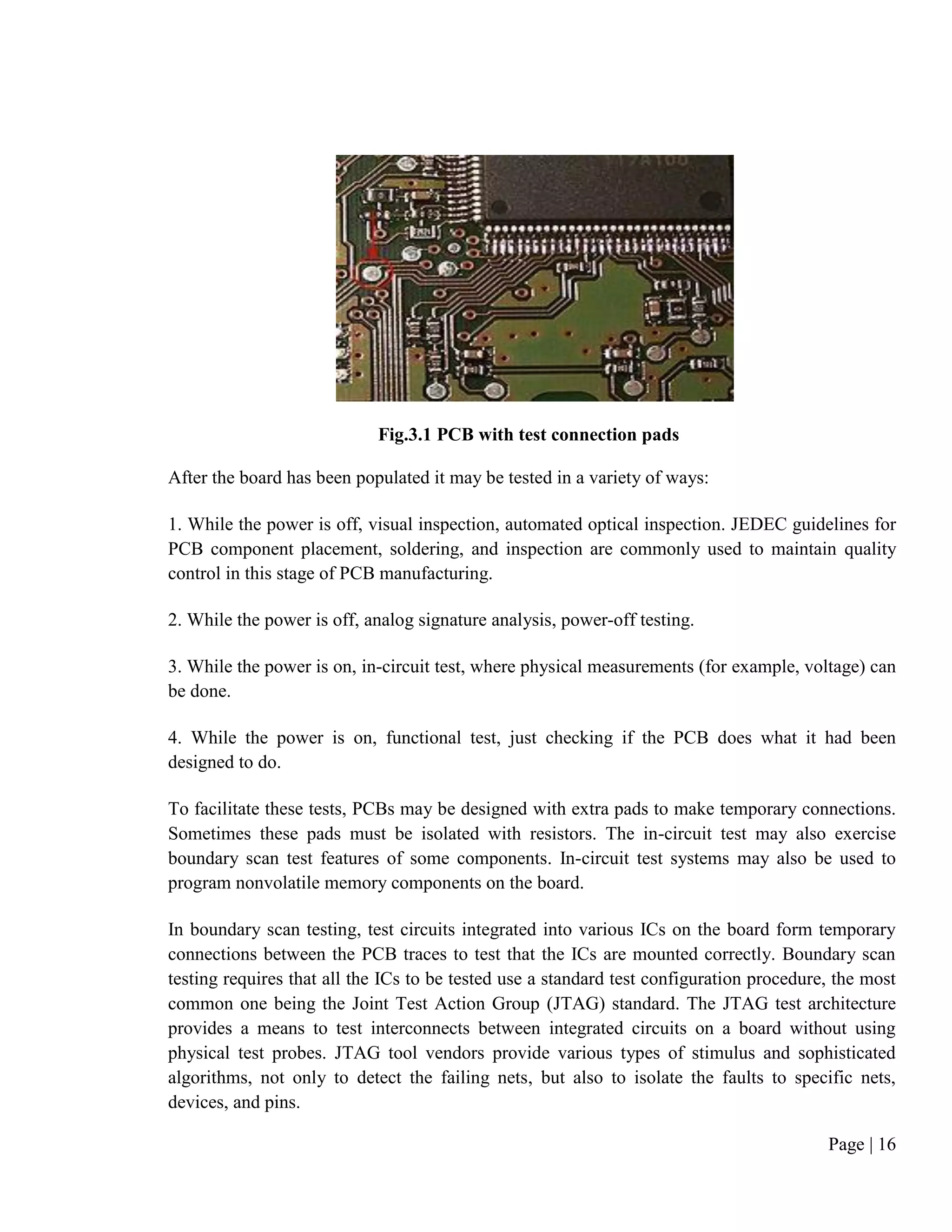
Fig.3.1 PCB with test connection pads
After the board has been populated it may be tested in a variety of ways:
1. While the power is off, visual inspection, automated optical inspection. JEDEC guidelines for
PCB component placement, soldering, and inspection are commonly used to maintain quality
control in this stage of PCB manufacturing.
2. While the power is off, analog signature analysis, power-off testing.
3. While the power is on, in-circuit test, where physical measurements (for example, voltage) can
be done.
4. While the power is on, functional test, just checking if the PCB does what it had been
designed to do.
To facilitate these tests, PCBs may be designed with extra pads to make temporary connections.
Sometimes these pads must be isolated with resistors. The in-circuit test may also exercise
boundary scan test features of some components. In-circuit test systems may also be used to
program nonvolatile memory components on the board.
In boundary scan testing, test circuits integrated into various ICs on the board form temporary
connections between the PCB traces to test that the ICs are mounted correctly. Boundary scan
testing requires that all the ICs to be tested use a standard test configuration procedure, the most
common one being the Joint Test Action Group (JTAG) standard. The JTAG test architecture
provides a means to test interconnects between integrated circuits on a board without using
physical test probes. JTAG tool vendors provide various types of stimulus and sophisticated
algorithms, not only to detect the failing nets, but also to isolate the faults to specific nets,
devices, and pins.
Page | 17
3.4 PROTECTION & PACKAGING
PCBs intended for extreme environments often have a conformal coating, which is applied by
dipping or spraying after the components have been soldered. The coat prevents corrosion and
leakage currents or shorting due to condensation. The earliest conformal coats were wax; modern
conformal coats are usually dips of dilute solutions of silicone rubber, polyurethane, acrylic, or
epoxy. Another technique for applying a conformal coating is for plastic to be sputtered onto the
PCB in a vacuum chamber. The chief disadvantage of conformal coatings is that servicing of the
board is rendered extremely difficult.
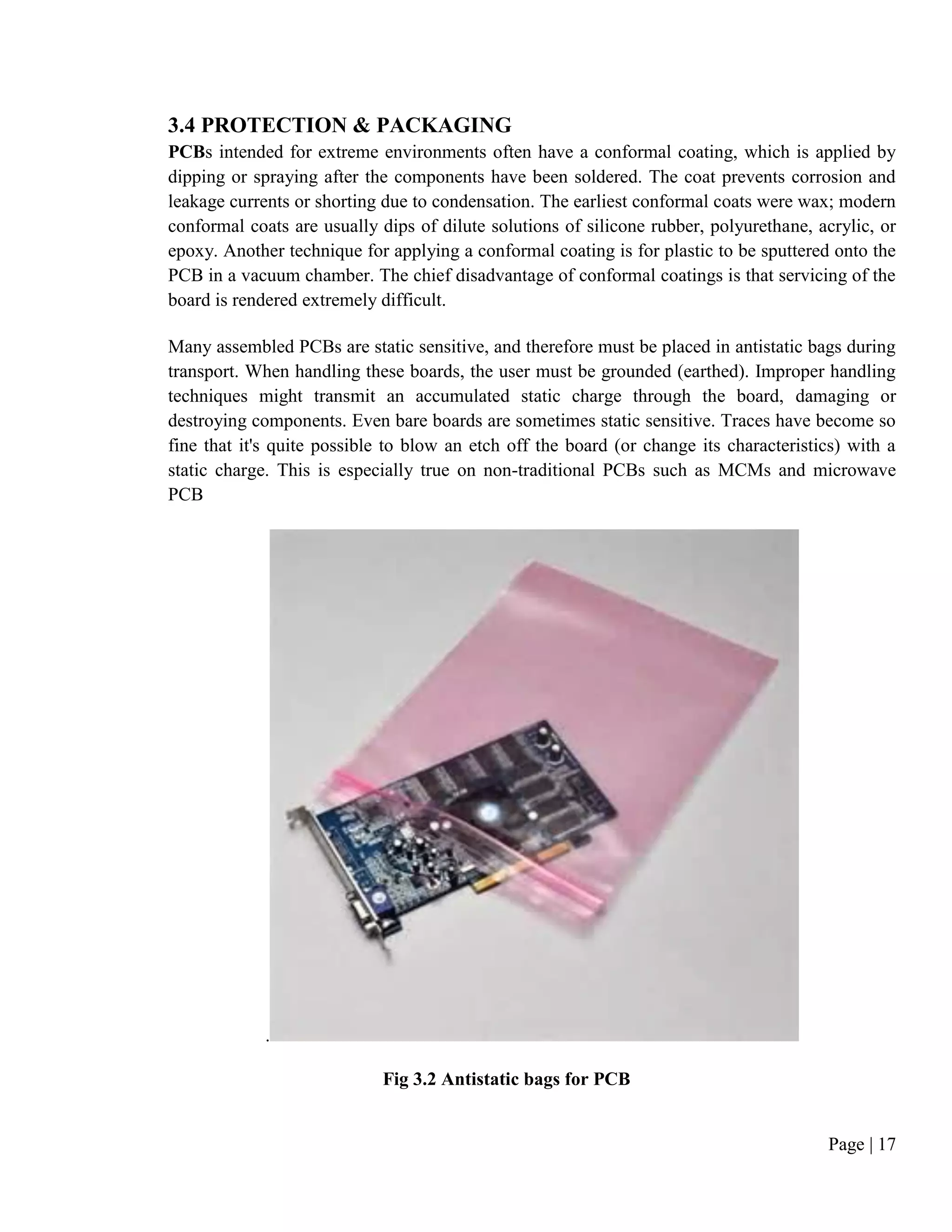
Many assembled PCBs are static sensitive, and therefore must be placed in antistatic bags during
transport. When handling these boards, the user must be grounded (earthed). Improper handling
techniques might transmit an accumulated static charge through the board, damaging or
destroying components. Even bare boards are sometimes static sensitive. Traces have become so
fine that it's quite possible to blow an etch off the board (or change its characteristics) with a
static charge. This is especially true on non-traditional PCBs such as MCMs and microwave
PCB
.
Fig 3.2 Antistatic bags for PCB
Page | 18
Week 4
4. DESIGN
Printed circuit board artwork generation was initially a fully manual process done on clear mylar
sheets at a scale of usually 2 or 4 times the desired size. The schematic diagram was first
converted into a layout of components pin pads, then traces were routed to provide the required
interconnections. Pre-printed non-reproducing mylar grids assisted in layout, and rub-on dry
transfers of common arrangements of circuit elements (pads, contact fingers, integrated circuit
profiles, and so on) helped standardize the layout. Traces between devices were made with self-
adhesive tape. The finished layout "artwork" was then photographically reproduced on the resist
layers of the blank coated copper-clad boards.
Fig 4.1 A board designed in 1967; the sweeping Curves in the traces
are evidence of freehand design using self-adhesive tape
Modern practice is less labor intensive since computers can automatically perform many of the
layout steps. The general progression for a commercial printed circuit board design would
include:-
Page | 19
1. Schematic capture through an Electronic design automation tool.
2. Card dimensions and template are decided based on required circuitry and case of the PCB.
Determine the fixed components and heat sinks if required.
3. Deciding stack layers of the PCB. 1 to 12 layers or more depending on design complexity.
Ground plane and power plane are decided. Signal planes where signals are routed are in top
layer as well as internal layers.[31]
4. Line impedance determination using dielectric layer thickness, routing copper thickness and
trace-width. Trace separation also taken into account in case of differential signals. Microstrip,
stripline or dual stripline can be used to route signals.
5. Placement of the components. Thermal considerations and geometry are taken into account.
Vias and lands are marked.
6.Routing the signal traces. For optimal EMI performance high frequency signals are routed in
internal layers between power or ground planes as power planes behave as ground for AC.
7. Gerber file generation for manufacturing.
In the design of the PCB artwork, a power plane is the counterpart to the ground plane and
behaves as an AC signal ground, while providing DC voltage for powering circuits mounted on
the PCB. In electronic design automation (EDA) design tools, power planes (and ground planes)
are usually drawn automatically as a negative layer, with clearances or connections to the plane
created automatically.
4.1COPPERTHICKNESS
Copper thickness of PCBs can be specified in units of length, but is often specified as weight of
copper per square foot, in ounces, which is easier to measure. Each ounce of copper is
approximately 1.4 mils (0.0014 inch) or 35 μm of thickness.
The printed circuit board industry defines heavy copper as layers exceeding 3 ounces of copper,
or approximately 0.0042 inches (4.2 mils, 105 μm) thick. PCB designers and fabricators often
use heavy copper when design and manufacturing circuit boards in order to increase current-
carrying capacity as well as resistance to thermal strains.
Heavy copper plated vias transfer heat to external heat sinks. IPC 2152 is a standard for
determining current-carrying capacity of printed circuit board traces
Page | 20
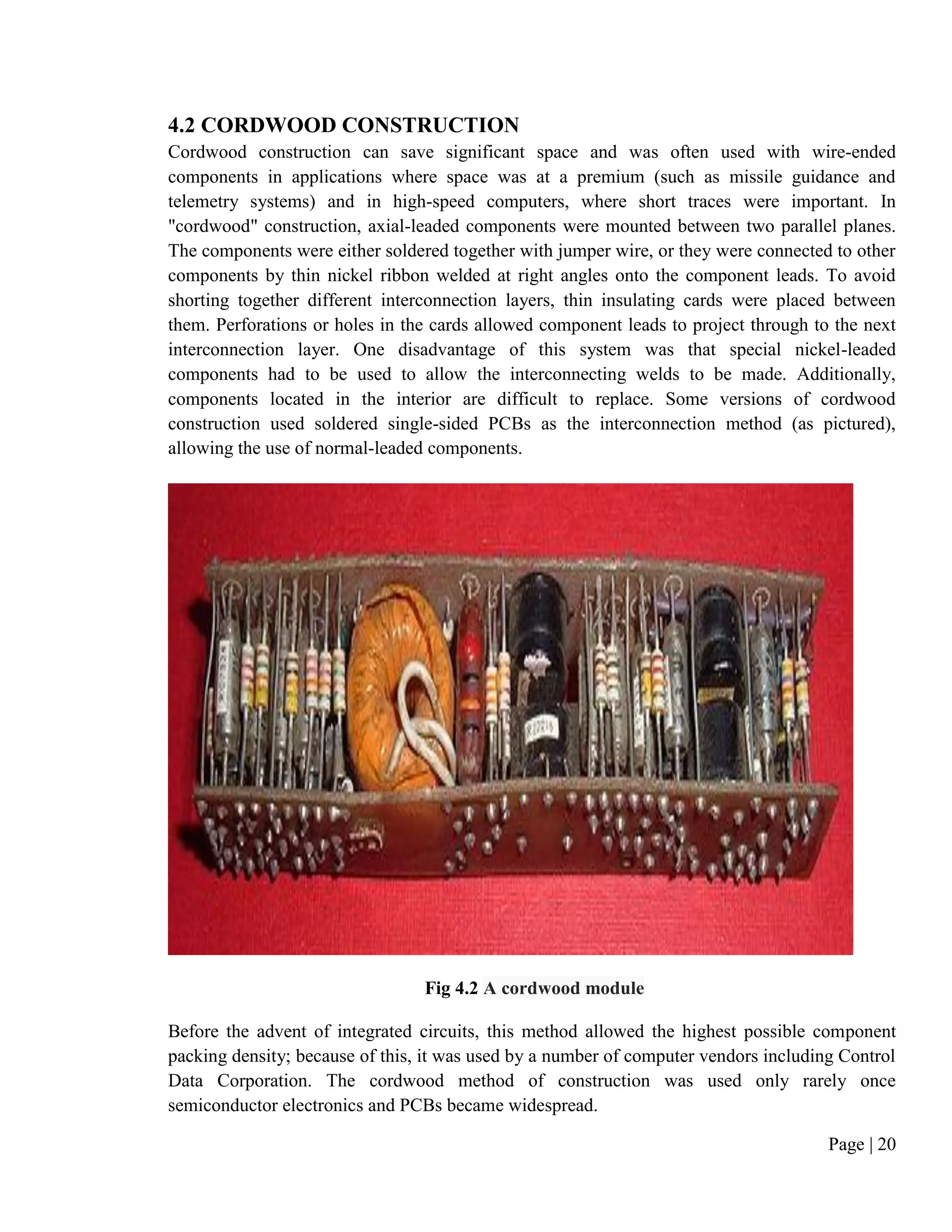
4.2 CORDWOOD CONSTRUCTION
Cordwood construction can save significant space and was often used with wire-ended
components in applications where space was at a premium (such as missile guidance and
telemetry systems) and in high-speed computers, where short traces were important. In
"cordwood" construction, axial-leaded components were mounted between two parallel planes.
The components were either soldered together with jumper wire, or they were connected to other
components by thin nickel ribbon welded at right angles onto the component leads. To avoid
shorting together different interconnection layers, thin insulating cards were placed between
them. Perforations or holes in the cards allowed component leads to project through to the next
interconnection layer. One disadvantage of this system was that special nickel-leaded
components had to be used to allow the interconnecting welds to be made. Additionally,
components located in the interior are difficult to replace. Some versions of cordwood
construction used soldered single-sided PCBs as the interconnection method (as pictured),
allowing the use of normal-leaded components.
Fig 4.2 A cordwood module
Before the advent of integrated circuits, this method allowed the highest possible component
packing density; because of this, it was used by a number of computer vendors including Control
Data Corporation. The cordwood method of construction was used only rarely once
semiconductor electronics and PCBs became widespread.
Page | 21
4.3 MULTIWIRE BOARDS
Multiwire is a patented technique of interconnection which uses machine-routed insulated wires
embedded in a non-conducting matrix (often plastic resin). It was used during the 1980s and
1990s. (Kollmorgen Technologies Corp, U.S. Patent 4,175,816 filed 1978) Multiwire is still
available in 2010 through Hitachi. There are other competitive discrete wiring technologies that
have been developed (Jumatech, layered sheets).
Since it was quite easy to stack interconnections (wires) inside the embedding matrix, the
approach allowed designers to forget completely about the routing of wires (usually a time-
consuming operation of PCB design): Anywhere the designer needs a connection; the machine
will draw a wire in straight line from one location/pin to another. This led to very short design
times (no complex algorithms to use even for high density designs) as well as reduced crosstalk,
though the cost is too high to compete with cheaper PCB technologies when large quantities are
needed.
Page | 22
Week 5
5. COMPONENT MOUNTING TECHNOLOGY
5.1 THROUGH HOLE TECHNOLOGY
INTRODUCTION
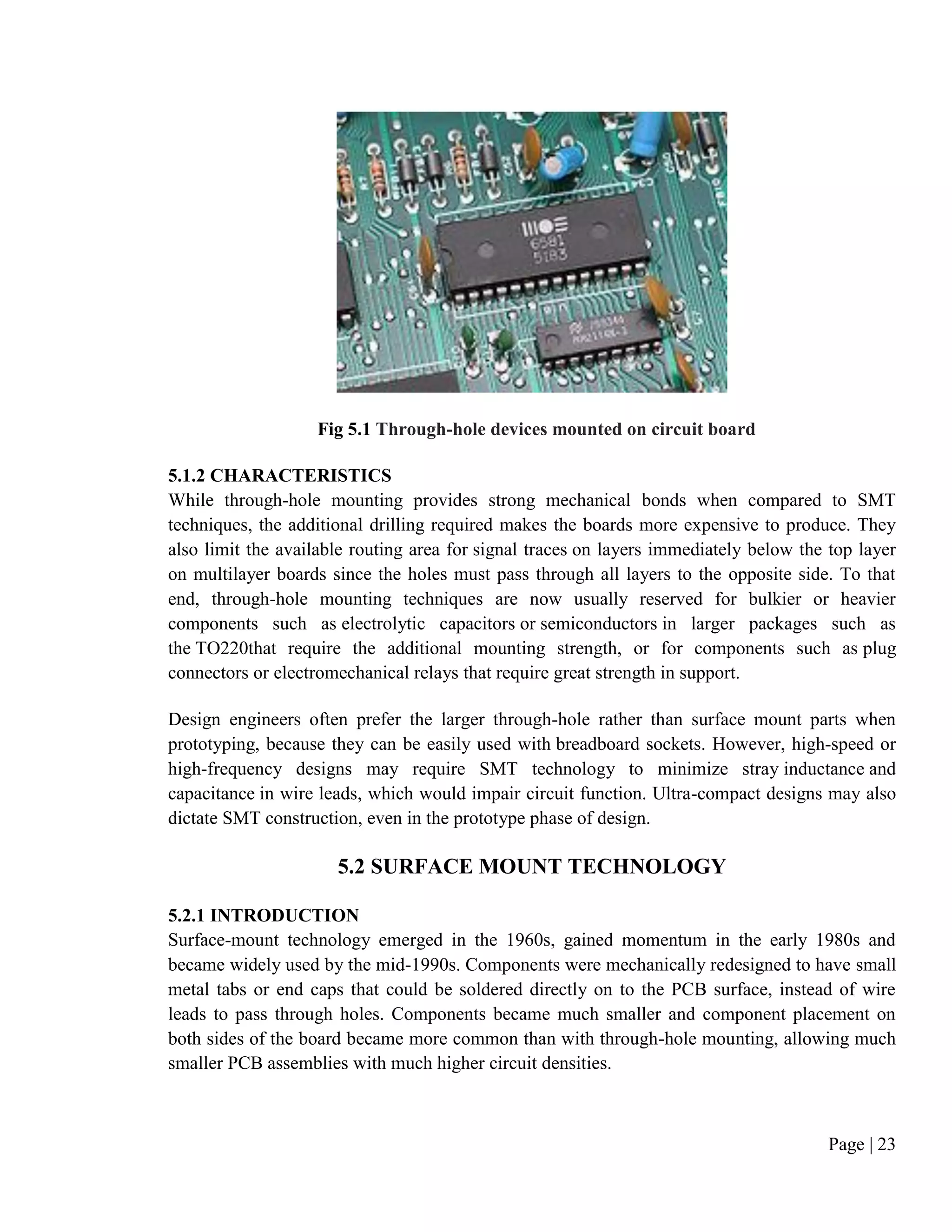
The first PCBs used through-hole technology, mounting electronic components by leads inserted
through holes on one side of the board and soldered onto copper traces on the other side. Boards
may be single-sided, with an unplated component side, or more compact double-sided boards,
with components soldered on both sides. Horizontal installation of through-hole parts with two
axial leads (such as resistors, capacitors, and diodes) is done by bending the leads 90 degrees in
the same direction, inserting the part in the board (often bending leads located on the back of the
board in opposite directions to improve the part's mechanical strength), soldering the leads, and
trimming off the ends. Leads may be soldered either manually or by a wave soldering machine.
Through-hole PCB technology almost completely replaced earlier electronics assembly
techniques such as point-to-point construction. From the second generation of computers in the
1950s until surface-mount technology became popular in the late 1980s, every component on a
typical PCB was a through-hole component.
Through-hole manufacture adds to board cost by requiring many holes to be drilled accurately,
and limits the available routing area for signal traces on layers immediately below the top layer
on multilayer boards since the holes must pass through all layers to the opposite side. Once
surface-mounting came into use, small-sized SMD components were used where possible, with
through-hole mounting only of components unsuitably large for surface-mounting due to power
requirements or mechanical limitations, or subject to mechanical stress which might damage the
PCB.
5.1.1 HISTORY
Through-hole technology almost completely replaced earlier electronics assembly techniques
such as point-to-point construction. From the second generation of computers in the 1950s until
surface-mount technology (SMT) became popular in the late 1980s, every component on a
typical PCB was a through-hole component. PCBs initially had tracks printed on one side only,
later both sides, then multi-layer boards were in use.
Through holes became plated-through holes (PTH) in order for the components to make
contact with the required conductive layers. Plated-through holes are no longer required with
SMT boards for making the component connections, but are still used for making
interconnections between the layers and in this role are more usually called vias.
Page | 23
Fig 5.1 Through-hole devices mounted on circuit board
5.1.2 CHARACTERISTICS
While through-hole mounting provides strong mechanical bonds when compared to SMT
techniques, the additional drilling required makes the boards more expensive to produce. They
also limit the available routing area for signal traces on layers immediately below the top layer
on multilayer boards since the holes must pass through all layers to the opposite side. To that
end, through-hole mounting techniques are now usually reserved for bulkier or heavier
components such as electrolytic capacitors or semiconductors in larger packages such as
the TO220that require the additional mounting strength, or for components such as plug
connectors or electromechanical relays that require great strength in support.
Design engineers often prefer the larger through-hole rather than surface mount parts when
prototyping, because they can be easily used with breadboard sockets. However, high-speed or
high-frequency designs may require SMT technology to minimize stray inductance and
capacitance in wire leads, which would impair circuit function. Ultra-compact designs may also
dictate SMT construction, even in the prototype phase of design.
5.2 SURFACE MOUNT TECHNOLOGY
5.2.1 INTRODUCTION
Surface-mount technology emerged in the 1960s, gained momentum in the early 1980s and
became widely used by the mid-1990s. Components were mechanically redesigned to have small
metal tabs or end caps that could be soldered directly on to the PCB surface, instead of wire
leads to pass through holes. Components became much smaller and component placement on
both sides of the board became more common than with through-hole mounting, allowing much
smaller PCB assemblies with much higher circuit densities.
Page | 24
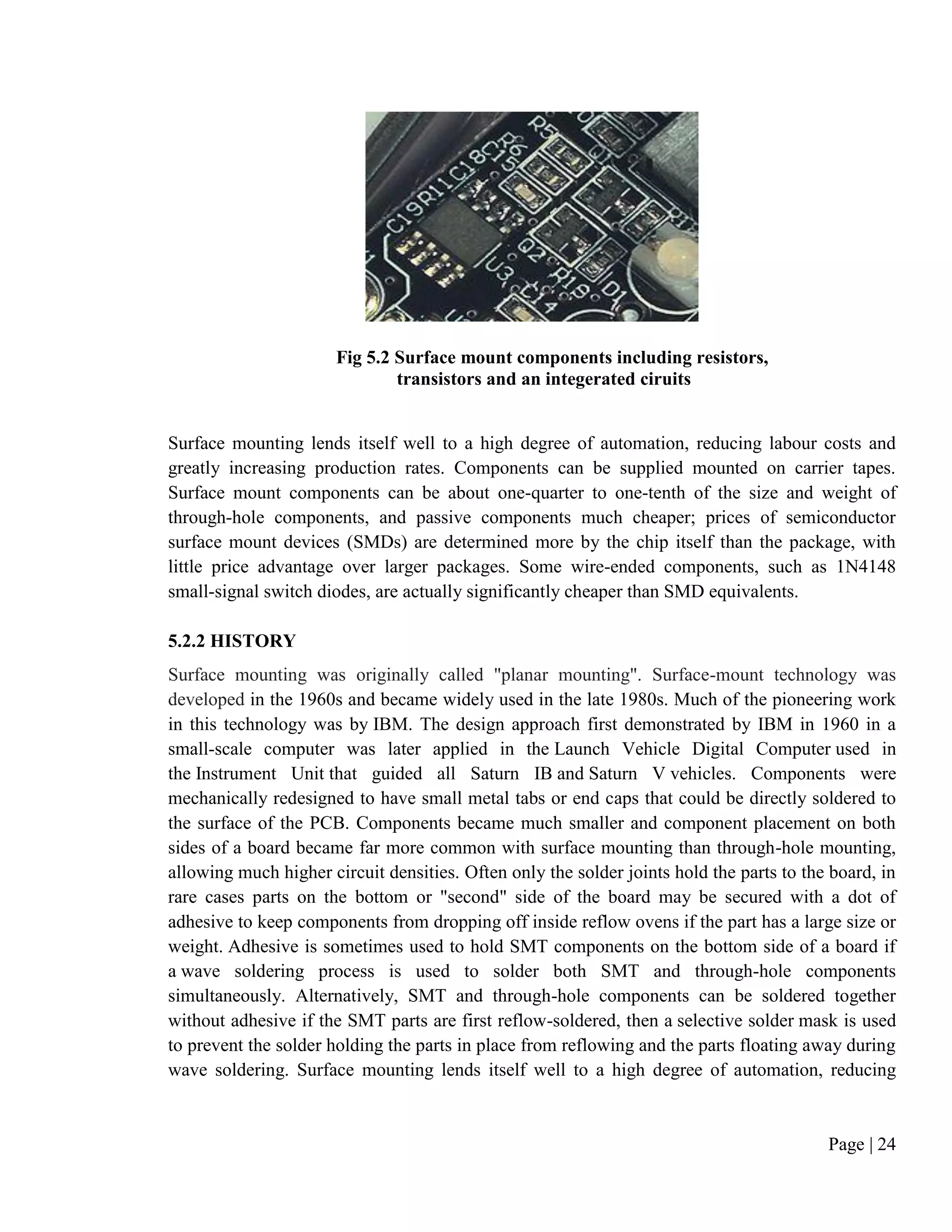
Fig 5.2 Surface mount components including resistors,
transistors and an integerated ciruits
Surface mounting lends itself well to a high degree of automation, reducing labour costs and
greatly increasing production rates. Components can be supplied mounted on carrier tapes.
Surface mount components can be about one-quarter to one-tenth of the size and weight of
through-hole components, and passive components much cheaper; prices of semiconductor
surface mount devices (SMDs) are determined more by the chip itself than the package, with
little price advantage over larger packages. Some wire-ended components, such as 1N4148
small-signal switch diodes, are actually significantly cheaper than SMD equivalents.
5.2.2 HISTORY
Surface mounting was originally called "planar mounting". Surface-mount technology was
developed in the 1960s and became widely used in the late 1980s. Much of the pioneering work
in this technology was by IBM. The design approach first demonstrated by IBM in 1960 in a
small-scale computer was later applied in the Launch Vehicle Digital Computer used in
the Instrument Unit that guided all Saturn IB and Saturn V vehicles. Components were
mechanically redesigned to have small metal tabs or end caps that could be directly soldered to
the surface of the PCB. Components became much smaller and component placement on both
sides of a board became far more common with surface mounting than through-hole mounting,
allowing much higher circuit densities. Often only the solder joints hold the parts to the board, in
rare cases parts on the bottom or "second" side of the board may be secured with a dot of
adhesive to keep components from dropping off inside reflow ovens if the part has a large size or
weight. Adhesive is sometimes used to hold SMT components on the bottom side of a board if
a wave soldering process is used to solder both SMT and through-hole components
simultaneously. Alternatively, SMT and through-hole components can be soldered together
without adhesive if the SMT parts are first reflow-soldered, then a selective solder mask is used
to prevent the solder holding the parts in place from reflowing and the parts floating away during
wave soldering. Surface mounting lends itself well to a high degree of automation, reducing
Page | 25
labor cost and greatly increasing production rates. SMDs can be one-quarter to one-tenth the size
and weight, and one-half to one-quarter the cost of equivalent through-hole parts.
5.2.3 TERMS
Because "surface-mount" refers to a methodology of manufacturing, there are different terms
used when referring to the different aspect of the method, which distinguishes for example the
components, technique, and machines used in manufacturing. These terms are listed in the
following table:
Tab 5.2.1 Expanded form of SMP terms
SMP
TERM
EXPANDED FORM
SMD Surface-mount devices (active, passive and
electromechanical components )
SMT Surface-mount technology (assembling and
mounting technology)
SMA Surface-mount assembly (module assembled with
SMT)
SMC Surface-mount components (components for SMT)
SMP Surface-mount packages (SMD case forms)
SME Surface-mount equipment (SMT assembling
machines)
5.2.4 ASSEMBLY TECHNIQUES
Where components are to be placed, the printed circuit board normally has flat, usually tin-lead,
silver, or gold plated copper pads without holes, called solder pads. Solder paste, a sticky
mixture of flux and tiny solder particles, is first applied to all the solder pads with a stainless
steel or nickel stencil using a screen printing process. It can also be applied by a jet-printing
mechanism, similar to an inkjet printer. After pasting, the boards then proceed to the pick-and-
place machines, where they are placed on a conveyor belt. The components to be placed on the
boards are usually delivered to the production line in either paper/plastic tapes wound on reels or
plastic tubes. Some large integrated circuits are delivered in static-free trays. Numerical control
Page | 26
pick-and-place machines remove the parts from the tapes, tubes or trays and place them on the
PCB.
The boards are then conveyed into the reflow soldering oven. They first enter a pre-heat zone,
where the temperature of the board and all the components is gradually, uniformly raised. The
boards then enter a zone where the temperature is high enough to melt the solder particles in the
solder paste, bonding the component leads to the pads on the circuit board. The surface tension
of the molten solder helps keep the components in place, and if the solder pad geometries are
correctly designed, surface tension automatically aligns the components on their pads. There are
a number of techniques for reflowing solder. One is to use infrared lamps; this is called infrared
reflow. Another is to use a hot gas convection. Another technology which is becoming popular
again is special fluorocarbon liquids with high boiling points which use a method called vapor
phase reflow. Due to environmental concerns, this method was falling out of favor until lead-free
legislation was introduced which requires tighter controls on soldering. Currently, at the end of
2008, convection soldering is the most popular reflow technology using either standard air or
nitrogen gas. Each method has its advantages and disadvantages. With infrared reflow, the board
designer must lay the board out so that short components don't fall into the shadows of tall
components. Component location is less restricted if the designer knows that vapor phase reflow
or convection soldering will be used in production. Following reflow soldering, certain irregular
or heat-sensitive components may be installed and soldered by hand, or in large-scale
automation, by focused infrared beam (FIB) or localized convection equipment.
If the circuit board is double-sided then this printing, placement, reflow process may be repeated
using either solder paste or glue to hold the components in place. If a wave soldering process is
used, then the parts must be glued to the board prior to processing to prevent them from floating
off when the solder paste holding them in place is melted.
After soldering, the boards may be washed to remove flux residues and any stray solder balls that
could short out closely spaced component leads. Rosin flux is removed with fluorocarbon
solvents, high flash point hydrocarbon solvents, or low flash solvents e.g. limonene (derived
from orange peels) which require extra rinsing or drying cycles. Water-soluble fluxes are
removed with deionized water and detergent, followed by an air blast to quickly remove residual
water. However, most electronic assemblies are made using a "No-Clean" process where the flux
residues are designed to be left on the circuit board [benign]. This saves the cost of cleaning,
speeds up the manufacturing process, and reduces waste.
Certain manufacturing standards, such as those written by the IPC - Association Connecting
Electronics Industries require cleaning regardless of the solder flux type used to ensure a
thoroughly clean board. Even no-clean flux leaves a residue which, under IPC standards, must be
removed. Proper cleaning removes all traces of solder flux, as well as dirt and other
contaminants that may be invisible to the naked eye. However, while shops conforming to IPC
standard are expected to adhere to the Association's rules on board condition, not all
manufacturing facilities apply IPC standard, nor are they required to do so. Additionally, in some
Page | 27
applications, such as low-end electronics, such stringent manufacturing methods are excessive
both in expense and time required.
Finally, the boards are visually inspected for missing or misaligned components and solder
bridging. If needed, they are sent to a rework station where a human operator repairs any errors.
They are then usually sent to the testing stations (in-circuit testing and/or functional testing) to
verify that they operate correctly.
5.2.5 ADVANTAGES
The main advantages of SMT over the older through-hole technique are:
 Smaller components. As of 2012 smallest was 0.4 × 0.2 mm (0.016 × 0.008 in: 01005).
Expected to sample in 2013 are 0.25 × 0.125 mm (0.010 × 0.005 in, size not yet
standardized)
 Much higher component density (components per unit area) and many more connections
per component.
 Lower initial cost and time of setting up for production.
 Fewer holes need to be drilled.
 Simpler and faster automated assembly. Some placement machines are capable of placing
more than 136,000 components per hour.
 Small errors in component placement are corrected automatically as the surface tension
of molten solder pulls components into alignment with solder pads.
 Components can be placed on both sides of the circuit board.
 Lower resistance and inductance at the connection; consequently, fewer unwanted RF
signal effects and better and more predictable high-frequency performance.
 Better mechanical performance under shake and vibration conditions.
 Many SMT parts cost less than equivalent through-hole parts.
 Better EMC performance (lower radiated emissions) due to the smaller radiation loop
area (because of the smaller package) and the smaller lead inductance.
5.2.6 DISADVANTAGES
 Manual prototype assembly or component-level repair is more difficult and requires
skilled operators and more expensive tools, due to the small sizes and lead spacings of many
SMDs.
 SMDs cannot be used directly with plug-in breadboards (a quick snap-and-play
prototyping tool), requiring either a custom PCB for every prototype or the mounting of the
SMD upon a pin-leaded carrier. For prototyping around a specific SMD component, a less-
expensive breakout board may be used. Additionally, strip board style proto boards can be
Page | 28
used, some of which include pads for standard sized SMD components. For prototyping,
"dead bug" bread boarding can be used.
 SMDs' solder connections may be damaged by potting compounds going through thermal
cycling.
 Solder joint dimensions in SMT quickly become much smaller as advances are made
toward ultra-fine pitch technology. The reliability of solder joints becomes more of a
concern, as less and less solder is allowed for each joint. Voiding is a fault commonly
associated with solder joints, especially when reflowing a solder paste in the SMT
application. The presence of voids can deteriorate the joint strength and eventually lead to
joint failure.
 SMT is unsuitable for large, high-power, or high-voltage parts, for example in power
circuitry. It is common to combine SMT and through-hole construction, with transformers,
heat-sinked power semiconductors, physically large capacitors, fuses, connectors, and so on
mounted on one side of the PCB through holes.
 SMT is unsuitable as the sole attachment method for components that are subject to
frequent mechanical stress, such as connectors that are used to interface with external
devices that are frequently attached and detached.
5.2.7 REWORK
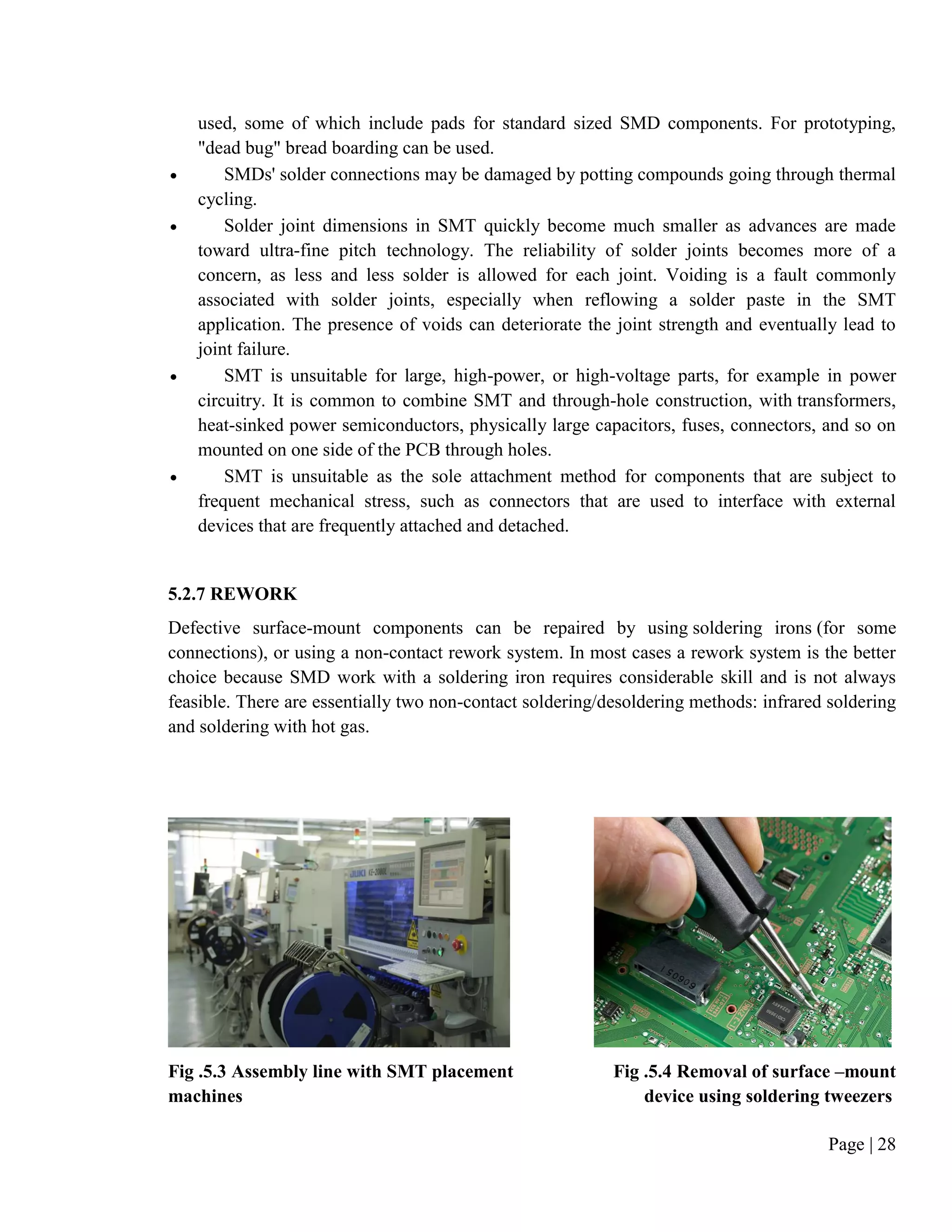
Defective surface-mount components can be repaired by using soldering irons (for some
connections), or using a non-contact rework system. In most cases a rework system is the better
choice because SMD work with a soldering iron requires considerable skill and is not always
feasible. There are essentially two non-contact soldering/desoldering methods: infrared soldering
and soldering with hot gas.
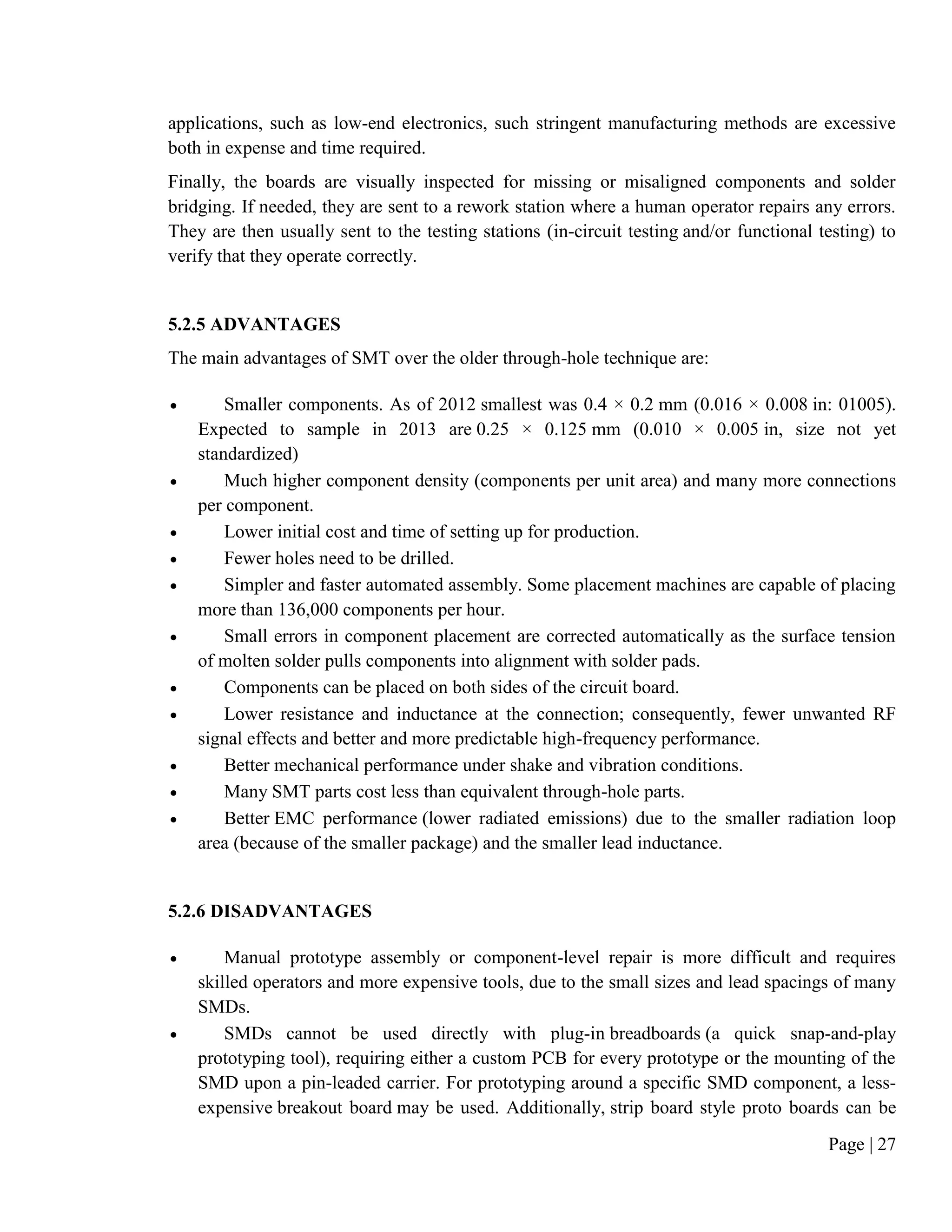
Fig .5.3 Assembly line with SMT placement Fig .5.4 Removal of surface –mount
machines device using soldering tweezers
Page | 29
Week 6
6. SOLDERING
INTRODUCTION
Soldering is a process in which two or more metal items are joined together by melting and
flowing a filler metal (solder) into the joint, the filler metal having a lower melting point than the
work piece. Soldering differs from welding in that soldering does not involve melting the work
pieces. In brazing, the filler metal melts at a higher temperature, but the work piece metal does
not melt. Formerly nearly all solders contained lead, but environmental concerns have
increasingly dictated use of lead-free alloys for electronics and plumbing purposes.
6.1 HISTORY
There is evidence that soldering was employed as early as 5000 years ago in Mesopotamia.
Soldering and brazing are thought to have arisen very early in the history of metal-working,
probably before 4000 BC. Sumerian swords from ~3000 BC were assembled using hard
soldering.
6.2 APPLICATIONS
Soldering is used in plumbing, electronics, and metalwork from flashing to jewellery.
Soldering provides reasonably permanent but reversible connections between copper pipes
in plumbing systems as well as joints in sheet metal objects such as food cans, roof flashing, rain
gutters and automobile radiators.
Jewelry components, machine tools and some refrigeration and plumbing components are often
assembled and repaired by the higher temperature silver soldering process. Small mechanical
parts are often soldered or brazed as well. Soldering is also used to join lead came and copper
foil in stained glass work. It can also be used as a semi-permanent patch for a leak in a container
or cooking vessel.
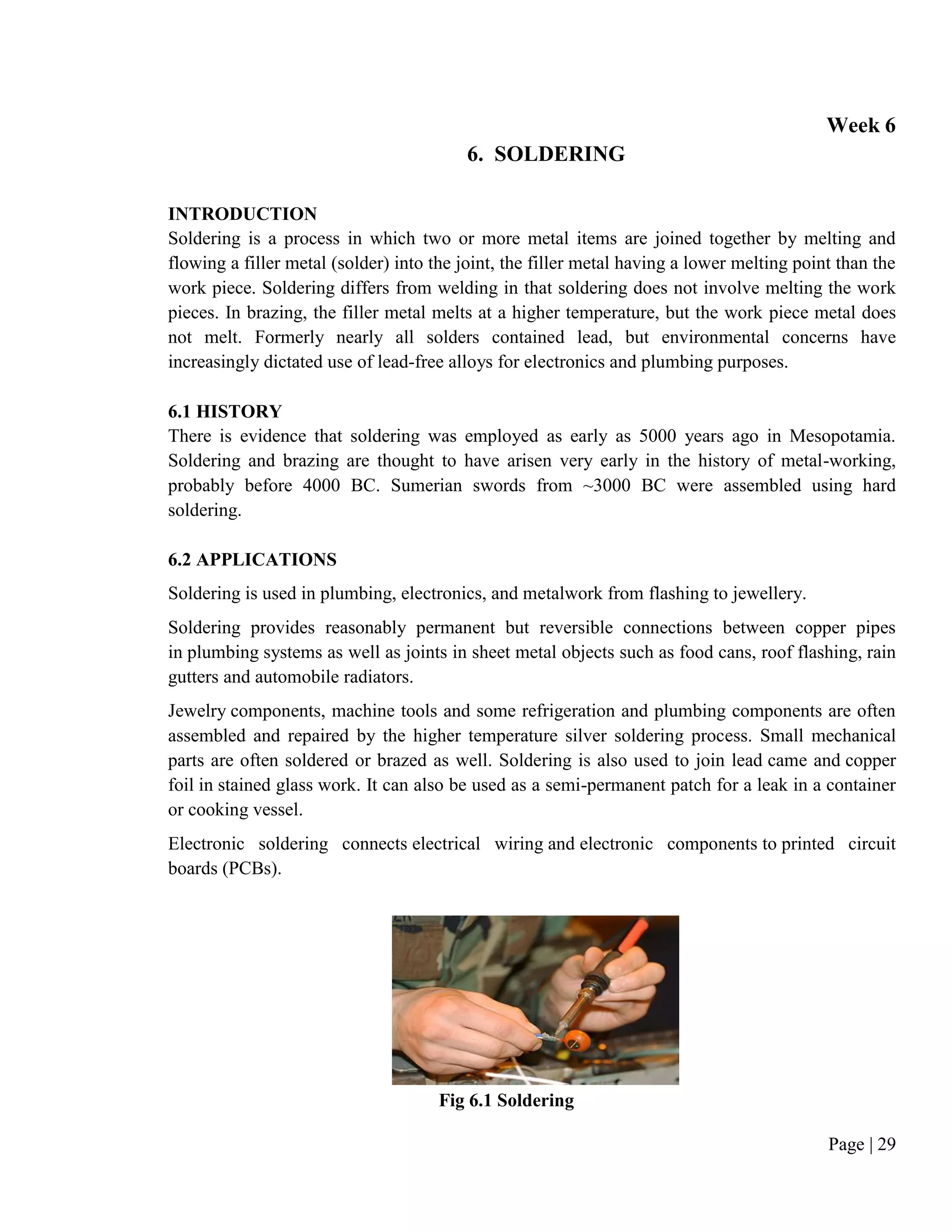
Electronic soldering connects electrical wiring and electronic components to printed circuit
boards (PCBs).
Fig 6.1 Soldering
Page | 30
6.3 SOLDERING IRON
INTRODUCTION
A soldering iron is a hand tool used in soldering. It supplies heat to melt the solder so that it can
flow into the joint between two work piece.
A soldering iron is composed of a heated metal tip and an insulated handle. Heating is often
achieved electrically, by passing an electric current (supplied through an electrical cord or
battery cables) through a resistive heating element. Cordless irons can be heated by combustion
of gas stored in a small tank, often using a catalytic heater rather than a flame. Simple irons less
commonly used than in the past were simply a large copper bit on a handle, heated in a flame.
Soldering irons are most often used for installation, repairs, and limited production work in
electronics assembly. High-volume production lines use other soldering methods. Large irons
may be used for soldering joints in sheet metal objects. Less common uses include pyrography
(burning designs into wood) and plastic welding.
6.4 TYPES OF IRONS
6.4.1 SIMPLE IRON
For electrical and electronics work, a low-power iron, a power rating between 15 and 35 watts, is
used. Higher ratings are available, but do not run at higher temperature; instead there is more
heat available for making soldered connections to things with large thermal capacity, for
example, a metal chassis. Some irons are temperature-controlled, running at a fixed temperature
in the same way as a soldering station, with higher power available for joints with large heat
capacity. Simple irons run at an uncontrolled temperature determined by thermal equilibrium;
when heating something large their temperature drops a little, possibly too much to melt solder.
6.4.2 CORDLESS IRON
Small irons heated by a battery, or by combustion of a gas such as butane in a small self-
contained tank, can be used when electricity is unavailable or cordless operation is required. The
operating temperature of these irons is not regulated directly; gas irons may change power by
adjusting gas flow. Gas-powered irons may have interchangeable tips including different size
soldering tips, hot knife for cutting plastics, miniature blow-torch with a hot flame, and small hot
air blower for such applications as shrinking heat shrink tubing.
Page | 31
6.4.3 TEMPERTURE CONTROLLED SOLDERING IRON
Simple irons reach a temperature determined by thermal equilibrium, dependent upon power
input and cooling by the environment and the materials it comes into contact with. The iron
temperature will drop when in contact with a large mass of metal such as a chassis; a small iron
will lose too much temperature to solder a large connection. More advanced irons for use in
electronics have a mechanism with a temperature sensor and method of temperature control to
keep the tip temperature steady; more power is available if a connection is large. Temperature-
controlled irons may be free-standing, or may comprise a head with heating element and tip,
controlled by a base called a soldering station, with control circuitry and temperature adjustment
and sometimes display.
A variety of means are used to control temperature. The simplest of these is a variable power
control, much like a light dimmer, which changes the equilibrium temperature of the iron without
automatically measuring or regulating the temperature. Another type of system uses a thermostat,
often inside the iron's tip, which automatically switches power on and off to the element. A
thermal sensor such as a thermocouple may be used in conjunction with circuitry to monitor the
temperature of the tip and adjust power delivered to the heating element to maintain a desired
temperature.
Another approach is to use magnetized soldering tips which lose their magnetic properties at a
specific temperature, the Curie point. As long as the tip is magnetic, it closes a switch to supply
power to the heating element. When it exceeds the design temperature it opens the contacts,
cooling until the temperature drops enough to restore magnetization. More complex Curie-point
irons circulate a high-frequency AC current through the tip, using magnetic physics to direct
heating only where the surface of the tip drops below the Curie point.
6.5 CLEANING
When the iron tip oxidizes and burnt flux accumulates on it, solder no longer wets the tip,
impeding heat transfer and making soldering difficult or impossible; tips must be periodically
cleaned in use. Such problems happen with all kinds of solder, but are much more severe with
the lead-free solders which have become widespread in electronics work, which require higher
temperatures than solders containing lead. Exposed iron plating oxidizes; if the tip is kept tinned
with molten solder oxidation is inhibited. A clean unoxidised tip is tinned by applying a little
solder and flux.
A wetted small sponge, often supplied with soldering equipment, can be used to wipe the tip. For
lead-free solder a slightly more aggressive cleaning, with brass shavings, can be used. Soldering
flux will help to remove oxide; the more active the flux the better the cleaning, although acidic
Page | 32
flux used on circuit boards and not carefully cleaned off will cause corrosion. A tip which is
cleaned but not retinned is susceptible to oxidation, particularly if wet.
Soldering iron tips are made of copper plated with iron. Copper is very easily corroded, eating
away the tip, particularly in lead-free work; iron is not. Cleaning tips requires the removal of
oxide without damaging the iron plating and exposing the copper to rapid corrosion. The use of
solder already containing a small amount of copper can slow corrosion of copper tips.
In cases of severe oxidation not removable by gentler methods, abrasion with something hard
enough to remove oxide but not so hard as to scratch the coating can be used. A brass wire
scourer, brush, or wheel on a bench grinder, can be used with care. Sandpaper and other tools
may be used but are likely to damage the plating.
Page | 33
Week 7
7. SOLDER
INTRODUCTION
Soldering filler materials are available in many different alloys for differing applications. In
electronics assembly, the eutectic alloy of 63% tin and 37% lead (or 60/40, which is almost
identical in melting point) has been the alloy of choice. Other alloys are used for plumbing,
mechanical assembly, and other applications. Some examples of soft-solder are tin-lead for
general purposes, tin-zinc for joining aluminum, lead-silver for strength at higher than room
temperature, cadmium-silver for strength at high temperatures, zinc-aluminum for aluminum and
corrosion resistance, and tin-silver and tin-bismuth for electronics.
A eutectic formulation has advantages when applied to soldering: the liquidus and solidus
temperatures are the same, so there is no plastic phase, and it has the lowest possible melting
point. Having the lowest possible melting point minimizes heat stress on electronic components
during soldering. And, having no plastic phase allows for quicker wetting as the solder heats up,
and quicker setup as the solder cools. A non-eutectic formulation must remain still as the
temperature drops through the liquidus and solidus temperatures. Any movement during the
plastic phase may result in cracks, resulting in an unreliable joint.
Common solder formulations based on tin and lead are listed below. The fraction represents
percentage of tin first, then lead, totaling 100%:
1. 63/37: melts at 183 °C (361 °F) (eutectic: the only mixture that melts at a point, instead of
over a range)
2. 60/40: melts between 183–190 °C (361–374 °F)
3. 50/50: melts between 185–215 °C (365–419 °F)
For environmental reasons (and the introduction of regulations such as the European ROHS
(Restriction of Hazardous Substances Directive)), lead-free solders are becoming more widely
used. They are also suggested anywhere young children may come into contact with (since
young children are likely to place things into their mouths), or for outdoor use where rain and
other precipitation may wash the lead into the groundwater. Unfortunately, most lead-free
solders are not eutectic formulations, melting at around 250 °C (482 °F), making it more difficult
to create reliable joints with them.
Other common solders include low-temperature formulations (often containing bismuth), which
are often used to join previously-soldered assemblies without un-soldering earlier connections,
Page | 34
and high-temperature formulations (usually containing silver) which are used for high-
temperature operation or for first assembly of items which must not become unsoldered during
subsequent operations. Alloying silver with other metals changes the melting point, adhesion and
wetting characteristics, and tensile strength. Of all the brazing alloys, silver solders have the
greatest strength and the broadest applications. Specialty alloys are available with properties
such as higher strength, the ability to solder aluminum, better electrical conductivity, and higher
corrosion resistance.
7.1 FLUX
The purpose of flux is to facilitate the soldering process. One of the obstacles to a successful
solder joint is an impurity at the site of the joint, for example, dirt, oil or oxidation. The
impurities can be removed by mechanical cleaning or by chemical means, but the elevated
temperatures required to melt the filler metal (the solder) encourages the work piece (and the
solder) to re-oxidize. This effect is accelerated as the soldering temperatures increase and can
completely prevent the solder from joining to the workpiece. One of the earliest forms of flux
was charcoal, which acts as a reducing agent and helps prevent oxidation during the soldering
process. Some fluxes go beyond the simple prevention of oxidation and also provide some form
of chemical cleaning (corrosion).
For many years, the most common type of flux used in electronics (soft soldering) was rosin-
based, using the rosin from selected pine trees. It was ideal in that it was non-corrosive and non-
conductive at normal temperatures but became mildly reactive (corrosive) at the elevated
soldering temperatures. Plumbing and automotive applications, among others, typically use an
acid-based (muriatic acid) flux which provides cleaning of the joint. These fluxes cannot be used
in electronics because they are conductive and because they will eventually dissolve the small
diameter wires. Many fluxes also act as a wetting agent in the soldering process, reducing the
surface tension of the molten solder and causing it to flow and wet the workpieces more easily.
Fluxes for soft solder are currently available in three basic formulations:
1. Water-soluble fluxes - higher activity fluxes designed to be removed with water after
soldering (no VOCs required for removal).
2. No-clean fluxes - mild enough to not "require" removal due to their non-conductive and non-
corrosive residue. These fluxes are called "no-clean" because the residue left after the solder
operation is non-conductive and won't cause electrical shorts; nevertheless they leave a plainly
visible white residue that resembles diluted bird-droppings. No-clean flux residue is acceptable
on all 3 classes of PCBs as defined by IPC-610 provided it does not inhibit visual inspection,
access to test points, or have a wet, tacky or excessive residue that may spread onto other areas.
Connector mating surfaces must also be free of flux residue. Finger prints in no clean residue is a
class 3 defect.
Page | 35
3. Traditional rosin fluxes - available in non-activated (R), mildly activated (RMA) and activated
(RA) formulations. RA and RMA fluxes contain rosin combined with an activating agent,
typically an acid, which increases the wettability of metals to which it is applied by removing
existing oxides. The residue resulting from the use of RA flux is corrosive and must be cleaned.
RMA flux is formulated to result in a residue which is not significantly corrosive, with cleaning
being preferred but optional.
Flux performance needs to be carefully evaluated; a very mild 'no-clean' flux might be perfectly
acceptable for production equipment, but not give adequate performance for a poorly controlled
hand-soldering operation.
7.2 PROCESSES
There are three forms of soldering, each requiring progressively higher temperatures and
producing an increasingly stronger joint strength:
1. Soft soldering, which originally used a tin-lead alloy as the filler metal,
2. Silver soldering, which uses an alloy containing silver,
3. Brazing which uses a brass alloy for the filler.
The alloy of the filler metal for each type of soldering can be adjusted to modify the melting
temperature of the filler. Soldering differs from gluing significantly in that the filler metals alloy
with the work piece at the junction to form a gas- and liquid-tight bond.
Soft soldering is characterized by having a melting point of the filler metal below approximately
400 °C (752 °F), whereas silver soldering and brazing use higher temperatures, typically
requiring a flame or carbon arc torch to achieve the melting of the filler. Soft solder filler metals
are typically alloys (often containing lead) that have liquidus temperatures below 350°C.
In this soldering process, heat is applied to the parts to be joined, causing the solder to melt and
to bond to the work pieces in an alloying process called wetting. In stranded wire, the solder is
drawn up into the wire by capillary action in a process called 'wicking'. Capillary action also
takes place when the work pieces are very close together or touching. The joint's tensile strength
is dependent on the filler metal used. Soldering produces electrically-conductive, water- and gas-
tight joints.
Each type of solder offers advantages and disadvantages. Soft solder is so called because of the
soft lead that is its primary ingredient. Soft soldering uses the lowest temperatures but does not
make a strong joint and is unsuitable for mechanical load-bearing applications. It is also
unsuitable for high-temperature applications as it softens and melts. Silver soldering, as used by
jewelers, machinists and in some plumbing applications, requires the use of a torch or other high-
temperature source, and is much stronger than soft soldering. Brazing provides the strongest joint
but also requires the hottest temperatures to melt the filler metal, requiring a torch or other high
temperature source and darkened goggles to protect the eyes from the bright light produced by
the white-hot work. It is often used to repair cast-iron objects, wrought-iron furniture, etc.
Page | 36
Soldering operations can be performed with hand tools, one joint at a time, or en masse on a
production line. Hand soldering is typically performed with a soldering iron, soldering gun, or a
torch, or occasionally a hot-air pencil. Sheet metal work was traditionally done with "soldering
coppers" directly heated by a flame, with sufficient stored heat in the mass of the soldering
copper to complete a joint; torches or electrically-heated soldering irons are more convenient. All
soldered joints require the same elements of cleaning of the metal parts to be joined, fitting up
the joint, heating the parts, applying flux, applying the filler, removing heat and holding the
assembly still until the filler metal has completely solidified. Depending on the nature of flux
material used, cleaning of the joints may be required after they have cooled.
Each alloy has characteristics that work best for certain applications, notably strength and
conductivity, and each type of solder and alloy has different melting temperatures. The term
silver solder likewise denotes the type of solder that is used. Some soft solders are "silver-
bearing" alloys used to solder silver-plated items. Lead-based solders should not be used on
precious metals because the lead dissolves the metal and disfigures it
7.2 SOLDERING & BRAZING
The distinction between soldering and brazing is based on the melting temperature of the filler
alloy. A temperature of 450 °C is usually used as a practical delineating point between soldering
and brazing. Soft soldering can be done with a heated iron whereas the other methods require a
higher temperature torch or furnace to melt the filler metal.
Fig.7.1 An Improperly soldered cold joint
Different equipment is usually required since a soldering iron cannot achieve high enough
temperatures for hard soldering or brazing. Brazing filler metal is stronger than silver solder,
which is stronger than lead-based soft solder. Brazing solders are formulated primarily for
strength, silver solder is used by jewelers to protect the precious metal and by machinists and
refrigeration technicians for its tensile strength but lower melting temperature than brazing, and
the primary benefit of soft solder is the low temperature used (to prevent heat damage to
electronic components and insulation).
Page | 37
Since the joint is produced using a metal with a lower melting temperature than the work piece,
the joint will weaken as the ambient temperature approaches the melting point of the filler metal.
For that reason, the higher temperature processes produce joints which are effective at higher
temperatures. Brazed connections can be as strong or nearly as strong as the parts they connect,
even at elevated temperatures.
7.4 SILVER SOLDERING
"Hard soldering" or "silver soldering" is used to join precious and semi-precious metals such as
gold, silver, brass, and copper. The solder is usually referred to as easy, medium, or hard. This
refers to its melting temperature, not the strength of the joint. Extra-easy solder contains 56%
silver and has a melting point of 1,145 °F (618 °C). Extra-hard solder has 80% silver and melts
at 1,370 °F (740 °C). If multiple joints are needed, then the jeweler will start with hard or extra-
hard solder and switch to lower temperature solders for later joints.
Silver solder is absorbed by the surrounding metal, resulting in a joint that is actually stronger
than the metal being joined. The metal being joined must be perfectly flush, as silver solder
cannot normally be used as a filler and any gaps will remain.
Fig.7.2 Solder
Another difference between brazing and soldering is how the solder is applied. In brazing, one
generally uses rods that are touched to the joint while being heated. With silver soldering, small
pieces of solder wire are placed onto the metal prior to heating. A flux, often made of boric acid
and denatured alcohol, is used to keep the metal and solder clean and to prevent the solder from
moving before it melts.
When silver solder melts, it tends to flow towards the area of greatest heat. Jewelers can
somewhat control the direction the solder moves by leading it with a torch; it will even run
straight up along a seam.
Page | 38
7.5 INDUCTION SOLDERING
Induction soldering uses induction heating by high-frequency AC current in a surrounding
copper coil. This induces currents in the part being soldered, which generates heat because of the
higher resistance of a joint versus its surrounding metal (resistive heating). These copper coils
can be shaped to fit the joint more precisely. A filler metal (solder) is placed between the facing
surfaces, and this solder melts at a fairly low temperature. Fluxes are commonly used in
induction soldering. This technique is particularly suited to continuously soldering, in which case
these coils wrap around a cylinder or a pipe that needs to be soldered.
Some metals are easier to solder than others. Copper, silver, and gold are easy. Iron, mild steel
and nickel are next in difficulty. Because of their thin, strong oxide films, stainless steel and
aluminum are even more difficult to solder. Titanium, magnesium, cast irons, some high-carbon
steels, ceramics, and graphite can be soldered but it involves a process similar to joining
carbides: they are first plated with a suitable metallic element that induces interfacial bonding.
7.6 DESOLDERING
Used solder contains some of the dissolved base metals and is unsuitable for reuse in making
new joints. Once the solder's capacity for the base metal has been achieved it will no longer
properly bond with the base metal, usually resulting in a brittle cold solder joint with a
crystalline appearance.
It is good practice to remove solder from a joint prior to resoldering—desoldering braids or
vacuum desoldering equipment (solder suckers) can be used. Desoldering wicks contain plenty
of flux that will lift the contamination from the copper trace and any device leads that are
present. This will leave a bright, shiny, clean junction to be resoldered.
The lower melting point of solder means it can be melted away from the base metal, leaving it
mostly intact, though the outer layer will be "tinned" with solder. Flux will remain which can
easily be removed by abrasive or chemical processes. This tinned layer will allow solder to flow
into a new joint, resulting in a new joint, as well as making the new solder flow very quickly and
easily.
7.7 SOLERING DEFECTS
In the joining of copper tube, failure to properly heat and fill a joint may lead to a 'void' being
formed. This is usually a result of improper placement of the flame. If the heat of the flame is not
directed at the back of the fitting cup, and the solder wire applied 180 degrees opposite the
flame, then solder will quickly fill the opening of the fitting, trapping some flux inside the joint.
This bubble of trapped flux is the void; an area inside a soldered joint where solder is unable to
completely fill the fittings' cup, because flux has become sealed inside the joint, preventing
solder from occupying that space.The most common defect when hand-soldering results from the
parts being joined not exceeding the solder's liquidus temperature, resulting in a "cold solder"
Page | 39
joint. This is usually the result of the soldering iron being used to heat the solder directly, rather
than the parts themselves. Properly done, the iron heats the parts to be connected, which in turn
melt the solder, guaranteeing adequate heat in the joined parts for thorough wetting. In electronic
hand soldering the flux is embedded in the solder. Therefore heating the solder first may cause
the flux to evaporate before it cleans the surfaces being soldered. A cold-soldered joint may not
conduct at all, or may conduct only intermittently. Cold-soldered joints also happen in mass
production, and are a common cause of equipment which passes testing, but malfunctions after
sometimes years of operation. A "dry joint" occurs when the cooling solder is moved, and often
occurs because the joint moves when the soldering iron is removed from the joint.
An improperly selected or applied flux can cause joint failure. If not properly cleaned, a flux may
corrode the joint and cause eventual joint failure. Without flux the joint may not be clean, or may
be oxidized, resulting in an unsound joint.
In electronics non-corrosive fluxes are often used. Therefore cleaning flux off may merely be a
matter of aesthetics or to make visual inspection of joints easier in specialized 'mission critical'
applications such as medical devices, military and aerospace. For satellites also to reduce weight
slightly but usefully. In high humidity, even non-corrosive flux might remain slightly active,
therefore the flux may be removed to reduce corrosion over time. In some applications, the PCB
might also be coated in some form of protective material such as a lacquer to protect it and
exposed solder joints from the environment.
Movement of metals being soldered before the solder has cooled will cause a highly unreliable
cracked joint. In electronics' soldering terminology this is known as a 'dry' joint. It has a
characteristically dull or grainy appearance immediately after the joint is made, rather than being
smooth, bright and shiny. This appearance is caused by crystallization of the liquid solder. A dry
joint is weak mechanically and a poor conductor electrically.
In general a good looking soldered joint is a good joint. As mentioned it should be smooth,
bright and shiny. If the joint has lumps or balls of otherwise shiny solder the metal has not
'wetted' properly. Not being bright and shiny suggests a weak 'dry' joint. However, technicians
trying to apply this guideline when using lead-free solder formulations may experience
frustration, because these types of solders readily cool to a dull surface even if the joint is good.
The solder looks shiny while molten, and suddenly hazes over as it solidifies even though it has
not been disturbed during cooling.
In electronics a 'concave' fillet is ideal. This indicates good wetting and minimal use of solder
(therefore minimal heating of heat sensitive components). A joint may be good, but if a large
amount of unnecessary solder is used then more heating is obviously required. Excessive heating
of a PCB may result in 'delamination', the copper track may actually lift off the board,
particularly on single sided PCBs without through hole plating.
Page | 40
8. REFERENCES
http://www.ilkota.in/html/prdh2.htm http://www.ilkota.in/html/prdh4.htm
http://www.ilkota.in/html/profile.htm http://en.wikipedia.org/wiki/Surface-mount_technology
https://www.bing.com/images/search?q=soldering+wiki&FORM=HDRSC2
http://www.scribd.com/doc/100005324/Report-on-Instrumentation-Limited
http://seminarprojects.com/Thread-instrumentation-limited-kota-raj
http://www.eiconnect.com/pcbprocessflow.aspx#top
http://www.technologystudent.com/pcb/pcbflow2.htm

PCB

  • 1.
    Page | 1 ORGANISATIONPROFILE Instrumentation Limited (better known as IL) is a Government of India Enterprise set up in 1964 with the prime objective of attaining self reliance in the field of Control and Automation for process industry. Today IL is manufacturing and supplying state of the art control equipment on turnkey basis to various sector of Industry viz. Power, Steel, Fertilizer, Chemical, Petrochemical, Refineries, Pharmaceutical, Cement, Paper, Textile, Space, and Oil & Gas. IL has its registered and corporate office at Kota in state of Rajasthan. Manufacturing facilities are based at Kota and Palakkad in Kerala State. Flow elements, control valve and actuators are manufactured at Palakkad plant and other items are manufactured at Kota plant. IL’s manufacturing facilities are accredited with ISO 9001:2008 certification. The marketing network is widely spread all over India having Branch offices in major cities of Delhi, Kolkata, Chennai, Mumbai, Jaipur and Secunderabad and Regional offices at Vadodara, Kolkata and Bhilai for organizing installation and commissioning and related services. Site offices at many project sites are functioning under these regional offices. with over Forty five years of experience and a competent and dedicated workforce, IL has mastered all complexities of control system requirement and can lead you through your project, from system design, detailed engineering, manufacturing, testing, system integration, installation, final commissioning to after sales service and customer training. IL has further diversified in the fields of Power electronics; Telecommunications, Railway Signaling systems, Defence electronics, IT enabled Products & services, Power Distribution and Transmission, Off- shore Instrumentation, Security & Surveillance system to have comprehensive range of product and services. The present product handling of the company comprises of sophisticated Digital Distributed Control systems, High Performance Smart Electronic Pressure and Temperature Transmitters, desk/panel mounted controllers, indicators, recorders and other hardware, liquid and gas analyzers, with sample handling and conditioning system, annunciation system, panels, instrument cabinet and racks, Flow elements, Control valves, actuators, power cylinders in addition to Telecommunication systems, IT based applications, Defence electronics, Railway signaling systems, Uninterrupted Power Supply Systems(UPS), Solar Dusk Dawn System(SDDS) etc.
  • 2.
    Page | 2 Week1 1. PRINTED CIRCUIT BOARD 1.1 INTRODUCTION A printed circuit board, or PCB, is used to mechanically support and electrically connect electronic components using conductive pathways, tracks or signal traces etched from copper sheets laminated onto a non-conductive substrate. PCBs can be (one copper layer), double sided (two copper layers) or multi-layer (outer and inner layers). Multi-layer PCBs allow for much higher component density. Conductors on different layers are connected with plated-through holes called vias. Advanced PCBs may contain components - capacitors, resistors or active devices - embedded in the substrate. FR-4 glass epoxy is the primary insulating substrate upon which the vast majority of rigid PCBs are produced. A thin layer of copper foil is laminated to one or both sides of an FR-4 panel. Circuitry interconnections is etched into copper layers to produce printed circuit boards. Complex circuits are produced in multiple layers. Printed circuit boards are used in all but the simplest electronic products. Alternatives to PCBs include wire wrap and point-to-point construction. PCBs require the additional design effort to lay out the circuit, but manufacturing and assembly can be automated. Manufacturing circuits with PCBs is cheaper and faster than with other wiring methods as components are mounted and wired with one single part. Furthermore, operator wiring errors are eliminated. When the board has only copper tracks and features, and no circuit elements such as capacitors, resistors or active devices have been manufactured into the actual substrate of the board, it is more correctly referred to as printed wiring board (PWB) or etched wiring board. Use of the term PWB or printed wiring board although more accurate and distinct from what would be known as a true printed circuit board, has generally fallen by the wayside for many people as the distinction between circuit and wiring has become blurred. Today printed wiring (circuit) boards are used in virtually all but the simplest commercially produced electronic devices, and allow fully automated assembly processes that were not possible or practical in earlier era tag type circuit assembly processes. A PCB populated with electronic components is called a printed circuit assembly (PCA), printed circuit board assembly or PCB Assembly (PCBA). In informal use the term "PCB" is used both for bare and assembled boards, the context clarifying the meaning. The IPC preferred term for populated boards is CCA, circuit card assembly. This does not apply to backplanes; assembled backplanes are called backplane assemblies by the IPC.
  • 3.
    Page | 3 Fig1.1 Printed circuit board Alternatives to PCBs include wire wrap and point-to-point construction. PCBs must initially be designed and laid out, but become cheaper, faster to make, and potentially more reliable for high- volume production since production and soldering of PCBs can be automated. Much of the electronics industry's PCB design, assembly, and quality control needs are set by standards published by the IPC organization 1.2 HISTORY Development of the methods used in modern printed circuit boards started early in the 20th century. In 1903, a German inventor, Albert Hanson, described flat foil conductors laminated to an insulating board, in multiple layers. Thomas Edison experimented with chemical methods of plating conductors onto linen paper in 1904. Arthur Berry in 1913 patented a print-and-etch method in Britain, and in the United States Max Schoop obtained a patent to flame-spray metal onto a board through a patterned mask. Charles Durcase in 1927 patented a method of electroplating circuit patterns. The Austrian engineer Paul Eisler invented the printed circuit while working in England around 1936 as part of a radio set. Around 1943 the USA began to use the technology on a large scale to make proximity fuses for use in World War II. After the war, in 1948, the USA released the invention for commercial use. Printed circuits did not become commonplace in consumer electronics until the mid-1950s, after the Auto-Sembly process was developed by the United States Army.
  • 4.
    Page | 4 Beforeprinted circuits (and for a while after their invention), point-to-point construction was used. For prototypes, or small production runs, wire wrap or turret board can be more efficient. Predating the printed circuit invention, and similar in spirit, was John Sargrove's 1936–1947 Electronic Circuit Making Equipment (ECME) which sprayed metal onto a Bakelite plastic board. The ECME could produce 3 radios per minute. During World War II, the development of the anti-aircraft proximity fuse required an electronic circuit that could withstand being fired from a gun, and could be produced in quantity. The Central lab Division of Globe Union submitted a proposal which met the requirements: a ceramic plate would be screen printed with metallic paint for conductors and carbon material for resistors, with ceramic disc capacitors and subminiature vacuum tubes soldered in place. The technique proved viable, and the resulting patent on the process, which was classified by the U.S. Army, was assigned to Globe Union. It was not until 1984 that the Institute of Electrical and Electronics Engineers (IEEE) awarded Mr. Harry W. Rubinstein, the former head of Globe Union's Centralab Division, its coveted Cledo Brunetti Award for early key contributions to the development of printed components and conductors on a common insulating substrate. As well, Mr. Rubinstein was honored in 1984 by his alma mater, the University of Wisconsin-Madison, for his innovations in the technology of printed electronic circuits and the fabrication of capacitors. Originally, every electronic component had wire leads, and the PCB had holes drilled for each wire of each component. The components' leads were then passed through the holes and soldered to the PCB trace. This method of assembly is called through-hole construction. In 1949, Moe Abramson and Stanislaus F. Danko of the United States Army Signal Corps developed the Auto- Sembly process in which component leads were inserted into a copper foil interconnection pattern and dip soldered. The patent they obtained in 1956 was assigned to the U.S. Army. With the development of board lamination and etching techniques, this concept evolved into the standard printed circuit board fabrication process in use today. Soldering could be done automatically by passing the board over a ripple, or wave, of molten solder in a wave-soldering machine. However, the wires and holes are wasteful since drilling holes is expensive and the protruding wires are merely cut off. From the 1980s small surface mount parts have been used increasingly instead of through-hole components; this has led to smaller boards for a given functionality and lower production costs, but with some additional difficulty in servicing faulty boards. Historically many measurements related to PCB design were specified in multiples of a thousandth of an inch, often called "mils". For example, DIP and most other through-hole components have pins located on a grid spacing of 100 thou, in order to be breadboard-friendly. Surface-mount SOIC components have a pin pitch of 50 thou. SOP components have a pin pitch
  • 5.
    Page | 5 of25 thou. Level B technology recommends a minimum trace width of 8 mils, which allows "double-track" -- 2 traces between DIP pins. Fig 1.2 The component side of a PCB in a computer mouse; Some examples for common components and their reference designation in the legend.
  • 6.
    Page | 6 Week2 2. PCB MANUFACTURING In manufacturing process, the manufacturing steps are different for different printed circuit board .like single side, double side, multisided PCB but the most common manufacturing process is given below. Tab. 2.1.1 PCB Manufacturing Process Steps CNC CCL CUTTING,PINNING, STACKING&DRILLING WET PROCESSING DPS PIT (D/F) D/F LAMINATION EXPOSE & DEVELOPING WET PROCESSING CU PLATING RESIST STRIPPING ELECTING & TIN STRIPPING ETCHINGINSPECTION ETECHING INSPECTION SCREAN PRINTING BRUSHING & S/M PRINTING PIT(SM) EXPOSE (S/M), DEVELOPING S M INSPECTION S/M INSPECTION WET PROCESSING HAL SCREEN PRINTING L P CNC V-GROOVE & ROUTING BBT FIXURE FABRICATION & TESTING FINAL INSPECTION PCB INSPECTION PPE PRE PRODUCTION ENGINNERING,(DATA, FILMS,PANALISATION, CAM WORK ) STORES RAW MATERIALS &GENERAL STORE ACTIVITIES MANITENANCE PLANT MAINTENCE
  • 7.
    Page | 7 Tab.2.1.2 Process Sequences for Single, Double and Multi-layer PCB Single side PCB Double side PCB Multi-layer PCB File inspection File inspection File inspection Drill data generation Drill data generation Drill data generation Cutting Cutting Cutting Drilling Drilling I/L Tooling Holes Photo imaging DPS I/L Photo image Etching Photo imaging I/L Etching Solder masking PTH Oxide Treatment HASL Etching Pressing Legend print Solder Masking Drilling V-grooving / routing HASL De smear BBT Legend print DPS FQC V-grooving / routing Photo image Stores BBT PTH FQC Etching Stores Solder masking HASL Legend Printing V-grooving / routing BBT FQC Stores
  • 8.
    Page | 8 2.1MATERIALS Excluding exotic products using special materials or processes, all printed circuit boards manufactured today can be built using the following four items which are usually purchased from manufacturers: 1. Laminates 2. Copper-clad laminates 3. Resin impregnated B-stage cloth (Pre-preg) 4. Copper foil 2.2 LAMINATES Laminates are manufactured by curing under pressure and temperature layers of cloth or paper with thermoset resin to form an integral final piece of uniform thickness. The size can be up to 4 by 8 feet (1.2 by 2.4 m) in width and length. Varying cloth weaves (threads per inch or cm), cloth thickness, and resin percentage are used to achieve the desired final thickness and dielectric characteristics. Tab .2.1.3 Standard laminate thickness per ANSI/IPC-D-275 IPC Laminate Number Thickness in inches Thickness in millimeters IPC Laminate Number Thickness in inches Thickness in millimeters L1 0.002 0.05 L9 0.028 0.70 L2 0.004 0.10 L10 0.035 0.90 L3 0.006 0.15 L11 0.043 1.10 L4 0.008 0.20 L12 0.055 1.40 L5 0.010 0.25 L13 0.059 1.50 L6 0.012 0.30 L14 0.075 1.90 L7 0.016 0.40 L15 0.090 2.30 L8 0.020 0.50 L16 0.122 3.10
  • 9.
    Page | 9 2.3PANELIZATION The purpose of Panelization is to secure PCB boards during manufacturing, shipping and assembly processes while making their separation as painless as possible. A number of identical circuits are printed on to a larger board (the panel) which can then be handled in the normal way. The panel is broken apart into individual PCBs when all other processing is complete. Separating the individual PCBs is frequently aided by drilling or routing perforations along the boundaries of the individual circuits, much like a sheet of postage stamps. Another method, which takes less space, is to cut V-shaped grooves across the full dimension of the panel. The individual PCBs can then be broken apart along this line of weakness. Panelization can be as simple as a rectangular board tab routed with a 100mil (0.100”) space between PCB boards and a 500mil (0.50”) border on four edges. Or, it can be as complex as a panel filled with combination jump v-score / routed rounded polygons. Some guidelines for panelization are simple for example with routed panels:  If the PCB is rectangular and all sides have a length greater than 1.00”, add 100 mil between PCBs and a 400 mil border along the outside.  If all sides do not have a length greater than 1.00”, add 300 mil between PCBs and a 400 mil border along the outside. But:  If the PCB is not rectangular provide a 300 mil space between PCBs For V-Scoring, use a 20mil space between the PCB board edge and copper pads or traces. Additionally, provide a 300 mil wide frame on at least two opposing sides. As with all technical subjects, exceptions abound. For example:  If a mounted component extends beyond the boundaries of the PCB board, the border between PCBs needs to include the overhang distance. This ensures the component is not damaged during de-panelization and doesn’t interfere with neighbouring components on adjacent PCBs.  If a particularly heavy component is to be installed, extra material will be required between PCB boards to ensure the mechanical strength of the panel. It’s important the clearance between any metal and the edge of the PCB board is a minimum of 5mil for routing and 20mil for v-scoring. Having the metal exposed during routing or v-scoring could lead to shorts after assembly and the jagged edges are unattractive. The size and shape of the board will determine how many breakout tabs to use. Too few and the PCB may not be
  • 10.
    Page | 10 mechanicallystable enough for assembly. Too many and the de-panelization process becomes onerous. It is not uncommon to order a pair of boards as a set. So panelizing them together makes sense. This is possible with some restrictions:  Boards should be of similar size to panel efficiently.  Most board parameters must be the same.  Copper distribution needs to be similar or failures from the etching process can occur. For those on a tight budget, we have seen designs panelized by the customer which use drilled holes to separate the boards. To save on routing charges, they are willing to saw their boards apart by hand as they need them. It comes down to how you value your own time and how attractive you need your final product to look. Fig .2.1 Panelization of PCBs When panelizing for production quantities, we are often requested to provide panelization or paste files. These outputs from the CAM process enable our customers to purchase solder paste stencils secure in the knowledge they will have a perfect match.
  • 11.
    Page | 11 2.4ETCHING The majority of printed circuit boards today are made from purchased laminate material with copper already applied to both sides. The unwanted copper is removed by various methods leaving only the desired copper traces, this is called subtractive. In an additive method, traces are electroplated onto a bare substrate using a complex process with many steps. The advantage of the additive method is that less material is needed, and less waste is produced. Double-sided boards or multi-layer boards use plated-through holes, called vias, to connect traces on different layers of the PWB. The method chosen for PCB manufacture depends on the desired number of boards to be produced. Fig 2.2 The two processing methods used to produce a double-sided PWB with plated through holes.
  • 12.
    Page | 12 2.5CHEMICAL ETCHING Chemical etching is usually done with ammonium persulfate or ferric chloride. For PTH (plated- through holes), additional steps of electroless deposition are done after the holes are drilled, then copper is electroplated to build up the thickness, the boards are screened, and plated with tin/lead. The tin/lead becomes the resist leaving the bare copper to be etched away. The simplest method, used for small-scale production and often by hobbyists, is immersion etching, in which the board is submerged in etching solution such as ferric chloride. Compared with methods used for mass production, the etching time is long. Heat and agitation can be applied to the bath to speed the etching rate. In bubble etching, air is passed through the etchant bath to agitate the solution and speed up etching. Splash etching uses a motor-driven paddle to splash boards with etchant; the process has become commercially obsolete since it is not as fast as spray etching. In spray etching, the etchant solution is distributed over the boards by nozzles, and recirculated by pumps. Adjustment of the nozzle pattern, flow rate, temperature, and etchant composition gives predictable control of etching rates and high production rates. As more copper is consumed from the boards, the etchant becomes saturated and less effective; different etchants have different capacities for copper, with some as high as 150 grams of copper per litre of solution. In commercial use, etchants can be regenerated to restore their activity, and the dissolved copper recovered and sold. Small-scale etching requires attention to disposal of used etchant, which is corrosive and toxic due to its metal content. Fig 2.3 PCBs in process of having copper pattern plated, notice the blue dry film resist. The etchant removes copper on all surfaces exposed by the resist. "Undercut" occurs when etchant attacks the thin edge of copper under the resist; this can reduce conductor widths and cause open-circuits. Careful control of etch time is required to prevent undercut. Where metallic plating is used as a resist, it can "overhang" which can cause short-circuits between adjacent traces when closely spaced. Overhang can be removed by wire-brushing the board after etching.
  • 13.
    Page | 13 2.6LAMINATION "Multi layer" printed circuit boards have trace layers inside the board. One way to make a 4-layer PCB is to use a two-sided copper-clad laminate, etch the circuitry on both sides, then laminate to the top and bottom pre preg and copper foil. Lamination is done by placing the stack of materials in a press and applying pressure and heat for a period of time. This results in an inseparable one piece product. It is then drilled, plated, and etched again to get traces on top and bottom layers. Finally the PCB is covered with solder mask, marking legend, and a surface finish may be applied. Multi-layer PCBs allow for much higher component density. 2.7 DRILLING Holes through a PCB are typically drilled with small-diameter drill bits made of solid coated tungsten carbide. Coated tungsten carbide is recommended since many board materials are very abrasive and drilling must be high RPM and high feed to be cost effective. Drill bits must also remain sharp so as not to mar or tear the traces. Drilling with high-speed-steel is simply not copper. Feasible since the drill bits will dull quickly and thus tear the copper and ruin the boards. The drilling is performed by automated drilling machines with placement controlled by a drill tape or drill file. These computer-generated files are also called numerically controlled drill (NCD) files or "Excellon files". The drill file describes the location and size of each drilled hole. These holes are often filled with annular rings (hollow rivets) to create vias. Vias allow the electrical and thermal connection of conductors on opposite sides of the PCB.When very small vias are required, drilling with mechanical bits is costly because of high rates of wear and breakage. In this case, the vias may be evaporated by lasers. Laser-drilled vias typically have an inferior surface finish inside the hole. These holes are called micro vias. It is also possible with controlled-depth drilling, laser drilling, or by pre-drilling the individual sheets of the PCB before lamination, to produce holes that connect only some of the copper layers, rather than passing through the entire board. These holes are called blind vias when they connect an internal copper layer to an outer layer, or buried vias when they connect two or more internal copper layers and no outer layers. The hole walls for boards with 2 or more layers can be made conductive and then electroplated with copper to form plated-through holes. These holes electrically connect the conducting layers of the PCB. For multilayer boards, those with 3 layers or more, drilling typically produces a smear of the high temperature decomposition products of bonding agent in the laminate system. Before the holes can be plated through, this smear must be removed by a chemical de-smear process, or by plasma-etch. The de-smear process ensures that a good connection is made to the copper layers when the hole is plated through. On high reliability boards a process called etch- back is performed chemically with a potassium permanganate based etchant or plasma.
  • 14.
    Page | 14 Week3 3. EXPOSED CONDUCTOR PLATING & COATING PCBs are plated with solder, tin, or gold over nickel as a resist for etching away the unneeded underlying copper. After PCBs are etched and then rinsed with water, the soldermask is applied, and then any exposed copper is coated with solder, nickel/gold, or some other anti-corrosion coating. Matte solder is usually fused to provide a better bonding surface or stripped to bare copper. Treatments, such as benzimidazolethiol, prevent surface oxidation of bare copper. The places to which components will be mounted are typically plated, because untreated bare copper oxidizes quickly, and therefore is not readily solderable. Traditionally, any exposed copper was coated with solder by hot air solder levelling (HASL). The HASL finish prevents oxidation from the underlying copper, thereby guaranteeing a solderable surface. This solder was a tin-lead alloy, however new solder compounds are now used to achieve compliance with the RoHS directive in the EU and US, which restricts the use of lead. One of these lead-free compounds is SN100CL, made up of 99.3% tin, 0.7% copper, 0.05% nickel, and a nominal of 60ppm germanium. It is important to use solder compatible with both the PCB and the parts used. An example is Ball Grid Array (BGA) using tin-lead solder balls for connections losing their balls on bare copper traces or using lead-free solder paste. Other platings used are OSP (organic surface protectant), immersion silver (IAg), immersion tin, electro less nickel with immersion gold coating (ENIG), and direct gold plating (over nickel). Edge connectors, placed along one edge of some boards, are often nickel plated then gold plated. Another coating consideration is rapid diffusion of coating metal into Tin solder. Tin forms intermetallics such as Cu5Sn6 and Ag3Cu that dissolve into the Tin liquidus or solidus (@50C), stripping surface coating or leaving voids. Electrochemical migration (ECM) is the growth of conductive metal filaments on or in a printed circuit board (PCB) under the influence of a DC voltage bias. Silver, zinc, and aluminum are known to grow whiskers under the influence of an electric field. Silver also grows conducting surface paths in the presence of halide and other ions, making it a poor choice for electronics use. Tin will grow "whiskers" due to tension in the plated surface. Tin-Lead or Solder plating also grows whiskers, only reduced by the percentage Tin replaced. Reflow to melt solder or tin plate to relieve surface stress lowers whisker incidence. Another coating issue is tin pest, the transformation of tin to a powdery allotrope at low temperature. 3.1 SOLDER RESIST Areas that should not be soldered may be covered with "solder resist" (solder mask). One of the
  • 15.
    Page | 15 mostcommon solder resists used today is called LPI (liquid photoimageable). A photo sensitive coating is applied to the surface of the PWB, then exposed to light through the solder mask image film, and finally developed where the unexposed areas are washed away. Dry film solder mask is similar to the dry film used to image the PWB for plating or etching. After being laminated to the PWB surface it is imaged and develops as LPI. Once common but no longer commonly used because of its low accuracy and resolution is to screen print epoxy ink. Solder resist also provides protection from the environment. 3.2 SILK SCREEN Line art and text may be printed onto the outer surfaces of a PCB usually by screen printing epoxy ink in a contrasting color, but can also be done with LPI or dry film like the solder resist. When space permits, the legend can indicate component designators, switch setting requirements, test points, and other features helpful in assembling, testing, and servicing the circuit board. Some digital printing solutions are used instead of screen printing. This technology allows printing variable data onto the PCB, including individual serial numbers as text and bar code. 3.3 PRINTED CIRCUIT ASSEMBLY After the printed circuit board (PCB) is completed, electronic components must be attached to form a functional printed circuit assembly or PCA (sometimes called a "printed circuit board assembly" PCBA). In through hole construction, component leads are inserted in holes. In surface mount construction, the components are placed on pads or lands on the outer surfaces of the PCB. In both kinds of construction, component leads are electrically and mechanically fixed to the board with a molten metal solder. There are a variety of soldering techniques used to attach components to a PCB. High volume production is usually done with SMT placement and bulk wave soldering or reflow ovens, but skilled technicians are able to solder very tiny parts (for instance 0201 packages which are 0.02 in. by 0.01 in. by hand under a microscope, using tweezers and a fine tip soldering iron for small volume prototypes. Some parts may be extremely difficult to solder by hand, such as BGA packages. Often, through-hole and surface-mount construction must be combined in a single assembly because some required components are available only in surface-mount packages, while others are available only in through-hole packages. Another reason to use both methods is that through-hole mounting can provide needed strength for components likely to endure physical stress, while components that are expected to go untouched will take up less space using surface-mount techniques.
  • 16.
    Page | 16 Fig.3.1PCB with test connection pads After the board has been populated it may be tested in a variety of ways: 1. While the power is off, visual inspection, automated optical inspection. JEDEC guidelines for PCB component placement, soldering, and inspection are commonly used to maintain quality control in this stage of PCB manufacturing. 2. While the power is off, analog signature analysis, power-off testing. 3. While the power is on, in-circuit test, where physical measurements (for example, voltage) can be done. 4. While the power is on, functional test, just checking if the PCB does what it had been designed to do. To facilitate these tests, PCBs may be designed with extra pads to make temporary connections. Sometimes these pads must be isolated with resistors. The in-circuit test may also exercise boundary scan test features of some components. In-circuit test systems may also be used to program nonvolatile memory components on the board. In boundary scan testing, test circuits integrated into various ICs on the board form temporary connections between the PCB traces to test that the ICs are mounted correctly. Boundary scan testing requires that all the ICs to be tested use a standard test configuration procedure, the most common one being the Joint Test Action Group (JTAG) standard. The JTAG test architecture provides a means to test interconnects between integrated circuits on a board without using physical test probes. JTAG tool vendors provide various types of stimulus and sophisticated algorithms, not only to detect the failing nets, but also to isolate the faults to specific nets, devices, and pins.
  • 17.
    Page | 17 3.4PROTECTION & PACKAGING PCBs intended for extreme environments often have a conformal coating, which is applied by dipping or spraying after the components have been soldered. The coat prevents corrosion and leakage currents or shorting due to condensation. The earliest conformal coats were wax; modern conformal coats are usually dips of dilute solutions of silicone rubber, polyurethane, acrylic, or epoxy. Another technique for applying a conformal coating is for plastic to be sputtered onto the PCB in a vacuum chamber. The chief disadvantage of conformal coatings is that servicing of the board is rendered extremely difficult. Many assembled PCBs are static sensitive, and therefore must be placed in antistatic bags during transport. When handling these boards, the user must be grounded (earthed). Improper handling techniques might transmit an accumulated static charge through the board, damaging or destroying components. Even bare boards are sometimes static sensitive. Traces have become so fine that it's quite possible to blow an etch off the board (or change its characteristics) with a static charge. This is especially true on non-traditional PCBs such as MCMs and microwave PCB . Fig 3.2 Antistatic bags for PCB
  • 18.
    Page | 18 Week4 4. DESIGN Printed circuit board artwork generation was initially a fully manual process done on clear mylar sheets at a scale of usually 2 or 4 times the desired size. The schematic diagram was first converted into a layout of components pin pads, then traces were routed to provide the required interconnections. Pre-printed non-reproducing mylar grids assisted in layout, and rub-on dry transfers of common arrangements of circuit elements (pads, contact fingers, integrated circuit profiles, and so on) helped standardize the layout. Traces between devices were made with self- adhesive tape. The finished layout "artwork" was then photographically reproduced on the resist layers of the blank coated copper-clad boards. Fig 4.1 A board designed in 1967; the sweeping Curves in the traces are evidence of freehand design using self-adhesive tape Modern practice is less labor intensive since computers can automatically perform many of the layout steps. The general progression for a commercial printed circuit board design would include:-
  • 19.
    Page | 19 1.Schematic capture through an Electronic design automation tool. 2. Card dimensions and template are decided based on required circuitry and case of the PCB. Determine the fixed components and heat sinks if required. 3. Deciding stack layers of the PCB. 1 to 12 layers or more depending on design complexity. Ground plane and power plane are decided. Signal planes where signals are routed are in top layer as well as internal layers.[31] 4. Line impedance determination using dielectric layer thickness, routing copper thickness and trace-width. Trace separation also taken into account in case of differential signals. Microstrip, stripline or dual stripline can be used to route signals. 5. Placement of the components. Thermal considerations and geometry are taken into account. Vias and lands are marked. 6.Routing the signal traces. For optimal EMI performance high frequency signals are routed in internal layers between power or ground planes as power planes behave as ground for AC. 7. Gerber file generation for manufacturing. In the design of the PCB artwork, a power plane is the counterpart to the ground plane and behaves as an AC signal ground, while providing DC voltage for powering circuits mounted on the PCB. In electronic design automation (EDA) design tools, power planes (and ground planes) are usually drawn automatically as a negative layer, with clearances or connections to the plane created automatically. 4.1COPPERTHICKNESS Copper thickness of PCBs can be specified in units of length, but is often specified as weight of copper per square foot, in ounces, which is easier to measure. Each ounce of copper is approximately 1.4 mils (0.0014 inch) or 35 μm of thickness. The printed circuit board industry defines heavy copper as layers exceeding 3 ounces of copper, or approximately 0.0042 inches (4.2 mils, 105 μm) thick. PCB designers and fabricators often use heavy copper when design and manufacturing circuit boards in order to increase current- carrying capacity as well as resistance to thermal strains. Heavy copper plated vias transfer heat to external heat sinks. IPC 2152 is a standard for determining current-carrying capacity of printed circuit board traces
  • 20.
    Page | 20 4.2CORDWOOD CONSTRUCTION Cordwood construction can save significant space and was often used with wire-ended components in applications where space was at a premium (such as missile guidance and telemetry systems) and in high-speed computers, where short traces were important. In "cordwood" construction, axial-leaded components were mounted between two parallel planes. The components were either soldered together with jumper wire, or they were connected to other components by thin nickel ribbon welded at right angles onto the component leads. To avoid shorting together different interconnection layers, thin insulating cards were placed between them. Perforations or holes in the cards allowed component leads to project through to the next interconnection layer. One disadvantage of this system was that special nickel-leaded components had to be used to allow the interconnecting welds to be made. Additionally, components located in the interior are difficult to replace. Some versions of cordwood construction used soldered single-sided PCBs as the interconnection method (as pictured), allowing the use of normal-leaded components. Fig 4.2 A cordwood module Before the advent of integrated circuits, this method allowed the highest possible component packing density; because of this, it was used by a number of computer vendors including Control Data Corporation. The cordwood method of construction was used only rarely once semiconductor electronics and PCBs became widespread.
  • 21.
    Page | 21 4.3MULTIWIRE BOARDS Multiwire is a patented technique of interconnection which uses machine-routed insulated wires embedded in a non-conducting matrix (often plastic resin). It was used during the 1980s and 1990s. (Kollmorgen Technologies Corp, U.S. Patent 4,175,816 filed 1978) Multiwire is still available in 2010 through Hitachi. There are other competitive discrete wiring technologies that have been developed (Jumatech, layered sheets). Since it was quite easy to stack interconnections (wires) inside the embedding matrix, the approach allowed designers to forget completely about the routing of wires (usually a time- consuming operation of PCB design): Anywhere the designer needs a connection; the machine will draw a wire in straight line from one location/pin to another. This led to very short design times (no complex algorithms to use even for high density designs) as well as reduced crosstalk, though the cost is too high to compete with cheaper PCB technologies when large quantities are needed.
  • 22.
    Page | 22 Week5 5. COMPONENT MOUNTING TECHNOLOGY 5.1 THROUGH HOLE TECHNOLOGY INTRODUCTION The first PCBs used through-hole technology, mounting electronic components by leads inserted through holes on one side of the board and soldered onto copper traces on the other side. Boards may be single-sided, with an unplated component side, or more compact double-sided boards, with components soldered on both sides. Horizontal installation of through-hole parts with two axial leads (such as resistors, capacitors, and diodes) is done by bending the leads 90 degrees in the same direction, inserting the part in the board (often bending leads located on the back of the board in opposite directions to improve the part's mechanical strength), soldering the leads, and trimming off the ends. Leads may be soldered either manually or by a wave soldering machine. Through-hole PCB technology almost completely replaced earlier electronics assembly techniques such as point-to-point construction. From the second generation of computers in the 1950s until surface-mount technology became popular in the late 1980s, every component on a typical PCB was a through-hole component. Through-hole manufacture adds to board cost by requiring many holes to be drilled accurately, and limits the available routing area for signal traces on layers immediately below the top layer on multilayer boards since the holes must pass through all layers to the opposite side. Once surface-mounting came into use, small-sized SMD components were used where possible, with through-hole mounting only of components unsuitably large for surface-mounting due to power requirements or mechanical limitations, or subject to mechanical stress which might damage the PCB. 5.1.1 HISTORY Through-hole technology almost completely replaced earlier electronics assembly techniques such as point-to-point construction. From the second generation of computers in the 1950s until surface-mount technology (SMT) became popular in the late 1980s, every component on a typical PCB was a through-hole component. PCBs initially had tracks printed on one side only, later both sides, then multi-layer boards were in use. Through holes became plated-through holes (PTH) in order for the components to make contact with the required conductive layers. Plated-through holes are no longer required with SMT boards for making the component connections, but are still used for making interconnections between the layers and in this role are more usually called vias.
  • 23.
    Page | 23 Fig5.1 Through-hole devices mounted on circuit board 5.1.2 CHARACTERISTICS While through-hole mounting provides strong mechanical bonds when compared to SMT techniques, the additional drilling required makes the boards more expensive to produce. They also limit the available routing area for signal traces on layers immediately below the top layer on multilayer boards since the holes must pass through all layers to the opposite side. To that end, through-hole mounting techniques are now usually reserved for bulkier or heavier components such as electrolytic capacitors or semiconductors in larger packages such as the TO220that require the additional mounting strength, or for components such as plug connectors or electromechanical relays that require great strength in support. Design engineers often prefer the larger through-hole rather than surface mount parts when prototyping, because they can be easily used with breadboard sockets. However, high-speed or high-frequency designs may require SMT technology to minimize stray inductance and capacitance in wire leads, which would impair circuit function. Ultra-compact designs may also dictate SMT construction, even in the prototype phase of design. 5.2 SURFACE MOUNT TECHNOLOGY 5.2.1 INTRODUCTION Surface-mount technology emerged in the 1960s, gained momentum in the early 1980s and became widely used by the mid-1990s. Components were mechanically redesigned to have small metal tabs or end caps that could be soldered directly on to the PCB surface, instead of wire leads to pass through holes. Components became much smaller and component placement on both sides of the board became more common than with through-hole mounting, allowing much smaller PCB assemblies with much higher circuit densities.
  • 24.
    Page | 24 Fig5.2 Surface mount components including resistors, transistors and an integerated ciruits Surface mounting lends itself well to a high degree of automation, reducing labour costs and greatly increasing production rates. Components can be supplied mounted on carrier tapes. Surface mount components can be about one-quarter to one-tenth of the size and weight of through-hole components, and passive components much cheaper; prices of semiconductor surface mount devices (SMDs) are determined more by the chip itself than the package, with little price advantage over larger packages. Some wire-ended components, such as 1N4148 small-signal switch diodes, are actually significantly cheaper than SMD equivalents. 5.2.2 HISTORY Surface mounting was originally called "planar mounting". Surface-mount technology was developed in the 1960s and became widely used in the late 1980s. Much of the pioneering work in this technology was by IBM. The design approach first demonstrated by IBM in 1960 in a small-scale computer was later applied in the Launch Vehicle Digital Computer used in the Instrument Unit that guided all Saturn IB and Saturn V vehicles. Components were mechanically redesigned to have small metal tabs or end caps that could be directly soldered to the surface of the PCB. Components became much smaller and component placement on both sides of a board became far more common with surface mounting than through-hole mounting, allowing much higher circuit densities. Often only the solder joints hold the parts to the board, in rare cases parts on the bottom or "second" side of the board may be secured with a dot of adhesive to keep components from dropping off inside reflow ovens if the part has a large size or weight. Adhesive is sometimes used to hold SMT components on the bottom side of a board if a wave soldering process is used to solder both SMT and through-hole components simultaneously. Alternatively, SMT and through-hole components can be soldered together without adhesive if the SMT parts are first reflow-soldered, then a selective solder mask is used to prevent the solder holding the parts in place from reflowing and the parts floating away during wave soldering. Surface mounting lends itself well to a high degree of automation, reducing
  • 25.
    Page | 25 laborcost and greatly increasing production rates. SMDs can be one-quarter to one-tenth the size and weight, and one-half to one-quarter the cost of equivalent through-hole parts. 5.2.3 TERMS Because "surface-mount" refers to a methodology of manufacturing, there are different terms used when referring to the different aspect of the method, which distinguishes for example the components, technique, and machines used in manufacturing. These terms are listed in the following table: Tab 5.2.1 Expanded form of SMP terms SMP TERM EXPANDED FORM SMD Surface-mount devices (active, passive and electromechanical components ) SMT Surface-mount technology (assembling and mounting technology) SMA Surface-mount assembly (module assembled with SMT) SMC Surface-mount components (components for SMT) SMP Surface-mount packages (SMD case forms) SME Surface-mount equipment (SMT assembling machines) 5.2.4 ASSEMBLY TECHNIQUES Where components are to be placed, the printed circuit board normally has flat, usually tin-lead, silver, or gold plated copper pads without holes, called solder pads. Solder paste, a sticky mixture of flux and tiny solder particles, is first applied to all the solder pads with a stainless steel or nickel stencil using a screen printing process. It can also be applied by a jet-printing mechanism, similar to an inkjet printer. After pasting, the boards then proceed to the pick-and- place machines, where they are placed on a conveyor belt. The components to be placed on the boards are usually delivered to the production line in either paper/plastic tapes wound on reels or plastic tubes. Some large integrated circuits are delivered in static-free trays. Numerical control
  • 26.
    Page | 26 pick-and-placemachines remove the parts from the tapes, tubes or trays and place them on the PCB. The boards are then conveyed into the reflow soldering oven. They first enter a pre-heat zone, where the temperature of the board and all the components is gradually, uniformly raised. The boards then enter a zone where the temperature is high enough to melt the solder particles in the solder paste, bonding the component leads to the pads on the circuit board. The surface tension of the molten solder helps keep the components in place, and if the solder pad geometries are correctly designed, surface tension automatically aligns the components on their pads. There are a number of techniques for reflowing solder. One is to use infrared lamps; this is called infrared reflow. Another is to use a hot gas convection. Another technology which is becoming popular again is special fluorocarbon liquids with high boiling points which use a method called vapor phase reflow. Due to environmental concerns, this method was falling out of favor until lead-free legislation was introduced which requires tighter controls on soldering. Currently, at the end of 2008, convection soldering is the most popular reflow technology using either standard air or nitrogen gas. Each method has its advantages and disadvantages. With infrared reflow, the board designer must lay the board out so that short components don't fall into the shadows of tall components. Component location is less restricted if the designer knows that vapor phase reflow or convection soldering will be used in production. Following reflow soldering, certain irregular or heat-sensitive components may be installed and soldered by hand, or in large-scale automation, by focused infrared beam (FIB) or localized convection equipment. If the circuit board is double-sided then this printing, placement, reflow process may be repeated using either solder paste or glue to hold the components in place. If a wave soldering process is used, then the parts must be glued to the board prior to processing to prevent them from floating off when the solder paste holding them in place is melted. After soldering, the boards may be washed to remove flux residues and any stray solder balls that could short out closely spaced component leads. Rosin flux is removed with fluorocarbon solvents, high flash point hydrocarbon solvents, or low flash solvents e.g. limonene (derived from orange peels) which require extra rinsing or drying cycles. Water-soluble fluxes are removed with deionized water and detergent, followed by an air blast to quickly remove residual water. However, most electronic assemblies are made using a "No-Clean" process where the flux residues are designed to be left on the circuit board [benign]. This saves the cost of cleaning, speeds up the manufacturing process, and reduces waste. Certain manufacturing standards, such as those written by the IPC - Association Connecting Electronics Industries require cleaning regardless of the solder flux type used to ensure a thoroughly clean board. Even no-clean flux leaves a residue which, under IPC standards, must be removed. Proper cleaning removes all traces of solder flux, as well as dirt and other contaminants that may be invisible to the naked eye. However, while shops conforming to IPC standard are expected to adhere to the Association's rules on board condition, not all manufacturing facilities apply IPC standard, nor are they required to do so. Additionally, in some
  • 27.
    Page | 27 applications,such as low-end electronics, such stringent manufacturing methods are excessive both in expense and time required. Finally, the boards are visually inspected for missing or misaligned components and solder bridging. If needed, they are sent to a rework station where a human operator repairs any errors. They are then usually sent to the testing stations (in-circuit testing and/or functional testing) to verify that they operate correctly. 5.2.5 ADVANTAGES The main advantages of SMT over the older through-hole technique are:  Smaller components. As of 2012 smallest was 0.4 × 0.2 mm (0.016 × 0.008 in: 01005). Expected to sample in 2013 are 0.25 × 0.125 mm (0.010 × 0.005 in, size not yet standardized)  Much higher component density (components per unit area) and many more connections per component.  Lower initial cost and time of setting up for production.  Fewer holes need to be drilled.  Simpler and faster automated assembly. Some placement machines are capable of placing more than 136,000 components per hour.  Small errors in component placement are corrected automatically as the surface tension of molten solder pulls components into alignment with solder pads.  Components can be placed on both sides of the circuit board.  Lower resistance and inductance at the connection; consequently, fewer unwanted RF signal effects and better and more predictable high-frequency performance.  Better mechanical performance under shake and vibration conditions.  Many SMT parts cost less than equivalent through-hole parts.  Better EMC performance (lower radiated emissions) due to the smaller radiation loop area (because of the smaller package) and the smaller lead inductance. 5.2.6 DISADVANTAGES  Manual prototype assembly or component-level repair is more difficult and requires skilled operators and more expensive tools, due to the small sizes and lead spacings of many SMDs.  SMDs cannot be used directly with plug-in breadboards (a quick snap-and-play prototyping tool), requiring either a custom PCB for every prototype or the mounting of the SMD upon a pin-leaded carrier. For prototyping around a specific SMD component, a less- expensive breakout board may be used. Additionally, strip board style proto boards can be
  • 28.
    Page | 28 used,some of which include pads for standard sized SMD components. For prototyping, "dead bug" bread boarding can be used.  SMDs' solder connections may be damaged by potting compounds going through thermal cycling.  Solder joint dimensions in SMT quickly become much smaller as advances are made toward ultra-fine pitch technology. The reliability of solder joints becomes more of a concern, as less and less solder is allowed for each joint. Voiding is a fault commonly associated with solder joints, especially when reflowing a solder paste in the SMT application. The presence of voids can deteriorate the joint strength and eventually lead to joint failure.  SMT is unsuitable for large, high-power, or high-voltage parts, for example in power circuitry. It is common to combine SMT and through-hole construction, with transformers, heat-sinked power semiconductors, physically large capacitors, fuses, connectors, and so on mounted on one side of the PCB through holes.  SMT is unsuitable as the sole attachment method for components that are subject to frequent mechanical stress, such as connectors that are used to interface with external devices that are frequently attached and detached. 5.2.7 REWORK Defective surface-mount components can be repaired by using soldering irons (for some connections), or using a non-contact rework system. In most cases a rework system is the better choice because SMD work with a soldering iron requires considerable skill and is not always feasible. There are essentially two non-contact soldering/desoldering methods: infrared soldering and soldering with hot gas. Fig .5.3 Assembly line with SMT placement Fig .5.4 Removal of surface –mount machines device using soldering tweezers
  • 29.
    Page | 29 Week6 6. SOLDERING INTRODUCTION Soldering is a process in which two or more metal items are joined together by melting and flowing a filler metal (solder) into the joint, the filler metal having a lower melting point than the work piece. Soldering differs from welding in that soldering does not involve melting the work pieces. In brazing, the filler metal melts at a higher temperature, but the work piece metal does not melt. Formerly nearly all solders contained lead, but environmental concerns have increasingly dictated use of lead-free alloys for electronics and plumbing purposes. 6.1 HISTORY There is evidence that soldering was employed as early as 5000 years ago in Mesopotamia. Soldering and brazing are thought to have arisen very early in the history of metal-working, probably before 4000 BC. Sumerian swords from ~3000 BC were assembled using hard soldering. 6.2 APPLICATIONS Soldering is used in plumbing, electronics, and metalwork from flashing to jewellery. Soldering provides reasonably permanent but reversible connections between copper pipes in plumbing systems as well as joints in sheet metal objects such as food cans, roof flashing, rain gutters and automobile radiators. Jewelry components, machine tools and some refrigeration and plumbing components are often assembled and repaired by the higher temperature silver soldering process. Small mechanical parts are often soldered or brazed as well. Soldering is also used to join lead came and copper foil in stained glass work. It can also be used as a semi-permanent patch for a leak in a container or cooking vessel. Electronic soldering connects electrical wiring and electronic components to printed circuit boards (PCBs). Fig 6.1 Soldering
  • 30.
    Page | 30 6.3SOLDERING IRON INTRODUCTION A soldering iron is a hand tool used in soldering. It supplies heat to melt the solder so that it can flow into the joint between two work piece. A soldering iron is composed of a heated metal tip and an insulated handle. Heating is often achieved electrically, by passing an electric current (supplied through an electrical cord or battery cables) through a resistive heating element. Cordless irons can be heated by combustion of gas stored in a small tank, often using a catalytic heater rather than a flame. Simple irons less commonly used than in the past were simply a large copper bit on a handle, heated in a flame. Soldering irons are most often used for installation, repairs, and limited production work in electronics assembly. High-volume production lines use other soldering methods. Large irons may be used for soldering joints in sheet metal objects. Less common uses include pyrography (burning designs into wood) and plastic welding. 6.4 TYPES OF IRONS 6.4.1 SIMPLE IRON For electrical and electronics work, a low-power iron, a power rating between 15 and 35 watts, is used. Higher ratings are available, but do not run at higher temperature; instead there is more heat available for making soldered connections to things with large thermal capacity, for example, a metal chassis. Some irons are temperature-controlled, running at a fixed temperature in the same way as a soldering station, with higher power available for joints with large heat capacity. Simple irons run at an uncontrolled temperature determined by thermal equilibrium; when heating something large their temperature drops a little, possibly too much to melt solder. 6.4.2 CORDLESS IRON Small irons heated by a battery, or by combustion of a gas such as butane in a small self- contained tank, can be used when electricity is unavailable or cordless operation is required. The operating temperature of these irons is not regulated directly; gas irons may change power by adjusting gas flow. Gas-powered irons may have interchangeable tips including different size soldering tips, hot knife for cutting plastics, miniature blow-torch with a hot flame, and small hot air blower for such applications as shrinking heat shrink tubing.
  • 31.
    Page | 31 6.4.3TEMPERTURE CONTROLLED SOLDERING IRON Simple irons reach a temperature determined by thermal equilibrium, dependent upon power input and cooling by the environment and the materials it comes into contact with. The iron temperature will drop when in contact with a large mass of metal such as a chassis; a small iron will lose too much temperature to solder a large connection. More advanced irons for use in electronics have a mechanism with a temperature sensor and method of temperature control to keep the tip temperature steady; more power is available if a connection is large. Temperature- controlled irons may be free-standing, or may comprise a head with heating element and tip, controlled by a base called a soldering station, with control circuitry and temperature adjustment and sometimes display. A variety of means are used to control temperature. The simplest of these is a variable power control, much like a light dimmer, which changes the equilibrium temperature of the iron without automatically measuring or regulating the temperature. Another type of system uses a thermostat, often inside the iron's tip, which automatically switches power on and off to the element. A thermal sensor such as a thermocouple may be used in conjunction with circuitry to monitor the temperature of the tip and adjust power delivered to the heating element to maintain a desired temperature. Another approach is to use magnetized soldering tips which lose their magnetic properties at a specific temperature, the Curie point. As long as the tip is magnetic, it closes a switch to supply power to the heating element. When it exceeds the design temperature it opens the contacts, cooling until the temperature drops enough to restore magnetization. More complex Curie-point irons circulate a high-frequency AC current through the tip, using magnetic physics to direct heating only where the surface of the tip drops below the Curie point. 6.5 CLEANING When the iron tip oxidizes and burnt flux accumulates on it, solder no longer wets the tip, impeding heat transfer and making soldering difficult or impossible; tips must be periodically cleaned in use. Such problems happen with all kinds of solder, but are much more severe with the lead-free solders which have become widespread in electronics work, which require higher temperatures than solders containing lead. Exposed iron plating oxidizes; if the tip is kept tinned with molten solder oxidation is inhibited. A clean unoxidised tip is tinned by applying a little solder and flux. A wetted small sponge, often supplied with soldering equipment, can be used to wipe the tip. For lead-free solder a slightly more aggressive cleaning, with brass shavings, can be used. Soldering flux will help to remove oxide; the more active the flux the better the cleaning, although acidic
  • 32.
    Page | 32 fluxused on circuit boards and not carefully cleaned off will cause corrosion. A tip which is cleaned but not retinned is susceptible to oxidation, particularly if wet. Soldering iron tips are made of copper plated with iron. Copper is very easily corroded, eating away the tip, particularly in lead-free work; iron is not. Cleaning tips requires the removal of oxide without damaging the iron plating and exposing the copper to rapid corrosion. The use of solder already containing a small amount of copper can slow corrosion of copper tips. In cases of severe oxidation not removable by gentler methods, abrasion with something hard enough to remove oxide but not so hard as to scratch the coating can be used. A brass wire scourer, brush, or wheel on a bench grinder, can be used with care. Sandpaper and other tools may be used but are likely to damage the plating.
  • 33.
    Page | 33 Week7 7. SOLDER INTRODUCTION Soldering filler materials are available in many different alloys for differing applications. In electronics assembly, the eutectic alloy of 63% tin and 37% lead (or 60/40, which is almost identical in melting point) has been the alloy of choice. Other alloys are used for plumbing, mechanical assembly, and other applications. Some examples of soft-solder are tin-lead for general purposes, tin-zinc for joining aluminum, lead-silver for strength at higher than room temperature, cadmium-silver for strength at high temperatures, zinc-aluminum for aluminum and corrosion resistance, and tin-silver and tin-bismuth for electronics. A eutectic formulation has advantages when applied to soldering: the liquidus and solidus temperatures are the same, so there is no plastic phase, and it has the lowest possible melting point. Having the lowest possible melting point minimizes heat stress on electronic components during soldering. And, having no plastic phase allows for quicker wetting as the solder heats up, and quicker setup as the solder cools. A non-eutectic formulation must remain still as the temperature drops through the liquidus and solidus temperatures. Any movement during the plastic phase may result in cracks, resulting in an unreliable joint. Common solder formulations based on tin and lead are listed below. The fraction represents percentage of tin first, then lead, totaling 100%: 1. 63/37: melts at 183 °C (361 °F) (eutectic: the only mixture that melts at a point, instead of over a range) 2. 60/40: melts between 183–190 °C (361–374 °F) 3. 50/50: melts between 185–215 °C (365–419 °F) For environmental reasons (and the introduction of regulations such as the European ROHS (Restriction of Hazardous Substances Directive)), lead-free solders are becoming more widely used. They are also suggested anywhere young children may come into contact with (since young children are likely to place things into their mouths), or for outdoor use where rain and other precipitation may wash the lead into the groundwater. Unfortunately, most lead-free solders are not eutectic formulations, melting at around 250 °C (482 °F), making it more difficult to create reliable joints with them. Other common solders include low-temperature formulations (often containing bismuth), which are often used to join previously-soldered assemblies without un-soldering earlier connections,
  • 34.
    Page | 34 andhigh-temperature formulations (usually containing silver) which are used for high- temperature operation or for first assembly of items which must not become unsoldered during subsequent operations. Alloying silver with other metals changes the melting point, adhesion and wetting characteristics, and tensile strength. Of all the brazing alloys, silver solders have the greatest strength and the broadest applications. Specialty alloys are available with properties such as higher strength, the ability to solder aluminum, better electrical conductivity, and higher corrosion resistance. 7.1 FLUX The purpose of flux is to facilitate the soldering process. One of the obstacles to a successful solder joint is an impurity at the site of the joint, for example, dirt, oil or oxidation. The impurities can be removed by mechanical cleaning or by chemical means, but the elevated temperatures required to melt the filler metal (the solder) encourages the work piece (and the solder) to re-oxidize. This effect is accelerated as the soldering temperatures increase and can completely prevent the solder from joining to the workpiece. One of the earliest forms of flux was charcoal, which acts as a reducing agent and helps prevent oxidation during the soldering process. Some fluxes go beyond the simple prevention of oxidation and also provide some form of chemical cleaning (corrosion). For many years, the most common type of flux used in electronics (soft soldering) was rosin- based, using the rosin from selected pine trees. It was ideal in that it was non-corrosive and non- conductive at normal temperatures but became mildly reactive (corrosive) at the elevated soldering temperatures. Plumbing and automotive applications, among others, typically use an acid-based (muriatic acid) flux which provides cleaning of the joint. These fluxes cannot be used in electronics because they are conductive and because they will eventually dissolve the small diameter wires. Many fluxes also act as a wetting agent in the soldering process, reducing the surface tension of the molten solder and causing it to flow and wet the workpieces more easily. Fluxes for soft solder are currently available in three basic formulations: 1. Water-soluble fluxes - higher activity fluxes designed to be removed with water after soldering (no VOCs required for removal). 2. No-clean fluxes - mild enough to not "require" removal due to their non-conductive and non- corrosive residue. These fluxes are called "no-clean" because the residue left after the solder operation is non-conductive and won't cause electrical shorts; nevertheless they leave a plainly visible white residue that resembles diluted bird-droppings. No-clean flux residue is acceptable on all 3 classes of PCBs as defined by IPC-610 provided it does not inhibit visual inspection, access to test points, or have a wet, tacky or excessive residue that may spread onto other areas. Connector mating surfaces must also be free of flux residue. Finger prints in no clean residue is a class 3 defect.
  • 35.
    Page | 35 3.Traditional rosin fluxes - available in non-activated (R), mildly activated (RMA) and activated (RA) formulations. RA and RMA fluxes contain rosin combined with an activating agent, typically an acid, which increases the wettability of metals to which it is applied by removing existing oxides. The residue resulting from the use of RA flux is corrosive and must be cleaned. RMA flux is formulated to result in a residue which is not significantly corrosive, with cleaning being preferred but optional. Flux performance needs to be carefully evaluated; a very mild 'no-clean' flux might be perfectly acceptable for production equipment, but not give adequate performance for a poorly controlled hand-soldering operation. 7.2 PROCESSES There are three forms of soldering, each requiring progressively higher temperatures and producing an increasingly stronger joint strength: 1. Soft soldering, which originally used a tin-lead alloy as the filler metal, 2. Silver soldering, which uses an alloy containing silver, 3. Brazing which uses a brass alloy for the filler. The alloy of the filler metal for each type of soldering can be adjusted to modify the melting temperature of the filler. Soldering differs from gluing significantly in that the filler metals alloy with the work piece at the junction to form a gas- and liquid-tight bond. Soft soldering is characterized by having a melting point of the filler metal below approximately 400 °C (752 °F), whereas silver soldering and brazing use higher temperatures, typically requiring a flame or carbon arc torch to achieve the melting of the filler. Soft solder filler metals are typically alloys (often containing lead) that have liquidus temperatures below 350°C. In this soldering process, heat is applied to the parts to be joined, causing the solder to melt and to bond to the work pieces in an alloying process called wetting. In stranded wire, the solder is drawn up into the wire by capillary action in a process called 'wicking'. Capillary action also takes place when the work pieces are very close together or touching. The joint's tensile strength is dependent on the filler metal used. Soldering produces electrically-conductive, water- and gas- tight joints. Each type of solder offers advantages and disadvantages. Soft solder is so called because of the soft lead that is its primary ingredient. Soft soldering uses the lowest temperatures but does not make a strong joint and is unsuitable for mechanical load-bearing applications. It is also unsuitable for high-temperature applications as it softens and melts. Silver soldering, as used by jewelers, machinists and in some plumbing applications, requires the use of a torch or other high- temperature source, and is much stronger than soft soldering. Brazing provides the strongest joint but also requires the hottest temperatures to melt the filler metal, requiring a torch or other high temperature source and darkened goggles to protect the eyes from the bright light produced by the white-hot work. It is often used to repair cast-iron objects, wrought-iron furniture, etc.
  • 36.
    Page | 36 Solderingoperations can be performed with hand tools, one joint at a time, or en masse on a production line. Hand soldering is typically performed with a soldering iron, soldering gun, or a torch, or occasionally a hot-air pencil. Sheet metal work was traditionally done with "soldering coppers" directly heated by a flame, with sufficient stored heat in the mass of the soldering copper to complete a joint; torches or electrically-heated soldering irons are more convenient. All soldered joints require the same elements of cleaning of the metal parts to be joined, fitting up the joint, heating the parts, applying flux, applying the filler, removing heat and holding the assembly still until the filler metal has completely solidified. Depending on the nature of flux material used, cleaning of the joints may be required after they have cooled. Each alloy has characteristics that work best for certain applications, notably strength and conductivity, and each type of solder and alloy has different melting temperatures. The term silver solder likewise denotes the type of solder that is used. Some soft solders are "silver- bearing" alloys used to solder silver-plated items. Lead-based solders should not be used on precious metals because the lead dissolves the metal and disfigures it 7.2 SOLDERING & BRAZING The distinction between soldering and brazing is based on the melting temperature of the filler alloy. A temperature of 450 °C is usually used as a practical delineating point between soldering and brazing. Soft soldering can be done with a heated iron whereas the other methods require a higher temperature torch or furnace to melt the filler metal. Fig.7.1 An Improperly soldered cold joint Different equipment is usually required since a soldering iron cannot achieve high enough temperatures for hard soldering or brazing. Brazing filler metal is stronger than silver solder, which is stronger than lead-based soft solder. Brazing solders are formulated primarily for strength, silver solder is used by jewelers to protect the precious metal and by machinists and refrigeration technicians for its tensile strength but lower melting temperature than brazing, and the primary benefit of soft solder is the low temperature used (to prevent heat damage to electronic components and insulation).
  • 37.
    Page | 37 Sincethe joint is produced using a metal with a lower melting temperature than the work piece, the joint will weaken as the ambient temperature approaches the melting point of the filler metal. For that reason, the higher temperature processes produce joints which are effective at higher temperatures. Brazed connections can be as strong or nearly as strong as the parts they connect, even at elevated temperatures. 7.4 SILVER SOLDERING "Hard soldering" or "silver soldering" is used to join precious and semi-precious metals such as gold, silver, brass, and copper. The solder is usually referred to as easy, medium, or hard. This refers to its melting temperature, not the strength of the joint. Extra-easy solder contains 56% silver and has a melting point of 1,145 °F (618 °C). Extra-hard solder has 80% silver and melts at 1,370 °F (740 °C). If multiple joints are needed, then the jeweler will start with hard or extra- hard solder and switch to lower temperature solders for later joints. Silver solder is absorbed by the surrounding metal, resulting in a joint that is actually stronger than the metal being joined. The metal being joined must be perfectly flush, as silver solder cannot normally be used as a filler and any gaps will remain. Fig.7.2 Solder Another difference between brazing and soldering is how the solder is applied. In brazing, one generally uses rods that are touched to the joint while being heated. With silver soldering, small pieces of solder wire are placed onto the metal prior to heating. A flux, often made of boric acid and denatured alcohol, is used to keep the metal and solder clean and to prevent the solder from moving before it melts. When silver solder melts, it tends to flow towards the area of greatest heat. Jewelers can somewhat control the direction the solder moves by leading it with a torch; it will even run straight up along a seam.
  • 38.
    Page | 38 7.5INDUCTION SOLDERING Induction soldering uses induction heating by high-frequency AC current in a surrounding copper coil. This induces currents in the part being soldered, which generates heat because of the higher resistance of a joint versus its surrounding metal (resistive heating). These copper coils can be shaped to fit the joint more precisely. A filler metal (solder) is placed between the facing surfaces, and this solder melts at a fairly low temperature. Fluxes are commonly used in induction soldering. This technique is particularly suited to continuously soldering, in which case these coils wrap around a cylinder or a pipe that needs to be soldered. Some metals are easier to solder than others. Copper, silver, and gold are easy. Iron, mild steel and nickel are next in difficulty. Because of their thin, strong oxide films, stainless steel and aluminum are even more difficult to solder. Titanium, magnesium, cast irons, some high-carbon steels, ceramics, and graphite can be soldered but it involves a process similar to joining carbides: they are first plated with a suitable metallic element that induces interfacial bonding. 7.6 DESOLDERING Used solder contains some of the dissolved base metals and is unsuitable for reuse in making new joints. Once the solder's capacity for the base metal has been achieved it will no longer properly bond with the base metal, usually resulting in a brittle cold solder joint with a crystalline appearance. It is good practice to remove solder from a joint prior to resoldering—desoldering braids or vacuum desoldering equipment (solder suckers) can be used. Desoldering wicks contain plenty of flux that will lift the contamination from the copper trace and any device leads that are present. This will leave a bright, shiny, clean junction to be resoldered. The lower melting point of solder means it can be melted away from the base metal, leaving it mostly intact, though the outer layer will be "tinned" with solder. Flux will remain which can easily be removed by abrasive or chemical processes. This tinned layer will allow solder to flow into a new joint, resulting in a new joint, as well as making the new solder flow very quickly and easily. 7.7 SOLERING DEFECTS In the joining of copper tube, failure to properly heat and fill a joint may lead to a 'void' being formed. This is usually a result of improper placement of the flame. If the heat of the flame is not directed at the back of the fitting cup, and the solder wire applied 180 degrees opposite the flame, then solder will quickly fill the opening of the fitting, trapping some flux inside the joint. This bubble of trapped flux is the void; an area inside a soldered joint where solder is unable to completely fill the fittings' cup, because flux has become sealed inside the joint, preventing solder from occupying that space.The most common defect when hand-soldering results from the parts being joined not exceeding the solder's liquidus temperature, resulting in a "cold solder"
  • 39.
    Page | 39 joint.This is usually the result of the soldering iron being used to heat the solder directly, rather than the parts themselves. Properly done, the iron heats the parts to be connected, which in turn melt the solder, guaranteeing adequate heat in the joined parts for thorough wetting. In electronic hand soldering the flux is embedded in the solder. Therefore heating the solder first may cause the flux to evaporate before it cleans the surfaces being soldered. A cold-soldered joint may not conduct at all, or may conduct only intermittently. Cold-soldered joints also happen in mass production, and are a common cause of equipment which passes testing, but malfunctions after sometimes years of operation. A "dry joint" occurs when the cooling solder is moved, and often occurs because the joint moves when the soldering iron is removed from the joint. An improperly selected or applied flux can cause joint failure. If not properly cleaned, a flux may corrode the joint and cause eventual joint failure. Without flux the joint may not be clean, or may be oxidized, resulting in an unsound joint. In electronics non-corrosive fluxes are often used. Therefore cleaning flux off may merely be a matter of aesthetics or to make visual inspection of joints easier in specialized 'mission critical' applications such as medical devices, military and aerospace. For satellites also to reduce weight slightly but usefully. In high humidity, even non-corrosive flux might remain slightly active, therefore the flux may be removed to reduce corrosion over time. In some applications, the PCB might also be coated in some form of protective material such as a lacquer to protect it and exposed solder joints from the environment. Movement of metals being soldered before the solder has cooled will cause a highly unreliable cracked joint. In electronics' soldering terminology this is known as a 'dry' joint. It has a characteristically dull or grainy appearance immediately after the joint is made, rather than being smooth, bright and shiny. This appearance is caused by crystallization of the liquid solder. A dry joint is weak mechanically and a poor conductor electrically. In general a good looking soldered joint is a good joint. As mentioned it should be smooth, bright and shiny. If the joint has lumps or balls of otherwise shiny solder the metal has not 'wetted' properly. Not being bright and shiny suggests a weak 'dry' joint. However, technicians trying to apply this guideline when using lead-free solder formulations may experience frustration, because these types of solders readily cool to a dull surface even if the joint is good. The solder looks shiny while molten, and suddenly hazes over as it solidifies even though it has not been disturbed during cooling. In electronics a 'concave' fillet is ideal. This indicates good wetting and minimal use of solder (therefore minimal heating of heat sensitive components). A joint may be good, but if a large amount of unnecessary solder is used then more heating is obviously required. Excessive heating of a PCB may result in 'delamination', the copper track may actually lift off the board, particularly on single sided PCBs without through hole plating.
  • 40.
    Page | 40 8.REFERENCES http://www.ilkota.in/html/prdh2.htm http://www.ilkota.in/html/prdh4.htm http://www.ilkota.in/html/profile.htm http://en.wikipedia.org/wiki/Surface-mount_technology https://www.bing.com/images/search?q=soldering+wiki&FORM=HDRSC2 http://www.scribd.com/doc/100005324/Report-on-Instrumentation-Limited http://seminarprojects.com/Thread-instrumentation-limited-kota-raj http://www.eiconnect.com/pcbprocessflow.aspx#top http://www.technologystudent.com/pcb/pcbflow2.htm