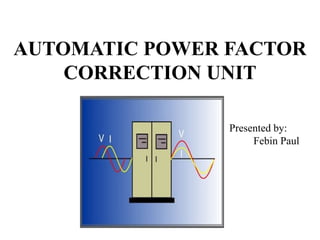
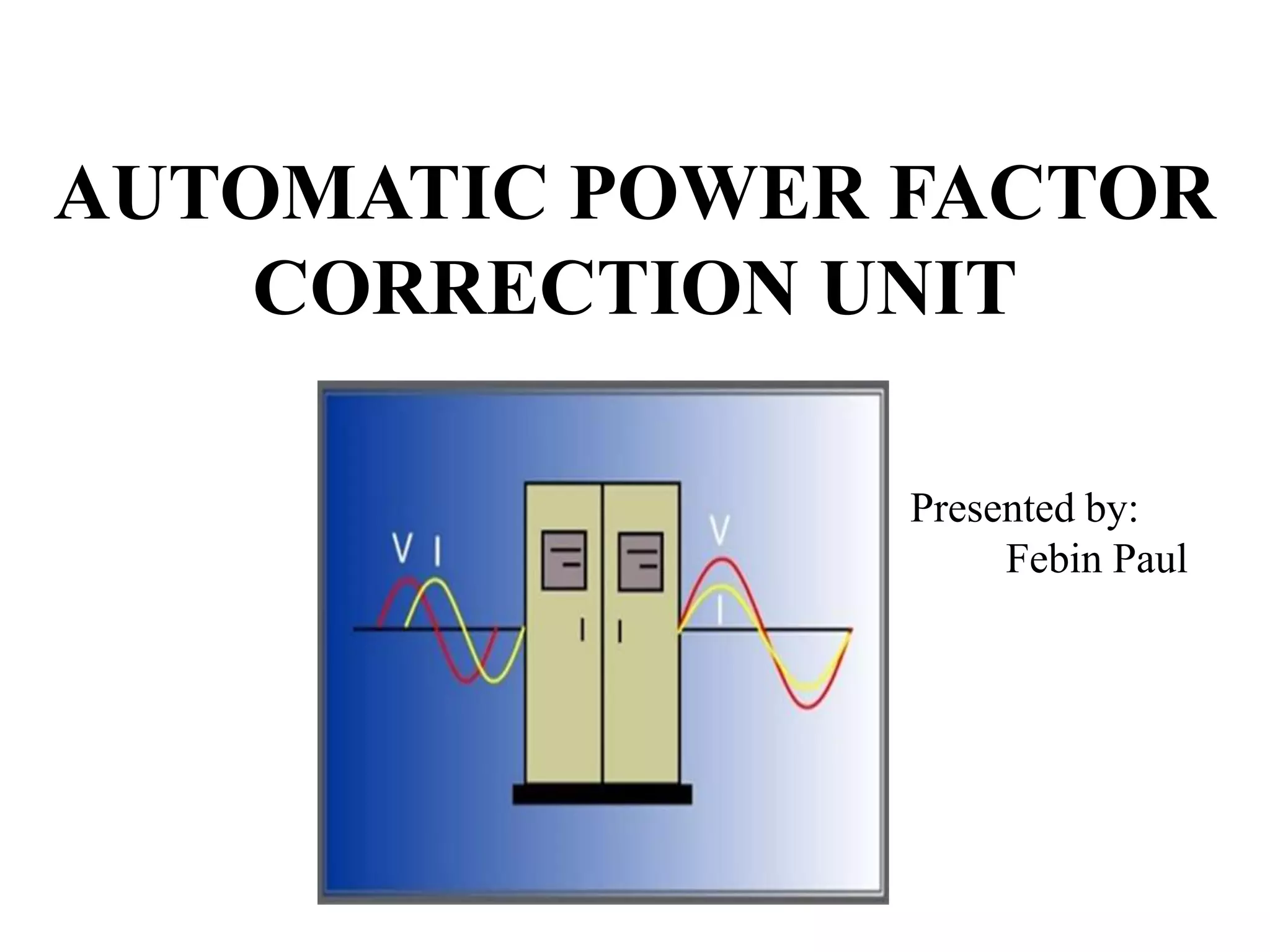
AUTOMATIC POWER FACTOR
CORRECTION UNIT
Presented by:
Febin Paul
CONTENT
INTRODUCTION
POWER FACTOR
WHAT CAUSES LOW PF?
WHY SHOULD WE IMPROVE PF?
METHODS TO CORRECT POWER FACTOR
NEED FOR AUTOMATIC POWER FACTOR
CORRECTION
BENEFITS OF APFC
AUTOMATIC POWER FACTOR CORRECTION UNIT
19 March 2017 2
INTRODUCTION
In our country, energy crisis is one of the major concerns.
Effective power transmission and power utilization of this
power is one of the main issues.
The Power Factor is the invisible factor, which causes a
great loss of electrical energy and also damages electrical
equipment.
The Power Factor of varying load can be measured and
compensated using static method.
19 March 2017 3
POWER FACTOR
It is defined as the cosine of the angle between the
voltage and current phases. It may also be defined as the ratio
of kW and the kVA drawn by the electrical load where kW is
the actual load power and kVA is the apparent power.
Active (or Working) Power is to perform the useful work. --
kW
Reactive Power is to create and maintain electro-magnetic
fields produced by magnetic Equipment. -- kVAR
Apparent (or Total) Power is the vector sum of the active
power and reactive power. -- kVA
19 March 2017 4
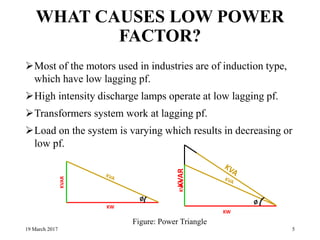
WHAT CAUSES LOW POWER
FACTOR?
Most of the motors used in industries are of induction type,
which have low lagging pf.
High intensity discharge lamps operate at low lagging pf.
Transformers system work at lagging pf.
Load on the system is varying which results in decreasing or
low pf.
19 March 2017 5
Ø
KW
KVAR
KW
KVARKVAR
Ø
Figure: Power Triangle
19 March 2017 6
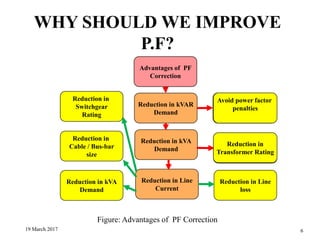
WHY SHOULD WE IMPROVE
P.F?
Reduction in
Transformer Rating
Reduction in kVAR
Demand
Advantages of P.F
Correction
Reduction in kVA
Demand
Reduction in Line
Current
Reduction in Line
loss
Reduction in
Cable / Bus-bar
size
Reduction in
Switchgear
Rating
Avoid power factor
penalties
Reduction in kVA
Demand
Reduction in
Transformer Rating
Avoid power factor
penalties
Reduction in
Transformer Rating
Avoid power factor
penalties
Reduction in
Transformer Rating
Avoid power factor
penalties
Advantages of PF
Correction
Reduction in
Switchgear
Rating
Figure: Advantages of PF Correction
NEED FOR APFC
Power factor also varies as a function of the load
requirements.
Difficult to maintain a consistent power factor due to the use
of fixed Compensation i.e. fixed capacitors.
Automatic variation is the compensation to suit the load
requirements.
19 March 2017 7
BENEFITS OF APFC
Consistently high power factor under fluctuating loads
Eliminate power factor penalty
Lower energy consumption by reducing losses.
Continuously sensing and monitoring the load
Automatically switch on/off relevant capacitors steps for
consistent power factor.
Ensures easy user interface
19 March 2017 8
AUTOMATIC POWER FACTOR
CORRECTION UNIT
19 March 2017 9
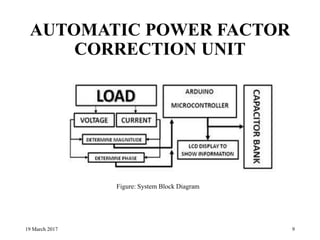
Figure: System Block Diagram
AUTOMATIC POWER FACTOR
CORRECTION UNIT(CONTD…)
It includes:
Power Factor Measurement
AC Current Measurement
AC Voltage Measurement
Capacitor can be added/removed in case of lagging/leading
power factor..
The capacitor will be added in parallel to the load.
Voltage & current is needed to measure required for reactive
power, apparent and active power.
19 March 2017 10
POWER FACTOR
MEASUREMENT
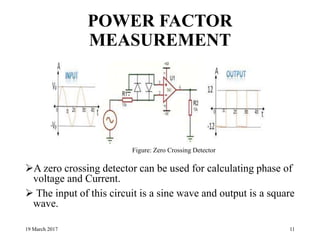
A zero crossing detector can be used for calculating phase of
voltage and Current.
 The input of this circuit is a sine wave and output is a square
wave.
19 March 2017 11
Figure: Zero Crossing Detector
POWER FACTOR MEASUREMENT
(CONTD…)
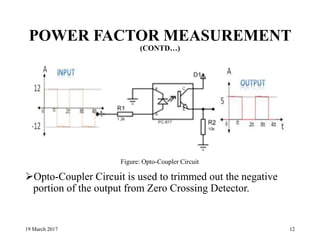
Opto-Coupler Circuit is used to trimmed out the negative
portion of the output from Zero Crossing Detector.
19 March 2017 12
Figure: Opto-Coupler Circuit
POWER FACTOR
MEASUREMENT(CONTD…)
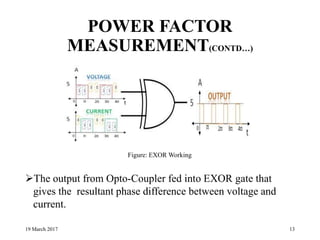
The output from Opto-Coupler fed into EXOR gate that
gives the resultant phase difference between voltage and
current.
19 March 2017 13
Figure: EXOR Working
POWER FACTOR
MEASUREMENT (CONTD…)
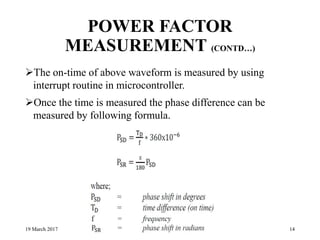
The on-time of above waveform is measured by using
interrupt routine in microcontroller.
Once the time is measured the phase difference can be
measured by following formula.
19 March 2017 14
AC VOLTAGE MEASUREMENT
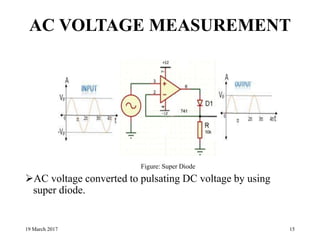
AC voltage converted to pulsating DC voltage by using
super diode.
19 March 2017 15
Figure: Super Diode
AC VOLTAGE
MEASUREMENT(CONTD…)
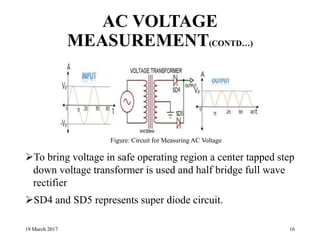
To bring voltage in safe operating region a center tapped step
down voltage transformer is used and half bridge full wave
rectifier
SD4 and SD5 represents super diode circuit.
19 March 2017 16
Figure: Circuit for Measuring AC Voltage
AC VOLTAGE
MEASUREMENT(CONTD…)
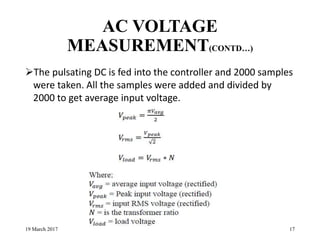
The pulsating DC is fed into the controller and 2000 samples
were taken. All the samples were added and divided by
2000 to get average input voltage.
19 March 2017 17
AC CURRENT MEASUREMENT
19 March 2017 18
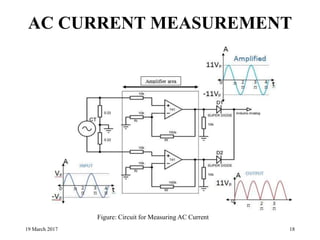
Figure: Circuit for Measuring AC Current
AC CURRENT
MEASUREMENT(CONTD…)
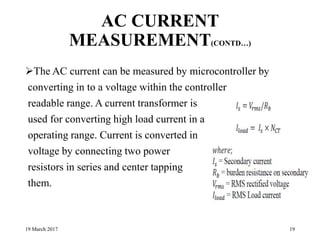
The AC current can be measured by microcontroller by
converting in to a voltage within the controller
readable range. A current transformer is
used for converting high load current in a safe
operating range. Current is converted in
voltage by connecting two power
resistors in series and center tapping
them.
19 March 2017 19
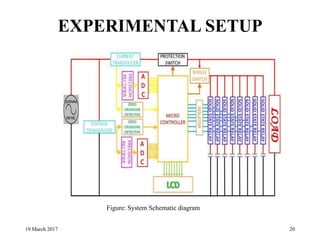
EXPERIMENTAL SETUP
19 March 2017 20
Figure: System Schematic diagram
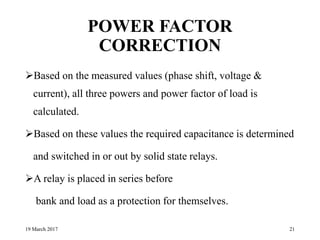
POWER FACTOR
CORRECTION
Based on the measured values (phase shift, voltage &
current), all three powers and power factor of load is
calculated.
Based on these values the required capacitance is determined
and switched in or out by solid state relays.
A relay is placed in series before
bank and load as a protection for themselves.
19 March 2017 21
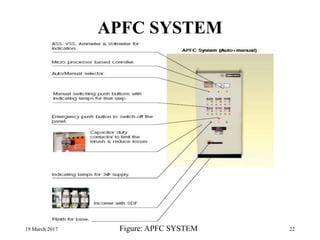
APFC SYSTEM
19 March 2017 22Figure: APFC SYSTEM
CONCLUSION
This technique used to overcome power losses due to low
power factor associated with common household and small
industrial units.
By installing suitably sized capacitors into the circuit the
Power Factor is improved and the value becomes nearer to
unity thus minimising line losses and improving the
efficiency of a plant.
19 March 2017 23
REFERENCE
1) Muhammad Bilal Khan, Muhammad Owais, “Automatic Power Factor
Correction Unit”, 2016 International Conference on Computing,
Electronic and Electrical Engineering (ICE Cube), Date of
Conference: 11-12 April 2016
2) Dr. Satadal Mal, Reetam Sen Biswas, “Automatic Power Factor
improvement using Microcontroller”, 2015 International Conference
and Workshop on Computing and Communication (IEMCON), Date of
Conference: 15-17 Oct. 2015
3) Chun-Lien Su, Ming-Chao Lin, Chi-Hsiang Liao, “A Energy-Savings
Evaluation Method to Justify Automatic Power Factor Compensators
on Marine Vessels”, Industry Applications Society Annual Meeting
(IAS), 2012 IEEE, Date of Conference: 7-11 Oct. 2012
4) Aparna Sarkar ,Umesh Hiwase , “Automatic Power Factor Correction
by Continuous Monitoring”, International Journal of Engineering and
Innovative Technology (IJEIT) Volume 4, Issue 10, April 2015
19 March 2017 24
19 March 2017 25

automatic power factor correction

  • 1.
    AUTOMATIC POWER FACTOR CORRECTIONUNIT Presented by: Febin Paul
  • 2.
    CONTENT INTRODUCTION POWER FACTOR WHAT CAUSESLOW PF? WHY SHOULD WE IMPROVE PF? METHODS TO CORRECT POWER FACTOR NEED FOR AUTOMATIC POWER FACTOR CORRECTION BENEFITS OF APFC AUTOMATIC POWER FACTOR CORRECTION UNIT 19 March 2017 2
  • 3.
    INTRODUCTION In our country,energy crisis is one of the major concerns. Effective power transmission and power utilization of this power is one of the main issues. The Power Factor is the invisible factor, which causes a great loss of electrical energy and also damages electrical equipment. The Power Factor of varying load can be measured and compensated using static method. 19 March 2017 3
  • 4.
    POWER FACTOR It isdefined as the cosine of the angle between the voltage and current phases. It may also be defined as the ratio of kW and the kVA drawn by the electrical load where kW is the actual load power and kVA is the apparent power. Active (or Working) Power is to perform the useful work. -- kW Reactive Power is to create and maintain electro-magnetic fields produced by magnetic Equipment. -- kVAR Apparent (or Total) Power is the vector sum of the active power and reactive power. -- kVA 19 March 2017 4
  • 5.
    WHAT CAUSES LOWPOWER FACTOR? Most of the motors used in industries are of induction type, which have low lagging pf. High intensity discharge lamps operate at low lagging pf. Transformers system work at lagging pf. Load on the system is varying which results in decreasing or low pf. 19 March 2017 5 Ø KW KVAR KW KVARKVAR Ø Figure: Power Triangle
  • 6.
    19 March 20176 WHY SHOULD WE IMPROVE P.F? Reduction in Transformer Rating Reduction in kVAR Demand Advantages of P.F Correction Reduction in kVA Demand Reduction in Line Current Reduction in Line loss Reduction in Cable / Bus-bar size Reduction in Switchgear Rating Avoid power factor penalties Reduction in kVA Demand Reduction in Transformer Rating Avoid power factor penalties Reduction in Transformer Rating Avoid power factor penalties Reduction in Transformer Rating Avoid power factor penalties Advantages of PF Correction Reduction in Switchgear Rating Figure: Advantages of PF Correction
  • 7.
    NEED FOR APFC Powerfactor also varies as a function of the load requirements. Difficult to maintain a consistent power factor due to the use of fixed Compensation i.e. fixed capacitors. Automatic variation is the compensation to suit the load requirements. 19 March 2017 7
  • 8.
    BENEFITS OF APFC Consistentlyhigh power factor under fluctuating loads Eliminate power factor penalty Lower energy consumption by reducing losses. Continuously sensing and monitoring the load Automatically switch on/off relevant capacitors steps for consistent power factor. Ensures easy user interface 19 March 2017 8
  • 9.
    AUTOMATIC POWER FACTOR CORRECTIONUNIT 19 March 2017 9 Figure: System Block Diagram
  • 10.
    AUTOMATIC POWER FACTOR CORRECTIONUNIT(CONTD…) It includes: Power Factor Measurement AC Current Measurement AC Voltage Measurement Capacitor can be added/removed in case of lagging/leading power factor.. The capacitor will be added in parallel to the load. Voltage & current is needed to measure required for reactive power, apparent and active power. 19 March 2017 10
  • 11.
    POWER FACTOR MEASUREMENT A zerocrossing detector can be used for calculating phase of voltage and Current.  The input of this circuit is a sine wave and output is a square wave. 19 March 2017 11 Figure: Zero Crossing Detector
  • 12.
    POWER FACTOR MEASUREMENT (CONTD…) Opto-CouplerCircuit is used to trimmed out the negative portion of the output from Zero Crossing Detector. 19 March 2017 12 Figure: Opto-Coupler Circuit
  • 13.
    POWER FACTOR MEASUREMENT(CONTD…) The outputfrom Opto-Coupler fed into EXOR gate that gives the resultant phase difference between voltage and current. 19 March 2017 13 Figure: EXOR Working
  • 14.
    POWER FACTOR MEASUREMENT (CONTD…) Theon-time of above waveform is measured by using interrupt routine in microcontroller. Once the time is measured the phase difference can be measured by following formula. 19 March 2017 14
  • 15.
    AC VOLTAGE MEASUREMENT ACvoltage converted to pulsating DC voltage by using super diode. 19 March 2017 15 Figure: Super Diode
  • 16.
    AC VOLTAGE MEASUREMENT(CONTD…) To bringvoltage in safe operating region a center tapped step down voltage transformer is used and half bridge full wave rectifier SD4 and SD5 represents super diode circuit. 19 March 2017 16 Figure: Circuit for Measuring AC Voltage
  • 17.
    AC VOLTAGE MEASUREMENT(CONTD…) The pulsatingDC is fed into the controller and 2000 samples were taken. All the samples were added and divided by 2000 to get average input voltage. 19 March 2017 17
  • 18.
    AC CURRENT MEASUREMENT 19March 2017 18 Figure: Circuit for Measuring AC Current
  • 19.
    AC CURRENT MEASUREMENT(CONTD…) The ACcurrent can be measured by microcontroller by converting in to a voltage within the controller readable range. A current transformer is used for converting high load current in a safe operating range. Current is converted in voltage by connecting two power resistors in series and center tapping them. 19 March 2017 19
  • 20.
    EXPERIMENTAL SETUP 19 March2017 20 Figure: System Schematic diagram
  • 21.
    POWER FACTOR CORRECTION Based onthe measured values (phase shift, voltage & current), all three powers and power factor of load is calculated. Based on these values the required capacitance is determined and switched in or out by solid state relays. A relay is placed in series before bank and load as a protection for themselves. 19 March 2017 21
  • 22.
    APFC SYSTEM 19 March2017 22Figure: APFC SYSTEM
  • 23.
    CONCLUSION This technique usedto overcome power losses due to low power factor associated with common household and small industrial units. By installing suitably sized capacitors into the circuit the Power Factor is improved and the value becomes nearer to unity thus minimising line losses and improving the efficiency of a plant. 19 March 2017 23
  • 24.
    REFERENCE 1) Muhammad BilalKhan, Muhammad Owais, “Automatic Power Factor Correction Unit”, 2016 International Conference on Computing, Electronic and Electrical Engineering (ICE Cube), Date of Conference: 11-12 April 2016 2) Dr. Satadal Mal, Reetam Sen Biswas, “Automatic Power Factor improvement using Microcontroller”, 2015 International Conference and Workshop on Computing and Communication (IEMCON), Date of Conference: 15-17 Oct. 2015 3) Chun-Lien Su, Ming-Chao Lin, Chi-Hsiang Liao, “A Energy-Savings Evaluation Method to Justify Automatic Power Factor Compensators on Marine Vessels”, Industry Applications Society Annual Meeting (IAS), 2012 IEEE, Date of Conference: 7-11 Oct. 2012 4) Aparna Sarkar ,Umesh Hiwase , “Automatic Power Factor Correction by Continuous Monitoring”, International Journal of Engineering and Innovative Technology (IJEIT) Volume 4, Issue 10, April 2015 19 March 2017 24
  • 25.